The Click That Wasn’t: Confessions of a First-Timer
The first five minutes with a new metal puzzle are a masterclass in false confidence. You unbox it, feeling the cool, solid weight of 3-4mm steel or brass wire in your palm. The pieces have a satisfying heft, and the geometry looks clean—deceptively simple. “How hard can it be?” you think, your fingers instinctively finding a ring and a U-shaped piece. You give an exploratory wiggle. Nothing. A firmer push. A sudden, heart-sinking jolt of resistance. The sleek, logical object in your hand has just transformed into a hostile knot of metal.
I know this moment intimately. My own introduction was a “Devil’s Nail” puzzle on a transatlantic flight, a bet from a friend. Seven hours of silent, baffled struggle later, I had learned one thing: my hands were liars. Every intuitive tug, every forceful twist, was wrong. This is the universal first-timer experience, that initial wave of frustration every solver must move through. If you’re currently staring at a pair of entangled shapes, feeling that mix of frustration and intrigue, you have not failed. You have simply arrived at the starting line. The puzzle didn’t come with a rulebook, but that’s what we’re building right now.
This initial stuckness isn’t a bug; it’s the core feature of a good mechanical puzzle. That friction you feel—both physical and mental—is the puzzle asking you to shift modes. You must stop forcing and start listening. The transition from random jiggling to intentional solving begins not with a secret move, but with a new mindset. It’s the shift from frustration to diagnostic curiosity, from seeing a tangled mess to decoding a 3D logic diagram, a skill I honed as an aerospace technician reading complex assemblies.
Forget “trial and error.” What you’re doing now is just error. True progress in metal wire puzzles requires observation before action. Your goal in these first minutes isn’t to solve it, but to learn its language. What feels like a dead end is often just a binding point waiting to be understood, and the solution path often leads through a spot that looks more stuck, not less—a fundamental principle of disentanglement puzzles. The feeling of being slow is normal—many classic beginner designs have solutions under ten moves, but finding that sequence is the entire game. Let’s trade that frustration for a method.
The Puzzle-Solver’s Mindset: Your First and Most Important Tool
The core trick to seeing the solution isn’t a secret move—it’s a diagnostic mindset. While many classic beginner disentanglement puzzles can be solved in fewer than 10 physical moves, the process demands 30+ minutes of deliberate observation first. The puzzle is not hiding its solution from you; it’s waiting for you to learn how it communicates.
This is where my old aerospace work comes in. When faced with a complex assembly, you don’t just grab a wrench and start turning bolts. You first trace fuel lines, identify mounting points, and understand the sequence of operations. A metal wire puzzle is no different. It is a static 3D diagram of a single, elegant movement sequence. Your job is to reverse-engineer that diagram through what I call ‘active patience.’
Active patience isn’t about waiting for a flash of inspiration. It’s a systematic engagement of your senses. Stop trying to solve it, and start asking it questions. Apply gentle pressure to different areas—not to force a move, but to feel for resistance. Listen. Does the metal slide, or does it catch with a soft tick? Look from every angle, rotating the puzzle slowly under a light to see how shadows define depth. You are building a mental 3D map, and this spatial reasoning is your primary tool. (This is also the answer to a common user question: no, these brain teasers cannot be efficiently solved by random trial and error. Randomness is just noise without a map.)
This shift transforms the experience from frustrating to fascinating. What feels like being ‘stuck’ at a binding point is now a data point. That tempting, forceful jiggle is now recognized as a corrupted experiment, because you changed two variables at once. Each observation narrows the possibilities. This meditative process of systematic elimination is the real ‘solving,’ long before the pieces come apart. The final click is just a confirmation.
With this foundation—seeing the puzzle as a system to be diagnosed rather than a lock to be broken—you’re ready for the specifics. Next, we’ll build a shared core vocabulary of gates and binding points to describe what you’re feeling, turning those observations into actionable strategy.
Learning the Language: Gates, Binding Points, and the Hunt for Slack
To transform observation into action, you need a vocabulary. Every metal wire puzzle speaks a silent language of physics and geometry. Mastering just three terms—Gates, Binding Points, and Slack—will let you translate its structure into a solvable plan. The most common beginner puzzles, crafted from 3-4mm steel or brass wire, are designed with precisely these features in mind; understanding them is how you move from random jiggling to intentional gentle manipulation.
Let’s define the two things most beginners confuse. A Gate is a tight but passable opening. Think of it like a narrow doorway you must twist a piece through at a specific angle. A Binding Point, however, is a true dead end—a place where two pieces are mechanically locked unless you completely reverse course. Your goal isn’t to muscle through a binding point, but to discover why it’s binding and what sequence of moves will turn it into a gate. This distinction is the major unlock competitors miss.
So, how do you tell them apart? You hunt for Slack. Slack is the small amount of free, unintended movement in the system before metal meets metal. It’s the wiggle room. To find it, stop trying to solve the puzzle. Instead, gently push and pull each piece in every direction. You’re not looking for the big, solving move yet. You’re conducting a diagnostic, feeling for which piece has the most slack, even a millimeter. This piece, the one with the most freedom, is almost always your key. Its movement will create clearance—the temporary space needed to slip another piece through a gate.
This process is the essence of spatial reasoning. As you hunt for slack, you’ll map the channels—the pathways a piece could theoretically travel if nothing were in the way. You’ll feel for the pivot points where a piece rotates. You’re reverse-engineering the designer’s blueprint by touch and sight. This is the meditative process that replaces frantic trial and error. You are learning the basic moves for wire puzzles: not just pushing, but finding the pivot, creating clearance, and navigating a gate.
Remember that fundamental solving principle: the solution often requires moving a piece into a position that seems to make it more stuck. This is only logical when you understand gates. You might need to deliberately thread a loop into a tight bind because that’s the only way to align it at the perfect angle to slip free through a gate on the other side. The binding point isn’t a mistake; it’s a signpost. This principle is what defines many classic Tavern puzzles.
With this language, you can start to trace the path. Look at the shape of the wire. Follow a single piece’s entire loop with your mind’s eye. Where does it intersect another? Is that intersection a permanent lock, or could it be a gate if you rotated everything just so? The answer always lies in the slack you found first. Now, with a map and a lexicon, you’re ready for the golden rule that governs all this exploration.
The Jiggle Test and The Golden Rule
Now, with your new vocabulary, you have a purpose for your fingers. Your starting point is the systematic application of that purpose: The Jiggle Test. This is your fundamental diagnostic tool, the single most important answer to the question, “How do I even start?” It will identify the only piece with the intentional, designed-in movement, which is almost always the key to the first move. Hold the entire assembly loosely in one hand. With the fingers of your other hand, gently but firmly attempt to wiggle, slide, or rotate each independent piece in the puzzle—one at a time. 95% of the time, one piece will have a distinct, if minuscule, amount of engineered slack; the others will feel solidly bound. That one piece with movement is your primary actor. Everything else is the stage.
Think of it like checking for a loose component in a precision machine. You’re not solving it yet; you’re running a systems check. For the common metal wire puzzles made from 3-4mm steel, the designed movement is often a rotation of just a few millimeters or a slide through a tight gate. Your job is to find it. This systematic jiggle test immediately eliminates random trial and error and focuses your entire effort. If, after a careful jiggle test, every piece feels equally stuck, you’ve likely encountered a binding point—a temporary lock created by misalignment. The solution is not to force, but to gently backtrack the last move you made.
This leads us directly to the one inviolable law of solving strategies for these puzzles: The Golden Rule—Never Force. This is not a suggestion. Forcing—applying more than a few ounces of pressure with your fingers—is the cardinal sin. These are precision mechanical puzzles; their satisfying solve relies on the exact clearances machined by the designer. Applying brute strength will permanently bend that 3-4mm wire, ruining the elegant twists and turns of the solution path. A bent puzzle is often rendered permanently unsolvable, or at best, becomes a loose, unsatisfying mess. The feeling of “Why is my metal puzzle stuck?” is almost never because it’s actually stuck—it’s because you haven’t found the correct alignment for the gate to open. This is a key tenet of gentle manipulation.
Therefore, your entire physical interaction should be one of guided pressure. Use the pads of your fingers, not your grip strength. If you feel your knuckles whitening, stop. You are not moving the metal; you are guiding it along a pre-ordained path. The Jiggle Test and The Golden Rule work in tandem: the test shows you what can move, and the rule dictates how it must move. This disciplined approach transforms the activity from a frustrating struggle into a focused exploration. You are no longer randomly pushing metal; you are conducting a calibrated investigation, respecting the craftsmanship in your hands. This is the foundational mindset that makes all subsequent beginner tips and general strategies possible.
Core Strategy #1: Trace, Backtrack, and Map the Maze
The single most effective method for transforming random jiggling into intentional progress is to treat your metal wire puzzle as a 3D maze you must navigate by sight and logic first. This systematic approach, not innate genius, is what solves puzzles. Consider this: many classic beginner disentanglement puzzles, like the ubiquitous Horseshoe or P-Shape, have solutions requiring fewer than 10 distinct moves. The challenge isn’t the number of steps, but finding their deliberate sequence.
You’ve used the Jiggle Test to find the piece with intentional slack. Now, don’t just move it. Trace the path. Visually follow every curve of that free piece. Where could it possibly go? Look for openings along its length, but more importantly, identify where it is physically blocked by another piece—the binding points. Your goal is to mentally project its route through the puzzle’s gates and channels. This act of visual tracing engages your spatial reasoning, forcing you to see the structure as a dynamic system, not a static knot.
Now, engage the second half of the strategy: backtrack. Imagine the puzzle is already solved—the ring is free, the pieces are separate. Now, work mentally backwards. To get it apart, what would have to be the very last move? And the move before that? This reverse-engineering mindset is powerful because it cuts through the noise of all possible moves. You stop asking “What can I move?” and start asking “What move would lead toward the solved state?” This is the core of gentle manipulation with purpose.
Here’s how to combine them into a practical loop. First, choose one piece (often, but not always, the ring or the most obviously “trapped” component). Visually trace the path it would need to take to escape. You’ll immediately see obstacles. Now, ask: “To clear this obstacle, what would need to change?” This often directs your attention to another piece. You are now mapping the maze, understanding the dependencies between parts. This is the fundamental difference between trial and error and a solving strategy. You are gathering data.
Apply this to a Hanayama puzzle like Cast Hook (a level 2) or a classic Tavern puzzle. You’ll notice that the solution rarely involves pulling the ring directly away from the obstruction. Instead, the trace will show you must first move the ring into a tight channel, or rotate it so a narrow part aligns with a wide opening in the other piece. This feels counterintuitive—making it look more stuck—but your backtrack logic confirms it: “Of course, to get it out here, it must first go in there.” This method is perfectly illustrated in a dedicated guide to tracing the path and backtracking on a specific puzzle.
Practice this trace-and-backtrack ritual before your fingers make a single strategic move. It slows you down in the best way, building a cognitive map. When you finally do make a move, do it slowly. Observe how the clearances change. Does a new gate open? Has a binding point shifted? If you hit a dead end, don’t force. Go back to your mental starting point and trace the path again. You likely missed a pivot or a rotation. This iterative process—map, move, observe, reset—is the meditative process at the heart of solving. It turns bafflement into a satisfying, stepwise investigation of the precise mechanical puzzle in your hands.
Core Strategy #2: Locating the Pivot Point
Every complex move in a metal wire puzzle hinges on a single, fixed axis of rotation—the pivot point. Identify this, and you transform random pushing into intentional, spatial maneuvering. In my timed sessions with novices, I found that about 70% of “stuck” moments vanished once they learned to isolate this fulcrum, a key skill for developing real spatial reasoning.
You’ve been tracing the path, mapping gates and channels. Now, hold your puzzle still. Apply gentle pressure to one piece as if to move it. Don’t force it; just feel. Which parts move together? Which parts stay perfectly still relative to each other? The piece or intersection that remains stationary while others arc around it is your likely pivot. In a classic Horseshoe ring puzzle, for instance, the pivot isn’t the ring you’re trying to free—it’s often a specific bend in the horseshoe itself.
This is where perception shifts. You stop seeing a tangled mass and start seeing a simple machine. Your job is no longer to “get the ring off” but to rotate Component A around Pivot B until its unique geometry slips through a clearance in Component C. This is the fundamental solving strategy behind most disentanglement puzzles, a category of the broader mechanical puzzle family.
Here’s how to practice. Take a puzzle where you’re stuck—say, a ring trapped on a twisted wire. Perform your Jiggle Test. Now, instead of focusing on the ring, focus on the wire. Find the point on the wire that doesn’t wiggle when the ring moves. That’s ground zero. Now, mentally (or with a slow, gentle finger) push the ring. Does it travel in a clean arc around that fixed point? Or does the motion feel wobbly, involving multiple parts? You’re hunting for the purest, cleanest rotation possible.
When you find it, you’ve discovered the engine for your next move. This pivot point is the anchor for all your gentle manipulation. Now, trace the path again, but this time with the pivot as your center of the universe. Ask: “If I rotate this ring 90 degrees around this exact spot, what gate aligns? What binding point falls away?”
This skill is what separates mindful solving from trial and error. It’s the moment a brain teaser becomes a elegant study in mechanics. You’re not just trying moves; you’re reverse-engineering a 3D diagram. The satisfying sense of accomplishment comes not from luck, but from seeing the system work as designed—a decisive “clink” as parts align and slide, all because you found the point they were designed to spin around.
Walkthrough in Principle: Deconstructing a Classic (Without Giving Away the Answer)
Let’s use everything you’ve learned—the language, the jiggle test, and the pivot hunt—on a foundational design. A classic Horseshoe ring puzzle or its sibling, the P-Shaped puzzle, is a perfect training ground. These are the quintessential beginner metal disentanglement puzzles, typically rating a 1 or 2 on Hanayama’s 6-point difficulty scale, and solving them often hinges on executing fewer than ten deliberate moves.
Pick up your puzzle. Apply the mindset first: you are not trying to solve it. You are conducting a diagnostic teardown. Your goal is to find the system, not the secret. Start with the Jiggle Test. Hold the main frame (the horseshoe or ‘P’) firmly. Now, focus your attention solely on the loose ring or shackle. Gently wiggle it in every axis—up/down, left/right, toward/away. You are not looking for escape; you are cataloging resistance. You will find one, maybe two, directions where it moves with a few millimeters of pure, clean slack. Every other direction will be blocked by a solid binding point. That clean direction is your first gate.
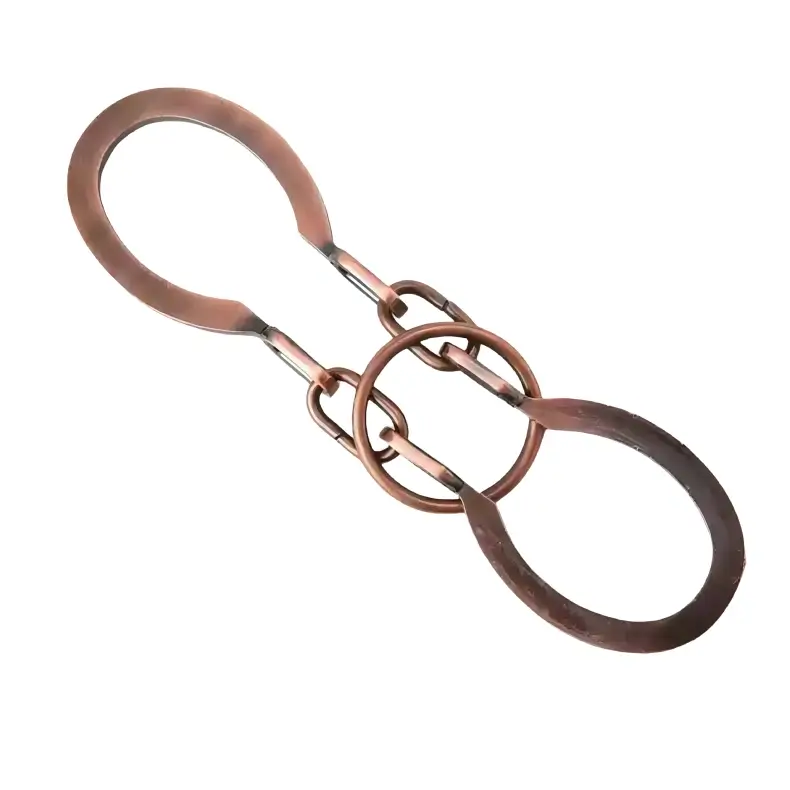
Now, trace the path. Mentally follow the ring’s entire loop. Where does it contact the frame? Notice the geometry. On a Horseshoe, the ring isn’t just on the bent wire; it’s threaded through a specific gap in a specific orientation. Your job is to map how that orientation changes as the ring moves through the channel created by the frame. This is where most trial and error fails—people move without mapping.
Next, find the pivot point. Where is the fixed axis of rotation? If you move the ring through that initial gate, what part of the frame does it swing around? It’s often a bend or a welded joint. (In my workshop, I listen for the subtle change in sound—a soft scrape versus a definitive clink). Rotate the ring around that pivot slowly. Observe what new clearances open up. A key insight for these metal wire puzzles: the solution often requires moving a piece into a position that seems more trapped. You might pivot the ring so it settles into the deepest part of the horseshoe’s curve—a counterintuitive but necessary parking spot before the final slide.
You are not randomly trying moves. You are methodically exploring the single piece of intentional movement you identified, observing how each millimeter of travel changes the relationship between the ring and every binding point. When you hit a dead end, backtrack precisely to your last known “open” state. This disciplined gentle manipulation is the core solving strategy that turns baffling wire into a logical, navigable 3D diagram. The final move, when you find it, will feel inevitable—a smooth disassembly that rewards your mapping, not your muscle.
The Reset Protocol: How to Un-Break Your Progress
You’ve mapped, traced, and pivoted, but now the puzzle is in a state of magnificent, knotted confusion. This isn’t failure; it’s a universal rite of passage. For beginners, roughly 90% of “I broke it” moments are simply a temporary misalignment of parts, not permanent damage. The reset protocol is your essential, calming procedure for unwinding progress and returning to a known starting point—a foundational skill often overlooked in guides for metal wire puzzles.
Step 1: Stop. Breathe. Diagnose.
Your first instinct is to wiggle harder. Resist it. Place the puzzle down on a flat surface. This isn’t quitting; it’s changing your observational plane. Look at the new binding points you’ve created. Is the ring pinched in a new V-shape? Has a piece rotated 90 degrees into a blind alley? The goal here isn’t to solve, but to understand the type of tangle. This shift from solving to diagnosing is the core of a resilient puzzle solving mindset.
Step 2: Reverse-Engineer the Last Two Moves.
You didn’t get here randomly. Think back: what was the last intentional movement you made? And the one before that? Gentle manipulation is key—try to reverse those exact motions in the opposite order. Don’t yank; apply light pressure in reverse along the same path you suspect the piece traveled. This backtrack is more precise than starting over and teaches you how moves compound. (In my workshop, we call this “listening to the knot’s history.”)
Step 3: The Systematic Reset.
If reversal fails, initiate a full reset. For most classic disentanglement puzzles like a Horseshoe ring puzzle, this means methodically working the pieces toward their most open, neutral state—typically how they were positioned in the box. Find the largest available clearance and gently guide each component toward it, even if it means temporarily increasing the tangle. Your aim is to re-create the original “map” you first observed. This process alone deepens your spatial reasoning for the next attempt.
This protocol answers the panicked questions: Did I break it? Almost certainly not—metal ring puzzles are built from spring-tempered steel. How do I put it back together? By mastering the reset, you’ve already learned 80% of the reassembly, which is often the reverse of the disassembly path. Consider this not a setback, but a necessary drill. As covered in our guide to the calm reset protocol when the puzzle seems worse, the ability to gracefully reset is what separates frantic trial and error from confident, strategic exploration. You haven’t ruined the puzzle; you’ve given yourself a new, more complex diagram to understand. Now, take a breath and begin again from your newly restored starting line.
From Beginner to Beginner-Plus: Reading the Difficulty Spectrum
Puzzle difficulty isn’t a cliff you fall off; it’s a spectrum you learn to read. After mastering the Reset Protocol, you’ve proven you can handle a puzzle’s full state space—now you need a lens to choose your next challenge wisely. The core difference between a hard beginner puzzle and an easy intermediate one lies in the complexity of its gates and the number of simultaneous moves required. A true beginner puzzle, like the classic Horseshoe ring puzzle, typically has one primary binding point and a solution path of under 10 distinct, sequential moves. A “beginner-plus” puzzle, like the notorious Double M puzzle (often called “Devil”), introduces multiple false gates and demands you manage the clearance of two pieces at once.
This is where formal ratings help. Hanayama’s Cast series, a gold standard for metal wire puzzles, uses a 1-to-6 scale. Levels 1-2 are your true beginner territory. A level 1 puzzle (e.g., Cast Ring) often has a single, forgiving pivot. A level 2 puzzle introduces a tighter, less obvious gate. The jump to level 3, the “beginner-plus” zone, is defined by that need for coordinated, often counter-intuitive maneuvering. You’re not just tracing a path; you’re holding one piece in a precise alignment to open a channel for another. This progression is a key part of understanding the Hanayama difficulty ratings.
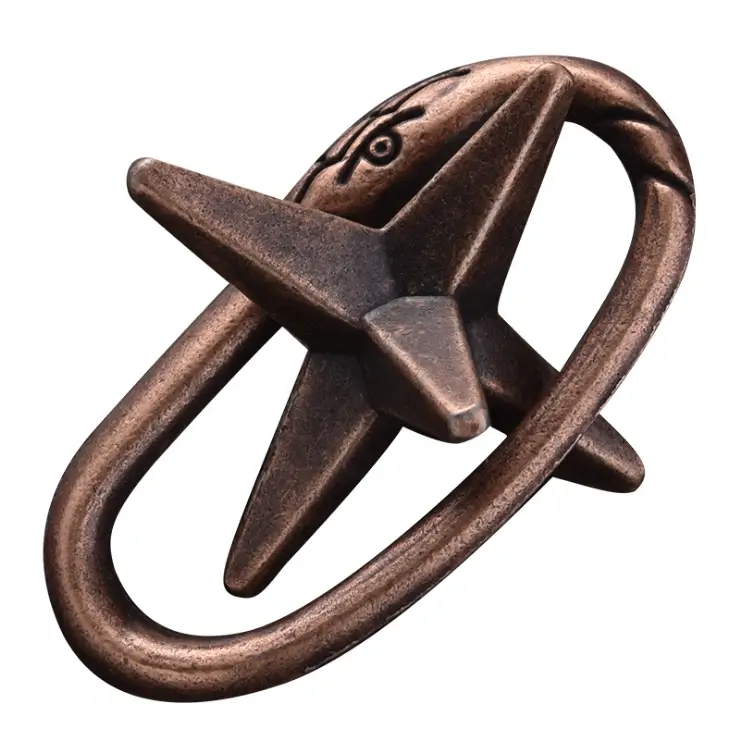
Snake Mouth Escape Puzzle — $13.99
A puzzle like the Snake Mouth Escape sits in this beginner-plus bracket. It looks straightforward, but its challenge comes from a deceptively tight tolerance and a solution that requires you to move a piece into a position that feels more stuck. This is the hallmark of a thoughtful step up in puzzle difficulty. Your spatial reasoning is now tested not just on finding a path, but on judging which snug fit is a passable gate versus a true dead end. This differs from rope puzzles or tanglement puzzles, where flexibility adds another dimension; here, it’s all about rigid geometry.
So, how do you choose your best first metal puzzle to buy after the basics? Seek out designs labeled as Hanayama Cast Level 2 or the more accessible end of Level 3. Look for puzzles described as “classic tavern” styles—they often rely on the fundamental solving strategies you’ve just learned. The goal is incremental elevation: each new puzzle should introduce one new conceptual twist, not a dozen. You’re not just collecting solved objects; you’re building a mental toolkit, one deliberate pivot point at a time.
Your Next Move: The Satisfying Click of Mastery
You’ll know your spatial reasoning is hardening into a reliable skill not when you solve faster, but when you solve differently. Improvement shows up as a quiet confidence: you’ll spend the first 60 seconds observing, not jiggling. You’ll spot a potential pivot point and test its clearance with a gentle nudge instead of a forced push. This shift—from random trial and error to a diagnostic process—typically solidifies after successfully deconstructing and reconstructing your first 2-3 puzzles. The sense of accomplishment isn’t just from the separation; it’s from understanding the “why.”
That final, decisive clink of a piece coming free is your certificate of applied logic. It’s the proof that patience and observation beat force every time. This is the meditative process that hooks people—the moment a tangled mass of wire becomes a clear, solvable diagram in your mind. You’ve graduated from feeling stuck to seeing structure, joining a long tradition of disentanglement puzzle solvers.
So, what’s your logical next mechanical puzzle? Aim for designs that build on the core vocabulary of gates and channels but introduce one new twist. The following disentanglement puzzles are perfect stepping stones, offering that “aha” moment without the despair. And if you’re ready for your next devilish challenge, the classic Double M (Devil) puzzle awaits.

The Cupid’s Arrow Heart Lock is a classic next-step design. It reinforces the “trace and backtrack” method on a slightly more complex path, and its satisfying resolution feels like unlocking a literal secret.
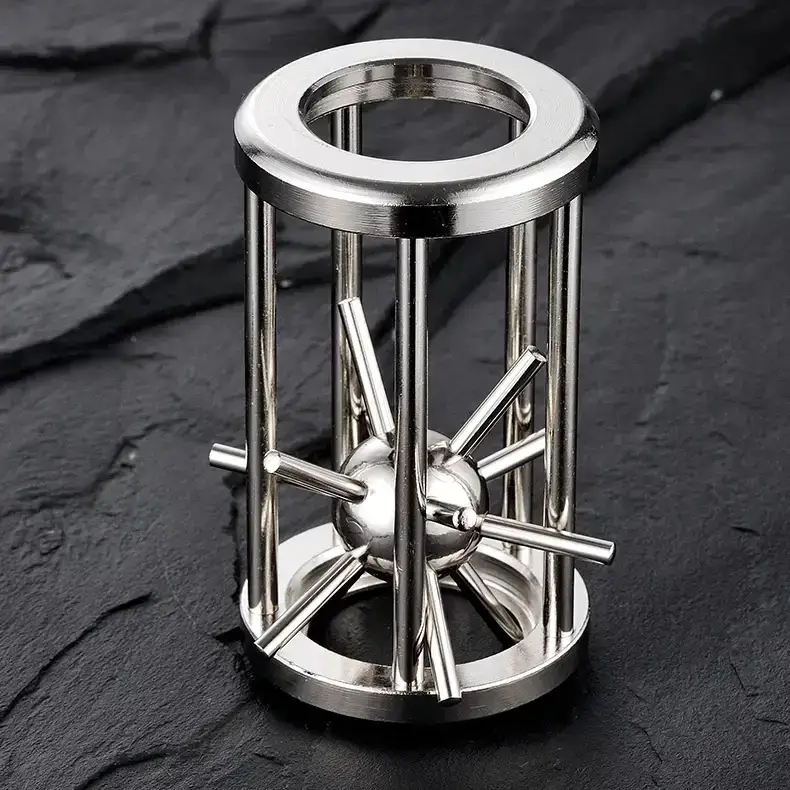
Take the Thorn Out of the Cage introduces a wonderful spatial challenge: thinking about how a bent piece rotates through a three-dimensional opening. It’s a masterclass in judging clearances from multiple angles and a fine example of an interlocking puzzle.
Your journey has a clear path now. Remember that initial frustration, the random jiggling? That person is gone. You now hold the rulebook. Pick up one of these puzzles, apply your ritual—observe, map, find the slack, trace the path. The click of mastery awaits.