There’s something deeply human about building miniature versions of the vessels that once conquered oceans. For over two thousand years, humans have been crafting ship models—not just as toys, but as historical records, works of art, educational tools, and bridges to our maritime past.
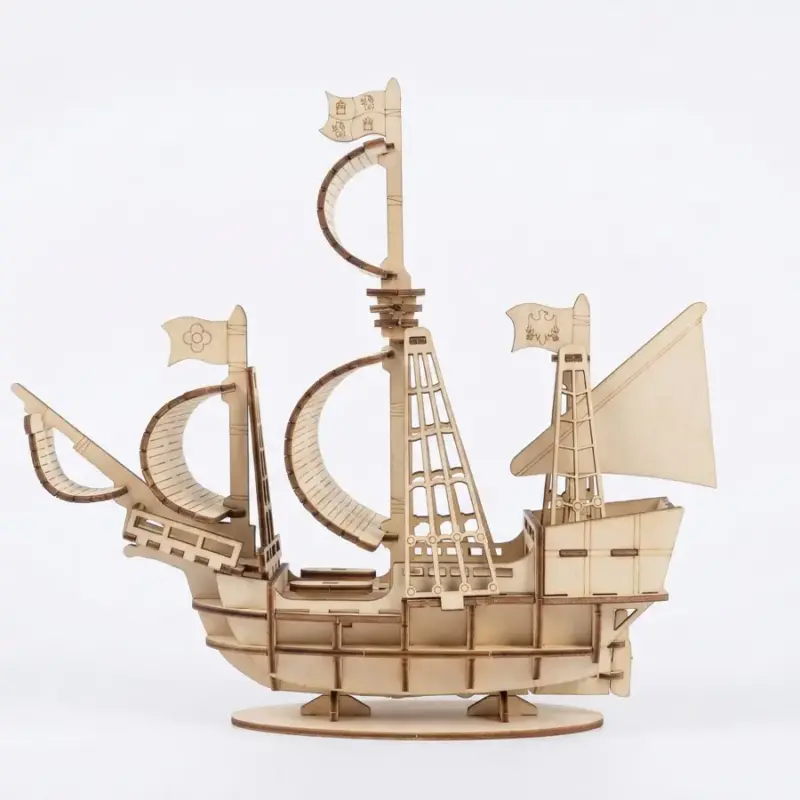
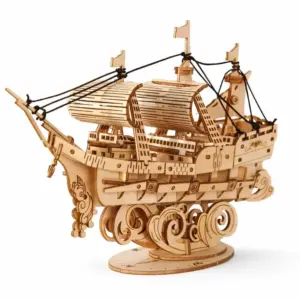
Wooden Sailboat 3D Puzzle Kit DIY Ship Model
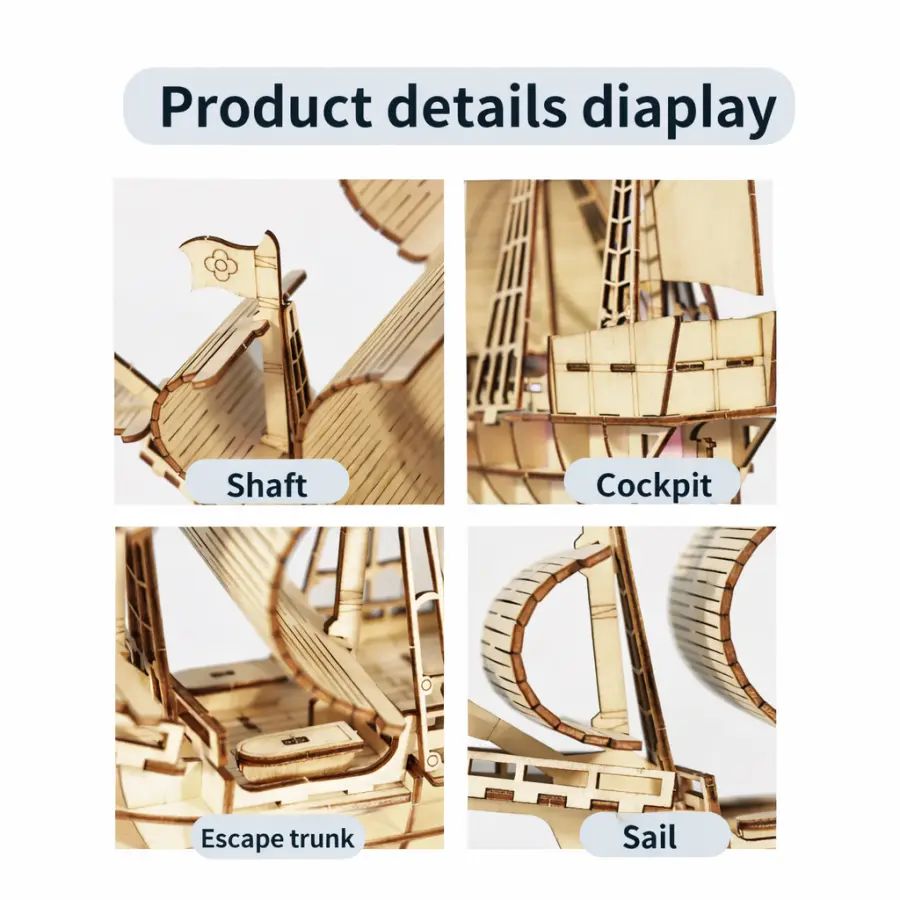
The Wooden Sailboat 3D Puzzle Kit from Tea-Sip is a 57-piece adult assembly kit: laser-cut natural wood pieces build into a display-ready sailing ship with authentic nautical details, from billowing sails and rigging to cockpit, escape trunk, and shaft. Made for adults who want a slow, hands-on evening project that ends in a keepsake model, and a strong gift for boat lovers, model builders, and anyone who finds ordinary jigsaws too temporary.
Let me take you on a journey through the fascinating history of ship model building, explore why these wooden puzzles captivate us centuries later, and uncover what makes a simple sailboat model more than just a desktop decoration.
The Unexpected Origins: When Prisoners Built Ships from Bones
Picture this: It’s 1805, and you’re a French sailor locked in a British prison during the Napoleonic Wars. You’re confined for years, sometimes on de-rigged warships called “hulks” anchored off England’s south coast. Your daily ration includes half a pound of meat. What do you do with the leftover bones?
You build ships.
During the Napoleonic Wars from 1792 to 1815, over one hundred thousand French prisoners were held captive in Britain in gaols, barracks, and prison ships moored in locations including Plymouth, Portsmouth, Chatham, and Liverpool. These weren’t common criminals—they were political prisoners, sailors who’d been captured at sea. And many of them had backgrounds in arts and crafts before being impressed into the French Navy.
Receiving daily rations of half a pound of meat from their British captors, the Frenchmen would whittle the leftover bones into recreations of the ships they had manned themselves. The models pack stunning complexity into typically just thirty to forty inches. Hulls seem almost to breathe, gracefully curving outward as they approach the decks. Dozens of cannons poke neatly out of a single side, held in place by invisible mechanisms.
But here’s what makes these models extraordinary: the rigging was made from human hair. The details—gun ports, lower deck configurations, figureheads, lifeboats, exacting dimensions—were all painstakingly precise and accurate because these men knew their ships intimately. They built from memory, spending years on a single model.
Prisoners were allowed to attend local markets to sell these wares and used the proceeds to supplement their meagre food rations. This trade enabled prisoners to acquire ivory and special tools to make the models even more decorative. Many of these talented artists stayed in England after the wars and continued their craft where it was appreciated.
Today, one of these bone ships can fetch tens of thousands of dollars at auction. They remain highly sought after, valuable collectibles that museums worldwide treasure. The Channel Islands Maritime Museum in California houses the second-largest collection in the United States, and the Peter Tamm Collection in Hamburg’s International Maritime Museum preserves some of the finest examples ever created.
A Craft That Spans Millennia
But ship model building didn’t begin with Napoleonic prisoners. The tradition stretches back far longer than you might imagine.
Ancient Origins: More Than Toys
The ancient Greeks crafted ship models dating back to around 3000 BCE. Archaeologists determined that Ancient Greek ship models were used as burial or votive offerings and as household articles such as lamps or drinking vessels. Models were cast in different materials, including wood, bronze, lead, and clay.
One remarkable example—a clay model acquired by the Staatliches Museum in Kassel, Germany—proves invaluable to archaeologists and historians in understanding what a hemiolia warship was like. Archaeologists tentatively dated the Kassel model to be from the sixth or fifth centuries BCE. This ship model features a distinctive prow shaped like a boar’s head described by Herodotus in his writings and depicted on pottery, coins, seals, and drinking cups.
Until this ship model was discovered, archaeologists, classicists, and historians had only been able to hypothesize about these ancient vessels based on written descriptions.
The Age of Sail: When Models Became Essential Tools
Fast forward to the 15th through 19th centuries—the Age of Sail, when sailing ships dominated global trade and warfare. This era, marked by the introduction of naval artillery, saw sailing vessels reach their peak of size and complexity.
By the nineteenth century, ships were built with reference to a half model, made from wooden layers that were pinned together. Each layer could be scaled to the actual size of the vessel to lay out its hull structure, starting with the keel and leading to the ship’s ribs. These weren’t decorative—they were engineering tools used to design full-sized vessels.
The National Maritime Museum at Greenwich holds nearly five thousand ship models, most stored in specialized facilities to preserve them. The Maritime Museum Rotterdam showcases the Mataró model—the oldest model ship in Europe, dating back more than six centuries and made extremely accurately.
These museums don’t collect models just for their looks. Models can be viewed as primary sources from specific moments in time. Well-built models show us how ships were used during their lifetimes, whether for leisure and pleasure, defense and commerce, or a mixture of all.
Why Wooden Ships Captivated an Era
To understand why ship models matter, we need to understand the ships themselves.
Engineering Marvels of Wood and Sail
During the Age of Sail, wooden sailing ships represented the pinnacle of human engineering. Consider the scale: a representative 74-gun ship of the line measured about one hundred seventy feet in length with a beam of around fifty feet, accommodating two or three gun decks.
The largest wooden warships ever built were technological wonders. The Spanish Santísima Trinidad, one of the few four-decker ships of the line, carried up to one hundred forty guns and required over a thousand sailors. The British HMS Victoria, commissioned as the last wooden first-rate three-decked ship, displaced nearly seven thousand tons—the largest wooden battleship ever to enter service.
Building these vessels required extraordinary craftsmanship. Hull shapes evolved from being relatively short and blunt to longer and finer at the bow. Ribs were pieced together from curved elements called futtocks and tied in place until installation of the planking. Planking was caulked with tar-impregnated yarn made from manila or hemp to make it watertight.
Sailing ships needed ballast to keep the centre of gravity low and supply stability when under sail. Ballast might consist of shingle, sand, lead, iron bars, or bricks. Care had to be taken in stowage so it didn’t move during heavy weather and endanger the ship.
The Golden Age and Its Decline
The period between the mid-19th century to early 20th century, when sailing vessels reached their peak of size and complexity with clippers and windjammers, is sometimes called the “Golden Age of Sail.”
But steamships were coming. The Suez Canal, which opened in 1869, was more practical for steamships than sailing ships. HMS Devastation, the first class of ocean-going battleships that didn’t carry sails, was commissioned in 1871. By the 1880s, ships with triple-expansion steam engines had the fuel efficiency to compete with sail on all major routes.
Sailing ships continued to be economical for transporting bulk cargo into the 1920s and 1930s, but steamships eventually pushed them out of those trades too. Today, sailing vessels survive only for small-scale coastal fishing and recreational use—though there’s growing interest in wind-assisted ships as a sustainable alternative.
What Makes Ship Models Special Today
So why, in our digital age, do people still build miniature wooden ships?
Living History in Your Hands
When you assemble a wooden ship model, you’re not just following instructions—you’re connecting with centuries of maritime tradition. Every piece represents techniques refined over generations. The way masts fit into the hull, how sails attach to rigging, the curve of the bow—these aren’t arbitrary design choices but solutions to real nautical challenges.
Ship modellers often have a close association with maritime museums. Not only does the museum have items that help the modeller achieve better accuracy, but skilled hobbyists sometimes contribute to museum collections or assist with restoration projects.
The Cognitive Challenge
Building models engages your brain in unique ways. You’re working with three-dimensional spatial reasoning, following sequential instructions, and problem-solving when pieces don’t immediately fit as expected. Research shows that puzzle activities recruit multiple cognitive abilities including visuospatial perception, constructional praxis, mental rotation, working memory, and episodic memory.
Unlike digital entertainment, physical model building provides tactile feedback. You feel the weight and texture of real wood, the satisfaction of pieces clicking into place, the accomplishment of transforming flat boards into a dimensional structure.
Meditation Through Making
There’s something meditative about working with your hands on a focused project. The repetitive, precise movements required to assemble a ship model create what psychologists call “flow state”—that mental zone where time disappears and worries fade.
Flow is associated with optimal performance and mental health benefits, including better mood and a sense of meaningfulness. Studies show that during flow experiences, there’s decreased activity in brain structures related to self-focus, which helps explain why flow can distract people from worry.
Crafts-based interventions raise self-esteem, improve mood, counteract social isolation, and reduce anxiety and depression according to systematic reviews by the National Institutes of Health.
The Art and Science of Ship Design
Let’s geek out for a moment about what makes a sailing ship work—because when you’re building a model, you’re replicating hundreds of years of naval architecture.
Anatomy of a Sailing Vessel
A traditional sailing ship consists of several key elements:
The Hull: The watertight body of the ship, traditionally built using one of five basic construction techniques—from solid wood hulls carved from single logs to intricate plank-on-frame methods where ribs provide structure covered by planking.
Masts and Rigging: European sailing ships during the Age of Discovery featured predominantly square rigs. A full-rigged ship had a bowsprit and three masts, each consisting of a lower mast, top mast, and topgallant mast. All masts were made of wood formed from single or several pieces of timber, typically from conifer trees.
Sails: The actual propulsion system, catching wind to drive the vessel forward. Different sail configurations suited different purposes—square sails for running before the wind, fore-and-aft sails for maneuvering closer to the wind.
Steering: Early ships used steering oars—large oars mounted on the stern. Later vessels developed the center-mounted rudder, a revolutionary innovation that improved maneuverability.
When you assemble a model sailboat, even a simplified one, you’re learning these components and how they work together. The forty-five degree angle of those masts isn’t decorative—it reflects actual nautical engineering.
From Museum Masterpieces to Desktop Companions
Not everyone can afford a twenty-thousand-dollar bone ship model from a museum collection. But the tradition of accessible ship building lives on through modern wooden puzzles.
The Modern Evolution
Today’s laser-cut wooden puzzles democratize the ship-building experience. While Napoleonic prisoners spent years carving bones by hand, modern precision cutting technology allows hobbyists to assemble historically-inspired models in hours rather than years.
But something important remains: the satisfaction of building with your hands, the connection to maritime history, and the cognitive engagement of solving a three-dimensional puzzle.
A typical wooden sailboat puzzle includes precision-cut pieces that fit together through careful engineering—no glue required, just like traditional ship models used wooden pegs (treenails) rather than nails to allow the wood to flex with the sea.
What You Learn by Building
Every ship model teaches you something:
Spatial reasoning: How flat pieces become three-dimensional structures
Sequential thinking: The importance of order and process
Attention to detail: Small adjustments make big differences
Patience: Rushing leads to mistakes; careful work yields better results
Problem-solving: When something doesn’t fit, you backtrack and try again
Historical appreciation: Understanding why ships were built certain ways
The Enduring Appeal Across Cultures
Ship models appear in cultures worldwide, reflecting humanity’s universal connection to the sea.
Eastern Traditions
Indian kingdoms such as the Kalinga had sailing ships as early as the second century CE. The Indian Ocean hosted increasing trade between India and Africa from 1200 to 1500, with vessels classified as dhows with lateen rigs growing from one hundred to four hundred tonnes capacity.
Japanese museums like the Yamato Museum in Kure display extraordinary models including a 1/10 scale replica of the battleship Yamato that measures over eighty feet long. The level of detail—from the chrysanthemum crest on the bow to individual gun turrets—demonstrates how models preserve technical knowledge.
Western Maritime Museums
From Ships of the Sea Maritime Museum in Savannah, Georgia, to the Merseyside Maritime Museum in Liverpool, institutions worldwide preserve ship models as crucial historical documents. These collections began modestly—the Merseyside collection started in 1862 as little more than “an old dug-out canoe and a few model ships,” but grew to encompass comprehensive maritime history.
The National Museum of Ship Models and Sea History in Illinois houses over two hundred fifty intricately crafted ship models, including a twenty-seven-foot-long model of the Queen Mary made entirely from one million toothpicks.
Why Build a Ship Model Today?
We live in a world of screens and instant gratification. So why spend time building a wooden ship?
Because some things can’t be digitized.
The weight of wood in your hands. The smell of natural materials. The visible progress as flat boards become a sailing vessel. The tangible result you can display, touch, and share. These sensory experiences connect us to the physical world in ways our screen-heavy lives often lack.
Building a ship model isn’t about escaping the modern world—it’s about enriching it with something timeless. It’s a reminder that humans have been solving three-dimensional puzzles and celebrating maritime achievements for millennia. When you snap that final piece into place and step back to admire your miniature sailboat, you’re participating in a tradition that spans from ancient Greek workshops to Napoleonic prison cells to modern living rooms.
You’re not just building a model. You’re building a bridge across time.

Starting Your Own Model-Building Journey
If you’re curious about trying your hand at ship model building, start simple. A small wooden sailboat puzzle with precision-cut pieces offers a gentle introduction to the craft without requiring years of experience or specialized tools.
Look for models that include:
- Pre-cut pieces (no carving required)
- Clear instructions with visual guides
- All materials included in the kit
- Reasonable assembly time (one to three hours)
- Display-worthy final result
As you gain confidence and develop the bug for model building, you can progress to more complex builds—multi-masted ships, intricate rigging, detailed deck layouts. The community of ship modellers worldwide shares techniques, offers guidance, and celebrates each other’s finished vessels.
Many museums offer workshops where modellers work alongside visitors, demonstrating techniques and sharing their passion for maritime history. Some even accept volunteer contributions to help maintain and restore historical ship models in their collections.
The Future of an Ancient Craft
Will ship model building survive in our increasingly digital world?
I think so—precisely because it offers what digital experiences can’t. The tactile satisfaction, the visible progress, the permanent result. As our lives become more virtual, the appeal of creating something real with our hands only grows stronger.
There’s even a movement toward wind-assisted commercial shipping to reduce carbon emissions—meaning the Age of Sail might not be as finished as we thought. Some experts predict a “New Age of Sail” driven by sustainability concerns and revolutionary energy technology. If that happens, model builders will once again be preserving and celebrating cutting-edge maritime technology, not just historical curiosities.
For now, whether you’re a history buff, a puzzle enthusiast, a stressed-out professional needing screen-free relaxation, or simply someone curious about how ships work, there’s a wooden model waiting to teach you something.
And who knows? Maybe centuries from now, someone will look at the models we build today and marvel at the craft, dedication, and human connection they represent—just as we marvel at those bone ships carved by French prisoners in the darkness of British prisons over two hundred years ago.
Want to explore more about maritime history and model building? Check out our collection of wooden puzzles or read more on our blog about the fascinating world of hands-on learning and historical crafts.
Questions about ship models or looking for recommendations? Visit our customer help center or explore our About page to learn more about our commitment to quality craftsmanship and educational experiences.
Keywords: ship model history, wooden ship building, Age of Sail, maritime history, Napoleonic prisoner models, wooden puzzle crafts, hands-on learning, nautical heritage
Share this article: Found this deep dive into ship model history interesting? Share it with fellow history buffs and craft enthusiasts who appreciate the intersection of art, engineering, and maritime tradition.
Authority Citations
- Wikipedia – Ship Model
Comprehensive history of ship models from ancient Greek burial offerings to modern museum pieces, including prisoner-of-war models.
URL: https://en.wikipedia.org/wiki/Model_ships - Wikipedia – Maritime Museum
Overview of maritime museums worldwide and their role in preserving ship models as historical documents.
URL: https://en.wikipedia.org/wiki/Maritime_museum - Wikipedia – Age of Sail
Detailed exploration of the historical period from mid-16th to mid-19th centuries when sailing ships dominated trade and warfare.
URL: https://en.wikipedia.org/wiki/Age_of_Sail - Wikipedia – Sailing Ship
Technical details about ship construction, including hull building, mast design, rigging systems, and ballast requirements.
URL: https://en.wikipedia.org/wiki/Sailing_ship - Wikipedia – Ship of the Line
Information about the largest wooden warships ever built, including dimensions, armament, and engineering innovations.
URL: https://en.wikipedia.org/wiki/Ship_of_the_line - The Mariners’ Museum – Prisoner of War Bone Ship Models
Educational resource detailing how French prisoners during Napoleonic Wars created intricate ship models from bones and human hair.
URL: https://www.marinersmuseum.org/2020/10/built-with-what-bones-hair-and-prisoners-model-ships-of-war/ - Atlas Obscura – Prisoner of War Bone Model Ships
Documentation of prisoner-of-war bone ship models and the Channel Islands Maritime Museum collection in California.
URL: https://www.atlasobscura.com/places/prisoner-of-war-bone-model-ships - Age of Revolution – Bone Ship Model
Historical context about French prisoners of war in Britain during 1803-1815 and their craft production including ship models.
URL: https://ageofrevolution.org/200-object/bone-ship-model/ - PrisonerOfWarBoneShips.de – Historical Documentation
Comprehensive resource on prisoner-of-war bone ship models from 1775-1814, including construction materials and techniques.
URL: http://www.pow-boneships.de/ - PMC (National Institutes of Health) – Go with the Flow
Research on flow state’s neurocognitive mechanisms and association with optimal performance and mental health benefits.
URL: https://pmc.ncbi.nlm.nih.gov/articles/PMC7983950/ - PMC (National Institutes of Health) – Jigsaw Puzzling Cognitive Abilities
Study showing puzzle activities recruit visuospatial perception, constructional praxis, mental rotation, working memory, and episodic memory.
URL: https://pmc.ncbi.nlm.nih.gov/articles/PMC6174231/ - PMC (National Institutes of Health) – Crafts-Based Interventions
Systematic review demonstrating crafts activities raise self-esteem, improve mood, counteract isolation, and reduce anxiety and depression.
URL: https://pmc.ncbi.nlm.nih.gov/articles/PMC11830576/ - Ships of the Sea Maritime Museum – Ship Model Collection
Museum resource on ship models commissioned to interpret Savannah’s maritime history and built to consistent scale.
URL: https://www.shipsofthesea.org/collection - Wikipedia – Yamato Museum
Information about Japanese maritime museum featuring 1/10 scale model of battleship Yamato and preservation of naval history.
URL: https://en.wikipedia.org/wiki/Yamato_Museum - Wikipedia – Maritime Museum Rotterdam
Details about six-century museum collection including the Mataró model, oldest model ship in Europe.
URL: https://en.wikipedia.org/wiki/Maritime_Museum_Rotterdam
About This Article: This educational piece explores the historical and cultural significance of ship model building, drawing on authoritative sources from maritime museums, historical archives, and archaeological research. For hands-on experience with this ancient craft, explore our collection of historically-inspired wooden puzzles. Questions? Contact our support team.