The Watchmaker’s Pistol
Munich, early 1540s. In a workshop that smells faintly of oil and metal filings, a craftsman leans over an object that shouldn’t exist—at least, not like this. It’s a pistol, yes, but also something stranger: a compact machine with two barrels and two separate ignition systems, as if someone tried to fold an entire century of innovation into a single handheld form.
The man behind it isn’t just a gunsmith. He’s also a watchmaker—someone trained to think in springs, friction, tolerances, and tiny moving parts. The pistol is destined for an emperor, lavishly decorated with symbols of power and ambition, built not merely to function but to demonstrate mastery. When you hold it, you’re not just holding a weapon; you’re holding a statement about technology—about how quickly human beings learn to miniaturize complexity and put it in the palm of a hand.
And that raises a question worth following across five centuries: how did a device meant to spark powder become one of the most enduring symbols of mechanism, craft, and human curiosity?
Part One: A Spark in the Palm—How Pistols Began
Long before pistols became the familiar silhouettes of later centuries, “handheld firearm” was almost a contradiction. Early gunpowder weapons were bulky, slow, and often awkward—closer to portable cannons than anything you’d tuck into a belt. The revolution wasn’t just gunpowder itself. It was ignition: the ability to create a reliable spark on demand.
By the 16th century, the earliest practical pistols were typically single-shot, muzzle-loading arms, often using wheel-lock mechanisms (and later flintlock variants) as ignition systems. They evolved alongside larger shoulder weapons, but their defining feature was portability—power compressed into a small format, meant for close-range use and last-resort moments.
The wheel-lock: a lighter, centuries early
The wheel-lock was one of the first truly “self-igniting” systems. Developed around 1515, it used a spinning wheel to strike sparks—an idea so intuitively mechanical that Britannica notes its principle resembles what later became the flint-and-wheel cigarette lighter. In practical terms, it freed the shooter from needing a burning match cord, making the firearm far more ready-to-use in unpredictable conditions.
Wikipedia’s overview of the wheellock helps explain why it mattered culturally as much as technically: it improved resistance to damp conditions compared to matchlocks, reduced the obvious glow/smell of a burning match, and enabled faster readiness—at a price. The mechanism was complex and expensive, which meant wheellock pistols quickly became objects of prestige as well as utility.
A pistol as a luxury machine
And that’s where our Munich watchmaker-gunsmith steps back in.
The Metropolitan Museum of Art describes one of the earliest surviving European pistols: a double-barreled wheellock pistol made for Emperor Charles V, designed and produced by Peter Peck, identified as a maker of watches and guns. Two barrels, two locks—an astonishing concentration of moving parts, and a perfect example of how early pistols could be as much “mechanical showpieces” as practical tools.
This is the origin point people often miss: pistols didn’t start as mass-market objects. They began as elite machines—crafted, experimental, and deeply tied to the prestige of mechanism itself. Which leads naturally to the next question:
If the wheellock was so clever, why didn’t it simply win?
Part Two: From Clever to Common—The Breakthroughs That Changed Everything
The short answer: complexity doesn’t scale easily.
Wheel-lock pistols were ingenious, but their precision-made parts were expensive and delicate. They worked—sometimes beautifully—but the cost of producing and maintaining them limited widespread adoption. The future belonged to mechanisms that were simpler, cheaper, and easier to standardize.
The flintlock: simplifying the spark
Encyclopaedia Britannica describes the flintlock as an ignition system that ultimately superseded earlier mechanisms like the wheel lock. The “true flintlock,” Britannica notes, was likely invented in France in the early 17th century, probably by Marin le Bourgeoys, with a frizzen (striker) and pan cover made in one piece—an elegant simplification that improved reliability and production feasibility.
Britannica’s broader discussion of military technology also places flintlock mechanisms as known earlier, but only appearing “in quantity” later—an important reminder that invention and adoption are not the same thing. Technologies can exist for decades before they become practical at scale.
The pistol spreads—and changes meaning
As ignition mechanisms improved, pistols diversified. Britannica notes early pistols ranged widely in size and purpose—large “horse” pistols for military use, and smaller pocket pistols for personal protection. This wasn’t just a technical evolution; it was a social one. Pistols moved from courtly showpieces and cavalry gear into the fabric of daily life, law enforcement, and personal identity.
But pistols also carried limitations that shaped their cultural role. Britannica’s discussion of pistols in the context of small arms emphasizes that, historically, they were difficult to use accurately at distance and often served as weapons of last resort—issued to officers as much as a badge of rank as for battlefield effectiveness.
So pistols became something paradoxical: not always the best tool for the job, but one of the most symbolically charged machines human beings ever put in a hand.
And when a tool becomes symbolic, it enters a “golden age” that’s about more than function.
Part Three: The Golden Age of Mechanism—When Pistols Became Cultural Objects
By the 17th through 19th centuries, pistols were no longer just experiments in ignition. They were deeply embedded in systems of power: military rank, personal defense, ritualized violence, and craftsmanship traditions.
A culture built around precision
The Met’s account of that early double-barreled wheellock pistol is revealing for a different reason: it connects pistols to watchmaking directly. A maker trained in clocks and watches brings a particular worldview—one obsessed with controlled motion, stored energy, and predictable release.
That worldview didn’t disappear. It matured. In Europe, the same regions that developed reputations for fine mechanical craft—springs, gears, regulated motion—also produced objects that were part tool, part art.
UNESCO’s description of the “craftsmanship of mechanical watchmaking and art mechanics” (inscribed in 2020) captures the broader tradition: mechanical devices that “generate movements,” often blending science, art, and technology into objects that feel alive in the hands.
In other words: even when pistols weren’t the most efficient weapons, they remained compelling as mechanisms.
And mechanism is a kind of storytelling. Every spring implies stored intention. Every moving part whispers, someone designed this to behave.
Which is exactly why, centuries later, people still feel drawn to build small, intricate machines—even when their modern life doesn’t require them.
That brings us to the real bridge between past and present: the science of why our brains love hands-on mechanical puzzles.
Part Four: Why Your Brain Loves Mechanical Puzzles
At first glance, a pistol and a puzzle kit seem to belong to different universes. One is history; the other is hobby. But psychologically, they overlap in a surprising way: both invite the mind to simulate cause and effect.
Puzzles as cognitive “full-body thinking”
A study in Frontiers in Aging Neuroscience (available via NIH/PMC) examined jigsaw puzzling and concluded that it strongly engages multiple cognitive abilities—especially visuospatial processing, working strategies, and sustained attention. The key idea isn’t that puzzles are magical; it’s that they recruit many brain systems at once, like a mental orchestra.
Another NIH/PMC study on puzzle-style gameplay and attention reported improvements in attention and concentration after intervention—again, not because “games fix you,” but because structured challenge plus feedback loops can train the brain’s ability to stay with a task.
And in a separate NIH/PMC paper investigating puzzle gameplay and stress/cognition indicators, researchers designed an experiment to compare gameplay vs passive watching, explicitly tracking stress and cognitive indicators. It’s the kind of research that supports a commonsense experience many people recognize: active engagement can shift how stressed you feel, because your attention is no longer scattered.
The underrated power of “manual + mental”
Harvard Health puts it in plain language: mentally stimulating activity helps build the brain’s resilience, and it specifically mentions trying activities that require manual dexterity alongside mental effort—drawing, painting, and other crafts. That manual component matters, because it anchors thinking in the body, not just in the abstract.
There’s also a growing body of academic discussion about the difference between interacting with physical objects and their digital surrogates. A Yale University-affiliated paper examining user experience between physical objects and digital surrogates exists precisely because the experiences aren’t identical—what you can touch, resist, and manipulate changes how you perceive and engage.
So when people say, “I like building things because it calms me down,” they’re often describing something real: a shift from open-ended, screen-based attention (always on call) to closed-loop, tactile problem-solving (you and the parts, nothing else).
Which raises a final, modern question that’s surprisingly historical:
What does it mean to hold a mechanism in your hands today—when most of our tools have become invisible software?
If you want a “mindful diversions” ethos in one sentence, Tea-sip’s own About page practically gives it to you.
Part Five: The Modern Meaning of a Wooden Mechanical Pistol Kit
In a screen-first world, we’ve become fluent in mechanisms we never see. Your phone’s camera is an optical miracle; its interface is pure illusion. We live surrounded by systems that work—yet rarely reveal how.
That’s why tactile, buildable mechanisms have come roaring back: not as necessities, but as ways to feel causality again. Turn this. Fit that. Reduce friction here. The result is immediate, legible, and oddly satisfying.
What maker communities notice (the “experience layer”)
Across maker discussions and build videos, a few themes repeat so consistently they almost sound like folk wisdom:
- Friction is the real final boss. People often improve motion by lightly sanding tight joints and then applying a small amount of wax to moving parts, especially gears.
- Finishing changes the feel. Woodworkers commonly mention simple finishes like oil-and-wax blends (or other straightforward approaches) to smooth surfaces and improve touch comfort—especially on plywood edges.
- Friction-fit is an art. Builders regularly talk about tapping pieces into place carefully (sometimes with gentle tools), because “perfect fit” is both the promise and the challenge of laser-cut parts.
- Small-part handling matters. Techniques for sanding tiny, intricate pieces show up frequently in build tutorials, because it’s easy to overdo it if you rush.
Those observations aren’t “authority” science; they’re the lived reality of assembling moving wooden mechanisms. And they help explain why the experience feels so close to history: early gunsmiths and watchmakers lived in the same universe of tolerances, friction, and tiny improvements that make a mechanism go from stiff to smooth.
A gentle way to “touch the tradition” today
If you want to step into that tradition without needing a workshop, that’s where a modern build kit becomes interesting—not as a product pitch, but as an educational experience.
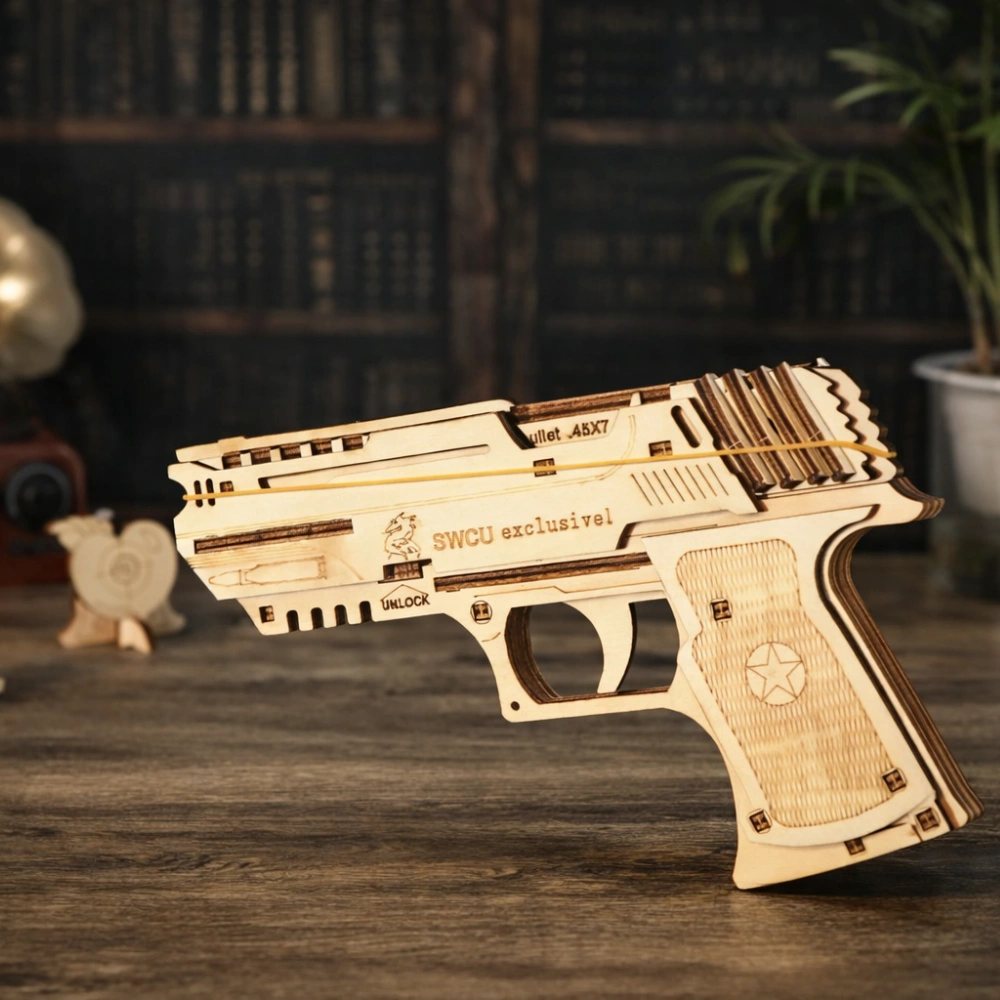
Tea-sip’s 3D Wooden Mechanical Pistol Kit is a laser-cut, hands-on build designed around that old mechanical logic: parts, fit, tension, motion. The kit lists 105 pieces, a difficulty rating of 3/5, and an estimated 1–2 hour build time—long enough to feel absorbed, short enough to finish in an evening.
It’s built from plywood, with a rubber-band mechanism, and it’s designed as a mechanical model / fidget toy, not a functional weapon. Tea-sip also positions it as a screen-free educational object, with a recommended age of 14+.
For desk-life practicality, the assembled size is compact—about 4.7 × 1.1 × 6.3 inches (roughly 11.9 × 2.8 × 16.0 cm)—the kind of object you can keep nearby as a conversation piece that also happens to be a tiny machine you built yourself.
If you want to explore that style of build beyond a single model, the broader wooden puzzles collection gives you the same “hands + brain” premise across different mechanisms and themes. (Internal link appears here, by design: late in the story, where it supports the experience rather than interrupting it.)
Internal link: wooden puzzles collection → https://tea-sip.com/puzzle-toys/wooden-puzzles/
And if you’re specifically curious about this mechanism-as-history idea in a pistol-shaped form, here’s the model that sparked the whole narrative:
Internal link: 3D wooden mechanical pistol kit → https://tea-sip.com/product/3d-wooden-mechanical-pistol-kit/
A final practical note for international readers (US/UK/CA/AU/DE): Tea-sip’s policy states orders are dispatched from China, offers worldwide shipping, and notes that import duties/taxes may apply depending on destination—something that matters especially for cross-border orders into the UK/EU.
Conclusion
Back in that Munich workshop, Peter Peck’s pistol wasn’t just a tool—it was a compressed lesson in how humans learn to make complexity behave. Springs, sparks, friction, fit: the same quiet logic that animates watches, automata, and every satisfying little mechanism you can’t stop clicking.
Five hundred years later, we don’t need pistols to understand mechanism. But we still need the feeling they represent: causality you can hold, motion you can explain, a system that rewards patience instead of stealing attention.
If the story left you curious, take that curiosity where it belongs—not into shopping, but into making: the kind of hands-on play that teaches your brain how the world fits together.
Internal link: Puzzle Toys → https://tea-sip.com/puzzle-toys/
Authority Citations
- The Metropolitan Museum of Art — Double-Barreled Wheellock Pistol Made for Emperor Charles V
Explains one of the earliest pistols; links gunsmithing with watchmaking craft.
URL: https://www.metmuseum.org/art/collection/search/22387 - Encyclopaedia Britannica — Wheel lock
Dates development (~1515) and describes how the mechanism generates sparks.
URL: https://www.britannica.com/technology/wheel-lock - Encyclopaedia Britannica — Pistol (weapon)
Establishes early practical pistols dating from the 16th century and ignition types.
URL: https://www.britannica.com/technology/pistol-weapon - Encyclopaedia Britannica — Flintlock
Summarizes flintlock development and why it replaced earlier systems.
URL: https://www.britannica.com/technology/flintlock - Encyclopaedia Britannica — Marin le Bourgeoys
Supports attribution of “true flintlock” invention to early 17th-century France.
URL: https://www.britannica.com/biography/Marin-le-Bourgeoys - Wikipedia — Wheellock
Provides accessible technical explanation and historical notes (advantages/complexity).
URL: https://en.wikipedia.org/wiki/Wheellock - UNESCO Intangible Cultural Heritage — Craftsmanship of mechanical watchmaking and art mechanics
Frames mechanical craft as a cultural tradition linking science, art, and technology.
URL: https://ich.unesco.org/en/RL/craftsmanship-of-mechanical-watchmaking-and-art-mechanics-01560 - NIH/PMC — Jigsaw Puzzling Taps Multiple Cognitive Abilities (2018)
Evidence that puzzling engages multiple cognitive abilities; useful for the “why it works” section.
URL: https://pmc.ncbi.nlm.nih.gov/articles/PMC6174231/ - NIH/PMC — The Effect of Brain Teaser Games on Attention (2021)
Discusses attention/concentration changes after puzzle-style interventions.
URL: https://pmc.ncbi.nlm.nih.gov/articles/PMC8818112/ - NIH/PMC — Evaluation of Stress and Cognition Indicators in a Puzzle Game (2022)
Focuses on stress/cognition indicators comparing gameplay vs passive watching.
URL: https://pmc.ncbi.nlm.nih.gov/articles/PMC9985795/ - Harvard Health — 12 ways to keep your brain young
Supports “mentally stimulating + manual dexterity crafts” as brain-healthy habits.
URL: https://www.health.harvard.edu/mind-and-mood/12-ways-to-keep-your-brain-young - Yale (Elischolar) — Comparative Study of User Experience: Physical Objects vs Digital Surrogates
Academic perspective on why physical interaction can differ meaningfully from digital.
URL: https://elischolar.library.yale.edu/cgi/viewcontent.cgi?article=1019&context=jcas