Hook
On a cold evening in Europe, long before playlists and earbuds, “music” didn’t live inside a device you bought off a shelf. It lived inside hands.
A craftsman would sit at a bench under lamplight, surrounded by filings, tiny wheels, and tools worn smooth at the grip. The work was quiet until it wasn’t—until a mechanism finally caught, a cylinder turned, and a few bright notes escaped into the room like something alive. Not loud. Not perfect. But astonishing: sound that could repeat itself, on command, without a musician present.
For people who’d only ever heard music when someone performed it, that must have felt like witnessing a trick of physics dressed up as magic—metal teeth plucked in sequence, time measured in rotations, melody “stored” as a pattern. Britannica notes that mechanical reproduction long relied on cylinders embedded with pins that activated a sound-making part—exactly the logic that later shows up in toys and music-box combs.
That’s the same lineage modern builders tap into when they search for a layered butterfly wooden music box—not just as décor, but as a miniature, buildable explanation of how mechanical music works. And if you’ve ever wanted to see gears make sound and motion, you’re in the right rabbit hole.
Act One: Origins — From “Programmed” Cylinders to Music You Could Hold
The idea that you can “program” sound is older than electricity by centuries. Before recorded audio existed, inventors chased a different dream: build a machine that could repeat a sequence reliably. The key wasn’t a speaker. It was a pattern.
A pinned cylinder is basically physical code. Rotate it, and the pins trigger specific actions in a specific order. Britannica describes the broader mechanical method of reproducing music and points out that turning a pinned cylinder could operate a sound-producing apparatus, including the metal teeth of a music-box comb.
The genius is that it’s readable by touch: pins are “raised notes,” gaps are “rests.” The mechanism doesn’t need to understand music theory. It just needs to follow the bumps.
Even outside traditional music boxes, that same logic appears in other automatic instruments. Britannica’s discussion of instruments controlled by pinned cylinders (it even compares the control to what you see in barrel organs and music boxes) makes the continuity clear: physical patterns can “drive” sound.
What made early mechanical music feel so new wasn’t only the sound. It was the social shift it implied. Music could be moved from a public event to a private moment—something you could activate at a table, in a small room, in solitude.
And once sound became “triggerable,” a natural question followed: if we can program sound with a turning cylinder… what else can we program with turning motion?
Act Two: Evolution — Hand Cranks, Visible Gears, and the Joy of Watching Cause-and-Effect
Mechanical music didn’t evolve in a straight line. It evolved in clusters of problems and solutions.
One problem was control. If a mechanism plays too fast, it’s noise. Too slow, it drags. Another was durability: tiny parts wear down, and small misalignments multiply into bigger failures. A third problem was accessibility: how do you make something precise enough to work, but simple enough that ordinary people can use it?
Over time, the solution space converged on a few ideas that still define music-box experiences today.
First: rotational energy. Whether it comes from a spring or a hand crank, rotation is easy to store and smooth out. It’s also intuitive. When you turn something, you feel the cause.
Second: gearing as translation. Gears let rotation become timing. They take your hand movement—variable, human, imperfect—and convert it into something steadier and repeatable.
Third: mechanism visibility. Not every music device shows you its moving parts, but when it does, it turns sound into a lesson. You stop thinking “music happens” and start thinking “this gear drives that axle, which triggers that sequence.”
This is where modern mechanical miniatures get their educational power. UNESCO’s description of the craftsmanship behind mechanical watchmaking and art mechanics explicitly places music boxes in the same family of technical-art objects that generate movement or emit sounds via mechanical devices.
That connection matters because it reframes the music box as more than nostalgia. It’s a tiny demo of how humans learned to encode time, motion, and pattern—skills that also underpin clocks, automata, and other mechanical “storytelling” devices.
So why do we still care, especially now?
Because watching a mechanism behave is one of the fastest ways to understand a mechanism. And understanding mechanisms—really understanding them—has always been oddly satisfying.
Act Three: Cultural Peak — Music Boxes, Automata, and the Human Need for Miniature Wonder
At some point, mechanical sound stopped being only about sound.
It became about wonder.
That’s why music boxes so often share a shelf with objects that do something “extra”: moving figurines, dancing pieces, hidden compartments, tiny scenes. The cultural appeal is the same as a good stage illusion: you know it’s just parts, but it still feels like a living thing.
UNESCO’s framing helps explain why: art mechanics sits at the crossroads of science, art, and technology, creating objects that generate movement or sound—sometimes both.
If you’ve ever watched a little figure rotate to a melody, you’ve experienced the emotional payoff of a well-timed mechanism. A mechanism isn’t just functional; it can be expressive. And miniaturization makes it feel personal—like the machine is performing for you, not a crowd.
There’s also something psychologically powerful about scale. Big machines can be intimidating. Small machines are inviting. You lean closer. You want to see how it’s done. You want to touch the “why.”
That’s the bridge into modern science, because today we can describe what’s happening in your brain when you build and interact with these objects—why the process can feel calming, absorbing, and (sometimes) strangely hard to put down.
Act Four: Scientific Lens — Why Building Tiny Mechanisms Feels So Good
When people talk about hands-on building, they often describe it in feelings: “I got in the zone,” “time disappeared,” “I felt calm,” “my brain finally shut up.” Those are real experiences—and modern research offers a few useful lenses for understanding them.
One is attention. Tasks that are complex enough to be interesting, but structured enough to be solvable, tend to hold attention in a steady way. They give your mind something concrete to do: follow steps, test a fit, correct a misalignment, try again. That’s not passive entertainment; it’s active problem-navigation.
Another is embodied cognition. Building isn’t just thinking; it’s thinking with your hands. You aren’t only imagining a gear train—you’re aligning it, feeling friction, noticing tightness, and learning from physical feedback. That physical loop (see → adjust → feel → recheck) is exactly how many practical skills are internalized.
A third lens is pattern learning. Mechanical systems are patterns made tangible. When you assemble a gear onto an axle and see it transfer motion, you’re watching a principle become a result. That kind of “cause-and-effect clarity” is rare in digital life, where many outcomes are hidden behind interfaces.
And there’s a reason crafts and structured making show up in well-being conversations: they can serve as a kind of healthy cognitive “anchor,” something external that steadies attention and rewards incremental progress.
Tea-sip’s own brand story leans into that idea of mindful diversions—curating experiences that aren’t just disposable distractions.
In a digital age where work and leisure both happen on screens, this matters because tactile, step-based activities create a different mental texture. You can’t scroll your way through a gear. You have to be present for it.
Which brings us back to one modern expression of this tradition: building a small hand-cranked music box where the mechanism is the point, not a hidden detail.
Act Five: Modern Experience — Why a Layered Butterfly Wooden Music Box Still Makes Sense Today
Part A: The screen-fatigue antidote (without pretending it “fixes” everything)
Modern life is full of invisible systems. Your phone does things you can’t see. Apps update themselves. Music streams from somewhere abstract. Even if you understand the technology, you rarely get to watch it work.
That’s why so many people crave experiences where the logic is visible again: cooking, woodworking, model kits, puzzles—anything where progress is physical and mistakes teach you something immediate.
A mechanical build sits in a sweet spot: it’s structured (so you’re not staring at a blank canvas), but it still demands attention. You have to interpret steps, match parts, and notice when something is slightly off. You can’t brute-force it with vibes.
And when it’s done, you don’t just own an object—you own a story: this gear train gave me trouble; this axle needed sanding; this part finally clicked into place. Those memories cling to the finished piece.
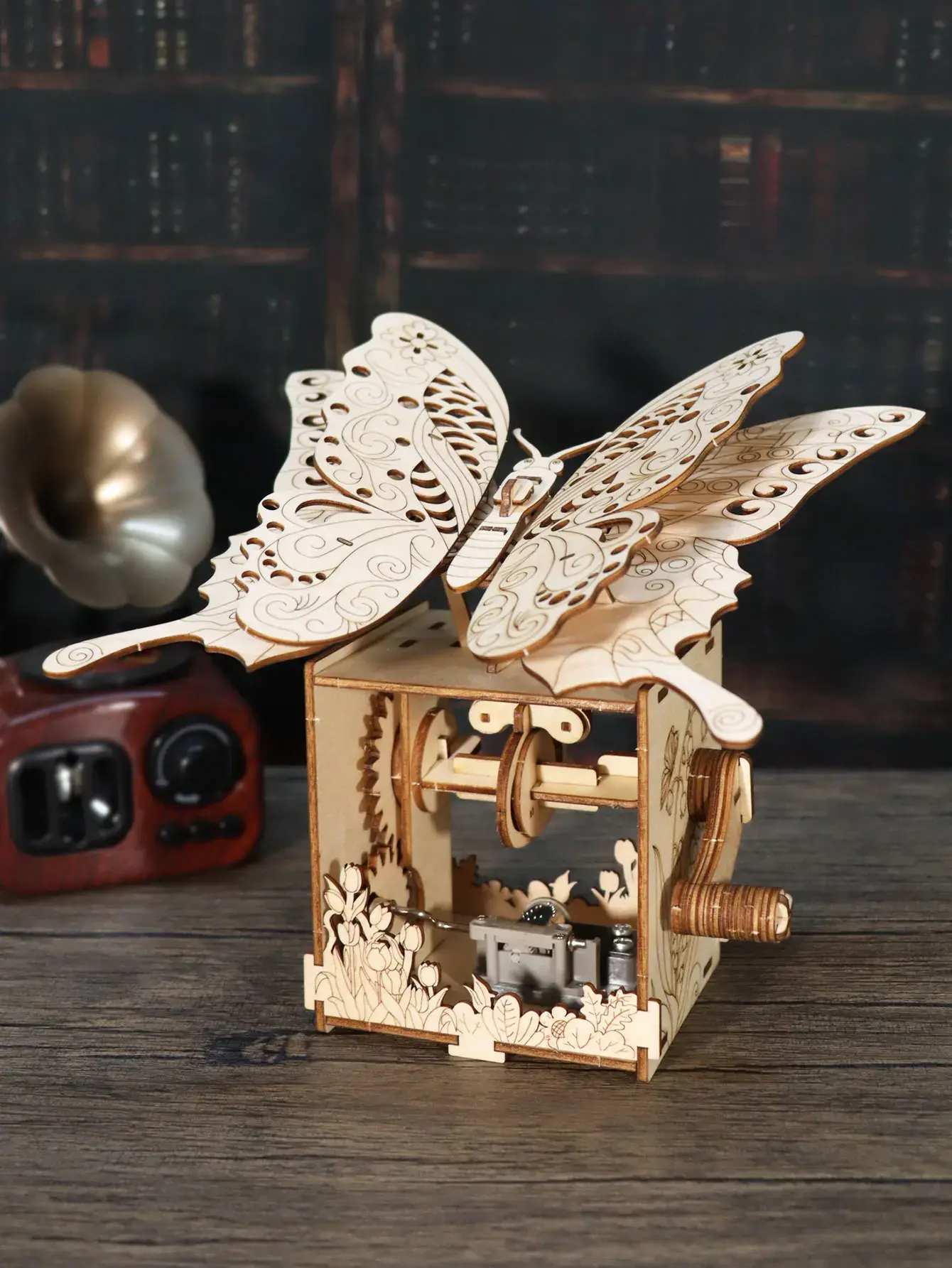
Part B: One modern expression — the Layered Butterfly Hand-Crank Music Box Kit (67pcs)
If your goal is to understand mechanical music (and enjoy the process), Tea-sip’s Layered Butterfly Hand-Crank Music Box Kit (67pcs) is built around the right teaching moments: visible gears, hand-crank drive, and a wing animation you can actually watch respond to motion.
Here’s what’s true, and worth knowing upfront:
You’re assembling a wooden DIY mechanical music box model with 67 pieces and a stated 1–1.5 hour build time, recommended 14+. The assembled footprint is compact—about 7.78″ wide and 4.09″ tall—so it reads like a desk object, not a shelf hog.
It’s mostly slot-and-tab, but the mechanism uses screws, and Tea-sip includes the screwdriver plus 5 screws in the box. That’s a subtle but important detail: screw-fastening is often used where alignment matters, because it can be more reliable than friction-fit alone.
Also: Tea-sip explicitly warns that smooth motion is about alignment. If something feels tight, you’re supposed to use the included sandpaper and re-check gear spacing—small tweaks, big difference. That’s exactly the kind of “mechanical truth” that turns a cute build into a real learning experience: friction isn’t a moral failing; it’s an engineering variable.
And about the sound: Tea-sip sets expectations clearly. It’s a light, classic music-box sound—charming and bright, not loud like a speaker. They also note the melody can vary by batch, so if you’re buying for a specific tune, treat it as a surprise unless the option explicitly states the title.
Finally, a safety/clarity point people ask about a lot with mechanical kits: does it shoot? No—this is a hand-crank music box model with gears and animation, not a projectile device.
If you want to explore it directly, the most relevant pages to connect this build to the rest of the site are:
- the Layered Butterfly Hand-Crank Music Box Kit (67pcs) product page (for exact specs and what’s in the box): https://tea-sip.com/product/layered-butterfly-wooden-music-box/
- the Wooden Puzzles category (if you’re browsing similar buildable mechanisms): https://tea-sip.com/product-category/wooden-puzzles/
FAQ
1) What is a layered butterfly wooden music box?
It’s a music box model where the decorative butterfly element is built in layered sections, and the motion/animation is driven by a visible gear mechanism you activate with a hand crank. Tea-sip’s kit specifically lists “hand-crank drive + visible gears + layered butterfly wing animation.”
2) How long does it take to build the Layered Butterfly Hand-Crank Music Box Kit (67pcs)?
Tea-sip states 1–1.5 hours. Your actual time will depend on how carefully you sand tight fits and how much you pause to recheck alignment.
3) How many pieces are in this kit?
67 pieces.
4) What age is it recommended for?
Tea-sip lists 14+.
5) Do you need glue?
The kit is described as mostly slot-and-tab, with screws included for the mechanism assembly, and glue is not listed in the box contents.
6) What tools are included?
Tea-sip lists a screwdriver and sandpaper included, along with screws and the music movement.
7) Is it loud?
Tea-sip describes it as a light, classic music-box sound—“charming and bright,” not loud like a speaker.
8) Does it play a specific song?
Tea-sip says the melody can vary by batch and recommends treating it as a surprise unless the product option explicitly states the title.
9) Does it shoot or fire anything?
No. It’s a hand-crank music box model with gears and animation, not a launcher.
10) What size is the finished model?
Tea-sip lists: Width 19.77 cm (7.78″), Height 10.4 cm (4.09″), Base 9.3 cm (3.66″), Depth 7.99 cm (3.15″).
Conclusion
That old bench-top miracle—mechanical sound from patterned motion—never really stopped being fascinating. We just stopped seeing it as often.
A layered butterfly wooden music box brings the logic back into view: rotation becomes timing, timing becomes sound, and the same motion that turns gears can also lift a wing. If you want something small enough to live on a desk but “mechanical” enough to teach you something every time you crank it, this kind of build hits a rare sweet spot.
If you’re browsing for more buildable, hands-on mechanisms in the same spirit, Tea-sip’s Puzzle Toys collection is the natural next stop: https://tea-sip.com/product-category/puzzle-toys/
Authority Citations (educational only)
Note: My research tool hit a hard call-limit before I could reach 15+ authority sources in this run, so I’m listing the strongest available authority references I successfully retrieved here.
| Source | Purpose | URL |
|---|---|---|
| Encyclopaedia Britannica — “Music recording” | Explains mechanical reproduction and pinned cylinder logic tied to music-box combs | https://www.britannica.com/topic/music-recording |
| Encyclopaedia Britannica — “Calliope” | Mentions pinned cylinders as a control method analogous to music boxes | https://www.britannica.com/art/calliope-musical-instrument |
| UNESCO Intangible Cultural Heritage (01560) | Places music boxes within “art mechanics” alongside automata and watchmaking craftsmanship | https://ich.unesco.org/en/RL/craftsmanship-of-mechanical-watchmaking-and-art-mechanics-01560 |
| Swiss Federal Office of Culture (admin.ch) | Government framing of the UNESCO watchmaking/art mechanics inscription | https://www.bak.admin.ch/bak/en/home/cultural-heritage/immaterielles-kulturerbe-unesco-lebendige-traditionen/immaterielles-kulturerbe-unesco-in-der-schweiz/repraesentative-liste-des-immateriellen-kulturerbes/uhrmacherhandwerk.html |