Hook (a real lantern, a real night)
London, 5 November 1605. The air is cold enough to sting, and the city is the kind of dark you can feel in your teeth—because “night” isn’t just a time back then, it’s a condition. Under the Palace of Westminster, in the cellar spaces that smell like damp stone and old timber, a watch moves through tight corridors with a single job: find what doesn’t belong.
A lantern goes first. Not a romantic, storybook lantern—an inspection lantern, the kind you carry when you expect danger and you need both hands free the moment you see it. The flame throws jittery shadows across barrels and beams. And then the light lands on the wrong shape in the wrong place: stacked gunpowder, hidden in plain sight.
History remembers that night as the Gunpowder Plot, and museums remember it with something surprisingly ordinary: the lantern associated with the search and arrest of Guy Fawkes. The object is small, practical, and almost blunt in its purpose—portable light for a world that had very little of it.
If you’ve ever found yourself drawn to the glow of a lantern—especially one with gothic arches and cutout patterns—you’re not alone. The modern wooden lantern 3D puzzle sits at a weirdly perfect intersection of history, engineering, and the simple human urge to make light feel… designed.
Act One: Origins — Why Lanterns Were a Breakthrough
Long before lanterns became décor, they were a survival tool: a way to carry fire without letting wind steal it, and without letting sparks turn your sleeve into kindling.
The core idea is elegantly simple: enclose a flame so it can breathe, but not misbehave. That enclosure could be made from horn, oiled cloth, paper, glass, or thin metal—whatever a place and period could reliably shape. Over time, “lantern” became less about a single material and more about a category of design: portable, protected illumination.
Different regions developed their own lantern traditions for different reasons. In East Asia, paper lanterns became both practical and ceremonial, with historical roots stretching back many centuries and growing into festival culture and public spectacle.
In Europe, lanterns tied closely to the social problem of darkness: travel risk, crime risk, workplace risk, and the sheer difficulty of coordinating city life after sunset. When you see a lantern in a painting or museum case, what you’re often seeing is a technology that made “night” negotiable.
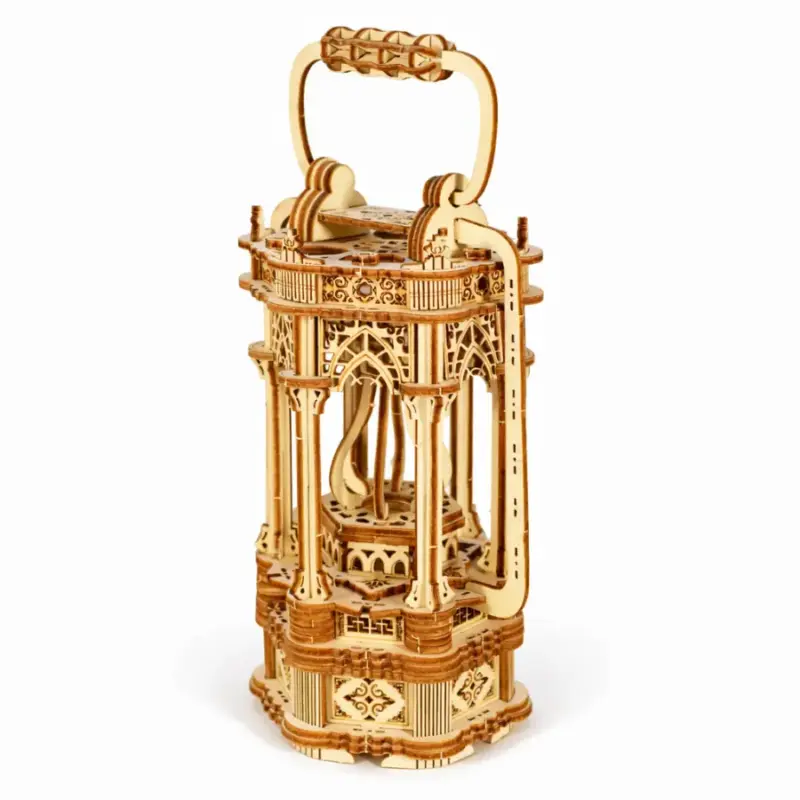
Light-Up Gothic Wooden Lantern 3D Puzzle
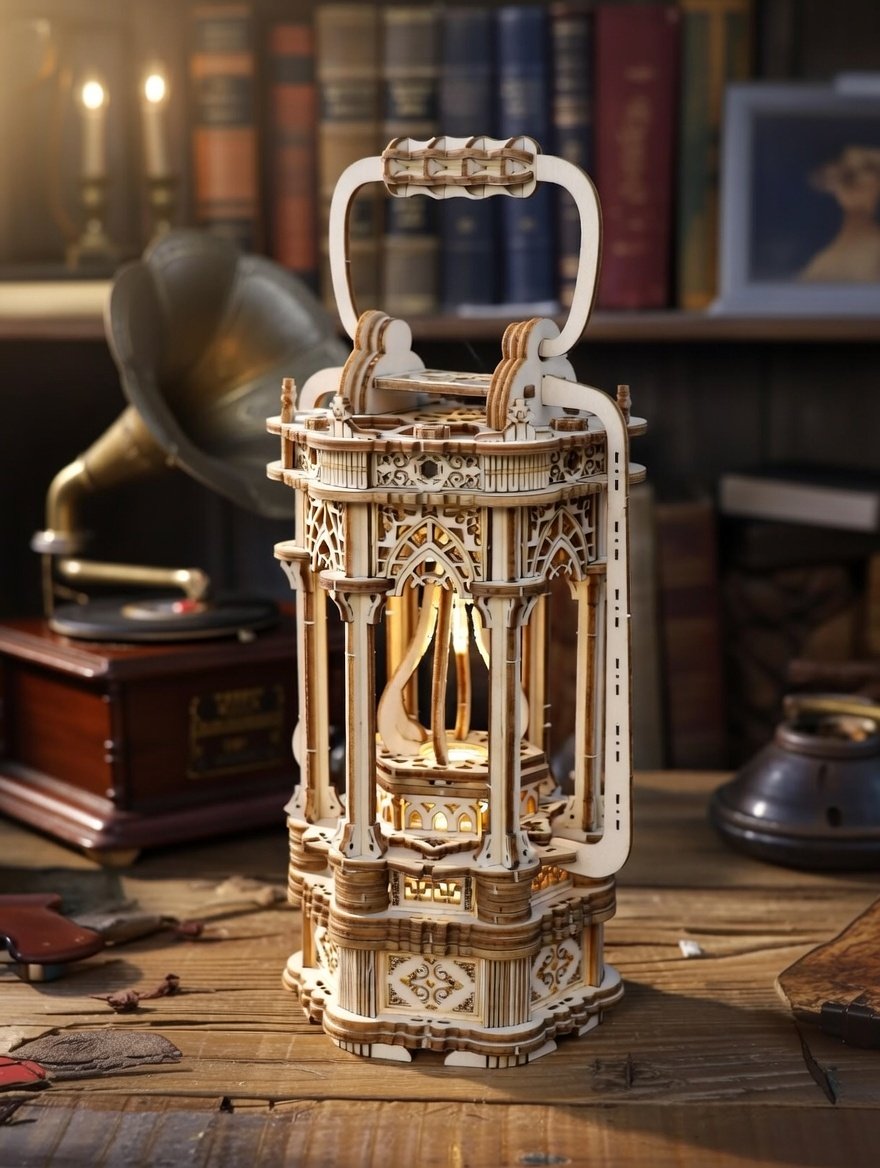
The Light-Up Gothic Wooden Lantern 3D Puzzle is a 154-piece wooden assembly kit that builds a 24 cm (9.45 in) working lantern with a carry handle, a wick-style light component, and Gothic window cutouts that cast patterned wall shadows. Sized for one focused evening — about 1.5 hours of build time — it is made for adult builders who want a puzzle that ends as usable ambient light, not a shelf statue.
And here’s the detail that matters for later: lantern design always balances three forces—light output, airflow, and safety. Push one too far and the other two complain. That tradeoff is the hidden engineering lesson inside every lantern-shaped object, including the wooden lantern 3D puzzle that shows up on desks today.
So what changed when cities grew and nighttime activity became less optional—and more organized?
Act Two: From Street Lanterns to DIY Craft — How We Got to the Wooden Lantern 3D Puzzle
When lanterns moved from personal tools to public infrastructure, design got standardized fast. Street lighting wasn’t just “more lanterns.” It was a new system: placement, maintenance, fuel logistics, and rules about who had to light what, when.
Over centuries, lighting technology stacked like a timeline you can almost feel: candle and oil, then gaslight, then electric. Each shift changed what lanterns needed to be. Glass became more common. Metalwork improved. Venting patterns got smarter. The lantern stopped being just a box for flame and became a small machine for managing heat, airflow, and brightness.
That’s why antique lanterns have so many “unnecessary” details—those holes, chimneys, and frames aren’t decoration first. They’re problem-solving.
And then something quietly modern happened: lanterns turned into a form factor people wanted even when they didn’t need open flame. We kept the silhouette because it still signals comfort, guidance, and shelter—especially in winters, during outages, or just in rooms where you want a warm corner.
At the same time, a parallel trend grew: model-building as a home activity. Not because we suddenly became craftspeople, but because the modern day is overloaded with abstract work—tabs, notifications, and tasks that never resolve into something you can hold. Building a model scratches the opposite itch: clear steps, tactile feedback, visible progress.
That’s the emotional and historical runway that leads to the modern wooden lantern 3D puzzle: an object that borrows an old lighting form and turns it into a hands-on build—part design study, part ritual.
But why do some lantern designs feel “gothic,” specifically—and why does that style look so good when light shines through it?
Act Three: Cultural Peak — Gothic Light and the Beauty of Cutouts
Gothic architecture wasn’t just an aesthetic—it was an engineering solution aimed at height and light. Builders developed structural tools like pointed arches, ribbed vaults, and flying buttresses to carry weight outward and upward, freeing walls for larger windows.
And those windows mattered because Gothic spaces treated light like a material. Stained glass didn’t merely “decorate” a cathedral; it transformed daylight into narrative, symbolism, and mood. UNESCO descriptions of Gothic sites repeatedly highlight stained glass as a defining feature—because it shapes how the space is experienced.
Now, take that idea—light shaped by structure—and shrink it down to lantern scale. The logic still works:
- Openings create patterned illumination.
- Arches and tracery-like cutouts turn light into texture.
- The enclosure makes the glow feel contained, like it belongs to an object rather than just leaking into the room.
Museums preserve lanterns from very different periods and places—proof that the object wasn’t one “thing,” but a recurring answer to recurring needs. The Metropolitan Museum of Art holds early examples of lantern forms in its collections, and the British Museum preserves later, more domestic versions—each reflecting local materials and habits.
So when you see a gothic-style lantern—whether historical ironwork or a modern wooden build—you’re seeing a miniature remix of a big architectural idea: structure that choreographs light.
Which brings us to the modern question: why does building something like this feel unusually absorbing, even for people who don’t think of themselves as “crafty”?
Act Four: The Scientific Lens — Why a Wooden Lantern 3D Puzzle Holds Your Attention
There are two things happening when you build a 3D puzzle: your brain is solving spatial problems, and your hands are negotiating precision. That combination is more powerful than it sounds.
Research on hand function and dexterity repeatedly shows that fine motor performance is not just “hand stuff”—it’s linked to broader functional ability across adulthood. Studies examining hand function measures (like dexterity assessments) connect them with everyday capability and aging-related outcomes.
Meanwhile, interventions that train manual dexterity can improve performance in targeted tasks—supporting the plain-language idea that hands get better at what you ask them to do, especially when tasks require controlled movement and attention.
Now layer in attention. One of the most cited concepts for deep engagement is flow—a state where challenge and skill meet at just the right height, so you’re focused without feeling crushed. Modern academic work continues to explore flow as a learning-friendly state—especially when tasks provide immediate feedback and clear goals.
Craft research also points to why making things can feel emotionally stabilizing: it’s structured, sensory, and progresses in visible steps. Reviews of crafting and wellbeing literature often emphasize the value of focused making as a meaningful activity—especially in stress-heavy environments.
In the digital age, this matters for a simple reason: so much of our “work” doesn’t end. You close a tab, but the task is still there. You send a message, but it spawns three more. A physical build gives you what screens are stingy with: completion.
If that’s the psychological “why,” what does a modern lantern build look like when it’s designed to live on a desk—not in a museum case?
(If you’re curious who’s behind Tea-sip and how the store thinks about puzzle experiences, the About page gives the brand’s positioning in plain language.)
Act Five: Modern Experience — Bringing Lantern Logic Back to the Table
We’re living through a quiet backlash against frictionless everything. Not loud rebellion—just small choices that make life feel textured again: a vinyl record, a fountain pen, a stovetop kettle, a paper book.
Model-building fits that same pattern. It’s not faster. It’s not optimized. And that’s the point.
The best builds have a particular rhythm: you pop a piece free, test-fit it, adjust, try again. You can’t brute-force it the way you can brute-force a to-do list. Your hands insist on patience. Your eyes insist on accuracy. The reward isn’t “productivity.” It’s the moment when a structure stands on its own and your brain accepts: yes, that’s real now.
One modern expression: Tea-sip’s Light-Up Gothic Wooden Lantern 3D Puzzle
Tea-sip’s version is explicitly styled around a gothic lantern silhouette, and it’s designed as a build you can complete in a single sitting: 154 pieces, 1.5 hours, age 14+, with no glue needed.
It also reads like a small “engineering sketch” in physical form. The cutout arches and layered walls make it easy to notice how light objects depend on structure—and how small changes in openings change the way light feels in a room. The kit includes wood boards, instructions, sandpaper, and a wick, which is a nice tell that this isn’t just a sculpture—it’s meant to behave like a lantern.
A few practical notes, grounded in what builders of laser-cut kits commonly discuss in hobby communities:
Tight fits are a recurring theme in wood kits, and sanding is one of the most common “fixes” people mention when parts feel stubborn—especially on tabs and slots.
Laser-cut edges can also carry a noticeable burnt-wood smell, which some makers specifically call out when talking about laser-cut projects.
That’s exactly why Tea-sip including sandpaper makes sense: it’s a small tool that turns “ugh, it won’t go” into “oh, now it slides.”
If you want to browse similar builds (music boxes, mechanical builds, and other display-friendly kits), Tea-sip’s Wooden Puzzles collection is the most natural next stop.
And if you’re still deciding what style of challenge you want—locks, disentanglement, or builds—the broader Puzzle Toys hub shows the full range.
FAQ
How long does a wooden lantern 3D puzzle take to build?
Tea-sip lists this build at 1.5 hours.
How many pieces is the Tea-sip lantern kit?
The product page lists 154 pcs.
Is glue required for this 3D wooden puzzle?
Tea-sip states “No glue needed.”
What age is this kit actually designed for?
Tea-sip lists 14+ as the recommended age.
Does it light up—what’s included?
The kit is titled “Light-Up” and includes a wick, plus wood boards, instructions, and sandpaper.
What size is the finished lantern?
As listed: 24 cm (9.45 in) tall, 11.5 cm (4.53 in) wide, 9.5 cm (7.74 in) long.
Does it shoot?
No. Nothing on the product page describes any projectile/shooting mechanism; it’s a tabletop lantern model kit.
What if a piece feels too tight?
Builder discussions around laser-cut kits often point to light sanding on tabs/slots and careful test-fitting rather than forcing parts. Tea-sip includes sandpaper in the box.
Conclusion
The funny thing about lanterns is that they never stopped being relevant—we just changed what “darkness” means. In 1605, it was literal and dangerous; a lantern was a tool you trusted with your life.
Now, darkness is often mental: screen fatigue, noisy attention, days that don’t end cleanly. A build that turns gothic light logic into something you can assemble on your table is a small way to reclaim focus—one slot, tab, and arch at a time.
If you want more display-friendly builds in this same “make it, then keep it” category, start with Tea-sip’s Wooden Puzzles collection.