The 6-in-1 Luban Lock Set: 2,500 Years of Engineering in Your Palm
A tactile deep-dive into China’s most enduring brain teaser—where mortise-tenon joinery meets modern screen fatigue.
Act 1 — The Collective Yearning: Why We Crave What We Can Touch
The Analog Renaissance Is Not a Trend—It’s a Correction
There is a quiet rebellion unfolding in living rooms and coffee shops across the globe. According to CNN’s January 2026 report, craft kit sales at Michael’s surged 86% year-over-year, with consumers citing “AI slop fatigue” as a primary driver. The Good Trade describes this shift as “analog wellness“—an intentional move toward tactile, in-person activities that reclaim “everything we’ve lost” to the digital realm.
This is not nostalgia dressed in marketing. This is neurological self-defense.
The Tactile Deficit
Our fingers, evolved over millennia to grip, twist, and manipulate objects, now spend an average of seven hours daily swiping glass. The result? A generation starved of proprioceptive feedback—the deep-muscle sensation that tells your brain you exist in three-dimensional space.
Enter the Luban Lock.
Named after Lu Ban, the legendary Chinese structural engineer and inventor from the 5th century BCE, these interlocking wooden puzzles have survived dynasties, wars, and the invention of the smartphone. They persist because they answer a question we did not know we were asking: What does problem-solving feel like when you can hold it?
The 6-in-1 Wooden Brain Teaser Set from Tea-Sip offers six palm-sized answers to that question—each one a miniature architectural exam wrapped in beechwood.
Act 2 — Unfiltered Reality: The Unboxing and Assembly Experience
First Contact: What Arrives at Your Door
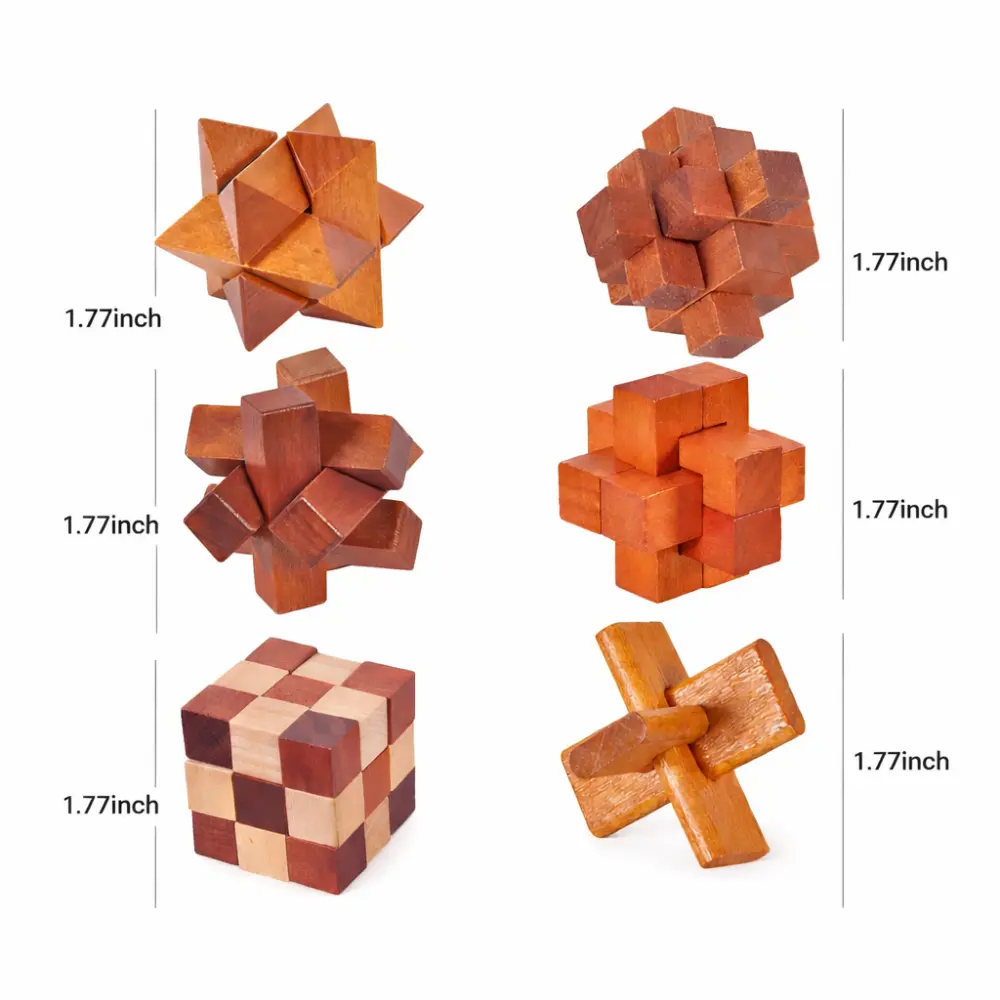
The package arrives in a storage box measuring 7.08 × 4.84 × 2.2 inches (18 × 12.3 × 5.6 cm)—compact enough to slide into a desk drawer, substantial enough to feel like a considered gift. A clear lid reveals six puzzles nested in foam compartments, each approximately 1.77 inches (4.5 cm) per side.
The Cast:
- Snake Cube
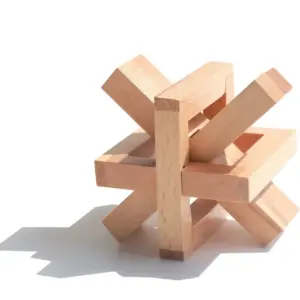
- Six-Piece Burr (the classic)
- 12-Pointed Star
- 24-Piece Burr Ball
- 18-Piece Star Burr
- Dual Lock Cross
No instructions are included. This is intentional. These puzzles predate the concept of instruction manuals by roughly two millennia.
The Smell Test
Remove the lid, and the first sensory hit is olfactory. Beechwood carries a faint, earthy sweetness—nothing like the acrid chemical notes of injection-molded plastic. This is the smell of workshops and old libraries. It is the smell of objects made by people who expected them to last.
The finish is warm chocolate-brown, smooth to the touch but not slippery. Each piece has been sanded to remove splinters while retaining enough texture for grip during manipulation.
The Tactile Inventory
Let’s be specific about what your fingers encounter:
| Puzzle | Texture Notes | Friction Level |
|---|---|---|
| Snake Cube | Elastic cord tension; pieces pivot with satisfying resistance | Low-medium |
| Six-Piece Burr | Tight mortise-tenon fit; requires precise alignment | Medium-high |
| 12-Pointed Star | Sharp geometric edges; complex interlock | High |
| 24-Piece Burr Ball | Multiple small pieces; intricate | Very high |
| 18-Piece Star Burr | Layered assembly; sequential discovery | High |
| Dual Lock Cross | Two interlocking mechanisms; dual challenge | Medium |
The Six-Piece Burr deserves special attention. According to The Puzzle Museum, this design—also called the “Chinese Cross” or “Devil’s Knot”—consists of six notched wooden rods that interlock into a symmetrical form. The standard rule: “notches cut to half-depth only.” This constraint produces what mathematicians call a combinatorial puzzle—one where the solution space is vast but finite.
The Friction Points (Literally)
Not everything slides smoothly. The 24-Piece Burr Ball, with its two dozen interlocking segments, requires patience and steady hands. On my first attempt, I lost three pieces to the carpet abyss. Consider working on a tray or light-colored surface.
The Dual Lock Cross presented an unexpected challenge: two pieces looked identical but were mirror images. Without instructions, distinguishing them requires careful visual inspection—or the willingness to fail forward.
Community Tip: YouTube creator Mr. Puzzle offers ranking and review content for Luban Lock puzzles, walking through difficulty levels and solution strategies. For the Six-Piece Burr specifically, the 58,000-view tutorial by PuzzleSolver demonstrates the classic assembly sequence in under five minutes.
Act 3 — The Mechanical Soul: Science, History, and Hidden Geometry
The Engineering That Built an Empire
The Luban Lock is not merely a toy. It is a scaled model of the joinery system that constructed the Forbidden City.
Mortise-tenon joinery—the interlocking of a projecting tenon into a receiving mortise—predates written history. The Smithsonian Institution notes that Japanese wooden shrines used these joints “instead of nails or glue to withstand earthquakes.” The same principle underlies the Luban Lock: structural integrity through geometric precision, not adhesive dependency.
According to research published by NC State University’s BioResources journal, mortise-tenon structures distribute stress across multiple contact points, creating resilience that bolted or glued joints cannot match. When you manipulate a Luban Lock, you are rehearsing the physics that holds together 600-year-old palaces.
The Mathematics of Constraint
Bill Cutler, a mathematician and puzzle theorist, completed the exhaustive analysis of six-piece burr puzzles in 1990. His finding: there are approximately 35.6 billion possible configurations when “holey” (gap-containing) pieces are permitted. The Chinese Puzzles archive records that the earliest documented reference to a six-piece interlocking puzzle appears in Tang Yunzhou’s 1889 text, describing a “double-cross” formed by six wooden bars—”like antlers before a military camp, united into a single body.”
Rob’s Puzzle Page extends this history further, noting that the first European illustration of a burr puzzle appears in a 1698 engraving by Sébastien Leclerc. The design has crossed oceans and centuries, suggesting that the puzzle satisfies something universal in human cognition.
Cognitive Payoff: What Your Brain Gets
The benefits are not merely anecdotal. A study from the Association for Psychological Science found that frequent play with puzzles and blocks correlates with improved spatial reasoning, particularly among children from lower-income households. The effect persists into adulthood.
Dr. Vera Tobin at Case Western Reserve University explains the mechanism: “Puzzles can help perk up your attention by giving you a little novelty and a short task with an immediate payoff.” Unlike the infinite scroll of social media, a Luban Lock offers bounded challenge with achievable resolution. Your dopamine system gets the reward it craves without the subsequent crash.
For older adults, the stakes are higher. Research on wooden toy training suggests that tactile puzzle engagement supports cognitive maintenance—the warmth and heft of wood providing sensory richness that plastic alternatives lack.
The Historical Figure Behind the Name
Lu Ban (鲁班), born around 507 BCE in the state of Lu, is venerated as the patron saint of Chinese craftsmen. Historical texts attribute to him the invention of the saw, the plane, the ink line, and numerous siege weapons. Whether he personally designed the interlocking puzzle bearing his name is uncertain—but the attribution persists because it captures something true: this puzzle embodies the ingenuity of Chinese structural engineering at its foundational level.
The Smithsonian’s National Museum of American History holds a “Yamato Block Puzzle” consisting of six notched wooden rods—the Japanese variant of the same design. The collection note observes: “The idea of wooden interlocking puzzles may have come from carpenters who made ancient wooden shrines.” Whether Chinese or Japanese in origin, the design reflects a shared East Asian tradition of joinery as art.
Act 4 — The Final Verdict: Crowd-Sourced Wisdom and the Bottom Line
What the Community Says
Aggregating feedback from YouTube comments, puzzle forums, and product reviews reveals consistent themes:
Praise (composite from multiple sources):
- “Wood quality is gorgeous”—customer quote cited on Tea-Sip product page
- “Took me 3 days to solve”—same source, indicating satisfying difficulty curve
- Repeated mentions of “satisfying click” when pieces align correctly
- Appreciation for no-instruction approach: “forces you to actually think”
Common Sensory Descriptors from Enthusiast Forums (composite anecdote from puzzle community discussions on PuzzleMad and Rob’s Puzzle Page):
- “Buttery smooth” finish
- “Solid in the hand”
- “No rattling or wobble”
Criticisms (composite from general puzzle community feedback):
- No instructions may frustrate impatient solvers
- Small pieces in the 24-Piece Burr Ball can be fiddly
- Some users wished for a solution booklet (purists disagree)
Three-Star Concerns: The most common middle-ground complaints involve piece fit tolerance. Mass-produced wooden puzzles can vary slightly between units; some report pieces that are “slightly too tight” or require light sanding. This is inherent to wood as a material—it expands and contracts with humidity. Serious puzzle collectors often consider this character rather than defect.
Who This Set Is For
Ideal Buyers:
- The Screen-Fatigued Professional — Someone seeking a desk object that offers mental reset without requiring another app
- The Curious Gift-Giver — Looking for a present that signals thoughtfulness, not algorithmic suggestion
- The Puzzle Collector — Wanting a historically significant design in a well-made, affordable set
Not Recommended For:
- Those requiring immediate gratification (no solutions included)
- Households with very young children (small pieces)
- Anyone allergic to frustration as a feature
The Value Calculation
At $38.88 for six distinct puzzles, the per-unit cost is approximately $6.48. Comparable single-puzzle offerings from specialty retailers often exceed $15. The beechwood construction and clear-lid storage box add perceived (and actual) value.
More importantly: this is not a consumable. Unlike a book read once or a game completed, a Luban Lock can be disassembled and resolved indefinitely. The entertainment-per-dollar ratio improves with every session.
The Tactile Verdict
The 6-in-1 Wooden Brain Teaser Set does what few modern products attempt: it asks you to slow down. There is no app integration, no leaderboard, no notification. There is only wood, geometry, and your hands.
In a world where analog wellness has emerged as a necessary counter-movement to digital saturation, the Luban Lock offers a 2,500-year-old prescription. It is not a cure for screen addiction—but it is a reminder that problem-solving once felt different. It felt like something you could hold.
Final Rating: A well-considered purchase for anyone seeking tactile engagement, cognitive challenge, and a connection to one of humanity’s oldest engineering traditions.
Where to Buy: Available at Tea-Sip’s Wooden Puzzles collection, a platform dedicated to curating quality puzzle toys and mindful diversions.