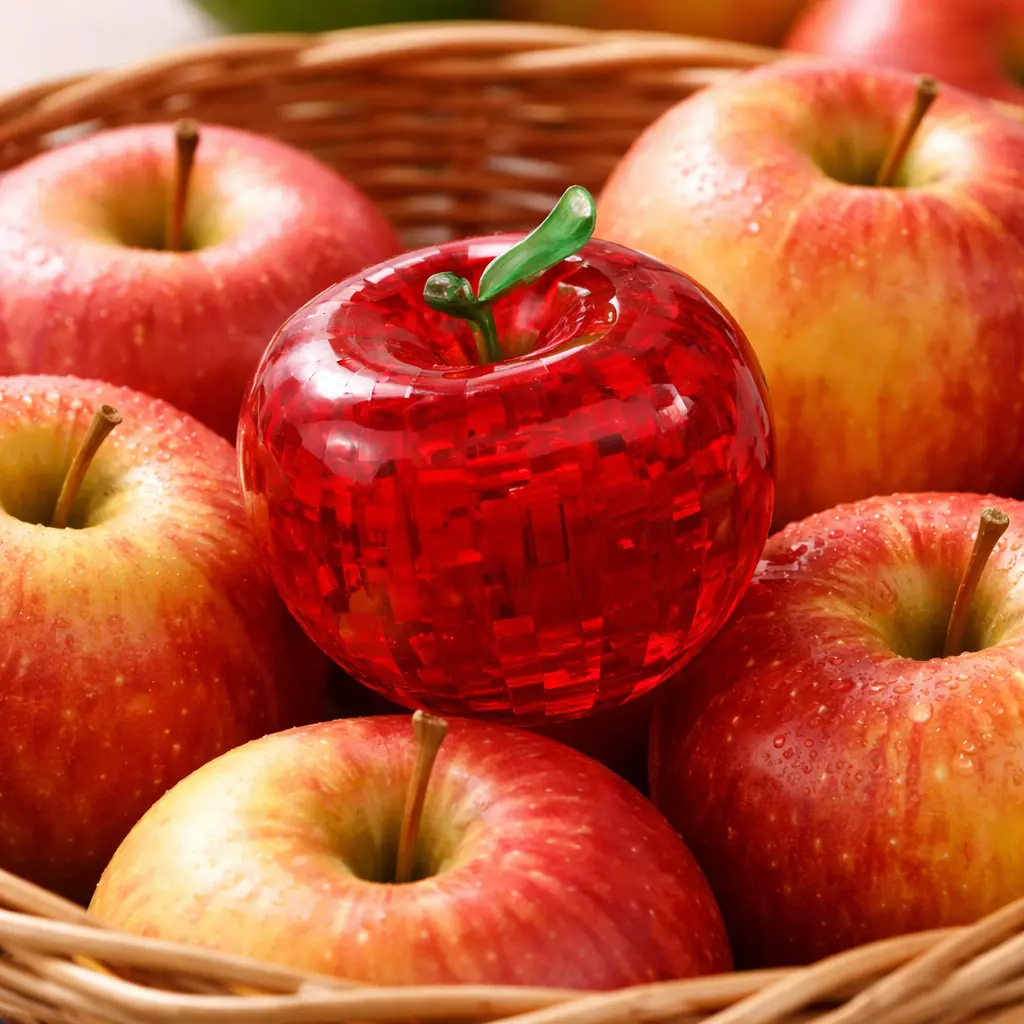
The first piece doesn’t snap. It slides—a smooth, almost liquid resistance as translucent red ABS plastic meets its neighbor at a slight angle. You adjust. Try again. This time: click. A soft, definitive lock that travels through your fingernails and tells you the connection is made.
That click is the defining sensation of the 3D Crystal Apple Puzzle. Not the thinking. Not the strategy. The click. You’ll hear it forty-three more times before a pile of curved red fragments becomes something you’d actually put on your desk.
This is a 44-piece spatial assembly puzzle, which means you’re not matching images like a traditional jigsaw—you’re constructing a three-dimensional sculpture from pieces that interlock at specific angles. The finished apple measures roughly 7.5 centimeters in diameter, about the size of a real apple, with a green stem and leaf adding the final touch. The translucent material catches light, and that’s not marketing language: place it near a window, and the afternoon sun turns it into something that looks like it cost three times what it did.
Difficulty sits in the Easy-to-Medium range. The pieces are numbered on their interior surfaces, giving you a clear assembly sequence if you want it. Or you can ignore the numbers entirely and work it out spatially—extending the build time from about 30 minutes to somewhere between one and two hours.
What You Actually Get: Grounded Unboxing
Per the product page, here’s what arrives:
- 44 translucent plastic pieces in red (most common) or green (shipped randomly)
- 1 stem and leaf assembly in green
- Package dimensions: 18cm × 13.5cm × 4cm
- Material: ABS plastic
- Recommended age: 8+
Notable claims from the product listing: no glue required, no tools needed, pieces “snap together with a satisfying click.” These claims hold up. The interlocking mechanism relies on shaped tabs and grooves, not adhesives.
What’s not specified on the product page: whether an instruction sheet is included (many crystal puzzles of this type rely solely on numbered pieces), or the exact weight of the finished assembly. If you need specific packaging details before ordering, the customer help page can address individual questions.
The Build Journey: Step-by-Step Reality
This section walks through the actual assembly experience—what you’ll try, what you’ll feel, what goes wrong, and how to fix it. Crystal apple puzzles share a common construction logic: you’re building a hollow sphere from the inside out, starting with an internal support structure and layering curved shells around it.
Phase 1: The Core Foundation (Pieces 1–8)
What you try: You start with the lowest-numbered pieces, which typically form an internal scaffold. These aren’t curved—they’re angular connector pieces that establish the vertical axis of the apple.
What you feel: A surprising amount of stability early on. ABS plastic has rigidity without brittleness, and the first few pieces lock together with reassuring clicks. The connections feel secure, not wobbly.
What goes wrong: Orientation confusion. Several early pieces look nearly identical. If you’re working without the numbers, you might try forcing a piece in the wrong direction. The resistance will tell you—it won’t click cleanly.
Fix: If a piece resists, don’t force it. Rotate 180 degrees and try again. Crystal puzzles are designed to slide together smoothly when aligned correctly. Friction and resistance mean misalignment.
What you learn: Your fingers become calibrated to the difference between “almost right” and “actually right.” This tactile feedback guides the entire build.
Phase 2: The Lower Hemisphere (Pieces 9–22)
What you try: Now you’re adding curved shell pieces around the core. These form the rounded bottom half of the apple shape.
What you feel: The click changes character here. Curved pieces joining curved pieces produce a slightly softer snap than the early angular connections—but it’s still distinct when correct.
What goes wrong: Sequencing errors. Skip a piece, and the next one won’t fit. Crystal puzzles are sequential by design; piece 14 won’t seat properly until pieces 9–13 are in place.
Fix: If you hit a wall, backtrack. Remove the last few pieces and check the numbers. The sequence is your map.
Checkpoint: By piece 22, you should have a recognizable bowl shape—the bottom half of an apple with an open top.
Phase 3: The Upper Shell and Closure (Pieces 23–42)
What you try: You’re closing the sphere now. The upper pieces curve inward, and the tolerances get tighter as the structure becomes more complete.
What you feel: Satisfying claustrophobia. Each piece narrows the opening. The last few clicks have a finality to them—the structure becomes solid in your hands.
What goes wrong: Two common issues here. First: misaligned seams. If the lower hemisphere pieces weren’t fully clicked, the upper pieces will gap or refuse to seat. Second: color variation. If you’re working with a random green apple instead of red, the translucency may differ slightly, making piece edges harder to see in low light.
Fix: Good lighting matters. The translucent material shows seams clearly under bright light. If something’s off, you’ll see daylight through gaps that shouldn’t exist. Work near a window or under a desk lamp.
Checkpoint: Piece 42 should complete the main sphere. The apple shape is now recognizable, just missing its crown.
Phase 4: The Stem and Finishing (Pieces 43–44)
What you try: The green stem and leaf assembly (1–2 pieces) inserts into the top aperture, completing the apple.
What you feel: A final, definitive click—different from the others because it’s the last one. The structure in your hands is now finished.
What goes wrong: Stem pieces are small and can be fumbled. The green plastic may have slightly different snap characteristics than the red body pieces.
Fix: Go slow. The stem doesn’t require force. If it resists, check orientation.
Result: A freestanding translucent apple sculpture that catches light and prompts questions from anyone who sees it.
Why Pieces Lock and Resist: The Mechanics You Can Feel
Understanding why crystal puzzle pieces behave the way they do makes the build less frustrating and more satisfying. Three mechanical principles govern the experience:
Tolerance and Friction
ABS plastic components are manufactured with specific tolerances—the permissible variation between designed dimensions and actual dimensions. Crystal puzzles rely on what engineers call an “interference fit,” where connecting surfaces are sized to create friction when joined. Too loose, and pieces fall apart. Too tight, and assembly requires dangerous force. The goal is a fit that clicks securely but doesn’t require a hammer.
Research on spatial reasoning and physical manipulation confirms that these tactile feedback loops—resistance, click, stability—are precisely what make hands-on puzzles effective for developing spatial cognition. A study from the University of Chicago published in Developmental Science found that children who engaged in puzzle play showed better spatial transformation skills, and the researchers noted that “manipulation and fit” were central to the learning effect.
Interlocking Geometry
Each piece has tabs (projections) and grooves (recesses) shaped to accept only specific partners. This isn’t arbitrary—the geometry ensures structural integrity once assembled. A 44-piece apple must hold together as a unit, and that requires each connection to resist both pulling and twisting forces.
The curved pieces add complexity. Unlike flat jigsaw pieces, 3D puzzle components must account for spherical geometry. The angles at which tabs meet grooves change across the surface of the apple. Your hands learn to compensate for this, adjusting insertion angles instinctively as you progress.
Sequential Constraints
Crystal puzzles are designed for sequential assembly. The internal support pieces must be placed before the shell pieces because the shells literally can’t reach their final positions otherwise. This is the same principle used in architectural construction: foundations before walls, walls before roof.
The numbered sequence encoded into each piece isn’t arbitrary—it’s the engineered solution path. Ignoring the numbers transforms the puzzle from a 30-minute assembly into a genuine spatial reasoning challenge, which some people prefer.
Spatial Skills and the Science of 3D Puzzles
Three-dimensional assembly puzzles like the Crystal Apple engage a specific cognitive skill: mental rotation, the ability to visualize how an object will appear when rotated in space. This isn’t abstract—you use it every time you try to fit a curved piece into a partially complete sphere and have to imagine the final alignment before attempting the connection.
Researchers at the University of Chicago have been studying the connection between puzzle play and spatial development for over a decade. Dr. Susan Levine, a psychologist specializing in early childhood cognition, led studies showing that children who play with puzzles between ages 2–4 develop measurably better spatial transformation skills by kindergarten. The findings controlled for parent education, income, and overall language input—the puzzle play itself was the significant variable.
Why does this matter for adults? Spatial reasoning isn’t just a childhood skill. Research published in Frontiers in Education confirms that spatial skills correlate with performance in STEM fields and that these skills remain malleable throughout life. A 44-piece crystal puzzle isn’t going to make you an engineer, but the mental rotation practice is real—and, unlike many brain-training apps, the tactile feedback makes it genuinely engaging.
The American Federation of Teachers has published extensive guidance on integrating spatial play into early education, citing research that shows spatial thinking predicts mathematical competence. For parents considering the Crystal Apple as a family activity, this context matters: you’re not just killing time, you’re engaging in documented skill-building.
Who This Is For (and Who Should Skip It)
Ideal For:
Teacher appreciation gifts: The apple symbolism is obvious and timeless. Unlike consumables or generic gift cards, this is something the recipient builds themselves—it becomes personal. A completed crystal apple on a teacher’s desk in September is a reminder of the student who gave it in June.
Desk workers who need screen breaks: The assembly takes 30–90 minutes depending on approach. That’s multiple sessions of hands-on engagement that aren’t scrolling. The finished product then sits on your desk as a conversation piece—something you made, not something you bought pre-assembled.
Kids 8+ who benefit from screen-free activity: The age recommendation is realistic. Younger children may struggle with the fine motor precision, but 8-year-olds can handle it, especially with the numbered guidance. The completion provides genuine achievement feedback.
Gift-givers who want something interesting under $20: The price point (check the current listing) positions this as a thoughtful gift that doesn’t look cheap. The translucent finish signals quality even before assembly.
Skip If:
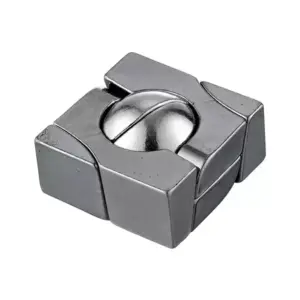
You want a serious challenge. The 44-piece count and numbered guidance make this accessible, not brutal. If you want puzzles that will genuinely test your limits, explore the metal puzzle collection at Tea-Sip—those are designed to frustrate in satisfying ways.
You need a specific color. The product ships randomly between red and green variants. Per the listing, you can mention a preference in order notes, but guarantees aren’t possible. If the classic red apple is non-negotiable, this may frustrate you.
You’re buying for children under 6. Small pieces and fine motor requirements make this unsuitable for very young children. The 8+ recommendation exists for good reason.
The Crystal Puzzle in Context: What Else Tea-Sip Offers
The 3D Crystal Apple sits within Tea-Sip’s broader plastic puzzle collection, which focuses on translucent construction kits that double as display pieces. The company’s stated mission centers on “mindful diversions”—products that engage hands and minds without requiring screens.
If the crystal apple clicks (literally) for you, adjacent options include:
- Wooden puzzles — warmer aesthetic, different tactile experience, often more complex mechanisms
- Metal puzzles — higher difficulty, designed for serious puzzle enthusiasts
- The full Puzzle Toys category — browse everything Tea-Sip carries
Buying Decision Framework
Before adding to cart, run through this checklist:
- ☐ Do I want a puzzle I can complete in one sitting (30–90 minutes)?
- ☐ Am I okay with random color assignment, or is red/green preference critical?
- ☐ Is the recipient 8+ years old?
- ☐ Do I value the finished product as decor, not just the puzzle process?
- ☐ Is my price tolerance under $20?
If you checked most boxes, the 3D Crystal Apple Puzzle is worth your time.
Tea-Sip ships with same-day processing and offers 30-day returns if something goes wrong. Questions before ordering? The contact page connects you directly.