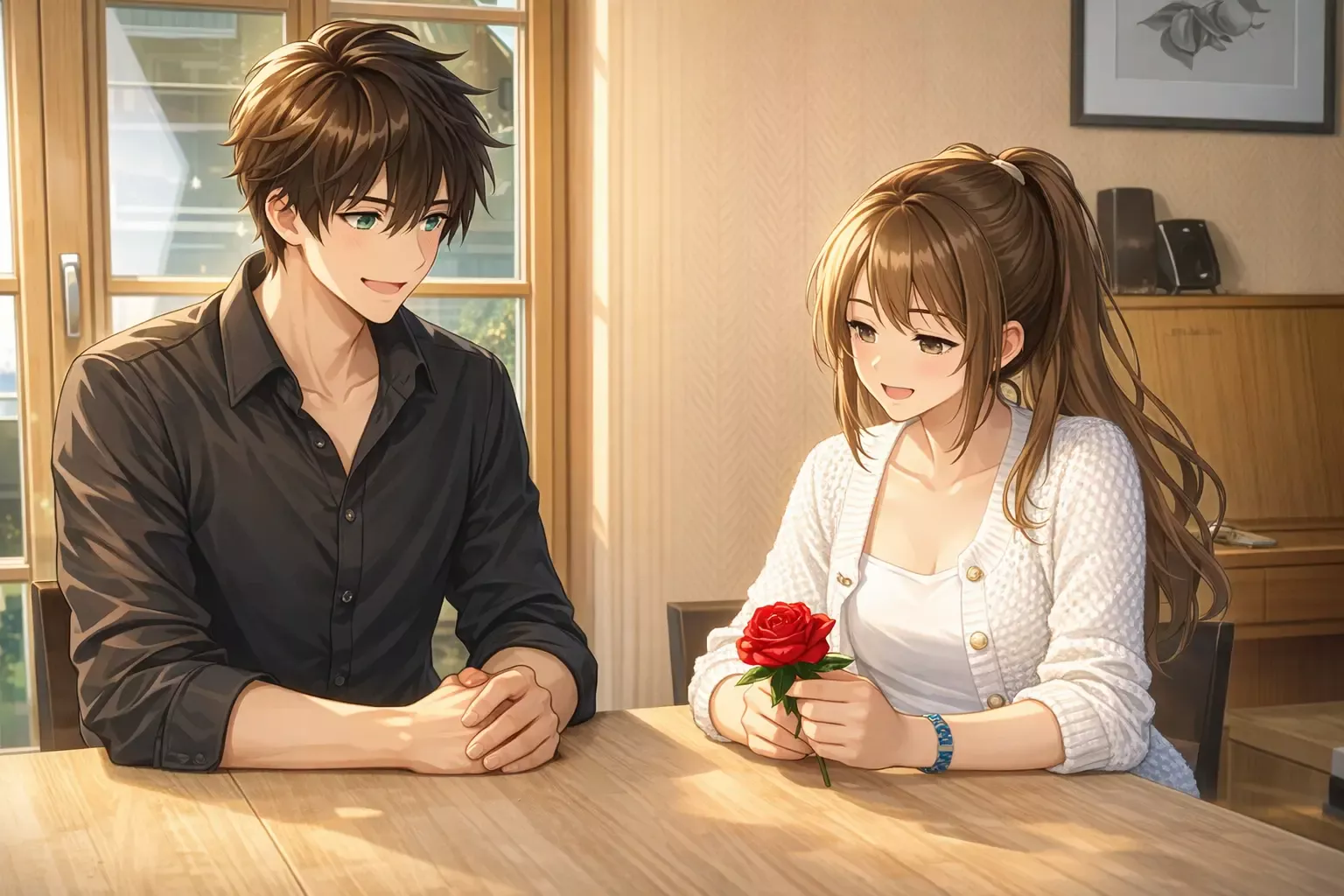
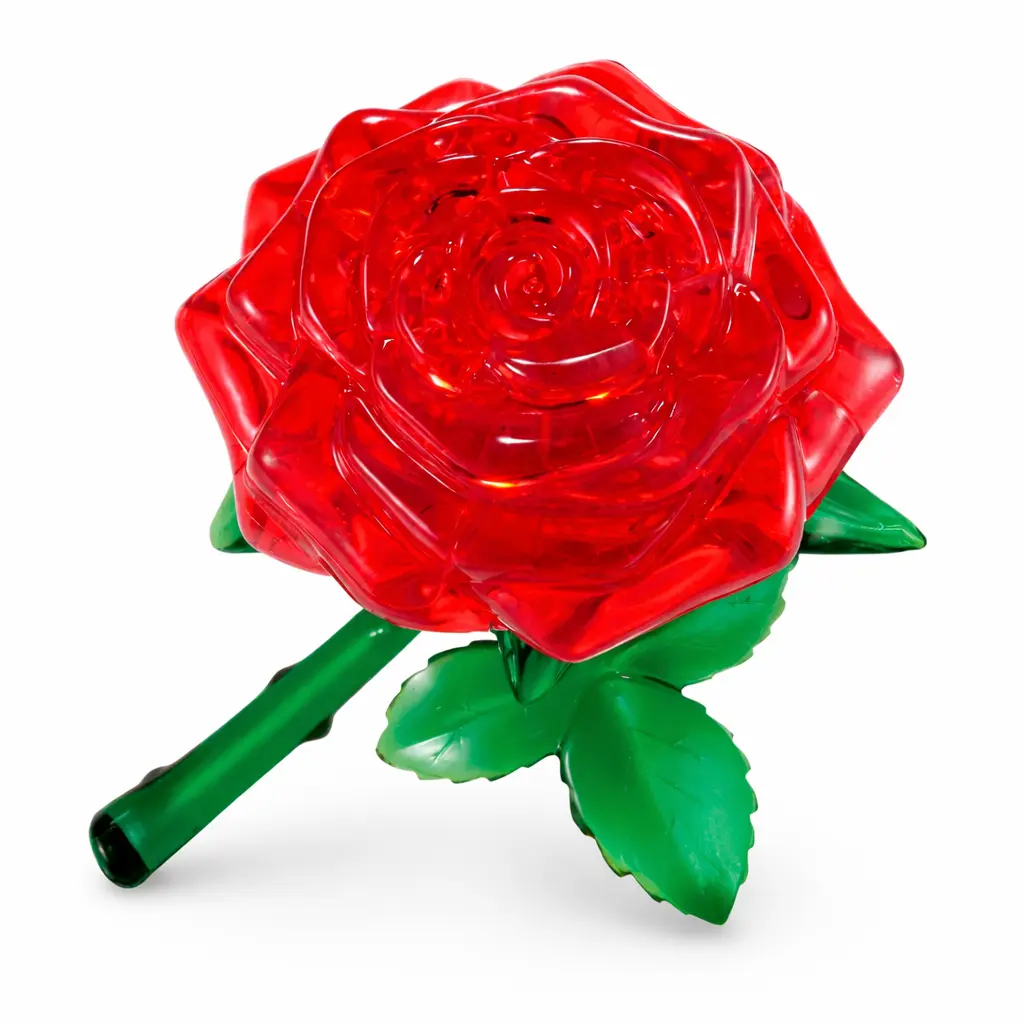
The first piece you pick up surprises you. It’s lighter than it looks—glossy, ruby-red, with a gentle curve that catches the overhead light and throws a faint crimson shadow onto your palm. You expected cheap-feeling plastic. This isn’t that. The ABS material has a density to it, a smoothness that suggests precision molding rather than mass-market throwaway production.
You rotate the piece between thumb and forefinger. No sharp edges. No visible seam lines. The translucency isn’t uniform—it’s deeper red at the thicker sections, almost glass-like where the plastic thins toward the petal edges. For a moment, you forget you’re holding puzzle components. It looks like something that belongs in a display case.
Then you notice the tiny number embossed on the inside curve: “12.” A hint. A breadcrumb. The puzzle wants to be solved, but it’s willing to help you get there—if you want the help. You glance at the instruction sheet, then back at the pile of 44 translucent pieces spread across your workspace. Some are clearly petals. Others are structural—the stem, the leaves, what might be the central core that holds everything together.
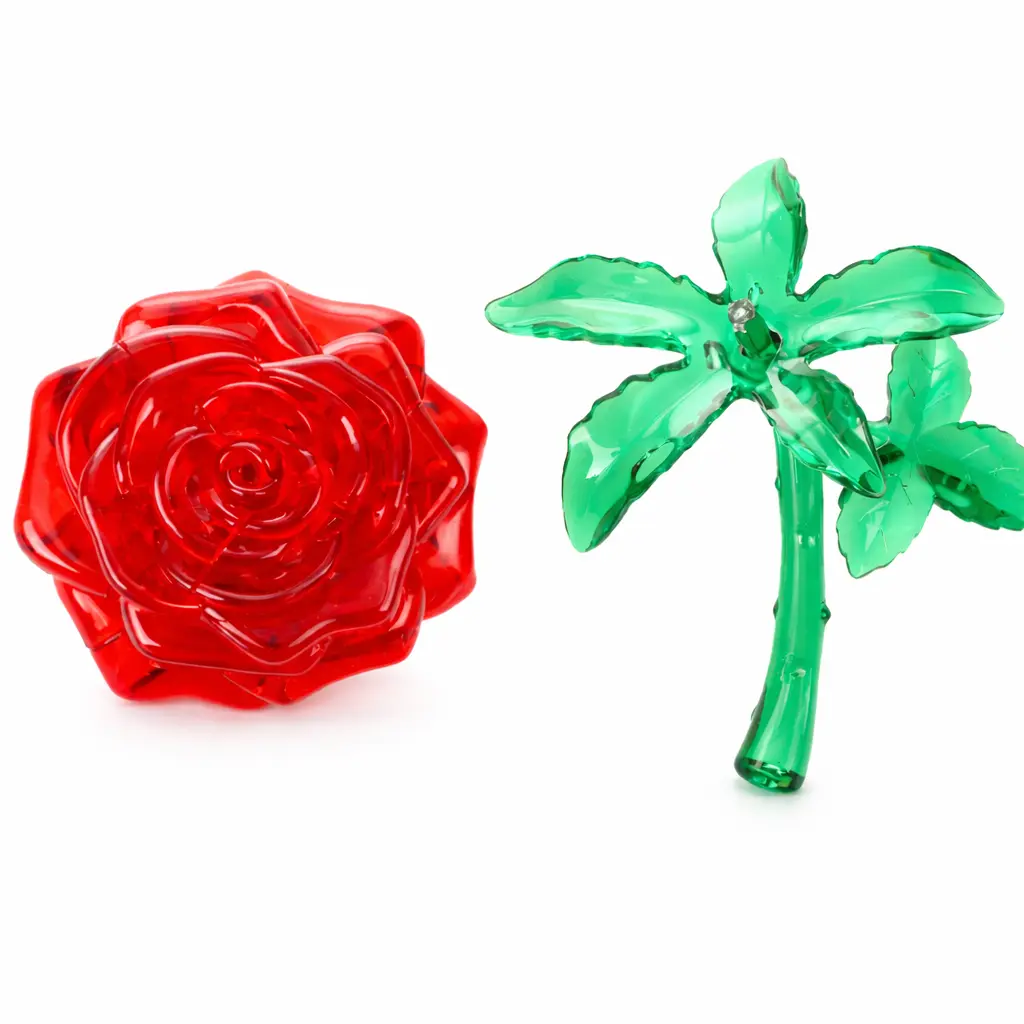
This is a 3D Crystal Rose Puzzle: 44 snap-fit pieces that assemble into a palm-sized sculpture of a rose. No glue required. No tools. Just your hands, your patience, and about an hour of focused attention. The finished result sits on desks, nightstands, and windowsills—catching light, inviting comments, and lasting far longer than any real flower ever could.
But first, you have to build it. And that’s where the interesting part begins.
What You Actually Get: The Unboxing Reality
Let’s ground this in facts before we go further. Everything that follows comes directly from the product page—no embellishments, no assumptions.
Product Truth Card
- Product Name: 3D Crystal Rose Puzzle
- Piece Count: 44 pieces
- Material: ABS plastic (translucent)
- Finished Size: Approximately 12cm × 8cm
- Package Size: 18cm × 13.5cm × 4cm
- Weight: 0.2 kg
- Color: Red rose with green stem and leaves
- Difficulty: Easy to Medium
- Recommended Age: 14+
- Estimated Build Time: 30–45 minutes with numbered guidance; 1–2 hours solving independently
- Tools Required: None (hobby knife optional for trimming manufacturing burrs)
- Assembly Method: Snap-fit; no glue needed
The product page explicitly notes that “some pieces may have small burrs from manufacturing” and recommends a quick trim with a hobby knife if needed. This is worth knowing before you start—not because it’s a flaw, but because a 30-second trim is far preferable to forcing a tight-fitting piece and risking a crack.
What’s not specified on the product page: exact internal structure diagrams, specific step-by-step assembly sequences beyond the numbered pieces, or detailed tolerances. The puzzle is designed to be discovered through assembly, not pre-explained in documentation. That’s part of the experience.
What’s in the Box
Based on the product description and images: 44 translucent ABS pieces in red (petals, core components) and green (stem, leaves), plus an instruction guide. The pieces arrive nested or bagged; images show the puzzle in various stages of assembly, confirming the snap-fit mechanism and the final sculptural form.
The packaging is compact—18cm × 13.5cm × 4cm—which makes it practical for shipping, gift-wrapping, or tucking into a bag. Total weight is 0.2 kg, light enough that the finished rose won’t feel precarious on a shelf but substantial enough to feel like an actual object rather than a trinket.
The Build Journey: Step-by-Step Reality
This section is the heart of the experience. Crystal puzzles like this one aren’t about brute-force assembly—they’re about discovering the logic embedded in the design. Each piece has a specific place; your job is to find it.
Because the product page doesn’t provide an explicit step-by-step guide (and the puzzle is designed to be intuitive), what follows is a generalized walkthrough based on the stated assembly method: numbered interior guidance, snap-fit connections, and building “petals from the inside out.”
Phase 1: Orientation (Minutes 1–5)
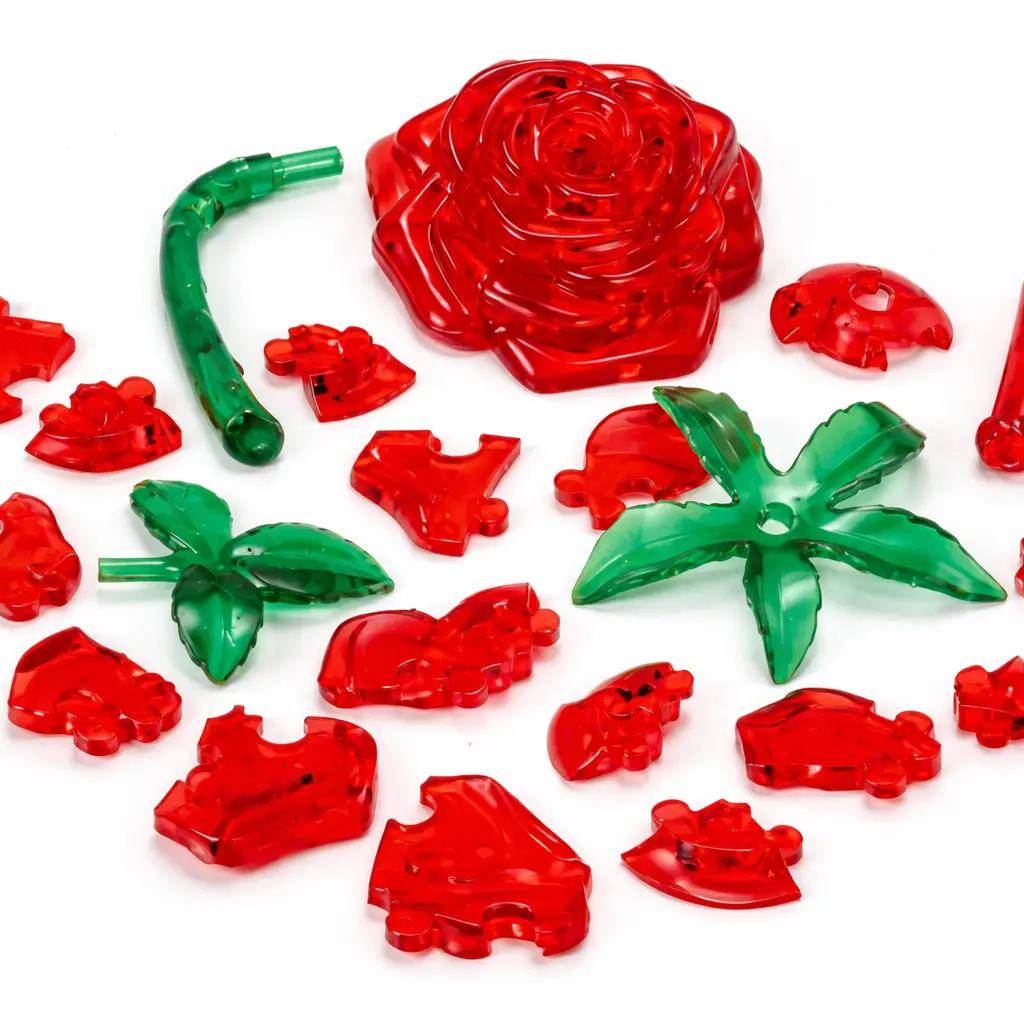
What you do: Spread all 44 pieces on a clean, well-lit surface. Group them loosely by shape and color: red petals in one area, green stem/leaf components in another, any structural or “core” pieces set aside.
What you notice: The pieces aren’t identical. Some are clearly outer petals—wider, more curved. Others are smaller, tighter curves meant for the inner layers. A few have obvious connection points: tabs, slots, or alignment ridges that hint at how they’ll snap together.
Common friction point: Impatience. The temptation is to start snapping pieces together immediately. Resist this. A few minutes of visual organization saves frustration later. Look for the numbered markings on the interior surfaces—they’re your roadmap if you want guidance.
Practical rule: Handle each piece at least once during orientation. Get a sense of the material’s flex, the sharpness of the edges, and any pieces that might need a quick burr trim. If a piece has a rough spot that catches your finger, address it now with a hobby knife or fine sandpaper.
Phase 2: Finding the Core (Minutes 5–15)
What you try: Identify the central structure—the piece or pieces that form the rose’s interior core. Crystal puzzles typically build outward from a central anchor. For a rose shape, this is likely a small, tightly curved piece or set of pieces that defines the innermost “bud.”
What you feel/hear: When you find the right connection, you’ll hear a soft click and feel a slight resistance followed by a secure seat. The snap-fit mechanism is designed to hold without glue, so the connection should feel definitive—not loose, not forced.
What goes wrong: Forcing pieces that don’t quite fit. If you’re applying significant pressure and the piece isn’t seating, stop. Check orientation. Check the number markings. Check for manufacturing burrs that might be preventing a clean connection.
Fix/mitigation: Rotate the piece 90 or 180 degrees. Many snap-fit puzzles have pieces that look symmetrical but have a specific orientation. The internal numbers, if present, should face inward (hidden once assembled). If a piece genuinely won’t fit despite correct orientation, inspect the connection points for plastic flash or burrs and trim carefully.
What you learn: The core sets the geometry for everything that follows. If it’s misaligned or loose, subsequent layers will compound the error. Take time here. A solid foundation makes the rest of the build smoother.
Phase 3: Layering the Inner Petals (Minutes 15–30)
What you try: Add the first ring of petals around the core. These are typically the smallest, most tightly curved pieces. The product description notes you’re “building petals from the inside out—layering translucent curves until suddenly, it’s a rose.”
What you feel/hear: Each petal should click into place with a satisfying snap. The ABS material has just enough flex to allow insertion, then holds firmly. You might feel a slight springiness as you press the piece into position.
What goes wrong: Losing track of the sequence. Once you’ve placed three or four inner petals, they start to look similar. If you’re not following the numbers, it’s easy to lose your place.
Fix/mitigation: Work in one direction—clockwise or counterclockwise—and maintain that pattern. If you’re using the numbered guidance, place pieces in numerical order and trust the system. If you’re solving blind, commit to a hypothesis (e.g., “smaller curves go closer to the center”) and test it systematically.
Mini-checkpoint: After placing 8–10 pieces, pause and inspect your work. Does the emerging shape look like a nascent rose bud? Are the connections secure? Is anything obviously misaligned? It’s easier to correct now than after 30 more pieces are in place.
What you learn: Crystal puzzles reward patience over speed. Each piece is a micro-decision, and the cumulative effect of good decisions is a beautiful result. The cumulative effect of forced or rushed decisions is frustration—or worse, a cracked piece.
Phase 4: Expanding to Outer Petals (Minutes 30–50)
What you try: Add the larger, more dramatically curved petals that form the outer layers of the rose. These pieces have more visual impact—they’re what people see first when they look at the finished sculpture.
What you feel/hear: The clicks become more satisfying as the rose takes shape. You start to see the light-catching properties the product description promises: translucent red curves overlapping, depth emerging, the “glass-like” effect becoming visible.
What goes wrong: Two common issues emerge here. First, pieces can look correct but be subtly rotated—fitting well enough to stay in place but preventing subsequent pieces from seating properly. Second, outer petals are more exposed; if you’ve accumulated small alignment errors in the inner layers, they become visible now as gaps or asymmetries.
Fix/mitigation: If an outer petal won’t seat and you’ve verified orientation, work backward. Gently remove the last few pieces and check their alignment. Crystal puzzles are forgiving of disassembly—the snap-fit connections are designed for multiple uses. Also, look at the puzzle from multiple angles. Sometimes a misalignment that’s invisible from above is obvious from the side.
What you learn: The outer petals are the “reveal” moment. This is where the puzzle transforms from “collection of plastic pieces” to “recognizable rose.” It’s also where your earlier patience (or impatience) pays dividends (or doesn’t). Enjoy this phase—it’s genuinely satisfying to watch the form emerge.
Phase 5: Stem and Leaves (Minutes 50–60)
What you try: Attach the green stem and leaf components. These are structurally simpler than the petal assembly—fewer pieces, more obvious connections—but they complete the sculpture and provide stability.
What you feel/hear: The stem should click firmly into the base of the rose bloom. The leaves attach to the stem with similar snap-fit connections. When everything is in place, the puzzle should feel stable—not wobbly, not top-heavy.
What goes wrong: The product page notes that burrs are most common “especially when inserting the central axis” and warns that “forcefully inserting may break the axis.” The stem/axis connection is a potential stress point. If it doesn’t insert smoothly, don’t force it.
Staff picks
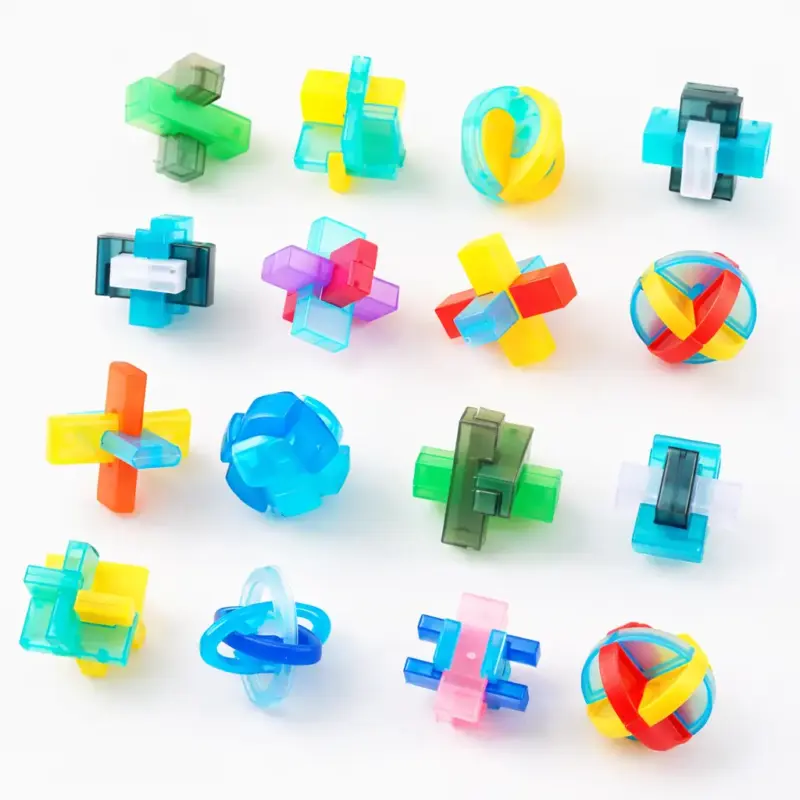
12 Piece Crystal Luban Lock Set
$28.88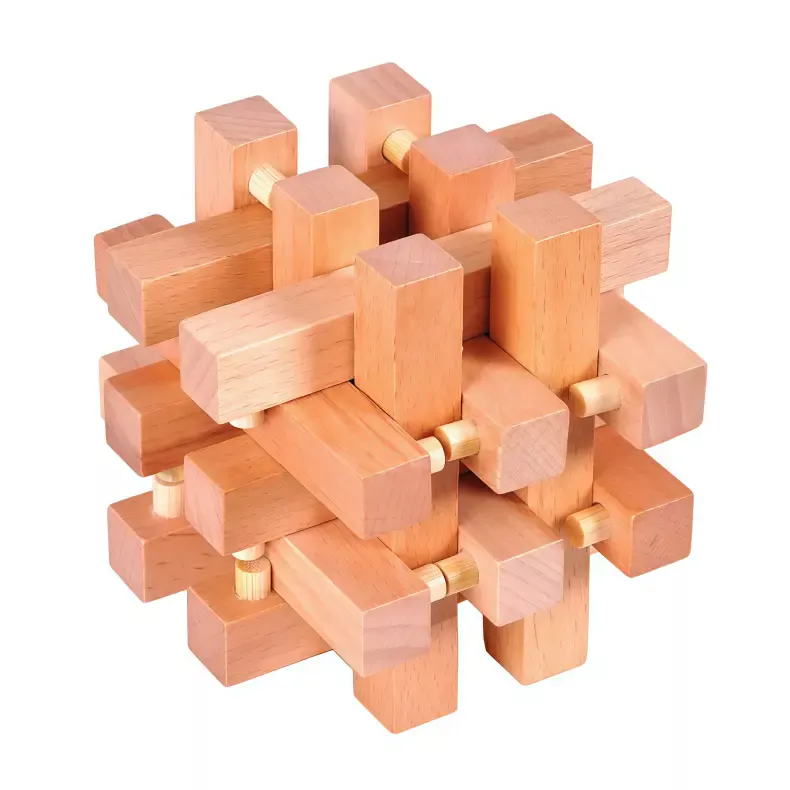
18 Piece Wooden Puzzle
$16.99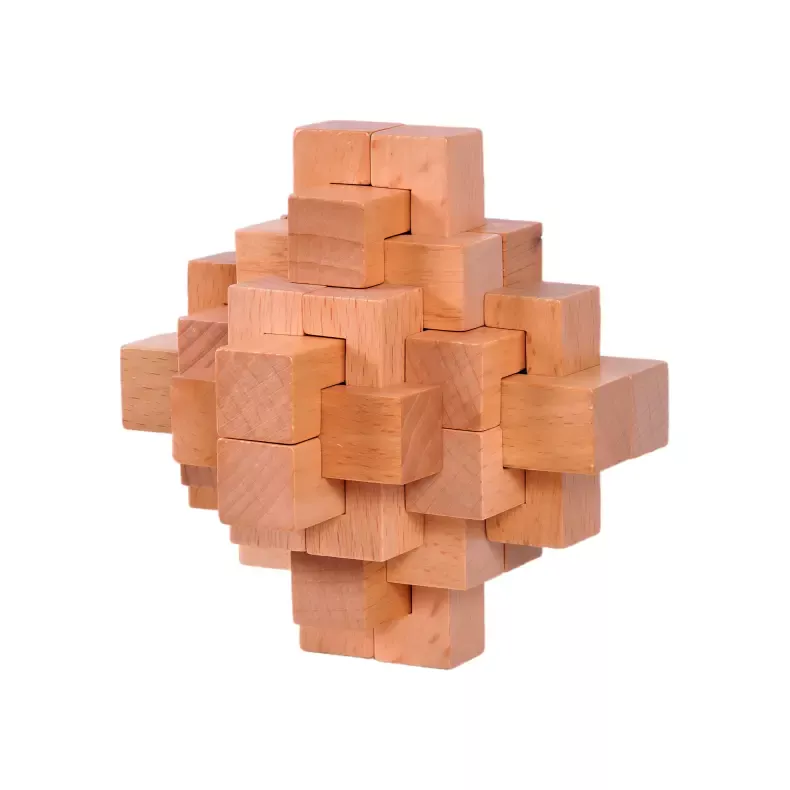
24 Lock Puzzle
$16.99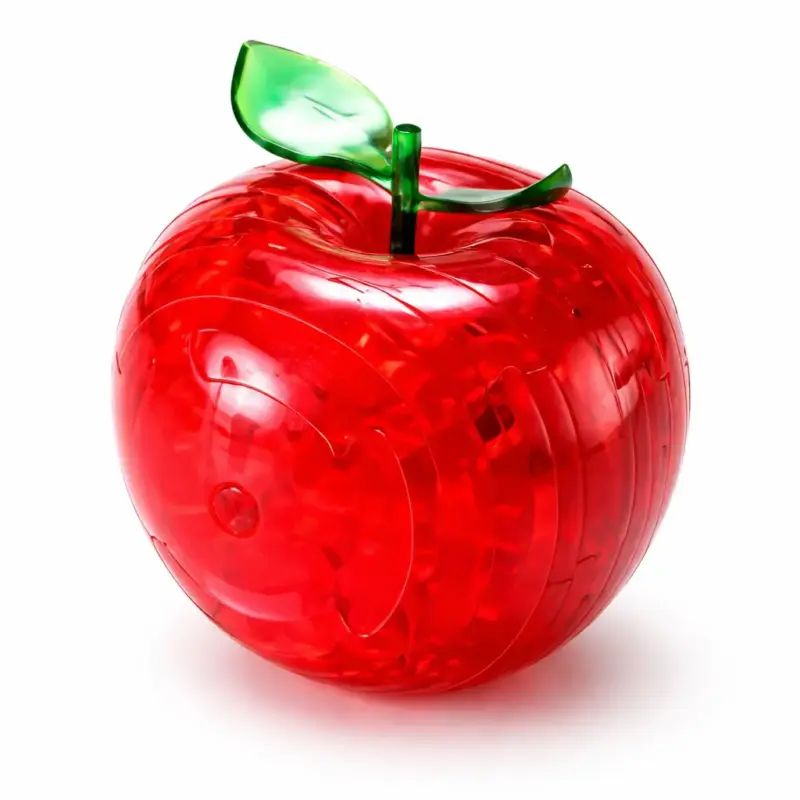
3D Crystal Apple Puzzle
$18.88
Fix/mitigation: Inspect the stem insertion point and the receiving socket. Trim any visible burrs. Apply gentle, steady pressure rather than a sharp push. If you feel significant resistance, stop and reassess. A broken stem is much worse than a five-minute troubleshooting pause.
What you learn: The stem and leaves are the finishing touches—literally. Take a moment to appreciate the completed sculpture before setting it in its final location. You built this. It catches light. It’s going to last.
Final Checkpoint: The Completed Rose
The finished 3D Crystal Rose Puzzle stands approximately 12cm × 8cm—substantial enough to be visually impactful, compact enough to fit on a desk, nightstand, or windowsill. The translucent ABS material delivers on the product description’s promise: it “catches and bends light, creating that ‘wait, is that glass?’ effect.”
Total build time, as stated on the product page: 30–45 minutes with numbered guidance, 1–2 hours solving independently. Your actual time will depend on your familiarity with crystal puzzles, your willingness to consult the numbers, and how much time you spend simply appreciating the pieces along the way.
Why It Gets Stuck: The Mechanics You Can Feel
Understanding why crystal puzzles sometimes resist assembly makes you a better solver. The friction points aren’t random—they’re predictable outcomes of how snap-fit mechanisms and injection-molded plastics work.
Snap-Fit Tolerance
Snap-fit connections rely on temporary elastic deformation: a tab flexes as it passes a retention feature, then springs back into a locked position. The connection strength depends on the interference fit—how much overlap exists between the tab and the socket. Too little interference, and pieces fall apart. Too much, and assembly requires excessive force or risks breaking the tab.
The MIT Mechanical Engineering department has studied snap-fit design extensively, noting that optimal performance requires balancing flexibility, retention force, and assembly force. The ABS plastic used in the 3D Crystal Rose Puzzle is well-suited for snap-fits: it has good elastic recovery and can withstand repeated assembly/disassembly cycles without fatigue cracking.
When a piece feels “stuck,” it’s often because you’re fighting the interference fit at the wrong angle. Snap-fits are designed to engage along a specific path. Approaching from the wrong angle increases friction and may feel like the piece doesn’t fit—when in reality, you just need to adjust your approach vector.
Manufacturing Burrs and Flash
The product page explicitly mentions that “some pieces may have small burrs from manufacturing.” This is a normal artifact of injection molding: when molten plastic fills a mold, small amounts can seep into the parting line (where mold halves meet) or the ejector pin locations. The result is thin, raised edges—burrs—that can interfere with precise connections.
NIST’s materials measurement resources document how injection molding tolerances affect final part quality. For a consumer puzzle, some burr presence is economically inevitable—the alternative is more expensive post-processing or more costly molds with tighter tolerances.
The fix is simple: a hobby knife or fine file removes burrs in seconds. This isn’t a defect to complain about; it’s a minor finishing step that’s standard for injection-molded parts at this price point.
Cumulative Alignment Error
In layered assembly puzzles, small misalignments compound. If piece #5 is rotated 2 degrees off-axis, and piece #12 compensates by shifting 3 degrees the other direction, by piece #30 you may have accumulated enough error that subsequent pieces genuinely don’t fit without force.
The solution is early intervention: check alignment frequently during the inner-petal phases, before errors become locked in by subsequent layers. Crystal puzzles are forgiving of partial disassembly—if something feels wrong, back up and investigate rather than pushing through.
Craft and Context: Where Crystal Puzzles Sit in the Puzzle Landscape
The 3D Crystal Rose Puzzle belongs to a category sometimes called “crystal puzzles” or “3D jigsaw puzzles”—translucent snap-together sculptures that prioritize aesthetic result over mechanical complexity. They’re distinct from traditional Luban locks (which focus on interlocking wooden bars) or metal disentanglement puzzles (which challenge spatial reasoning through wire manipulation).
The Appeal of Building Toward Beauty
Most mechanical puzzles reward you with a solution—an open lock, a separated pair of rings, a disassembled structure. Crystal puzzles reward you with an object you actually want to display. The solving experience is part of the value, but the finished sculpture is the lasting payoff.
This positions crystal puzzles closer to decorative arts traditions than to pure puzzle-solving. The Metropolitan Museum of Art has documented how crafted objects serve dual functions: demonstrating skill while creating beauty. A completed crystal rose isn’t just proof you solved a puzzle; it’s a functional piece of decor that catches light and invites conversation.
Material Heritage: Why ABS for Translucency
ABS (acrylonitrile butadiene styrene) is a thermoplastic polymer with excellent optical properties when molded thin and polished. It’s the same material family used in LEGO bricks—the Smithsonian has noted how ABS’s consistency and durability made it the industry standard for precision snap-fit toys.
For crystal puzzles, ABS offers the necessary translucency while maintaining structural integrity. The material can be injection-molded with smooth, optically clear surfaces, and it accepts color additives well—hence the deep ruby red and emerald green of the rose puzzle components.
The Rose as Symbol
Roses carry heavy cultural weight in Western gift-giving traditions. They signify romance, appreciation, and thoughtfulness. A physical rose is ephemeral—beautiful for days, then gone. A crystal rose inverts that expectation: it requires effort to create, but once complete, it persists indefinitely.
The product page leans into this symbolism deliberately: “Flowers die. Chocolates disappear. This stays on her desk or nightstand for years—and every time she looks at it, she remembers you built it for her.” The puzzle becomes a vehicle for meaning that transcends the physical object.
Who This Is For (and Who Should Skip It)
Not every puzzle is for everyone. Here’s an honest assessment based on the product’s stated specifications and typical crystal puzzle characteristics.
This Puzzle Is Well-Suited For:
- Gift-givers seeking something memorable: The romantic symbolism, the “I made this for you” narrative, and the lasting display value make this ideal for Valentine’s Day, anniversaries, or “just because” gestures. The product page explicitly targets this use case.
- Desk decorators who want a conversation piece: If you want something on your workspace that isn’t a plant, a photo, or a fidget toy, a translucent rose sculpture qualifies. It’s unusual enough to prompt comments, beautiful enough to justify its presence.
- Puzzle newcomers who want a satisfying entry point: The “Easy to Medium” difficulty rating and numbered guidance make this accessible. You don’t need prior crystal puzzle experience. The 30–60 minute build time is manageable in a single session.
- Long-distance couples or friends: The product page suggests a compelling use case: “Send the kit. Build it together over video call.” Shared experience, separate locations, matching results.
- People who appreciate light-catching objects: If you’ve ever bought a prism, a crystal suncatcher, or a piece of colored glass specifically because of how it interacts with light, you’ll appreciate what a completed crystal rose does on a windowsill.
This Puzzle May Not Be Ideal For:
- Solvers seeking high mechanical difficulty: If you want a puzzle that resists solution for hours or days, this isn’t it. Crystal puzzles prioritize aesthetic assembly over intellectual challenge. The numbered guidance, if used, reduces build time to under an hour.
- People impatient with delicate materials: ABS is durable, but the translucent pieces are thinner than, say, wooden puzzle components. Forcing connections can crack pieces. If “patience” and “gentle pressure” aren’t part of your solving vocabulary, consider a more robust metal or wooden puzzle instead.
- Those seeking open-ended replayability: Once you’ve built the rose, the “puzzle” aspect is complete. You can disassemble and rebuild, but the solution doesn’t change. This is a build-once-and-display product more than a solve-repeatedly product.
- Young children (under 14): The product page recommends age 14+, likely due to the precision required and the potential need for burr trimming with a sharp tool. Younger children may find the assembly frustrating or may damage pieces through excessive force.
Buying Decision Framework
Before adding the 3D Crystal Rose Puzzle to your cart, run through this quick checklist:
- Purpose clear? Gift (romantic, appreciation, “just because”) vs. self-purchase (desk decor, hands-on project, light-catching display)
- Time available? At least 30–60 uninterrupted minutes for a single-session build, or patience to spread across multiple shorter sessions
- Expectations calibrated? This is a beautiful assembly experience, not a brain-bending puzzle challenge. The reward is aesthetic, not intellectual triumph.
- Tools accessible? Hobby knife or fine file on hand (optional but recommended for potential burr trimming)
- Display location identified? The finished rose looks best where it can catch natural or lamp light. Near a window, on a nightstand, on a desk with good lighting.
If you checked all five, the 3D Crystal Rose Puzzle is likely a good fit.
Related Products Worth Considering
If the crystal rose appeals but you want to explore variations, Tea-Sip offers several adjacent options:
- 3D Crystal Apple Puzzle — same crystal puzzle format, different shape, popular as a teacher appreciation gift
- Plastic Puzzle collection — browse other ABS-based builds with different aesthetics and complexity levels
- Wooden Puzzles — if you prefer natural materials and mechanical interlocking challenges over snap-fit assembly
- Metal Puzzles — for solvers seeking more resistance and tactile weight
Questions about orders, shipping, or returns? Tea-Sip offers same-day processing, free shipping on orders over $100, and a 30-day return policy. Shipping details are here.
And if you want to understand more about why Tea-Sip curates the puzzles they do—the philosophy behind “mindful diversions”—the About page offers context.
A rose that never wilts, because you built it. That’s the promise. The 3D Crystal Rose Puzzle delivers on it—one satisfying click at a time.