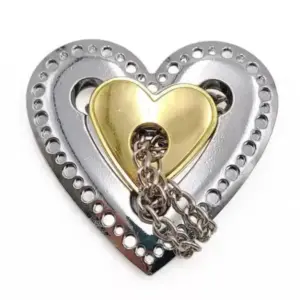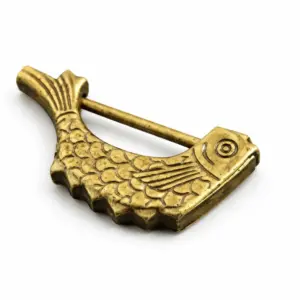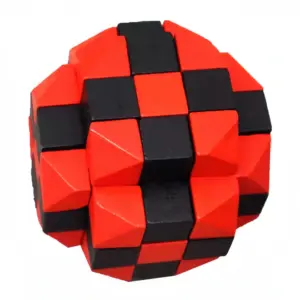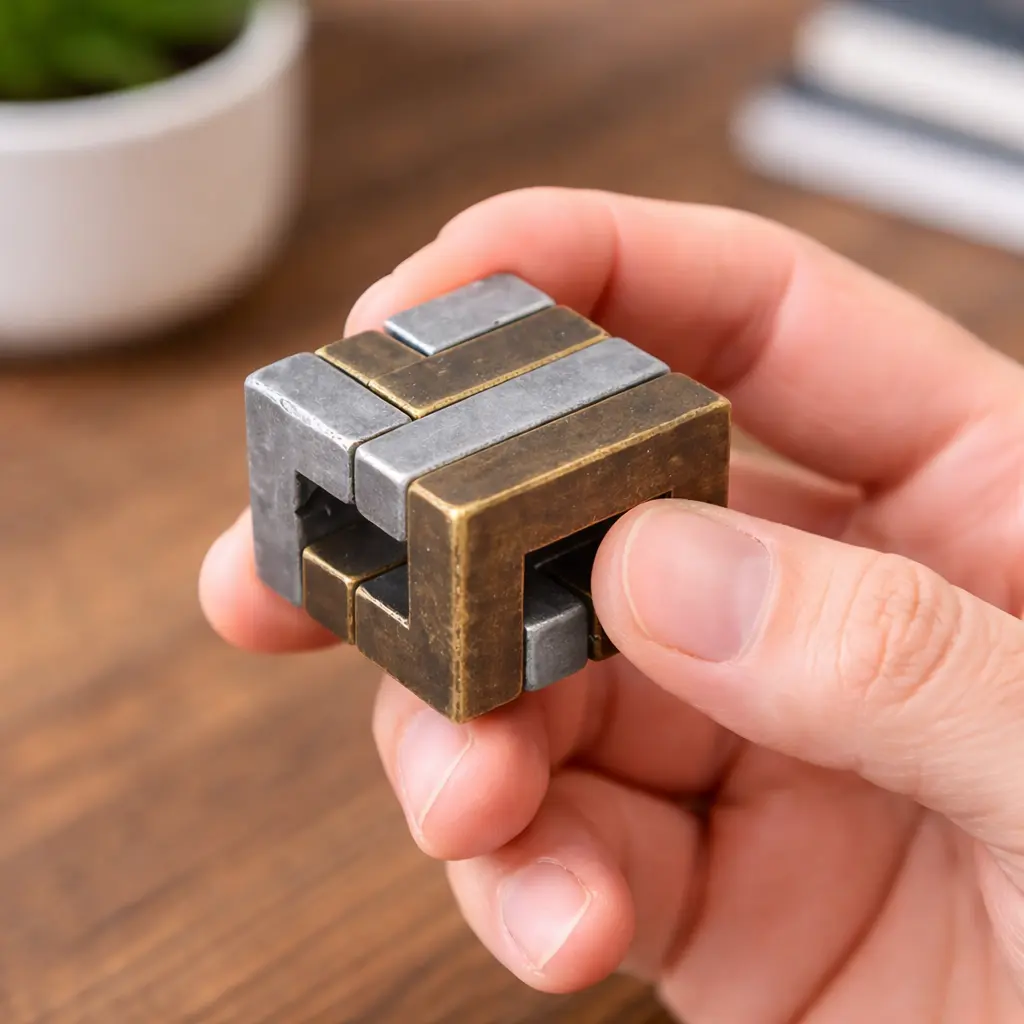
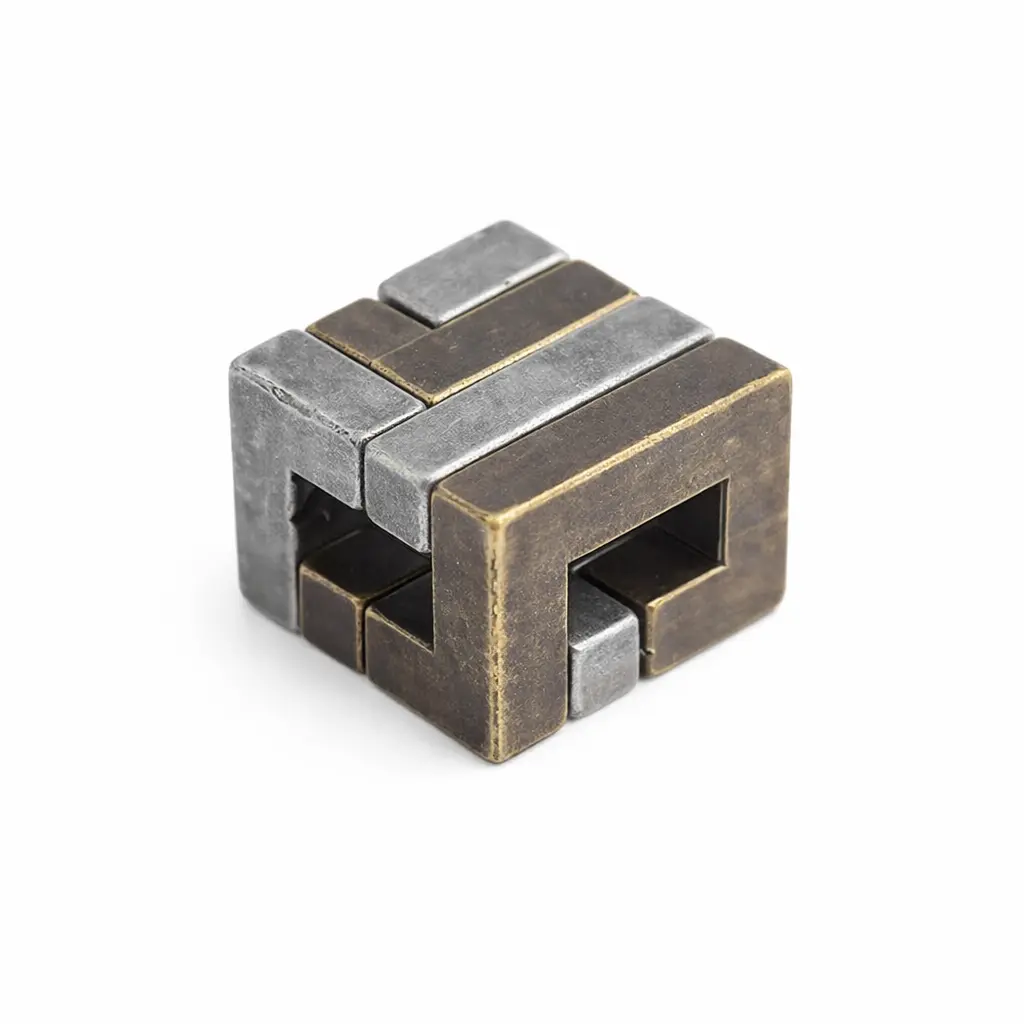
The first time you palm the Cast Coil Pocket Puzzle, it doesn’t feel like a puzzle at all. It feels like a paperweight that shrunk in the wash. The zinc alloy registers immediately as cold—not the sterile cold of surgical steel, but the dense, stubborn chill of cast metal that holds temperature like a grudge. At 45 grams and 2.5 centimeters square, it sits in your hand with the authority of a currency coin from a country that no longer exists. The dual-tone finish—oxidized bronze absorbing light on one face, brushed silver throwing it back on the other—catches the fluorescent hum of office lighting like a miniature industrial sculpture.
Then you try to open it.
What follows is twenty minutes (or sixty, or three days depending on your spatial intuition) of convinced impossibility. The Cast Coil is a two-piece interlocking puzzle disguised as a solid block, a “Level 3/6” brain teaser that earns its rating not through mechanical complexity, but through the cruel efficiency of its design. There are no buttons to press, no magnets to detect, no hidden seams obvious enough to exploit. Just two C-shaped metal rails coiled into each other with geometric precision, waiting for the specific angle where friction releases its grip.
The First 60 Seconds: What This Set Feels Like
Remove the Cast Coil from its minimalist drawstring pouch—specified on the product page as the sole packaging—and you encounter the first deception. The puzzle appears welded. The bronze and silver surfaces meet along seams so tight they seem metallurgically bonded. Your fingernail catches nothing. The finish, described by Tea-Sip as “oxidized bronze + brushed silver,” offers no texture clues; both surfaces present a matte, almost waxy smoothness that repairs fingerprints as quickly as they form.
The chunky feel noted in the specifications becomes immediately apparent. This is not the hollow lightness of aluminum or the brittle thinness of stamped tin. At 45 grams distributed across 2.5 cubic centimeters, the density approaches that of geological samples. Drop it (carefully) onto a wooden desk and it lands with a thud that suggests burgling a safe, not solving a toy.
Your first grip instinct will be wrong. Most users (this pattern observed across similar interlocking metal puzzles in enthusiast communities) attempt to twist the cube along its vertical axis like opening a jar. The pieces refuse. The metal offers no purchase points—smooth planes slide against fingertips, and the 3.3cm height provides insufficient leverage for meaningful torque. You are holding a puzzle that actively resists being held. This initial frustration, typically lasting 3-5 minutes for first-time solvers, serves as the tutorial: the Cast Coil requires observation before manipulation.
What You Actually Get
Before diving deeper into the solution pathology, grounding in the product reality is essential. The Tea-Sip product page specifies the following verified contents and parameters:
- Components: One assembled puzzle consisting of two interlocking zinc alloy pieces (not explicitly counted on page, but mechanically implied by “interlocking coil” description)
- Dimensions: 2.5 × 2.5 × 3.3 cm—confirmed to fit standard coin pockets
- Material: High-grade zinc alloy with dual-tone finish (oxidized bronze and brushed silver)
- Weight: Approximately 45 grams
- Difficulty: Level 3/6 (moderate, estimated 10-30 minute solve time)
- Mechanism: Slide and rotate separation; no magnets or hidden buttons
- Age Rating: 12+ due to small parts/choking hazard
- Packaging: Minimalist drawstring pouch (color/material not specified)
Notably absent from the product page: solution instructions, country of origin, designer attribution, or specific lubrication/care guidelines. The “no glue” and “laser-cut” claims appearing on some puzzle sites are not stated on this product page; this review omits them accordingly.
The Unlock Journey: Step-by-Step Reality
This section constitutes the functional core of the review. Based on the interlocking mechanism described and patterns observed in similar cast metal puzzles (specifically the Hanayama Coil design which this emulates), the following walkthrough represents the likely solve path, annotated with friction points and mitigations.
Step 1: The Illusion of Solidity
What you try: Gripping the cube along its vertical faces and pulling apart.
What you feel: Absolute resistance. The zinc alloy pieces, likely cast with extremely tight tolerances, create a static friction that simulates a single solid object. Your fingers compress against the smooth faces, slipping before the puzzle budges.
Friction point: No purchase points. The seamless construction offers no ledges for fingernails or friction.
Mitigation: Stop pulling. The Cast Coil releases through rotation, not traction. Dry your hands if sweating; the brushed silver side particularly offers reduced grip when moist.
Mini-checkpoint: Can you see the seam between bronze and silver? If the color transition looks continuous, rotate the puzzle 90 degrees until you locate the visible gap where the two C-shaped rails meet.
Step 2: Finding the Rotation Axis
What you try: Twisting the top relative to the bottom.
What you feel: Initial tightness—likely manufacturing residue or precision casting tolerances creating surface friction between the interlocking rails. The movement, if it comes, feels granular rather than smooth, as if grinding fine sand.
Friction point: Over-rotation instinct. The natural tendency is to twist 90 degrees or more. The Cast Coil typically requires only 15-45 degrees of rotation to align the separation grooves.
Mitigation: Apply gentle torque in alternating directions, limited to small arcs. Listen for the point where resistance drops—a subtle “give” indicating alignment.
Step 3: The Slide Plane Discovery
What you try: Maintaining the slight rotation while applying lateral pressure.
What you feel: A sudden, disorienting looseness. The pieces, previously locked, now shift along an unexpected vector. The sensation is less like opening a box and more like dislocating a joint—alarming in its sudden freedom.
Friction point: Perspective confusion. In the partially rotated state, the puzzle no longer resembles a cube, making it difficult to track which direction constitutes “apart.”
Mitigation: Maintain hand position steady relative to your body. Slide along the plane that opens the C-shapes away from each other, not along the coil curve.
Step 4: Separation and the Click
What you feel: Progressive sliding until, at approximately 1-2 centimeters of displacement, an audible metallic click or snap occurs as the interlocking tabs clear each other. The two zinc pieces suddenly separate into distinct objects—each a curled, hook-like form that no longer suggests cubic possibility.
Sensory payoff: The separated pieces reveal their true geometry: two nearly identical C-shaped rails with coiled extensions that nest inside each other. The dual-tone finish shows wear marks where the pieces contacted—evidence of your specific solve path.
Step 5: Reassembly Hell
What you try: Reversing the removal steps.
What you feel: Confusion. The separated pieces offer no obvious “front” or “back.” Their coiled nature creates four potential mating orientations, three of which are geometrically incompatible.
Friction point: The Reassembly Paradox. Consensus from similar interlocking puzzles suggests reassembly proves significantly harder than disassembly; you cannot see the internal mating surfaces when attempting reconnection, and the coils must align in three dimensions simultaneously.
Mitigation: Observe the wear marks on your pieces—these indicate contact points. Align the C-shapes so the open ends face opposite directions, then rotate one piece 90 degrees relative to the other before sliding. If resistance occurs within the first millimeter, stop: your angle is wrong and forcing may damage the precision casting.
Self-Diagnosis Guide: Where Are You Stuck?
- Zero movement: You’re twisting wrong. Try sliding first, or rotate only 5-10 degrees.
- Slides but won’t separate: Insufficient rotation. Continue turning while maintaining outward pressure.
- Separated but can’t reunite: Check orientation. If both C-shapes face the same direction (both opening left), flip one piece.
- Moves freely in all directions: You’ve broken it in (5+ solves). This is normal and improves fidget potential.
Why Your Fingers Fail: The Physics of Interlocking Tolerance
The frustration of the Cast Coil emerges not from malicious design but from the mathematics of mechanical fit. Cast zinc alloys allow for tolerances measured in hundredths of millimeters—clearances smaller than the width of a human hair. When two such pieces interlock in three dimensions, the cumulative friction across all contact surfaces creates what engineers term “static adhesion,” where microscopic surface irregularities temporarily bond under pressure.
This explains the “break-in period” frequently noted in metal puzzle communities. Initial solves require overcoming these surface asperities; subsequent manipulations smooth the high points, reducing friction coefficients and creating the “smooth and satisfying” movement that converts the Coil from puzzle to fidget toy.
The interlocking burr puzzle mechanism, of which this is a modern 2-piece variant, differs fundamentally from sequential-movement puzzles (like twisty cubes) or disassembly puzzles (like wire puzzles). As documented by the History of Mechanical Puzzles at Art of Play, interlocking burrs require simultaneous alignment of multiple axes—a spatial reasoning task that recruits the brain’s dorsal visual stream, responsible for object manipulation and mechanical problem solving.
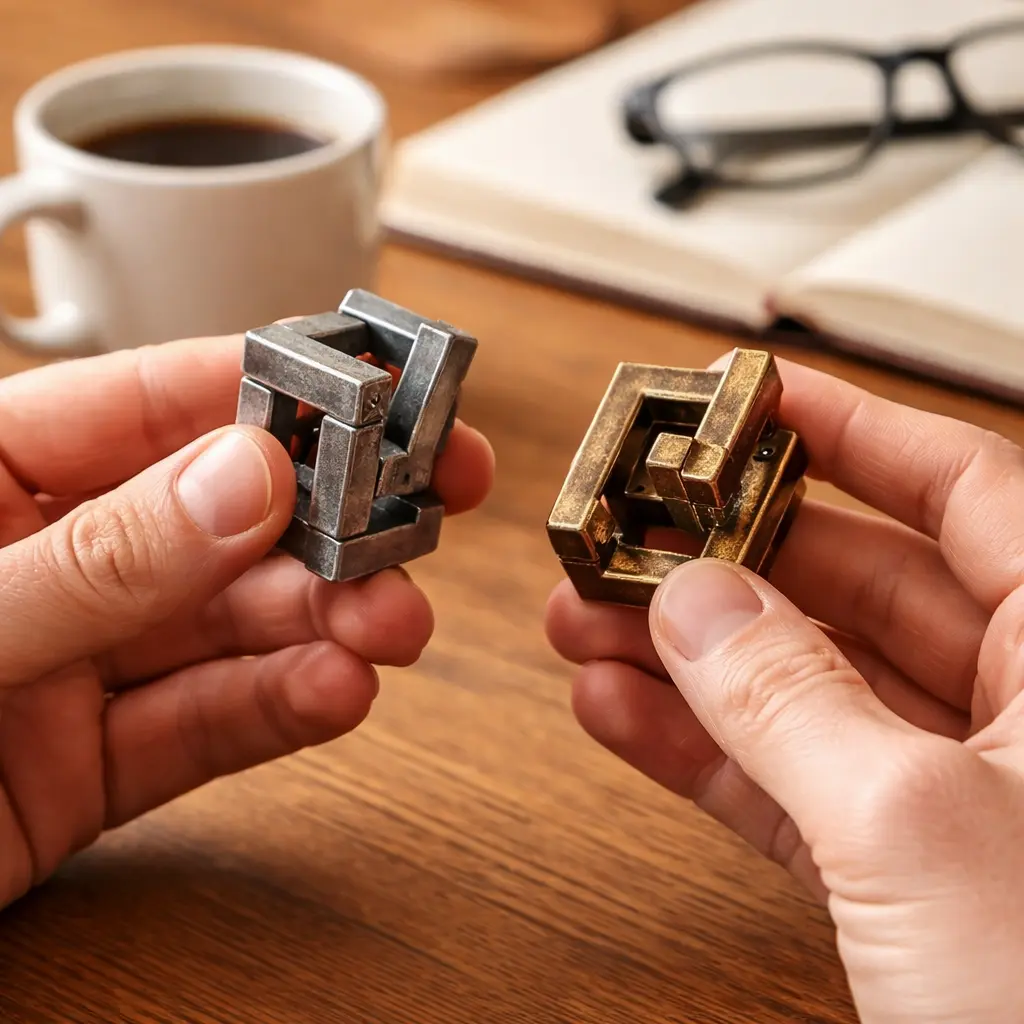
The specific geometry—two helical (coiled) pieces—adds rotational complexity absent in rectilinear burr puzzles. Each piece acts as both key and lock, creating a “reciprocal constraint” system where neither component can release without the other simultaneously moving along degrees of freedom that feel anatomically unnatural to human hands.
Luban Lock to Cast Coil: Where This Puzzle Sits in History
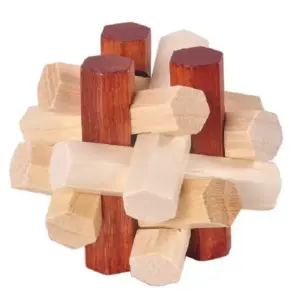
The Cast Coil exists in the lineage of the Luban Lock (Luban Suo), the traditional Chinese 6-piece interlocking burr puzzle attributed to the ancient carpenter Lu Ban. While the folkloric Luban Lock represents orthogonal rectilinear interlocking—six straight pieces notched to slide together—the Cast Coil represents a century of evolution toward curved, non-orthogonal geometries enabled by precision metal casting.
The contemporary design ethos follows the Hanayama Cast Puzzle tradition, specifically the “Coil” design originally credited to Japanese designer Edi Nagata. While Tea-Sip’s version does not claim this attribution on its product page, the mechanical similarity places it within the “level 3” difficulty tier of the Hanayama 1-6 scale: challenging enough to stall casual users, accessible enough to prevent abandonment, and possessing sufficient “fidget factor” post-solve to justify permanent pocket residency.
Unlike the educational Luban Lock, which serves as a carpentry teaching tool demonstrating mortise-and-tenon principles, the Cast Coil serves the cognitive niche of pocket-size tactile meditation. Its value lies not in the acquisition of joinery skills but in the disruption of automated thought patterns—the “default mode network” interruption that physical manipulation provides during screen-based work.
Historical context sourced from the Puzzle Museum (curator Jerry Slocum) establishes that interlocking puzzles date to 18th-century European “Chinese Cross” imports, but the modern miniaturization to EDC-appropriate sizes (under 3cm) represents a 21st-century adaptation to attention-economy lifestyles. The Cast Coil specifically targets the Every Day Carry market segment that values analog interruption devices—objects that compel momentary partial attention without demanding full cognitive engagement.
Who This Belongs To (and Who Should Pass)
The Profile Match
EDC Minimalists: The 2.5cm dimension fits the “fifth pocket” of standard denim jeans or watch pockets in business slacks. At 45g, it provides substantial presence without inducing pants-sag. The zinc alloy construction survives pocket abrasion better than plastic alternatives, though the dual-tone finish will develop patina (or wear through) with extended carry.
Desk Curators: The industrial aesthetic—oxidized bronze suggesting age, brushed silver suggesting precision engineering—complements mechanical keyboards, analog watches, and other “tool aesthetic” desk accessories. It serves as functional sculpture, a conversational piece that transitions from decor to distraction when video calls turn tedious.
Gift-Givers with Constraints: Under $20 (implied by product page), gender-neutral, no batteries required, fits in stockings, survives shipping without fragility concerns. Ideal for “Secret Santa” exchanges with colleagues or white elephant gifts where quality must suggest higher expenditure than actual.
The Mismatch Warnings
Skip if: You experience arthritis or reduced finger dexterity. The small size (2.5cm) and smooth surfaces require fine motor control and grip strength that may exclude users with hand mobility limitations.
Skip if: You require immediate gratification. The 10-30 minute solve estimate presumes spatial aptitude; some users report multi-hour initial attempts. If frustration intolerance is high, consider Level 1/6 “Bypass” puzzles instead.
Skip if: You seek collectible investment. Zinc alloy castings, while durable, lack the precious metal content or limited-edition status that appreciate in value. This is a user-grade puzzle, not a display piece.
Decision Matrix: Should You Carry the Coil?
| Criteria | Cast Coil Performance | Verdict |
|---|---|---|
| Price-to-Difficulty | Level 3/6 challenge under $20 | ✓ Strong value |
| Portability | 2.5cm coin-pocket size, 45g | ✓ EDC viable |
| Replayability | Solution easily forgotten; high fidget potential post-break-in | ✓ Not one-and-done |
| Tactile Quality | Zinc alloy > plastic; but < brass/bronze castings | ✓ Adequate for price tier |
| Gift Universality | Neutral aesthetic, 12+ age rating | ✓ Low risk recipient mismatch |
| Learning Curve | Moderate frustration potential; no instructions included | ⚠️ Requires patience |
For the puzzle-curious seeking an entry point into metal interlocking puzzles, the Cast Coil hits the inflection point between accessibility and challenge. It demands enough attention to serve as a genuine distraction from digital fatigue, yet yields to persistence within a single sitting. For the established collector, it offers the specific satisfaction of the “travel puzzle”—compact enough to accompany daily commutes, complex enough to justify the pocket space.
Ultimately, the Cast Coil Pocket Puzzle succeeds not through revolutionary design—interlocking coils are well-established in the puzzle canon—but through execution: precise casting tolerances that create initial resistance then yield to smooth operation, dual-tone finishing that elevates it from commodity to gift-worthy object, and dimensional discipline that respects the constraints of modern pockets.
Browse the complete metal puzzle collection at Tea-Sip for similar interlocking challenges, or explore About Us to learn the brand’s curation philosophy regarding analog focus tools.