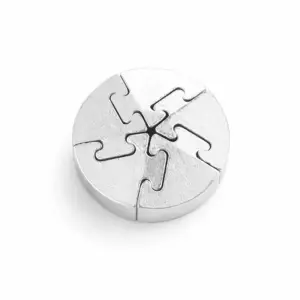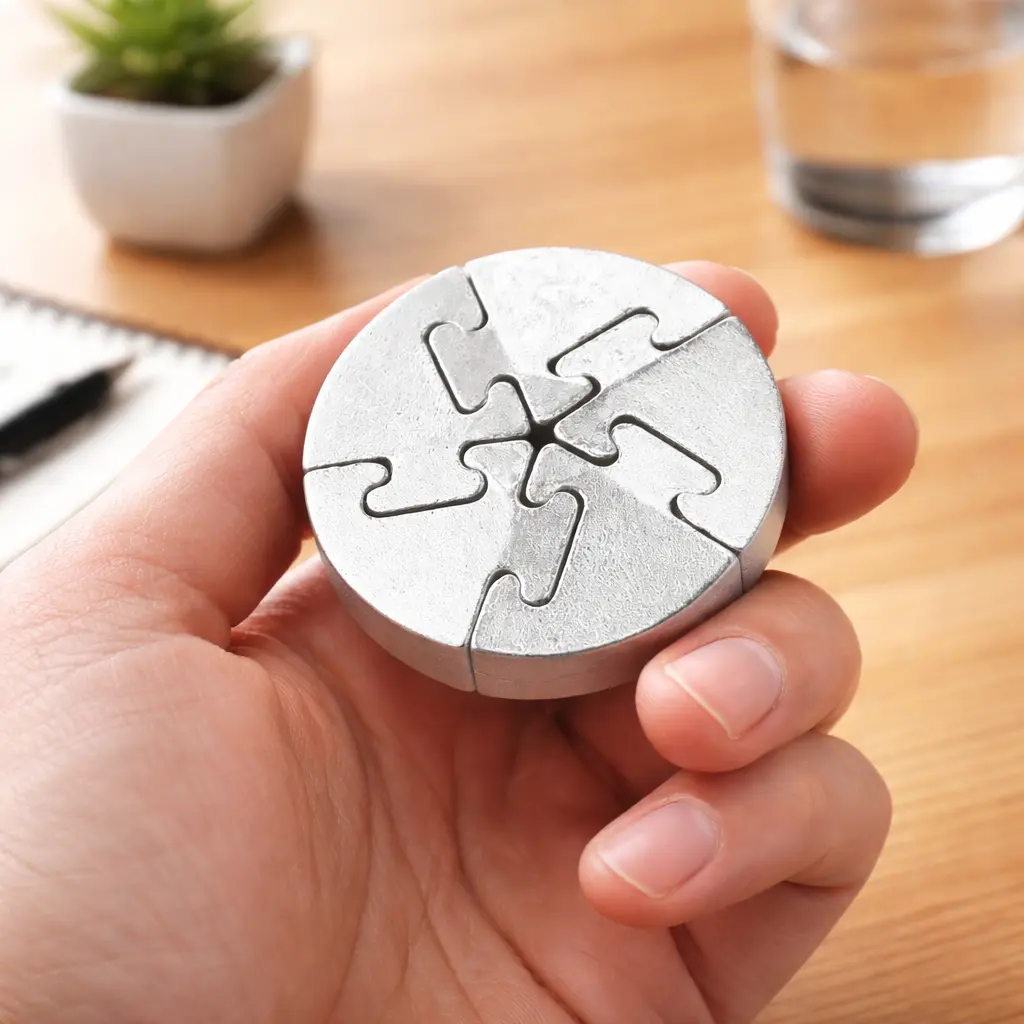
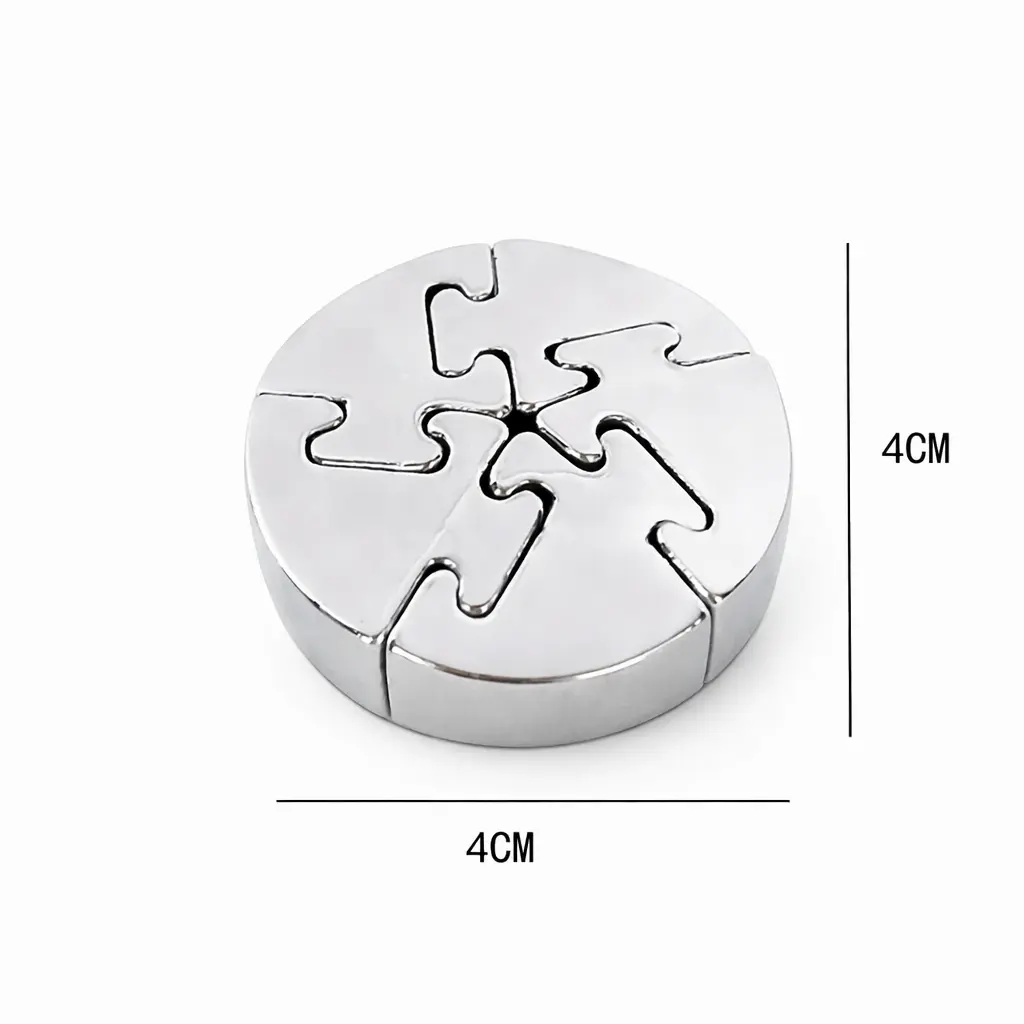
Pick up the Cast Spiral, and the first thing you notice is the weight. Forty-six grams of solid cast metal settling into your palm, cool at first, warming slowly against your skin. At roughly 4.8 centimeters across—about the size of a poker chip but twice as heavy—it looks like a silver dollar that someone carved with impossible precision.
Five wedges spiral outward from the center, their curved seams tracing what appears to be a frozen whirlpool. The joints are so tight that most people assume it’s decorative. A paperweight, maybe. A desk ornament. Then someone mentions it comes apart, and you start pushing.
That’s usually when the trouble begins.
What Happens When You First Touch It
The Cast Spiral belongs to a category of metal puzzles that reward patience over force. This isn’t a combination lock where the right sequence clicks into place. It’s a study in tapered geometry—each piece only moves in one specific direction, and pushing the wrong way just locks everything tighter.
Most new solvers go through the same phases:
Minutes 0–3: You rotate the puzzle, testing each seam with light pressure. The pieces wobble slightly but refuse to separate. You press harder. Nothing.
Minutes 3–10: Something shifts. One wedge moves a fraction of a millimeter more than the others. You focus there, trying different angles, applying more pressure. The piece seems to catch on something invisible.
Minutes 10–20: Either you find the rotational trick—a slight twist that releases two pieces at once—or you force it, jam the mechanism, and spend ten more minutes carefully unjamming what you just broke.
The mechanism, designed by Kennet Walker of Rivermore, California, relies on what puzzle engineers call tapered interlocking. Each wedge widens in one direction and narrows in the other. When assembled correctly, they form a self-locking disc where no single piece can escape without first freeing another. Finding the starting point—the one wedge with just enough freedom to begin the cascade—is the heart of the puzzle.
The Real Puzzle Isn’t Taking It Apart
Disassembly surprises most people with how quickly it collapses. Once you find the key piece and apply the correct rotational pressure, all five wedges separate within seconds. You’ll probably reassemble it immediately, just to confirm you understood what happened.
Then you scatter the pieces on your desk and try again from scratch.
This is where the Cast Spiral earns its reputation—and also where the difficulty rating controversy begins.
The five wedges look nearly identical. Their curved edges and tapered connections create multiple ways they seem like they should fit. You’ll find configurations that close almost perfectly, with just one piece refusing to slide into place. You’ll find assemblies that look correct but have a visible gap along one seam. Only one configuration actually works, and recognizing it requires attention to subtle geometric cues that most people miss on their first dozen attempts.
Expect reassembly to take two to three times longer than disassembly initially. Some solvers report half an hour before everything clicks. Others crack it in ten minutes but can’t replicate the result the next day because they didn’t internalize the pattern—they just got lucky.
The lesson is older than the puzzle itself: taking things apart is easy. Understanding how they fit together requires a different kind of attention.
About That Difficulty Rating
The Cast Spiral carries a Level 5 difficulty rating on Hanayama’s 1–6 scale. This has drawn consistent criticism from the puzzle community. Forums and review sections across specialty retailers tell a similar story: solvers expecting a brutal challenge find themselves finishing in minutes, then questioning whether they received a defective unit.
The consensus among experienced puzzlers places it closer to Level 3 in practice. Disassembly is genuinely quick once you spot the trick. Reassembly adds challenge, but veterans of sequential-move puzzles often crack it within a few attempts.
Does this matter? It depends on why you’re buying it.
If you want something that will stump you for days, look elsewhere. The top metal puzzles guide covers options with higher complexity ratings. If you want a satisfying desk companion that rewards observation without demanding hours of frustration, the Cast Spiral delivers exactly that.
The mismatch between rated and experienced difficulty doesn’t make the puzzle bad. It makes the rating misleading. Adjust your expectations accordingly.
Four People Who’ll Appreciate This
The Desk Fidgeter
You keep stress balls, pens, or random objects within reach during work. You click things. You spin things. The Cast Spiral is quiet enough for video calls, engaging enough to occupy restless hands, and small enough to tuck in a drawer when focus returns. Unlike a stress ball, it provides genuine mental engagement without requiring enough attention to distract from your actual work.
The Commuter
Trains, planes, waiting rooms—the Cast Spiral thrives in dead time. No battery. No screen. No Wi-Fi required. Forty-six grams of precision-machined metal that fits in a jacket pocket. One solver mentioned keeping it in their bag specifically for airport security lines: by the time they reached the scanner, they’d solved it twice. For more ideas on portable puzzles, check the brain teaser gift guide.
The Gift-Giver Seeking Something Different
Tired of candles and gift cards? The Cast Spiral makes an impression. It looks expensive, feels substantial, and provides genuine entertainment—unlike most novelty gifts that end up in donation bins. The price point works for office exchanges and stocking stuffers. The mechanism provides actual replay value.
The Puzzle Collector Starting Their Journey
If you own zero mechanical puzzles and want to test whether this hobby suits you, the Cast Spiral is a reasonable entry point. It’s challenging enough to feel rewarding, but not so brutal that you’ll abandon it after an hour. From here, you might explore the Alloy Triangle Lock Puzzle or the Bagua Lock Puzzle for progressively complex mechanisms.
Three People Who Should Skip It
The Extreme Difficulty Seeker
You’ve solved dozens of metal puzzles. You have a shelf full of Hanayama castings. You specifically enjoy puzzles that take days or weeks to crack. The Cast Spiral will underwhelm you. The disassembly trick becomes obvious quickly, and even reassembly won’t challenge someone with your experience. Consider the puzzles featured in Mind Over Metal: 12 Intricate Puzzles for more appropriate difficulty levels.
The Impatient Solver
If you tend to force pieces, shake puzzles aggressively, or give up after five minutes, you’ll find this frustrating rather than relaxing. The Cast Spiral’s mechanism jams when forced—pieces that should glide can lock together so tightly that separating them requires patient, careful manipulation. Forcing just makes everything worse.
Children Under 10
While there’s no small-parts choking hazard for older kids, children under 10 often lack the fine motor control and patience for this type of puzzle. The metal edges, while not sharp, can cause discomfort if pieces are gripped too tightly during frustrated attempts. Wooden puzzles like those in the Luban lock family offer a gentler introduction to mechanical puzzles for younger solvers.
The Mechanism (Without Spoilers)
The Cast Spiral’s five-piece design differs from the more common four-piece spiral puzzles through deliberate asymmetry. With five pieces, no two wedges sit directly opposite each other. This prevents the “push both ends” approach that simplifies even-numbered variants. You can’t apply balanced force across a five-piece spiral—you have to find the weak point.
The spiral pattern isn’t decorative. It’s functional. The curved seams create rotational dependency: Piece A can’t move until Piece B shifts. Piece B needs Piece C to rotate first. The interlocking geometry forms a sequential puzzle disguised as a simultaneous one.
This principle—sequential dependency—appears throughout mechanical puzzle design. The six-piece burr puzzle guide explores similar concepts in wooden construction. Understanding how pieces must free each other in a specific order transforms random manipulation into strategic problem-solving.
One detail that helps during reassembly: one of the five pieces has slightly more distinctive geometry than the others. Before you disassemble the puzzle for the first time, examine each piece carefully. Find the one that looks most unique. That’s your reference point for reassembly—the anchor around which the other four pieces must orient.
Common Mistakes and How to Avoid Them
Forcing pieces apart
The most common error. When pieces won’t separate, adding force just locks them tighter. The mechanism becomes a Chinese finger trap—resistance increases with pressure. Solution: release completely. Let the pieces settle. Rotate 15 degrees. Try again with minimal force. The correct movement feels almost effortless.
Ignoring taper direction
Pieces only move one way along their interlocking curves. If you’re pushing and feeling resistance, you’re pushing the wrong direction. What felt like “pulling apart” should become “sliding along.” Reverse your motion. Follow the curve rather than fighting it.
Random trial-and-error during reassembly
Once apart, the five pieces look similar enough that many solvers try random combinations rather than systematic approaches. This works eventually but teaches nothing. Before disassembling, memorize the position of the most distinctive piece. During reassembly, start with that piece and orient everything else around it. Pattern recognition beats random luck.
Expecting audible confirmation
Unlike some traditional brain teasers, the Cast Spiral doesn’t click when solved. The pieces simply stop moving. If you’re waiting for confirmation, you might already be done. Test by trying to separate pieces—if nothing moves, you’ve solved it.
Getting frustrated and putting it down incorrectly
If you need a break during reassembly, leave the pieces stacked together in whatever partial configuration you’ve achieved. Scattering them across your desk erases any progress in understanding their relationships. When you return, you’ll start from scratch instead of from wherever you stopped.
When Fresh Eyes Actually Help
The Cast Spiral responds well to breaks. Unlike puzzles that require sustained attention to track multiple variables, this one rewards insight over persistence. Sometimes the trick becomes obvious after stepping away for ten minutes—your subconscious processes the geometric relationships while you make coffee or answer email.
This characteristic makes it particularly suitable for desk use. You don’t need to protect long solving sessions. You can pick it up, manipulate it for a few minutes, put it down for an hour, and return with fresh perspective.
For more on how mechanical puzzles interact with stress and attention, see why common advice fails at stress-relief puzzles.
Physical Specifications
What you can expect from a standard Cast Spiral:
- Diameter: Approximately 4.8 cm (about 1.9 inches)
- Thickness: Approximately 2.2 cm (about 0.9 inches)
- Weight: Approximately 46 grams
- Material: Cast zinc alloy with chrome-style finish
- Pieces: 5 interlocking wedges
- Designer: Kennet Walker (Rivermore, California)
- Original release: 2003
- Age recommendation: 12 and up
The exact specifications vary slightly between manufacturers, but these dimensions are typical. The puzzle fits comfortably in most pockets and won’t set off metal detectors at security checkpoints (though you might get asked about it).
Gift-Giving Considerations
The Cast Spiral works well for specific occasions:
Office exchanges and Secret Santa: The price point fits typical budgets. The design looks interesting enough to avoid the “obvious regift” category. It provides actual entertainment, which many novelty gifts don’t.
Stocking stuffers: Small, affordable, genuinely engaging. Better than candy that disappears in a day.
Thinking-of-you gifts: For someone who appreciates puzzles, this shows you understand their interests without requiring deep research into what they already own.
Recovery and waiting gifts: For someone facing medical recovery or extended waiting periods, the Cast Spiral provides distraction without screens or heavy concentration. It’s something to do with your hands while healing.
Avoid gifting to: people who openly dislike puzzles (respect their preferences), children under 10 (frustration risk), anyone who needs instant gratification, or collectors who already own 50+ metal puzzles (they probably have it or something equivalent).
For themed gift sets, consider pairing with the Cupid’s Heart Chain Puzzle or exploring the collector’s brain teaser guide for complementary options.
Frequently Asked Questions
How long does it take to solve?
Most first-time solvers complete disassembly in 10–20 minutes. Reassembly typically takes 20–45 minutes initially, dropping to under 10 minutes once you’ve internalized the pattern.
Is it really Level 5 difficulty?
Community consensus suggests it’s easier than rated—closer to Level 3 in practice. Experienced puzzlers often describe it as entry-level despite the official rating.
Can I damage it by forcing?
Yes. Excessive force can scratch the finish and jam pieces together. If stuck, release all pressure and try a different angle. The correct movements require almost no force.
Does it come with instructions?
Most versions include a basic solution guide. Using it defeats the purpose, but it’s there if you need it.
What if pieces get stuck?
Don’t pull harder. The mechanism works on tapered interlocking—force increases friction. Release pressure completely, rotate the entire puzzle slightly, then try gentle movements in different directions. The pieces will eventually release.
Is it suitable for fidgeting during calls?
Yes. The puzzle is quiet (no clicking), and the repetitive manipulation creates a meditative rhythm that can actually improve focus during long meetings. Many users keep one specifically for this purpose.
What puzzles should I try next?
If you enjoyed the Cast Spiral, the Snake Mouth Escape Puzzle offers similar metal construction with different mechanics. The Four-Leaf Clover Puzzle uses interlocking rings rather than wedges. For increased difficulty, explore the Grenade Lock Puzzle.
The Verdict
The Cast Spiral won’t change your life. But it might change your afternoon—and sometimes, that’s exactly what’s needed.
It’s a desk companion that rewards patience, a travel puzzle that fits in any pocket, and a gift that looks thoughtful without requiring extensive research. The difficulty rating misleads, but the puzzle itself delivers what matters: a genuinely satisfying mechanical challenge that improves with familiarity rather than becoming tedious.
Buy it expecting a pleasant distraction, not a brutal challenge. Accept that the official difficulty rating oversells the experience. Appreciate the precision engineering and the elegant spiral geometry. Keep it within reach during work, and let it teach you something about observation and sequential thinking.
The straightest path requires no force—only understanding.
Ready to try it? Browse the metal puzzles collection or explore all puzzle toys for more brain-teasing options.