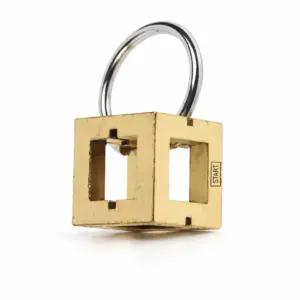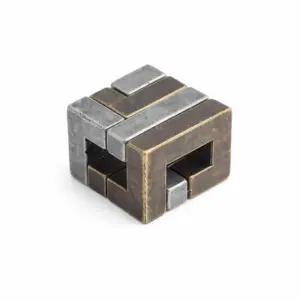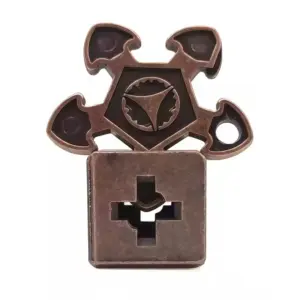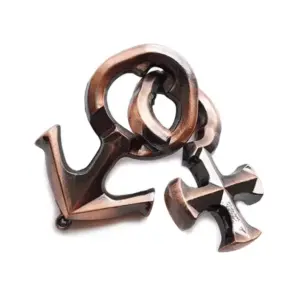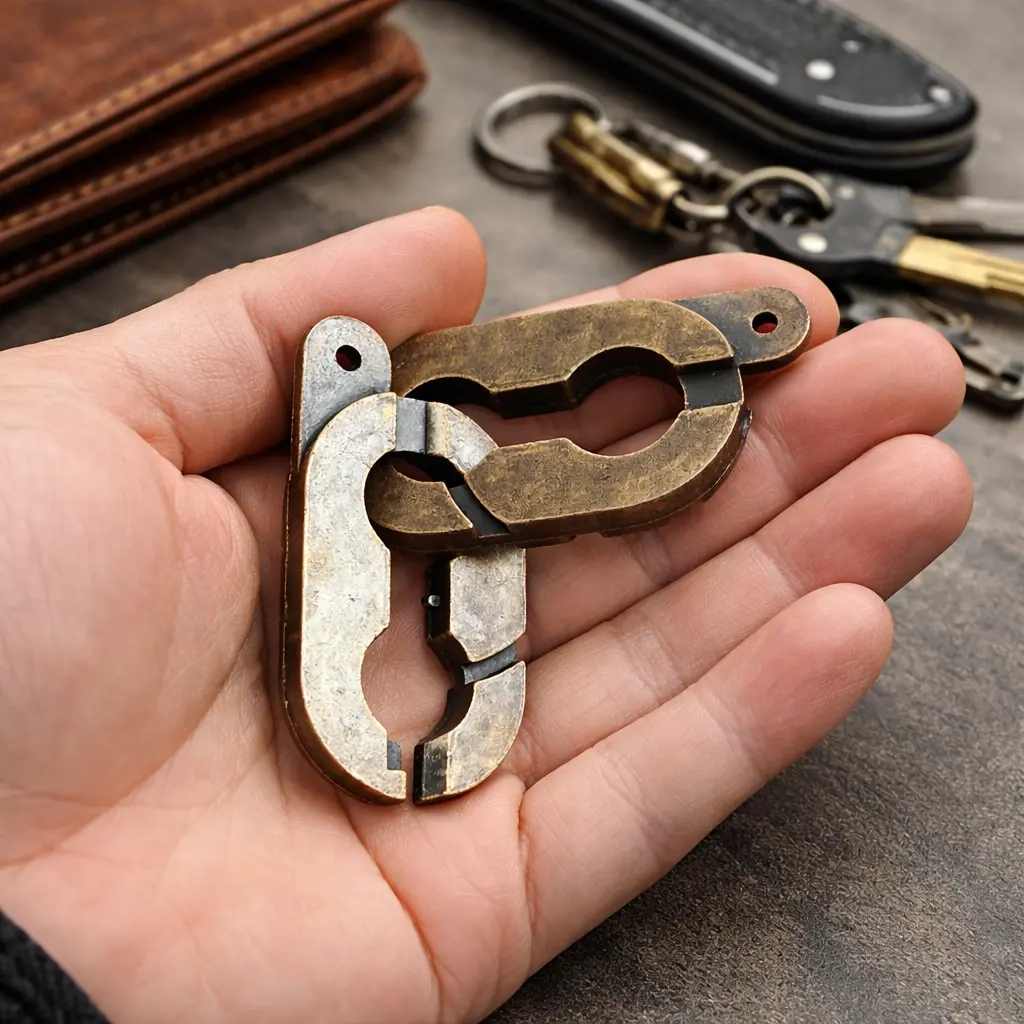
The first surprise is the weight. Not heavy—but heavier than expected for something marketed as a keyring attachment. Around 50 grams of solid cast metal settling into your palm, cool to the touch, with that particular density that separates genuine alloy from hollow stamped novelties. You expected a trinket. This is a tool.
Two interlocked bronze pieces catch the afternoon light differently depending on angle—the antique patina isn’t uniform, which suggests actual hand-finishing rather than mass-application spray coating. One piece threads through the other in a geometry that looks almost accidental, like two components that fused during manufacturing and nobody bothered to separate them.
Except someone designed this exact fusion. Someone calculated the precise tolerances that allow separation through one specific sequence while blocking every intuitive attempt you’ll make for the first fifteen minutes.
What You’re Actually Holding
The Antique Bronze Metal Keyring Puzzle is a two-piece cast metal disentanglement brain teaser. At $14.99, it occupies a specific niche: expensive enough to signal quality, cheap enough to impulse-buy, compact enough to actually use.
The bronze finish isn’t decorative wallpaper—it’s a deliberate material choice that develops character over time. Handle it daily for a month, and the patina begins reflecting your specific grip patterns. The places your thumb rests most often develop subtle polish. The recessed areas deepen. Your puzzle becomes visually distinct from every other identical model.
This patina development aligns with research on copper alloys showing how bronze surfaces respond to skin oils and environmental exposure, creating what metallurgists call “living finishes” that evolve rather than degrade.
Both pieces feature smooth, burr-free edges—important for something you’ll manipulate repeatedly while thinking about other things. No sharp catches, no rough seams where casting molds met. The polish quality suggests post-production finishing, not just spray-and-ship manufacturing.
The Solving Experience: What Actually Happens
Your instinct is to pull. Everyone pulls. The two pieces resist with exactly enough friction to suggest you’re on the right track while leading you absolutely nowhere. This isn’t stubbornness—it’s intentional mechanical design that exploits human problem-solving defaults.
Puzzle designers understand that most people approach disentanglement challenges with force-first strategies. The bronze keyring puzzle weaponizes this instinct. Pull harder, and the pieces seem to lock tighter. The resistance isn’t a bug—it’s the puzzle telling you “wrong direction” in the only language it knows.
According to puzzle classification systems used by organizations like the International Puzzle Party, disentanglement puzzles fall into a specific taxonomy based on the number of moves required for separation. Two-piece cast metal puzzles typically require between 3 and 8 sequential movements, each building on the previous position. Skip one, and the sequence fails. The mechanism doesn’t care how strong you are.
After roughly ten minutes of intuitive failure, something shifts. Not in the puzzle—in your perception. You stop trying to force separation and start observing how the pieces relate spatially. The gap that looked purely decorative suddenly suggests a pathway. The curve you ignored reveals itself as a track. This perceptual shift—what puzzle theorists call “insight transition”—represents the actual solving moment. The physical separation that follows is just confirmation.
The separation, when it finally happens, arrives quietly. A gentle metallic whisper as one piece slides free. No dramatic snap, no triumphant click. Just physics finally permitted to complete a sequence you’d been blocking with impatience. Many solvers describe this moment as disproportionately satisfying relative to the puzzle’s apparent simplicity.
Then comes the actual challenge: reassembly without visual guidance. The same path in reverse, but now you can’t see the tracks because your reference piece is in your other hand. Many solvers discover here that they didn’t actually understand the mechanism—they just got lucky with enough random attempts. True mastery requires successful reassembly without hesitation.
The reassembly challenge is where this puzzle earns its replay value. Unlike puzzles that reveal everything on first solve, the two-piece design creates a memory game layered over spatial reasoning. Can you internalize the path well enough to reverse it blind? For many users, this becomes the primary challenge after initial separation success.
For those interested in understanding how disentanglement puzzles work mechanically, the underlying physics involves precisely calculated clearances that permit specific movement sequences while blocking all others. The puzzle isn’t random—it’s engineered.
Why This Difficulty Level Matters
The puzzle occupies what designers call the “sweet spot” of challenge—difficult enough to require genuine engagement, approachable enough to avoid rage-quit territory. According to flow state research, optimal engagement occurs when challenge slightly exceeds current skill level. Too easy breeds boredom; too hard triggers frustration-based abandonment.
For cast metal brain teasers, this translates to solve times between 10 and 45 minutes for first-time users. Experienced puzzle solvers might crack it in 5 minutes. Complete novices might need an hour. Nobody needs a week.
This positioning makes it genuinely useful for daily carry. Unlike extreme-difficulty puzzles that become decorative objects after initial failure, the keyring puzzle offers reliable, repeatable engagement. Solve it once, reset, solve again differently. The muscle memory aspect means your solve time decreases with practice, providing measurable progress that sustains interest.
Material Science: Why Cast Metal, Why Bronze
Not all metal puzzles are created equal. The material choice directly impacts both durability and solving experience—and understanding why manufacturers choose specific alloys reveals whether you’re buying a functional tool or disposable novelty.
Stamped sheet metal—common in budget wire puzzle sets and bulk brain teaser packs—bends under pressure, creating tolerance issues that either make puzzles unsolvable or trivially easy. One aggressive solve attempt can permanently deform the geometry. Cast metal, by contrast, maintains consistent tolerances across thousands of manipulation cycles. The puzzle you buy is the puzzle you’ll have in five years, assuming normal use.
The casting process itself matters. Zinc alloy casting—the method used for quality IQ metal puzzles in this category—involves pouring molten metal into precision molds under pressure. This creates dense, uniform material without the air pockets or structural weaknesses that plague cheaper manufacturing shortcuts. According to the American Foundry Society, die-cast zinc alloys achieve dimensional accuracy within ±0.001 inches per inch—tight enough tolerances for puzzle mechanisms requiring specific gap clearances.
Bronze specifically offers advantages over steel or aluminum alternatives. The Copper Development Association documents bronze alloys’ excellent wear resistance and self-lubricating properties—the surface actually becomes smoother with use, reducing friction at high-contact points without becoming slippery. This means your tenth solve feels smoother than your first, but not so smooth that the puzzle loses its mechanical resistance.
The thermal conductivity of bronze also creates a more pleasant tactile experience than steel alternatives. Bronze warms to body temperature faster, making extended manipulation sessions more comfortable. Steel puzzles remain cold longer, which some solvers find distracting.
The antique finish serves dual purposes: aesthetic differentiation from industrial-looking steel puzzles, and practical concealment of minor surface variations inherent to casting. A mirror-polish bronze piece would show every microscopic imperfection. The antique patina turns those imperfections into texture—the puzzle looks intentionally aged rather than imperfectly manufactured.
For collectors familiar with traditional Chinese ring puzzles and classical metal brain teasers, the bronze finish carries historical resonance. Ancient puzzle mechanisms—documented in texts dating to the Han Dynasty—were typically constructed from bronze or brass. The material choice connects modern manufacturing to millennia-old puzzle traditions.
Practical Portability: EDC Brain Teaser Reality
“Keyring puzzle” implies daily-carry functionality. Does it actually deliver on the EDC (everyday carry) promise, or is that just marketing language?
The attachment hole appears designed for standard split rings, positioned to avoid interfering with the puzzle mechanism. You can clip this to a bag strap, belt loop, or actual keychain and still have a functional puzzle—the dangling position doesn’t lock the pieces into unsolvable orientations. Unlike some portable fidget toys that require flat surfaces or specific handling positions, this puzzle works equally well held, dangled, or resting in your palm.
For the fidget toy community—particularly users seeking stress relief and anxiety management tools—the puzzle offers something beyond endless spinning or clicking. There’s a goal. A discrete challenge that resets into new challenge. The solving process demands enough cognitive engagement to distract from anxious thoughts without demanding so much attention that you can’t maintain awareness of your environment. You can solve it during a meeting, on public transit, or in waiting rooms without completely disengaging from your surroundings.
Weight adds up, though. If you’re already carrying phone, wallet, keys, and multitool, another 50 grams (approximately 100 grams according to similar SkillToyz models at the upper end) might tip into noticeable territory. The puzzle works better attached to a bag than buried in a front pocket with your phone. Some EDC enthusiasts treat it as rotational carry—bring it when you’re expecting waiting time (airports, doctors’ offices, DMV lines), leave it when you need minimal bulk.
The bronze finish holds up to pocket environment reasonably well. Keys won’t scratch it, coins won’t dent it. The cast metal construction laughs at the wear patterns that would destroy stamped alternatives. Prolonged moisture exposure (sweaty gym bags, rain-soaked jackets) may accelerate patina development unevenly, but that’s cosmetic rather than functional degradation.
For those who approach EDC as a serious discipline—optimizing pocket loadouts, balancing utility against weight, categorizing items by essential versus situational—this puzzle falls into “situational comfort” territory. It’s not solving problems or opening packages. It’s occupying hands and engaging minds during dead time. Whether that earns permanent pocket space depends entirely on how much dead time you encounter and how poorly you handle it without occupation.
The pocket puzzle format has historical precedent. Before smartphones colonized every idle moment, small manipulation toys served the same attention-anchoring function. Some users report that switching from phone-scrolling to puzzle-solving during wait times reduces the anxious compulsion to check notifications while providing more satisfying engagement than infinite feeds.
Who Should Actually Buy This
The Conference Attendee You’re sitting through the third panel discussion of the day. Your phone battery is dying. The speaker is reading bullet points you can see perfectly well on the screen. A silent metal puzzle gives your hands productive occupation while your ears do the actual work. No clicking, no screens, no social media rabbit holes.
The Anxious Fidgeter Not everyone with restless hands needs a diagnostic label. Some people just think better when their fingers are occupied. The puzzle offers fidget toy functionality with an actual goal—you’re not just clicking and spinning indefinitely, you’re working toward a discrete accomplishment that resets into new challenge.
The Gift-Giver With Taste Brain teasers make excellent desk gifts because they signal “I think you’re smart” rather than “I grabbed something generic.” The bronze aesthetic reads more sophisticated than typical novelty puzzles. The price point—$14.99—lands in the thoughtful-but-not-excessive range. Browse the metal puzzles collection for similar options at varying difficulty levels.
The IQ Test Enthusiast Traditional metal wire IQ puzzles—the kind sold in sets of 16 with pouches—operate on simpler topological principles. Cast metal puzzles like this one add mechanical precision to the challenge. If you’ve exhausted wire puzzle sets and want dimensional upgrade, this is the intermediate step before serious cast puzzles like the Cast Coil Triangle.
The Casual Collector You don’t need 200 puzzles. You need 5-10 genuinely good ones you’ll actually touch. A well-curated desk rotation of distinct puzzle types—maybe a two-key lock puzzle, a geometric disentanglement, a sequential movement box—offers more engagement than a drawer of forgotten duplicates.
Who Should NOT Buy This
The Impatient Solver If five minutes without visible progress triggers frustration, this puzzle ends up in a drawer or flying across the room. The mechanism doesn’t reveal itself quickly to aggressive manipulation. You need patience for rotational observation. If that sounds exhausting rather than engaging, save your money.
The Solution-First Crowd No solution card included. No QR code linking to a video walkthrough. The design philosophy assumes you want to solve it yourself, which means potentially hours of genuine confusion before breakthrough. If unsolvable puzzles drive you insane, choose products that include answer keys.
Anyone Buying for Young Children Small separable pieces present choking hazard for kids under 8. The difficulty level also exceeds most young children’s spatial reasoning development. This is an adult fidget toy and teen-appropriate brain teaser, not a kindergarten activity.
Minimalist EDC Practitioners If you’re counting grams and eliminating redundancies, a recreational puzzle doesn’t justify pocket space. This is a luxury carry for people who prioritize mental engagement over ultralight optimization.
Collectors Seeking Extreme Difficulty At easy-to-medium rating, this puzzle won’t challenge experienced enthusiasts. If you’ve solved Hanayama Level 6 puzzles and want equivalent difficulty, look at multi-piece sequential movement designs rather than two-piece disentanglements.
How It Compares to the Category
The IQ metal puzzle market splits into three tiers, each serving different user needs and budgets.
Budget wire puzzle sets (16-32 pieces, $8-15 total) offer quantity and variety but thin material that bends under determined force. These bulk brain teaser collections—popular on Amazon and eBay as party favors and stocking stuffers—work well for introductory sampling. You get exposure to multiple puzzle types: Chinese rings, horseshoe puzzles, linked chains, and simple topological disentanglements. Solve times range from 30 seconds to 10 minutes per puzzle. Good for discovering whether you enjoy the category; poor for repeated engagement once novelty fades. The wire gauge on most sets can’t withstand aggressive manipulation—bend one piece, and the puzzle becomes either trivially easy or permanently unsolvable.
Mid-range cast puzzles ($10-20 individual pieces) provide the heft and precision that wire puzzles lack. These include products like the bronze keyring puzzle under review, as well as similar offerings from specialty retailers like SkillToyz (who sell a nearly identical model at £4.99 with 100g weight and 70mm dimensions). Solve times extend into meaningful territory—15 minutes to an hour for new users. Cast construction means consistent geometry across extended use. The mechanism rewards genuine problem-solving rather than lucky fumbling.
Premium designer puzzles (Hanayama, Kovarna, artisan casters) command $15-50+ per piece with exceptional finishing, attributed designers, and difficulty calibrated for enthusiasts. Hanayama’s “Keyring” cast puzzle—designed by Oskar van Deventer—represents the premium end of this specific form factor: a two-piece disentanglement with designer attribution and Mensa rating. The step up requires genuine puzzle hobby commitment. Most casual users don’t need Level 6 difficulty; they need accessible engagement with room to grow.
The bronze keyring puzzle delivers mid-tier quality at mid-tier pricing. You’re not getting Hanayama’s packaging, prestige, or designer attribution, but you’re getting comparable mechanism design and material quality for less. For users transitioning from bulk wire sets to serious cast puzzles, this represents a sensible intermediate purchase.
The $14.99 price point specifically competes with Amazon’s mid-range offerings: products marketed as “IQ test toys,” “intelligence puzzles,” and “mind game brain teasers for adults.” Most of those alternatives ship in plastic bags with machine translations on the packaging. This puzzle ships with better presentation and equivalent mechanism quality.
Solving Tips Without Spoilers
Rotation reveals more than translation. Turn the puzzle slowly through all three axes before attempting separation. Gaps that appear blocked from one angle become pathways from another.
Watch for false paths. The mechanism includes at least one movement direction that feels correct but leads to dead ends. If you’re stuck, try the opposite of your intuition.
Temperature affects friction slightly. Cold metal grips tighter; warm metal slides more easily. If you’ve been handling the puzzle in a cold room and nothing moves, your body heat may free it after a few minutes of contact.
Set it down. Seriously. Many solvers report breakthrough moments occurring after stepping away—unconscious processing continues without the interference of focused attention. Five minutes of ignoring the puzzle often accomplishes more than thirty minutes of aggressive manipulation.
For general disentanglement puzzle strategies, understanding the underlying physics helps more than memorizing specific solutions.
Cognitive Benefits: What Brain Teasers Actually Do
Beyond entertainment, metal brain teasers offer documented cognitive benefits—though the research requires careful interpretation.
Studies published in journals like Frontiers in Psychology suggest that spatial reasoning tasks—including three-dimensional manipulation puzzles—can improve performance on related cognitive measures. The key word is “related.” Practicing metal puzzles won’t raise your IQ score or make you better at unrelated tasks. What it does is strengthen specific neural pathways associated with three-dimensional spatial processing.
For adults, these benefits manifest most noticeably in pattern recognition and mental rotation tasks. Engineers, architects, surgeons, and others whose work involves visualizing three-dimensional relationships often report that puzzle practice maintains cognitive sharpness. Whether this represents genuine improvement or simply enjoyable maintenance remains debated, but the correlation exists.
For students, particularly those preparing for standardized tests with spatial reasoning components (GRE, MCAT, some engineering qualifying exams), regular exposure to physical manipulation puzzles may provide modest advantages over purely two-dimensional practice. The tactile feedback adds information density that screen-based training can’t replicate.
The stress-relief angle—often marketed as a primary benefit—operates through simpler mechanisms. Focused manipulation tasks occupy attention that would otherwise spiral into anxious rumination. This isn’t puzzle-specific; any engaging manual activity achieves similar effects. The puzzle format simply adds goal-structure that sustains engagement longer than pure fidgeting.
For individuals managing ADHD or anxiety, the structured challenge can provide better attention anchoring than open-ended fidget toys. The clear goal—separate the pieces—creates completion pressure that channels restless energy productively. Some users report that puzzle sessions during work breaks prevent the afternoon attention collapse that unstructured breaks fail to address.
None of this makes metal puzzles a medical intervention or substitute for professional treatment. But as a supplementary tool for managing attention and stress, the evidence supports modest effectiveness for modest claims.
Care and Longevity
Cast metal puzzles are nearly indestructible under normal use. No springs to fatigue, no plastic to crack, no hinges to wear. The main degradation vector is finish wear—eventually the bronze patina develops into full polish at high-contact areas.
Some owners accelerate this deliberately, treating patina development as desirable customization. Others prefer to maintain the original antique appearance by periodic application of renaissance wax or similar metal protectants.
Avoid prolonged submersion. Brief moisture exposure won’t damage the alloy, but extended wet storage can create uneven oxidation that affects sliding friction. If the puzzle gets thoroughly wet, dry it promptly and consider light oiling at the contact surfaces.
Store separated pieces together but not forcibly interlocked. Leaving the puzzle in solved state for months creates friction patterns that make the first post-storage solve slightly harder. This isn’t damage—it’s just the metal settling into resting contact geometry.
The Verdict
The Antique Bronze Metal Keyring Puzzle succeeds at exactly what it attempts: a portable, durable, attractively finished brain teaser that rewards patient observation over brute force.
It won’t challenge puzzle enthusiasts who’ve moved into advanced sequential movement territory. It won’t satisfy solvers who need immediate victory or clear instructions. It occupies a specific niche—the thoughtful fidget, the desk companion, the waiting-room engagement—and fills that niche competently.
At $14.99, you’re paying for cast metal construction, hand-finished patina, and a mechanism that actually requires solving rather than just manipulation. Compared to bulk wire puzzle sets, that’s a premium. Compared to designer cast puzzles, that’s a bargain.
If you have restless hands and patient curiosity, this puzzle earns its pocket space.
Frequently Asked Questions
How long does it typically take to solve this puzzle the first time?
Expect 10 to 45 minutes depending on your spatial reasoning experience and patience threshold. The puzzle reveals itself through rotational observation rather than force. Aggressive pullers take longer than careful observers.
Can I actually use this as a functional keyring?
Yes. The attachment hole accommodates standard split rings without interfering with the puzzle mechanism. The weight adds up with other keychain items, though—many users prefer bag attachment over pocket carry.
Does the bronze finish wear off over time?
The patina evolves rather than wears off. High-contact areas develop polish while recessed areas maintain darker tones. Many owners consider this desirable customization. If you prefer uniform appearance, periodic wax application slows the development.
Is this puzzle appropriate for teenagers?
Yes, the difficulty and construction suit ages 12 and up. Younger children may lack the patience for observation-based solving, and pieces pose choking hazard for children under 8.
What happens if I get permanently stuck?
No solution card is included, but online puzzle communities and video platforms cover common two-piece disentanglement mechanisms. The design philosophy favors self-discovery, but external help exists for those who need it.
How does this compare to Hanayama cast puzzles?
Similar mechanism principles and material quality at lower price points. Hanayama offers more extensive difficulty scaling (levels 1-6) and attributed designers. This puzzle delivers comparable engagement without the premium packaging and brand markup.
Will pocket carry damage the finish?
Standard pocket environment—keys, coins, fabric friction—won’t scratch or dent the cast metal. Prolonged moisture exposure may create uneven patina. The puzzle holds up to reasonable daily carry.
Related Brain Teasers Worth Considering
If this puzzle appeals to your solving style, explore similar challenges:
- Three Brothers Lock Puzzle — Steps up to three interlocking pieces
- Cast Coil Pocket Puzzle — Different mechanism style, similar portability
- Snake Mouth Escape Puzzle — Organic shape disentanglement
- Metal Starfish Puzzle Ring — Two-piece cast puzzle with unique geometry
Browse the full puzzle toys collection for additional difficulty levels and mechanism types.
Ready to test your spatial reasoning? The Antique Bronze Metal Keyring Puzzle rewards the patient observer. Add to cart and discover why some brain teasers deserve permanent pocket space.