My kitchen table was covered in what looked like expensive kindling. After forty-five minutes of trying to rebuild a disassembled 6-piece burr, I had reached that specific stage of puzzle-induced madness where you begin to suspect the laws of physics have personally slighted you. The wood felt warm, the notches were precise, but the pieces simply refused to occupy the same space at the same time. I set the blocks down, walked to the kitchen, and made a very deliberate cup of coffee.
The secret to any wooden puzzle cube solution isn’t found in your eyes; it’s found in your fingertips and your willingness to let the wood tell you where it wants to go. Most people approach these challenges with a “brute force” mindset, trying to jam tabs into slots through sheer willpower. But these objects, many based on 2,500-year-old Chinese joinery, are designed to punish impatience.
The thesis of this guide is simple: To solve a wooden cube, you must stop looking for the “right” spot and start looking for the “only” spot. Every interlocking puzzle has a hierarchy of movement. If you don’t respect the sequence, the wood stays stubborn. If you find the “key” piece, the entire structure yields with a satisfying, tactile grace that no plastic Rubik’s variant can match.
The Geometry of Frustration: Why Wood is Different
When you handle a mechanical puzzle, you’re dealing with tolerances that would make a machinist sweat. Unlike metal puzzles, which often rely on gravity or hidden magnets, wooden cubes rely on friction and the inherent “give” of the grain. I’ve tested over 200 of these things, and I can tell you that a $15 wooden burr can be more frustrating than a $100 brass maze because the wood lives and breathes.
In my years of reviewing, I’ve noticed that most beginners fail because they treat every piece as equal. They aren’t. In the world of interlocking puzzles, there is almost always a “Level 1” piece—the one that has no notches holding it back in at least one direction. Finding that piece is 90% of the battle.
The Anatomy of the Classic Burr
The most common “wooden cube” is actually a version of the Six-Piece Burr. It looks like a cross or a star, but its soul is a cube. Each piece is a square stick with specific notches cut out of it. When they are all in place, they lock each other into a solid mass.
The Six-Piece Burr ($17.99) is the quintessential entry point for anyone serious about this hobby. It’s what I call a “pure” puzzle—there are no tricks, no hidden springs, just raw geometry. When I first handled this specific version, I noticed the beechwood had a slight texture that helped with grip, which is crucial when you’re trying to slide three pieces simultaneously without the other three collapsing into a heap on your lap.
If you’re struggling with this one, look for the piece that looks “fuller” than the others. Usually, there’s one piece that lacks the deep internal notches of its siblings. This is almost always the last piece in and the first piece out. It’s the “locking” bar. If you try to force any other piece before sliding this one out, you’re just fighting the physical integrity of the wood.
Scaling the Difficulty: From 6 to 18 Pieces
Once you master the six-piece, the natural inclination is to go bigger. But “bigger” in the puzzle world doesn’t just mean more parts; it means more “dead ends.” An 18-piece puzzle isn’t three times harder than a 6-piece; it’s exponentially more complex because the number of “false moves” increases.
18 Piece Wooden Puzzle
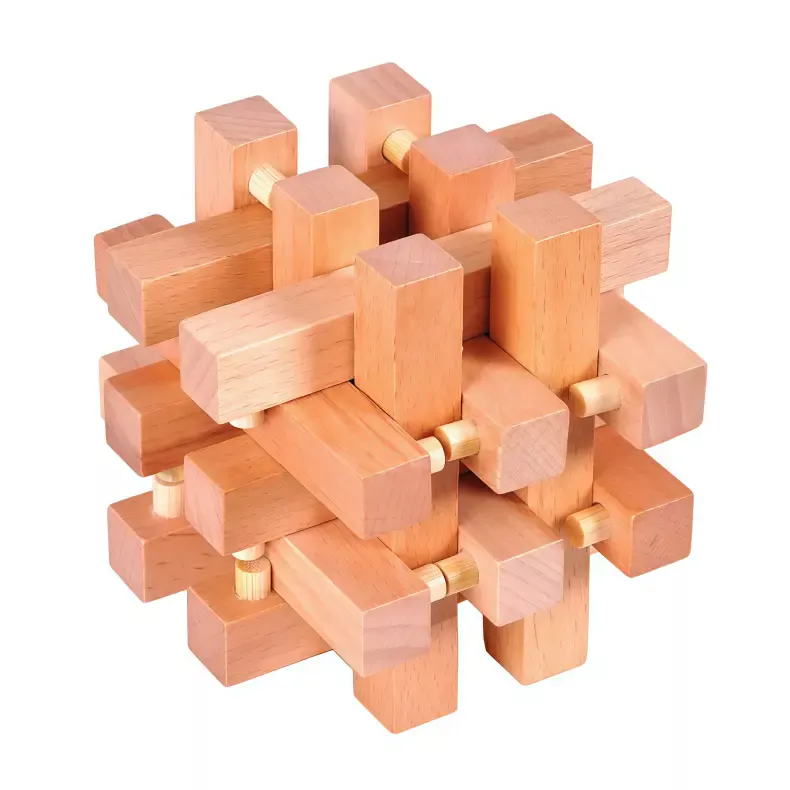
The 18 Piece Wooden Puzzle ($16.99) is a masterclass in architectural balance. Unlike the smaller sets, this one features seventeen identical pieces and one “key” piece. This is where most people lose their minds. When seventeen pieces look exactly the same, your brain loses its ability to categorize them. I spent an entire rainy Sunday with this on my desk, and the breakthrough only came when I stopped trying to remember which piece went where and started focusing on the “voids” inside the structure.
This puzzle is for the person who finds the standard burr too intuitive. It requires a different kind of spatial reasoning—you aren’t just building a cube; you’re weaving wood. The tolerances here are tight; there is zero wiggle room. If you’re buying this for a child, make sure they have the patience of a saint, or you’ll be the one spending your evening searching for the hidden logic of these wooden locks to put it back together.
The Cultural Heritage of the Luban Lock
You can’t talk about wooden puzzle cube solutions without mentioning Lu Ban. He was a legendary Chinese structural engineer from the 5th century BCE. Legend has it he created these puzzles to test his son’s intelligence. Whether that’s true or not, the “Luban Lock” (or Kongming Lock) remains the gold standard for joinery-based puzzles.
Luban Lock Set 9 Piece
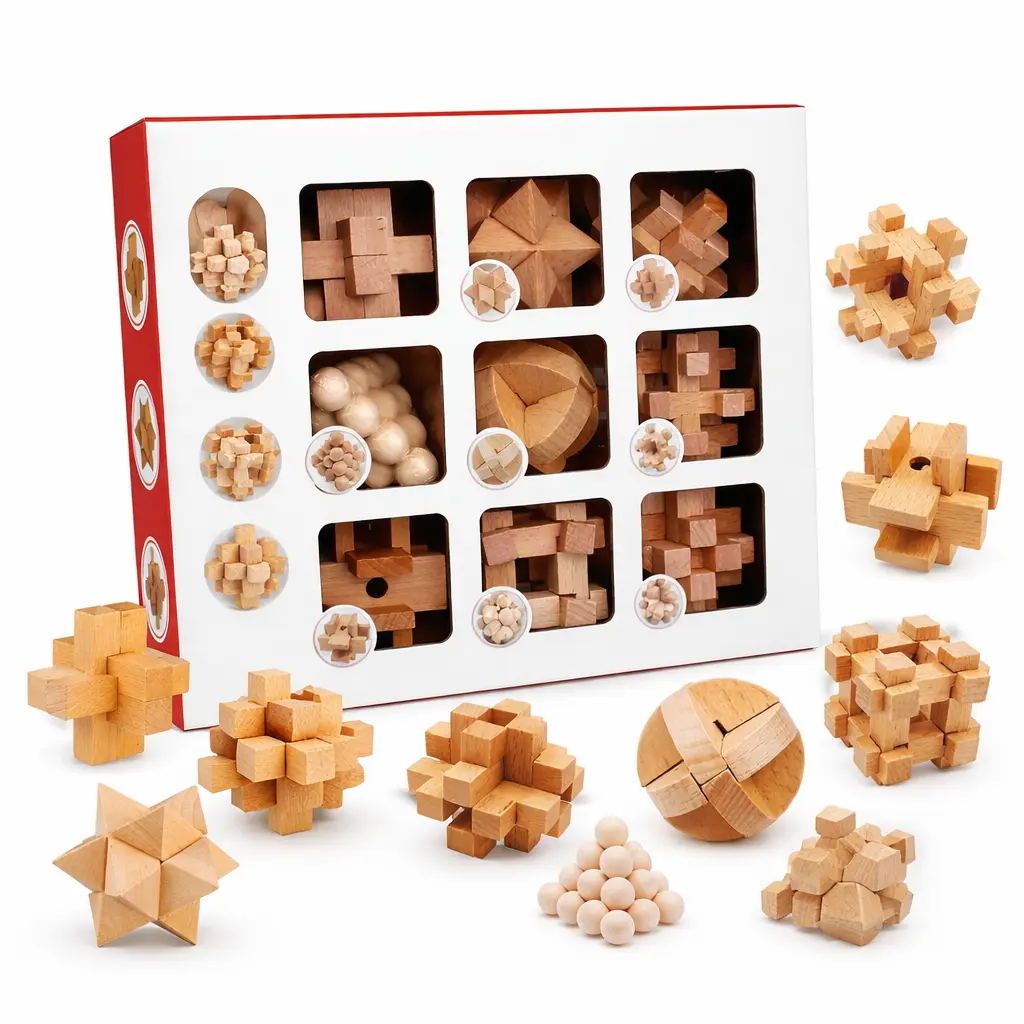
The Luban Lock Set 9 Piece ($39.99) is essentially a “Greatest Hits” collection of ancient engineering. For about forty dollars, you get nine distinct challenges that range from the “how is this hard?” to the “I am going to throw this out the window.” What I love about this set is the variety. You aren’t just solving cubes; you’re solving spheres, stars, and cages.
Each piece in this set uses mortise-tenon joinery—the same technique used to build temples that have stood for a millennium. There’s a weight to these puzzles that feels significant. When you finally slide the last piece of the “Ball” puzzle into place, the “thunk” it makes is incredibly rewarding. It’s a tactile “Aha!” moment that you just don’t get from digital games. If you find yourself getting too frustrated, I occasionally take a break and play some classic digital reflex games just to clear my head before diving back into the 3D space.
The “Cage” Problem: Solving from the Inside Out
Some puzzles don’t look like cubes but behave like them. The “Cage” style puzzles are particularly devious because you can see the internal mechanism, but you can’t reach it. It’s a teasing kind of difficulty.
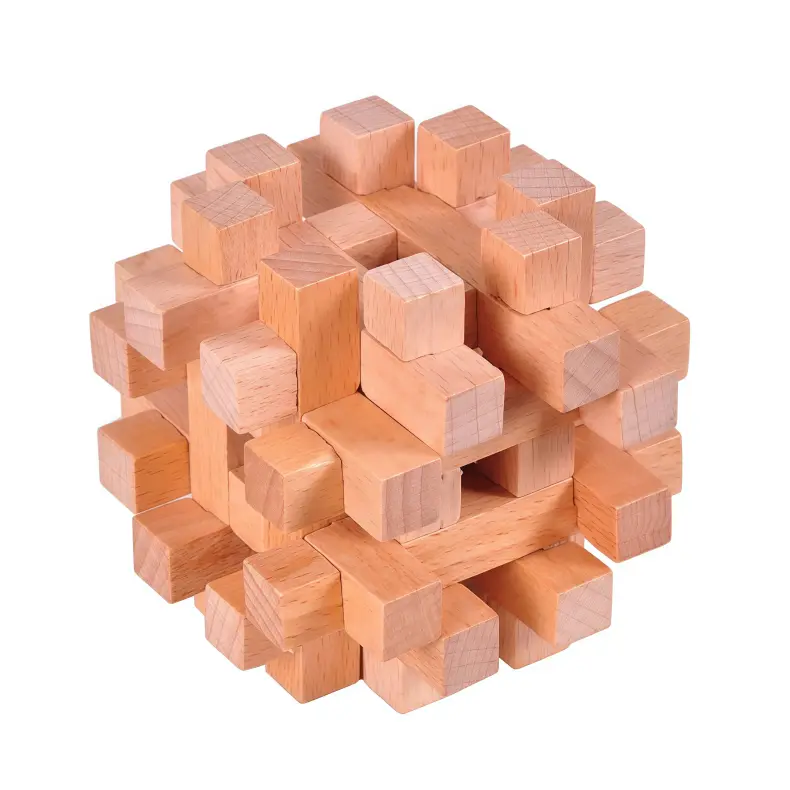
Double Cross Cage Puzzle
The Double Cross Cage Puzzle ($18.88) is a beast. It uses twenty-four identical pieces to create a structure that feels as solid as a brick. The challenge here isn’t just finding the first move; it’s maintaining the structural integrity of the “cage” while you’re adding the final pieces. I’ve had this one collapse on me at the 90% mark more times than I care to admit.
It’s a puzzle that rewards a steady hand. If your fingers are shaky or you’re prone to rushing, the Double Cross will humiliate you. It’s a meditation on patience. If you’re gifting this, it’s best suited for the “tinkerer”—the person who likes to take apart their toaster just to see how it works. For those who prefer a different kind of visual challenge, looking into 3D crystal assembly might be a nice change of pace, but for raw mechanical satisfaction, the Cage is king.
The Gateway Sets: For the Office Desk and the Commute
Not every puzzle needs to be a weekend-long project. Some of the best “cube” solutions are found in smaller, palm-sized sets designed for fidgeting during a Zoom call or a long flight.
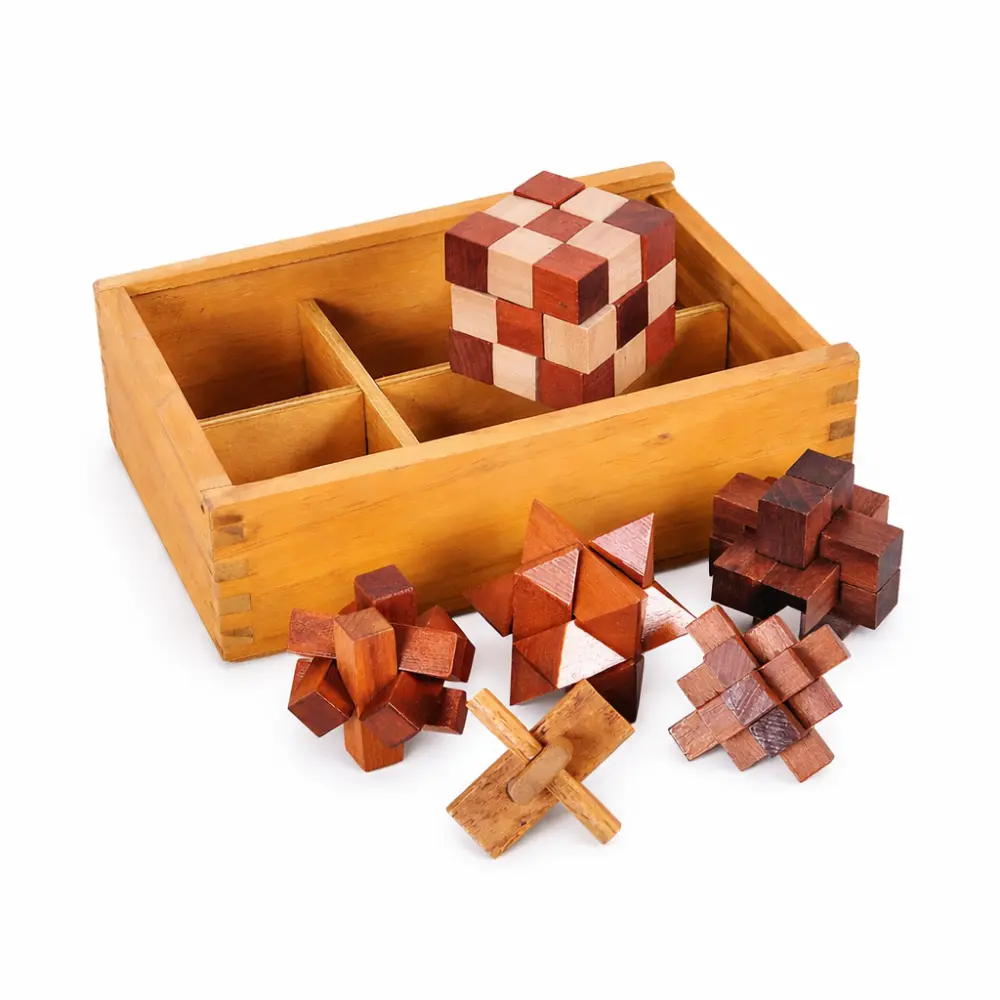
6-in-1 Wooden Brain Teaser Set
The 6-in-1 Wooden Brain Teaser Set ($38.88) is my go-to recommendation for an office gift. These are carved from solid beechwood and are small enough to be solved one-handed if you’re talented. Each of the six puzzles focuses on a different geometric principle. You have the classic burr, a star, and several “locked” cubes.
The beauty of a set like this is the progression. You can start with the simplest one to build your confidence before tackling the more complex interlocking shapes. I keep one of these on my desk constantly. When I’m stuck on a writing project, I’ll take one apart and put it back together. There’s something about the spatial logic of metal enigmas and wooden locks that resets the brain’s problem-solving pathways.
The Outliers: Stars, Orbs, and Keys
While the “cube” is the iconic shape, the same principles apply to other geometric forms. These often use “twisted” pieces or semi-circular joints that add a layer of rotational difficulty to the standard sliding moves.
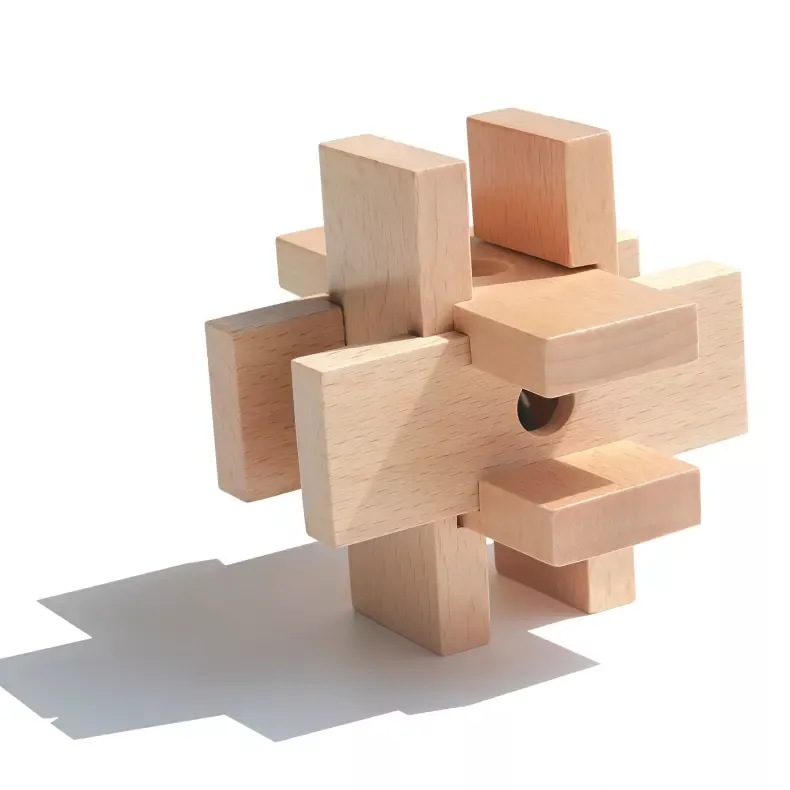
6 Piece Wooden Puzzle Key — $12.99
The 6 Piece Wooden Puzzle Key ($12.99) is a budget-friendly way to experience “Wu Wei” problem-solving. It’s only six pieces, but because of the way they interlock, the solution feels more like a dance than a construction project. It’s less about force and more about finding the “flow” of the wood.
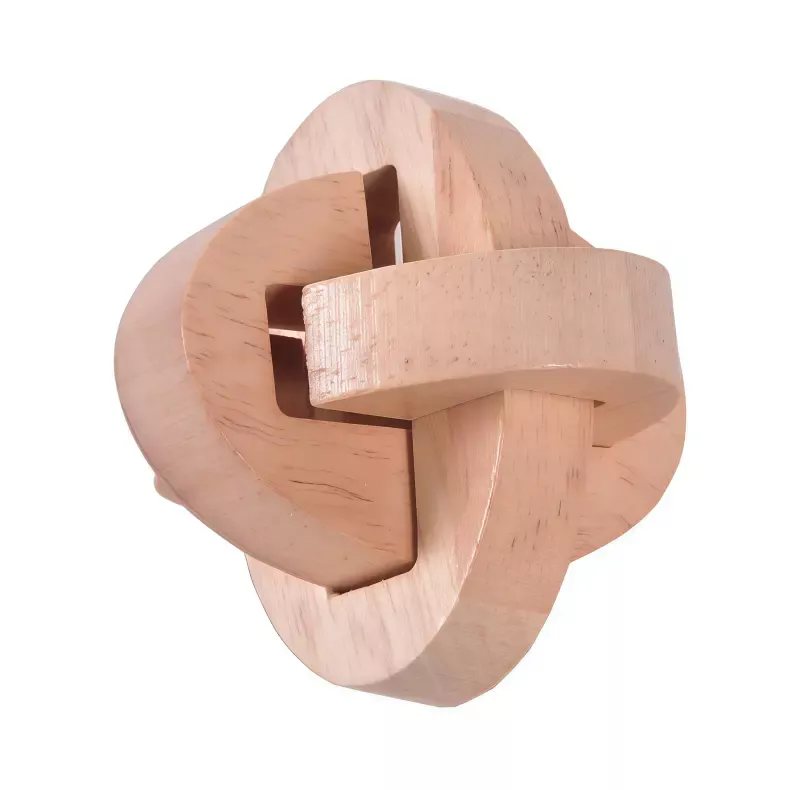
Circular Lock — $16.99
Similarly, the Circular Lock ($16.99) moves away from the 90-degree angles of a cube and introduces smooth, arced motions. It only has three pieces, but don’t let that fool you. In many ways, fewer pieces can be harder because each piece has more “responsibility” for the lock. It reminds me of solving a bead-based pyramid—the simplicity is the trap.
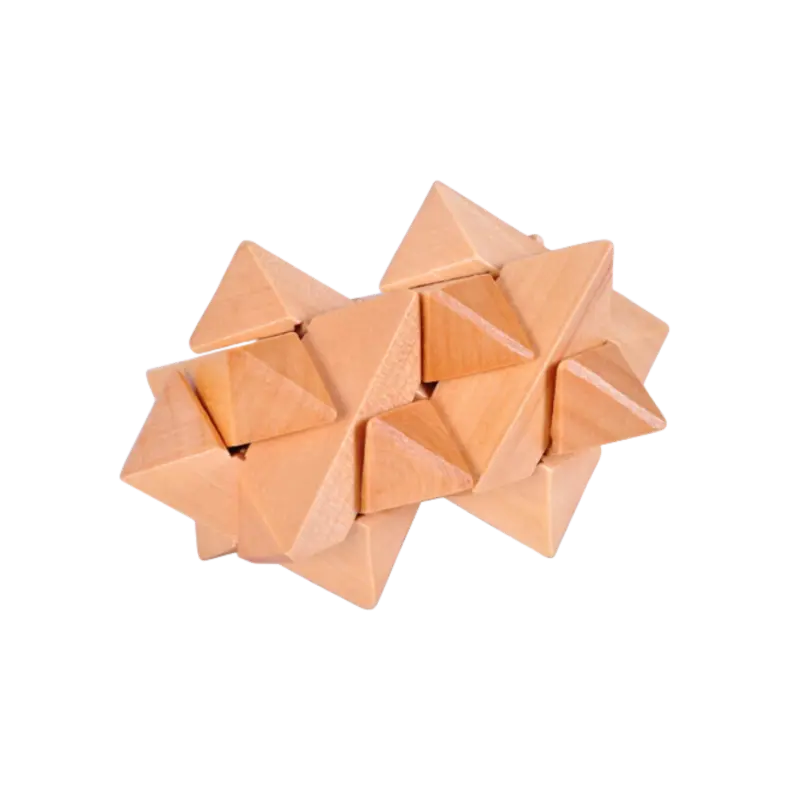
The Twin Star Puzzle — $17.88
Then there’s the Twin Star Puzzle ($17.88). This one is a nightmare for anyone who likes symmetry. It uses three different types of blocks, including two “twisted” pieces that require you to rotate them as you slide. It’s a great example of how the “wooden puzzle cube solution” evolves as you move into non-Euclidean thinking.
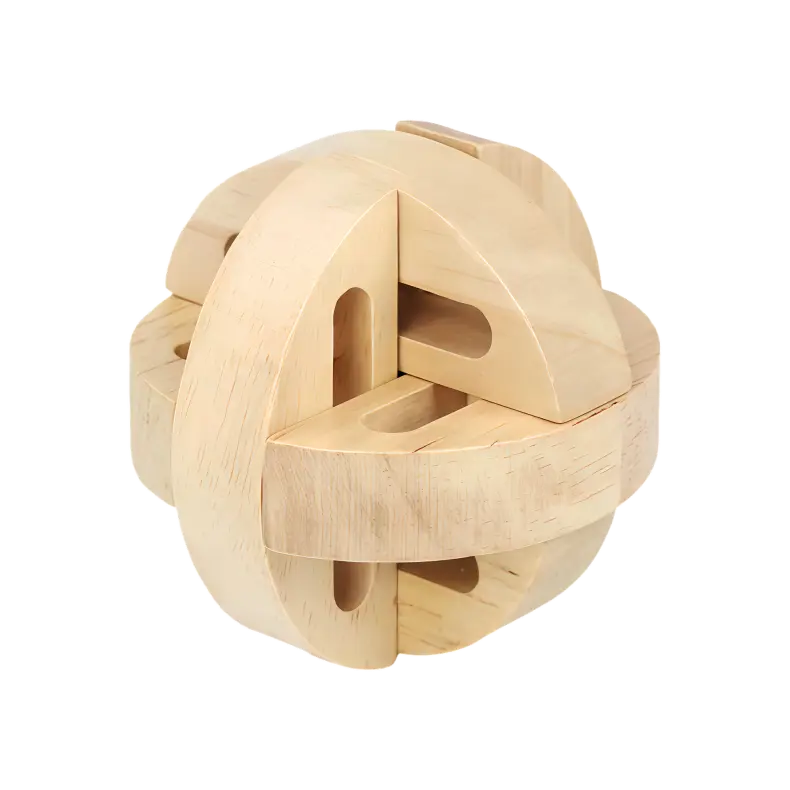
The Mystic Orb Lock — $16.99
Finally, the Mystic Orb Lock ($16.99) uses semi-circular pieces with precision grooves. This is the “boss fight” of the Luban lock world. It embodies the Taoist idea of finding the “gap” where there is no resistance. If you’re forcing this one, you’re doing it wrong. It should snap together with the lightness of a whisper.
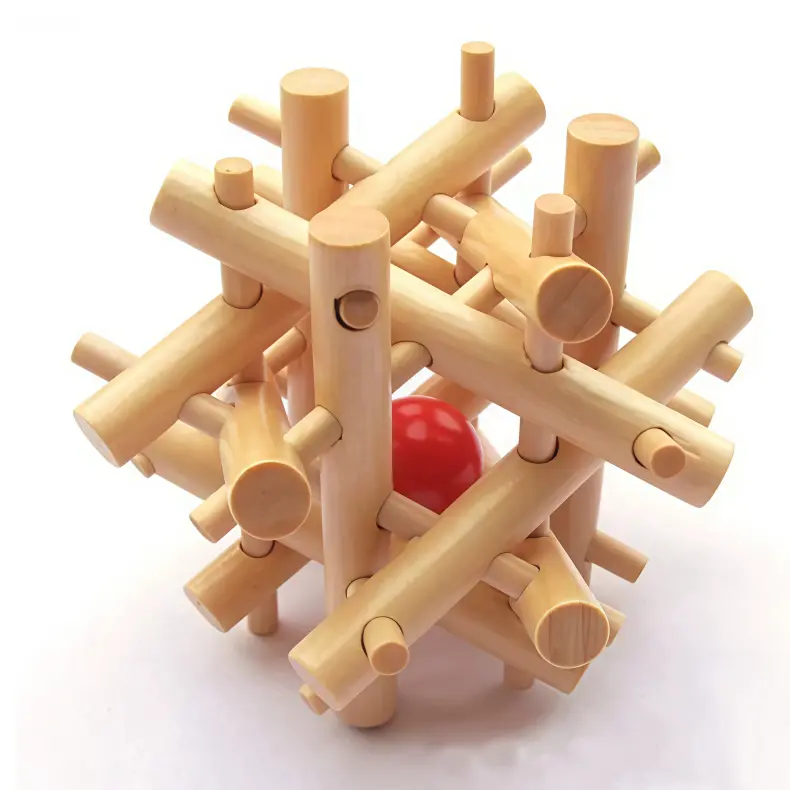
Twelve Sisters Puzzle — $19.99
If you really want to test your limits, the Twelve Sisters Puzzle ($19.99) uses a crimson center sphere as its heart. It’s a 25-piece monster that combines rods and sticks. It’s the kind of thing you see in a museum and think, “There’s no way that comes apart.” It does, and putting it back together is a genuine achievement.
Why Your First Solve Will Probably Be an Accident
Here is a truth most puzzle reviewers won’t tell you: the first time you solve a complex wooden cube, you probably won’t know how you did it.
You’ll be fiddling with the pieces, your mind will wander, and suddenly—click—the pieces align. This is what I call “The Gift.” Your subconscious mind is actually much better at 3D spatial reasoning than your conscious mind. Your fingers find the tolerances before your brain does.
The real challenge isn’t the first solve; it’s the second. Can you do it again, but this time, with intent? This is where the hidden benefits of giving kids tactile challenges come in. It teaches them (and us) that “doing” is a form of “knowing.”
Maintenance: Keeping the “Click” Smooth
Because these are made of organic material, they change. I once left a beautiful rosewood burr near a humidifier, and by the next morning, it was a solid block of wood. The fibers had swollen just enough to lock the pieces permanently.
- Humidity is the Enemy: Keep your puzzles in a dry, room-temperature environment.
- Don’t Sand the Notches: It’s tempting to sand down a tight fit, but once you lose that friction, the puzzle will never feel “solid” again.
- Natural Oils: The oils from your hands are actually good for the wood. The more you solve it, the smoother the action becomes.
If you find yourself getting bored with wood, you can always pivot to trick boxes with hidden compartments or sequential discovery boxes, which add “tools” and “keys” to the mix.
FAQ: Everything You’re Afraid to Ask While Stuck
How do I find the “key” piece in a wooden cube?
The key piece is almost always the only one that can move without shifting other pieces first. Look for a piece that has a “flat” side or lacks internal notches. In a standard 6-piece burr, this is the solid bar. If no single piece moves, try sliding two parallel pieces simultaneously. This is a common “Level 2” trick where the lock is shared between two components.
My puzzle is stuck and won’t budge. Should I use a hammer?
Absolutely not. If you need a tool to move a wooden puzzle, you’ve already lost. Wood can “bind” if it’s put together slightly crooked. Instead of forcing it, try to “jiggle” the entire structure. Often, a small internal misalignment is creating friction. If it’s really stuck, put it in a dry area (or even a bag with some silica gel) for 24 hours to let the wood shrink slightly.
Are these puzzles good for seniors with arthritis?
It depends on the puzzle. Small, tight sets like the Twin Star might be frustrating. However, larger sets like the Luban Lock 9-piece offer pieces that are easier to grip. Solving these is actually great for improving your short-term recall and keeping fine motor skills sharp, but always check the “heft” of the pieces first.
What is the “Level” system in mechanical puzzles?
The “Level” refers to how many moves are required to remove the first piece. A “Level 1” puzzle means the first piece slides out in one move. A “Level 5” puzzle might require you to slide several pieces back and forth in a specific sequence before the first one is released. Most of the puzzles on this list are Level 1 or 2, making them accessible but still challenging.
Can I solve these by looking at a PDF?
You can, but I don’t recommend it for your first attempt. A PDF solution for a 3D object is notoriously hard to follow because you have to translate 2D drawings into 3D space. It’s better to watch a video or, better yet, just keep fiddling. The “Aha!” moment is the only reason we do this; don’t rob yourself of it by looking at the answer key too early.
Why are some wooden puzzles so much more expensive than others?
It usually comes down to the wood type and the precision of the cuts. Cheap puzzles use softwoods that warp and have “fuzzy” edges. Premium sets use hardwoods like beech, rosewood, or ebony. The tighter the tolerances, the more expensive the machining. A high-end puzzle will have pieces that slide with zero resistance but stay together with zero “wobble.”
Are wooden puzzles better than metal ones?
They offer a different experience. Metal puzzles (like the Hanayama series) are often about “disentanglement”—getting a ring off a post. Wooden puzzles are usually about “interlocking”—building a structure. Wood is warmer and more tactile, but metal is more durable and allows for “trick” mechanisms like magnets or ball bearings.
What age is appropriate for a 6-piece burr?
I’ve seen 8-year-olds solve them in minutes and 40-year-olds struggle for hours. Generally, 10+ is the sweet spot for the spatial reasoning required. For younger kids, stick to simpler 3D shapes or basic logic games to build their confidence.
How do I know if I’ve put it back together correctly?
If there are any gaps, “steps” in the wood, or if the structure feels “mushy,” something is wrong. A correctly solved wooden cube should feel like a single solid block of wood. You should be able to pick it up and turn it over without it falling apart.
Do I need to lubricate my wooden puzzles?
Usually, no. If a puzzle is very tight, a tiny amount of dry wax (like a birthday candle) rubbed on the sliding surfaces can help. Never use oil or WD-40, as this will soak into the wood, cause it to swell, and eventually ruin the finish.
What’s the hardest puzzle on this list?
In my opinion, the 18 Piece Wooden Puzzle is the most difficult because of the visual repetition. The Twelve Sisters is a close second due to the sheer number of components. If you’re a beginner, start with the 6-Piece Burr or the Circular Lock.
I lost a piece. Can I get a replacement?
Because these are often mass-produced in sets, getting a single replacement piece is difficult. This is why I always recommend solving your puzzles over a tray or a felt mat. If a piece drops on a hardwood floor, it can chip; if it drops into a deep-pile rug, it’s gone forever.
The Final Word: Embracing the Silence
After years of reviewing these objects, I’ve realized that the “wooden puzzle cube solution” isn’t the goal. The goal is the state of mind you enter while searching for it. In a world of notifications, pings, and endless scrolling, a wooden puzzle demands 100% of your focus. It is a silent, unmoving object that refuses to give up its secrets unless you give it your full attention.
When you finally find that key piece, and the cube slides together in your hands, there’s a moment of perfect clarity. The chaos of the “kindling” on the table has been transformed into order. You’ve mastered the geometry, respected the wood, and earned the “click.”
My advice? Start with the Luban Lock Set. It’s the most honest introduction to this world. Take one apart, leave the pieces on your desk, and resist the urge to Google the solution. Let it sit there. Let it annoy you. And then, one day, while you’re thinking about something else entirely, pick it up and let your fingers find the way.
That’s when the real fun begins.