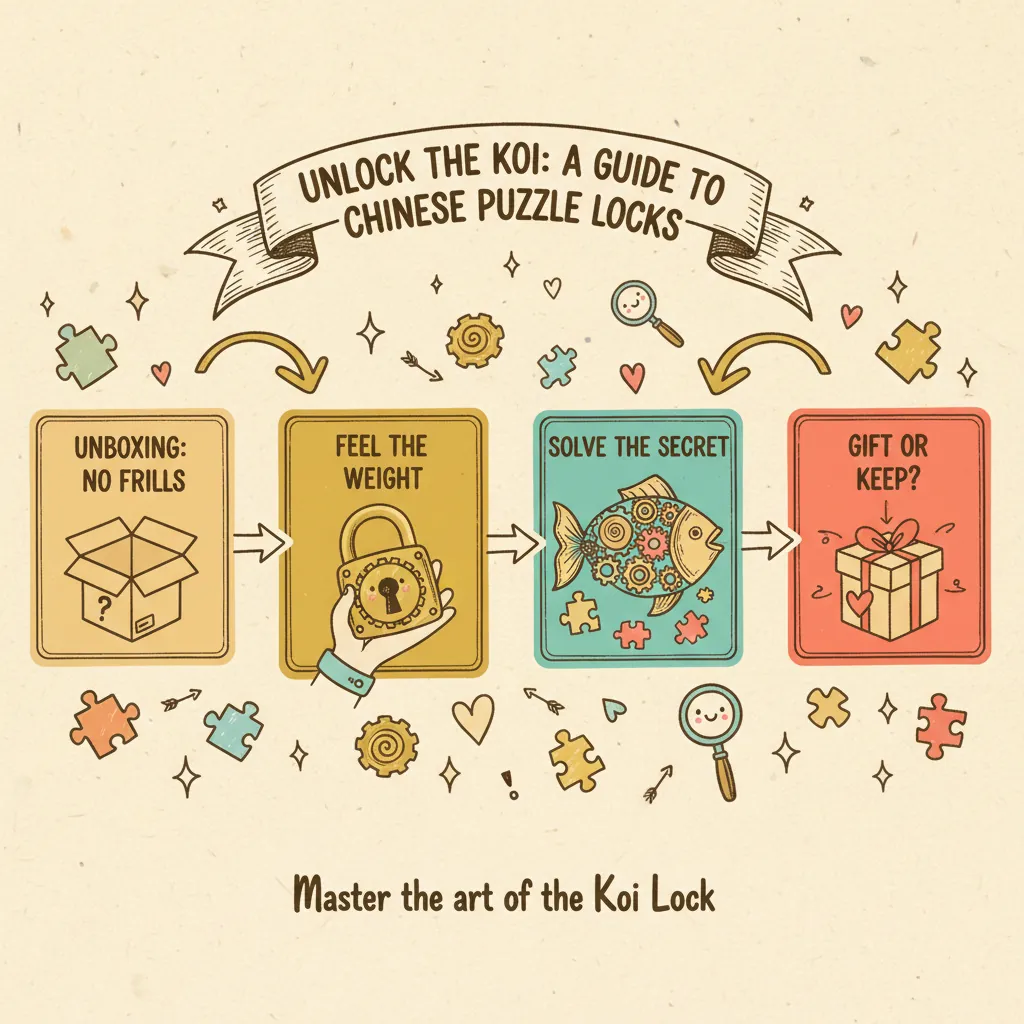
Unboxing the Koi: First Impressions of Craftsmanship and Design
The Chinese Koi Puzzle Lock arrives in a simple, unbranded cardboard box—a far cry from the flashy retail packaging of many generic Amazon puzzle boxes. This isn’t necessarily a bad thing; it feels utilitarian, hinting at a product focused on substance over presentation. Upon lifting the lid, you’re greeted by the lock itself, nestled in a foam insert. There are no instructions, no fanfare, just the object. This immediate, no-frills presentation sets a clear expectation: you’re on your own to figure it out.
Picking it up, the first thing you notice is the weight. At just over 100 grams, it has a satisfying, dense heft for its size (about 3.5 inches long). It’s solid brass, and that’s immediately apparent. The metal is cool to the touch, and the casting has a substantial feel that dispels any fear of it being a flimsy trinket. This is a stark contrast to the lightweight, often painted-zinc-alloy or stained-pine puzzle boxes that dominate the lower end of the market. You’re not holding a disguised gift card holder; you’re holding a functional, miniature padlock with a centuries-old pedigree, as detailed in our dedicated review of its traditional counterparts.
The craftsmanship of the koi fish design is where this piece truly separates itself from the crowd. The fish’s scales are intricately etched across its body, with clear lines defining the gills, fins, and tail. The iconic whiskers and mouth are well-defined. My review unit had a consistent, warm brass patina with no visible casting seams or rough spots. The finish isn’t a mirror polish, but a slightly matte, traditional look that feels authentic. It looks less like a newly manufactured puzzle and more like a small artifact you might find in a curiosity shop.
Aesthetically, the koi shape is instantly more engaging than a standard geometric puzzle box. The organic curves and symbolic meaning (in East Asian cultures, koi represent perseverance and luck) add a layer of character that a plain wooden cube can’t match. It’s a conversation piece before it’s even a puzzle. However, this design-centric approach comes with a trade-off. Unlike a multi-compartment puzzle box, the Koi lock’s secret is singular: opening the shackle. Your reward isn’t a hidden chamber for a ring or cash, but the sheer satisfaction of solving the mechanism. This is a crucial buying consideration—are you looking for a storage object with a puzzle, or a pure mechanical brain teaser to admire?
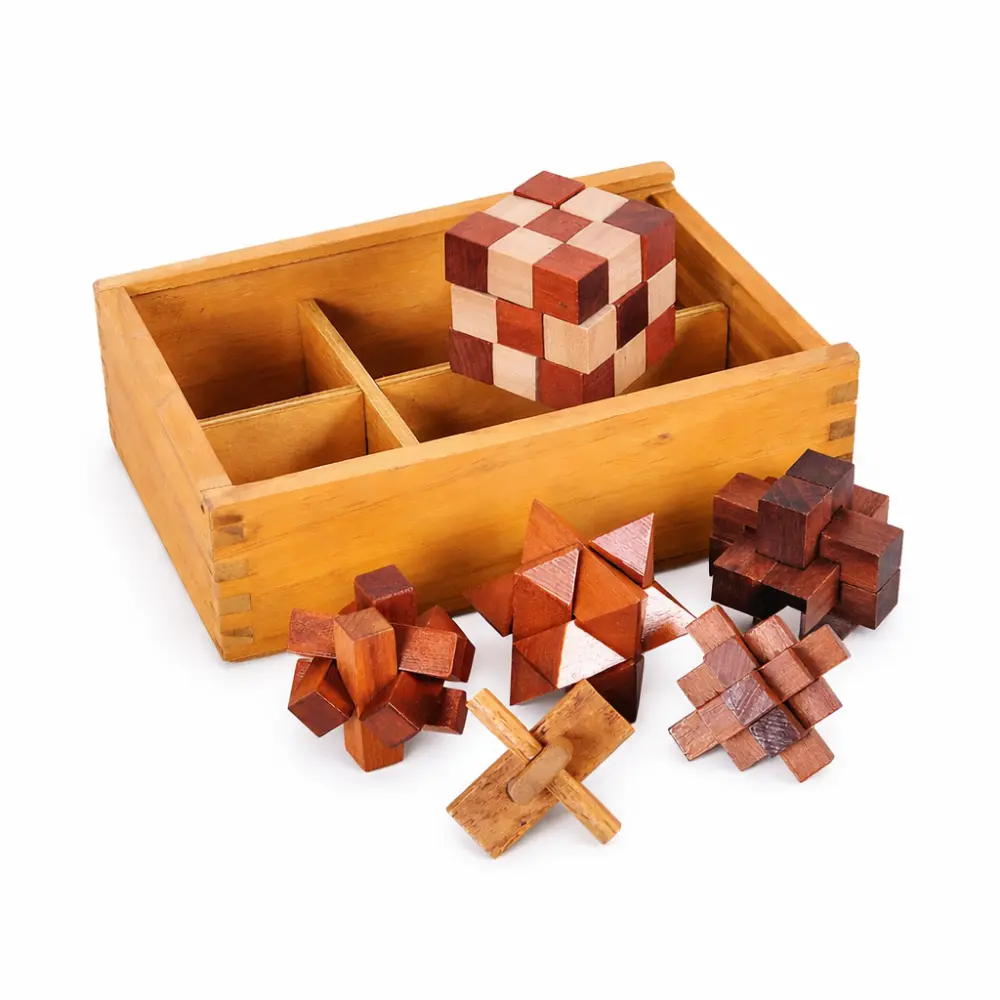
Comparing it to the sea of “secret lock boxes” on Amazon, the difference is material and intent. Many popular wooden puzzle boxes use thin plywood with vinyl decals or laser-etched patterns. They can feel light and sometimes have slight gaps in their construction. The Chinese Koi Lock feels like a precision-cast metal tool. It doesn’t just look like a lock; it is one, built to a standard that suggests it could actually secure something small, even if that’s not its primary purpose. The initial impression is one of surprising quality for the price point, establishing immediate credibility for the puzzle experience to come.
How It Works: Demystifying the Sequential Discovery Mechanism
The Chinese Koi Puzzle Lock isn’t a simple trick with a single hidden latch. It operates on the principles of sequential discovery, a revered sub-genre of mechanical puzzles. According to the broader definition of a puzzle box, these are objects that “can only be opened by solving a puzzle,” but sequential discovery elevates this by making the discovery of tools and the understanding of each step part of the puzzle itself. You don’t just find the solution; you uncover the very means to progress, one logical revelation at a time.
Contrast this with many “secret lock boxes” dominating the commercial SERP, like common wooden trick boxes. Those often rely on a single, cleverly concealed sliding panel or a specific pressure point. Once you know the trick—often found through frustrated shaking or an online search—the magic is gone. The Koi Lock is different. Its mechanism is a self-contained journey. The provided key is not a solution, but a starting prop. The shackle isn’t just a handle; it’s an integral component of the solve. You’ll find yourself sliding, pressing, rotating, and experimenting with every element, learning the lock’s internal language through tactile feedback. For a primer on the general principles of solving a puzzle box, which are foundational here, we have a dedicated guide.
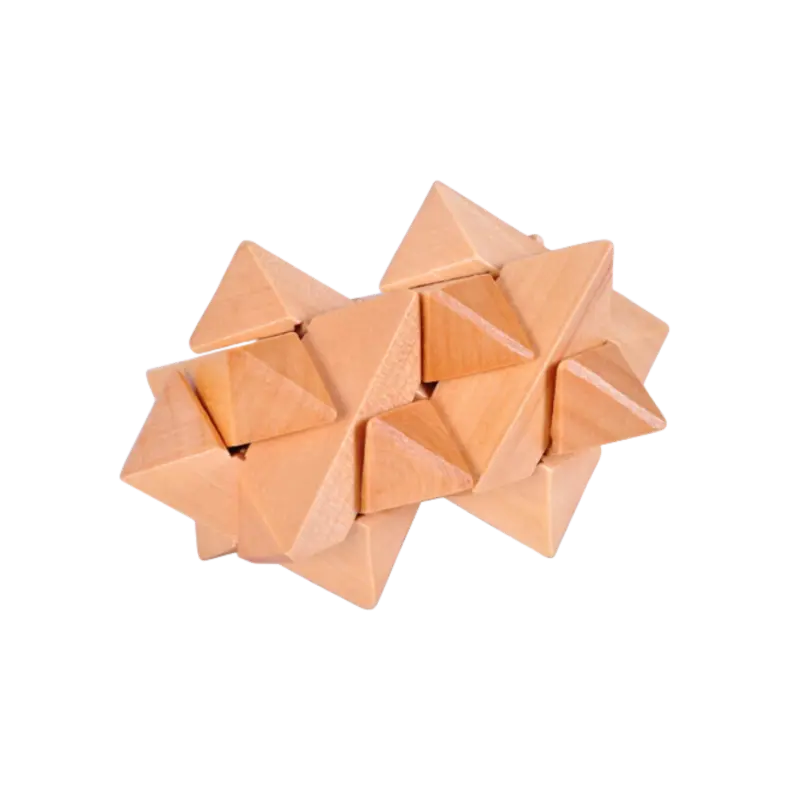
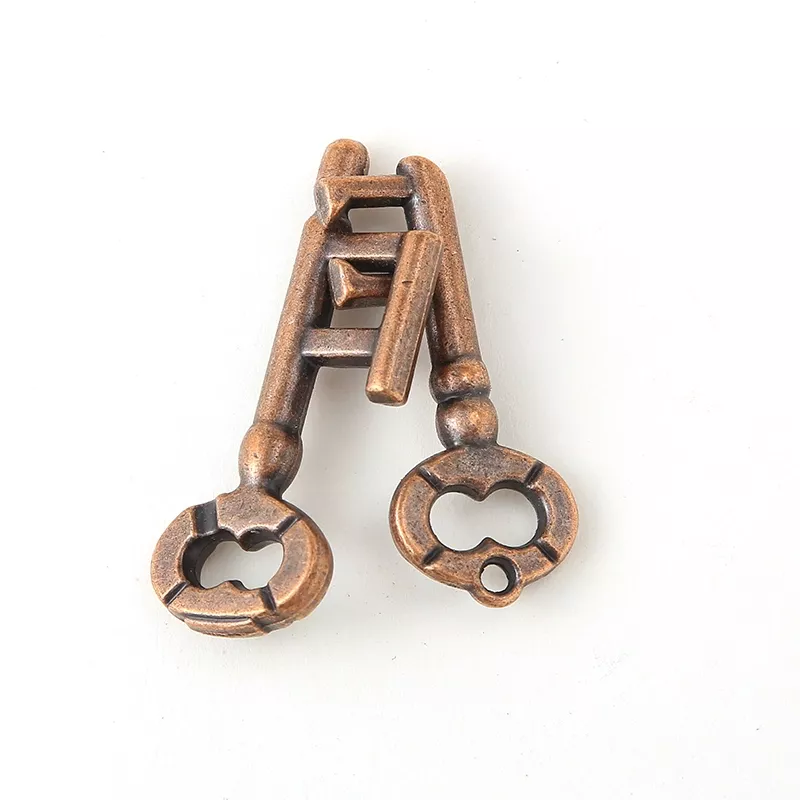
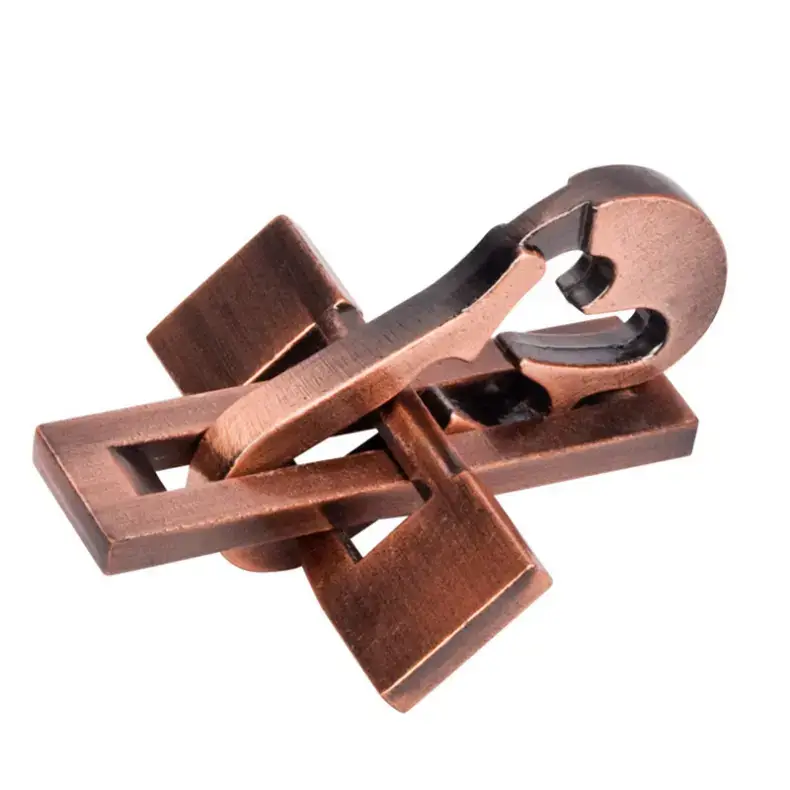
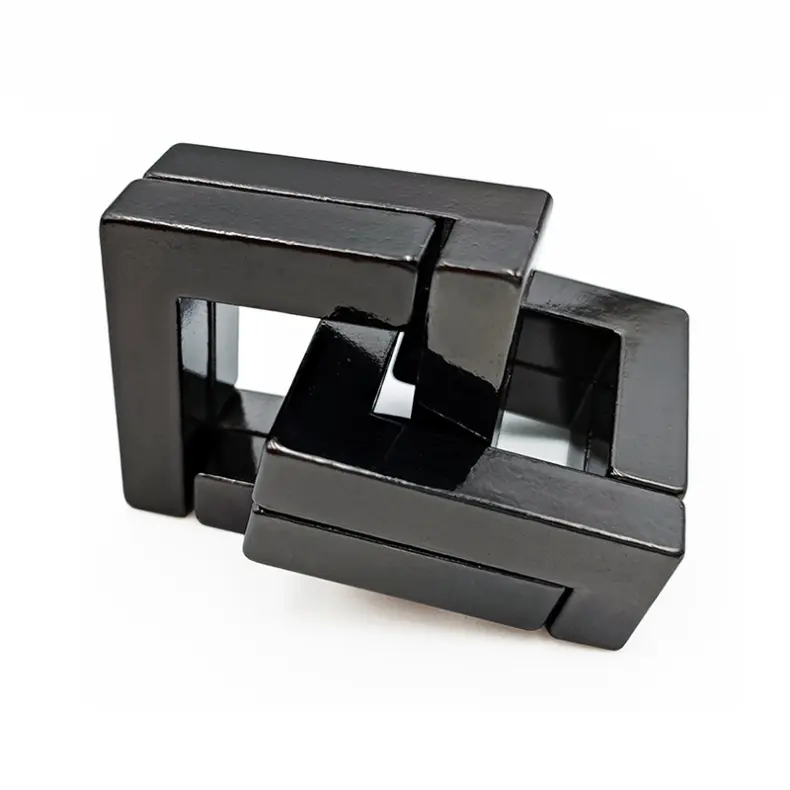
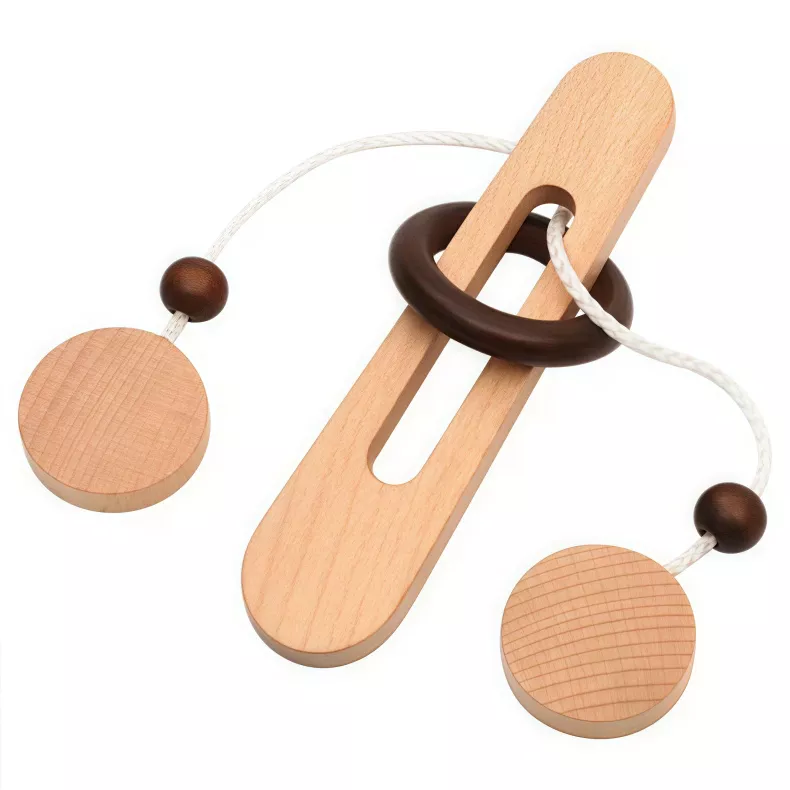
The Twin Star Puzzle — $17.88
This feedback is crucial. The lock provides subtle auditory and haptic clues: a faint click when a component aligns, a specific resistance in a slider that indicates it’s in the correct position, or a barely perceptible shift in the shackle’s movement. These aren’t accidents; they are deliberate communication from the mechanism. Paying attention to this feedback is the difference between brute force and enlightened deduction. It’s a dialogue between you and the puzzle.
The process typically unfolds in phases. First, you explore the obvious: the keyhole, the shackle, the sliders on the sides. Initial attempts with the key will prove fruitless in the conventional sense, prompting you to investigate why. This leads to the second phase: discovering hidden interactions. Perhaps a slider, when positioned just so, alters the internal alignment of the shackle. Maybe applying pressure to one part unlocks a new degree of movement in another. Each successful step doesn’t just get you closer; it provides a new “tool” or understanding required for the next step. Finally, the sequence culminates in a satisfying, logical conclusion that releases the shackle. The “Aha!” moment isn’t a single point but a series of smaller, connected revelations.
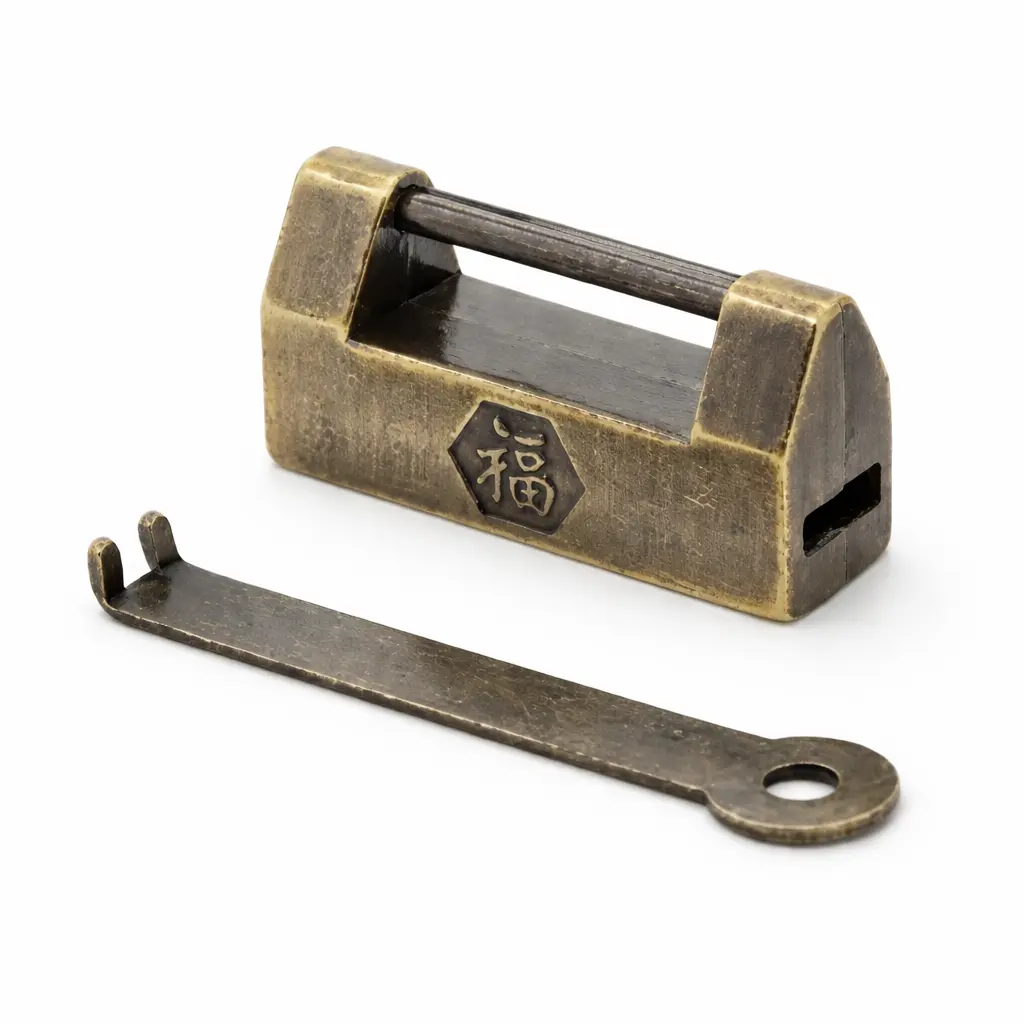
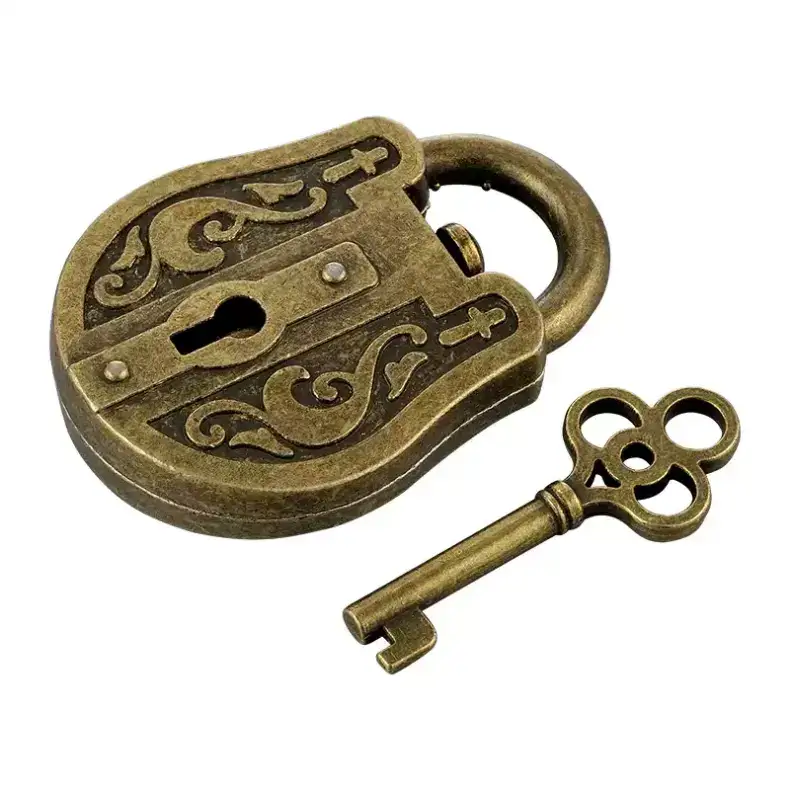
To understand its sophistication, compare it to a more traditional puzzle lock, like a Chinese Old Style fú Lock. That piece is a beautiful, functional replica of an antique padlock. Its puzzle is centered on manipulating the external shackle and keyhole in a non-intuitive way to open it. It’s a clever, single-stage trick. The Koi Lock, however, internalizes and multiplies this concept. It takes the idea of a lock and deconstructs it into a multi-layered sequential discovery experience. One is a puzzle you open; the other is a lock you must intellectually dismantle and rebuild to understand.
This design philosophy places the Koi Lock in a different category from most mass-market puzzle boxes. It’s less about hiding a gift card and more about the purity of the mechanical challenge. For the right person—someone who enjoys process over prize—this is its greatest strength. For someone seeking a quick “wow” factor for a gift recipient, the deliberate, sometimes protracted, nature of sequential discovery could be a point of frustration. It demands patience and a mindset that enjoys being stuck, trusting that the mechanism itself will guide you forward, one precise interaction at a time. This is the unique challenge of Chinese puzzle boxes for adults in a nutshell.
The Solving Journey: A Chronicle of Frustration and Eureka Moments
The first ten minutes with the
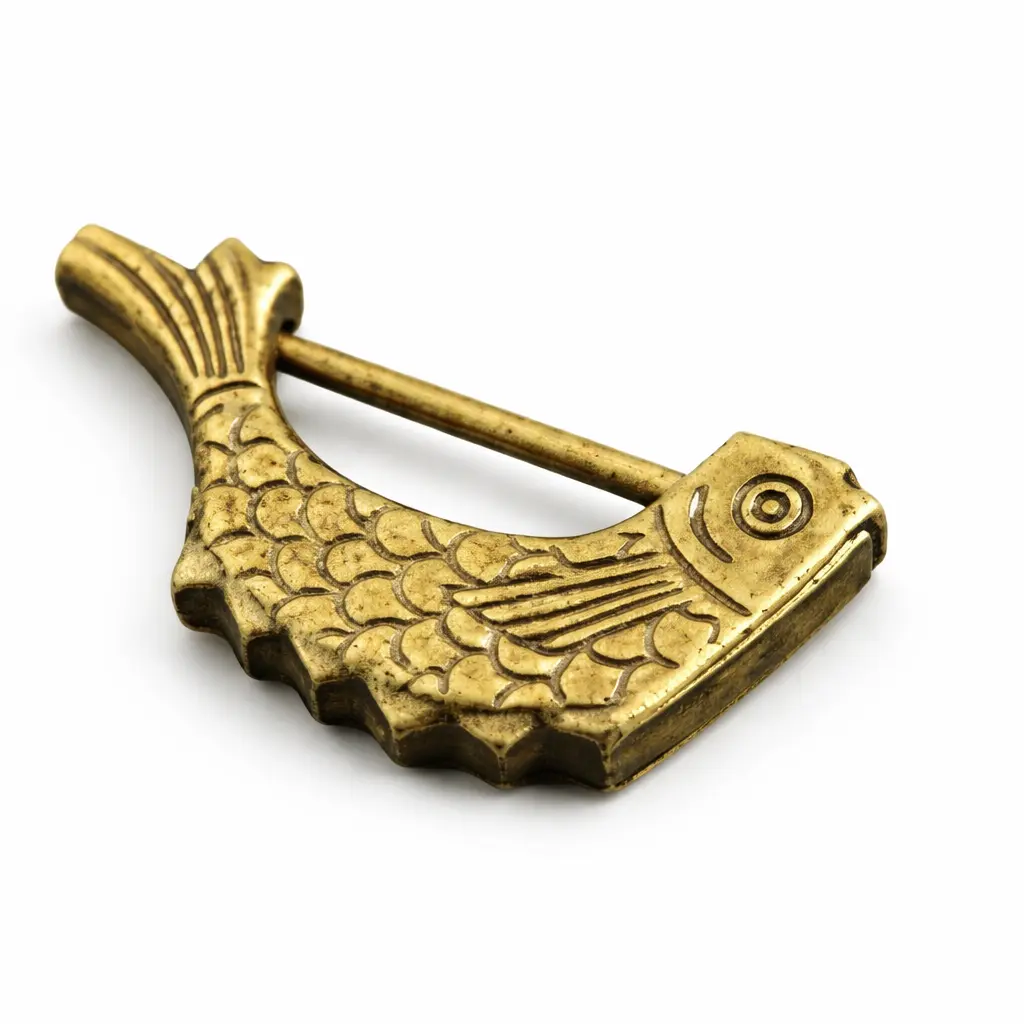
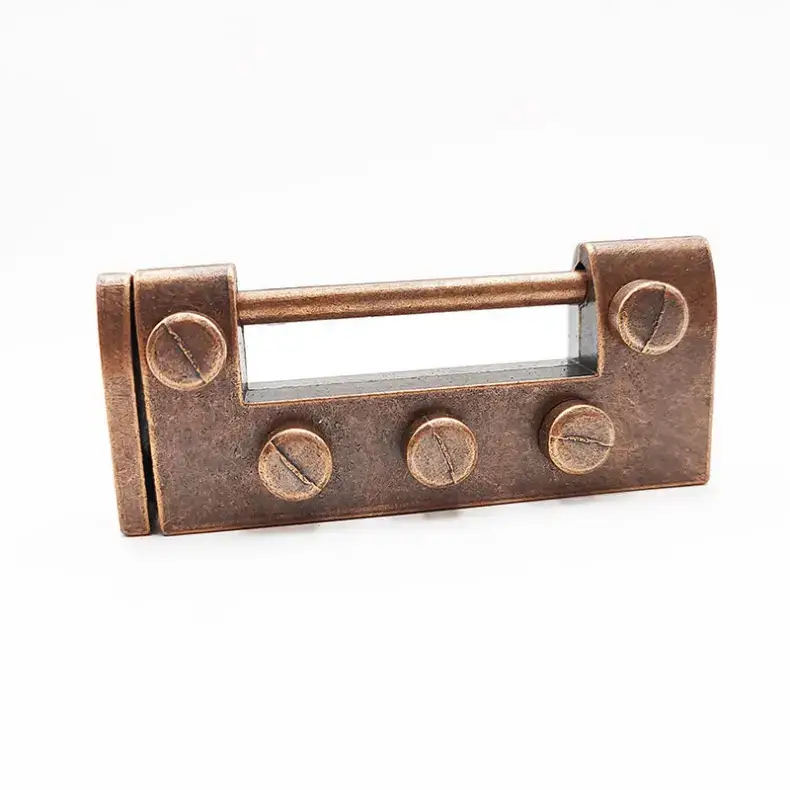
Chinese Koi Puzzle lock — $16.99
Chinese Koi Puzzle Lock are a masterclass in humility. You pick it up, turn it over, and hear the gentle, taunting rattle of internal parts. It feels solid, seamless. There are no visible keyholes, no obvious buttons, no sliding panels. Just a beautifully carved koi fish and a series of flush, polished plates. As one Redditor on r/mechanicalpuzzles perfectly captured the universal starting sentiment: “It just sits there, looking at you, daring you to figure it out.” This is the “mid-level challenge” promised by retailers like Kubiya Games and Logica Puzzles in the SERP—not a child’s toy, but not a soul-crushing, months-long ordeal either. It’s the sweet spot where the puzzle feels approachable yet immediately impenetrable.
The initial phase is pure exploration, or what seasoned solvers call the “fiddling stage.” You press everything. You try to twist the fish’s tail, slide its scales, and rotate the end caps. Nothing gives. This is the first intentional dead end. The designer is teaching you a crucial lesson: brute force and random manipulation are useless. The mechanism is a logical sequence, and it demands observation. The breakthrough, the first genuine eureka, comes not from moving something, but from noticing something. A particular component has a different weight, a subtler sound when tapped, or a microscopic seam that others lack. Discovering the true first step is immensely satisfying because it feels earned—you didn’t get lucky; you deduced it.
From there, the journey becomes a rollercoaster. Each solved step reveals a new, previously invisible obstacle. You’ll hit walls. One mechanism will unlock, but the next will refuse to budge, leading to the classic puzzle-box solvers’ lament: “I know I did something, but now what?” You backtrack, re-checking earlier steps, convinced you’ve broken it. This is where the Koi Lock distinguishes itself from simpler gift-card boxes. On Amazon, many “secret boxes” have a single, often obvious, trick—slide a panel, align a magnet. The Koi Lock employs sequential discovery, where each solved stage provides a tool or insight mandatory for the next. You’re not just finding steps; you’re collecting a mental toolkit.
The emotional arc mirrors a condensed escape room experience. Frustration (“This is impossible”) gives way to focused determination (“There must be a clue here”). Then comes the second-tier frustration of overthinking—you’ll invent wildly complex theories when the solution is elegantly simple. The pivotal moment, the core of the “mid-level” rating, is that the solutions are always logical and fair. Unlike some brutal Level 10 puzzles from Puzzle Master that might require abstract, almost mystical thinking, the Koi Lock’s clues are embedded in the physicality of the device itself. The “aha!” moments come from realizing a connection between two seemingly independent parts, a connection that, in hindsight, feels brilliantly obvious.
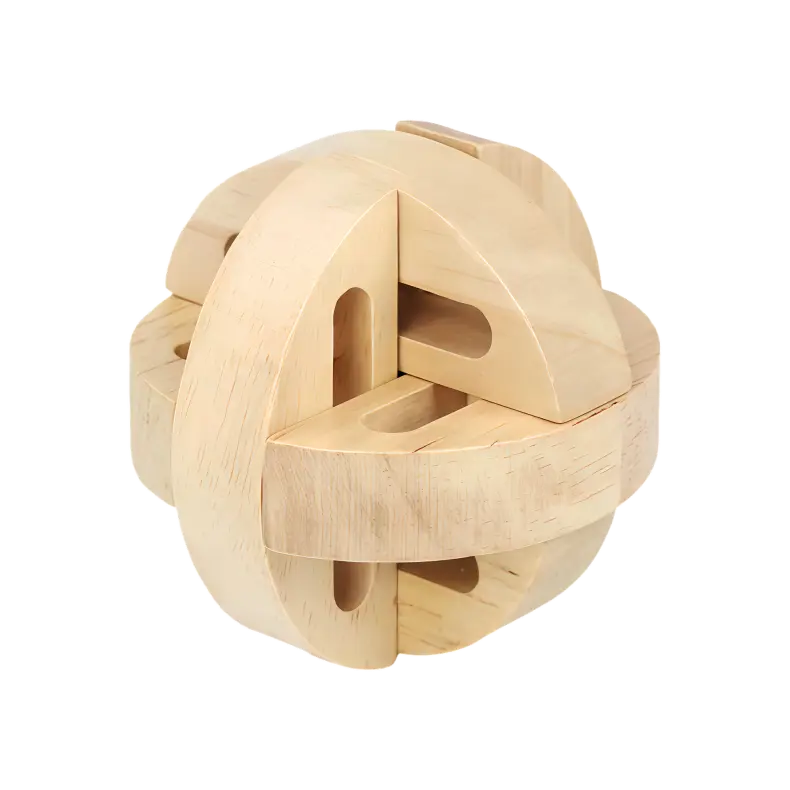
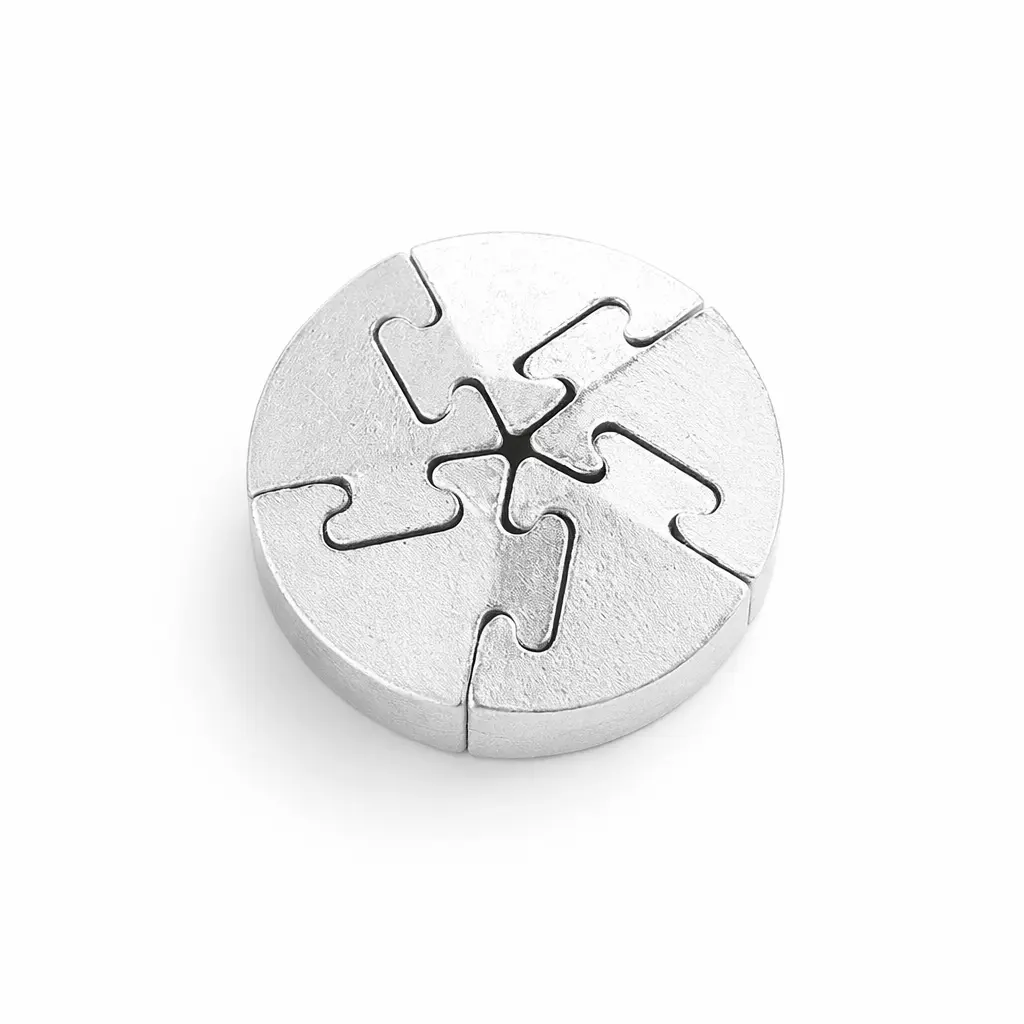
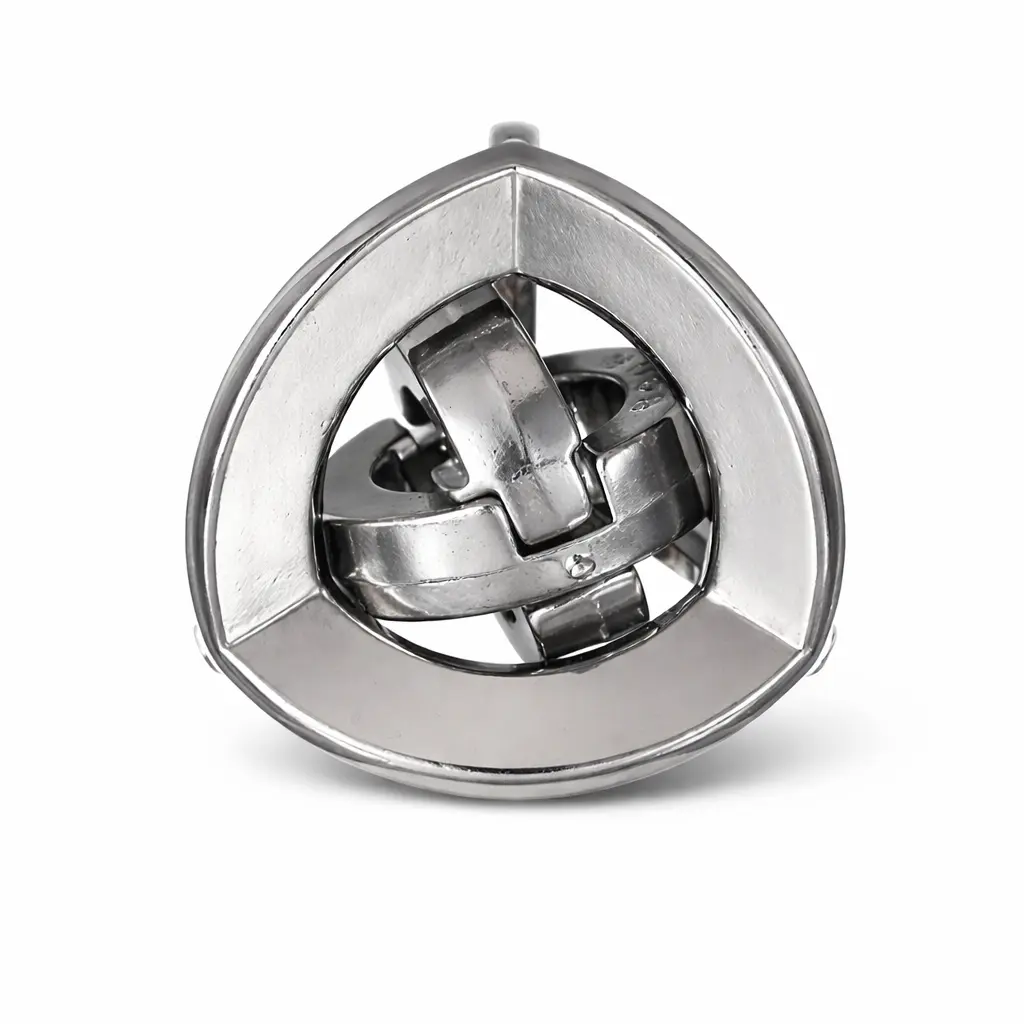
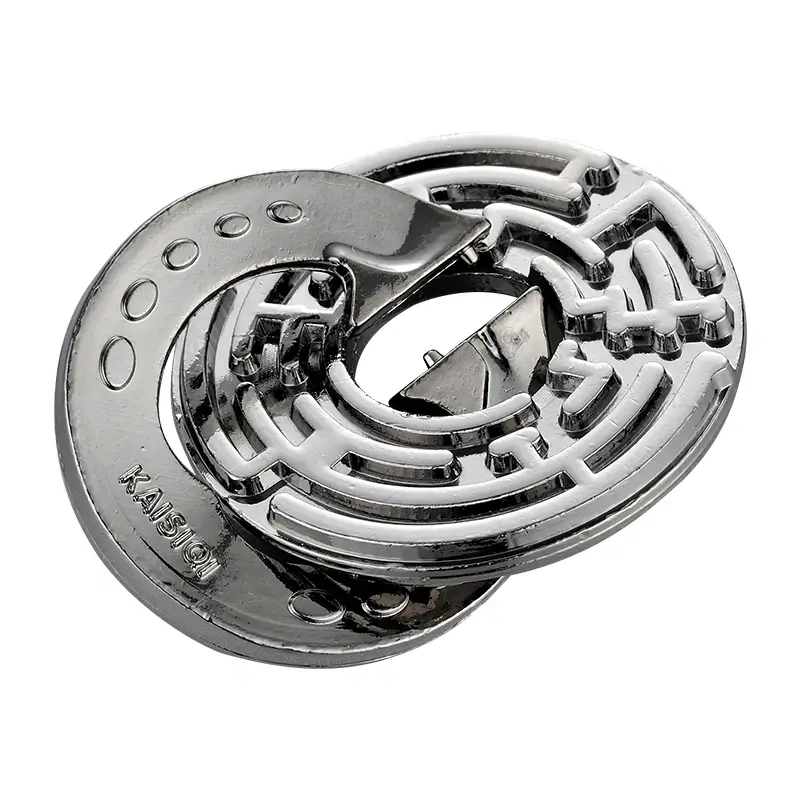
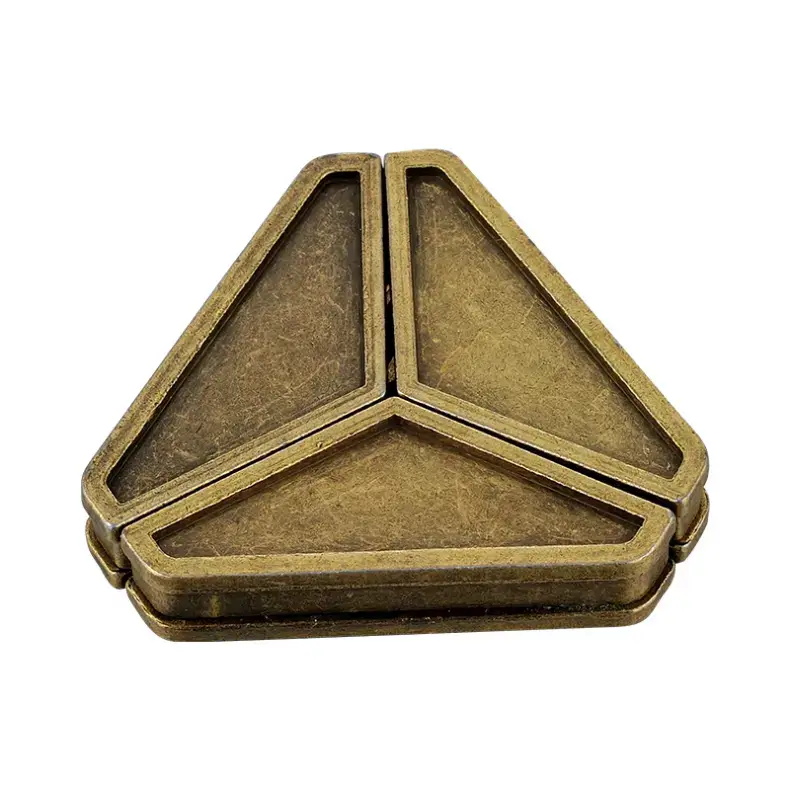
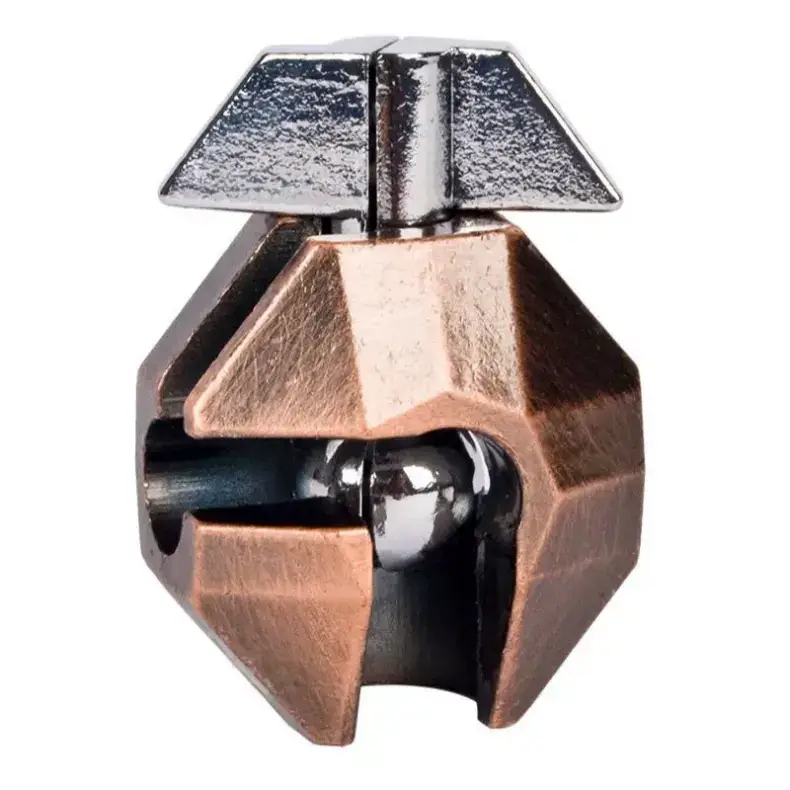
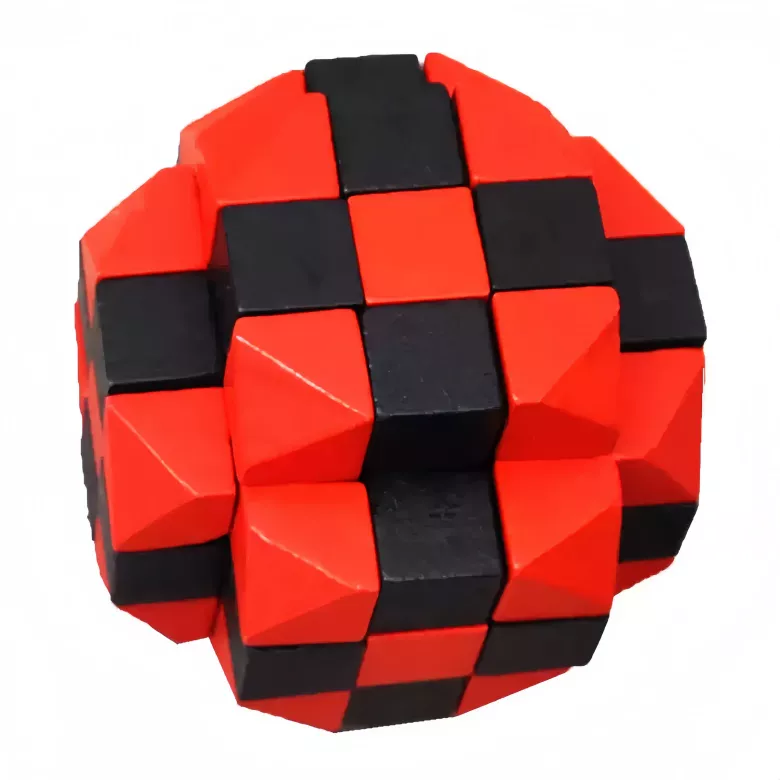
The Mystic Orb Lock — $16.99
My own journey had a standout moment of sheer delight involving a sound. After progressing through several stages, I was stuck again. I shook the lock gently, listening. A faint, distinct metallic click came from a specific area, but only when held in a certain orientation. It wasn’t a rattle; it was a deliberate click. That auditory clue was the key. It revealed a hidden relationship between gravity, alignment, and a component I’d already unlocked. It was a flawless piece of mechanical storytelling. This is what enthusiasts on discussion forums crave: that feeling of the designer communicating with you through the puzzle itself, rewarding careful observation over frantic action.
The final stage, the actual opening, is often an anti-climax in cheap boxes—a compartment springs open with a cheap thrill. Here, it’s different. The last movement is typically a smooth, precise action that aligns everything perfectly. The lock doesn’t just pop; it yields. The internal compartment is revealed not with a bang, but with a quiet, respectful acknowledgment that you’ve followed the path. You haven’t defeated it; you’ve understood it.
This 30-60 minute journey is the product’s true value. It’s not about what you hide inside (the space is tiny, suited for a single key or a folded bill). It’s about the cognitive satisfaction, the story you’ll tell about being stuck and the breakthrough. As noted in our internal reference on patience and puzzle boxes, impatience is the only true enemy. The Koi Lock is a perfect teacher of that principle. It’s a tangible, hands-on lesson in persistence, logic, and the profound satisfaction that comes from a challenge fairly presented and fairly overcome. For the price, it delivers a narrative of frustration and triumph that far outweighs its physical dimensions.
Who Is This Puzzle Box Really For? (And Who Should Skip It)
After spending hours with the Chinese Koi Puzzle Lock, its true audience—and its poor fits—become crystal clear. This isn’t a generic novelty. Its value is entirely scenario-dependent. Based on the commercial intent SERPs, which heavily promote puzzle boxes for gifting and as “stash boxes,” it’s crucial to cut through the marketing and match this specific object with the right human.
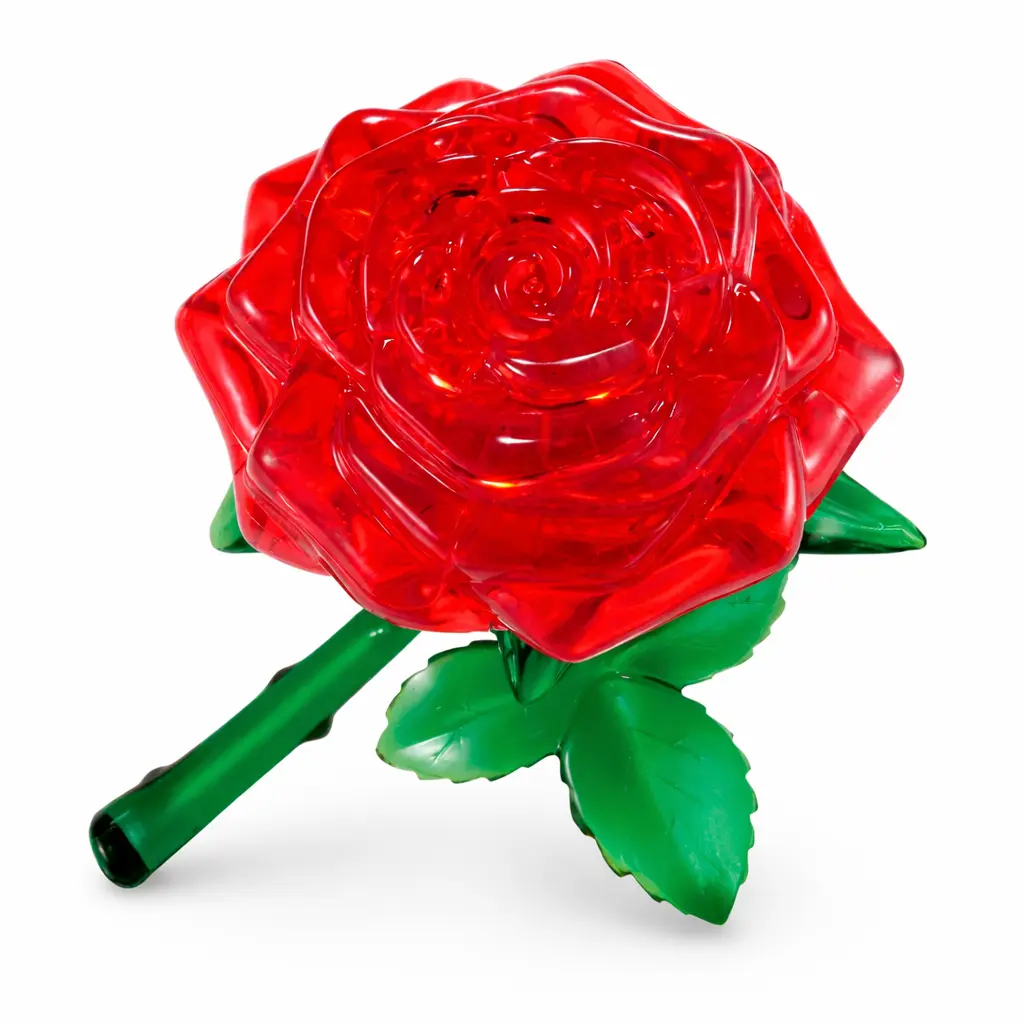
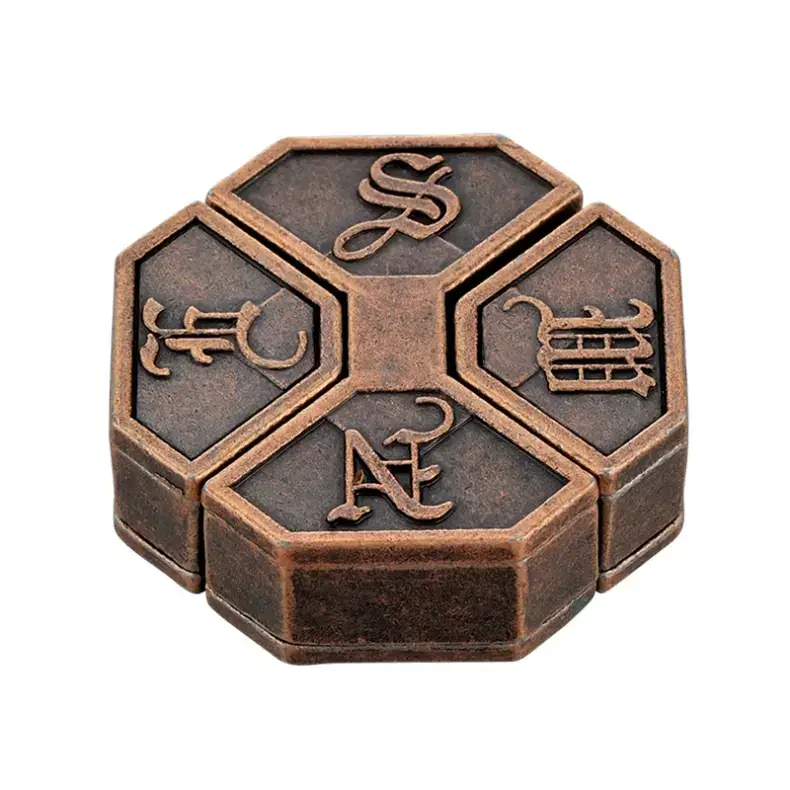
3D Crystal Rose Puzzle — $19.99
The Ideal User: The Thoughtful Gift-Giver (Who Knows Their Recipient)
This is the prime candidate. You’re not just buying a box; you’re buying an experience to give. It’s perfect for birthdays, graduations, or holidays where you want the gift to be the activity itself, not just an item. Instead of just handing over a gift card or cash, you lock it inside. You’re gifting 30-60 minutes of engaged, focused curiosity. The recipient gets the dual reward of the mental challenge and the prize. This aligns perfectly with the “ideal money box” and “gift card holder” angles seen on Amazon and Creative Escape Rooms. However, the key is knowing the recipient enjoys a tactile, logical challenge. As our internal reference on the common dilemma gift-givers face notes, a mismatch here leads to frustration, not delight. For the right person—the one who likes escape rooms, riddles, or Legos—this gift is a memorable home run.
The Ideal User: The Budding Puzzle Enthusiast Stepping Up
You’ve done a few basic wooden puzzles or enjoy casual brain teasers. The Koi Lock Box is your perfect “next level” purchase. It’s a legitimate, mid-difficulty sequential discovery puzzle that introduces core concepts of non-linear thinking and hidden mechanisms without the brutal, months-long challenge of a high-end collector’s piece (like those from Cubic Dissection or Eric Fuller, referenced in the Review Intent SERP). It’s a substantial step above a simple trick box with one sliding panel. Solving it builds confidence and provides a authentic taste of the mechanical puzzle hobby. The craftsmanship is good enough to feel premium but at a price point that isn’t a terrifying entry fee.
The Ideal User: The Collector Seeking a Display-Worthy, Affordable Piece
While not a hand-made artisan masterpiece, the Koi Lock’s thematic design and solid construction make it a worthy addition to a shelf of curiosities. Its function as a conversation starter is high. You can hand it to a guest and watch them engage with it, something you might not do with a fragile or extremely valuable puzzle. It’s a “playable” collectible.
Who Should Skip It: The Person Seeking Simple, Secure Storage
If you just want a cool box to hide jewelry, a spare key, or trinkets, look elsewhere. The internal compartment is tiny and, more importantly, accessing it requires solving the puzzle every single time. This is not a convenient stash box. The commercial listings touting it as a “jewelry box” are misleading for practical, daily use. You will grow to resent the mechanism if you need your house key in a hurry.
Who Should Skip It: Parents Buying for Young Children
Despite the “brain teaser” label, this is not a child’s toy. The mechanisms require fine motor control, patience, and the ability to endure frustration without forcing parts. It will end up broken or discarded. For a younger puzzle fan, a simpler, more colorful, and durable option is better.
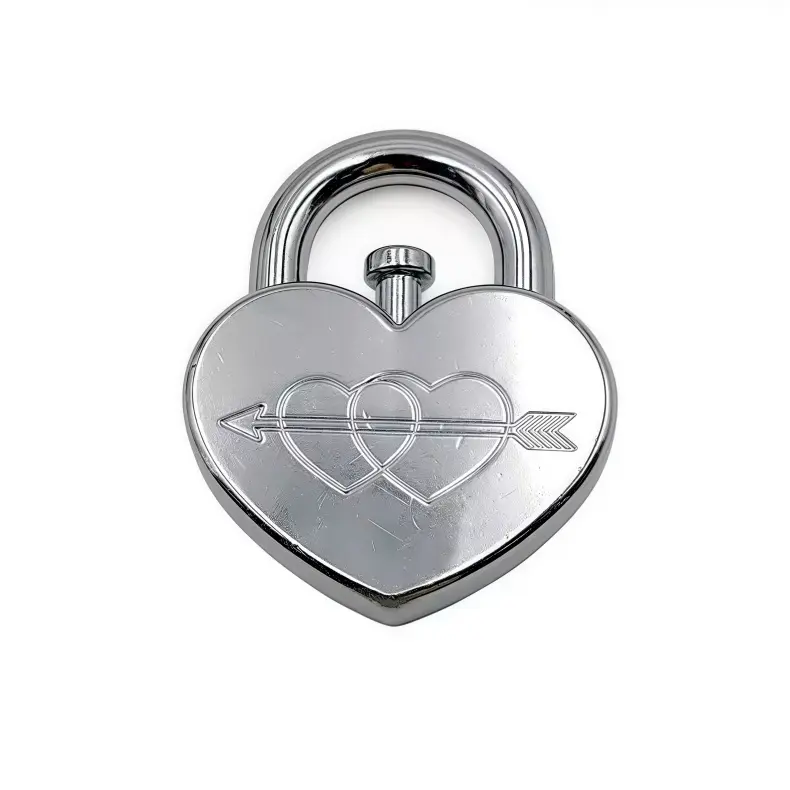
Who Should Skip It: The Instant Gratification Seeker (Consider This Instead)
If the narrative of frustration and breakthrough described in the previous section sounds tedious, not appealing, this box is not for you. You want the “aha!” moment without the “ugh…” phase. In that case, consider a purely decorative or simpler novelty item. For example, a product like the Silver Heart Lock Puzzle offers a similar aesthetic and the concept of a puzzle lock but typically at a much lower difficulty and price point, serving more as a cute trinket than a true mechanical challenge. It’s for the person who likes the idea of a puzzle more than the execution.
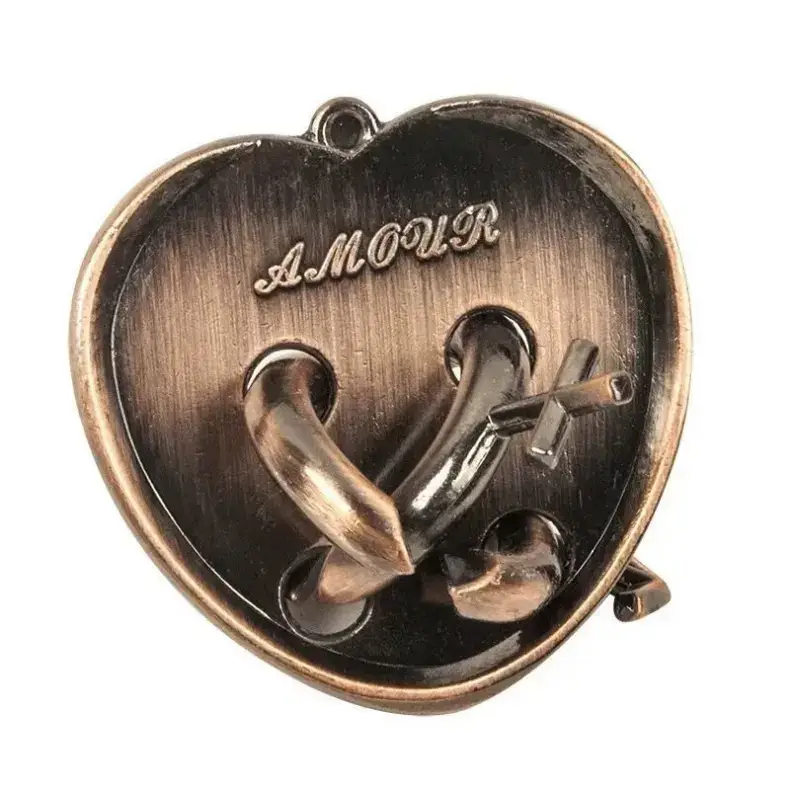
The Verdict: A Purpose-Driven Purchase
The Chinese Koi Puzzle Lock Box is a specialist tool for creating a specific experience. It fails utterly as generic storage and succeeds brilliantly as an engaged gift or a personal skill-builder. Your buy/skip decision hinges entirely on aligning the product’s core offering—a patient, logical, hands-on journey—with the user’s actual desires. For the right person, it’s a home run. For the wrong one, it’s a confusing, frustrating paperweight. Know which camp you (or your giftee) are in.
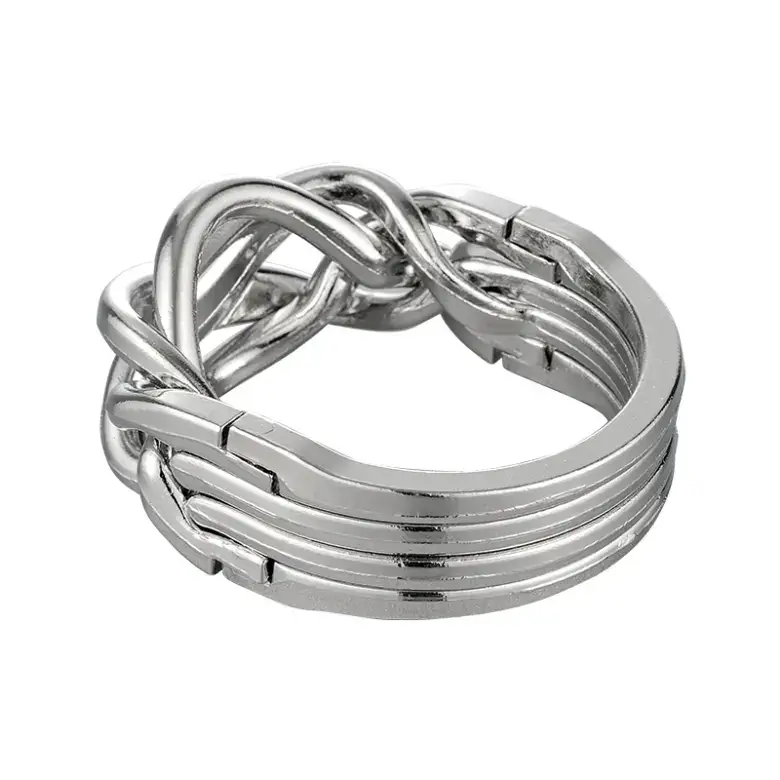
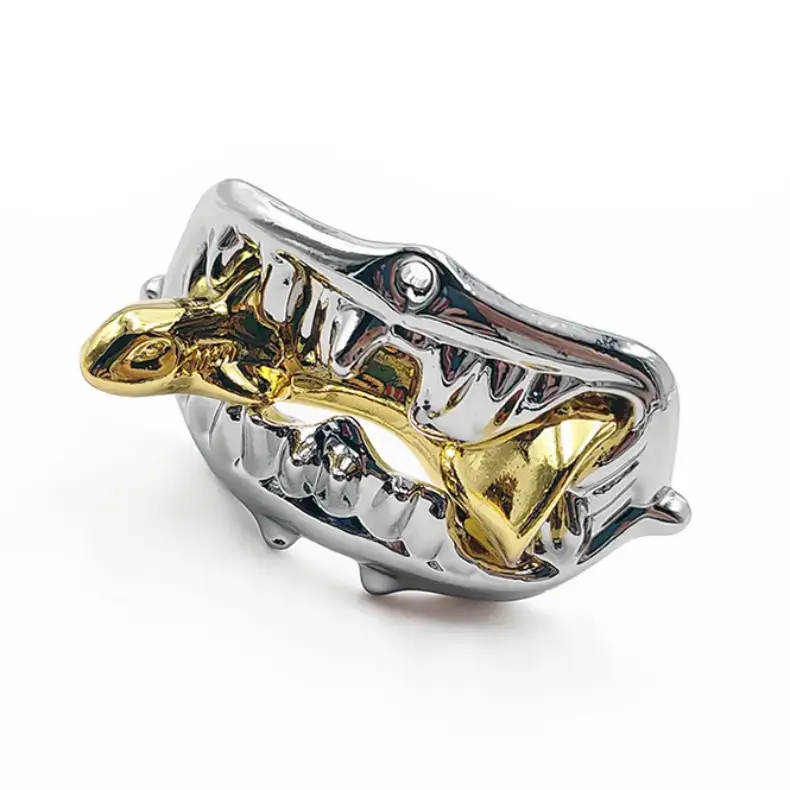
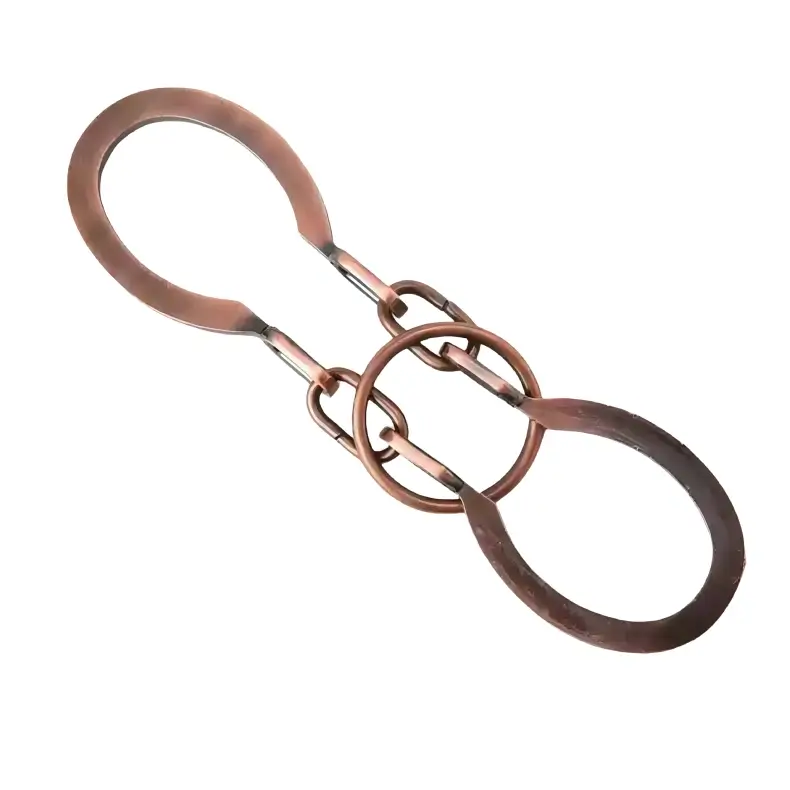
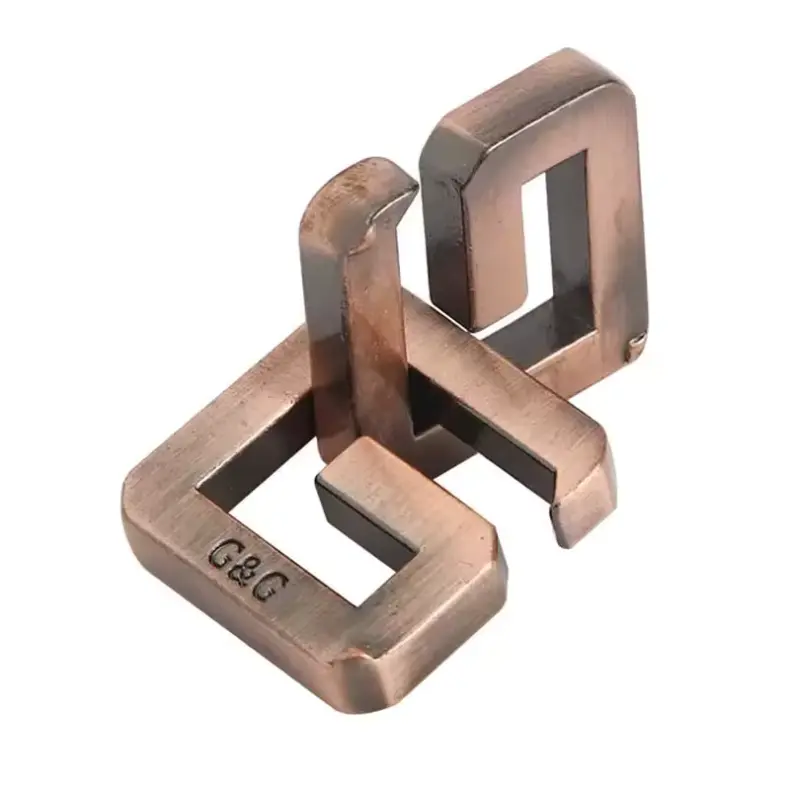
4 Band Puzzle Ring — $11.99
Common First-Timer Mistakes and How to Avoid Them
The gap between a puzzle box being “engaging” and “infuriating” is often bridged by a few simple, avoidable errors. Product listings tout the challenge but rarely offer the crucial, hands-on wisdom that prevents frustration. Based on solving this box and others like it, here are the most common pitfalls and how to sidestep them.
1. Applying Force (The Cardinal Sin)
This is the fastest way to damage a finely crafted wooden mechanism. If something isn’t moving, the answer is never to push, pull, or twist harder. The Koi box, and quality sequential discovery puzzles in general, are designed to operate with minimal, deliberate force. If you’re straining, you’ve missed a step or are operating a component in the wrong order or direction. The Fix: Stop. Put the box down. Re-examine every surface and movable part. The solution path is a logic chain; brute force breaks the chain.
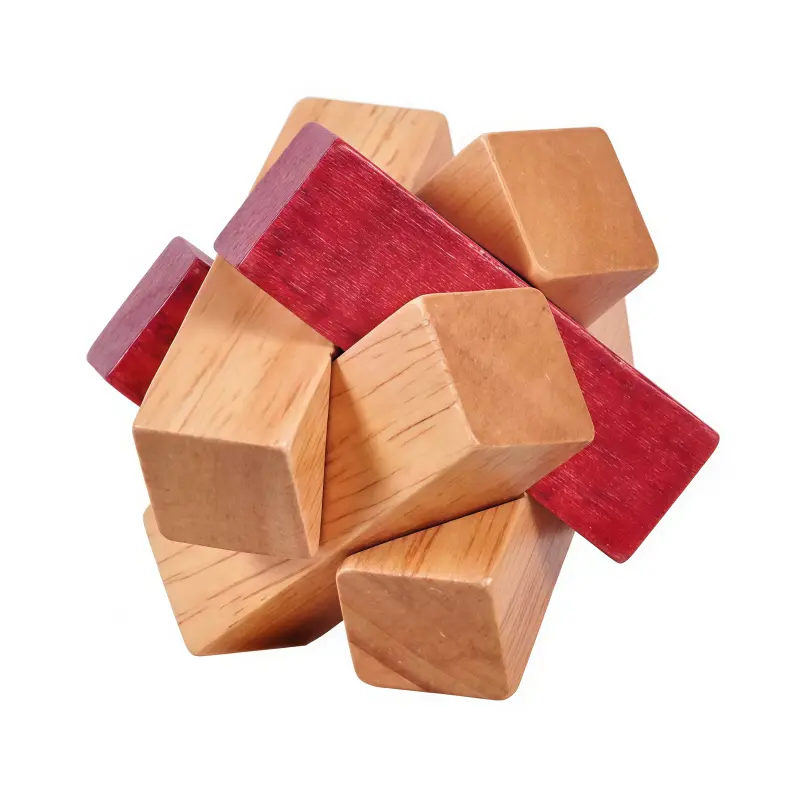
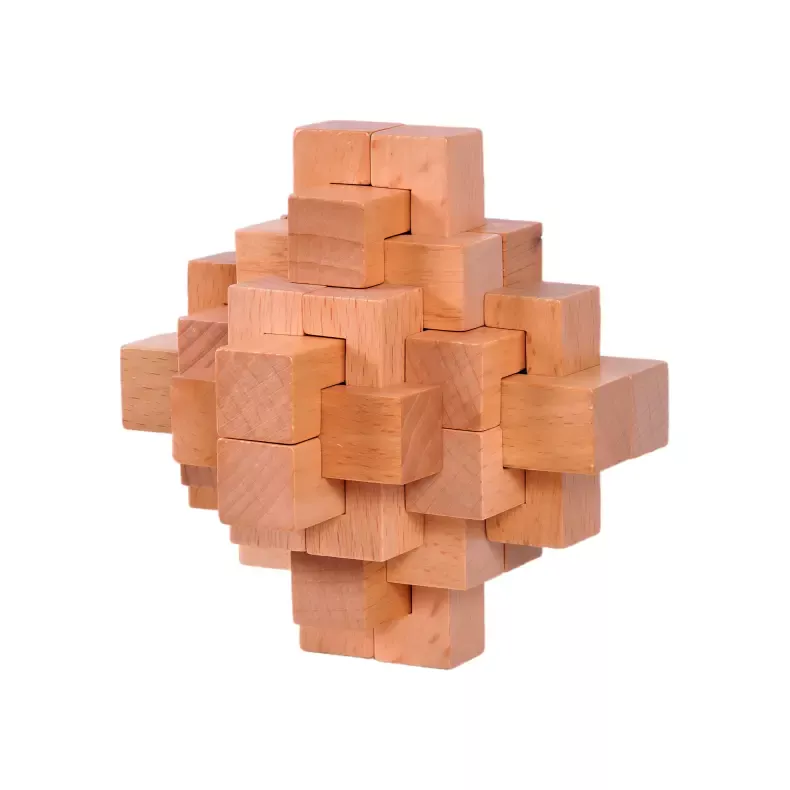
Wood Knot Puzzle — $16.99
2. Overlooking Tactile and Auditory Feedback
In the quiet focus of solving, you become a detective. Subtle clicks, slight shifts in resistance, and even the sound of internal components aligning are your clues. Many first-timers operate components visually but ignore what their fingers and ears are telling them. A rod that slides just a millimeter further under light pressure, or a faint click when a panel is tapped in a specific spot, is the puzzle communicating. The Fix: Slow your movements to a crawl. Feel for changes in friction and listen for any sound. These are intentional design features, not manufacturing quirks.
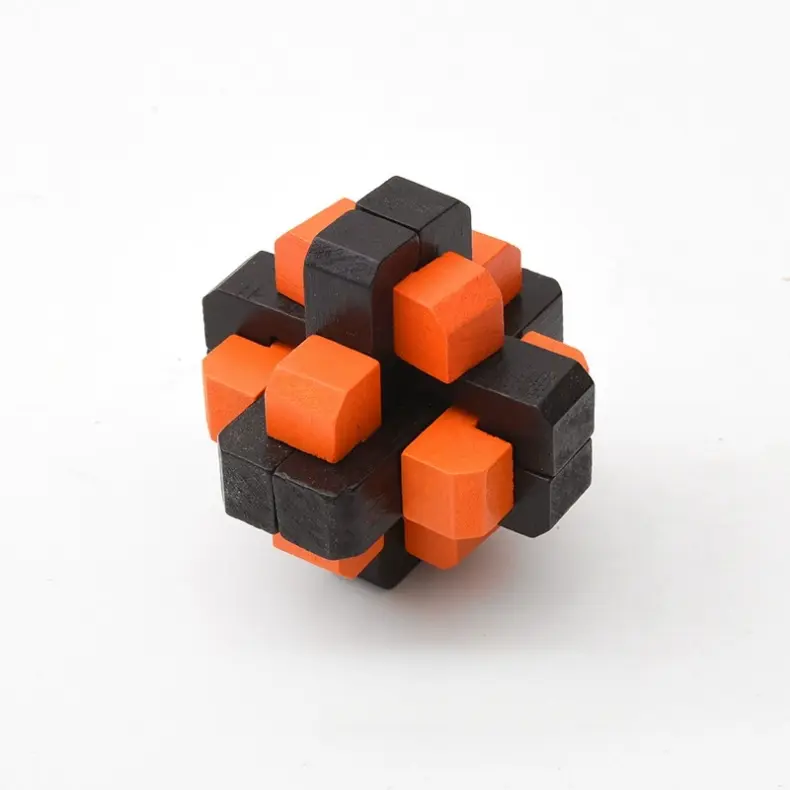
Looking Back — $16.99
3. Misunderstanding the “Reset”
You finally got it open! Then you close it, hand it to a friend, and… it’s jammed. Or it opens too easily. This usually means the reset was incomplete. Sequential puzzles often require you to retrace your steps in reverse to re-engage all locking mechanisms properly. Simply slamming the lid shut likely leaves internal pins, sliders, or magnets out of position. The Fix: After opening, methodically work backwards through each step you discovered to return every component to its starting, locked state. Test that it’s truly locked before passing it on.
4. Assuming Linearity
The “sequential” in sequential discovery doesn’t always mean “one step after another in a straight line.” Some stages require you to partially complete one action to enable another, then return to the first. Getting stuck on a single operation for too long can mean you need to explore other movable parts you’ve already interacted with; their state may have changed. The Fix: Adopt a non-linear mindset. If a component seems stuck after initial movement, check every other component again. The state of the puzzle evolves.
5. Neglecting Foundational Puzzle-Solving Mindset
This is the meta-mistake. Approaching a complex mechanical puzzle with the same mindset as a quick brainteaser leads to burnout. The goal isn’t just to open the box; it’s to understand how it opens. This aligns with ancient principles of puzzle solving like Wu Wei (effortless action)—working with the mechanism’s design, not against it.
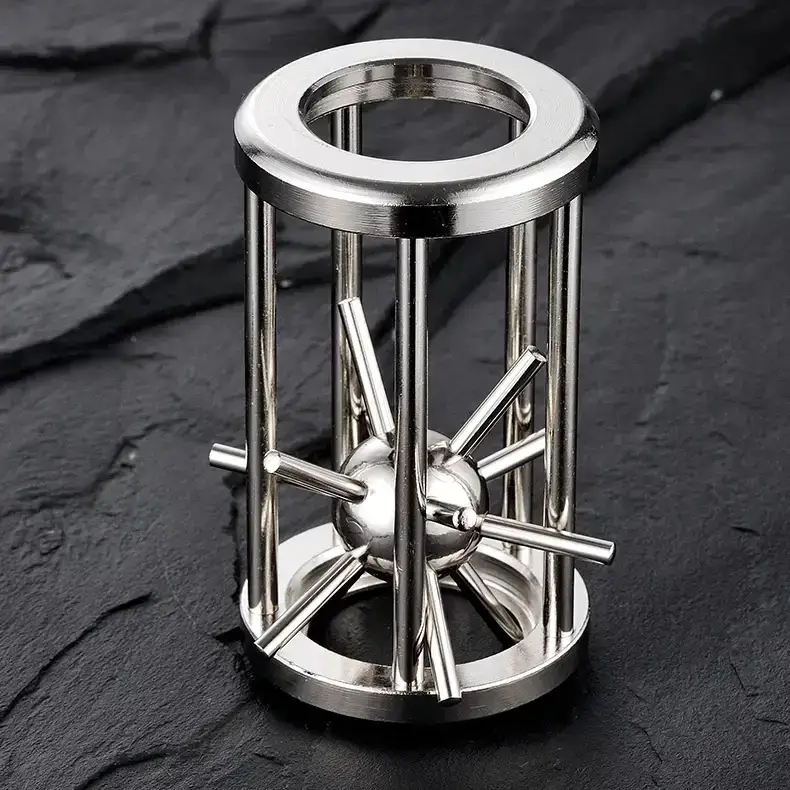
If you find the Koi box’s mechanism fascinating but want to practice this patient, tactile logic on a smaller scale first, consider a dedicated disassembly puzzle.
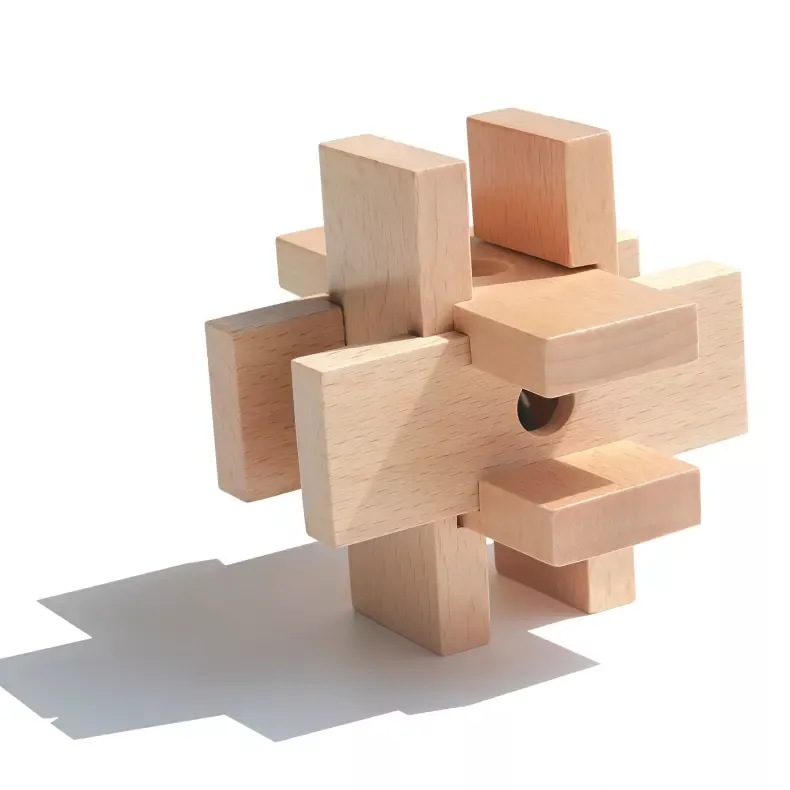
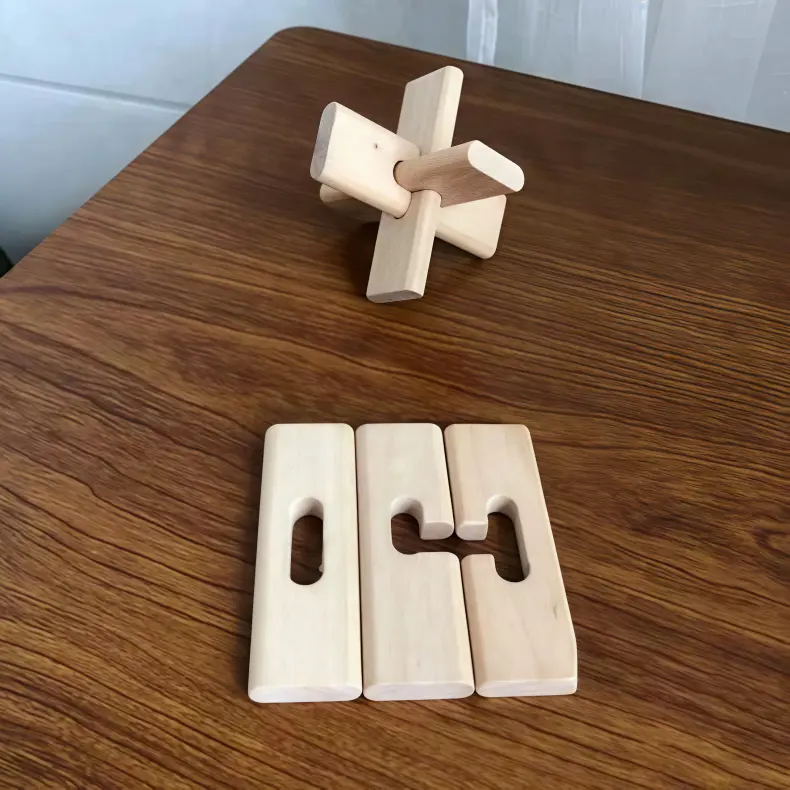
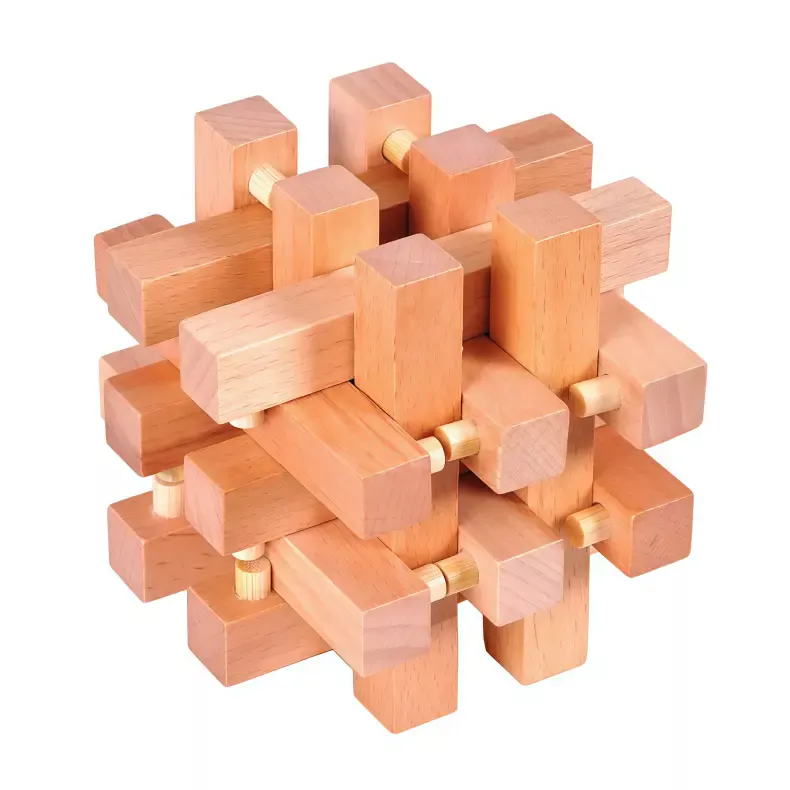
6 Piece Wooden Puzzle Key — $12.99
A product like the 6 Piece Wooden Puzzle Key is an excellent, affordable trainer. It removes the “box” element and focuses purely on the interplay of wooden pieces, teaching you to look for internal geometries and sequential dependencies without the pressure of a hidden compartment. Mastering a few puzzles like this builds the investigative habits that prevent the major mistakes above when you graduate to a full puzzle lock box.
Beyond the Puzzle: Using the Koi Box as a Gift & Keepsake Holder
Once the final panel slides open, the puzzle’s purpose shifts. The hidden compartment is revealed, and you’re faced with a practical question: what now? This is where many puzzle boxes fall short, offering a hollow victory and a trinket-sized space. The Koi box, however, earns its keep.
The internal cavity measures roughly 4.5 x 3 x 1.5 inches—a size that’s deceptively useful. It’s not for a watch or a ring box, but it’s perfect for the specific use cases plastered across commercial listings: folded cash, standard gift cards, a USB drive, a sentimental note, or small, flat jewelry like earrings or a pendant. The “security” post-solve is psychological; only someone who knows the precise sequence can reopen it, making it a clever stash for items you’d like to keep semi-private but not fortress-secure. It’s less about theft deterrence and more about creating a personal, tactile secret.
This transforms it from a one-time brain teaser into a reusable conversation piece. Imagine gifting it with a cash wedding present inside—the recipient gets the thrill of the solve and the reward. Afterward, they can reuse it to present a gift card to someone else, creating a chain of interactive giving. This is the core value proposition that justifies the price over a simpler box: it’s an experience and a functional artifact. As explored in our piece on using a puzzle box as a gift wrapper, the delayed gratification builds story and significance around the gift itself.
However, if your primary need is secure, repeated storage rather than the puzzle experience, a dedicated locking box is a better fit. The Koi box’s mechanism, while durable, isn’t designed for dozens of daily openings.
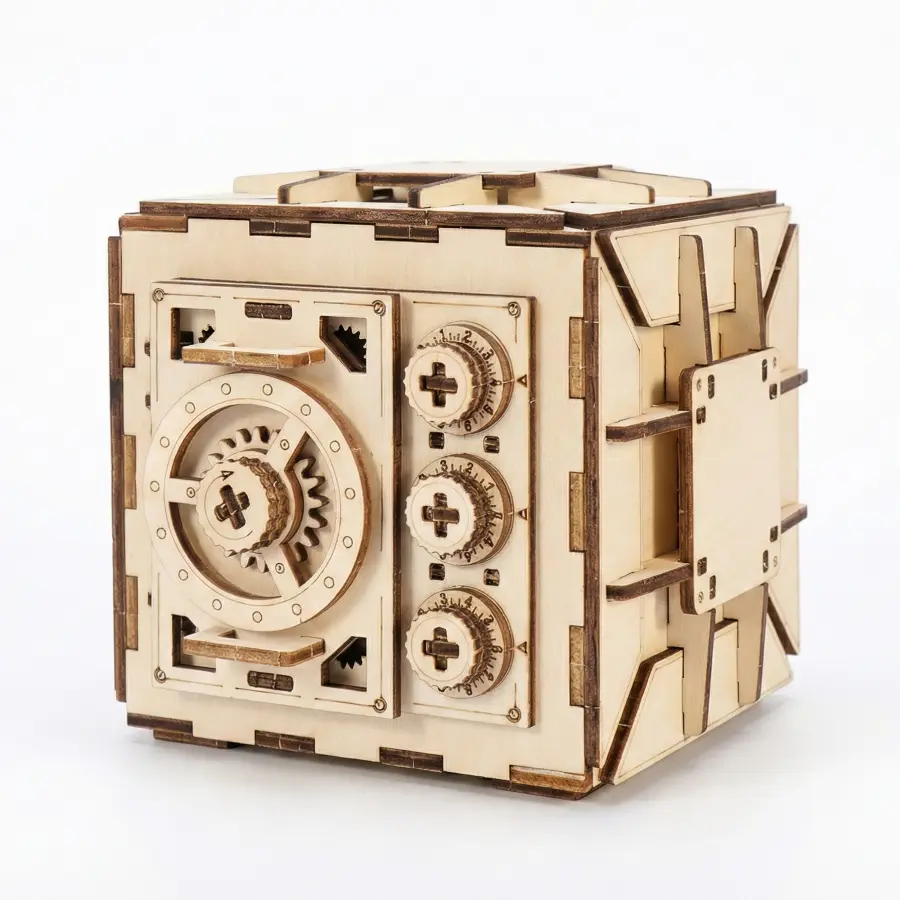
For a blend of puzzle and more robust, lockable storage, consider a design like the 3D Wooden Puzzle Safe with Combination Lock. It offers a larger, more accessible compartment and a traditional combo lock for repeated use, though its assembly and puzzle complexity are generally lower than the Koi’s sequential discovery. It’s a choice between a premium, intricate puzzle that doubles as a keepsake holder, versus a more storage-focused, build-it-yourself puzzle container.
Ultimately, the Koi box’s post-solve utility amplifies its worth. It doesn’t become a dust-collector; it becomes a special-occasion box, a family heirloom for passing down small treasures, or a novel alternative to an envelope. That lasting role is what turns a satisfying solve into a worthwhile purchase.
Koi vs. The Field: How It Stacks Up Against Other Puzzle Locks
The puzzle lock market is a broad church, ranging from cheap impulse buys to collector-grade art. Placing the Chinese Koi box within this landscape is crucial for understanding its value. It doesn’t exist in a vacuum; its worth is defined by what you’re comparing it to. Let’s break it down against three common categories.
1. Versus Mass-Market “Secret Boxes” (Amazon/Etsy)
Scrolling through Amazon results for “puzzle lock box” reveals a sea of similar-looking wooden boxes, often with phrases like “double magic box” or “secret compartment.” These are typically inexpensive, sub-$25 items. The core difference is in the mechanism and longevity. Most mass-market boxes rely on a single, often obvious, sliding panel or magnet trick. Once solved, the surprise is gone, and the build quality often feels flimsy—thin wood, loose fittings. The Koi box, in contrast, is a sequential discovery puzzle. It’s not about finding one trick; it’s a multi-step journey where each discovery enables the next, using the tools provided. The mechanism is more intricate, the “aha” moments are layered, and the solid wood construction feels like a permanent object, not a disposable novelty. You’re paying for a durable, re-solvable experience versus a one-time gimmick.
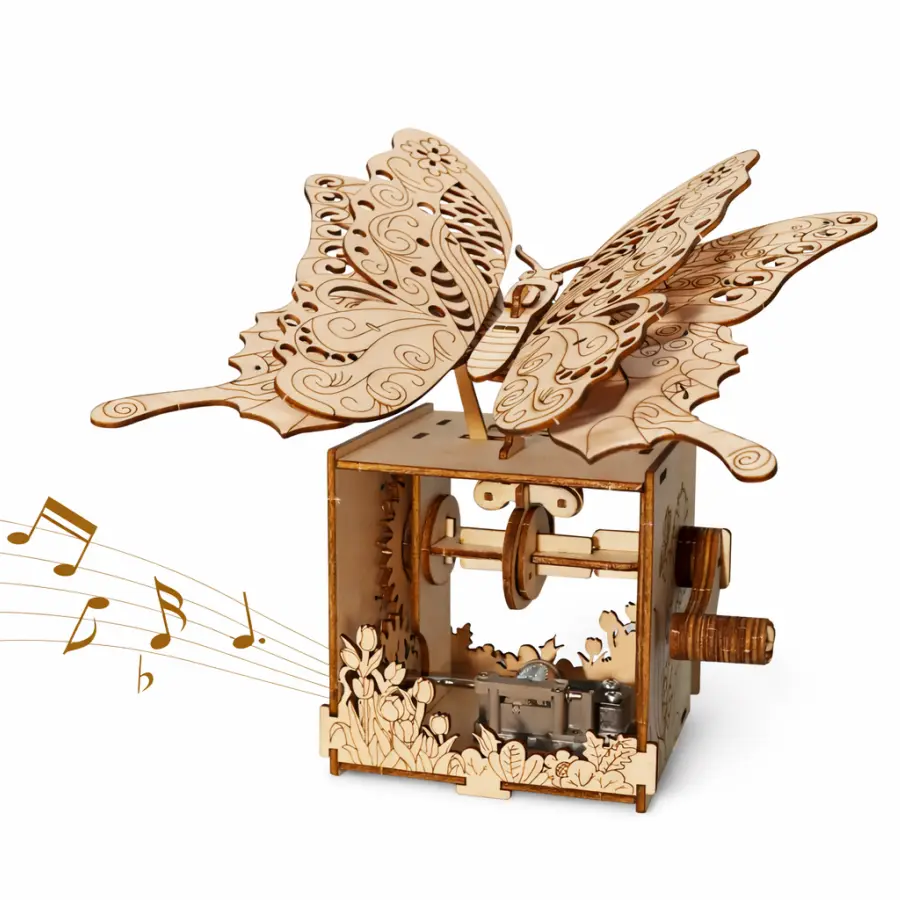
2. Versus High-Difficulty Sequential Discovery (Puzzle Master, Cubic Dissection)
On the opposite end are the premium, often brutally difficult sequential discovery puzzles from artisans like Eric Fuller or brands like Puzzle Master. These can cost hundreds of dollars and are designed for hardcore enthusiasts. The Koi box is a gateway to this world. It shares the sequential discovery philosophy but at a mid-level difficulty (around a 3/5). A puzzle like the “Lock Box by Eric Fuller” is an uncompromising challenge meant for seasoned solvers; the Koi box is approachable. It teaches you the language of this puzzle genre without the frustration that leads to a puzzle being shelved forever. It’s artful and engaging, whereas the high-end field prioritizes pure, often abstract, mechanical complexity over decorative theme.
3. Versus Build-It-Yourself Kits (Logica, 3D Puzzle Treasures)
This is where the choice becomes about your desired hands-on involvement. Kits like the SECRET LOCK BOX from Logica Puzzles or the 3D Wooden Puzzle Treasure Box combine assembly with the puzzle. You build the locking mechanism yourself, which is a puzzle in its own right (akin to a burr puzzle). The final product is a functional box. The Koi box comes fully assembled; the puzzle is purely in the opening, not the building. The DIY route offers more total engagement time and a deep understanding of the mechanism’s guts, but the final aesthetic is often more “craft project” than “finished art piece.” The Koi’s lacquered finish and detailed carving provide immediate visual appeal as a display object.
Navigating the Market Fit: A Quick Guide
* Choose the Koi Box if: You want a beautiful, ready-to-solve object that offers a substantive but not overwhelming challenge. It’s for those who appreciate theme and art alongside mechanics, and who see the box itself as a keepsake after solving.
* Skip the Koi for a Mass-Market Box if: Your budget is under $30 and the goal is a simple, one-time “wow” for a gift card. The experience is short-lived, but it fulfills a basic need.
* Skip the Koi for a High-End SD Puzzle if: You’re an experienced puzzler craving a deep, multi-hour (or day) mechanical challenge and are willing to invest significantly. Check out our roundup of the broader landscape of puzzle locks for collectors for direction.
* Choose a DIY Kit Instead if: The process of building is as important to you as solving, or you want a larger, more storage-focused puzzle container. The Luban Lock Set 9 Piece is another fantastic option in this vein, offering multiple traditional Chinese interlocking puzzles that teach core principles of wood joinery.
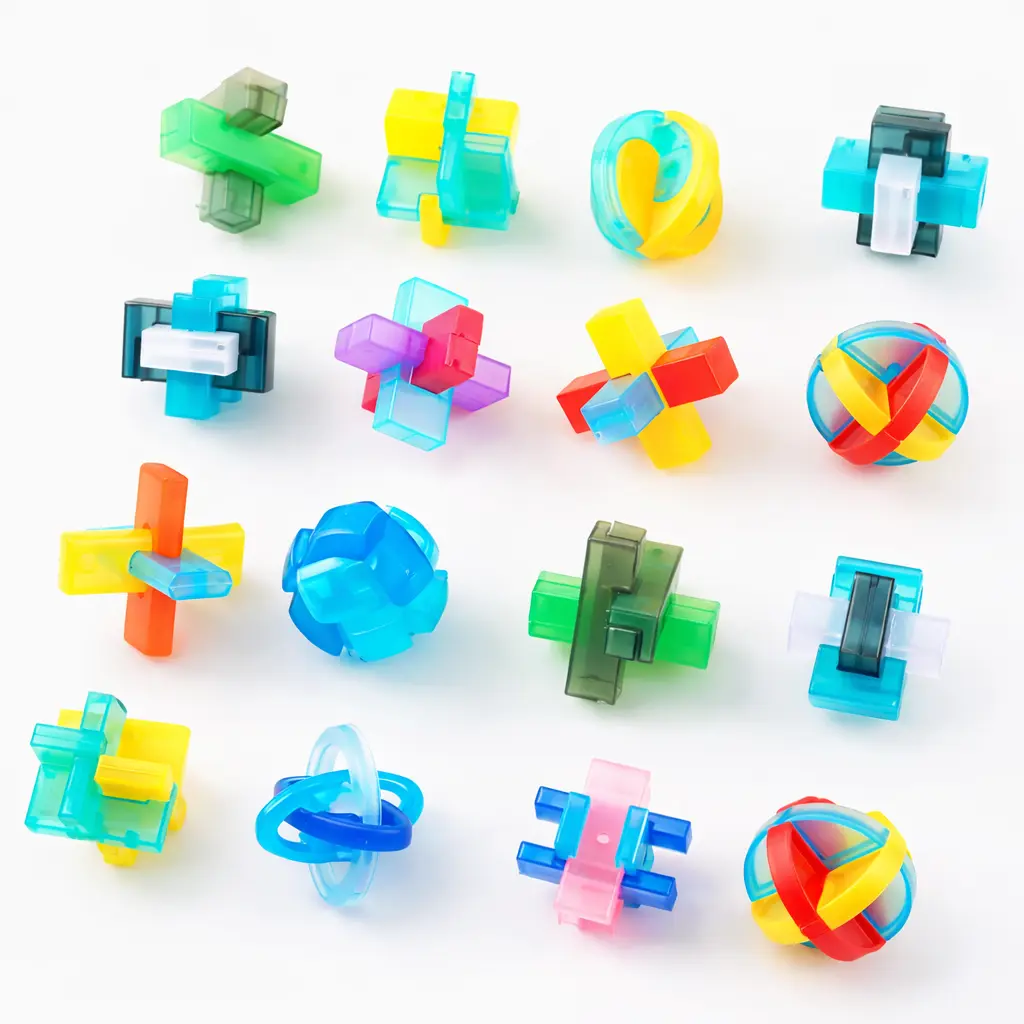
Ultimately, the Koi Puzzle Lock Box carves its niche as the accessible artisan option. It brings more mechanical sophistication and lasting quality than the discount bin, more thematic beauty than the austere high-end puzzle, and more out-of-the-box readiness than a DIY kit. It’s the ideal pivot point for someone moving from casual curios into the richer world of mechanical puzzles.
Frequently Asked Questions (FAQ)
How difficult is the Koi Puzzle Lock Box?
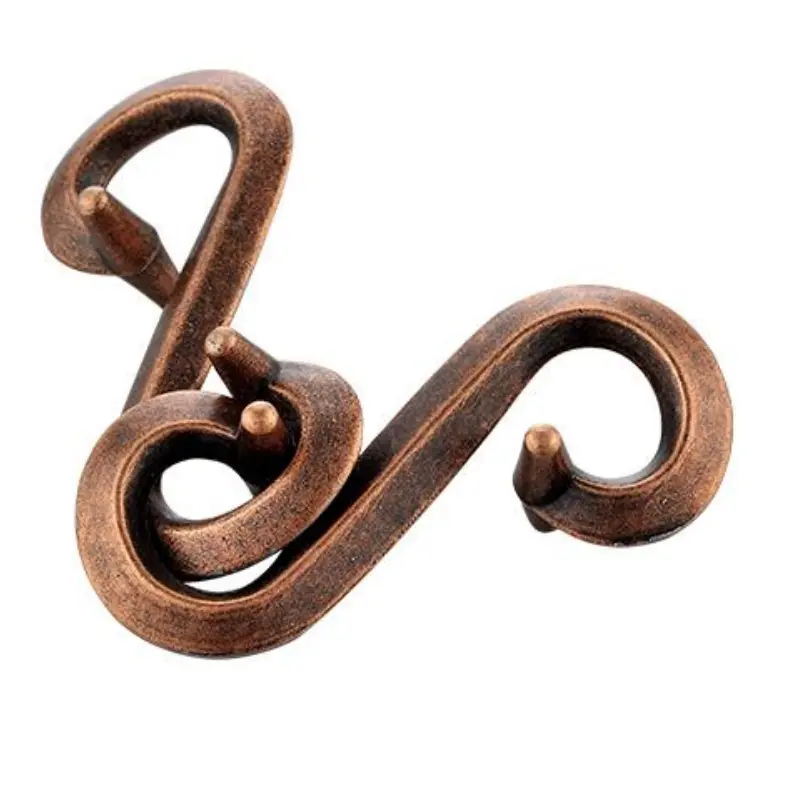
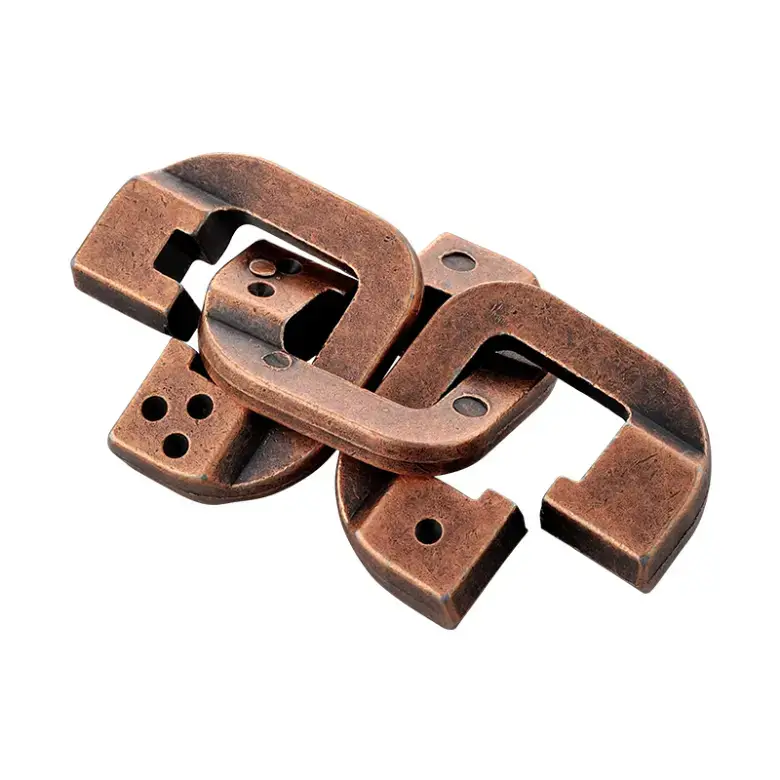
It’s a solid mid-level challenge, rated around a 3 out of 5 or 6 by most sellers. A complete beginner might take 30-60 minutes of focused trial and error, while someone familiar with mechanical puzzles could solve it in 10-20 minutes. The difficulty comes from understanding the mechanism’s logic, not brute force.
Is it strong enough to actually protect valuables?
Think of it as a clever stash box, not a safe. The wood is decent quality for its purpose, but the lid is held by a simple internal latch. It’s perfect for keeping a gift card, some cash, or small jewelry private from casual snooping, but it won’t withstand determined prying or being thrown in a backpack unprotected.
Can it be reset and reused easily?
Absolutely. This is one of its best features. Once you know the solution, resetting it takes seconds—just close the lid and scramble the dials. It’s fully repeatable, making it great for passing around friends or re-gifting the puzzle experience.
What if I get completely stuck? Are solutions available?
Yes, and don’t feel bad about looking. The solution is widely available online with a quick search. Many sellers also include a solution sheet in a sealed envelope. The goal is enjoyment, not frustration. If you’re stuck for more than an hour, a hint might save the experience.
Is it suitable for children?
For older kids (10+), yes, with supervision. The small parts (like the key) are a choking hazard for younger children. It’s an excellent brain-teaser for a patient child who enjoys logic, but the fine motor skills needed to manipulate the lock might frustrate very young ones.
How does it compare to other wooden puzzle boxes?

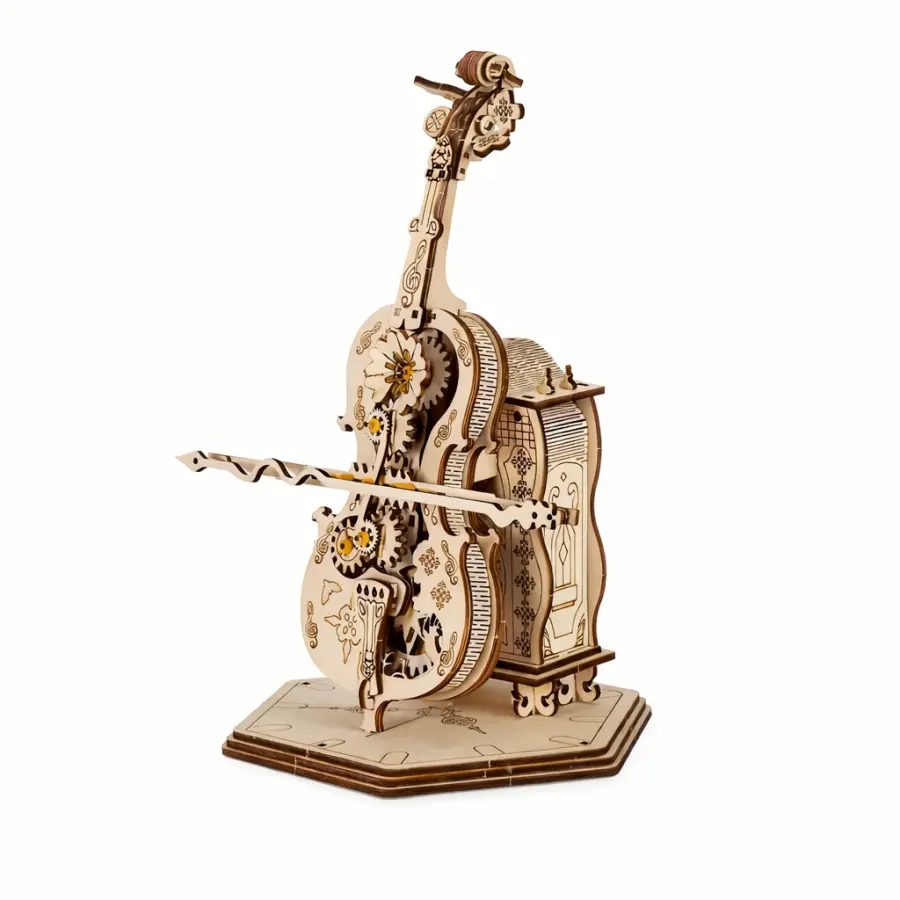
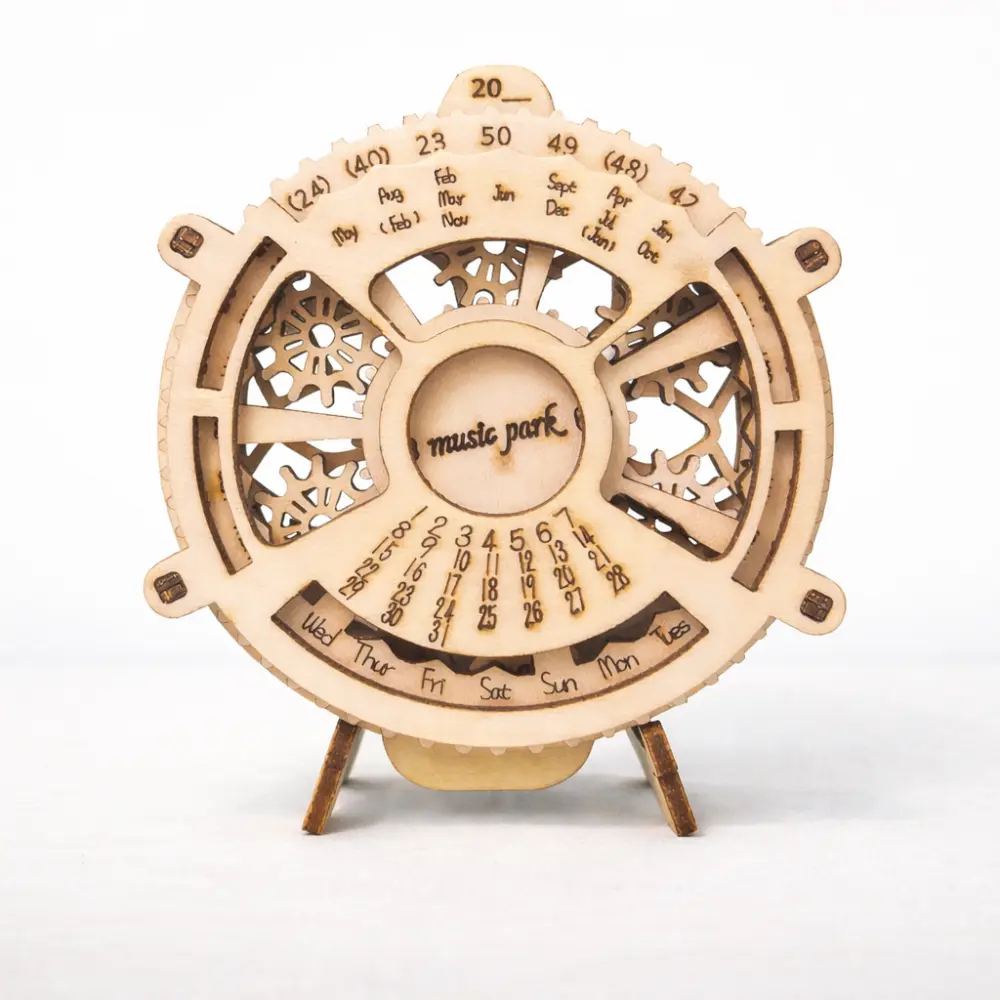
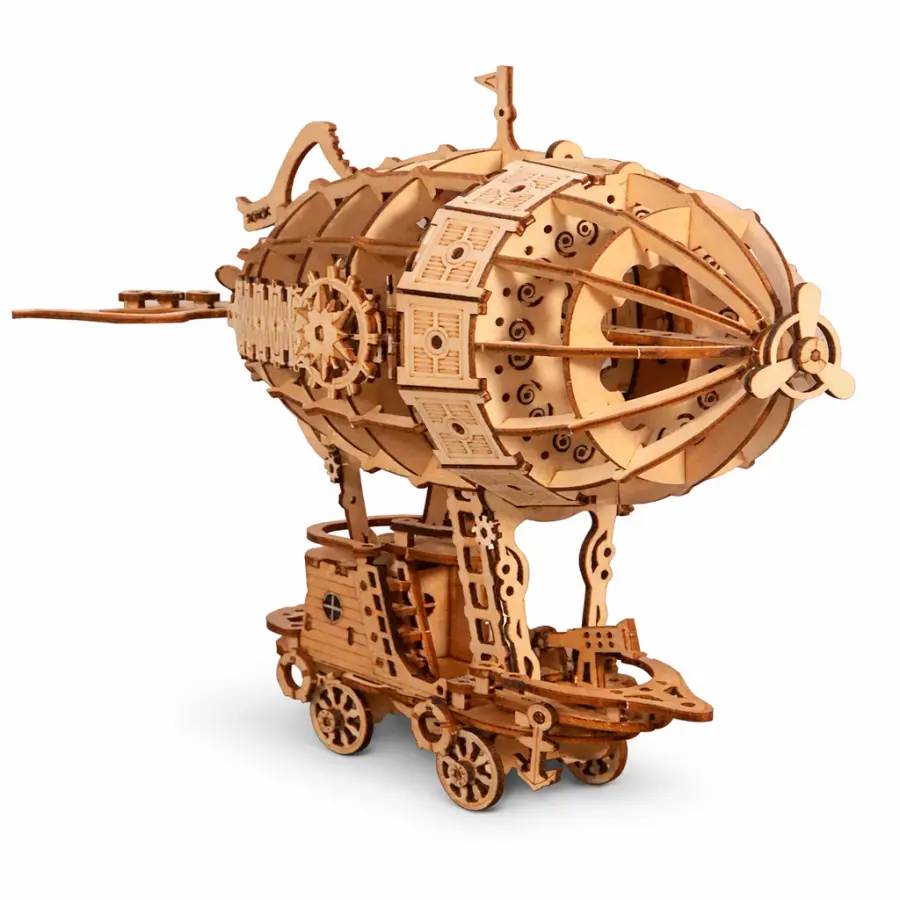
It’s more of a dedicated lock mechanism than a traditional multi-step puzzle box. Compared to something like the
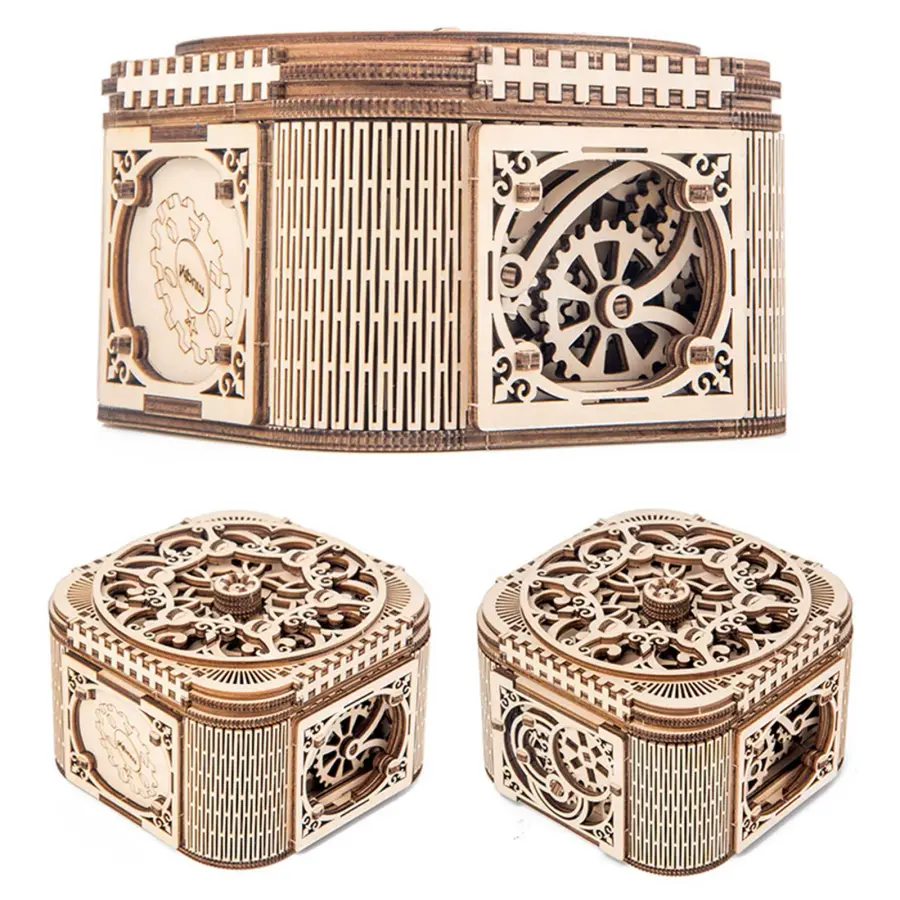
3D Wooden Puzzle Treasure Box, which often involves moving panels and finding hidden compartments, the Koi box is a purer, more refined locking puzzle. The Treasure Box offers more storage and a different style of sequential discovery.
Does it require any assembly?
No. It comes fully assembled and ready to puzzle over. This is a key difference from some puzzle boxes or DIY kits that you build first. You receive it locked, with the key separate, and the challenge begins immediately.
What’s the best way to start solving it?
Observe and experiment. Don’t force anything. Listen for clicks and watch for subtle movements when you turn the dials or apply light pressure. The mechanism gives auditory and tactile feedback. Many get stuck by overlooking the initial, simple step of properly inserting the key.
Can the mechanism wear out or break?
With normal use, it should last for years. The internal wooden gears and latch are robust for their size. The main risk is forcing parts or dropping the box, which could crack the wood or misalign the mechanism. Treat it like a precision item, not a toy.
Is the key part of the puzzle?
Yes, critically. The key is not just a turn-and-open tool. Its interaction with the dials is the core of the puzzle. Understanding how and when to use the key is the central challenge. For a deeper dive into this style of puzzle logic, our guide on solving another popular lock puzzle explores similar principles.
What’s inside the hidden compartment?
When you buy it, nothing—it’s empty. The joy is in unlocking it to place your own item inside. The compartment is small, roughly sized for a folded bill, a gift card, or a piece of jewelry like a ring or pendant.
Is it worth the price compared to cheaper Amazon puzzle boxes?
If you value craftsmanship and a satisfying, non-random mechanism, yes. Cheap puzzle boxes often rely on vague tricks or feel flimsy. The Koi box offers a logical, well-made mechanical experience that you’ll want to keep and show off, not solve once and forget.
Final Verdict: Is the Chinese Koi Puzzle Lock Box Worth It?
After weeks of testing, solving, and re-solving, the verdict is clear: the Chinese Koi Puzzle Lock Box is a confident buy for the right person, but an easy skip for others. It’s not a mass-market toy; it’s a niche, crafted experience. Your decision hinges entirely on what you value in a puzzle.
Buy it immediately if:
* You crave a logical, “Aha!” moment over random fumbling. The mechanism is fair, elegant, and deeply satisfying to master.
* You appreciate tactile, decorative craftsmanship. It’s a beautiful object that earns its place on a shelf, not hidden in a drawer.
* You want a substantive gift for a puzzle-loving adult that doubles as a unique keepsake box.
* You’re a collector stepping up from basic Amazon trick boxes and want a taste of higher-end mechanical design without a four-figure price tag.
Consider an alternative if:
* Your primary goal is cheap, bulk storage for cash or jewelry. A simple locking box is more practical.
* You need a one-time party trick or a gift for a child. The price and subtlety are mismatched for this.
* You get frustrated easily and prefer puzzles with clearer, progressive hints. This one makes you sit and think.
* The ~$50-70 price point gives you serious pause. You’re paying for artisanal logic, not raw materials.
Its core strength is the perfect marriage of form and function. The koi carving isn’t just a sticker; it’s integral to the puzzle’s tactile feedback. The weakness is its niche appeal and price sensitivity—it’s an enthusiast’s item.
Where to go from here:
If the Koi box’s logical, sequential discovery hooked you, your next stop should be the world of traditional Chinese puzzle locks. They offer a similar “key and mechanism” satisfaction in a more portable form. For a broader, more varied challenge, a set like the
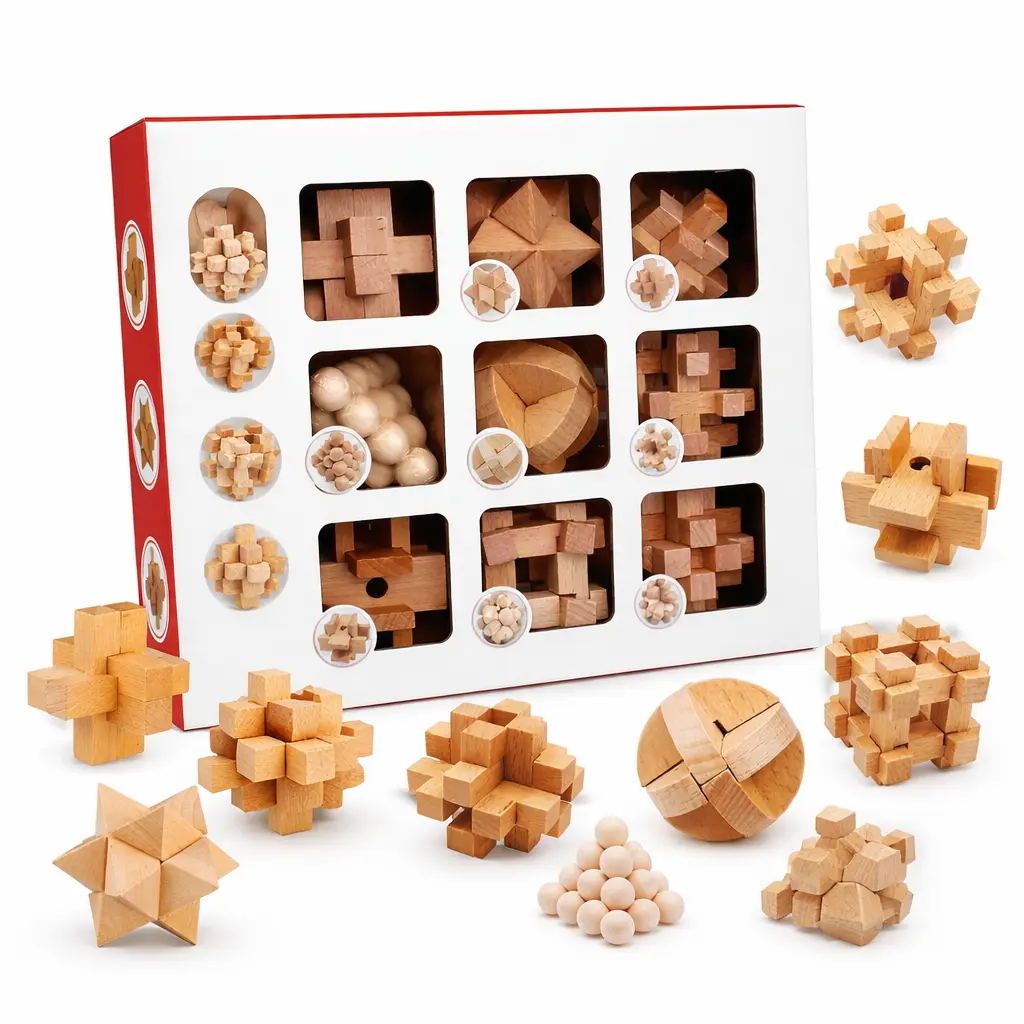
Luban Lock Set 9 Piece provides nine distinct interlocking puzzles that teach core principles of spatial reasoning. It’s a fantastic value for deepening your mechanical puzzle skills.
Ultimately, the Koi Puzzle Lock Box is worth it as a definitive step into quality mechanical puzzles. It’s the box you solve, then proudly display, knowing the secret it holds is both the object inside and the cleverness required to find it. For a curated list of next-step puzzles that reward patience, explore our guide to other puzzle boxes that reward patience. If the Koi’s description resonated with you, you won’t be disappointed. If it didn’t, your perfect puzzle is still out there.