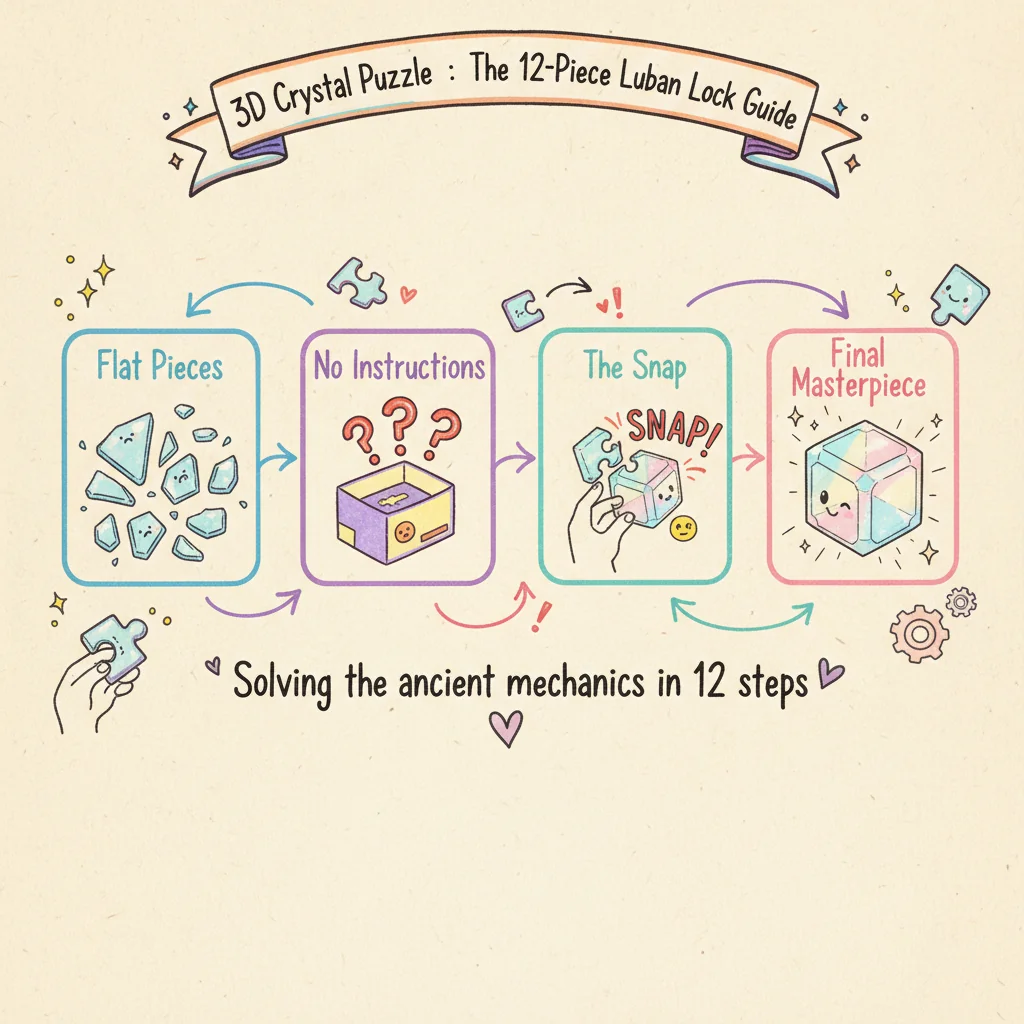
From Flat Pieces to 3D Masterpiece: My First Encounter with the Crystal Luban Lock
I’ve built my share of puzzles. The satisfying thump of a 1000-piece jigsaw section snapping into place, the quiet triumph of a wooden brain teaser finally giving up its secret. But when the box for the 12 Piece Crystal Luban Lock Set arrived, I knew I was in for something categorically different. This wasn’t a flat landscape to reconstruct or a colorful Disney character to assemble, like the glossy collectibles from BePuzzled that dominate the SERPs. This was a bundle of transparent, geometric strangers, clattering together in a bag, promising a lesson in ancient mechanics rather than a picture.
Dumping the pieces onto my desk, the first thing that struck me was their heft and clarity. These aren’t the thin, sometimes brittle-feeling plastic of many mass-market 3D crystal puzzles. Each polycarbonate piece—twelve in total—felt substantial, cool, and smooth in the hand, with a refractive quality that caught the light like ice. They were beautifully machined, with no visible seams or flash, a sign of precision that immediately set expectations high. Unlike the 40+ piece crystal puzzles of a pirate ship or a castle, where the challenge is often a vast, sequential assembly of similar-looking parts, this set presented a compact, intimidatingly intelligent problem. Twelve pieces. That’s it. How hard could it be? (Spoiler: very.)
The included guide was a single sheet, showing the final, interlocked cube and a few cryptic diagrams. There were no numbered steps, no “piece 1 connects to piece 2.” This was the first major departure from the standard 3D crystal puzzle experience, where, as noted on the AreYouGame blog, you can choose to “ditch the instructions” but they are there as a sequential crutch. Here, the crutch was gone. The puzzle demanded spatial reasoning from the first second. Picking up two pieces, I tried to slot them together. Some connections were obvious—a male tab into a female slot—but they’d join only to form a wobbly, unstable L-shape that immediately fell apart the moment I reached for a third piece. The frustration was immediate, but so was the intrigue. This wasn’t about following a map; it was about understanding a principle.
This is where the “Luban Lock” heritage became palpable. Named for the legendary Chinese master carpenter, Lu Ban, these are a type of mechanical puzzle rooted in ancient joinery, where pieces interlock in three dimensions to form a stable, self-supporting structure—no glue, no screws, no external fasteners. As I fumbled, I realized each piece wasn’t just a shape; it was a structural component with a specific load-bearing role. The goal wasn’t to build a cube, but to discover the hidden lattice of tension and compression that would allow these twelve independent elements to become one solid, handle-able object. The transparency was a brilliant, sometimes cruel, design choice. You can see through the problem, watching how pieces almost, but don’t quite, align, which is infinitely more maddening than working blind.
My first hour was a cycle of tentative assemblies and catastrophic collapses. It felt like a game of three-dimensional Jenga in reverse, where every added piece threatened to undo the fragile equilibrium. I thought of the Reddit user whose pirate ship “fell apart 3 times… and almost made me cry.” I felt that. The difference, I soon understood, was that my puzzle’s failure wasn’t due to flimsy connections or missed steps in a booklet. It was a fundamental error in my mental model of the structure. Each collapse was a lesson written in clear, clattering plastic. This hands-on struggle, this direct conversation with geometry and physics, created a stark contrast with the more decorative, follow-the-steps process of a standard 3D crystal animal or object. This wasn’t a puzzle you simply completed; it was a logic you had to internalize. And that made the eventual, silent click of the first true, stable connection feel less like progress and more like a revelation. For a more detailed exploration of this specific set’s design and philosophy, check out our deep dive into this very set.
What Exactly Is a Luban Lock? (And Why This Crystal Version Is Different)
To understand the appeal of the crystal set on my desk, you have to go back about 2,500 years. The Luban Lock, also known as a burr puzzle, is a classic form of mechanical puzzle with roots attributed to the legendary Chinese craftsman Lu Ban. Its principle is deceptively simple: several notched sticks (or pieces) are interlocked in three dimensions to form a solid, stable structure, often a symmetrical ball or cube. The genius lies in the fact that removing a single, specific “key” piece is typically impossible without understanding the precise sequence of assembly and disassembly. It’s a physical lesson in geometry and spatial reasoning, a world away from the pictorial matching of a traditional jigsaw.
This ancient brainteaser has seen countless iterations, from simple six-piece wooden versions to elaborate modern designs. You can find classic wooden burrs, like the Six-Piece Burr, which offers a pure, unadorned introduction to the interlocking principle. More complex sets, like the one discussed in our review of the wooden Luban Lock set, expand the challenge with more components and intricate, often symmetrical, final forms. These puzzles live firmly in the realm of tactile problem-solving; they are tools for the mind, often finished in plain wood that highlights the craftsmanship of the joints.
So, what changes when you render this ancient form in modern, transparent acrylic? Everything. The crystal version is a radical transformation that repositions the puzzle from a workshop brainteaser to a contemporary art object, squarely placing it within the popular “3D crystal puzzle” category seen across SERPs, yet making it fundamentally distinct.
First, the transparency adds a layer of visual complexity that a wooden puzzle can’t match. As I fumbled with the pieces, I wasn’t just feeling for alignment—I was seeing the internal latticework of connections and voids. It creates a cruel irony: the solution is visually apparent, yet mechanically elusive. You watch pieces almost interlock, see the gaps, and yet the correct orientation remains hidden. This transforms the solve from a tactile exploration into a visual-logical duel, a phenomenon we explore in why 3D crystal puzzles are harder than they look.
Second, the material changes the physical experience. The sleek, glossy plastic has a different grip and weight than wood. Pieces can feel more slippery, and the satisfying snick of a wooden joint is replaced by a softer, sometimes ambiguous click. This isn’t a downgrade; it’s a different sensory language. It demands more finesse and less force, aligning with the precision the puzzle requires.
Most importantly, the ‘display-worthy’ finish—a quality repeatedly noted in SERP reviews of decorative 3D crystal puzzles—completely shifts the object’s purpose. A wooden burr puzzle, once solved, often goes back in the box. A completed crystal Luban Lock, with its jewel-like facets catching the light, is designed to be a centerpiece. It becomes a sculpture, a conversation starter that whispers of its hidden complexity. This fulfills the “interactive decorative accessory” promise highlighted in commercial listings, but for a non-representational form. While most 3D crystal puzzles are of dolphins, castles, or Disney characters—essentially three-dimensional jigsaw puzzles of a known image—the crystal Luban Lock is an abstract geometric artifact. Its beauty isn’t in resembling something else, but in embodying a perfect, self-contained structural logic, a concept rooted in the ancient wisdom found in the Lu Ban Jing carpentry manual.
In short, the crystal Luban Lock is a hybrid. It carries the ancient, cerebral DNA of the burr puzzle, explained in texts like the Lu Ban Jing (learn more about the ancient carpentry text behind these puzzles), but delivers it in a modern package that prioritizes aesthetic impact as much as intellectual challenge. It’s not just a puzzle to solve; it’s a crystal to conquer and then proudly display.
A Step-by-Step Walkthrough: Solving the 12-Piece Set Without the Tears
Alright, let’s get tactical. After unboxing the 12 Piece Crystal Luban Lock Set, you’re faced with a bag of 12 identical-looking, faceted acrylic rods and a feeling that can only be described as “where do I even start?” This is the moment where many 3D puzzle attempts falter. The key is to abandon any notion of rushing. Based on my hands-on assembly and the collective wisdom from frustrated Reddit threads where builds “fell apart 3 times,” a methodical, phase-based approach is your only path to a stable, satisfying solve.
Phase 1: The Calm Before the Storm – Examination & Sorting
Don’t just dump the pieces on the table. Pour them into a soft-lined tray or onto a cloth to prevent scratches and annoying rolls. Your first job isn’t to build, but to see. Pick up each piece. You’ll notice they are not truly identical. Each rod has a specific pattern of notches and protrusions cut into its length. Some notches are deep, some shallow; some protrusions are wide, some narrow. Gently sort them into two loose groups: pieces with more prominent, central features and pieces that look relatively simpler. This isn’t about finding “piece 1,” but about training your eyes and fingers to recognize the subtle language of the lock’s geometry. This initial tactile familiarization is more valuable than any instruction sheet.
Phase 2: Identifying the Keystone – The First Interlock
The entire structural integrity of the Luban Lock hinges on the first correct interlock. You’re looking for two pieces that, when slid together perpendicularly, create a solid, cross-shaped unit that doesn’t wiggle. It should feel like a single, chunky block. A common pitfall here is forcing a connection that seems “close enough.” If it’s not snug, it’s wrong. This initial cross is your core. Everything else builds out from it. If you get this wrong, the puzzle will become unstable and collapse spectacularly later, leading to the exact tears this guide aims to prevent. If you’re stuck after 10-15 minutes of trial and error, it’s permissible to peek at a guide like the Luban Sphere Puzzle Disassembly Assembly Guide just for this first step. Consider it learning the foundational vocabulary.
Phase 3: Building the Internal Lattice – Patience Over Speed
With your stable core, start adding pieces one at a time. The goal now is to slowly grow a three-dimensional lattice inside the eventual sphere. Think of it as constructing the hidden scaffolding. Each new piece will slide into the existing structure, locking against multiple faces simultaneously. Apply firm, steady pressure, but never brute force. If a piece won’t go, rotate it 180 degrees or try a different piece from your “simple” pile. A tip from experienced builders: listen and feel for the “click.” A proper seat often has a subtle, satisfying tactile feedback. This phase is meditative. Don’t think about the final shape; just focus on the next logical connection, ensuring each addition reinforces the whole.
Phase 4: The Frustrating “Almost There” Phase – Managing the Wobble
Around piece 8 or 9, disaster often strikes. The structure becomes a loose, wobbly mess that seems to defy logic. This is the most common point of failure, mirroring countless online complaints where puzzles “almost made me cry.” The pieces aren’t broken; you’ve simply entered the phase where the structure lacks its final, binding components. It feels fragile because it is fragile—temporarily. The solution is counterintuitive: slow down. Support the loose assembly gently in one hand while using the other to insert the next piece. Your remaining pieces are the critical external binders that will apply tension and pull everything tight. This is where faith in the process is essential.
Phase 5: The Final “Click” – Securing the Sphere
The last two pieces are the architects of tension. They are typically the ones that slide into the last remaining gaps, threading through multiple other pieces. As you press the second-to-last piece in, you should feel the entire puzzle stiffen. The wobble vanishes. When you insert the very final piece, it should require a confident, definitive push. The culmination is a profound, multi-part click as the last protrusion seats home. Suddenly, the loose bundle of rods is transformed into a rigid, weighty crystal sphere that you can confidently roll in your palm. It will not come apart. This moment is the entire reward.
Final Assembly Tips & Pitfalls to Avoid:
* Surface Matters: Build on a flat, non-slip surface. A silicone mat or felt pad is ideal to prevent pieces from skating away.
* Lighting is Key: Use good, direct light to see the nuances of the notches clearly. Shadow can hide critical alignment details.
* Resist the Urge to Dismantle Mid-Solve: If you get stuck, don’t take it all apart. Backtrack one or two pieces at most. Complete disassembly often resets you to a more confused state.
* Instructions as a Last Resort: Heed the advice from guide SERPs: use instructions only when truly desperate. The deep learning and satisfaction come from the struggle. A quick glance to unstick a specific step is smarter than following a diagram from start to finish.
* The Clean Finale: Once complete, wipe the sphere with a microfiber cloth to remove fingerprints and admire the flawless, interlocking geometry. You haven’t just solved a puzzle; you’ve engineered a crystal.
Who Is This Puzzle For? (And Who Should Steer Clear)
Let’s cut to the chase: the 12-Piece Crystal Luban Lock is not a casual toy. It’s a specific, sometimes brutal, experience that will either become a cherished obsession or a source of genuine frustration. Based on my hands-on time and the collective voice from forums like r/Jigsawpuzzles, here’s who should buy it and who should run the other way.
Buy This If You Are:
- The Puzzle Veteran Seeking a Pure Logic Test: You’ve conquered 1000-piece jigsaws, you’ve assembled complex model kits, and you’re bored. You crave a challenge that strips away imagery and color, reducing the problem to pure geometry and spatial reasoning. This is that. It’s the Sudoku to your crossword puzzle—abstract, elegant, and unforgiving.
- The STEM-Minded Tinkerer: If you enjoy the tactile feel of engineering, where every notch and angle has a deliberate function, this puzzle is a physical algorithm. It’s a hands-on lesson in mechanical principles and structural integrity. The satisfaction isn’t just in “finishing a picture,” but in understanding how the tension and interlock create a stable whole from chaos.
- Someone Seeking a Meditative, Screen-Free Deep Focus Activity: This isn’t a 20-minute distraction. It demands your full, undivided attention for hours, pulling you into a state of flow. The world melts away as you rotate pieces, testing hypotheses. For those looking to disconnect and engage their brain in a singular, tangible task, it’s perfect.
- The Collector of Unique, Display-Worthy Challenges: Once solved, the crystal sphere is a striking conversation piece. It’s a trophy that says, “I figured this out.” Unlike the SERP’s picturesque Disney castles or pirate ships, its beauty is in its austere, engineered complexity, not its licensed imagery.
Steer Clear If You:
- Want a Relaxing, Pictorial Build: If your ideal puzzle involves sorting by color and gradually revealing a beautiful scene (like the Disney or Ship puzzles common in search results), this will disappoint. There is no picture, only translucent rods and mounting frustration. This is a brain burn, not a gentle unwind.
- Have Low Frustration Tolerance: Let’s surface a key objection from the “Real User Voice” threads: fragility during assembly. As one Redditor lamented about their 3D crystal puzzle, “It fell apart 3 times while putting it together and almost made me cry.” This Luban Lock is the same. Pieces will slip, your progress will collapse, and you will groan. If you lack the patience to rebuild from a setback, this isn’t for you.
- Are Looking for a Quick Win or a Gift for a Casual Enthusiast: This is not a “fun for the whole family” item for a game night. It’s a deep, solitary dive. Gifting this to someone without gauging their love for brutal logic puzzles is a recipe for a regift.
- Dislike Abstract Thinking Without Guided Steps: While guide SERPs emphasize using instructions as a last resort, some solvers need more scaffolding. If the idea of staring at 12 identical-looking rods with only vague notches for clues sounds tedious rather than intriguing, you’ll hate it.
Scenario-Based Decision:
- “I loved the Hanayama Cast puzzles.” → BUY. This is the next level.
- “I enjoy 3D crystal puzzles like the BePuzzled castle.” → CAUTION. The decorative, snap-together style of those is different. This is mechanically more complex and less forgiving. You might love the step up, or you might find it needlessly difficult. For context on that more traditional experience, see our take on BePuzzled 3D crystal puzzles.
- “I want a challenging gift for my engineer dad.” → BUY. It’s a cliché for a reason—it fits.
- “I need something to keep my hands busy during meetings.” → SKIP. This requires too much cognitive load. You’ll miss the meeting, or break the puzzle.
For those who fit the ideal profile but find the 12-piece version daunting, a logical stepping stone exists. The Luban Lock Set 9 Piece offers a slightly reduced piece count and complexity for a lower price point ($39.99), serving as a more accessible entry into this specific world of mechanical puzzles before tackling the ultimate 12-piece crystal challenge.
Ultimately, this puzzle serves a niche. It’s for the patient, the persistent, and those who find joy in the struggle itself. Its value isn’t in the minutes of entertainment per dollar, but in the profound satisfaction of conquering a truly elegant and difficult problem. If that describes you, welcome to the club. If not, there are plenty of beautiful, less punishing 3D puzzles out there. Honesty is the best policy here: this is the ultimate 3D brain teaser, but only for the right brain.
The Great Crystal Debate: Luban Lock vs. Traditional 3D Crystal Puzzles
So, you’re intrigued by 3D crystal puzzles. You’ve seen the glossy, colorful Rose or the iconic Apple on a shelf. They look like fun, collectible display pieces. Then you see this 12-Piece Crystal Luban Lock, a transparent geometric orb that gives nothing away. They share the “crystal puzzle” name, but the experience is fundamentally different. Choosing between them isn’t about difficulty level; it’s about what kind of satisfaction you’re after.
Let’s break down the core differences, using popular examples from the SERP like BePuzzled’s Castle, Duck, or Snoopy puzzles as our benchmarks for “traditional” 3D crystal puzzles.
Representational Story vs. Abstract Geometry
Traditional 3D crystal puzzles are about building a thing. You start with a bag of plastic shards and, by following a numbered sequence, you assemble a recognizable object: a pirate ship, a turtle, Snoopy on his doghouse. The payoff is visual and narrative. You get a cute or cool display piece that sparks conversation. The Luban Lock offers no such story. It is pure, abstract geometry. Its purpose is not to resemble anything but to embody a mechanical principle. The satisfaction is entirely intellectual—the “aha!” moment of understanding how the internal lattice holds itself together, invisible from the outside.
Assembly by Number vs. Logical Deduction
This is the most practical divergence. Every traditional crystal puzzle, from the 40-piece Deluxe models (explored in our piece on deluxe 3D crystal puzzles) to the simpler ones, comes with a crucial lifeline: a numbered instruction sheet. As noted in countless guides and Reddit pleas for help, these instructions are essential. Users frequently say things like, “I downloaded a chart that has numbered illustrated pieces and says that’s the order to place together.” You follow a paint-by-numbers process. It can be challenging and fiddly—pieces can pop out if you’re not careful—but the path is laid out.
The Crystal Luban Lock provides no numbered sequence. You get 12 identical-looking (but subtly unique) pieces and the goal. The solution requires spatial reasoning, symmetry analysis, and deduction. You must think in terms of opposing forces and interlocking planes. This is why 12 pieces here can be a far greater mental challenge than a 40-piece model puzzle. The latter tests manual dexterity and patience; the former tests your fundamental logic and 3D visualization skills.
The Final Form: Display Piece vs. Mysterious Artifact
Once completed, a BePuzzled Castle is a castle. It goes on a shelf, a testament to your patience. As one reviewer said, “you have a nice display piece that doesn’t require glue.” The Luban Lock, when solved, is… a sphere. To the uninitiated, it’s a paperweight. But to you, it’s a sealed secret, a physical manifestation of a solved problem. Its value as a display is personal, not decorative. You’re not showing off a rose; you’re showcasing a conquered theorem. This speaks to the transparency trap of 3D crystal puzzles, where seeing the solution doesn’t mean you can reach it.
So, Which One Is For You?
Choose based on your goal:
Choose a Traditional 3D Crystal Puzzle (like the Rose or Apple) if: Your primary goal is a relaxing, meditative build with a beautiful, recognizable result. You want a hands-on activity that doesn’t demand deep logical leaps, and you appreciate having instructions to fall back on. It’s for the collector, the decorator, or the puzzle enthusiast who enjoys the tactile journey more than the cerebral fight.
Choose the Crystal Luban Lock if: The puzzle is the point. You crave the raw, sometimes frustrating, process of deduction. You want a battle of wits against geometric principles, where the victory is the understanding itself, not the object created. It’s for the engineer, the mathematician, the escape room devotee, or anyone who’s bored by following steps and wants to discover the path themselves.
In short, traditional crystal puzzles are about building a story. The Luban Lock is about solving a mystery. Both are valid, but they cater to different puzzle-solving appetites. Knowing which one you have is the first step to avoiding disappointment—or finding your perfect challenge.
Mistakes I Made (So You Don’t Have To): A Confessional from the Puzzle Battlefield
Let’s be honest: the path to puzzle mastery is paved with broken pieces and muttered curses. I’ve been there, staring at a pile of glossy plastic that seems to defy logic. My journey with the Crystal Luban Lock—and its more traditional cousins—wasn’t a smooth ascent to genius. It was a series of face-palming errors. I’m detailing them here so you can skip the despair and get to the “aha!” moment faster.
Mistake #1: Forcing Pieces That Clearly Don’t Fit
This is the cardinal sin. In a moment of frustration with the Luban Lock, convinced the diagram must be wrong, I applied a little more pressure to a stubborn interlock. The resulting pop wasn’t a satisfying click; it was the sound of two pieces warping and refusing to seat properly, forcing me to backtrack and find the actual correct piece. Crystal puzzle plastic is rigid; it doesn’t bend or “break in.” If it’s not sliding together with moderate, even pressure, it’s not the right connection. The Correction: Treat force as a failure signal. Step back, set the piece down, and re-examine the orientation of the pieces you’re trying to join. The solution always lies in re-evaluating, not in muscling through.
Mistake #2: Ignoring the Subtle Orientation Clues
Every piece in a crystal puzzle has a specific face, edge, and direction. With the Luban Lock, a tab might be angled 5 degrees off, making it useless in one rotation but perfect in another. In a traditional puzzle like the , I once spent 20 minutes trying to attach a petal because I had its curved side facing inward instead of outward. The pieces are asymmetrical for a reason. The Correction: Before attempting any connection, rotate the piece slowly in your hand. Look at the thickness of the edges, the angle of the connectors, and the shape of the grooves. Match it visually to the space you’re trying to fill. This mindfulness saves hours.
Mistake #3: Building from the Outside In
My instinct was to create the shell or the recognizable outline first—to build the “shape” of the rose or the apparent outer frame of the Lock. This is a trap. These puzzles are engineered from a core outward. Starting on the exterior leaves you with no internal structure to support the final pieces, leading to the infamous mid-build collapse that Reddit users lament. I’ve had a half-built ship disintegrate in my hands, sending 40 pieces skittering across the table. The emotional toll is real. The Correction: Trust the process, even if it looks wrong. The instructions for traditional puzzles, and the logical progression for the Luban Lock, almost always start with an unassuming central cluster. Build that core tightly. Every subsequent piece will lock onto and reinforce that foundation.
Mistake #4: Not Using a Flat, Contained Surface
I thought my coffee table was fine. It was not. A slight bump, a rogue elbow, or the simple act of reaching for a different piece can send your nascent structure sliding. The heartbreak of a pre-collapse scatter is entirely preventable. The Correction: Work on a non-slip mat, a felt-lined tray, or simply inside the lid of the puzzle box. This creates a shallow “bowl” that catches pieces and prevents them from fleeing. It’s the single easiest thing you can do to preserve your sanity.
Mistake #5: Stubbornly Refusing to Walk Away
There’s a point where frustration actively inhibits problem-solving. I’ve squinted at the same two Luban Lock pieces for 45 minutes, my brain looping in useless circles. The Correction: Set a 15-minute rule. If you’re genuinely stuck, put everything down. Make tea, look out the window, work on something else. When you return, the solution often presents itself almost immediately. Your subconscious needs time to process the spatial relationships without the pressure of your staring eyes.
Learning these lessons the hard way taught me more about puzzle mechanics than any successful solve ever did. Embrace the mistakes as part of the process, but use this confessional as a cheat sheet to avoid the most soul-crushing ones. The victory is sweeter when you haven’t had to cry over scattered pieces first.
Frequently Asked Questions: From Glue to Gifting
Here are the most common questions I had before buying, and the ones I see popping up constantly in forums and reviews.
Do I need glue to hold it together?
No, and you shouldn’t use it. The entire design philosophy of these puzzles, from the Luban Lock to traditional crystal shapes, relies on precise mechanical interlocking. Glue can cloud the transparent plastic, create messy seams, and ironically, weaken the structure by preventing pieces from seating fully. The structural integrity comes from the friction and clever joinery. If your completed puzzle feels loose, it’s almost always because a piece is one click away from its correct, locked position—not because it needs adhesive.
Are the pieces durable, or will they snap?
The plastic is surprisingly robust. I’ve applied significant pressure during tricky fits, and the pieces have held up without cracking. The main risk isn’t snapping, but wear on the interlocking tabs over dozens of assemblies and disassemblies. For a puzzle you solve a few times and display, durability is excellent. For a fidget toy you plan to solve daily for years, the plastic may eventually show some wear.
How long does it take to solve the 12-Piece Luban Lock?
This is highly personal. A complete novice to spatial puzzles might take 1-2 hours of focused effort for their first solve. Someone familiar with burr or interlocking puzzles might crack it in 30-45 minutes. The key variable is your patience for trial and error. The second solve, knowing the basic sequence, can be as quick as 10-15 minutes.
Is it a one-time thing, or can I take it apart and re-solve it?
Absolutely re-solvable! That’s a major advantage over glued models. The 12-Piece Luban Lock is designed for repeated solving. It becomes a satisfying kinetic object for your desk. The fun shifts from “What is this?” to “Can I remember the path?” This reusability makes it a much better value over time than a single-solve display puzzle.
What if I lose or break a piece? Can I get replacements?
This is a genuine weak spot in the 3D puzzle world. Manufacturers rarely, if ever, sell individual replacement pieces. Your best bet is to contact the retailer you purchased from immediately. For this reason, I recommend working on a tray or inside the box lid to prevent catastrophic scatter. Treat the pieces like precious components—because functionally, they are irreplaceable.
Is it suitable for a bright 12-year-old?
Yes, but with caveats. The “Ages 12+” rating is about right. A bright, patient, and spatially-inclined child will love the challenge. A child who frustrates easily with Lego instructions or traditional puzzles might find it overwhelming. It’s an excellent shared activity for an adult and child; you can work on the logical steps together, which turns frustration into a collaborative victory.
What’s the best way to display it?
Once solved, it’s a gorgeous desk or shelf ornament. For a traditional crystal puzzle like the 3D Crystal Apple Puzzle, many users seek out LED light bases (as mentioned on the official brand site and Reddit) to make them glow from within. For the Luban Lock, its beauty is in its geometric complexity. Display it somewhere it can be picked up and admired from different angles. A simple, solid-color base or a small display stand elevates it from a desk toy to a conversation piece.
Is this a good gift?
It’s a fantastic gift for the right person. Ideal for: puzzle enthusiasts, engineers, gamers who love spatial problems, or anyone who appreciates clever design. It’s a terrible gift for someone who wants a quick, relaxing activity or who values immediate gratification. Gifting it requires you to know the recipient’s tolerance for a thoughtful challenge. Pair it with a note that says “For when you need to outsmart something” and it’ll be a hit.
The Final Verdict: Is the 12 Piece Crystal Luban Lock Set Worth Your Time?
After hours of assembly, disassembly, and genuine moments of both triumph and frustration, my answer is a resounding yes—but with a crucial caveat. This isn’t a casual purchase; it’s an investment in a specific type of mental and tactile experience.
Buy it immediately if: You are a puzzle veteran bored of traditional jigsaws, a spatial thinker (engineer, programmer, gamer), or someone who values elegant, reusable mechanical challenges over a one-and-done build. Its strengths are profound: the crystal acrylic is stunning, the interlocking mechanism is deeply satisfying, and the reusability means the “Aha!” moment can be relived. It’s a pure, unadulterated brain teaser that feels more like solving a beautiful, physical algorithm than following assembly steps.
Consider a simpler model first if: You are new to 3D puzzles, easily frustrated, or seeking a relaxing, meditative activity. The learning curve is steep and the initial experience can feel opaque. If your goal is a cute display piece, a traditional 3D Crystal Apple Puzzle is a better fit. For a slightly gentler introduction to interlocking burr-style logic, the Six-Piece Burr Puzzle offers similar satisfaction in a more manageable package.
Ultimately, the 12 Piece Crystal Luban Lock Set earns its place as the ultimate 3D brain teaser for those it’s designed for. It’s not a toy; it’s a sophisticated puzzle that commands respect and rewards patience with a unique sense of accomplishment. If you’re convinced your mind is up for the challenge, your next step is clear. You can explore the full range and purchase the set directly via our dedicated resource page: Crystal Luban Lock Puzzle Set. Prepare to engage with an object that is as much a piece of kinetic art as it is a test of intellect.