The First Click: How a Bad Sound Betrayed a Bad Box
It clicked. That was the problem.
It was a cheap, tinny sound—a hollow plastic snap from a box marketed as “antique walnut.” I’d bought it on impulse from a crowded online marketplace, seduced by the phrase “secret compartment” and a price that promised no commitment. The solve was a simple slide panel, its movement gritty with what felt like sand in the tracks. When I finally found the catch, the lid sprang open with a weak, unconvincing pop. The whole experience was over in ninety seconds. It felt like a transaction, not a discovery. The box now sits in a drawer, a monument to a disappointing mechanical conversation.
That experience launched my quest. I needed to know what made a good box. The answer wasn’t in the listing copy, but in the hand.
Sound matters. A well-made puzzle box doesn’t just click; it actuates. The sound is a deep, resonant thunk from solid wood mating with solid wood. It’s the sound of precision. When you slide a panel on a quality Japanese puzzle box from Hakone, it whispers—a soft, satisfying hiss of fine sanding and perfect tolerance. That sound is your first clue. It tells you the layers of veneer are thin and expertly aligned, that the hidden mechanism isn’t fighting itself.
Feel is everything. This is about tactile feedback. Run your fingers along the seams. On a mass-produced piece, you’ll often feel a slight lip, a mismatch where the laser-cut pieces were hastily assembled. On a crafted box, the fit and finish are seamless. The joints disappear. The weight is substantial, not from lead inserts, but from dense, stable hardwoods like maple or walnut. When you manipulate a piece, the movement has intention. There’s resistance, then a clean release—a satisfying actuation that speaks of a spring, a pin, or a cleverly balanced gravity lock working as designed.
My escape room days trained me to build props that could survive hundreds of frantic, adrenaline-fueled solves. Durability isn’t an optional feature; it’s the foundation of the experience. That flimsy box from the marketplace? Its trick lock was a bent piece of sheet metal that deformed after a dozen opens. A true sequential discovery puzzle is engineered to be revisited, to become a desk heirloom you can hand to a friend without a tutorial. The mechanism should welcome the interaction, not fear it.
This is what’s missing when you’re just looking at a grid of products labeled trick wooden puzzle box. You’re not just buying a locked container. You’re choosing a partner for a silent, tactile dialogue. A good box asks questions with its constraints. A great one rewards your patience with a moment of perfect, logical clarity—that sublime thunk.
So, how do you find that instead of the hollow click? You learn to read between the lines of listings and reviews. You start to understand that where to buy quality puzzle boxes is less about a specific store and more about recognizing the markers of craft. It begins by listening. Before you ever learn the steps, you should learn how to hear one. The difference between a cheap souvenir and a genuine mechanical puzzle is often just a few decibels and a gram of heft, but it’s the difference between a forgettable trinket and a conversation that lasts for years.
Defining Your Dialogue: The Puzzle Box Personality Spectrum
That idea of a lasting conversation is the key. Once you’ve learned to listen for quality, the next step is to understand what the box is trying to say. Because not all puzzles converse the same way. Framing them by price or wood type alone misses the point. You need to ask: What is this box’s personality? How does it want to be interacted with?
In my collection, boxes fall into three distinct archetypes. This isn’t about good or bad—it’s about matching the object’s nature to your intent. Get this right, and the box becomes a permanent fixture in your life. Get it wrong, and it gathers dust after the first sequential discovery.
The Fidget: The Tactile Companion
This is the box for your desk. Its primary function isn’t secrecy or extreme difficulty, but tactile feedback. It’s a 3D wooden puzzle designed for rhythmic, almost meditative solving. The mechanism is clean, the hidden openings are satisfying to actuate, and the entire solve path can be completed in a few minutes. You’ll open and close it while thinking, on phone calls, as a ritual. This is the best puzzle box for beginners because it builds intuition without frustration, and it’s the quintessential puzzle box gift for an engineer who appreciates elegant mechanics but doesn’t want a weekend-long project. Think of brands like Idventure’s Cluebox series or clever little trick wooden puzzle boxes from Brilliant Puzzles—they offer a reliable, rewarding loop. Re-solvability is paramount here; the joy is in the familiar, fluid dialogue.
The Heirloom: The Functional Secret Keeper
This personality is defined by duality. First, it is a beautiful object, a wooden storage box meant for display. Second, its secret is robust and functional. We’re talking about a puzzle box for jewelry storage, a ring box, or a place for keepsakes. The puzzle is the lock, often a secret box with a hidden compartment that feels definitive when it closes—that resonant thunk we talked about. Authentic Japanese puzzle boxes (himitsu-bako) live here, as do finely crafted boxes from artisans. The solve might be more deliberate than a Fidget’s, but the goal isn’t to break your brain; it’s to protect and present. After the initial solve, it transitions into a functional piece of collectible puzzle art. You’re not buying a one-time trick; you’re investing in a desk heirloom. This answers the user wondering if boxes can hold things: absolutely, but prioritize craftsmanship so the mechanism withstands regular use.
The Brain-Burner: The Weekend Project
This is the antagonist in your mechanical conversation. It’s the difficult puzzle box for adults, the escape room experience condensed onto your coffee table. Its personality is cryptic, stubborn, and layered. Opening it is a multi-step challenge that demands notes, deduction, and patience over multiple sessions. Brands like Fort Knox Box or the more complex offerings from Pelikan or Escapewelt embody this. The sequential discovery element is deep; tools might be hidden within, and the logic is non-linear. This is not a fidget toy. It’s a project. You buy it for the singular, triumphant payoff of finally hearing that lock release, knowing you’ve out-thought the designer. Re-solvability is low—once you know the secret, the mystery is gone—but the memory of the struggle is the real trophy. This is what enthusiasts seek when they ask for a box that will “take me days to solve.”
Understanding this spectrum changes your search entirely. You stop asking “what’s the best puzzle box?” and start asking “what’s the best puzzle box for my coffee table?” or “…to hold my wedding band?” The Fidget offers daily dialogue. The Heirloom offers a lasting secret. The Brain-Burner offers a monumental, likely one-time, debate. Your scenario dictates the personality you need. A beginner given a Brain-Burner will feel defeated. A collector given a simple Fidget will feel underwhelmed. But match them correctly, and you initiate a dialogue that can last for years—or one unforgettable weekend. To understand this compulsion better, consider the secret language of the puzzle box.
Inside the Machine: A Field Guide to Puzzle Box Mechanisms
Understanding the personality of a puzzle box is the first step. The next is understanding its skeleton—the hidden engineering that creates that personality in the first place. Whether a box is a fidgety conversationalist or a stoic heirloom comes down to its underlying mechanism. Think of this as a field guide to the creatures you’ll encounter in the wild, from elegant classics to modern mechanical beasts.
Let’s start with the originator: the Japanese himitsu-bako, or “secret box.” True to their name, these boxes from Japan’s Hakone region are masters of deception. Their mechanism is a symphony of precision-cut wooden slides. The external panels are often adorned with intricate parquetry (Yosegi), but beneath that beautiful veneer lies a logical, sequential path. To open one, you manipulate the panels in a specific, non-intuitive order—sliding this one three millimeters to the left, tapping that corner twice, then pushing a seemingly decorative piece. The move count is the gospel here, ranging from a simple 4-step to brain-bending sequences of 100 moves or more. The tactile feedback is subtle: a faint, sanded-wood whisper as a slide moves, a barely perceptible click of alignment. An authentic Japanese puzzle box feels like a quiet, respectful debate. The solve path is linear and prescribed; the joy is in memorizing and executing the elegant, secret dance.
Then we have the modern evolution: the sequential discovery puzzle box. This is where the escape room designer in me gets genuinely excited. Here, the box itself is the narrative. The goal isn’t just to open it; it’s to discover the tools and clues hidden within the structure to progress. You might find a metal rod trapped behind a panel you just slid, or realize a decorative element is a key that only works after you’ve rotated the entire box 90 degrees. Brands like Idventure (Cluebox) and Pelikan excel here. The mechanism isn’t just about moving parts; it’s about a multi-stage logic puzzle where the box actively participates in the reveal. The escape room experience is embodied here—each aha moment unlocks not just a compartment, but the next chapter of the puzzle. The personality is often that of a theatrical Brain-Burner.
A more straightforward, but no less satisfying, category is the trick lock or disguised mechanism box. These are the cousins to the wooden secret box. The entry might be hidden behind a magnetic panel, opened by solving a wooden combination lock, or triggered by pressing a concealed button in a specific sequence. They often prioritize function—like holding jewelry—alongside the puzzle. The mechanism is usually a singular, clever trick. The solve path is shorter, but the payoff is in the cleverness of the concealment itself.
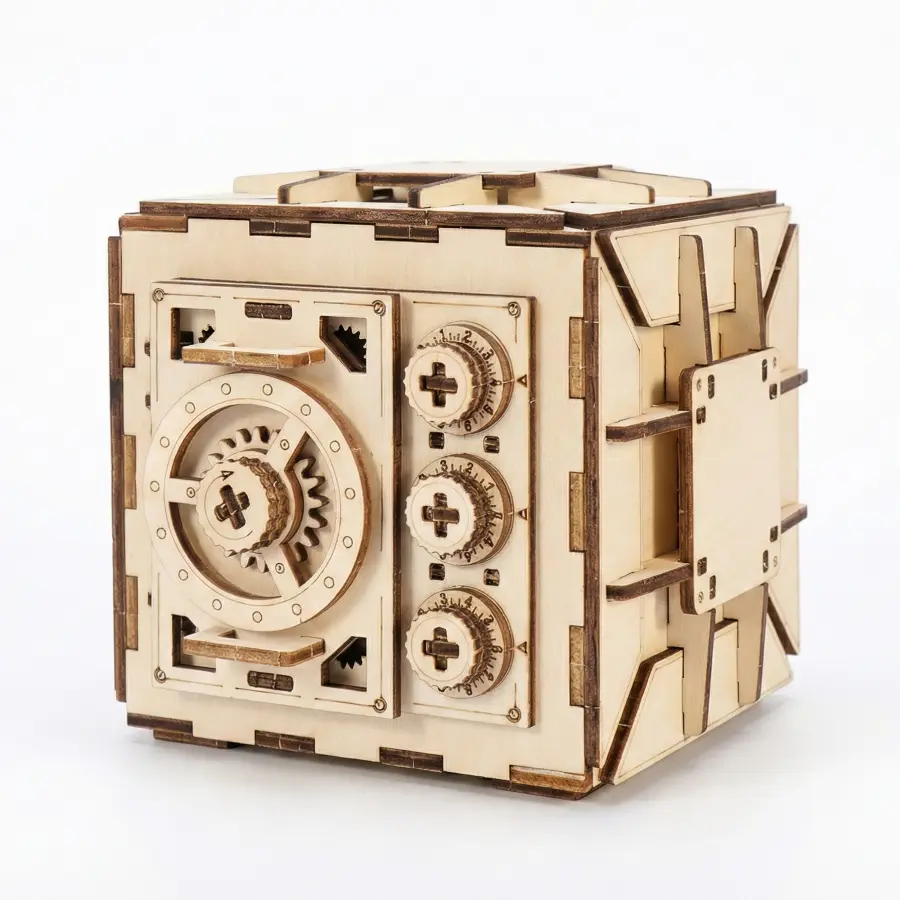
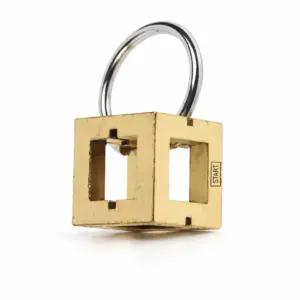
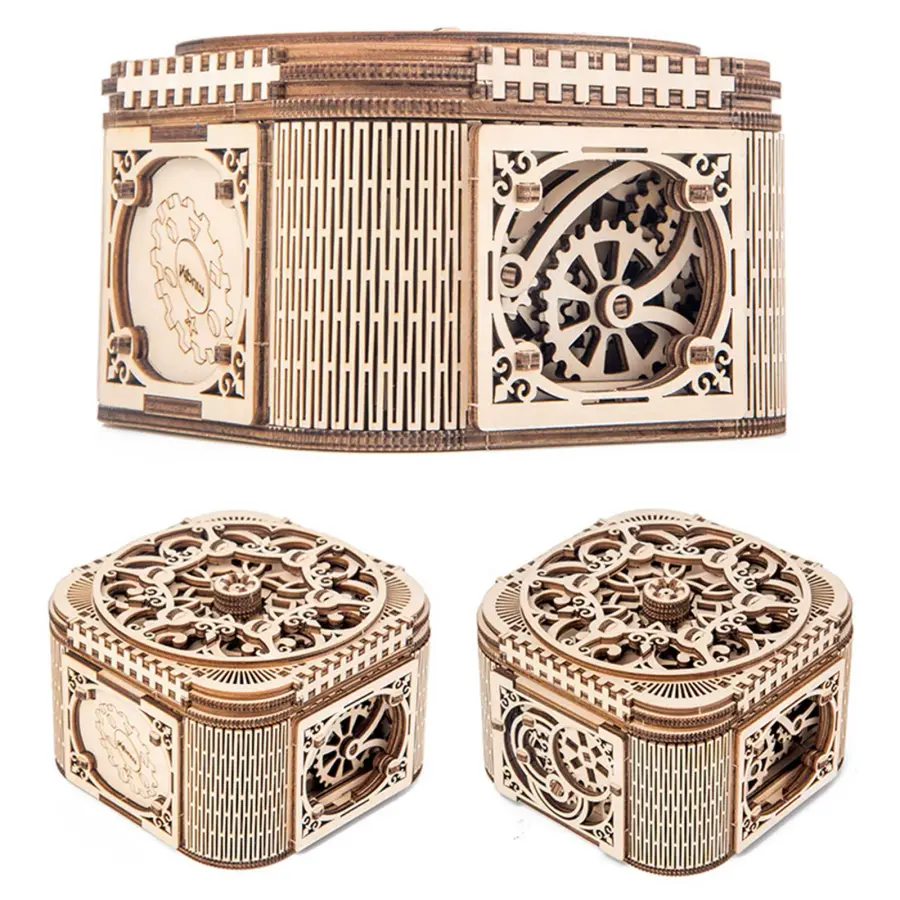
The box above is a classic example of the trick lock hybrid. It presents as a wooden secret box with a lock mechanism, but the combination is part of the 3D assembly puzzle. It’s a bridge between a buildable model and a functional secret compartment. This gets to a key point: many modern boxes are hybrids. You’ll find Japanese-style slides married to a hidden keyhole, or a sequential discovery box that requires you to first assemble it from a kit—a double layer of challenge.
Material is the final tell. A himitsu-bako relies on the tight, friction-based fit and finish of fine, unfinished hardwoods like walnut or maple. A poorly made copy, often using MDF or birch plywood with a veneer, will have slides that either stick hopelessly or rattle loosely, breaking the illusion. A sequential discovery box from a brand like Idventure often uses laser-cut wood or acrylic for precise, repeatable action. The tactile feedback is engineered—clicks are more pronounced, movements are crisper. It’s a different kind of mechanical conversation, one that speaks in clearer punctuation.
So, when you’re evaluating a box, ask: what kind of machine is this? Is it a silent, sliding poem (Japanese himitsu-bako)? A layered, narrative journey (sequential discovery)? A single, clever sleight of hand (trick lock)? This knowledge cuts through marketing fluff. It’s how you know if that beautiful Hakone-style box on Amazon is likely to deliver an authentic experience or just a frustrating imitation. This internal logic is what separates a mere container with a secret from a true mechanical puzzle.
Calibrating the Challenge: From 5-Minute Fidget to Weekend Obsession
Understanding a box’s internal logic is one thing. Knowing if that logic will delight you or defeat you is another. This is where generic terms like ‘hard’ or ‘easy’ fail us. A puzzle’s difficulty isn’t just about steps; it’s a cocktail of time, logic type, and dexterity. It’s the difference between a satisfying mechanical conversation and a dialogue where you’re just shouting at a wall.
Let’s ditch the numbers and talk about the experience. Think of it as a spectrum from quick-fix to deep dive.
The Appetizer: The 5-Minute Fidget.
This is the domain of the trick wooden puzzle box with a single, clever mechanism. The goal isn’t to stump you for hours, but to deliver a moment of delightful surprise. The logic is often spatial—a slide you didn’t notice, a panel that pivots unexpectedly. Dexterity is minimal; the solve is about observation over manipulation. These are perfect best puzzle box for beginners. They teach you the foundational language of hidden mechanisms without the frustration. A classic example is a small, affordable puzzle box with a magnetic latch or a simple sliding panel. The solve is quick, but the satisfying actuation of that one hidden latch provides a complete, self-contained moment of pleasure. They’re the palate cleansers between heavier challenges.
The Main Course: The Evening Engagement.
Here’s where you find most well-regarded sequential discovery boxes from brands like Idventure (Cluebox) or Pelikan. The solve path unfolds over 30 minutes to a few hours. The logic becomes layered. Step B is only revealed after you’ve completed Step A, and you might need to use a discovered tool in an unintended way. This is the heart of the modern escape room experience in a box. Dexterity requirements increase slightly—precise alignment of components matters. The tactile feedback of each click is crucial; it’s your confirmation you’re on the right path. This level is for the person who wants to be fully absorbed, to have their reasoning picked apart and reassembled. The Reddit consensus often points to boxes in the $40-$80 range here as the sweet spot for value and satisfying complexity.
The Weekend Obsession: The Deep Dive.
You asked about a difficult puzzle box for adults that takes days. This is that territory. We’re talking about high-move Japanese puzzle boxes (himitsu-bako) with 50+ steps, or artisan-crafted challenging wooden brain teaser boxes that function like Rube Goldberg machines in miniature. Time melts away. Logic is abstract, often requiring pattern recognition, sequence memorization, or non-linear thinking. Dexterity is critical; a single mis-slide can reset your progress. The mechanical conversation is slow, deliberate, and sometimes cryptic. These boxes aren’t solved in one sitting. They live on your desk, becoming a background thread in your week. You’ll walk away, your subconscious will work on it, and you’ll return with a new hypothesis. This level includes collector-grade pieces from makers like Jesse Born or the famously complex designs from the Karakuri Creation Group in Japan. The price reflects it, but the payoff is a profound, almost meditative engagement.
The key is self-awareness. Are you looking for a quick hit of cleverness, a satisfying narrative sequential discovery, or a protracted battle of wits? My own rule, forged from one too many late nights: if you feel genuine frustration, not curiosity, walk away. Put the box down. That “aha” moment often comes when your hands are busy with something else entirely. For a more structured approach to this struggle, our guide on how to solve a puzzle box without losing your mind might offer a nudge.
Remember, a box’s personality is locked in its mechanism, but your enjoyment is unlocked by choosing a challenge level that matches your appetite.
Wood, Weight, and Wonder: The Craftsmanship Inspection
So, you’ve calibrated the challenge and glimpsed a box’s personality. Now, what gives that personality its voice? Its physical form. The difference between a frustrating trinket and a desk heirloom isn’t just clever design; it’s in the materials whispering under your fingertips and the precision of its assembly. This is where the $30 affordable puzzle box parts ways from the $100+ investment, and where your inner inspector needs a flashlight.
Let’s start with the most honest tell: weight. Pick up a box. A hollow, suspiciously light feel often points to thin materials or excessive internal empty space not dedicated to the hidden mechanism. A solid, substantial heft suggests denser wood, more internal components, and a general sense of durability. It’s the difference between a plastic toy safe and a bank vault door.
Material is message.
* Solid Hardwoods (Walnut, Maple, Cherry): This is the lexicon of artisan puzzle box makers and higher-end production brands. These woods are dense, often beautifully grained, and machined to exacting tolerances. They produce that satisfying, deep ‘thunk,’ wear gracefully, and feel warm and organic. A trick wooden puzzle box in solid walnut isn’t just a puzzle; it’s a wooden storage box first, with a secret.
* Birch Plywood: The workhorse. High-quality, multi-layered birch ply is dimensionally stable, strong, and takes fine laser-cutting beautifully. It’s the preferred material for many respected brands producing sequential discovery boxes. Don’t dismiss it—in skilled hands, it allows for intricate, reliable mechanisms at accessible prices. The feel is smooth, but the sound is a crisper tap rather than a thud.
* MDF or Low-Grade Ply: The red flag. Medium-density fiberboard is essentially sawdust and glue. It feels dead to the touch, has no grain, and its edges fuzz or crumble over time. It’s a primary cost-cutter. A puzzle box made primarily of MDF will have a muffled, cheap sound and its moving parts may degrade with repeated solves. If a listing is vague, just says “wood,” and the price is very low, suspect this.
Fit and finish is the conversation.
This term is your most critical tool. Run your fingers along every seam. On a quality box, the joints should be nearly invisible, with panels meeting flush. Gaps aren’t just ugly; they’re clues. They can expose the secret compartments, short-circuit the solve path, or simply announce poor craftsmanship.
Examine the joinery. Are corners merely glued? Or is there evidence of finer techniques—dovetails, finger joints, splines? These aren’t just for show; they distribute stress and ensure the box withstands the twisting and pressing of a solve. My own disaster box failed because its thin panels, glued at stress points, simply sheared apart during a stubborn maneuver.
Now, the tactile feedback. Press a panel. Does it slide with a smooth, fluid resistance, or does it grind, catch, or wobble? A quality mechanism feels intentional. Each movement has a defined start and end point. You should feel pins engaging, slides meeting stops, levers catching. This feedback is the box talking to you, confirming a correct move or gently denying a wrong one. Cheap boxes feel vague—mushy, sticky, or loose.
So, the $30 vs. $100 question? It crystallizes here. A $30 box often buys cleverness in concept, executed in MDF or thin ply with sticker veneers, laser-cut tolerances that can be fuzzy, and mechanisms that might work but lack satisfying actuation. It’s a paper puzzle in 3D form. A $100 box pays for material density, precision machining, durable hardware (like metal pins or springs), layered design that hides its secrets more deeply, and that intangible fit and finish that makes the object feel complete. You’re paying for the mechanical conversation to be held in a worthy vessel.
Common flaws to watch for, especially on marketplaces: photos that hide the seams, descriptions lacking material specifics, and reviews that mention “sticky pieces” or “arrived broken.” A genuine Japanese puzzle box from Hakone will be proud of its intricate yosegi marquetry and fine joinery; an imitation will have a photographed pattern that looks printed-on.
Ultimately, the best puzzle boxes are collectible puzzles because they are built to last through hundreds of satisfying interactions. They are functional sculptures where the wonder is as much in the crafted object as in the hidden solution. For a deeper dive into this world of wood and wit, consider our companion guide, The Artisan’s Riddle, which focuses solely on choosing these exceptional pieces. Your hands will know the difference long before your mind solves the puzzle.
The Gift-Giver’s Decoder Ring: Matching a Box to a Person
So you’ve learned to spot a resonant thunk from a hollow click, and you understand that fit and finish matters. Now comes the real test: choosing a box for someone else. This is where most buying guides fail, defaulting to the lazy label of ‘gift idea’. A puzzle box isn’t a candle. It’s a mechanical conversation you’re starting on someone else’s behalf. The goal isn’t just to give a box, but to give the right kind of friction, the right personality, for the person who will receive it. Forget difficulty alone; think temperament.
For The Analytical Mind (The Engineer, The Programmer):
They don’t just want to solve; they want to reverse-engineer. The pleasure is in mapping the sequential discovery logic, in feeling like they’ve outsmarted a system. Look for boxes with clear, deducible internal logic—think Idventure’s Cluebox series or an escape room puzzle box with a thematic narrative. These often involve codes, layered clues, and a satisfying “Aha!” that feels earned, not accidental. Avoid purely tactile sliders; they crave a multi-step challenge with a payoff that explains itself. This is your quintessential puzzle box gift for engineer.
For The Patient Collector (The Appreciator, The Tactile Thinker):
This person values objecthood. They’ll display the box on a shelf as much as they’ll solve it. Their joy is in the material, the weight, the hidden openings that reveal themselves as art. Here, a traditional Japanese puzzle box with intricate yosegi marquetry is a profound choice. Or, consider a box that doubles as a functional object—a wooden storage box for jewelry or trinkets. The puzzle grants access, but the beautiful vessel remains. You can explore some stunning examples in our list of Japanese puzzle boxes that humble your IQ.
For The Theatrical Storyteller (The Escape Room Fan, The Imaginative Gifter):
They want drama. The box isn’t a puzzle; it’s a prop in a story they’re telling. This is where theme reigns supreme. Gift them an entire escape room experience in a box—something like the “Davy Jones’ Locker” or “Schrödinger’s Cat” boxes that build a world. The solve path feels like unlocking chapters. Presentation is everything; place the box inside another box with a cryptic note. The object becomes a memory-making event.
When presenting it, set the right expectation. Say, “This one is supposed to be a stubborn weekend project,” or, “This feels more like a 3D wooden puzzle you fiddle with while thinking.” This manages frustration and frames the experience. And remember the core principle from our deeper dive, Why The Best Puzzle Box For A Gift Is A Trojan Horse For Focus: a well-matched box isn’t just a distraction; it’s an invitation to a specific, satisfying state of mind. You’re not giving a thing. You’re giving a specific type of quiet, focused engagement. That’s the real secret compartment.
The Collector’s Conundrum: Artisan Finds and Limited Runs
So you’ve found a box that clicks for you—it fits your skill, it matches your desired pace. Maybe it’s even nestled on your desk as a wooden storage box for trinkets. For some, that’s the end of the journey. For others, it’s the prologue. This is where the puzzle box transcends its function and becomes a pursuit of mechanical art. Welcome to the collector’s mindset.
Here, the question isn’t “What do I want to solve?” but “What story do I want to own?” The mass-market secret box is a conversation; the artisan box is a soliloquy. It speaks of singular vision, obsessive tolerances, and materials chosen for their beauty as much as their workability. A collector isn’t just buying a puzzle; they’re investing in a piece of a maker’s ingenuity, often manifested in tiny production runs or one-of-a-kind commissions.
Let’s talk artisans. Names like Jesse Born, Eric Fuller (through CubicDissection), and the craftsmen behind Puzzle Box World produce objects where the hidden openings are marvels of engineering. I handled a Born box once—a commission piece in figured walnut. Its sequential discovery path wasn’t just clever; it was elegant. Each movement had the deliberate, smooth weight of a bank vault door, and the final compartment revealed itself not with a pop, but a silent, almost reluctant slide. You’re not finding a compartment; you’re being granted an audience. These pieces are collectible puzzle objects first, storage second. Their price, often soaring past $300, reflects that shift in priority.
But the collector’s tier isn’t exclusively the domain of solo woodworkers. This is where nuanced reviews of brands like Idventure (Cluebox) and Fort Knox Box become essential. Idventure’s offerings, like their thematic “Escape The Room” series, occupy a fascinating middle ground. They are produced in higher quantities than an artisan’s one-off, yet they maintain a coherent, challenging sequential discovery narrative that earns fervent respect in enthusiast circles. An Idventure puzzle box review on Reddit often highlights this: they are the accessible gateway into collector-grade mechanical puzzles, with a fit and finish that shames typical big-box store fare. Similarly, the Fort Knox puzzle box review consensus praises its over-engineered, satisfyingly tactile heft—it feels like a serious object, a desk heirloom meant to be solved and displayed for years.
This leads to the secondary market and the community pulse. Sold-out limited runs from makers like Pelikan or Art of Play circulate on forums and auction sites, often at a premium. The value isn’t just in the wood; it’s in the documented solve path, the reputation of the maker, and the story of its edition number. This is where the Reddit Consensus truly thrives, dissecting availability, trades, and upcoming drops from trusted retailers like Kubiya Games.
Which brings us to the final, crucial hook: Beyond the Solve. For the collector, the first open is just the beginning of the relationship. After the secrets are laid bare, these boxes transform. They become kinetic sculptures on a shelf, conversation pieces that beg to be handed to a guest with a sly, “See if you can find how it opens.” The best ones retain their satisfying actuation forever, becoming a tactile meditation you can revisit not for the challenge, but for the pure joy of the mechanism’s movement. It ceases to be a locked thing and becomes a familiar, beautiful machine—a testament to the puzzle box’s journey from a tricky gift idea to a permanent piece of your personal landscape. For a curated look at boxes that excel in this lasting-reward category, see our list of 11 puzzle boxes for adults that actually reward your patience.
Navigating the Marketplace Minefield: Where to Shop with Confidence
So, you’ve met the personalities, decoded the mechanisms, and know the feel you’re after. Now, where do you actually go to make the purchase without getting a box of frustration? The landscape is split: curated specialty shops and the wild west of mass marketplaces. Your choice depends on whether you want a guided experience or are willing to hunt for a diamond in the rough.
For a confident first step, seek out the curators. Retailers like Kubiya Games and Art of Play act as filters. They select for solid fit and finish, reliable mechanisms, and clear difficulty communication. You’re paying for their vetting process. This is where you’ll find well-regarded escape room experience-in-a-box titles and sequential discovery puzzles with clear documentation. Similarly, Puzzle Box World and Brilliant Puzzles offer vast catalogs with a focus on wooden brain teaser boxes and clear categorization by skill level. Shopping here is straightforward: you get what the description says, often with helpful community reviews.
Then, there’s the marketplace. Amazon, Etsy, and eBay are brimming with options, from true artisan work to mass-produced disappointments waiting to happen. This is where the Review Scrutiny Checklist becomes your essential tool:
- Ignore the Star Average. Dig into the 3-star reviews. Do they mention loose panels, weak magnets, or mechanisms that bind? That’s the truth.
- Decode the “Material.” “Wooden” is not enough. Descriptions proudly stating “MDF” or “composite wood” signal a box prioritizing laser-cut intricacy over tactile feedback and longevity.
- Spot the Stock Photos. If every listing uses the same glamour shots, you’re not buying from the maker. Reverse-image search can reveal a dozen sellers offering the same AliExpress-sourced box.
- Demand Real Solve Videos. A trustworthy seller often provides a video of the solve path or a genuine, unboxing review from a puzzler, not a promotional animation.
This scrutiny leads directly to The Reddit Consensus. On forums like r/PuzzleBox, certain brands earn repeated praise for value. Idventure (makers of the Cluebox series) is hailed for delivering thematic, multi-step puzzles with good production value in the $44-$60 range. For difficult puzzle box seekers, Polish-made Pelikan boxes are revered for their devious, often beautiful, mechanical puzzles. Brands like Escapewelt offer a middle ground of affordable, satisfying trick wooden puzzle boxes. This crowd-sourced vetting is invaluable; it points you to consistent performers.
Where to Buy Quality Puzzle Boxes ultimately depends on your scenario:
- For a Guaranteed-Good Gift: Stick to the curators. Buy an Idventure box from Kubiya Games or a themed escape room puzzle box from Art of Play. Wrap it with confidence.
- For the Budget-Conscious Newcomer: Use the Reddit consensus to find a brand like Escapewelt, then apply the review checklist on Amazon or eBay. Target the $25-$50 range.
- For the Artisan Hunt: Etsy is your ground zero, but filter for “handmade” and read the “About” section. A real maker will have a story. eBay is for tracking down sold-out Pelikan or Fort Knox Box editions from collectors.
- For the Purist Seeking Japanese Puzzle Boxes: Be wary of generic “Hakone-style” claims on big marketplaces. Seek specialty puzzle retailers or sellers based in Japan with provenance. A true himitsu-bako will note its move count (e.g., 4-move, 78-move) and region. The history of these objects is deep, tracing a lineage back to the clever lock puzzles and automata of the Renaissance era, a fascinating evolution documented on the puzzle box Wikipedia page.
Your journey, which started with that hollow click of disappointment, ends here with a map. The anticipation isn’t just for a package to arrive; it’s for the first heft of the box in your hands, the initial inspection for seams, and that first, deliberate slide of a panel. That deep, resonant thunk is out there. Your next step is simple: choose one scenario from this guide, pick its corresponding retailer, and make your first informed purchase. The mechanical conversation awaits. And when you finally have that box in hand, if you need a primer on the universal principles of engagement, our complete guide on how to open a puzzle box is there to help start the dialogue.