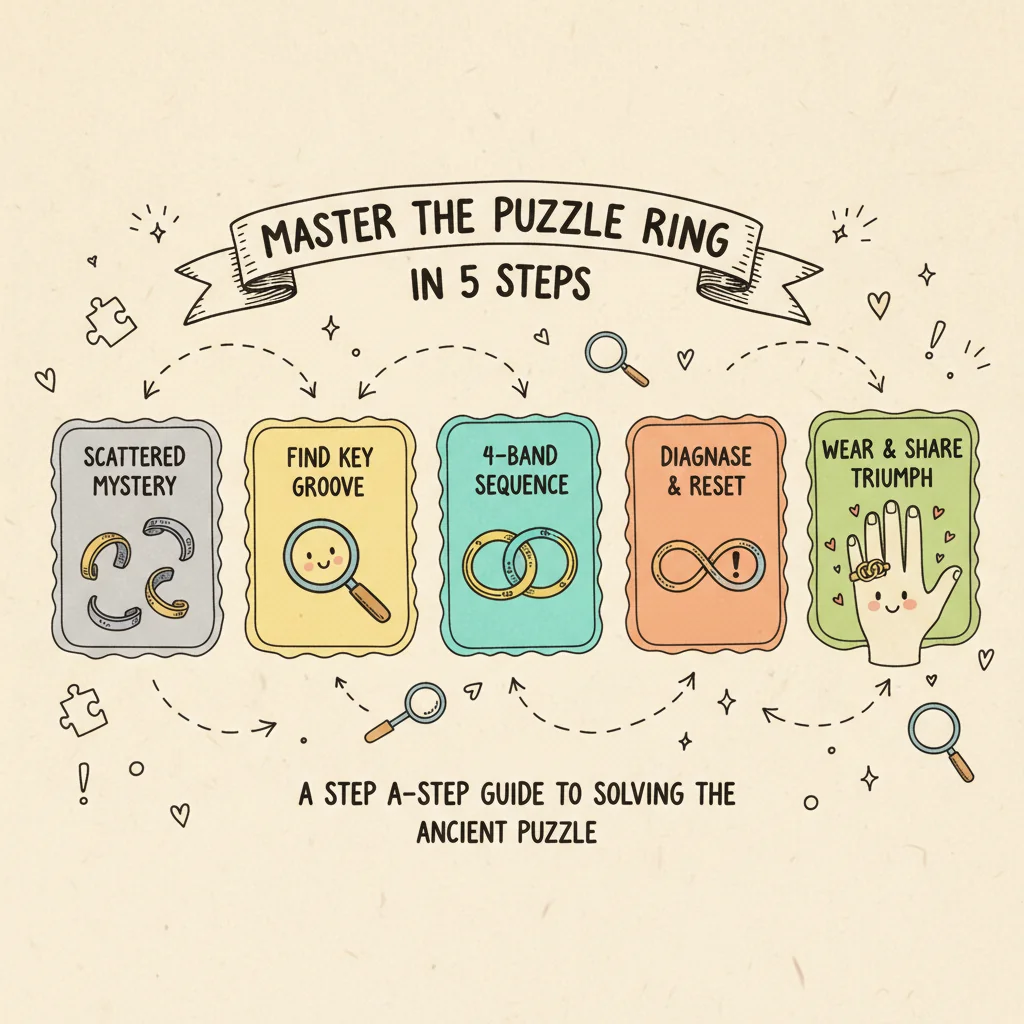
From Scattered Mystery to Solvable Puzzle: Your First, Calming Step
You’re holding four (or six, or eight) innocent-looking bands of metal. A moment ago, they were a ring. Now, they’re a mystery. Don’t worry—this isn’t broken, it’s a puzzle. And every puzzle has a solution. Let’s find yours, step by step.
First, let’s clear the mental clutter. Lay the pieces on a flat surface. Take a breath. What you have is a disentanglement puzzle, a piece of functional art designed to challenge and delight. For centuries, from Turkish puzzle rings to Celtic endless knots, these interconnected rings were crafted as tests of wit and tokens of commitment. The very fact it came apart so easily is proof of its ingenious, mechanical puzzle design—it wants to be solved.
Your frustration is the first clue. It means you’re engaging with the puzzle as intended. The scattered bands aren’t chaos; they are a locked door, and you simply need to find the key. That key isn’t a hidden tool, but a specific groove or notch on one of the bands. Understanding this is your “Aha!” moment.
Before we touch a single piece, remember the most important rule: never force it. These are often made of soft metals like sterling silver. Applying pressure is the one way to turn a temporary puzzle into a permanently bent puzzle ring. Our entire method is built on gentle, guided alignment.
So, let’s shift your mindset. You are not wrestling with scraps. You are a craftsman about to reassemble a clever, centuries-old device. The solution is logical, tactile, and deeply satisfying. In the next step, we’ll learn how to spot the master key hidden in plain sight among your silver puzzle ring bands. From there, the mystery becomes a clear, solvable sequence.
The ‘Groove is the Key’ Principle: Reading Your Ring’s Secret Language
Now, with that calm, craftsman’s mindset, let’s look at your scattered bands. You’re not just seeing pieces of metal; you’re looking at components of a tiny machine. Every working machine has a driving part, and in a puzzle ring, that part is almost always defined by a groove. This is the core principle that transforms a confusing jumble into a logical sequence.
First, sort your bands on a flat, clean surface. Spread them out. Look closely at the inner curve of each one. Do you see it? One or two bands will have a distinct, machined channel or a pair of notches cut into its inner surface. This is your key band. If you’re thinking, “But they all look the same!”—take them to the light. Run your fingernail gently along the inside. You are searching for that subtle catch, that ridge that defines a channel. For most classic 4-band and 6-band rings, this key band is singular and paramount. In an 8-band ring, you’ll often find two such grooved bands that work as a pair.
So, what does this groove actually do? It’s not a decoration. Think of it as a railway track or a dedicated slot. The other, smooth bands are designed to interlock and ride within this groove. When everything is aligned, the groove provides a path for the other bands to slide into their final, locked position. It’s the architectural spine of the entire assembly. Trying to solve a puzzle ring without identifying this feature is like trying to build a cabinet without first finding the piece with the dovetail joints.
“Is there a right side up?” This is a brilliant question, and the answer is: usually, yes. The groove gives it away. On most traditional rings, the key band’s groove will face inward toward your palm when the ring is worn correctly. When you hold the key band in a loose ‘C’ shape as if it were on your finger, the groove should be on the inside of that curve. Orient it this way before you begin. This simple act answers the silent question of how to tell if puzzle ring is assembled correctly before you even start—it sets your entire build on the proper foundation.
Let’s distinguish between the common systems:
- For a classic 4-band puzzle ring: You are looking for one band with a continuous central groove or two deep notches. The other three bands will be smooth. This is the most straightforward configuration and the core of our method.
- For a 3-band puzzle ring: The principle is similar but simpler. Often, one band has a central groove, or the locking mechanism is achieved through a specific bend or overlap. It functions on the same ‘track and slot’ logic, just with fewer parts.
- For 6, 7, and 8-band rings: The system scales. A 6-band ring might have one master grooved band, or sometimes two. An 8-band ring is essentially built as two interlocked 4-band units; you will typically find two key bands, each with its own groove system to manage a set of smooth bands. The principle remains: find the grooved guides first.
Hold your identified key band between your thumb and forefinger, oriented with its groove facing inward. Feel the channel with your thumb. This is the track everything else will follow. The other bands aren’t random; they are passengers waiting for their specific seat on this tiny railway. By learning to read this secret language of grooves and notches, you’ve already decoded 80% of the puzzle ring assembly challenge. You’re no longer staring at a mystery—you’re holding the blueprint.
Mastering the Foundation: The Foolproof 4-Band Sequence (And the Simpler 3-Band)
Now, with your blueprint in hand—the key band identified—the abstract becomes concrete. You’re moving from understanding the why to executing the how. This sequence is the heart of the method, the physical realization of the “Groove is the Key” principle. For a 4-band puzzle ring, this is the universal language. Master this, and you unlock the logic for nearly every variation.
Let’s build it. Think of this not as a memorized trick, but as a logical construction where each band lays the precise track for the next one to follow.
The 4-Band Sequence: A Step-by-Step Journey
Position 1: The Foundation
Hold your grooved key band vertically between your thumb and forefinger. Orient it so the groove (the indented channel you found) is facing inward, toward your palm. Your other three smooth bands are to the side. This vertical key band is your central pillar.
Position 2: The First Crosspiece
Take your first smooth band. You will place it horizontally behind the vertical key band. Now, gently slide the horizontal band’s midpoint into the groove on the key band. It should nestle into that channel. Don’t force it; it should seat with a slight, satisfying slide. You now have a classic “plus sign” (+) formation, with the horizontal band held in place by the key band’s groove. This is your first interlock.
Position 3: The Second Crosspiece & The First Weave
Here’s where the magic of sequence begins. Take your second smooth band. Your goal is to place it horizontally in front of the key band, but it must also weave over the first horizontal band on one side and under it on the other. A good way to start is to hook one end of this new band under one arm of the first horizontal band, then bring it across in front of the key band. As you align it, its midpoint will also press against the key band, but it is not seated in the groove yet. It is simply resting in front. The weave (over/under) is what begins to create the puzzle’s integrity.
Position 4: The Locking Band & The Final Click
This is the moment of truth. Take your final smooth band. Your task is to orient it vertically, parallel to your original key band, but on the opposite side of the horizontal crosspieces. This band will slot into the existing weave. Carefully, guide its top end over the second horizontal band, then under the first horizontal band. Do the reverse at the bottom: guide it under the second horizontal and over the first. This creates a complementary weave.
Now, here is the key mechanical action. While holding this new vertical band in this woven position, you must now gently push its midpoint into the groove of the key band from the front. You are, in essence, zipping the two vertical bands together using the groove as the zipper track. Apply gentle, steady pressure. You will feel resistance, then a distinct, gentle click as the metal of the final band seats fully into the key band’s groove.
If it doesn’t slide easily, just back up a step. Ensure your weaves (over/under) are correct and that no band is twisted. Forcing is the #1 mistake and can bend the soft metal, ruining the snug fit permanently.
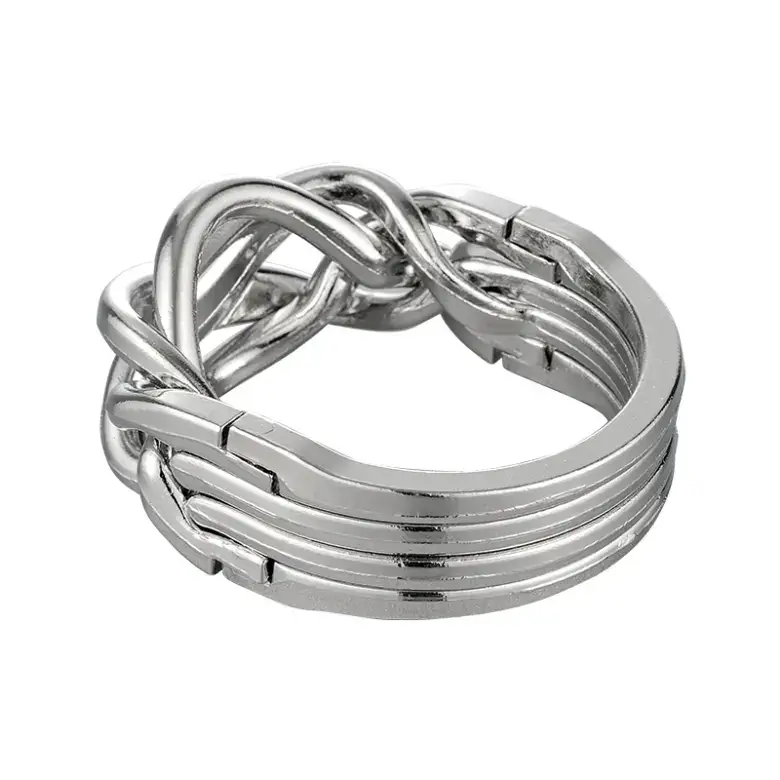
The Final Assembly: Once that click happens, relax your grip slightly. The entire assembly should now hold itself together as a single, coherent unit—a woven square or diamond shape. Gently compress all bands toward the center. You should see a symmetrical pattern, often called an X pattern or an endless knot. This is the solved state. Slide it onto your finger. If it’s correctly assembled, it will feel solid, a single piece of jewelry, not a bundle of loose wires. You’ve just completed the core puzzle ring assembly.
The Simpler Sibling: Solving a 3-Band Puzzle Ring
Many puzzle ring instructions gloss over the three-band version, but it’s a perfect training tool. The logic is a direct, simplified subset of the above. Often, one band has a central bend or a shallow groove acting as the key.
The 3-Band Method:
1. Identify the band with a distinct central feature—a V-bend, a slight flat spot, or a groove. This is your guide.
2. Hold this guide band vertically.
3. Take the second band and place it horizontally, hooking its center into or around the guide band’s feature. This creates a T-shape.
4. Take the third band. You will loop it around the assembly in a figure-eight or infinity path. It typically goes over one end of the horizontal band, under the guide band, then over the other end of the horizontal band.
5. The final motion is to gently twist or slide the third band’s midpoint into place against the guide feature. You’ll feel it lock, achieving a stable triangular or braided shape.
The tactile feedback is similar, but with one less band to manage, it’s an excellent way to build confidence before tackling a 4-band or 6-band puzzle ring.
Why This Sequence Works: The Logic Behind the Lock
Remember, you’re not just following steps; you’re building a self-locking mechanism. The initial key band with its groove provides a fixed track. The first horizontal band becomes a crossbar locked in that track. The second horizontal band, by weaving over and under, creates a template—a specific path that the final band must follow. When that final band is woven through that path and then clicked into the master groove, it completes a circuit. All bands are now mutually constrained; no single band can be removed without first reversing the precise sequence.
This is the essence of a mechanical puzzle, a broader category of hands-on challenges defined by their physical interaction. If your solved ring feels loose or falls apart, it’s almost always because one band (usually the last one) is not fully seated in its groove, or a weave is reversed. Don’t fret. This is where our next section, “The ‘Reset’ Guide,” will be your salvation. But for now, practice this 4-band sequence. Feel the click. That’s the sound of the puzzle solving itself under your patient guidance. Once you’ve internalized this rhythm, you’re ready to scale the mountain of more complex rings.
Why Your Ring ‘Won’t Go Back Together’: The Universal Diagnostic
You’ve felt the click. The bands are woven and seem snug. But when you lift the ring or give it a gentle shake, it collapses back into a handful of pieces. This isn’t failure; it’s feedback. Your ring is telling you, very clearly, that one critical rule of its mechanical logic has been broken. Don’t start over in frustration. Pause, and listen to what it’s saying.
In nearly every case, a solved ring that falls apart is suffering from one of three issues. Let’s diagnose yours.
1. The Groove is Empty.
This is the most common culprit. The key band’s groove is the lock, and the final band’s edge is the deadbolt. If that bolt isn’t fully seated, the lock can’t hold. After your final weave, you must actively press the last band’s edge down into that groove until you feel a definitive stop. A ring assembled correctly will have no visible gap where that final band meets the key band’s channel. Run your fingernail across the join—it should be smooth. If it catches, the groove is empty.
2. A Band is Flipped or Inverted.
Every band has a specific “right side up,” determined by the orientation of its curves. If a band is flipped 180 degrees, its curves will oppose the adjacent bands instead of nesting with them. The weave might look correct from above, but the tension will be wrong, and the ring will be unstable. Gently roll each band between your fingers. The high points (the “hills”) of one band should settle into the low points (the “valleys”) of its neighbor, like gears meshing.
3. The Weaving Sequence is Reversed.
This is subtle but vital. For the ring to lock, the over-under pattern must be consistent and complete. A single “over” that should be an “under” creates a weak point. If your ring has a specific band that always seems loose or is the first to fall out, that’s your sign. Isolate that band and trace its path. Mentally compare it to the puzzle ring solutions you’ve learned: does it mirror the pattern, or is it the photographic negative?
Here is your universal diagnostic checklist. Find the symptom, apply the fix.
Symptom: The ring holds shape in my palm but falls apart when lifted.
- Diagnosis: The final band is not seated in the key groove.
- Fix: Apply gentle, downward pressure along the entire edge of the last band you assembled, focusing on the point where it crosses the grooved key band.
Symptom: The ring feels “springy” or gaps appear between bands when I squeeze it.
- Diagnosis: A band is flipped or inverted.
- Fix: Lay the assembly down. Observe each crossover point. The bands should hug each other; if one seems to be pushing away, remove the problematic band (you may need to loosen one other), flip it, and re-weave.
Symptom: One specific band always comes out first, or the weave looks asymmetrical.
- Diagnosis: A sequence error. The weave order for your 4 band puzzle ring or 6 band puzzle ring is incorrect at one junction.
- Fix: Don’t take it all apart. Gently work backwards one or two steps from the loose band, then re-weave forward, paying meticulous attention to the over-under pattern. Remember, the sequence creates a self-locking path.
Symptom: The bands bind and won’t slide into final position at all.
- Diagnosis: You are forcing, not guiding. Metal is catching on an edge.
- Fix: This is critical: STOP. Forcing is the #1 mistake that bends soft silver puzzle ring bands. Gently back up. Ensure all bands are flat and not twisted on their axis. Use a fingernail to guide the band’s edge, not your thumb to crush it into place.
This diagnostic approach turns a moment of defeat into a simple correction. You’re not failing; you’re calibrating. Once you correct the flaw, that final, satisfying click will be more than a sound—it will be the confirmation that you understand the mechanism, not just the movements. For more strategies on maintaining composure during tricky assembly, our guide on how to solve a puzzle ring without losing your mind offers helpful perspective. And if you find yourself hopelessly turned around? That’s what the next section is for: a complete and gracious reset.
The Infinity Reset: How to Untangle Any Botched Attempt
So, you’ve followed the steps, applied the diagnostic, and yet your ring looks less like a piece of jewelry and more like a tiny, rebellious metal tumbleweed. The bands are crossed, bound, and seemingly fused in defiance. This is the critical moment. Your instincts scream to pull, to pry, to use force. This is where we must be still. A disentanglement puzzle—a sub-category of mechanical puzzles focused on separating linked elements—must be respected, not wrestled.
Welcome to the Infinity Reset. This isn’t failure; it’s a standard part of the learning process for any complex puzzle ring assembly. Think of it not as taking it apart, but as tracing each band back along its infinite path until it is free. The goal is to return to a clean slate of separate, unbent bands.
Step 1: Rest, Don’t Wrestle.
Place the tangled mass on a soft, well-lit surface—a mousepad or a cloth is perfect. Your hands are for finesse, not force. Look. Don’t pull. Identify any band that has a clear, loose curve or loop. There is always one.
Step 2: Find an Open Loop.
Gently rotate the knot until you see a band forming a loose ‘C’ or horseshoe shape that isn’t being pinched from both sides. This is your entry point. Slide your fingernail or a blunt, soft tool (a toothpick works) into that loop. Your job is to enlarge it, not collapse it.
Step 3: The Infinity Trace.
Here is the core principle: every band in a 4 band puzzle ring or 6 band puzzle ring follows a continuous, over-under path. Your task is to reverse-engineer that path. With your fingernail in the open loop, gently follow that specific band’s trajectory. Does it go under the next band? Gently guide it back over. Does it go over? Guide it back under. You are not pulling the band out; you are persuading it to retrace its steps.
Work one band at a time, with infinite patience. As you free a section, the tension on the others will lessen. (If you feel any metal catching or binding, stop. You’re moving the wrong band or in the wrong direction. Back up.)
Step 4: The Un-Knotting Motion.
For severe tangles, use a combination of slight twisting and sliding motions, always along the natural curve of the metal. Imagine you are loosening a delicate knot in a silk thread. The metal has memory; it wants to return to its smooth, annular shape. You are helping it remember.
Step 5: The Final Release.
As the last interlock separates, you won’t get a dramatic pop. You’ll get a quiet sigh as the bands lay flat and independent on the cloth. This is success. You have just performed the most advanced maneuver in puzzle ring instructions: the controlled, non-destructive reset.
Now, you have your separate bands again. But you are not back at the beginning. You are wiser. You’ve felt the tension points and seen the structure from the inside out. This kind of spatial reasoning is exactly why puzzle rings test spatial humility. Lay them out, find your grooved key band once more, and begin the foundational sequence with new clarity. The path from scattered mystery to solvable puzzle is once again clear, because you now hold the master key for any botched attempt: the infinite patience of the trace.
Scaling the Ladder: How the 4-Band Logic Builds 6, 7, and 8-Band Rings
You’ve mastered the reset, feeling the structure from the inside out. Now, with your bands neatly separated once more, let’s build something taller. If the 4-band ring is a sturdy square, then 6, 7, and 8-band rings are the elegant towers built upon its foundation. The beautiful secret is this: you already know how to solve them. Complex puzzle ring assembly isn’t about learning a dozen new moves; it’s about seeing the familiar patterns within the complexity.
The governing principle is pairing. In most multi-band designs, bands are not independent; they work in committed pairs. A 6 band puzzle ring, for example, is often a standard 4-band core with an additional pair of bands woven around it. An 8 band puzzle ring is typically two complete 4-band units, perfectly interlaced. Your task shifts from assembling individual bands to assembling pre-coupled units. Look at your scattered bands. Do any of them seem permanently linked, or have matching grooves? They are likely a pair.
Let’s start with the most common step-up: the 6-band ring.
The 6-Band Sequence: A Core and a Shell.
1. Identify the Pairs. Examine your six bands. Two of them will likely be identical, often with a central groove or a specific bend. These are your “outer pair” or “shell.” The remaining four are your core unit.
2. Assemble the 4-Band Core First. Using the exact sequence from the foundation section, interlock your four core bands completely. You should now be holding what looks like a finished, but slightly sparse, puzzle ring.
3. Introduce the First Outer Band. Take one of your identified outer bands. Hold your completed core in one hand. Gently weave this outer band over and under the core bands, following their existing path. Think of it as putting a sleeve on. It will sit outside the core structure, its grooves or notches clicking into place on the core bands.
4. Add the Final Outer Band. Take the matching outer band. This final piece typically threads through the first outer band and the core, locking the entire assembly into rigidity. You will feel a distinct, solid snug fit when this second shell band seats into place.
(If you hit resistance, ensure your core is perfectly assembled. A wobble in the foundation makes the shell impossible to attach.)
The Curious Case of 5, 7, and Other Odd-Numbered Rings.
You asked, “My ring has 5 bands and no instructions fit—what do I do?” This is the niche challenge. Odd-numbered rings often use a clever trick: one band is a “double” or “keeper” band that performs the function of two. The assembly logic remains—find the key band and build around it. Usually, you will assemble a stable 3-band or 4-band base, and the final odd band acts as a locking pin that threads through multiple points. Your best approach is to search for the band with the most complex bends or notches; that is your linchpin. Assemble the simpler bands around it as a scaffold, then interlock the final, complex band last. It’s a patient game of deduction, but the mechanical principles are unchanged.
Mastering the 8-Band: Two Rings in One.
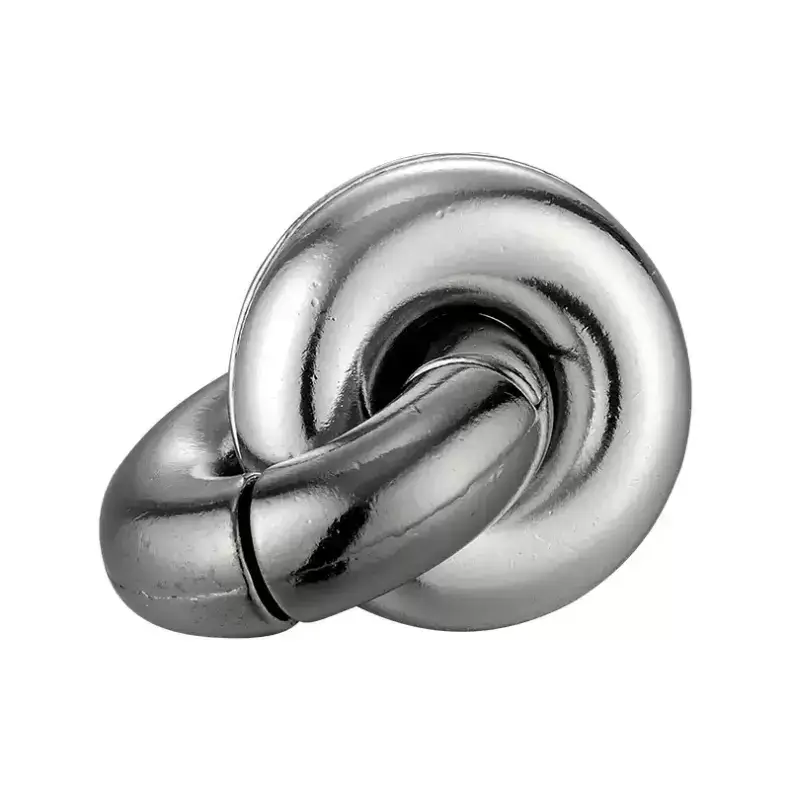
This is where the pairing principle shines. As noted in our key facts, the assembly pattern for an 8-band ring is similar to a 4-band, treating bands in pairs. You are essentially building two interlocked 4-band rings. The process shares DNA with other interlocking ring puzzles, which you can explore in our guide to interlocking double-ring puzzles.
1. Create Two 4-Band Units. Separate your eight bands into two sets of four. Assemble each set independently into a complete, loose 4-band ring. Do not try to tighten them fully yet.
2. Interlock the Units. Hold one completed unit. Carefully rotate and slide the second unit through the open spaces of the first. This is a delicate, three-dimensional weave. The goal is to mesh them so their bands alternate.
3. The Final Tightening. Once they are partially meshed, begin the final tightening sequence you learned for a 4-band ring, but now you are moving pairs of bands together. Apply gentle pressure symmetrically. The entire structure will condense into a dense, magnificent endless knot of metal. The tactile feedback here is profound—a series of satisfying clicks as multiple grooves engage simultaneously.
Why Does My Complex Ring Keep Falling Apart?
If your 6 or 8-band ring seems unstable, the diagnosis is almost always the same: one pair of bands is not fully seated. The ring relies on the tension between paired units. Go back to the last band or pair you added. Remove it, and re-seat it, ensuring every notch catches its partner. Forcing is never the answer; precision is. Sometimes, the solution lies in trusting the real way to solve metal puzzles, which is about feel and geometry over muscle.
You have now scaled the ladder. The logic that solved four bands can solve forty, because you are no longer just following steps—you are understanding the architecture. This knowledge turns a daunting mechanical puzzle into a series of manageable, familiar connections. Your patience has built a new lens to see through the complexity. Now, let’s ensure your solved masterpiece stays that way.
When Metal Meets Flesh: Care, Handling, and Fixing a Bent Band
You’ve done the patient work. Your ring is a snug, interlocked symbol of your focus. Now, the puzzle becomes a piece of jewelry again, meant to be worn and appreciated. This final shift—from solver to steward—requires its own gentle knowledge. The metal, especially if it’s traditional sterling silver, is soft. It’s designed to yield slightly to your touch, but it remembers abuse.
Can you wear a puzzle ring every day?
Yes, but with awareness. A well-assembled ring is surprisingly sturdy, its strength coming from the mutual tension of the bands. However, it is not a solid band. Avoid catching it on rough fabrics, straps, or during manual work. The primary risk isn’t it falling apart—it’s snagging, which can apply uneven force and bend a band. For daily wear, choose a ring that fits comfortably without being loose. A proper fit reduces wiggle and snagging.
How to clean a puzzle ring without it falling apart.
Never submerge a disassembled ring. Always clean it while it’s fully assembled. The solution is simple. Use a soft, lint-free cloth (a jewelers’ polishing cloth is ideal) and gently rub each visible band. For stubborn tarnish on silver puzzle rings, use a tiny drop of mild soap in lukewarm water. Dip the cloth, wring it nearly dry, and wipe. Immediately dry the entire ring thoroughly with a separate cloth, taking a moment to gently pat within the crevices of the endless knot pattern. This maintains its shine without risking water or cleaner trapped between the bands, which can cause corrosion.
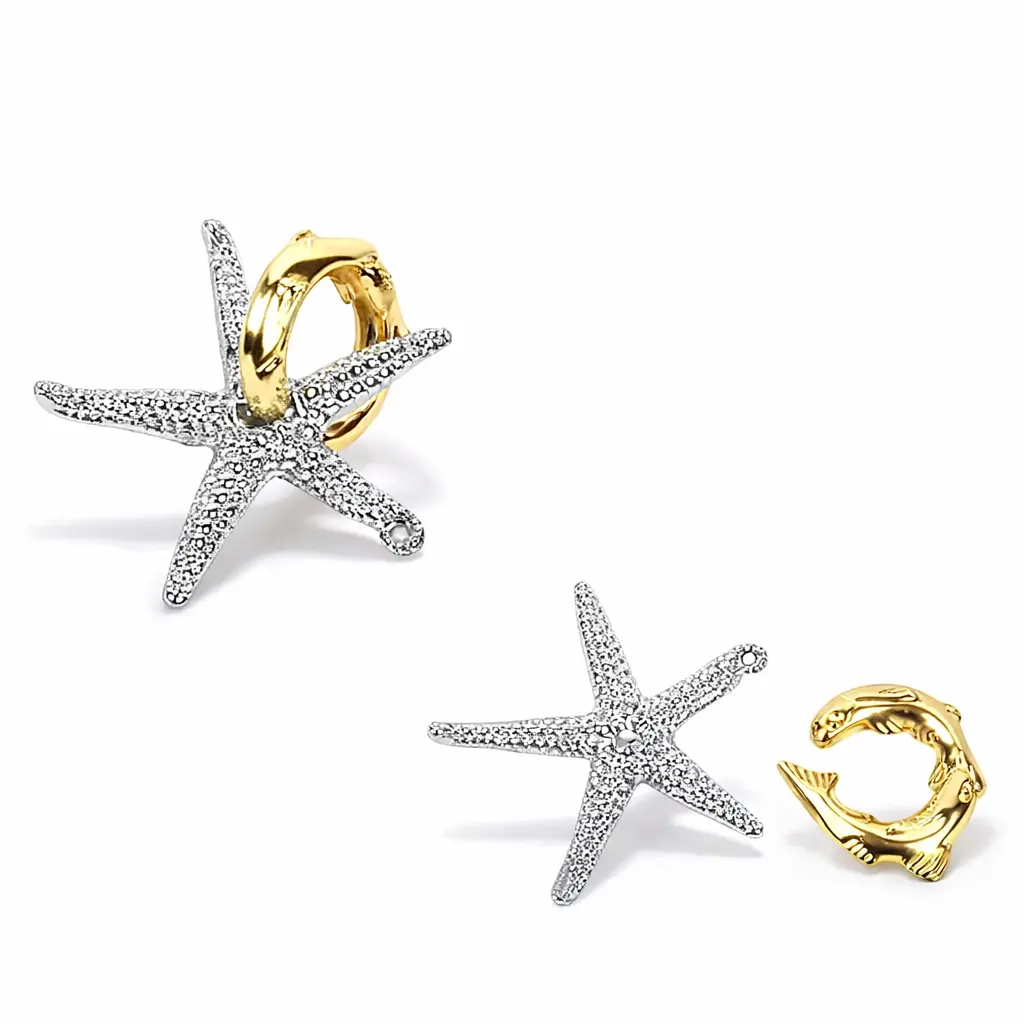
Metal Starfish Puzzle Ring — $13.99
Note on metal quality: A sterling silver puzzle ring is more malleable and forgiving than cheaper, harder alloys. The cheaper metals are often more brittle and can be harder to manipulate without risk of a sharp kink, a point explored in our veteran’s guide to durable metal puzzles. The assembly logic is the same, but the tactile feel differs.
The delicate art of fixing a bent band.
This is the most critical skill. Forcing is the #1 mistake, and its consequence is a bent band. If this happens, don’t panic. A slight bend is often fixable.
First, disassemble the ring using the ‘Infinity Reset’ logic. Lay the bent band flat on a hard, smooth surface. Examine the curve. Your goal is not to hammer it straight, but to coax it back to its true arc. Use your thumbs. Apply slow, rolling pressure along the entire length of the band, working from the ends toward the center of the bend. Never press on just the high point. You are not bending it back; you are encouraging it to remember its original shape.
Turn the band frequently. Check your progress by trying to seat it into another, known-good band. Does the groove align? Does it lie flat? Go slowly. (If the bend is severe or creates a sharp kink, stop. A jeweler with a mandrel and nylon mallet can often save it, but the metal is permanently weakened.)
After straightening, the puzzle ring assembly process is your final test. If the band smoothly inter-locks and the final ring achieves a snug fit, you’ve succeeded. If it binds or feels strained, the band likely needs more gentle correction. This meticulous care transforms a mechanical puzzle into a lasting heirloom, a passed down ring ready for its next generation of thoughtful hands.
From Solved to Second Nature: Wearing and Sharing Your Triumph
Now that your ring is whole and you understand its care, you move from mechanic to master. That first snug fit is a triumph. Wear it. Feel its unique, slightly textured presence on your ring finger. But the true confidence comes from knowing you can do it again, and again, until the puzzle ring assembly becomes a satisfying, tactile meditation.
Take it apart. (Yes, I mean it.) Now, solve it again. This time, don’t just follow steps—listen for the logic. Feel how the key band guides the others. Notice the interconnected rings moving into their endless knots. This practice builds muscle memory, turning a deliberate process into something intuitive. Soon, you won’t need puzzle ring instructions; your fingers will know the dance. This is the craftsman’s secret: repetition reveals elegance. For a deeper look into mastering this kind of dexterous challenge, the metal starfish puzzle ring deep dive explores a related, intricate puzzle.
Your solved ring is a quiet testament to patience, a mechanical puzzle transformed into personal jewelry. It becomes a conversation piece. When someone admires it, you have a choice: you can simply accept the compliment, or you can show them the magic. Taking it apart and reassembling it for a friend is a wonderful way to share the satisfaction you’ve earned. It’s a heirloom ring in the making, not just of metal, but of a story and a skill you now possess.
For a deeper reflection on the patience this object teaches, consider when a ring becomes a masterclass in patience.
Your journey from scattered pieces to a unified whole is complete. You started with a mystery and, through focused attention, became its solution. Keep that confidence. The next time those bands sit innocently in your palm, you’ll smile. You know the secret isn’t a trick—it’s understanding. And now, so do you. Go ahead, give it one more solve. Just for the joy of it.