The First Contact: Where Beauty Meets a Secret
The first one I ever held was a 2-Sun box. My fingers traced the repeating chevron pattern of Yosegi, its surface a cool, geometric river of chestnut brown and pale ash. To the eye, it was a perfect, seamless cube, a static mosaic of wood. There were no hinges, no locks, no visible seams—only a faint, almost imaginary grid of lines suggesting where its panels might meet. It was quiet. It held its secret with a kind of elegant stillness you’d expect from a polished stone or a piece of cloisonné.
Then, I applied pressure. Not where you’d expect a lid to be, but on a specific corner of that wooden mosaic. There was a resistance, a hair’s breadth of give. Then, a quiet, internal click—a sound felt more in the bones of the hand than heard with the ear. A single, thin panel slid backward by a precise centimeter, revealing a dark sliver of inner space. The solid object had performed its first secret gesture. This is the moment that defines a Japanese puzzle box, or Himitsu-Bako.
Himitsu-Bako translates literally to “secret box.” The term refers specifically to the ingenious internal mechanism—the hidden choreography of sliding panels, levers, and blocks, often held in place by nothing more than gravity and precise friction. It is a functional secret. The stunning wooden mosaic covering it is a separate, equally revered craft: Yosegi-zaiku.
Think of it this way: the Himitsu-Bako is the locked room. The Yosegi is the exquisite, patterned wallpaper on its walls. One is engineering; the other is art. They converged in the Hakone region, where artisans mastered both, wrapping complex mechanical puzzles in jackets of intricate, pieced-wood veneer. This combination is what we now call a Yosegi puzzle box. The meaning of the object lives in this duality. It is a handmade container designed to be experienced, not just viewed. It asks a question of your hands and rewards you with a silent, mechanical sigh.
As a conservator, I learned to see objects as dialogues between material and intention. A teacup speaks of utility and ceremony. A painting, of pigment and light. A Japanese puzzle box speaks of concealment and revelation, of beauty that is also a blind. It is not a “trick.” There is no deception, only a sequence you have not yet learned. The mechanism is stubborn, but fair. Its logic is geometric, tactile. The puzzle mechanism doesn’t fight you; it simply waits for you to find the first, correct pressure point. From there, a dance begins.
That first, hesitant slide of a panel is a tiny collapse of the boundary between you and the object. The beautiful, static mosaic is revealed as a facade—a gorgeous, intentional facade—for a hidden machine of sublime simplicity. You are no longer just holding a box. You are holding a conversation. And the box has just spoken its first, silent word.
From Hakone to Your Hands: The Origin of a Quiet Revolution
That first silent word spoken by the box—that click or shift felt in the fingertips—is the endpoint of a very specific conversation between geography, necessity, and craft. To understand why a Himitsu-Bako feels the way it does, you must travel back to the late Edo period, into the misty, wooded mountains of Hakone.
Hakone was, and remains, a region defined by its vertical landscape and its position on the vital Tōkaidō road linking Kyoto and Edo. This brought travelers, but its true wealth lay underground in its hot springs and, crucially for our story, in its forests. The area is a natural mosaic of tree species: light zelkova, dark cherry, reddish cedar, and pale dogwood. This diversity of multi-toned woods didn’t just provide material; it inspired a visual language. Local artisans had long perfected Yosegi-Zaiku, the intricate craft of creating geometric designs by bonding, slicing, and shaving different colored woods into veneer sheets. It was beautiful, decorative marquetry. But it was about to become the skin for a secret.
Into this setting steps the figure of Jinbei Ishikawa (1790-1850), a woodworker from the post-town of Hatajuku. The commonly accepted origin story is that Ishikawa, responding to a practical need of the era, devised the first true secret puzzle box. The late Edo period was a time of both flourishing arts and strict social hierarchies, where individuals—from samurai to merchants—sometimes required discreet, secure ways to store personal documents, medicines, or valuables. A locked box declares it has secrets. A box with no visible lock, no hinges, and no discernible opening mechanism does not. It is simply a beautiful, inert object. Ishikawa’s genius was to marry the region’s ornamental Yosegi craft with a precise, internal mechanical puzzle of interlocking sliding pieces.
His invention was not a whimsical brain teaser for entertainment, but functional craft born of a tangible need for secrecy. The mechanism was a choreography of sequential moves, where one panel, moved in the correct direction, would unlock the next, and so on, until the final compartment was revealed. This was the birth of the “step” system, though it would not be labeled as such for generations. The object’s entire purpose was to be un-openable to anyone who did not know its specific, tactile sequence.
The Hakone region provided the perfect cradle for this craft. The diversity of woods allowed for strong, fine-grained internal mechanisms and stunning, complex surface patterns. The steep terrain and isolated valleys fostered tight-knit communities of artisans where techniques were guarded and passed down through family lines. A handmade wooden puzzle box from this era was a confluence of local resources and human ingenuity, a self-contained secret system as intricate as the social world that demanded it.
This origin story explains the Himitsu-Bako’s enduring character. It was never meant to be a mere container, nor a simple diversion. From its inception, it was a functional sculpture, a beautiful denial of its own function. The shift from Ishikawa’s original, purpose-driven designs to the wider world of collectible mechanical puzzles was a quiet revolution. The need for secrecy faded, but the profound satisfaction of the tactile dialogue—the conversation between hand and hidden mechanism—only grew stronger. It’s a testament to the design that the same principles that safeguarded a samurai’s correspondence 200 years ago can now captivate a puzzle enthusiast halfway across the globe. As many modern DIY plans discover (and often fail to replicate, as explored in our article on why most Japanese puzzle box plans fail), the true challenge lies not in the idea, but in the exacting, silent tolerances of the traditional craft itself.
Decoding the Specs: What ‘3 Sun, 6 Steps’ Actually Feels Like
Having traced the Himitsu-Bako from its Hakone origins, you now face its modern, often confusing, description: a series of numbers like a secret code. “3 Sun, 6 Steps.” Every listing uses this lexicon. And every newcomer wonders: what does this feel like in my hands? As a conservator, I learned that specifications are a dry translation of a physical experience. Let’s re-translate them back into sensation.
First, the Sun (寸). This is not a modern metric, but a traditional Japanese unit of length, where 1 Sun is approximately 3.03 centimeters. It refers to the approximate length of one side of the mostly cubic box. When a listing says “3 Sun,” it’s describing a cube roughly 9 cm (3.5 inches) per side.
But the number is a ghost of the object. You need to know what it haunts.
* A 2 Sun box is a diminutive treasure, about 6 cm. It fits neatly in a cupped palm, its movements requiring a delicate, precise touch from your fingertips. This is a personal puzzle, an intimate secret.
* The 3 Sun or 4 Sun sizes are the quintessential handmade wooden puzzle box. At 9-12 cm per side, they have a satisfying heft and presence on a desk. Your whole hand can engage, pushing panels with a confident pad of your thumb. This is the Goldilocks zone for most solvers: substantial enough to feel like a real object, small enough to manipulate comfortably.
* A 5 Sun box (about 15 cm) is a statement piece. It commands attention, its larger Yosegi patterns more expansive and dramatic. The movements can require a firmer push, the internal clicks more pronounced. This isn’t just a puzzle; it’s a sculptural centerpiece that happens to contain a secret choreography.
The Sun measurement, therefore, tells you about presence and handling. It answers: Will this live on my shelf or in my hand? Is it a fidget-sized companion or a display-worthy artifact of traditional craft?
Then, there are the Steps. This term is the greater source of intrigue and misunderstanding. A “step” is defined as one discrete, necessary sliding movement of a panel to progress toward opening. A “4-step” box requires four such movements. A “21-step” requires twenty-one.
The immediate, intuitive assumption is that more steps equal higher difficulty. This is the step-count lie, and it’s the most important concept to grasp when choosing a mechanical puzzle.
Think of steps not as a difficulty rating, but as the length of the sequence. A 4-step box can be diabolically clever, its moves counter-intuitive and tightly interlocked, demanding you unlearn logical assumptions. A 21-step box might simply be a longer, more repetitive sequence of similar movements—a longer dance, but with easier steps to follow. The true challenge lies in the design of the sequence, not its length. Is the mechanism straightforward but lengthy, or brief but devious? The spec sheet won’t tell you.
This is why, in collections and discussions among enthusiasts, you’ll find reverence for certain low-step Japanese puzzle boxes that humble the overconfident. Their difficulty is compressed, not protracted. Step count is a promise of duration, not a guarantee of struggle.
So, what does “3 Sun, 6 Steps” feel like? It is likely a compact, palm-sized cube of multi-toned woods, bearing a geometric Yosegi-zaiku pattern. Its six moves will constitute a short to medium-length tactile conversation. It may be stubborn or straightforward—the number alone cannot say. But its size makes it an ideal candidate for repeated handling, for the kind of familiar, almost meditative solving that comes once you’ve learned its particular rhythm. It is a perfect example of how the specs sketch only the silhouette of the experience. The substance—the grain under your thumb, the resistance of a well-fitted panel, the quiet, internal click of discovery—is what you’re truly buying.
The Step-Count Lie: Why Difficulty Resides in Design, Not Numbers
That distinction—between the silhouette of specs and the substance of experience—leads us directly to the most common misconception in choosing a Himitsu-Bako. You have likely seen boxes advertised with their step count prominently displayed, a numerical beacon meant to signal challenge. This is the step-count lie. In the world of mechanical puzzles, difficulty is a function of cleverness, not chronology. A long sequence can be perfectly logical, while a short one can be a masterclass in misdirection.
Think of it as the difference between following a long but well-signed path and finding the hidden latch on a seemingly solid door. A 21-step box might guide you through a beautiful, linear procession of sliding panels, each move revealing the next with a satisfying inevitability. It is a prolonged, elegant dance you learn by rote. Conversely, a 4-step box may present a solid, unbroken Yosegi face, offering no purchase for your fingers and no hint of internal compartmentalization. Its challenge is one of perception: finding the first, perfectly concealed seam. That single, elusive discovery may require more insight and experimentation than two dozen obvious slides. The designer’s artistry is spent on concealment and tactile feedback, not on length.
So, what truly governs difficulty if not step count? It’s the presence of what collectors call “false moves” or “red herrings”—panels that slide but lead nowhere, designed to send you down a frustrating garden path. It’s the reliance on specific sequences or simultaneous pressures that defy linear logic. It’s the quality of the puzzle mechanism itself: a perfectly fitted panel provides almost no auditory or tactile clue when manipulated correctly, while a looser fit might whisper its secrets. A high-step-count box from a standard workshop might feel like a straightforward if lengthy, procedure. A low-step creation from an artisan like Akio Kamei can feel like debating with a locked-room mystery.
How, then, can you assess real difficulty from a product description? Look beyond the number.
* Language of Obscurity: Descriptions that mention “completely seamless,” “hidden compartments,” or “non-linear solution” are hinting at a devious design philosophy, regardless of stated steps.
* The Artisan’s Name: Boxes from renowned modern makers are almost always more conceptually challenging than mass-produced counterparts with similar step counts. Their reputation is built on innovative mechanism design.
* The “First Move” Problem: As a general principle, the harder it is to locate and execute the first move, the more intellectually demanding the entire Japanese puzzle box will be. A product photo that shows a perfectly geometric, unbroken pattern is a subtle clue.
This is why asking how to open a Japanese puzzle box is the wrong question. The right question is: how does this particular box think? Does it reveal its logic grudgingly, through patient exploration and pressure testing? Or does it guide you along a pre-set path? A stubborn, fair box—one that yields its secrets only to careful observation and deduction—provides a deeper, more lasting satisfaction than one that simply occupies your hands for a longer time. Step count is a marketing number. The silent, clever conversation between your hands and the box’s hidden choreography—that is the real measure of a puzzle’s worth. For a foundational approach to this conversation, our complete guide from frustration to mastery offers essential principles.
The Choice Matrix: Matching a Box to Your Purpose (Self, Gift, Display)
Now that we’ve liberated ourselves from the tyranny of the step count, we can approach the real joy: choosing a Himitsu-Bako that fits your life. Forget shopping by spec sheet. Think instead about the role the box will play. Will it be your first tactile conversation with this craft? A meaningful gesture for a thoughtful friend? Or a striking piece of functional art for your shelf? Your purpose is the most reliable compass.
For the First-Time Solver: Seeking a “Stubborn, But Fair” Partner
Your goal is to learn the language. You need a box that teaches the basic grammar of pressure, slide, and sequence without resorting to cruelty or triviality. This is where the best Japanese puzzle box for a beginner is not about the lowest number, but the clearest feedback.
- Size Matters (More Than You Think): Start with a 3 or 4 Sun box. At roughly 9-12 cm, it fits comfortably in your hands, allowing you to feel subtle shifts and apply controlled pressure to all sides. A 2 Sun can be too fiddly, while a 5 Sun might feel cumbersome for initial exploration.
- The Sweet Spot for Steps: Look for a range of 4 to 8 moves. This often indicates a classic, sequential design where each action reveals the next. It’s a complete choreography, but one you can hold in your mind. Beware of a 2-step box—it can be deceptively simple or maddeningly obscure. A Japanese puzzle box 21 steps is a destination, not a starting point.
- The “Satisfaction Guarantee”: A good beginner box has a discernible “click” or stop at the end of each move. This tactile feedback is your reward, confirming you’re on the right path. The final opening should deliver a quiet, physical revelation—the lid lifting, a drawer sliding out. That moment is the hook.
- Functionality: Yes, you can store things in it. A small ring, a USB drive, a single meaningful note. Closing it is simply the sequence in reverse—a satisfying ritual that resets the puzzle. It becomes a keeper of small secrets, not just a solved object.
The ideal first box isn’t the easiest; it’s the one that best teaches you how a Japanese puzzle box thinks. For a hands-on primer on engaging with those first hidden seams, the insights in our guide on the art of the invisible seam are invaluable.
As a Meaningful Gift: The Gift of a Process
Gifting a puzzle box is not gifting an object; it’s gifting an experience, a period of focused curiosity. The choice becomes an act of empathy.
- Read the Recipient: For the methodical thinker, a sequential, multi-step box (think 15-25 steps) offers a delightful logical chain to unravel. For the intuitive, tactile person, a box with a mechanism based on hidden magnets or unusual pressure points might be more engaging than a pure slide puzzle.
- The Presentation is Part of the Puzzle: The Yosegi pattern is the wrapping paper that can never be torn off. Choose a pattern that resonates—geometric for the minimalist, a detailed koyosegi (detailed mosaic) image for the art lover. The woods themselves tell a story: the warmth of cherry, the gravity of zelkova.
- Manage Expectations: A subtle, crucial step. When you give the box, you might say, “It’s said to have about [X] movements,” immediately framing the step count as folklore, not a definitive map. This prevents frustration and opens the door to discovery.
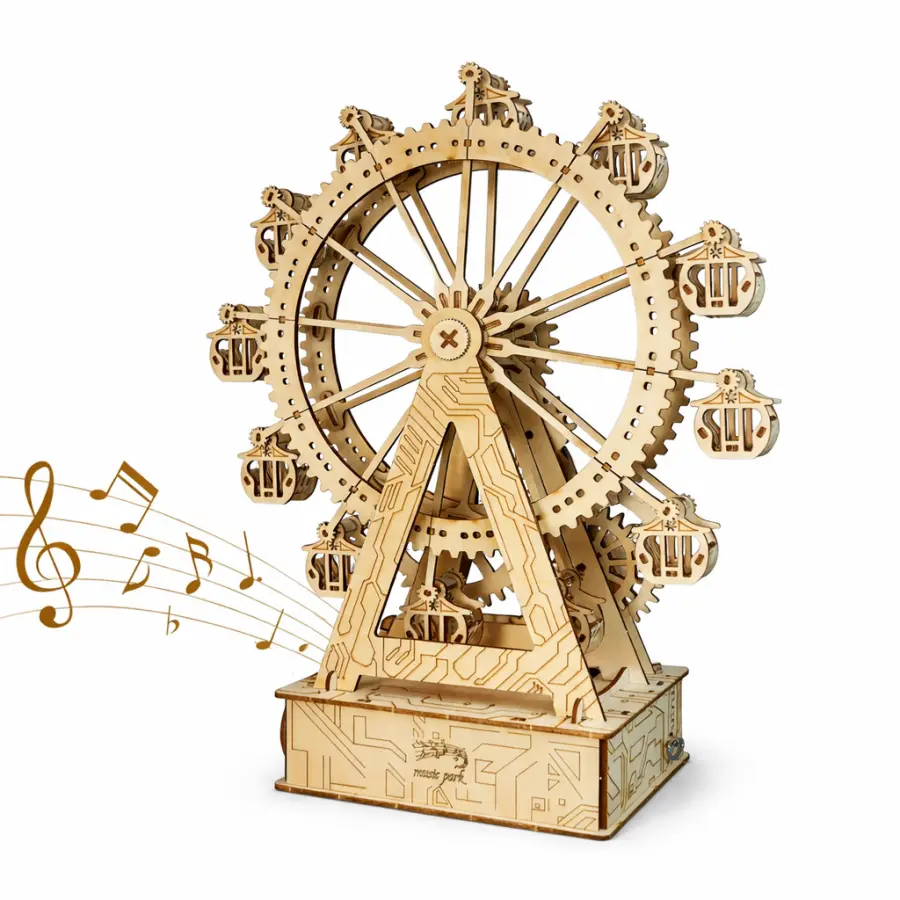
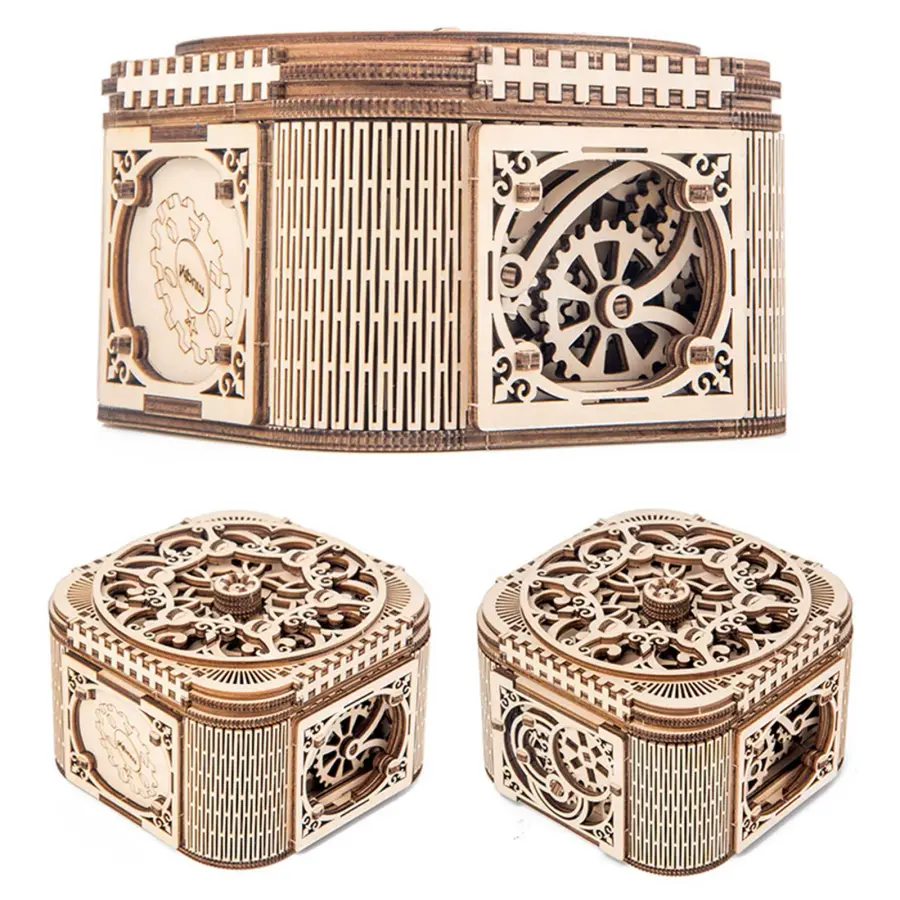
- The Alternative Gateway: If the pure secret puzzle box feels like too niche a leap, consider a related mechanical art piece that showcases craftsmanship and interaction. A decorative music box kit, for instance, offers the satisfaction of assembly and a beautiful, kinetic result.
As Functional Art & Display: Where the Craft Takes Center Stage
Here, the puzzle mechanism is almost a secondary virtue. The box is a stationary sculpture that happens to contain a secret. Your criteria shift from the mental to the material.
- Yosegi as the Masterpiece: Prioritize complexity and artistry in the marquetry. Look for intricate, detailed patterns like koyosegi (pictorial mosaics of birds, flowers) or sophisticated geometric illusions. The surface should be a gallery, inviting endless visual exploration even when the box is closed.
- Wood Selection & Finish: Premium boxes use a wider palette of native Hakone region woods—yellow yew, white Japanese oak, dark walnut. The finish should be a silken-smooth urushi lacquer that deepens the grain and color, protecting the art. You’re choosing a painting, but one you can hold.
- Form and Proportion: Display pieces often benefit from a larger Sun size—4 or 5 Sun—to better showcase the pattern. The shape becomes part of the aesthetic; a clean, hexagonal or rectangular form can have a serene, architectural presence on a shelf.
- The Secret is a Bonus: In this context, the puzzle mechanism is a private pleasure for you or trusted guests. It’s the fact that the static art object has a hidden, kinetic dimension that adds layers of value. A beautifully complex box can still house a modest, elegant mechanism—the surprise isn’t in the difficulty, but in the mere existence of the hidden compartment.
Ultimately, the best box is the one whose purpose aligns with your own. It might be a humble 4-step Sun puzzle box that lives on your desk, a fidget tool for moments of thought. It might be a stunning display piece that sparks conversations. Or it might be a gift that says, “I trust you with a mystery.” Choose the role first, and the perfect wooden puzzle box will reveal itself. For more inspiration across different styles and mechanisms, our curated list of 11 Puzzle Boxes For Adults That Actually Reward Your Patience is an excellent next stop.
The Artisan’s Touch: Akio Kamei and the Modern Evolution
Having chosen a box whose purpose aligns with your own, you might think the story of the Japanese Puzzle Box is one of pure tradition, locked in a Hakone mountain village. But the craft did not fossilize. A parallel, innovative evolution was occurring, one that treats the Himitsu-Bako not just as a secret container, but as kinetic sculpture. This is the realm of the modern artisan, led most influentially by a man named Akio Kamei.
Where the traditional Hakone box is a geometric prism dressed in Yosegi, Kamei’s creations are often organic, even alien. Think of spheres, ovoids, and intricate polyhedrons. His work answered a question few had asked: what if the puzzle was not just in the sequence of slides, but in the very form of the object itself? A Kamei box might not have a single straight line or obvious panel. The puzzle mechanism is integrated into a sculptural whole, demanding a solver to abandon all preconceived notions of how a secret puzzle box should behave. This was not an incremental improvement; it was a philosophical shift.
So, who is Akio Kamei? He is a modern karakuri master, a descendant of the inventive spirit of Edo-period craftsmen like Jinbei Ishikawa, but operating with a contemporary designer’s mind. Emerging in the late 20th century, Kamei’s background in engineering and design allowed him to deconstruct and reimagine the core principles of the sliding panel puzzle. His mechanisms often incorporate rotations, magnetic latches, and sequential discoveries that feel more like unlocking a piece of elegant machinery than following a set path. For collectors, an Akio Kamei puzzle box represents the apex of the form—where art and brain-teaser merge completely.
This shift created a distinct collector’s market. While a traditional Hakone box is valued for its craftsmanship and wood mosaic, a modern art-level box is often valued for its conceptual innovation and the reputation of its maker. Kamei’s pieces, and those of other esteemed artisans, are typically signed, produced in very limited numbers, and command prices that reflect their status as functional art. Authentication here is different than verifying Hakone origin; it involves provenance, the maker’s signature, and often a certificate. These are not souvenirs, but focal points for a serious collection, much like the 7 Japanese puzzle boxes that will humble your IQ on a collector’s desk.
The influence is bidirectional. Kamei’s innovations have, in turn, inspired some traditional Hakone workshops to experiment with more complex internal mechanisms and occasional non-traditional shapes, broadening the spectrum of what a wooden puzzle box can be. Yet, the two streams remain distinct. The Hakone box is a testament to regional craft and pattern; the modern art box is a testament to an individual’s ingenuity.
Owning such a piece changes the relationship with the object. Solving it is a profound, often lengthy dialogue with the artisan’s mind. The tactile feedback is everything. And, as with any great piece of art, its value extends beyond the first interaction. Once solved, it becomes a stunning display object, a conversation piece that holds a secret history of your own effort. For a deeper look at the mindset required to engage with such intricate designs, the principles in our guide on How To Solve A Puzzle Box Without Losing Your Mind are doubly relevant here.
Kamei’s legacy, therefore, is one of liberation. He demonstrated that the soul of the mechanical puzzle (a category well-documented on Wikipedia) is not a specific set of dimensions or a traditional pattern, but the intellectual choreography between maker and solver. He expanded the definition of the craft, inviting us to see that the most beautiful secret a box can hold is not an empty compartment, but a new way of thinking.
The Ethical Hunt: Where to Buy Authentic Himitsu-Bako
After understanding the creative vision behind a Kamei piece or the regional tradition of Hakone, the natural next question is practical: where does one actually acquire such an object? The hunt for an authentic Himitsu-Bako is part of the journey, a tactile scavenger hunt that rewards patience and discernment. Whether you’re browsing from afar or planning a pilgrimage, navigating the marketplace ethically ensures your box is not just a product, but a piece of supported craftsmanship.
For most, the search begins online. While this lacks the sensory experience of handling a box, a few curated, authoritative retailers bridge the gap with transparency and expertise. Puzzle Master (Canada) and Karako (Japan) are two pillars in the online space. Puzzle Master acts as a serious curator for the global puzzle community, offering a range from traditional Hakone boxes to modern mechanical puzzles, with clear photographs and accurate step counts. Their reputation is built on reliability for international buyers. Karako, based in Japan, offers a more direct source, specializing in Yosegi-zaiku and traditional boxes shipped from the Hakone region. Their listings often include details about the artisan cooperative, providing a clearer lineage from workshop to your hands. A third, highly specialized source is Cubicdissection, a site catering to high-end puzzle collectors. While their inventory is sporadic and often sells out quickly, they are a primary source for acquiring original works by modern artisans like Akio Kamei. Here, you’re not just buying a puzzle box; you’re securing a limited-edition piece of functional art.
However, if your travels take you to Japan, the hunt becomes a far richer sensory experience. In Tokyo, the dedicated puzzle shop Kobayashi Toy Museum Shop (in Kyobashi) is a haven. It’s a compact space filled with exquisite puzzles, including a selection of fine Hakone boxes. The staff are knowledgeable, and you can feel the weight and slide of panels before you buy. Another reliable Tokyo option is the Hakone Gora Craft House boutique, often found in major department store craft sections like those in Takashimaya. These shops offer authenticated pieces from the region, saving you the trip while guaranteeing provenance. For the true enthusiast, though, the pilgrimage to Hakone itself is transformative. The town of Hatajuku, the birthplace of the craft founded by Jinbei Ishikawa, is the epicenter. Here, small family-run workshops and stores like Himitsu-Bako Hakone Takenoko line the streets. You can watch artisans at work, see the variety of multi-toned woods up close, and choose from hundreds of designs directly from their source. The box you buy here carries the scent of the workshop and the story of the mountain.
In either arena, online or in-person, a few key checks separate an authentic piece from a disappointing imitation. First, examine the Yosegi pattern. Authentic work features precise, seamless geometric designs with clean, sharp lines where different wood grains meet; fakes often have blurry, printed-on patterns or poorly aligned veneer. Second, ask about origin. A reputable seller will willingly state the box is handmade in the Hakone region. Vague terms like “Japanese-style” or “Asia-made” are red flags. Third, assess the price. While a small, simple 2 Sun box can be found for around $50, an authentic, intricate box with a higher step count will command a price reflecting its handcrafted nature—typically well over $100. A $30 “42-step” box is almost certainly a mass-produced counterfeit with a misleading description. Finally, feel the action (if possible). Even through a screen, a seller’s description should focus on the precision of the sliding panels and the satisfying tactile feedback of the mechanism, not just its decorative function.
The ethical hunt concludes not with a simple transaction, but with a connection. You become the temporary custodian of a object born from a specific forest, a specific tradition, and a specific set of hands. Whether you secure it from a trusted online curator or from a sunlit workshop counter in Hatajuku, that informed pursuit is the final, satisfying move before the real puzzle begins.
Beyond the Solve: Caring for Your Box as a Living Object
The moment you become an owner, your role shifts from solver to steward. This isn’t a static trophy; it’s a functional sculpture crafted from organic materials. My conservator’s instinct is to whisper a warning about the enemies of all wooden puzzle boxes: dramatic swings in humidity and direct, harsh sunlight. A stable environment is the best gift you can give it. Keep it away from radiators, air vents, and sunny windowsills. Think of the wood as a living skin, subtly expanding and contracting—extreme dryness can cause seams to gape, while excessive moisture might swell the sliding panels tight.
Handling is part of the ritual. Always move your Himitsu-Bako with clean, dry hands. The natural oils and acids on your skin are harmless with occasional contact, but a consistent buildup can slowly dim the luster of the Yosegi. For dusting, a soft, dry microfiber cloth is perfect. Never use furniture polish or chemical cleaners; they can seep into the microscopic seams and gum up the precise puzzle mechanism. The beauty is in the wood itself.
This care ritual reinforces the object’s duality. It is for display, certainly—a conversation piece that whispers of traditional craft. But its greater satisfaction often emerges after the first triumphant open. A well-made box becomes a tactile companion. The action of solving and resetting it turns into a meditative fidget, a physical mantra. The choreography of movements you’ve internalized becomes a quiet pleasure, a way to reconnect with the artisan’s logic through your fingertips. Unlike a glued-down 3D puzzle display (a process we detail for other types of wooden puzzles here), its value is in its enduring motion.
So, let it live. Don’t solve it once and lock it away. Place it on a shelf where you’ll see it, pick it up, and run through its secret dance every few months. This periodic interaction is the ultimate tribute to the craft. It honors the handmade precision of Hakone and the clever patience of its maker, ensuring that for decades, the only thing hidden inside is whatever small secret you choose to place there. In this way, the Japanese puzzle box completes its journey from a secret puzzle box of the Edo period to a timeless piece of interactive art, a beautiful, stubborn, but fair companion in your own history.