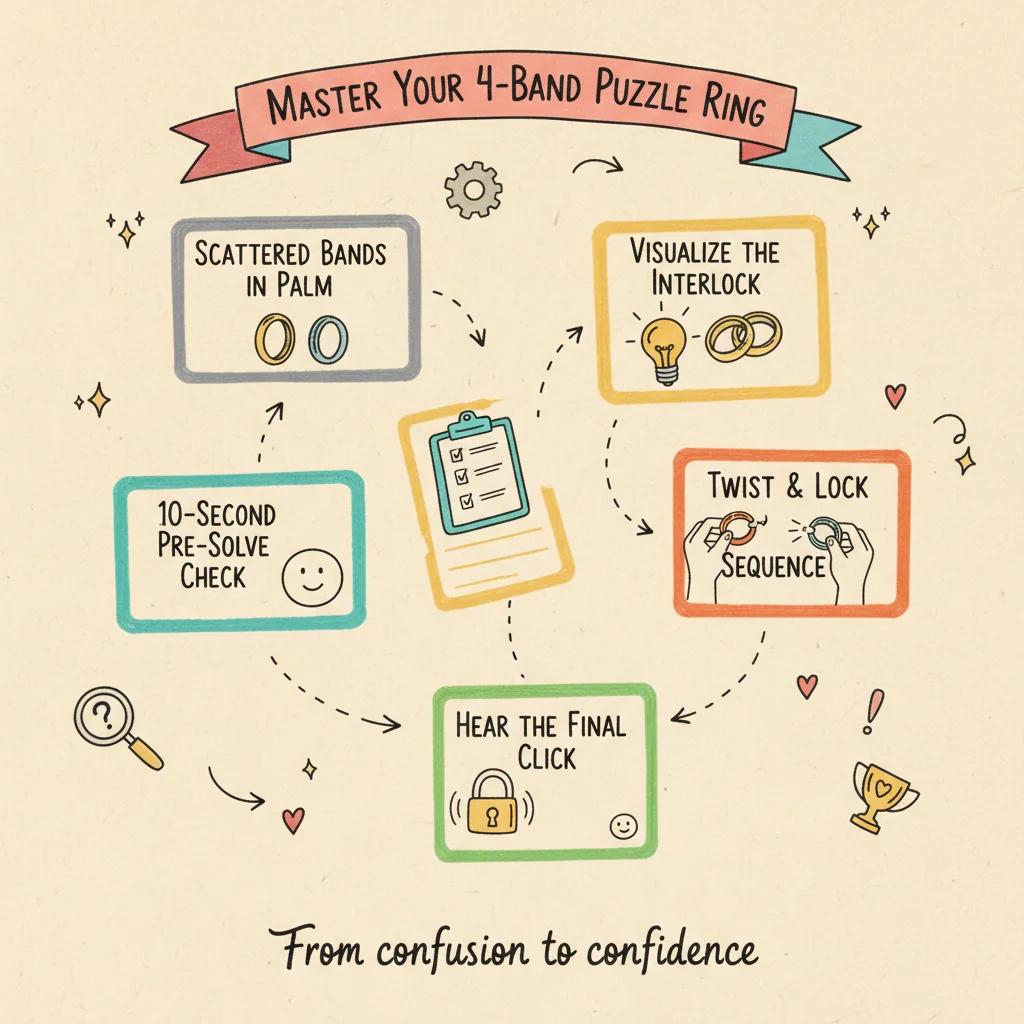
Four Bands in Your Palm: Welcome to the Club (It’s Not Your Fault)
There you are. A few minutes ago, you had a single, elegant ring. Now, you have four separate, seemingly identical bands scattered on the table or clutched in your palm. That moment of quiet defeat? I know it well. Every customer who walks into my shop with a disassembled 4 band puzzle ring wears the same look.
You’re in good company. I got my first one in a trade with a sailor, a worn sterling silver band. He just grinned and handed it over in pieces. I spent an entire weekend on it, turning the interlocking bands over in my hands until the logic finally clicked. That moment of triumph—that’s what I want for you.
Let’s get one thing straight: if your puzzle ring instructions are long gone or were just a cryptic diagram, that’s not a failure on your part. The tiny pamphlets they come with are often more frustrating than helpful. This guide is your replacement. We’re not just going to walk through the steps; we’re going to unlock the simple mechanical principle that makes the whole thing work. Once you see it, you’ll be able to assemble it from memory.
The core of your confusion is right in front of you. The four bands look identical, but they are engineered partners. The real challenge isn’t dexterity—it’s understanding how the notches cut into each band’s inner surface are designed to mate in a specific sequence. This isn’t a mystery; it’s a neat little mechanical puzzle of precision, a classic form of disentanglement puzzle.
Think of this as learning a handshake. You need to know how to position your hand before you can lock grips. By the end of this, you’ll know that handshake. We’ll move from the anxiety of pieces to the focus of understanding the principle.
First, take a deep breath. Lay the four bands out on a flat, well-lit surface. This is where we start turning frustration into a solved puzzle.
The One Mental Picture That Makes a 4 Band Puzzle Ring Click
Now, with your four separate bands laid out, forget they are circles. This is the shift in thinking that changes everything. You are not looking at four rings. You are looking at the components of two interlocking ‘V’ shapes.
Every top puzzle ring solution fails to explain this core principle. They show you a sequence of moves but not the why. The why is geometry and mechanics. A standard 4 piece puzzle ring is engineered so that two pairs of bands form rigid, interlocked V-shapes. These two V’s then twist and lock together to form the final, stable circle. Your job is to first build those two V units.
Look closely at the inner surface of any band. You will see notches—precise cuts in the metal. These are not decorations; they are the locking mechanism. On each band, one notch is deep and wide (the “channel”), and the opposite notch is shallower and often angled (the “lock” or “key”). When assembled correctly, the thick shank of one band sits snugly in the channel of another, and the key notch snaps over it to prevent slippage. This is the fundamental mechanical puzzle you are solving.
Think of it like a firm handshake. The deep notch is your palm, accepting the other band’s shank. The key notch is your thumb, curling over to secure the grip. If you try to shake hands with your palm turned away, it fails. The same is true here. The Most Common Reassembly Mistake (And How to Avoid It in 10 Seconds) is starting with all bands oriented the same way. They are identical, but their notches must face specific directions relative to each other to create those interlocking V’s.
This design is why the 4 band puzzle ring is considered the easiest level for beginners in the world of disentanglement puzzle jewelry. The band count is low enough to manage mentally, but the principle is the same as in more complex versions. Whether your ring is sterling silver, gold puzzle rings, or platinum plated, the mechanical logic is identical.
So, the mental picture to hold is this: you will first create two separate, interlocked pairs. Each pair forms a V-shape that is floppy on its own. Then, you will bring these two V’s together, twisting one 90 degrees so they weave into each other’s structure. When the final key notch engages, you’ll feel a distinct, satisfying click. The ring transforms from a pile of parts into a single, solid unit—a clever piece of jewelry that’s now ready to wear.
Understanding this “two-V” principle is what will allow you to solve the ring from memory. You’re not memorizing a rote sequence; you’re understanding how the structure is built. Let’s now use that principle to orient your bands correctly.
The 10-Second Pre-Solve Checklist (Avoid the #1 Mistake)
That understanding of the “two-V” structure is your foundation. But before you start interlocking anything, you must orient your bands. This is The Most Common Reassembly Mistake (And How to Avoid It in 10 Seconds). Most failed attempts happen right here, before step one, because the bands are flipped. Let’s get them set correctly.
Lay your four bands flat on the table. Look closely at the inner curve of each one—this is where the notches are cut. Every 4 piece puzzle ring has four notches on the inside of each band, but their placement creates a specific “handedness.”
Here’s your tactile checklist:
- Flip All Bands Notch-Side Up. Pick up each band. Run your finger along the inside. Feel the four small divots? That’s the notch channel. Turn every band so these notches are facing up, toward the ceiling, like a little trough. This is non-negotiable for the mechanical puzzle to work.
- Pair Them Into Two Identical Sets. With all notches facing up, you’ll notice each band has a distinct “S” curve. The goal is to create two matching pairs. Take two bands and place them side-by-side. Their curves should mirror each other perfectly, like two parentheses )( . Do the same with the remaining two. You now have Pair 1 and Pair 2. If the curves oppose each other like )( for one and () for the other, swap one band until both pairs are mirror images.
- Create the Preliminary “V”. Hold one pair (both bands notch-side up) in one hand, one in each finger. Let them cross naturally in the middle. They should form a shallow “X” or “V” shape that is symmetrical. Do the same with the second pair. If the bands are fighting you and won’t sit in a balanced cross, one is likely flipped. Re-check step 1.
This pre-check ensures every notch is positioned to receive and lock with its partner. If you skip this, you can go through all the motions of assembling but the final click will never happen; the ring will just fall apart or feel perpetually loose. Getting this right is what makes solving a 4 band puzzle ring approachable, even for beginners.
You are now prepped. Your two V-shaped pairs are ready to be woven together, transforming your sterling silver or gold puzzle rings from separate pieces into unified jewelry. Let’s move to the core sequence.
The Core Sequence: A Tactile Walkthrough of the ‘Twist & Lock’
With your two symmetrical pairs prepped and notch-side up, you’re ready for the main event. Forget about four separate bands. You are now about to weave two distinct ‘V’ shapes together. This is the entire mechanical principle in action. If you remember that, you can reconstruct these steps from memory. Let’s begin the tactile walkthrough.
The Key Principle to Remember: You are not stacking rings. You are interlacing two independent structures. The final, satisfying click happens when the notches of all four bands align and lock under tension. We’ll build that tension methodically.
Maneuver 1: Form the Foundation ‘V’
Take Pair 1. Hold one band between your thumb and forefinger of your non-dominant hand. Hold the other band between your thumb and forefinger of your dominant hand. Let them cross naturally in the middle, forming a shallow ‘X’. Now, gently press down at the crosspoint.
Instruction: Apply slight downward pressure where the bands intersect.
Why: This flattens the crossing into a stable, inverted ‘V’ shape that sits on your work surface. This is your foundation. It shouldn’t rock. If it does, your pairs aren’t mirrored correctly—go back to the 10-second checklist.
Maneuver 2: Introduce the Second ‘V’
Pick up Pair 2. You will now position it perpendicular to the foundation V. This is critical.
Instruction: Hold Pair 2 vertically, so its crossing point is high. Lower it down over the center of the foundation V. The legs of Pair 2 should straddle the legs of the foundation V.
Why: You are creating the interlocking grid. One V lies flat (Pair 1), the other stands upright (Pair 2). Their notches are now poised to engage, but they aren’t locked yet. This is the setup for the key move.
Maneuver 3: The ‘Twist and Lock’ (The Heart of It)
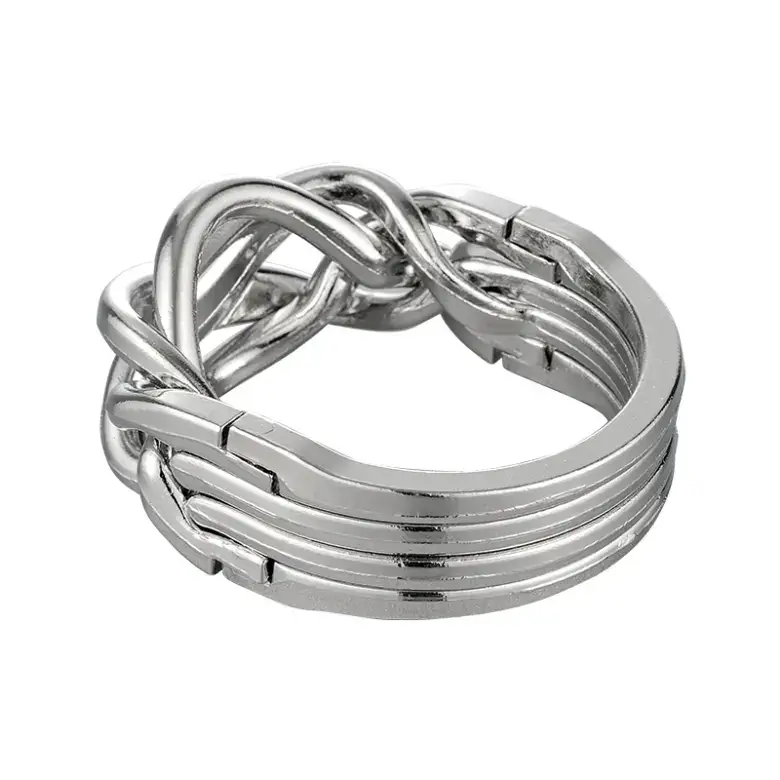
Here is the single move that defines putting together a 4 band puzzle ring. Right now, the upright V (Pair 2) is just sitting loosely within the flat V (Pair 1). You will now rotate one of these pairs 90 degrees, weaving the bands.
Instruction: With one hand, firmly pinch the center crossing point of the upright V (Pair 2). With your other hand, stabilize the flat V. Now, twist the upright V a quarter-turn (90 degrees). Do not force it. You should feel the notches begin to catch and guide the rotation.
Why: This twist is what interlocks the two structures. It moves the bands from being merely crossed to being physically captured by each other’s notches. The correct sensation is a guided, slightly gritty rotation—not a free spin and not a hard jam. If it jams, you likely started with incorrect orientation. If it spins freely, the notches aren’t engaging; re-check that all bands are notch-side up.
Maneuver 4: The Squeeze into Place
After the quarter-turn, the assembly will look like a loose, three-dimensional knot. It’s time to collapse it into a ring shape.
Instruction: Release your pinch, but keep the structure loosely together. Now, use both hands to gently compress the assembly from the top and bottom. Imagine you’re squishing a small, soft box into a circle.
Why: You are guiding the bands along their notched pathways into their final, circular orientation. Apply even, gradual pressure. You will see the distinct bands start to align side-by-side, forming the recognizable X style pattern on the ring’s top. This is where many people rush and force it, which can bend the sterling silver or other metal. Patience is key.
Maneuver 5: The Final Seat and Click
The ring is almost circular, but likely feels floppy. The final step is to seat all notches under full tension.
Instruction: Hold the nearly-formed ring between your thumbs and index fingers. Your thumbs should be on the inside of the circle, your fingers on the outside. Apply firm, opposing pressure—push outwards with your thumbs slightly while pulling inwards with your fingers. Simultaneously, rotate your hands as if you’re turning a tiny steering wheel.
Why: This multi-directional pressure creates the final bit of travel needed for the notches to slide completely past each other and lock. When it happens, you will feel a distinct, subtle click or snap. It’s more tactile than auditory. The ring will instantly become rigid. This is the triumph moment of your four band puzzle ring tutorial.
What You Have Now & How to Know It’s Right
You should be holding a solid, cohesive ring. Test it:
1. The Twist Test: Gently try to twist the bands against each other. In a correctly locked ring, there will be no movement; the entire ring turns as one unit.
2. The Visual Check: Look at the pattern. You should see a symmetrical, woven pattern on the top (the shank). On the inside, you should see the seams where bands meet, but no large gaps.
3. The ‘Loose’ Feeling Resolved: If the ring still feels slightly wobbly or loose, you are 95% there. The notches are aligned but not fully seated under tension. Go back to Maneuver 5 and apply more firm, rotational pressure. From a Jeweler’s Bench: The Real Reason Why Some Rings Feel ‘Loose’ Even When Assembled is almost always shallow notch engagement. A few more ounces of pressure during the final seat usually solves it.
If it falls apart, don’t be discouraged. This is the trial and error phase. The most common point of failure is rushing the ‘Twist and Lock’ (Maneuver 3) without ensuring the notches are guiding the turn. Go back to your two prepared Vs and start again. The muscle memory will build quickly. For a different perspective, you can always consult our full visual guide on how to solve a puzzle ring.
Remember, you are not just following steps; you are learning a mechanism. Once you’ve felt that guiding twist and the final click a few times, you’ll own the skill. The puzzle is solved not just in your hands, but in your understanding.
The Final Click: How to Know It’s Locked (Not Just Snagged)
Now, with the four bands seemingly in place, you’re at the critical moment. You’ve been through the trial and error; this is where you learn to recognize triumph.
First, the definitive sign: The Click. When you apply the final, firm rotational pressure to seat all notches, you will feel—and often hear—a subtle, solid click. It’s not a snap, but a quiet, unified settling. This is the sound of all four interlocking points dropping into their final, seated position under tension. If you didn’t hear it, you may only have a snag—a precarious alignment that will fall apart with a light touch.
Here’s how to verify a true, stable assembly without breaking it apart.
The Visual Test. Look at the ring from all angles. The seams where bands cross should be tight, with no light visible through the joints. The overall shape should be a symmetrical, continuous X style weave. If one band seems to ride higher or creates a visible gap, the notches aren’t home.
The Tactile Test. This is the jeweler’s method. Hold the assembled ring between your thumb and forefinger. Gently try to twist the shank (the part that goes around your finger) along its circumference. In a correctly assembled 4 piece puzzle ring, the entire structure will turn as one solid unit. No individual band should slip, shift, or feel gritty against another. Now, try to pinch two opposite bands of the weave and pull them apart slightly. You should feel no give, no play. It should resist as a single piece of jewelry.
If it passes these tests, congratulations. You’ve solved it. Once correctly assembled, the ring is stable and can be worn daily. You can confidently slip it on.
But what if it feels loose? This directly answers the user question: Why does my puzzle ring feel loose even when I think it’s together? A loose, wobbly feeling—where the bands can shift slightly—means the notches are aligned but not fully seated under the ring’s inherent spring tension. You’re one step short. Apply more firm, comprehensive pressure during that final seating maneuver. Squeeze the entire circumference evenly and give it that last quarter-turn. You’ll feel it cinch down from a wobbly basket into a solid mechanical puzzle.
Your sterling silver or gold puzzle ring is now a coherent whole. The disentanglement is complete. You can stop holding your breath.
From the Jeweler’s Bench: Pro Tips & Triage for Common Frustrations
You’ve felt the final click. You’ve tested the solidity of your assembled 4 piece puzzle ring. But the real world of wearing a mechanical puzzle introduces new questions. Let’s move from assembly to ownership, troubleshooting the friction points I see every week at my bench.
The Real Reason Why Some Rings Feel ‘Loose’ Even When Assembled
This isn’t just about improper assembly. If your sterling silver or gold puzzle ring has a persistent wobble or shift after you’re sure it’s locked, the culprit is often the notches themselves. Over years of assembling and taking apart, or from a manufacturer’s slightly over-zealous filing, the notches can become just a hair too deep or wide. This removes the critical spring tension that locks the bands tightly together.
The fix: For a slightly loose ring, you can often add tension by gently, carefully squeezing the entire ring circumference with smooth-jaw pliers (wrap the jaws in masking tape first to prevent scratches). Apply uniform pressure to encourage the bands to grip each other more tightly. For a severely worn ring, a jeweler can add a tiny, nearly invisible spot of solder at a key intersection to permanently stabilize it—though this, of course, ends the puzzle.
How to Keep It From Pinching Your Skin
Pinching happens when the interlocking weave has a slight gap or misalignment, creating a tiny scissor action. The answer is rarely to force the bands apart.
The maneuver: If you feel a pinch spot, don’t pull the bands. Instead, hold the ring and apply a gentle, twisting pressure opposite the pinch point, as if you’re giving the entire ring a quarter-turn to tighten it. This often re-seats the notches more evenly, closing the gap. A perfectly assembled 4 band puzzle ring should feel as smooth as any solid band of jewelry.
Is It Normal For It To Come Apart In My Pocket or While Washing Hands?
A correctly locked puzzle ring is remarkably stable. It should not spontaneously disassemble during normal wear, hand-washing, or in a pocket. If this is happening, it means the ring is not fully locked. The most common trigger is lateral pressure—catching the side of the weave on a jacket cuff or bag strap—which can apply just the right force to pop one band out of its notch sequence.
Pro Tip: Before putting it in a pocket or putting on a coat, perform the quick test from the last section: try to pinch and pull opposite bands. If it’s solid, you’re good. If there’s any give, reseat it. This directly addresses the worry behind ‘puzzle ring keeps coming apart.’
Your Workspace is a Tool: Use a Soft Surface
If you’re still practicing the sequence or troubleshooting, never work on a bare, hard table. A dropped band can roll away or, worse, pick up a dent.
Set up: Use a soft, neutral-colored towel or a jeweler’s bench pad. The cloth cushions the bands, prevents bouncing, and makes those silvery 4 band puzzle rings much easier to see and pick up. It turns a frustrating fumble into a controlled practice session.
Final Triage Checklist for “It Won’t Stay Together!”
If your puzzle ring won’t stay together, run through this list:
1. Orientation: Are all four bands oriented the same way, with notches facing the same direction? This is the foundation. (Revisit the 10-second checklist).
2. The Key Band: Is your starting band (the one that stands up vertically) the correct one? On some rings, one band has a slightly different notch profile. Try each band as ‘Band A’.
3. The Final Seat: Did you apply the final, comprehensive squeeze and slight twist? A partial seat feels right until it moves.
4. Inspect the Notches: Hold each band to the light. Look for debris (lint, soap scum) packed into the notches. Clean them with a soft toothpick and a drop of dish soap in water. Dry thoroughly.
Remember, this is considered the easiest level of disentanglement puzzle for a reason. Its elegance is in its simplicity. Once you understand the principle of the interlocking ‘Vs,’ a four band puzzle ring tutorial becomes a memory. The goal isn’t just to follow puzzle ring instructions, but to internalize the logic. Then, you won’t need them at all.
Beyond the Puzzle: Wearing, Sizing, and Caring for Your Ring
Now that your 4 band puzzle ring is locked together with that satisfying final click, let’s shift from solving to living with it. You’ve mastered the mechanical puzzle; the next logical question is, “Okay, but can I actually wear this thing?” The answer is a confident yes—with a few bench jeweler’s insights.
First, daily wear. A correctly assembled 4 piece puzzle ring is remarkably stable. The interlocking notches distribute pressure, creating a single, solid unit. You can wash your hands, type, and go about your day. However, treat it like the intricate piece of engineering it is. Avoid heavy impacts (like weightlifting or hammering) that could torque the bands and potentially spring a notch out of alignment. If it does come apart in a pocket or during a vigorous activity, don’t panic—you now possess the principle to solve it again.
On the Bench: The Resizing Question.
This is the most common professional query I get: “Can you resize this?” The short, honest answer is: it’s complex and often not recommended for standard jewelry shops. Here’s why. Resizing a traditional ring involves cutting the shank, adding or removing metal, and soldering it back together. A puzzle ring has four separate bands, each with precision notches that must align perfectly post-alteration. Sizing up or down even a half-size requires expertly adjusting all four bands in perfect proportion. For sterling silver rings, a skilled artisan might attempt it. For platinum plated or gold puzzle rings, the risk of damaging the finish or structure is high. My advice? If sizing is a concern, seek out a made to order option from a specialist when purchasing.
Material Care & Cleaning.
Your ring’s material dictates its care. Sterling silver (the most common) will tarnish over time. Clean it with a mild jewelry polishing cloth. For a deeper clean, use a drop of dish soap in lukewarm water and a soft-bristle toothbrush. Pay attention to the notches—gently brush out any built-up soap or lint. Rinse thoroughly and dry completely with a soft cloth before assembling. This prevents moisture from getting trapped, which can accelerate tarnishing inside the channels. For gold or platinum bands, the same gentle cleaning method applies. This routine is essential for cleaning and maintaining any fine puzzle ring.
Finding the Right Fit.
Standard ring sizes for these puzzles typically range from 4 to 12. Because the design involves multiple bands, the fit can feel slightly different than a solid band. It should slide over your knuckle with a snug but comfortable resistance and sit without spinning. A proper fit also minimizes pinching—if the ring is too large, the bands have more room to shift and trap skin.
The Point of It All.
Beyond being a satisfying disentanglement puzzle, these rings are wearable conversation pieces. They connect you to a long tradition of craftsmanship and intellectual play, a testament to why metal puzzle rings remain the ultimate test of spatial humility. Whether it’s a simple X style band or an ornate Claddagh puzzle ring, its true value is in the understanding you now hold in your hand. It’s a lesson in patience and logic you can carry with you. As I wrote in a piece on finding focus through such tasks, when a simple ring becomes a masterclass in patience, the object transforms from a frustrating trinket into a token of personal accomplishment.
So wear your solved puzzle with pride. You haven’t just followed puzzle ring instructions; you’ve learned a tangible, mechanical truth. And that knowledge is what makes the ring truly yours.
Your Questions, Answered: The Puzzle Ring FAQ
You’ve locked the final ‘click,’ and the ring is back on your finger. That moment of triumph often gives way to a few practical, lingering questions. Let’s tie up those loose ends.
Are all four bands identical?
Yes and no. For a standard 4-band puzzle ring, the bands are mechanically identical—each has the same pattern of notches cut into it. This is what allows them to interlock. However, in higher-end or custom designs, like some Claddagh puzzle rings or diamond puzzle rings, one band may be slightly different to accommodate a setting or decorative element. For 99% of 4 band puzzle rings, treat them as identical.
What’s the point besides being a puzzle?
At its heart, it’s a wearable mechanical puzzle, a category well-documented in resources like Wikipedia’s overview of mechanical puzzles. Historically, they were sometimes used as wedding puzzle rings, symbolizing a union that, while complex, forms a single, unbreakable whole. Today, it’s a conversation starter and a personal test of logic and patience. The point is the ‘aha’ moment you just had.
Can you resize a 4-band puzzle ring?
You can, but it’s a complex job. A jeweler must resize each of the four bands identically and re-cut the notches to align perfectly. This requires specialized skill and can be costly. It’s often more practical to trade it for a correct size if you bought it new. This is a key factor when choosing a ring size.
Why does mine feel ‘loose’ even when assembled?
This usually means the notches aren’t fully seated. The bands are resting against each other, but the key interlocking notch isn’t deep enough into its partner. Re-check the final step of the ‘twist and lock’ maneuver. Apply firm, even pressure to snap it home. If it’s still wobbly, the notches themselves may be worn or shallow from manufacturing—a flaw, not user error.
Is it normal for it to come apart in my pocket?
A properly assembled ring is quite stable for daily wear. However, an active lifestyle or catching it on something can torque the bands apart. Washing hands is fine, but I wouldn’t recommend wearing it while doing heavy manual work. It’s a piece of jewelry, not a solid shank.
How do I stop it from pinching?
A proper fit is the best defense. If the ring is too large, the bands can shift and trap skin. A snug fit minimizes movement. Also, ensure it’s fully locked; a partially assembled ring is much more prone to pinching.
What’s the difficulty level compared to other puzzle rings?
The 4 piece puzzle ring is widely considered the easiest level and is the one I recommend for beginners. Six, eight, and twelve-band rings increase the complexity exponentially. Mastering the four-band is the foundational skill.
What materials are best?
Sterling silver is the most common, durable, and affordable. You’ll also find gold puzzle rings (usually 10k or 14k), platinum plated options, and even titanium. Silver offers a good balance—it’s soft enough for precise notches but hard enough for daily wear. Some enthusiasts even explore how to make their own from wire.
I lost my instructions forever. Now what?
You now hold the puzzle ring solution in your head. The principle of the interlocking ‘Vs’ and the ‘twist and lock’ is your permanent guide. Bookmark this page, or challenge yourself: take it apart again tomorrow and reassemble from memory. That’s the true test of learning.
Can I customize one?
Absolutely. Many jewelers offer customizing for made to order pieces. You can choose the metal, integrate gemstone rings, and even adjust the band count. Remember, adding complexity changes the solving process.
What’s next after mastering the 4-band?
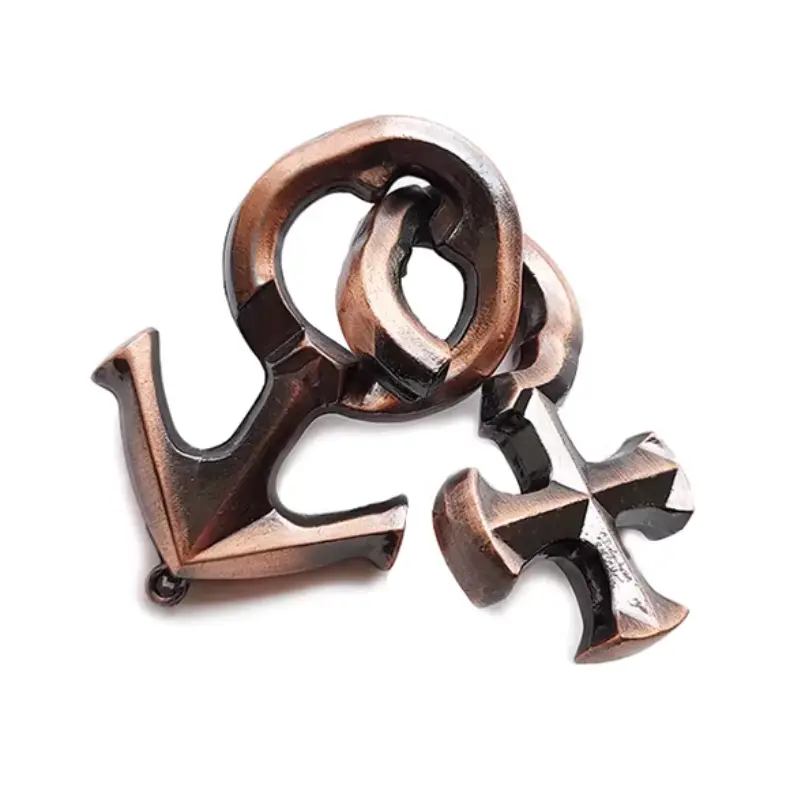
If you enjoyed the tactile logic, consider more complex disentanglement puzzles. The satisfaction is similar, as explored in our guide to the I Ching-inspired metal starfish ring or the hands-on approach in this hands-on guide to the metal starfish puzzle ring. For a different type of interlocking challenge, you might enjoy a complete guide to the interlocking double-ring lian puzzle. The principle is the same: understand the mechanism, and the solution follows.
So, was it ‘hard’?
It was unfamiliar. There’s a difference. You started with four separate bands and a feeling of defeat. Now, you understand the mechanism. That’s the journey from frustration to confidence, much like the process described in our look at the metal starfish puzzle ring and its unique challenge.
Your next step? Take it apart on purpose. Do it once more, right now, while the sequence is fresh. Prove to yourself that the puzzle is solved not by your hands, but by your understanding.