The Heft & The Hook: Deconstructing First Impressions
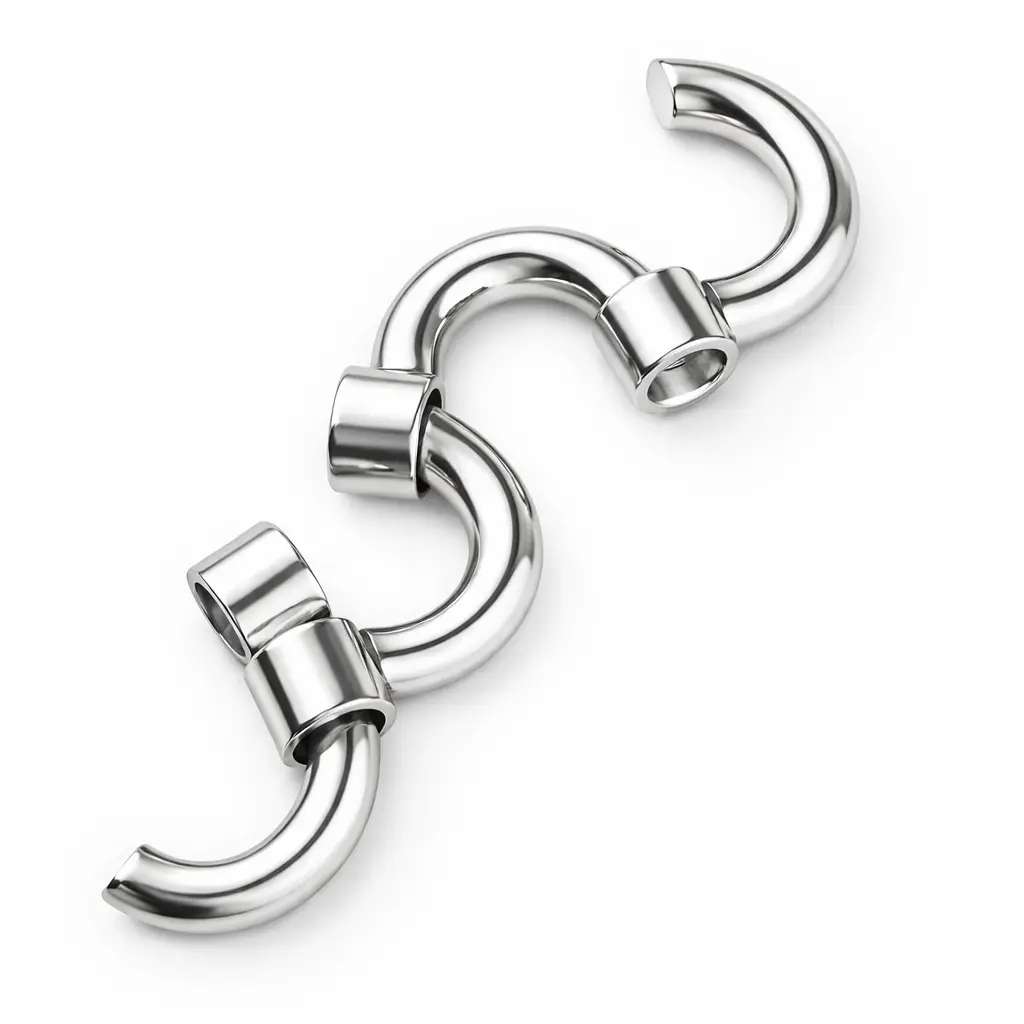
Your first encounter with the Hanayama Cast Devil is a quiet, physical one. It is a cool, dense weight in your palm, roughly the size of a silver dollar but with the substantial heft of cast zinc alloy. The two interlocked pieces—a pair of mirrored, claw-like hooks—present an image of perfect symmetry. Your initial, confident thought is that they should simply slide apart. They don’t.
It resists. You twist, you pull, you tilt. The polished, almost oily-smooth plating offers no grip, no purchase. What looked like an obvious path is a dead end. This is the instant the Cast Devil puzzle review shifts from a visual assessment to a tactile dialogue. The metal disentanglement puzzle reveals its true nature: it is not about force, but about finding the single, specific series of rotations and pivots hidden within its form. That moment of frustrated confusion is exactly where the 1905 designer intended you to be.
The original puzzle, known as the “Devil’s Claws,” was born during the golden age of mechanical puzzles. In an era before digital distractions, these cast-metal conundrums were the province of parlors and patient thinkers. The Hanayama revival captures that spirit perfectly. Holding it, you’re not just holding a modern desk toy fidget puzzle; you’re holding a kinetic sculpture with a century of stubbornness baked into its geometry.
As a former industrial designer, my fingers immediately go to the seams—the faint, almost imperceptible lines where the two pieces interface. They are the only visual clue to the puzzle’s internal logic. The pieces are not just mirror images; they are truly identical, a fact that becomes central to the solution. This is a conversation conducted entirely through pressure and release, a series of tentative explorations that teach you the language of its mechanisms.
You begin to notice subtleties. The way the weight shifts as you rotate one piece, the specific angle at which a curved inner surface catches on its twin, the faint tic of metal-on-metal when you approach a valid position. This isn’t random fumbling. It’s a process of mapping constraints with your fingertips, learning what the puzzle allows before you can understand what it requires. For more on the foundational logic behind puzzles like this, see our veteran’s guide to cast logic.
The hook is set. You’ve moved from intrigued simplicity to tactile curiosity. The puzzle is no longer an object to be solved, but a system to be understood. And the first lesson it imparts is the most valuable: the solution is never where your eyes tell you it should be. It lives in the blind spots of your intuition, waiting to be discovered by your hands.
Decoding ‘Level 5’: What Hanayama’s Rating Actually Means for You
Hanayama’s “Level 5” rating for the Cast Devil translates to a genuine, often humbling, 30-45 minutes of nonlinear exploration for a first-time solver. This isn’t a puzzle of sequential deduction but of spatial intuition—your hands must learn a dance your eyes can’t fully trace. It sits squarely in the upper tier of the six-point Cast series, harder than the deceptively tricky Vortex (Level 4) but more accessible than the famously opaque Enigma (Level 6). For an enthusiast, Level 5 is the sweet spot: a substantial, satisfying hurdle that won’t languish unsolved on a shelf for months.
Understanding this scale is crucial because it’s more about the type of thinking required than pure time investment. Level 1-2 puzzles (like Cast Ring or Heart) are often about finding a single, clever trick. Levels 3-4 introduce more steps or subtle misdirection. The Devil, at Level 5, demands you abandon linear assumptions entirely. The two identical pieces create a symmetrical deadlock—the solution path isn’t about following a visible channel, but discovering a specific three-dimensional axis of rotation that aligns internal geometries you cannot see. It’s a lesson in mechanical empathy.
This leads to the common point of confusion: retailer ratings. Puzzle Master, a major seller, uses its own scale where their Level 5 is beginner-friendly, equivalent roughly to Hanayama’s Level 1. Their listing for the Cast Devil would label it a “Level 10” on their system. This discrepancy baffles many new buyers. If you see a high “level” on a retailer site, always check whose scale they’re using.
So, how does the Devil’s difficulty manifest practically? Your initial frustration—the phase where the pieces seem permanently, illogically wedged—is the puzzle’s core challenge. It’s designed to guide you via negative feedback. A wrong move meets solid, unyielding resistance. A correct move offers a millimeter of smooth travel and that faint, telltale click. The learning happens in your fingertips as they catalog these moments of permission and denial. It’s why calling it a “one-move solution” is technically true but profoundly misleading. That one move is a precise, compound maneuver you must discover through a process of elimination; it’s the final keystone, not the first step.
For a beginner, is this too much? It depends on temperament. A patient, tactile-learner new to metal puzzles could find the Devil a fascinating, if intense, first deep dive. Someone seeking quick, logical gratification might be better served starting with a Level 3 or 4, like the Cast L’Oeuf or the intriguingly layered Cast Galaxy, to build confidence with the language of disentanglement puzzles.
Cast Galaxy 4-Piece Silver — $14.88
The Cast Galaxy, for instance, is a Hanayama Level 4. Its challenge comes from managing four independent pieces and breaking an assumption about how they should interlock—a different, more combinatorial type of thinking than the Devil’s deeply intuitive spatial negotiation. It’s an excellent puzzle in its own right, as detailed in our Cast Galaxy puzzle review, but the friction is of a different texture.
Ultimately, Hanayama’s Level 5 for the Cast Devil is a promise: you will be stuck. You will be frustrated. And if you pay attention to the pressure in your palms and the sounds in the quiet, you will have a genuine “aha” moment that feels earned. It’s a rating for adults not because of complexity, but because it rewards a mature, persistent curiosity—the willingness to be quietly confounded, and to listen closely to what the metal is trying to say.
A Dialogue with Metal: The Non-Spoiler Philosophy of the Solve
The promise of frustration in Hanayama’s Level 5 rating is not a threat—it’s an invitation to a specific kind of conversation. Solving the Cast Devil is not about logic, deduction, or sequence memorization; it is a purely physical dialogue with a piece of kinetic sculpture, conducted through pressure, sound, and spatial intuition. Your primary tools are your fingers, and your only reliable guide is the tactile and auditory feedback the zinc alloy gives you as you gently push its limits.
This is why so many initial attempts end in aggressive tugging. Our brains are wired for visual and logical problems. We see two pieces that look like they should slide apart, so we apply linear force. The Cast Devil resists. It locks up. It mocks you. The first breakthrough is abandoning that mindset and treating the puzzle not as a problem to be solved, but as a mechanism to be understood. As I explored in Why Your Hands Are Lying To You, your sense of sight often misleads you in puzzles like this. You must learn to trust your palms and fingertips over your eyes.
So, what does the metal say? It speaks in clicks, resistance, and releases. The two identical claws are not simply mirrored; they are interlocked along a path dictated by their curved hooks and the precise geometry of their slots. The goal is to navigate one piece’s hook through the other’s internal channel. This requires finding alignment points—specific, counterintuitive orientations where pressure in one direction creates a millimeter of slack in another. You are not pulling the pieces apart; you are negotiating a shared path through three-dimensional space.
This is where the famous auditory feedback becomes your compass. During the correct sequence, you’ll encounter a series of distinct, satisfying clicks. These are not random. They are positive mechanical confirmations, like tumblers in a lock falling into place. The first is a soft, shallow snick as a hook seats into a new position. The next is more definitive, a resonant tock of metal engaging with a manufactured seam. The final release, when you’ve truly earned it, is a quiet, deep clunk of total disengagement. This almost musical click sequence is the puzzle’s way of whispering, “You’re on the right path.” If you hear grinding or feel a dead, mushy resistance, you’ve forced a move the geometry doesn’t allow.
The question of a “one-move solution” is a semantic trap. In a purely technical sense, the final act of separation is a single, smooth motion. But arriving at the precise configuration that allows that motion is the entire puzzle. It’s like saying a key opens a lock in “one move”—the genius is in the cuts on the key, not the turn of the wrist. You spend your time not performing the move, but discovering the exact alignment that makes the move possible. This is the non-linear, intuitive thinking the Devil teaches: a focus on state over action, on configuration over sequence.
Your hands learn to feel for these states. Apply gentle rotational pressure. Feel how the weight shifts. Notice the subtle catch of a polished edge against the inner wall of a slot. The zinc alloy has a slight, pleasant grip against skin, letting you sense minute vibrations. The manufacturing seams—those tiny, almost imperceptible lines from the casting mold—become tactile landmarks. One particular seam on the inner curve of a claw will align perfectly with the opening of the opposite piece’s slot only at the critical moment. This is the conversation: you propose a move through pressure, and the puzzle responds with either permission (a click, a slide) or a polite, firm denial.
This process rewires your approach. It becomes meditative, fidget-worthy. You’re no longer trying to “beat” the puzzle; you’re learning its language. The value shifts from the singular eureka moment to the deeply satisfying fluency of repeating the dialogue. Once you know the path, solving it becomes a soothing, five-second ritual of precise motions and confirming clicks—a perfect desk toy with a hidden depth.
If you must seek a roadmap, understand that you are trading this experiential discovery for mere instructions. A guide like our step-by-step guide to the Cast Hook provides steps, but the Devil’s lesson is in the journey of tactile listening. The solution isn’t a series of moves you memorize; it’s a specific, symmetrical relationship between the two pieces that you learn to feel in your hands before your eyes ever see it. The metal has been waiting since 1905 to have this conversation. Your job is to stop talking, and start listening.
The Click That Hooks You: Mapping the Auditory & Kinesthetic Journey
The conversation you begin with the Cast Devil is not silent. It speaks in a precise vocabulary of clicks, scrapes, and shifts—a language you learn not by seeing, but by feeling and hearing. The puzzle’s true difficulty, and its subsequent value as a meditative, fidget-worthy object, hinges on this sensory dialogue. There are three distinct auditory events in the correct solve, each mapping to a specific, confirmatory kinesthetic cue that guides you from confused frustration to confident ‘Aha!’ Insight.
When you first start manipulating the pieces, the sound is a dead, muted scrape. The zinc alloy surfaces, smooth as they are, slide against each other with a faint, gritty whisper. It’s the sound of unproductive friction. You push harder. The interlock tightens, the seams vanish, and the whole assembly becomes a solid, immutable lump. It grates. This is the auditory signature of incorrect force—a polite but firm denial from the metal.
Then, you find it. The first correct alignment.
It’s not a slide or a pull. It’s a specific, quarter-turn rotation of one claw relative to the other, pivoting on a hidden internal fulcrum. When you apply the correct, gentle pressure, the puzzle shifts. You feel a tiny, internal weight transfer through your fingertips before you hear the satisfying click. It’s a soft, percussive tock—like a marble dropping onto a wooden table from an inch high. This is the permission you’ve been seeking. The pieces are now in a transitional state, a temporary equilibrium unlocked by that precise rotational pressure.
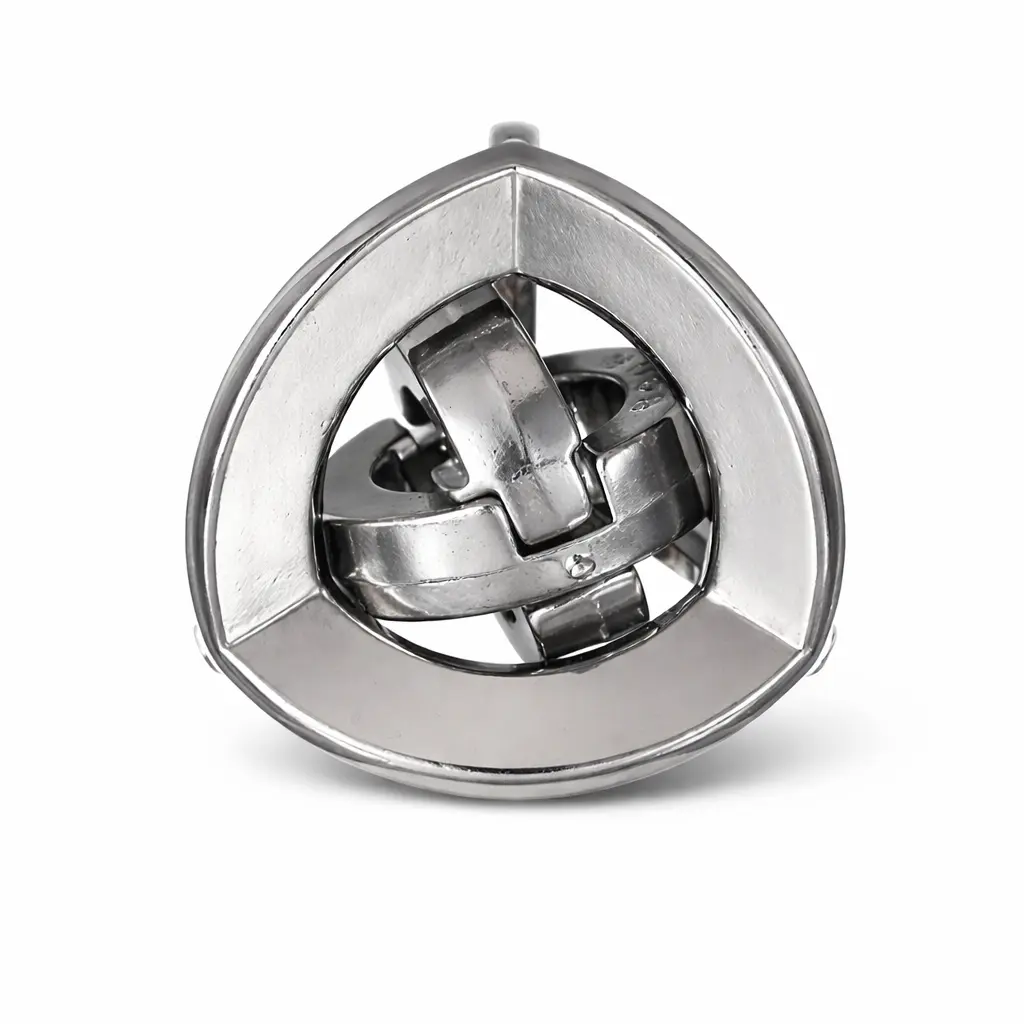
The second and third clicks form a sequence—a rhythmic, almost musical cadence that signals you’re on the right path. After the first tock, you slide one piece along a newly revealed channel. The motion is smooth, silent for a few millimeters, then: click. A higher-pitched, definitive snap. This is the sound of a key feature clearing an internal obstruction. It’s followed almost immediately by the final, quieter separation click—a soft tick that feels more like a vibration in the metal than a sound. The pieces come apart in your hands with a sigh, not a shout. This auditory feedback loop transforms the solve from a visual problem into a kinetic one. You stop looking and start listening with your hands.
This is why the Cast Devil transcends its “solved” status to become a kinetic sculpture for your desk. The pleasure shifts from discovery to performance. Once you know the language, solving it is a five-second ballet of pressure, rotation, and attentive listening for that confirming tock-click-tick. It’s deeply tactile, satisfying in the way a well-made lock feels when the key turns. The polished zinc develops a warmer hand-feel with frequent handling, and the patina of your own use becomes part of the object’s story. It resists tarnishing, but the plating will develop subtle, satiny wear along the high-contact seams—a testament to the conversations you’ve had.
This fidget-quality, driven by auditory and kinesthetic tactile feedback, makes it a standout even among other Hanayama Cast puzzles. The Cast Vortex offers a smoother, more continuous spin; the Cast Infinity has a silent, meshing complexity. The Devil’s charm is its punctuated, musical confirmation. It’s a puzzle that teaches your hands a secret handshake, and the click is the password. This repeated, ritualistic solve is a form of active meditation, a perfect desk toy fidget puzzle that quiets the mind by fully engaging the senses in a precise, repeatable task. For more ideas on puzzles that serve this calming, focused purpose, explore our list of the best office puzzles for stress relief.
So, is it a one-move solution? Only if you consider a perfectly timed sequence of three distinct rotations and slides—each announced by a specific click—to be a single “move.” In the language of your fingers and ears, it’s an elegant, multi-step sentence. And learning to speak it fluently is where the real, lasting satisfaction lives.
The Devil in the Details: Zinc Alloy, Plating, and Collector Caliber
The Cast Devil is engineered from cast zinc alloy, giving it a dense, satisfying heft of 1.7 ounces—substantially weightier than the aluminum-based Cast Vortex and more balanced in the hand than the spindly Infinity. This isn’t just a detail; it’s central to the solve. That weight provides the necessary inertia for the pieces to slide and lock with authority, and its polished, plated finish is designed to endure hundreds of cycles from frustrated fumbling to fluid mastery without tarnishing.
As an industrial designer, I’m drawn to the seams. The two pieces are cast separately, leaving a subtle manufacturing seam along the inner curve of each claw. Run your thumb over it. That ridge isn’t a flaw; it’s a tactile landmark. In the early, blind stages of solving, your fingers learn to index off that slight imperfection, orienting the puzzle in the dark. The plating—a cool, gunmetal grey—is uniformly excellent, with no sharp casting spurs or rough edges. It feels expensive. Compared to the sometimes-gimmicky finishes in the budget puzzle space, Hanayama’s Hanayama quality is evident in this refined, almost jewelry-like execution.
But how does it stack up within the revered Hanayama Cast series? The Devil is a midpoint in both size and sensory experience. The Cast Vortex (Level 4) is lighter, with a smoother, continuous rotary motion that feels like machining a tiny part. The Cast Infinity (Level 6) is more cerebral and silent, its pieces meshing with a complex, geometric precision. The Devil sits between them: heavier and more deliberate than Vortex, but more kinesthetically musical and immediately tactile than Infinity. Its feedback is chunkier, more punctuated. For a collector, it represents the pinnacle of simple-form, complex-mechanism puzzles.
Will the plating wear? With aggressive, daily fidgeting over years, yes—but beautifully. It won’t rust or corrode. Instead, the high-contact points on the inner claws and hooks will slowly lose their mirror shine, gaining a soft, satiny patina. This isn’t damage; it’s a history of your solves etched into the metal. My own Devil, after months on my desk, has developed these subtle worn trails—a map of every correct sequence. It adds character, transforming it from a generic product to a personal artifact.
Its pocket-sized nature (1.8 x 1.8 x 0.6 inches) is perfect. It disappears in a jeans pocket but has enough mass to never feel cheap or flimsy. This makes it an ideal companion puzzle, unlike larger, more cumbersome Cast puzzles that are strictly desk pieces.
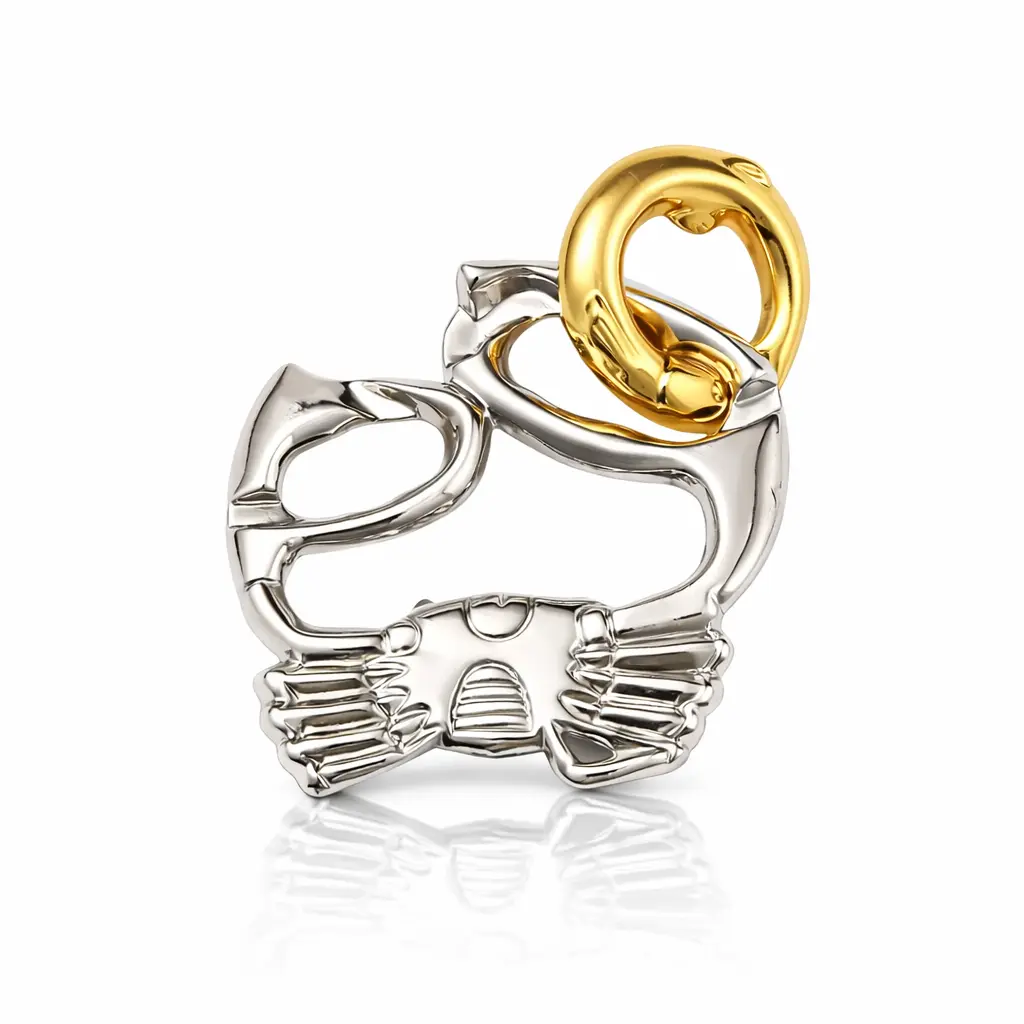
For those who appreciate this form of tactile engineering, our guide on The Best Metal Puzzles For Adults delves deeper into the category, analyzing what makes a puzzle endure beyond a single solve. The Cast Devil is a prime example. It’s not disposable. The materials and construction are chosen for a lifecycle measured in decades, not hours. It’s a kinetic sculpture built to be manipulated, a collector’s piece built to be used. The heft, the seams, the evolving finish—they all contribute to a dialogue that deepens over time, making it one of the few puzzles that feels more valuable the more you handle it.
Is the Cast Devil For You? A Decision Matrix Beyond the Challenge
The Cast Devil’s value crystallizes not in the first solve, but in the second, and the tenth. It transitions from a daunting challenge to a satisfying, repeatable ritual, making it ideal for the patient solver who values tactile meditation over a quick win. For those who need a simpler kinetic fidget, the lighter Cast Coil Pocket Puzzle might be a better fit, but the Devil rewards a specific, persistent mindset.
So, who is this for? Let’s move beyond the generic label of a mechanical puzzle gift.
For the Patient Learner (or a Gift for One):
This is not a beginner’s puzzle. Gifting it to someone who’s never handled a metal disentanglement puzzle is a high-risk, high-reward proposition. The Level 5 difficulty is real. The ideal recipient is someone with a high frustration tolerance, who finds intrigue in struggle, and who appreciates tactile feedback as a form of communication. Think of a patient teen with a methodical mind, a coder who enjoys debugging physical systems, or a hobbyist who relishes a project. It’s a gift that says, “I think you’re clever enough to enjoy being stumped.” Contrast this with the experience offered by many gift card puzzle boxes for adults, which often prioritize theatrics over enduring mechanical intrigue—a distinction we explore in our guide Why Most Gift Card Puzzle Boxes For Adults Fail And The 10 That Don’t.
As a Desk Toy & Fidget Puzzle:
Post-solution, its character transforms. The heft and the well-memorized sequence of satisfying clicks make it an exceptional desk toy fidget puzzle. It’s a kinetic sculpture for your hands during calls or deep thought. Unlike a stress ball, it demands just enough focused, non-verbal thinking to pull you into a flow state, then releases you with that final separation. It resists mindless fiddling—you must engage with it properly—which is precisely its meditative power. If your fidget needs are more about constant, simple motion, a puzzle with a looser, more fluid mechanism might be better.
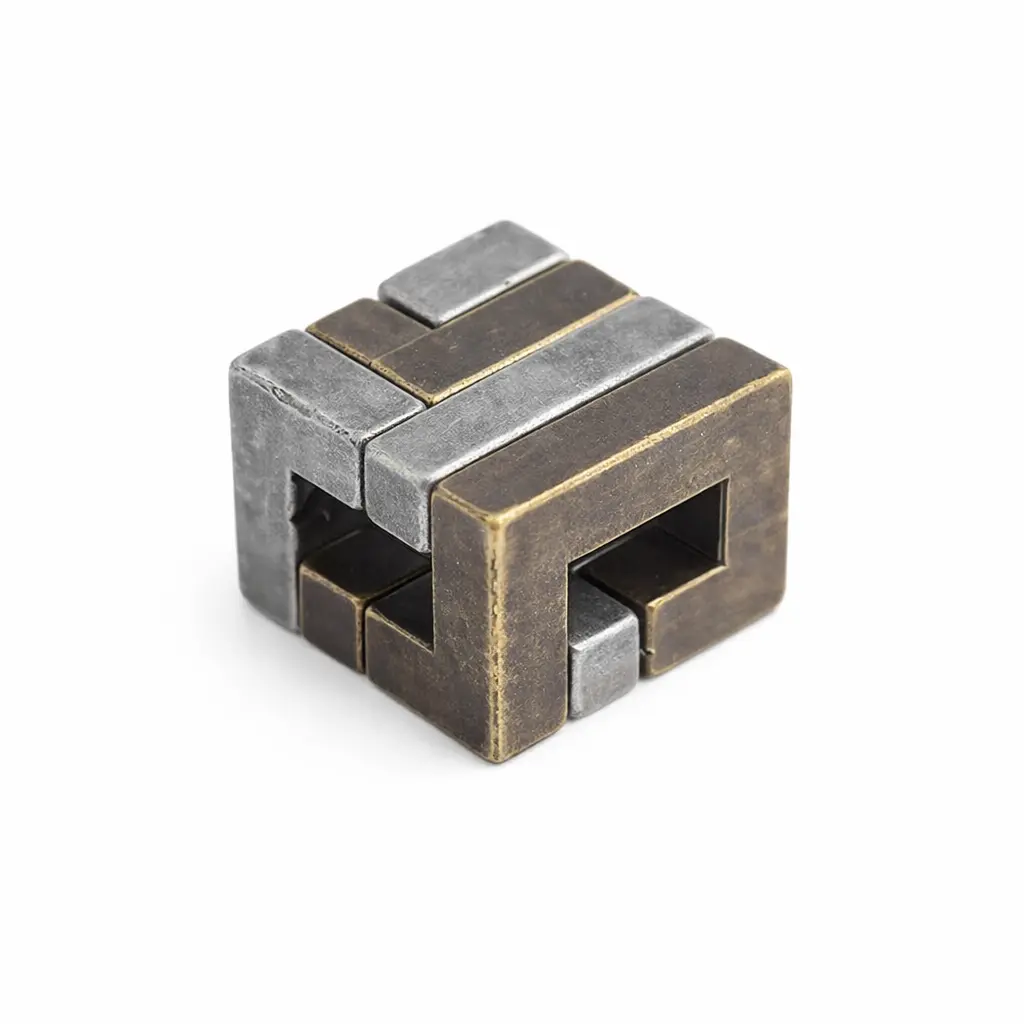
Cast Coil Pocket Puzzle — $18.99
The Cast Coil, for instance, offers a different, more continuous fidget rhythm—a smooth, winding motion rather than the Devil’s precise, punctuated clicks. Choose based on the tactile punctuation you crave.
For the Collector:
Absolutely. Its status as a 1905 design revival gives it historical pedigree. The zinc alloy construction and robust plating mean it’s built to last on a shelf, and its small size makes it easy to display among others. More importantly, it represents a specific school of thought in puzzle design: deceptive simplicity. It’s a benchmark. A collection feels incomplete without this classic—it’s the humbling anchor that keeps your ego in check.
Replay Value: The True Test.
This is the critical question. Once solved, does it gather dust? For many, no. The pleasure shifts from discovery to performance. Mastering the exact pressure and tilt to execute the solution in one fluid, 20-second motion is a separate skill. It becomes a party trick for puzzle people, a calming reset for your hands, and a lesson in non-linear thinking you can revisit to feel that click of understanding in your fingers again. The patina it develops—those subtle fingerprints and wear marks on the high-contact seams—becomes a record of your interactions, a dialogue etched in metal.
Where to Buy & What to Pay: A Value Breakdown Across Retailers
The Cast Devil’s value isn’t just its price tag—it’s in the guaranteed, repeatable tactile journey. For that, you should expect to pay between $12 and $20 USD. Where you buy primarily affects shipping speed, whether a solution is included, and the depth of community knowledge you can tap into.
Having just discussed its replay value and the developing patina of repeated solves, the next logical step is finding your own specimen. The market splits into three clear lanes: mass-market convenience, enthusiast-focused retailers, and curated specialty shops.
Amazon & Big-Box Retailers: Speed and Prime Real Estate.
Price: Typically $14-$18. You’re paying for one-click convenience and fast shipping. The trade-off is product knowledge. Listings are sparse, often using stock photos and generic descriptions. Crucially, most do not include the paper solution sheet—you’ll be relying on YouTube if you get truly stuck. Packaging can be a simple poly bag, leaving the puzzle to rattle in a box during transit. It’s a fine choice if you know what you want and want it tomorrow, but it’s a transactional purchase, not a curated one.
Puzzle Master & Dedicated Puzzle Retailers: The Enthusiast’s Pick.
Price: Around $16-$20, often before shipping. This is where you buy context. Sites like Puzzle Master don’t just sell the item; they provide their own difficulty rating (noting their scale differs from Hanayama’s), detailed photos, and almost always include that coveted printed solution. Their customer service understands that “tangled beyond belief” is a real, frustrating state. You pay a slight premium for this ecosystem. For a first-time buyer or someone deeply in the “consideration” phase, this is often the wisest spend. You’re buying the puzzle and a safety net.
Specialty Toy & Game Shops (Brick-and-Mortar or Online): The Curated Experience.
Price: Can hit the high end, up to $22-$25. Here, you’re paying for discovery and handling. A well-stocked shop lets you feel the heft of the Devil versus a Cast Vortex before deciding. The staff might share a personal solving anecdote. It’s the most expensive path, but it transforms the purchase from an online cart into an event—a tangible beginning to your own solving story. This is the route for the gift-giver wanting to convey thoughtfulness.
Final Verdict: Invest in the Journey.
Benchmark against the $15 mark. If you find it for $12, it’s a steal. At $20, you should be getting extras: a solution, superb packaging, or expert advice. Given the dozens of hours of fidget-worthy engagement it promises—shifting from a stubborn object to a kinetic sculpture you command—even the high end is a profound value. My recommendation? For your first metal disentanglement puzzle, spend the extra few dollars at a dedicated puzzle retailer. The included solution sheet is a stress-relief valve that preserves the joy of discovery. Later, when you’re hunting for your next Cast puzzle, you’ll have the confidence to shop by tactile feedback description alone. Start with the Devil. Learn its language. The cost per satisfying click becomes negligible.
Opening Scene and Core Thesis
So, you’ve decided to buy it. You hold the box. The journey begins not with a strategy, but with a sensation—the cold, dense weight of the Cast Devil settling into your palm. Two identical, polished claws are hooked together in a configuration that looks laughably simple. It promises a single, elegant slide to freedom. It lies. This moment of intrigued simplicity is the core thesis of the entire experience: the Hanayama Cast Devil is a masterclass in deceptive design, a kinetic sculpture that teaches you to think with your fingers before your brain. Your goal isn’t just separation; it’s learning a silent, tactile language.
That initial, confident pull meets immediate, humbling resistance. The frustrated confusion is part of the curriculum. You’ll twist, push, and peer at the manufacturing seams, certain you’ve found a flaw. This is where most give up. But if you lean into the tactile curiosity, quieting the impulse to force it, you start to listen. Your fingertips map the subtle chamfers and the precise gaps. You learn the satisfying click of a piece seating into its correct alignment—a sound like a tiny, metallic latch. This is the puzzle’s true voice.
The ‘Aha!’ insight arrives not as a visualized solution, but as a physical intuition. You stop trying to pull the pieces apart and start guiding them through each other, understanding the claw mechanism from the inside. The subsequent determined focus is a rhythmic, almost meditative state of testing sequences, feeling for the next faint click in the chain. Then, with a final, quiet release, it happens. The deep satisfaction of the solve is profound and quiet—a personal victory witnessed only by your own hands.
This cycle doesn’t end with one solve. The confident mastery comes from reassembly and repeated solves, transforming the object from a daunting challenge into a fidget-worthy companion. It becomes a physical mantra on your desk, a metal disentanglement puzzle whose value accrues not in its shelf presence, but in the calm, non-linear focus it cultivates in you. The thesis, proven through tactile feedback, is that the Cast Devil isn’t a problem to be solved once and discarded. It’s a tool for a different kind of thinking. Your next step is to place your order, clear a space on your desk, and prepare for your first, wonderfully frustrating conversation with metal.