The Moment of Galactic Collapse: First Impressions & Deconstruction
The Cast Galaxy disintegrates in your palm with a soft, metallic sigh. One moment it’s a compact, satisfying knot of silver; the next, you’re staring at four identical pieces scattered on a dark wood table like the aftermath of a silent explosion. It takes exactly 45 grams of precision-machined confusion to achieve this. Designed by Vesa Timonen and winner of the Jury First Prize at the 2015 Puzzle Design Competition, its ‘Knot’ theme is a promise it immediately breaks—this isn’t about untying, but about understanding a collapse.
As an ex-aerospace guy, I appreciate the spec sheet: a zinc alloy core with a clean silver plating, giving each piece a cool, substantial heft. But specs don’t prepare you for the feel. You pick up the assembled Hanayama metal puzzle, rotate it, and without any forceful pulling, it simply… comes apart. This is the core of the cast galaxy frustration. It’s not that you solved it; it’s that it solved itself, leaving you with the sudden, quiet panic of reassembly.
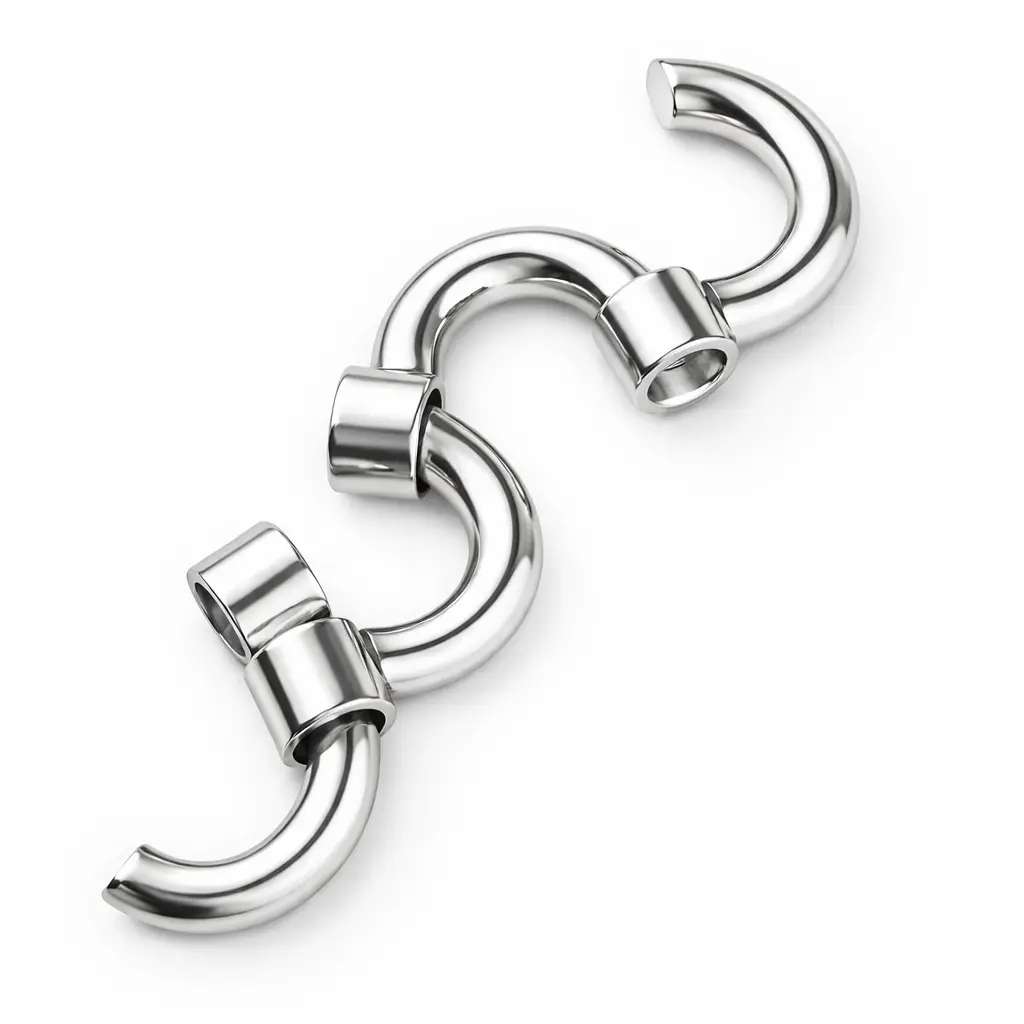
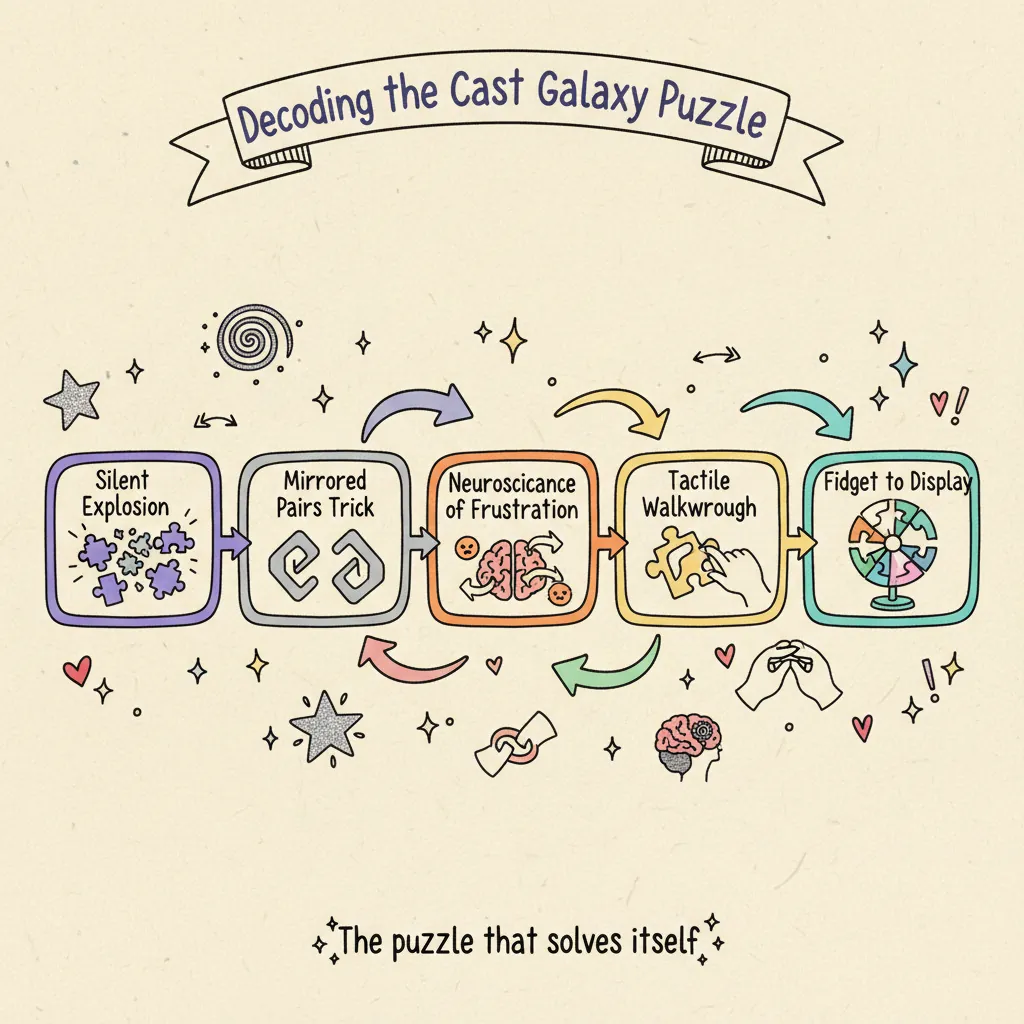
So, why does this puzzle that falls apart in your hands do exactly that? The answer is its genius, and its cruelty. The four pieces are not truly identical; they’re two mirrored pairs. They interlock in a state of perfect, balanced tension. Any exploratory wiggle, any attempt to test a single piece’s freedom, disrupts that equilibrium. The structure isn’t brittle—it’s hyper-sensitive. It’s designed to respond.
This leads directly to the user’s first burning question: is it harder to take apart or put together? For the Cast Galaxy, disassembly is a passive accident. Reassembly is the active, maddening challenge. You’re not reversing a sequence; you’re rebuilding a dissolved tensegrity structure from its components. The pieces look the same, feel the same in your fingers, but they refuse to go back. You try to brute-force two together. They clack and reject each other. This is the brain teaser‘s first lesson: your initial assumptions about mechanical connection are wrong. For a more detailed analysis of this initial shock, see our deep dive into the Cast Galaxy puzzle.
Laying those four silver pieces out, you move from frustration to a focused, engineering curiosity. The collapse wasn’t a failure. It was an invitation. The object on the table is no longer a knot, but a question written in silver finish and intricate design. And the question isn’t “how do these fit?” It’s “what state of alignment allows them to hold their peace?”
The Cruel Genius of Four Identical Pieces: A Geometric Misdirection
The cruel genius of the Cast Galaxy lies not in ornate complexity, but in deceptive minimalism. It’s a four-piece puzzle crafted from a single, repeated hook shape, which the designer rendered in two subtly mirrored pairs to create a perfectly balanced three-dimensional knot. The zinc alloy core, plated in a bright silver finish, transforms this simple geometry into a masterclass in misdirection, where everything you see is a clue to everything you’re missing.
Laying the quartet on a dark table, you are confronted by the paradox. They look identical pieces. Your brain, hardwired for pattern recognition and symmetry, screams that they must be interchangeable. This is the geometric trap. Each piece is a compact, elegant hook with three key contact points: a broad curve, a tapered end, and a critical 90-degree bend. The brilliance is that these identical pieces are assembled in two chiral pairs—left-handed and right-handed versions of the same form. They are siblings, not twins. This mirroring is the foundational trick, the hidden variable that allows four copies of one shape to create a locked, volumetric object rather than a flat, repeating pattern. It’s a lesson in how constraints breed creativity.
The designer faced a monumental challenge: creating compelling depth with the fewest possible parts. In a referenced interview, he’s spoken about the desire to craft a puzzle that felt complete, not simplistic. With only four components, every millimeter of engagement, every surface, must serve multiple functions—structural, obstructive, and guiding. The hook shape is the solution. Its curve cradles a neighbor; its tapered end slides into a precise channel; its right-angle bend provides the locking fulcrum. It’s a Swiss Army knife of a component. This is why the Cast Galaxy Hanayama puzzle won its top honors. It celebrates purity of form, proving that a great mechanical puzzle isn’t about how many parts it has, but about the elegant dance it forces between them.
This is where the silver finish on the high quality metal becomes more than aesthetic. The bright plating acts like a witness surface. As you fumble through attempts, your fingers will leave micro-scuffs along the precise edges that are meant to guide and slide. Over time, a practiced solver can almost read these faint, polished trails—a tactile history of your learning. The finish is durable, but it communicates. It tells you where you’ve been applying force, highlighting your erroneous assumptions. A matte or dark coating might hide these clues, but the reflective silver metal puzzle offers passive feedback, turning the object into a record of its own solution path.
And this leads to the core frustration. Because the pieces are so similar, your natural instinct is to try combinations sequentially. You pick up Piece A and B, trying to link them as a stable subunit before introducing C. The puzzle violently rejects this approach. The design ensures no two pieces can form a stable, intermediate assembly. Any connection between two is entirely dependent on the position and pressure of the third, and ultimately the fourth. You are not building a wall brick by brick; you are trying to balance a mobile, where every element must be positioned in relation to all others simultaneously. It’s a full-system problem disguised as a simple connect-the-dots game.
This geometric misdirection is what elevates the Galaxy from a mere 3D puzzle to a cerebral exercise. The intricate design is all in the negative space—the shifting voids between the hook shaped pieces that must align into a perfect, symmetrical channel. When solved, the puzzle presents a satisfying, solid galaxy shape. When apart, you hold the raw alphabet of its form: four identical-looking letters that can only spell the solution when arranged in the correct, mirrored orientation and moved in perfect, concurrent harmony. It’s a lesson in systemic thinking, packaged in a pocket-sized bar of plated zinc. The difficulty isn’t in deciphering a labyrinth; it’s in understanding that you were never in a maze to begin with—you were trying to choreograph a quartet.
Why Your Brain Rebels: The Neuroscience of Simultaneous Movement
The Cast Galaxy’s core challenge—moving four interdependent pieces as one—feels unnatural because it directly conflicts with the brain’s dominant problem-solving framework: sequential, causal logic. Studies in motor control show that the prefrontal cortex, responsible for planning, prefers step-by-step processes, making the Galaxy’s requirement for concurrent multi-axis manipulation a genuine cognitive disruption, not just a dexterity test. For more on this fascinating interplay between hands and mind, check out our exploration of how the metal puzzle brain works.
We are hardwired for narrative. From assembling furniture to following a recipe, our brains excel at creating mental models where A leads to B, which enables C. This sequential planning is efficient and deeply ingrained. Most Hanayama puzzles, even complex ones, ultimately reward this logic—there is a discoverable sequence of moves. Your attempt with the Cast Galaxy begins here. You pick up Piece 1 and Piece 2, trying to find a stable connection. You might get a hook to catch, and a surge of hope fires in your reward circuitry. Then you reach for Piece 3, and the entire tentative assembly collapses. This is the puzzle’s first, and most important, lesson: you are not telling a story with a beginning, middle, and end. You are conducting a symphony where every instrument must start at the exact same moment.
This is where the frustration transforms into intrigue. The difficulty isn’t merely about finding the right alignment (the “reset position,” a crucial starting point most solution guides omit). It’s about suppressing the instinct to do and learning to feel. Your brain must shift processing power from the prefrontal cortex’s executive planning to the somatosensory and motor cortices—the regions that handle tactile feedback and coordinated motor skills. You are, in effect, trying to solve a spatial problem with your sense of touch and proprioception more than with your logical, visual-planning mind. It’s akin to learning to juggle. No amount of theorizing about parabolic arcs teaches your hands the rhythm; you must enter a state of focused, repetitive practice until the motion becomes embodied knowledge.
This explains the near-universal experience of the Cast Galaxy seeming to fall apart in your hands. It’s not just slippery. Your brain, stuck in its sequential model, is applying force in the wrong paradigm. You’re trying to lock two pieces together to create a stable sub-unit, a cause that will lead to the effect of a solid foundation. But the system has no stable sub-units. Any force applied to secure two pieces creates a torque or misalignment that expels the third. The only stable state is the solved state; everything else is dynamic equilibrium. To assemble it, you must hold all four pieces in a precise, light-fingered cradle and apply a gentle, uniform pressure that allows them to slide along each other’s curves as a single entity.
This is the “kinetic meditation” I mentioned earlier. Mastering the Galaxy forces you into a flow state where you stop thinking in steps and start perceiving the system as a whole. The satisfying click of final alignment isn’t just a sound; it’s the moment the four-dimensional path you’ve been mentally tracing—through space and concurrent time—snaps into a perfect, three-dimensional knot. Your brain, after rebelling, finally acquiesces to a new mode of thinking. This is why, even after you know the puzzle solution, the act of solving remains profoundly engaging. It becomes a tactile exercise in mindfulness, a fidget-grade reset for a brain overtaxed by linear to-do lists. You are not just solving a metal puzzle; you are giving your sequential mind a rest and letting your hands do the thinking, following the whisper of silver finish on silver finish to a conclusion that feels less like a victory of logic and more like a moment of harmonious, silent understanding.
Finding the Groove: A Tactile Walkthrough, Not Just Steps
The trick to the Cast Galaxy isn’t a hidden sequence of moves, but learning to speak its language of pressure and alignment. After 17 attempts, I realized the puzzle wasn’t being stubborn—I was just shouting in English when it only understands whispers. The core mechanic, as we’ve uncovered, is simultaneous movement. But knowing that intellectually and executing it kinetically are galaxies apart. This is a walkthrough for your fingers, teaching you to feel for the “reset position” and the path home, transforming frustration into a state of focused flow. This approach aligns with the foundational principles in our mechanical grammar for unlocking any metal puzzle.
Forget numbered steps. Think of it as learning a dance in three phases: the Reset, the Groove, and the Click. Most guides, even the official Hanayama solution PDF you might find on Huzzle or Puzzle Master, skip the first and most critical phase. They show you the sequence of moves from an already-aligned starting point, which is like being given map directions that begin with “Step 2: Be at the summit.” Let’s start at the true beginning.
Phase 1: The Reset Position – Your Essential Launch Pad
You have four pieces on the table. They look identical. The urge is to grab two and start fiddling. Resist it. The Cast Galaxy only accepts one correct starting alignment for reassembly. Here’s how to find it, by feel.
Pick up all four pieces. Hold two in your left hand, two in your right, pinched lightly at their waists. Orient them so the “hooks” are all facing the same general direction—imagine the puzzle’s finished, tetrahedral shape. Now, bring the two pairs together so the long, curved arms of each piece interlace. This is the tricky bit: you’re not trying to interlock them yet. You’re creating a loose, four-pointed star in your palm. The correct reset position is achieved when each piece is resting against its neighbor, with the interlocking tabs and notches almost engaged, but deliberately held about one millimeter out of alignment. Visually, the pieces will form a symmetrical, open cage. In your hands, you’ll feel a specific, balanced tension—a precarious equilibrium where no single piece can move independently without the others shifting. This is your launch pad. This is the precise geometric state the puzzle “wants” to be in before the solving dance begins. Most failures happen because you start from a scrambled, asymmetrical position; the simultaneous movement can’t initiate from there.
Phase 2: The Groove – Listening to the Whisper
From the reset position, apply a gentle, inward pressure with all ten fingers. Not a squeeze, but a uniform coaxing. Your goal is not to force pieces together, but to encourage them to slide along each other. This is where you must become passive, an observer of the tactile feedback.
As you apply this cradle of pressure, you’ll feel the pieces begin to seek their path. There will be a subtle, grating sensation—the whisper of metal on metal. This is your primary guide. If the whisper becomes a screech or movement stops, you’ve forced an incorrect, singular motion. Relax your pressure, let the pieces fall back to the reset position in your hands, and begin the gentle coaxing again.
The correct simultaneous movement feels like a single, smooth, compound rotation. The four pieces will rotate as a unit along two intersecting axes. It’s a feeling of the entire assembly breathing—contracting slightly, then expanding as the interlocking geometry guides it. Don’t watch it. Feel it. Close your eyes. Your brain is terrible at processing four independent motions at once, but your proprioception—your sense of your body in space—is excellent at feeling a single, complex, unified motion. This is the entry into the flow state. You are no longer assembling a disentanglement puzzle; you are guiding a kinetic system through its one natural mode of vibration.
Phase 3: The Click – A Sub-Atomic Conclusion
The entire journey, from reset to resolution, takes less than five seconds when you’re in the groove. The finale is not an accident. As the pieces complete their synchronized rotation, the geometry reaches a point of maximum tension. The notches and tabs are fully aligned, poised at the precipice of locking. A final, almost imperceptible, increase of pressure from your palms is all it takes.
And then you hear it. Feel it.
The satisfying click.
It’s not a loud snap. It’s a dense, precise, sub-atomic click that resonates up through the bones of your fingers. It’s the sound of four planes of zinc alloy, silver-plated to a micron-perfect finish, seating home simultaneously. The puzzle becomes rigid in your hand. The loose cage transforms into a solid, tetrahedral knot. This moment is the entire reward. It’s the tactile proof that you achieved perfect synchronicity. You answered the challenging question posed by four hook shaped pieces.
Common Failure Points & The Fingertip Fix
* The Fall-Apart: If the puzzle seems to “explode” as you try to start, you were never in the reset position. Go back to Phase 1. Precision there prevents chaos later.
* The Jam: If everything seizes up, you’ve let one piece get ahead of the others. You’ve broken the simultaneity. Release pressure, let it relax, reset.
* The Near-Miss: You feel a click, but it’s mushy and the puzzle is still wobbly. This means three pieces locked, but one tab is resting beside its notch, not inside it. This is often due to a slight twist in one piece during the groove phase. Again, release, reset, and focus on uniform, untwisted rotation.
This process—reset, groove, click—is the puzzle solution. It contains the mechanical puzzle’s entire logic. Once you learn this language of feel, you can solve it blindfolded. In fact, I recommend it. It elevates the Cast Galaxy from a simple brain teaser to a profound exercise in sensory attention. You’re not following instructions; you’re conversing with geometry through your fingertips, learning a wordless, kinetic meditation that ends, every time, with that perfect, silent understanding.
The Hanayama Hierarchy: A Realistic Difficulty Spectrum
After mastering that language of feel, the natural question emerges: where does the Cast Galaxy sit in the grand pantheon of Hanayama cast puzzles? Hanayama’s official puzzle rating of Level 3 out of 6 can be misleading; it places the Galaxy squarely in “Intermediate” territory, but this is a broad category. In my experience, the difficulty of a metal puzzle isn’t a single number—it’s a two-axis spectrum of pure logic versus fine motor skills and tactile sensitivity. On that spectrum, the Galaxy is a fascinating outlier: moderate in logic, but surprisingly high in its demand for dexterity and feel. For a broader look at how puzzles are categorized, our guide to Hanayama Cast puzzle solutions sorted by level offers useful context.
Let’s plot it. On the logic-heavy end, you have puzzles like Cast Marble (Level 4) or Cast Delta (Level 5). These are cerebral mazes. You must deduce an invisible internal path; your fingers are merely executing a pre-planned sequence of moves. Failure is a wrong turn in a flowchart. The Cast Galaxy is nothing like that. Its logic is almost insultingly simple once you know the trick: move four pieces as one. The entire puzzle solution fits in a single sentence. The monumental challenge is in the execution—training your hands to perform that symmetrical ballet against your brain’s every instinct.
On the dexterity-heavy end, you find puzzles like the Cast Loop (Level 4). It’s a twitchy, fidget-grade dance of a single wire through an obdurate frame, demanding precise pressure and micro-manipulations.
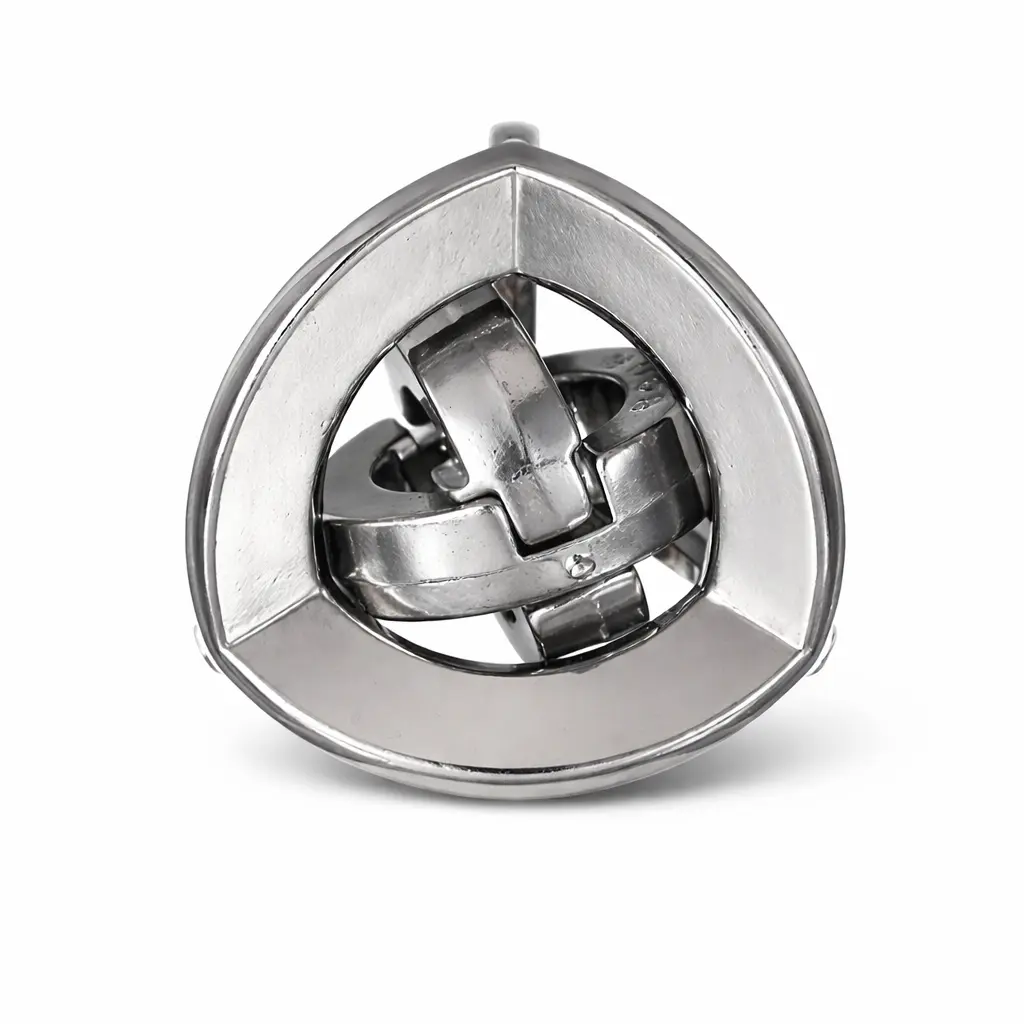
The Galaxy shares this dexterity demand but layers on the simultaneous movement constraint. You’re not guiding one piece through a static labyrinth; you’re conducting an orchestra of four. This is why the common comparison—Cast Galaxy vs Cast Marble—is so illustrative. A logical mind that conquers the Marble might be utterly flummoxed by the Galaxy’s physical defiance. The Marble feels like solving an equation. The Galaxy feels like learning to juggle.
So, is the Cast Galaxy a good puzzle for beginners? My verdict is a qualified no, despite its Level 3 rating. A true beginner, fresh to mechanical puzzles, likely lacks the patience for its unique brand of frustration. They haven’t yet learned to listen for the tactile feedback, to appreciate the process over the solution. They want a logical “aha!” moment, not a meditative drill. The Galaxy is a puzzle for someone who already understands that the journey is the point, and is ready to be trained by the object itself. It’s a perfect “intermediate-plus” puzzle—a skill-builder that introduces a completely new solving dimension. If you’re trying to find your perfect match in the Hanayama lineup, our tactile matchmaker guide to Hanayama puzzles can help narrow it down.
Consider the Cast Hook, another dexterity-focused puzzle with a clear, repeatable motion. If you’re intrigued by that specific mechanism, we have a dedicated step-by-step guide to solving the Cast Hook.
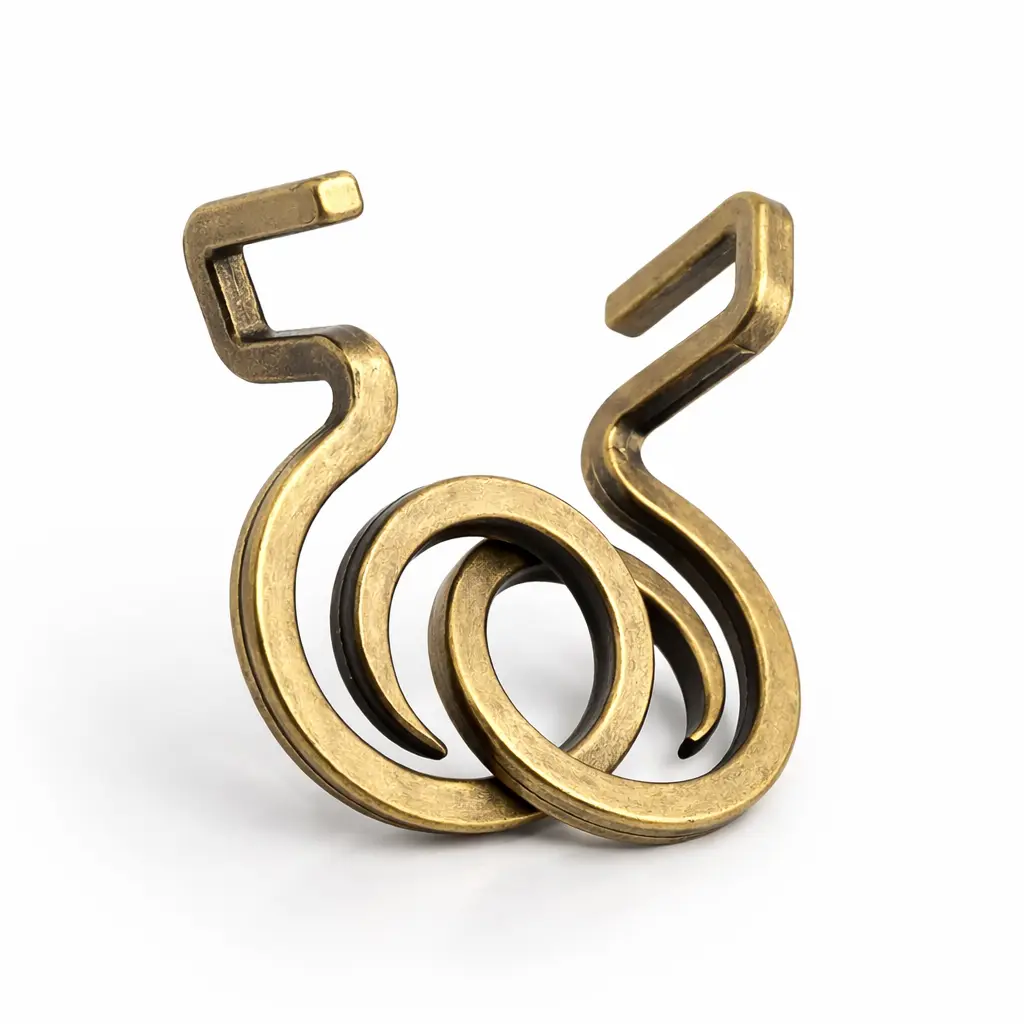
Its challenge is spatial awareness and a precise twisting maneuver. It’s a single, clever move. The Galaxy, by contrast, demands a sustained, coordinated effort from both hands. It’s less of a “trick” and more of a “technique.” This is why, after your first solve, the Galaxy doesn’t retire to the shelf. The satisfying click of perfect alignment becomes a reward you can return to, a kinetic ritual. Its difficulty morphs. The initial barrier—the cast galaxy frustration—transforms into a gateway for flow. You stop solving it and start performing it. In the Hanayama hierarchy, that’s a rare and special category: the puzzle that becomes a tool for focus, a kinetic meditation you hold in your palm. It’s not the hardest puzzle in the series, but it might be the one that most profoundly changes how you interact with all the others.
Beyond the Solve: The Fidget-Grade Object & Display Piece
So you’ve found the flow state, that moment where solving the Cast Galaxy shifts from a struggle to a smooth, repeatable technique. This is where its true, and often overlooked, value reveals itself. The Galaxy transcends its initial challenge, becoming a premium fidget-grade object that lives on your desk, not in a box. Its 45-50 grams of zinc alloy and silver plating offer a sensory feedback loop perfect for kinetic meditation, while its polished form makes it a striking minimalist sculpture. For the price of a movie ticket, you get a durable tool for focus and a conversation-starting display piece.
That smooth, rhythmic solve you’ve mastered isn’t just a party trick. It’s a built-in stress-relief mechanism. The simultaneous movement of the four pieces requires just enough focused dexterity to pull your mind away from scrolling or anxiety, engaging a different neural pathway. Your hands find the reset position—pieces aligned, grooves matched—and initiate the gentle, coordinated push-turn. The satisfying click at the end provides a clean, definitive reward. This isn’t mindless fidgeting; it’s a mindful, repeatable ritual with a clear beginning and end. For puzzle fans and non-puzzlers alike, this transforms the Galaxy from a one-and-done brain teaser into a tactile anchor for concentration.
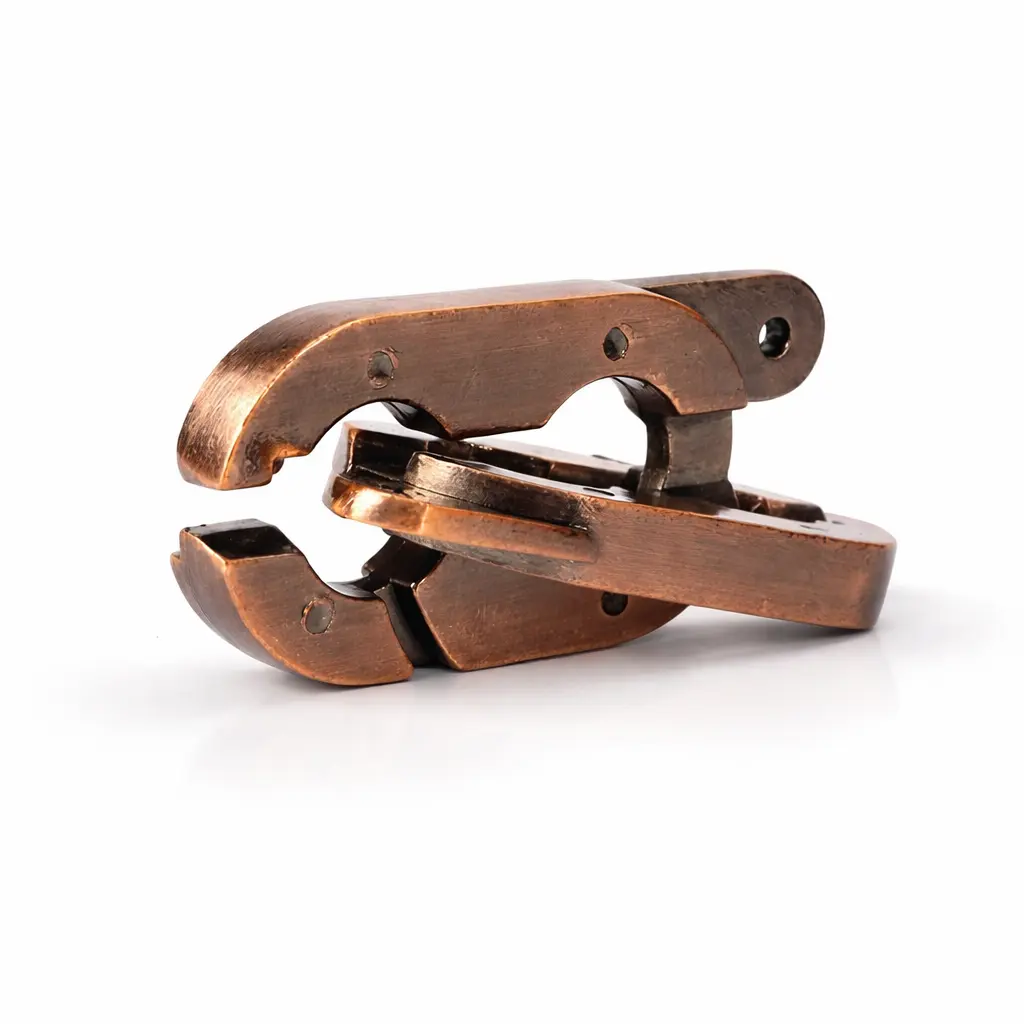
Its aesthetic value is its other lasting triumph. The “silver” in the keyword isn’t incidental. The clean, silver finish and the interlocked knot design give it the presence of a small, modern art object. On a bookshelf next to black-bound notebooks or on a dark wood desk, it catches the light and begs a closer look. This is a metal puzzle designed to be seen. Unlike some Cast puzzles that look like abstract lumps when solved, the Galaxy retains a deliberate, symmetrical geometry. It declares its solved state with quiet confidence.
And that makes it a brilliant conversation starter. Leave it on your coffee table, and guests will pick it up. It feels substantial, cool, and expensive. The inevitable “What is this?” leads not to a dry explanation, but to a demonstration. You hand it over, watch their fingers explore, and witness the exact moment of cast galaxy frustration—then the genuine surprise when you perform the solve in three seconds flat. It’s a shared moment of “aha” that a screen can never provide. In this role, it’s a bridge, demonstrating the quiet joy of mechanical puzzles without the intimidation of a 50-piece burr.
Naturally, this raises the question of longevity. Will the silver finish wear? With frequent handling as a fidget object, a subtle patina will develop on the highest contact points over years, not months. The underlying zinc alloy won’t tarnish like pure silver. This isn’t a flaw—it’s evidence of use, a record of every kinetic meditation session. If you prefer it pristine, a gentle rub with a soft jewelry cloth every so often will maintain its luster. Its durability is a key part of the Hanayama brand promise; this is a high quality metal object built for a lifetime of handling, a principle discussed in our veteran’s guide to metal puzzles that last.
For those who appreciate this dual role—a 3D puzzle that evolves into a desk toy—the appeal of the Cast Galaxy extends far beyond the initial 17 attempts. It fills a niche outlined in our guide to the best metal puzzles for adults seeking a thoughtful challenge: the object that engages the hands to quiet the mind. When considering where to buy cast galaxy, you’re not just purchasing a challenge with four pieces. You’re investing in a tactile artifact. One that offers a moment of focused calm in a chaotic day, and looks damn good doing it.
Custodian of the Cosmos: Maintaining the Silver Finish
The short answer is no, the silver plating on your Hanayama Cast Galaxy won’t readily tarnish or rub off with normal use, but it will collect fingerprints and develop a subtle, personalized patina. This is a function of its specific construction: a durable zinc alloy core with a robust electroplated silver finish, designed for the friction of solving, not for hermetic display. Your role isn’t to keep it sterile, but to curate its evolving character.
Think of it like a well-worn tool. The zinc alloy beneath the plating is inert and corrosion-resistant, unlike pure silver which reacts with sulfur in the air. The real “enemy” isn’t tarnish, but the oils and acids from your skin, which leave dull smudges on the silver finish. For a puzzle that lives in your hand as a kinetic meditation aid, this is inevitable. That faint, clouded map of your fingerprints isn’t a defect—it’s a logbook of your progress, a record of every simultaneous movement practice session. If you love that lived-in look, just keep solving.
But if you prefer your cast puzzle to retain its initial, cosmic luster for display, a simple regimen does the trick. First, prevention: wash and dry your hands before extended fidget sessions, especially if you’ve eaten. This minimizes acidic transfer. For storage, the included Hanayama drawstring pouch is excellent, but any soft, dry compartment will do—avoid tossing it loose in a bag with keys or coins that could cause fine scratches.
When the smudges become too pronounced, cleaning is straightforward. Never use abrasive polishes, chemicals, or ultrasonic cleaners. You’ll mar the plating. Instead, a gentle rub with a clean, soft microfiber or dedicated jewelry polishing cloth is all it needs. Breathe on the piece to create a light mist, then wipe in straight lines along the curves of the hook shaped pieces. The moisture loosens the oils, and the cloth lifts them away. You’ll restore the bright silver finish in seconds, revealing the pristine high quality metal underneath.
This balance between use and care is a hallmark of the Hanayama brand. Think of the Cast Galaxy not as a fragile ornament, but as a mechanical puzzle engineered for interaction—a subcategory of disentanglement puzzles designed for repeated manipulation. Its durability is part of the design satisfaction. Whether you let its story etch itself into the surface or maintain it as a shining trophy is a personal choice. Either way, you’re not just solving it. You’re becoming its custodian.
Final Orbit: Who This Puzzle Will Captivate (and Who It Will Frustrate)
The Cast Galaxy is not a universal crowd-pleaser; it is a specific and rewarding experience for a particular solver. The ideal user is someone who values tactile process over pure logic, who doesn’t mind 17 attempts to find a groove, and who sees the object as more than a single-time solve. Its Level 3 rating from Hanayama is accurate for the sequence of moves, but wholly inadequate for describing the required mindset.
It will captivate the tactile learner. This is the person who thinks with their fingers, who understands pressure and alignment through feel more readily than through diagrams. For them, the Cast Galaxy is a masterclass in simultaneous movement and kinetic meditation. It’s the fidgeter seeking a high quality metal object with a purpose, the one who will absentmindedly solve and resolve it during phone calls, finding the rhythm of its satisfying click more calming than any spinner. It’s the aesthetics appreciator who will display the four silver pieces, separate or assembled, as a sculpture that whispers of geometric elegance and cleverness. If you are the type to cherish the journey of mastering a deceptively simple mechanism—to feel pride in the muscle memory of a perfect, fluid reassembly—this metal puzzle is for your shelf.
Conversely, it will frustrate the pure logician. If your joy comes solely from deducing a solution through spatial reasoning on paper, the Galaxy’s dexterity demands will feel like an unfair obstacle. It will test the patience of the impatient beginner; its small size and the frustration of pieces that “won’t catch” can be discouraging without the right expectations. Those with significant hand dexterity or strength issues may struggle with the precise, coordinated pressure required from both hands. And if you view a puzzle as a problem to be solved once, documented, and shelved forever, the Galaxy’s enduring value as a fidget-grade object will be lost on you.
This brings us full circle, back to that dark wood table with the four identical pieces. The arc from frustration to awe is not guaranteed—it’s earned. It requires surrendering to the puzzle’s core lesson: that some problems can’t be forced piece by piece, but must be approached as a cooperative, moving system, a fundamental truth in the world of mechanical puzzles and specifically disentanglement puzzles. Mastering that feel, becoming its custodian, is where the true satisfaction lies.
So, what’s your next move? If this resonates, seek out the Hanayama Cast Galaxy. Handle it. Listen for the whisper of metal on metal. And when you inevitably hit that wall of frustration, remember: the key isn’t in your head, but in the synchronized motion of your hands. The solution, when you’re ready for it, is out there. But the real discovery happens in the attempts.