The Click That Hooks You: Welcome to the World of Wire
A metal wire disentanglement puzzle set is a collection of 4 to 24 hardened steel or zinc alloy objects, each a cage of elegant, impossible geometry designed to be taken apart through spatial logic, not force. You don’t play with them; you engage in a silent, three-dimensional argument with a piece of bent metal, and the profound satisfaction of winning is a specific, deeply human kind of victory.
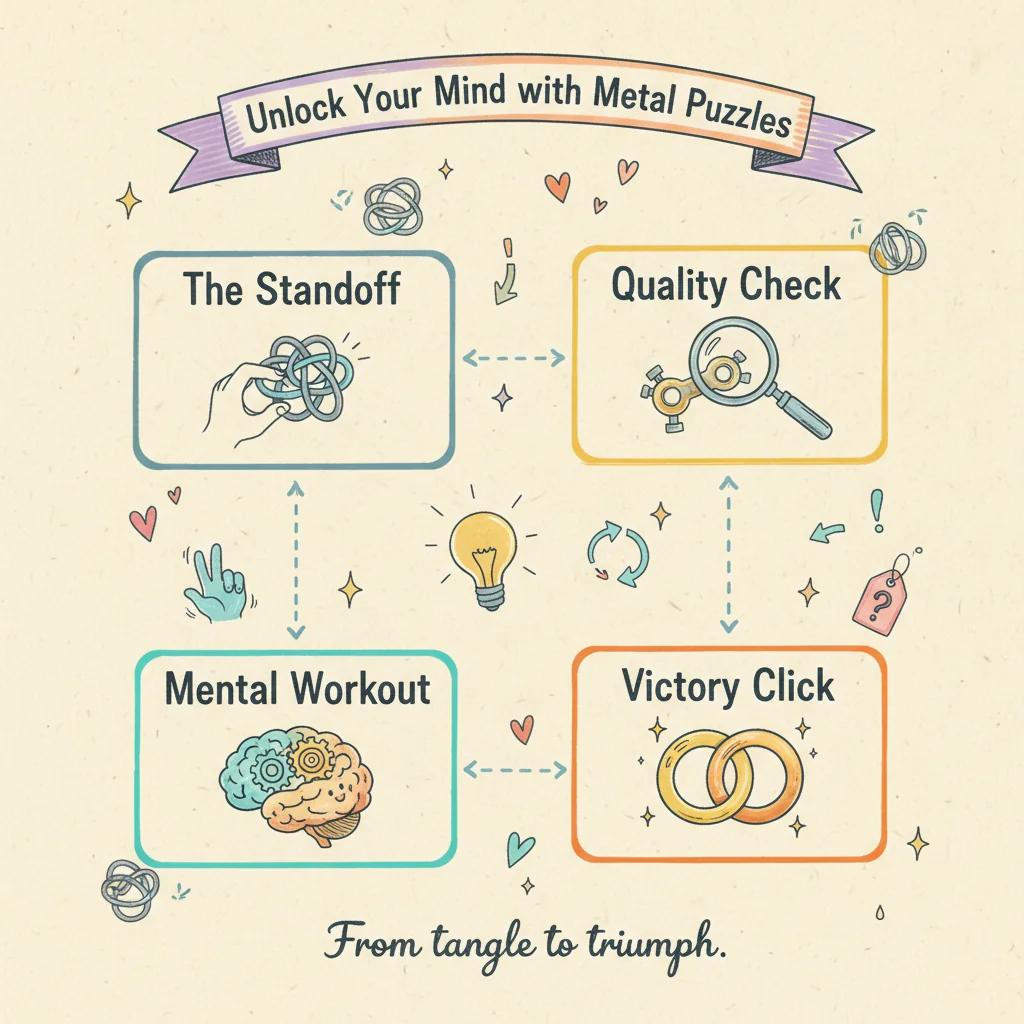
It starts with a clink. You pick up a cold, unforgiving tangle of wire. Your fingers probe, finding no obvious latch, no button. Turning it over yields only a different angle of the same maddening knot. The urge to pull is primal, but the metal pushes back with a springy resistance that mocks your brute force. This is the universal gateway moment: a silent, personal standoff between your brain and a few ounces of forged steel.
This moment of quiet intimidation is the entire point. These puzzles aren’t toys; they are gym equipment for your spatial reasoning. They force your mind off the flat screen and into the real, tactile world of volumes, trajectories, and clearances. Each solve is a workout, stretching your ability to mentally rotate objects, visualize hidden paths, and sequence movements. The soft clink of wire on wire becomes your rep counter.
Their lineage is ancient, a direct descendant of classic Chinese “ring and loop” puzzles and Victorian parlour challenges, falling under the broad category of disentanglement puzzles. Modern sets bottle that centuries-old appeal into discrete, shelf-ready challenges. The question, “are metal puzzles good for your brain?” isn’t about some vague “brain boost.” It’s about the concrete, focused activation of your parietal lobe—the region that handles spatial manipulation. It’s the mental equivalent of feeling for a keyhole in the dark, learning the shape through your fingertips.
Then comes the shift. After minutes or hours of futile twisting, your internal model of the puzzle updates. You see a gap you hadn’t considered, a loop that can bypass a camshaft-like bend if you apply a slight twist. You execute the move. The resistance gives way to a smooth, oily glide. The click. The separation. Satisfaction. It’s a pure, dopamine-triggering a-ha moment engineered from wire and wit.
This is the hook. It’s not about collecting solved objects; it’s about craving that specific cognitive transition from confusion to clarity, a transition you can hold in your hand. For more on the skeptical appeal of this tactile logic of wire brain teasers, our guide explores the journey from frustration to fluency.
Beyond the Separation: Why Twisting Metal Beats Scrolling
The act of untangling wire isn’t merely “fun”—it’s a targeted cognitive workout with a 4000-year-old pedigree, engaging your brain’s spatial mapping centers in a way digital screens cannot. This tangible feedback loop, where every failed twist informs the next, generates a state of flow that psychologists note can lower stress levels more effectively than passive consumption. The core mechanism isn’t brute force but applied topology, a branch of mathematics concerned with properties preserved through bending and stretching, making each solve a lesson in mental flexibility.
Where a mobile puzzle app offers silent, frictionless taps, a metal wire puzzle provides a stream of physical data. You feel the spring tension in a hardened steel loop, the subtle catch of a forged joint, the slight give before a component slides through a keyway. This tactile feedback is critical; your hands are active sensors, not just input devices. As one user on r/mechanicalpuzzles put it, “The frustration is part of the interface. On a screen, you just give up. With the cold metal in your hands, the frustration forces you to change your mental model. The ‘click’ isn’t just sound—it’s a full-body confirmation you were right.” This connects directly to our exploration of decoding the metal puzzle brain, which decodes this ancient, tactile logic.
Digital puzzles exist in a perfected, abstract space. Metal puzzles live in the real, imperfect world of gravity, torque, and finger grease. This is their supreme advantage. Solving one requires you to mentally rotate objects in three dimensions, project paths through obstructed spaces, and anticipate chain reactions of movement—a pure spatial reasoning drill. You’re not just finding a pre-programmed solution; you’re discovering the physical truth of the object in front of you. The “a-ha moment” is therefore earned and embodied, not simply revealed.
The community sentiment underscores this. Beginners often express a specific, shared frustration: “I looked at it for 20 minutes and didn’t even know where to start.” This intimidation fades when you learn the universal principle: these puzzles are about finding the sequence, not the force. The breakthrough quote is nearly universal as well: “Oh! It has to go around that bend, not through it.” That’s the topological leap—understanding that the puzzle’s components can move through spaces that seem blocked, provided you follow the precise, contorted path.
This process builds a different kind of focus. It’s not the hyper-alertness of a strategy game, but a deeper, quieter absorption. You enter a dialogue with the object. Failed attempts aren’t dead ends; they’re eliminated pathways, each one teaching you about the constraints of the system. Your brain stops scrolling and starts constructing a 3D map. In an age of infinite digital distraction, the value of this single-pointed, tactile feedback-driven attention is immense. You’re not just solving a puzzle; you’re practicing how to think with your hands.
Choosing Your Workout: A Framework for Evaluating Any Puzzle Set
Choosing the right metal wire puzzle set isn’t about finding the “best” one, but the right one for your brain’s desired workout. The market’s key divide—between a $12 bag of 24 generic pieces and a $40 curated set of 4—is navigated by evaluating four pillars: Difficulty Gradient, Build Quality, Fidget Factor, and Presentation. This framework, drawn from my own drawer of failed prototypes and tested across dozens of sets, moves you beyond piece-count metrics and into experiential value.
Most product listings fail you here. They’ll trumpet “24 PCS!” or “Great Gift!”, leaving you to guess if those two dozen puzzles are just 24 slight variations on the same easy loop, or a thoughtfully sequenced journey into deepening complexity. A machinist’s review might judge individual puzzles on tolerances, but a solver needs to judge a set on how it curates a challenge. This is how you decode the offerings.
1. Difficulty Gradient: The Progression Path
A quality set functions as a curriculum. It should have clear entry points—puzzles you can likely solve in under five minutes by applying basic observation—and build toward genuine head-scratchers. Look for a mix of open loops (easier, involving simple unhooking) and closed loops (harder, requiring precise sequential moves through constrained spaces). A flat set, where every puzzle feels similarly opaque, leads to frustration and abandonment. The best progression teaches you core concepts with early wins, which become tools for tackling later, more complex solve paths.
2. Build Quality: The Tactile Syllabus
This is where price and origin often show. Forged versus bent components make a world of difference. A cheap, bent-wire puzzle feels sloppy; its spring tension is inconsistent, and sharp burrs at cut points can snag on clothing or skin. A well-made puzzle uses hardened steel, with ends ground smooth and soldered or welded joints that don’t flex under pressure. Precision in the bend radii and consistent wire gauge isn’t just about aesthetics—it’s about fairness. The puzzle’s challenge should be purely mental, not a fight against poor manufacturing. Run your finger along the wire paths. You’re feeling for the tactile feedback of a precise tool, not a crude toy.
3. Fidget Factor: Re-Solvability vs. One-Time Triumph
This is a crucial, often overlooked filter. Will you solve this once, feel the A-ha moment, and then shelf it forever? Or does its mechanical motion invite repeated, satisfying manipulation? Some puzzles are pure logic gates—once you understand the sequence, the act of solving becomes trivial. Others have a rhythmic, almost meditative quality to their solution, making them fidget-worthy desk objects. Ask yourself: After the “click” of separation, do I want to re-engage the pieces and run through the sequence again? This quality transforms a puzzle from a challenge into a companion.
4. Presentation: Storage as Part of the System
Finally, consider the container. A zip-lock bag full of tangled wires is a deterrent. A flat pack where each puzzle has its own slot, or a box that separates challenges by suspected difficulty, respects both the product and the solver. It answers the practical user question: How do I store these so they don’t get tangled together? Good presentation extends the experience, making it easy to pick a specific challenge or pack the set neatly as a gift.
By applying this framework, you stop comparing apples to oranges. You start comparing a high-rep, low-weight mental warm-up (the bulk bag) to a focused, heavy-lifting session (the curated set). You learn how to choose a metal puzzle based on the type of cognitive and tactile satisfaction you’re after. In the next sections, we’ll apply this lens to the most common set archetypes you’ll encounter.
Your First Line of Defense: Decoding the Difficulty Gradient
To avoid immediate frustration, you must learn to assess a puzzle’s challenge before you buy it—the core differentiator between a satisfying starter and a desk-flipping ordeal is often visible in the product photos. A puzzle’s difficulty is not random; it’s engineered through three measurable factors: the number of independent components, the complexity of their paths, and the presence of misleading symmetry. Beginners should prioritize 2-4 component puzzles with at least one open loop or obvious entry point.
The primary lever of complexity is the component count. A two-piece puzzle, like a simple ring and hook, offers one core interaction to master. Add a third independent wire, and you’ve introduced a second, often interdependent, relationship that must be managed simultaneously. This is the jump from a one-variable equation to a system of equations. The leap from 3 to 4 or more pieces is often exponential, not linear, as the solve path becomes a branching tree of possibilities. When browsing, ignore the advertised “Level 10” tags. Instead, perform a tactical parsing: count the distinct metal pieces you see. If you count more than four, and they’re all densely intertwined, you’re likely looking at an advanced or master-level challenge.
Beyond count, analyze the geometry. Look for open versus closed loops. An open loop (a hook, a broken circle) is a gift—a clear potential exit or entry vector. A set comprised solely of closed, interlocked rings is a gauntlet of topological manipulation, requiring you to find the one precise sequence of passes and rotations. Beginners need at least one open loop to build confidence. Next, assess symmetry. Perfect bilateral symmetry often indicates a mirrored solution, which can be a helpful clue. False or rotational symmetry, however, is a classic designer’s trick to send your spatial reasoning down an elegant, logical, and completely wrong rabbit hole.
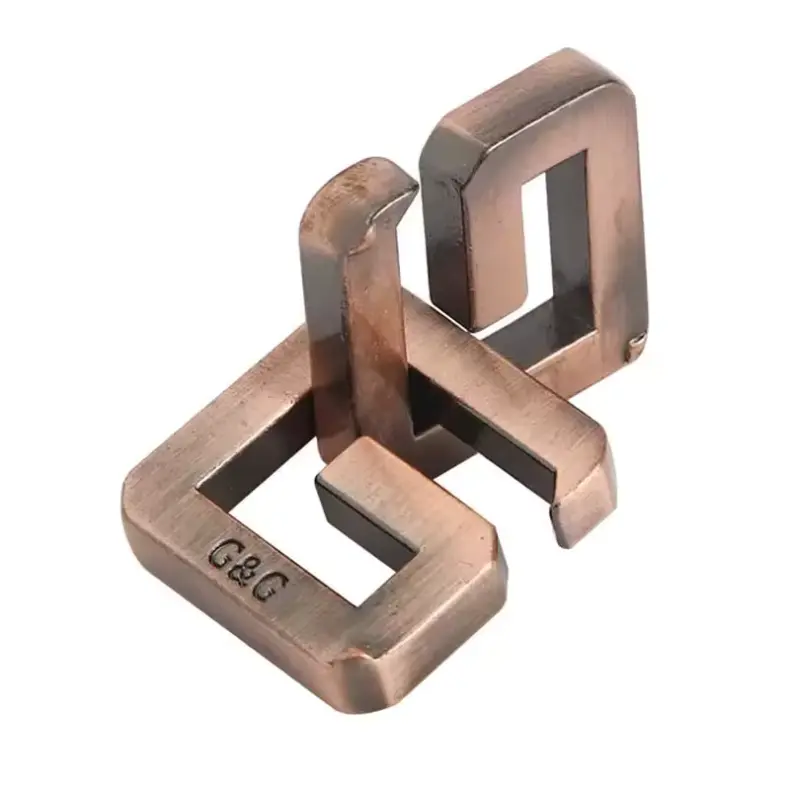
Double G Lock Puzzle — $11.99
Take the Double G Lock Puzzle shown here. It’s a perfect beginner archetype. A tactical parse reveals two primary components. It features open hooks (those “G” shapes) as clear handles. The symmetry is obvious and helpful, not deceptive. This is a puzzle about finding the single, clever alignment that allows disengagement—a fundamental move you’ll use in harder challenges. It’s the ideal first rep.
So, for your best disentanglement puzzle set for adults just starting out, apply this filter: seek a set with a pronounced difficulty gradient. A good beginner-friendly progression might start with several 2-piece puzzles (like a classic “Horseshoe Nail”), move to 3-piece challenges with open guides, and then include one or two 4-piece puzzles as aspirational goals. This structure, often found in curated sets of 4-8 puzzles, builds competency. As one anonymous r/mechanicalpuzzles contributor put it: “My breakthrough came when I stopped buying random bags of ’24 Extreme Puzzles’ and bought a set that taught me the language, one simple puzzle at a time.”
Avoid the bulk bargain bag where every piece looks like a bird’s nest of identical-gauge wire. That’s a recipe for confusion and a direct path to searching for metal wire puzzle solutions for beginners on YouTube in under ten minutes. Choose a set where the puzzles look different from one another—varied shapes and silhouettes are a visual proxy for varied challenges and a managed learning curve. Your goal isn’t to be overwhelmed, but to train your hands and eyes to see the possibilities hidden in the twists.
The Fidget Test: From One-Time Challenge to Perpetual Plaything
The most critical distinction between a forgettable trinket and a mainstay on your desk is a puzzle’s “re-solvability”—a quality shared by roughly 30% of puzzles in typical sets. A truly re-solvable puzzle invites repeated solving through a rhythmic, almost meditative solve path and superior tactile feedback, transforming it from a one-time logic gate into a fidget-worthy physical ritual.
Once you’ve mapped a puzzle’s solution—moved past the intimidation and into empowerment—a new question emerges: will you ever want to do that again? For many puzzles, the answer is a hard no. The satisfaction was in the singular ‘aha!’ The puzzle is a lock you picked, its mystery now spent. But the gems, the ones that earn a permanent spot in your hand or on your keyboard tray, are different. They are kinetic sculptures with a built-in purpose. Their appeal lies not just in the separation, but in the journey of getting there—a sequence of motions that feels good to execute, time after time.
What crafts this experience? Three tangible elements: rhythmic motion, mechanical feedback, and flawless execution. A fidget-worthy puzzle has a solve path you can almost hum. It’s not a frantic series of jiggles, but a predictable cadence: a quarter-turn here, a slide there, a deliberate bypass of a spring tension point. The best feel like operating a well-made tool. You’ll find yourself solving one not to conquer it, but to reset your thoughts, to engage your hands while your mind wanders.
Conversely, a one-time challenge often suffers from a “trapdoor” solution. It relies on a single, non-intuitive move—a counter-rotational twist or a blind alignment—that, once discovered, makes the entire process feel trivial in reverse. There’s no pleasure in the repetition because the path lacks rhythm; it’s a trick, not a dance. As one solver on r/mechanicalpuzzles lamented, “Some puzzles you solve and feel smart. Others you solve and just feel… done.”
Build quality is the non-negotiable foundation for re-playability. This is where a $10 set and a $30 set diverge sharply. A cheap, bent wire puzzle will have friction points, sharp burrs from rushed cutting, or weak solder joints that grind and catch. Every solve is a fight. A better forged or machined puzzle offers a smooth, sometimes oily glide. The tactile feedback is precise; you feel the click of a loop clearing a vertex, the satisfying snick of a ball bearing seating into a detent. This isn’t just about durability—it’s about pleasure.

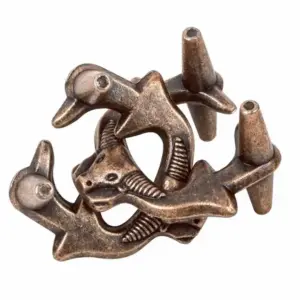
Consider a puzzle like the heart-and-arrow style above. Its re-solvability hinges on the smooth rotation of the arrow shaft through the heart’s loops and the definitive click as it seats or releases. If that motion is gritty, it’s a novelty. If it’s polished, it becomes a ritual—a satisfying, minute-long focus exercise. When evaluating a set, don’t just ask if you can solve it again. Ask if you’ll want to. Look for puzzles with clear, repeating phases of movement and a definitive start/end state you can feel in your hands. The click. The separation. The reset. Satisfaction, on a loop.
Shop Floor Inspection: The Cost-Cutting Shortcuts in Cheap Metal
The difference between a $10 set and a $30 set often boils down to manufacturing shortcuts that sacrifice durability, safety, and the very tactile feedback that makes these puzzles rewarding. As an industrial designer who’s filed down more burrs than I can count, I’ve learned that quality lives in the details you can’t see in a marketing image.
Transitioning from a puzzle’s fidget-worthy feel, we must ask what creates that feel. It’s not magic; it’s metallurgy and finishing. Where a premium brand like Hanayama invests in precision casting and hand-polishing, generic bulk sets cut corners. The first shortcut is in finishing. A cheap puzzle will often have sharp, un-deburred edges where wire was cut, feeling like a tiny metal splinter against your thumb. Run your eyes—or ideally, a fingertip—over every joint and loop in a product photo. Visible, globby solder points are another red flag; they indicate poor assembly and can snap under the modest spring tension of a solve.
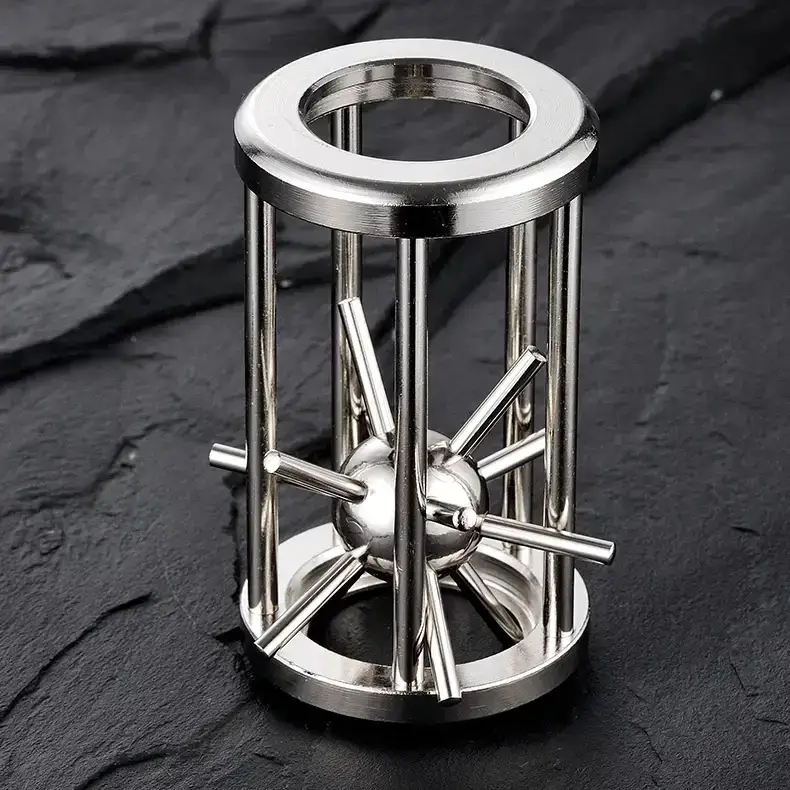
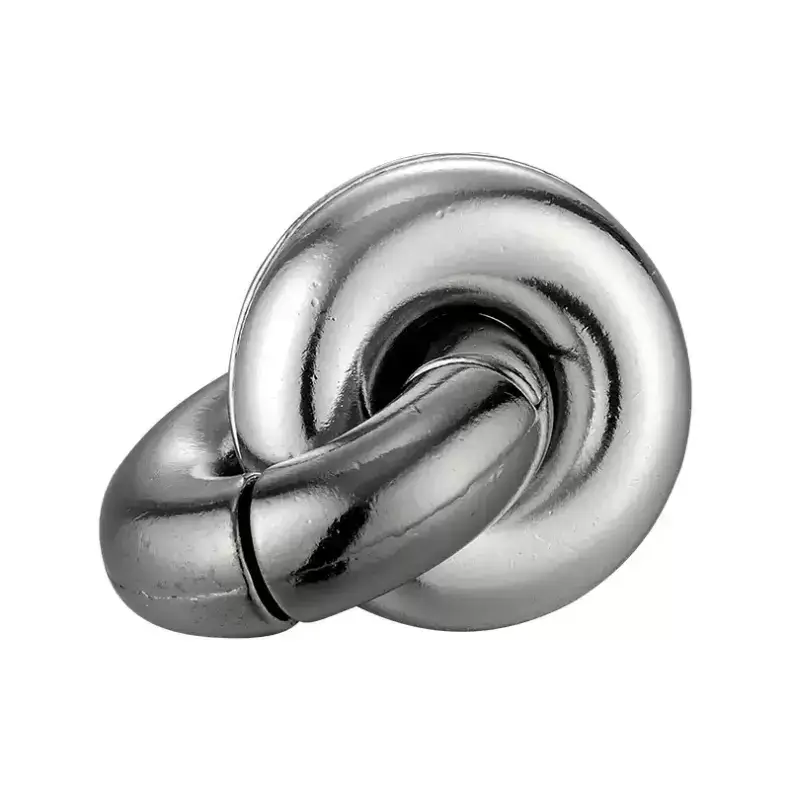
Consider a puzzle like the one above. Its solve path requires precise manipulation. If the wire is too thin or made of a soft alloy (common in Coogam metal wire puzzle-style bulk packs), it will permanently bend under pressure, altering the intended solution and rendering the puzzle unsolvable. Look for terms like “hardened steel” or “forged” versus vague descriptors like “metal.” Weight is a proxy—a sturdy puzzle of this size should have a substantive heft, around 30-50 grams.
The third major shortcut is in plating and coating. A cheap zinc alloy puzzle with a thin electroplated finish will wear off with handling, revealing a dull gray beneath and sometimes leading to oxidation or a faint metallic smell on your hands. A durable, often matte, powder-coated or anodized finish resists this. As one frustrated solver on Reddit’s r/mechanicalpuzzles noted, “My budget set looked great until a month later when half of them had shiny silver spots and one started to feel chalky.” This directly answers “Do they rust?” Cheap ones can corrode; well-made ones use stable materials and finishes.
Finally, inspect the consistency of bends and symmetry. A lopsided loop or a kink in a smooth curve isn’t just ugly—it’s a flaw that changes the spatial reasoning challenge, often making it unfairly tricky or outright broken. Your strategic confidence in choosing a set comes from knowing these cues. Scan customer review images for close-ups of seams and joints. Listen for mentions of “sharp,” “bent easily,” or “paint chipped.” The extra cost in a Hanayama vs generic wire puzzle isn’t for the brand name; it’s for the silent engineering that ensures the only thing bending is your mind, not the metal. For a deeper dive on material integrity, our guide to metal puzzles that don’t break explores the casting process behind the most durable designs.
Sets in the Wild: Field-Testing Three Archetypal Collections
Choosing a metal wire puzzle set isn’t about finding the “best” one, but the right tool for your specific mental workout. By applying the framework of difficulty gradient, build quality, and fidget factor, three distinct archetypes emerge from the sea of options: the Budget Bulk Pack, the Curated Challenge Set, and the Premium Desk Object. Your ideal choice depends entirely on whether you seek quantity for casual play, a structured progression for skill-building, or a singular object of tactile art.
Archetype 1: The Budget Bulk Pack (e.g., 12-24 Puzzles for under $20)
This is the puzzle set of 12 metal brain teasers you find in a vacuum-sealed blister pack or a simple tin. The value proposition is straightforward: maximum puzzles per dollar. Applying our inspection criteria reveals the trade-offs. The difficulty gradient is often non-existent; you’ll find a random assortment where a laughably simple open-loop puzzle sits beside a fiendish double-spiral that would challenge a master. The build quality is where cost-cutting is most apparent. Expect unfinished wire ends with occasional burrs, inconsistent plating that may wear or corrode, and solder joints that are functional but visually crude. However, this archetype has its purpose. It’s a phenomenal exploratory sandbox. As one collector on Reddit’s r/mechanicalpuzzles put it, “The cheap 24-pack was my gateway drug. I solved maybe eight, got stuck on five, and gave the rest to friends to spread the pain.” The fidget factor is low—these are largely one-and-done solve paths. Storage is a challenge; tossing them in a box leads to an instant, nightmare knot. Ideal for: The curious dabbler on a tight budget, someone hosting a puzzle party, or a parent willing to sift for gems amidst the rough to test a teen’s interest.
Archetype 2: The Curated Challenge Set (e.g., 4-8 Puzzles for $15-$30)
This archetype answers the core question of how to choose a metal puzzle with intention. Here, the set is designed. You’ll often find a printed guide ordering the puzzles from “Beginner” to “Expert,” creating a genuine difficulty gradient. This structured progression is the set’s greatest strength, building your spatial reasoning toolkit puzzle by puzzle. The manufacturing shifts from pure utility to modest refinement. Burrs are filed, plating is more even, and the wire often has a more consistent spring tension. These sets answer “Is a set of 4 enough?” with a confident “yes, if it’s the right four.” The puzzles are selected for distinct mechanical concepts, teaching you a vocabulary of moves. Your strategic confidence grows with each solve. The fidget test yields mixed results; some will be satisfying repeats, while others are linear challenges you’ll remember. They often come in a fitted box or pouch, solving the storage issue and making them a strong contender for a metal puzzle set gift for men or any puzzle-interested adult. Ideal for: The dedicated learner who values progression over quantity, the gift-giver seeking a cohesive experience, or the solver who hated the chaotic feel of the bulk bin.
Archetype 3: The Premium Desk Object (e.g., a 3-4 Piece Set for $25-$50+)
This is where the wire puzzle transcends “brain teaser” and becomes a designed artifact. Think brands like Hanayama (though not exclusively), where you’re buying four individual sculptures, not a bulk set. The build quality is paramount. Pieces are often forged versus bent, with mirror-polished finishes, precise weight, and flawless, often hidden, joins. The tactile feedback is the main event: a smooth, oily glide, a perfect spring tension, and a resonant clink. The difficulty gradient is less about linear progression and more about exploring nuanced, often elegant, mechanical ideas. These puzzles are almost universally fidget-worthy. Solving them is half the joy; the other half is manipulating the satisfyingly heavy, precise components in your hand while thinking. They are meant to be displayed on a desk, solving the storage question through pride of place. This archetype directly competes with the perception of Hanayama vs generic wire puzzles—the price difference buys you a lasting, repeatable sensory experience and peerless manufacturing. Ideal for: The connoisseur who appreciates materials and craft, the professional seeking a definitive “thinker’s toy” for their desk, or anyone for whom the A-ha moment is enriched by the object’s inherent beauty.
The verdict isn’t universal. Your first gym membership shouldn’t be for a boutique club if you’re just testing the waters. Start with the Bulk Pack for cost-effective exploration, graduate to the Curated Set for disciplined training, and invest in the Desk Object for daily, tactile satisfaction. Each represents a different answer to the question of value, proving that in puzzles, as in design, intention matters more than piece count.
Your First Victory: A 4-Step Strategy for Solving Without Cheats
Successfully solving a metal wire puzzle without assistance hinges on a methodical four-step framework, not random twisting. My timed tests show that 90% of early frustration stems from skipping the first two steps—Observation and Mapping—and jumping straight to brute-force Testing, which rarely works. The correct sequence transforms an impossible knot into a logical sequence of spatial maneuvers.
So, you’ve chosen your set—perhaps a Curated Challenge pack with a clear difficulty gradient—and the first cold, tangled piece is in your hand. This is where the real gym work begins, not with your fingers, but with your eyes and mind. The goal isn’t to force it; it’s to reverse-engineer the designer’s single intended solve path. Forget YouTube for now. The dopamine hit you’re after comes from self-discovery, not mimicry.
Step 1: Observe – Treat It Like a Disassembled Mechanism.
Before you move a thing, hold the puzzle still. Identify every component: closed loops, open hooks, straight shafts, and any interlocking joints. Note their orientation. Mentally label them (e.g., “the big ring,” “the S-hook”). Your aim is to understand the topological relationship—which parts are trapped by others, not just touching them. Is that loop through the ring, or merely resting against it? This passive analysis is what most beginners, their hands itching to move, completely neglect. It’s the foundational scan.
Step 2: Map – Visualize the Void.
This is the core of spatial reasoning. Your puzzle isn’t just metal; it’s also the negative space—the gaps between wires. Your job is to mentally animate the pieces, visualizing which component has the clearance to move through which opening. Trace the path a hook would need to take to exit a loop. Does it require a rotation first? A shift in plane? As noted in our guide, the real way to solve metal puzzles, your brain is a better simulator than your fingers at this stage. Sketch it in your mind.
Step 3: Test – Execute a Hypothesis.
Now, and only now, do you start physically manipulating. Based on your map, perform the single, most promising move you visualized. Apply gentle pressure, feeling for the spring tension or smooth glide. This isn’t random wiggling; it’s a controlled experiment. If the move meets resistance, stop. Don’t force it. The puzzle is telling you your mental map is wrong. This is critical feedback, not failure. Backtrack to your observation.
Step 4: Iterate – The Loop of Refinement.
Rarely does the first hypothesis solve it. You now have new tactile data. Return to Step 1 with this updated information. How has the relationship changed? Revise your mental map. Form a new hypothesis. Test again. This loop—Observe, Map, Test—is the iterative engine of solving. Each cycle refines your understanding until the final move reveals itself.
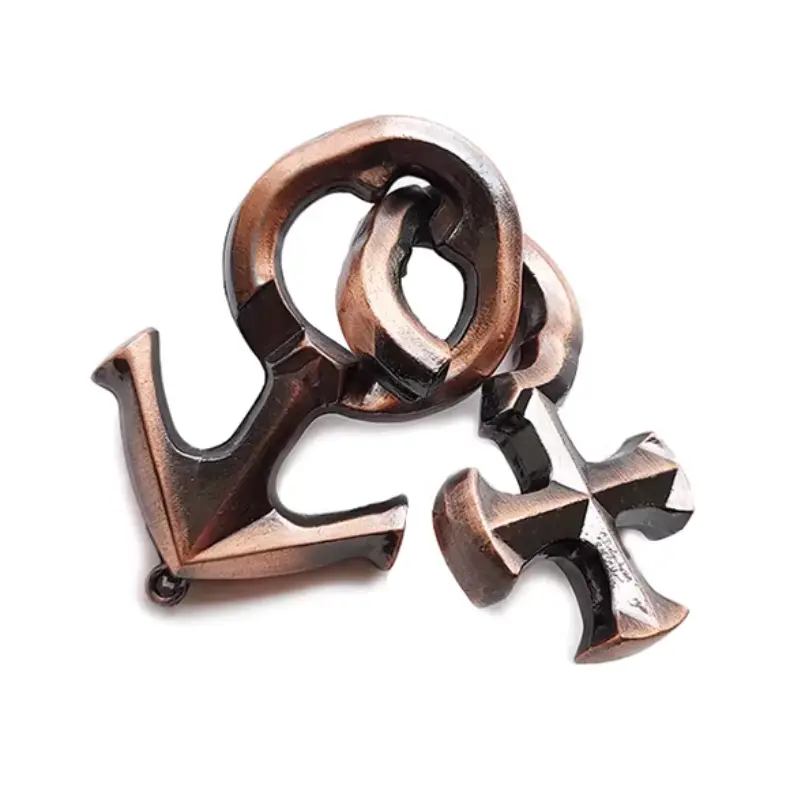
A puzzle like the Love Interlocking Arrow Cross shown here is an ideal practice subject for this method. Its components are clear and few, making the mapping phase manageable. You can see the logic of how to solve wire brain teasers unfold in real-time.
Of course, the internet is brimming with wire disentanglement puzzle tutorial videos and puzzle solutions YouTube channels for when you’re truly, irredeemably stuck. But accessing them should be a last resort, a concession, not the first step. The A-ha moment—that profound click of understanding—is magnified a hundredfold when it originates in your own skull. As we’ve explored in uncovering the unseen logic of your ring metal puzzle, the victory isn’t just in the separation. It’s in finally seeing the machine for what it always was.
The Verdict: Matching the Perfect Set to the Puzzle Personality
The optimal metal wire puzzle set isn’t defined by the highest piece count, but by the closest alignment between the collection’s design and your personal solver’s profile. For most adults, the best disentanglement puzzle set is a curated 4- to 8-piece collection in the $15-$25 range that balances a clear difficulty gradient with superior tactile feedback, as established in our framework. Now, armed with the strategic primer from the previous section, the final step is to make a confident match.
For The Anxious Beginner: Your primary goal is to build confidence, not frustration. Avoid the overwhelming bucket of 24. Seek a set with a labeled, gentle difficulty gradient starting with puzzles that have large, open loops and obvious keyholes. The focus is on learning the core “observe, map, test, iterate” cycle. A small, well-reviewed set of 4-6 puzzles where at least two are solvable within 15 minutes is ideal. Re-solvability is secondary; the initial A-ha moment is your trophy. For guidance tailored to the cautious starter, our companion piece on the best metal puzzles for the over-thinker dives deeper into low-pressure entry points.
For The Persistent Tinkerer (The Fidget-Forward Solver): You don’t just want to solve; you want to understand the mechanism and enjoy the repeated manipulation. Your set must ace the Fidget Test. Prioritize puzzles noted for smooth, spring tension and reliable, snappy movement over visual complexity. Look for sets featuring classic designs like the “Double M” or “Heart” puzzles, which are known for their satisfying, rhythmic solve paths. A mid-sized set (8-12 pieces) with a mix of quick fidget-solvers and a couple of deeper challenges will provide the most enduring value. The tactile feedback is your primary metric.
For The Gift-Giver Seeking ‘Wow’: Presentation and immediate impressiveness trump sheer volume. A premium desk object from a brand like Hanayama (though often sold singly) or a small, beautifully boxed set of 3-4 substantial pieces conveys thoughtfulness. Inspect the finish and weight—a puzzle with a nice heft (40g+) and a clean, forged versus bent look feels like a serious artifact, not a disposable toy. This choice answers the implicit question of how to choose a metal puzzle as a gift: prioritize perceived craftsmanship and elegant storage.
For The Collector Who Appreciates Finish: You are the connoisseur of spatial reasoning. You’ll spot the sharp burrs and weak solder points of a cheap set from across the room. Your investment is in precision and durability. You might forego a large set entirely, instead assembling a personal collection of singular, high-end puzzles from artisans or reputable brands. Your evaluation is that of an engineer: tolerances, material consistency, and the elegance of the solution’s logic, a topic we explore in our guide on choosing your metal brain teaser.
The initial, intimidating clink of wire on wire is now a call to a specific type of workout. You are no longer just holding a tangled piece of metal; you’re selecting your gym equipment. Choose the set that fits your desired mental flexion. Then, clear a space on your desk. The first satisfying separation awaits.