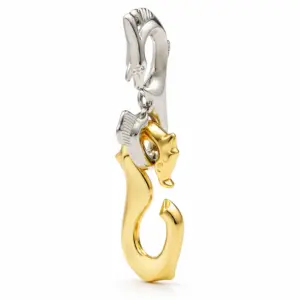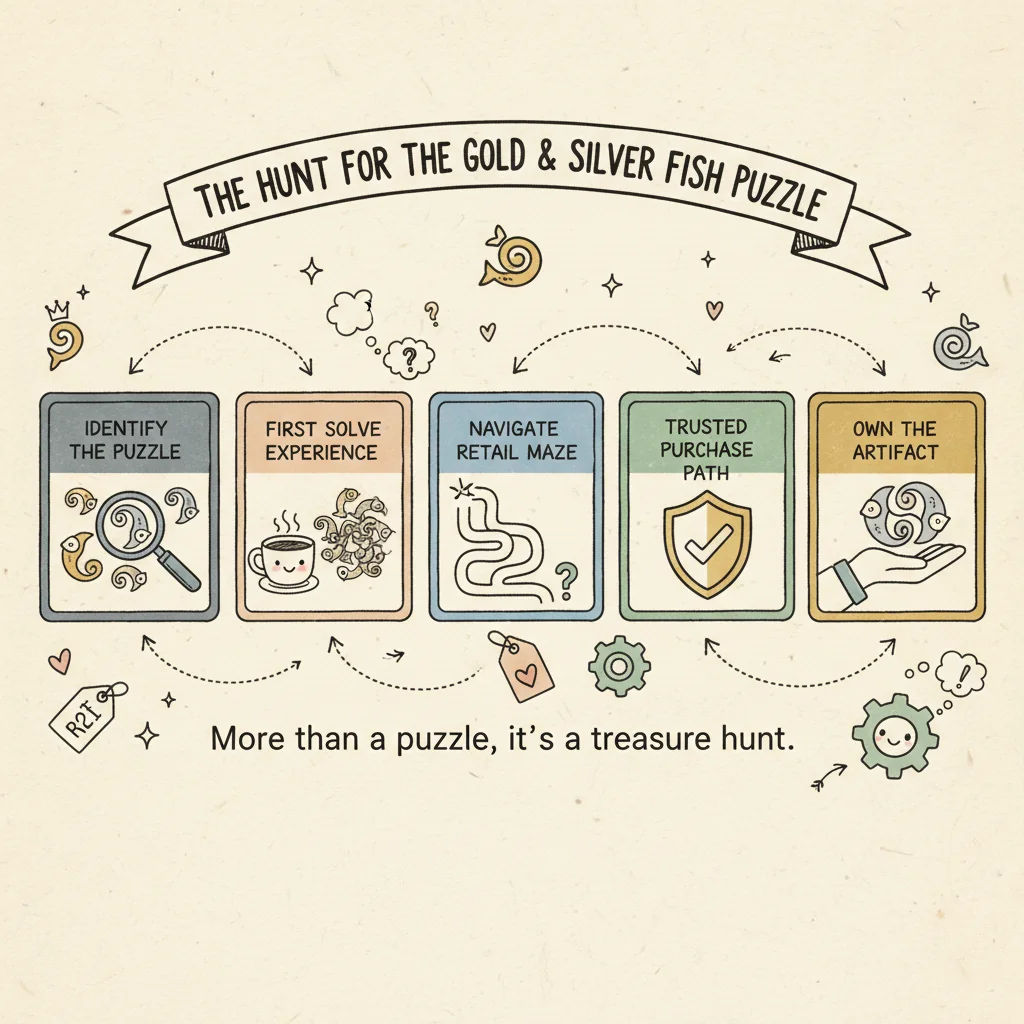
That Click in Your Hand: Identifying the Exact Puzzle You’re Hunting
The object you’re searching for is a palm-sized, two-toned metal puzzle, typically 2 to 3 inches long and weighing a solid 40 to 70 grams. It’s not a jigsaw or a child’s toy, but a precision-cast disassembly puzzle where two intricately intertwined fish—one gold, one silver—must be separated through logic and manipulation. This is your definitive identification.
The first thing you notice isn’t the shine of the gold or the silver, but the weight. It’s a solid, satisfying handful of metal that begs to be turned over and over, your fingers tracing the sleek curves of two fish locked in an eternal, puzzling embrace. You’ve seen it somewhere—maybe online, maybe in a friend’s collection—and now you need to know: where can you actually buy this thing?
Your search for “gold silver double fish puzzle” likely returns a chaotic sea of irrelevant results. Pages of children’s wooden fish jigsaws. Cartoonish plastic toys. This is the core frustration. The puzzle you want exists in a specific niche: adult cast metal brain teasers. It belongs on the same shelf as Hanayama puzzles—those sleek, silent tests of spatial reasoning. It’s a desk objet d’art with a secret mechanism.
Here’s how to confirm you’ve found the right one in an image or listing. Look for two fish, their bodies elegantly looped and locked. One is finished in a bright gold electroplate, the other in a cooler silver. The metal has a smooth, almost oily feel from the plating, with no sharp edges. It will be marketed as an “IQ metal puzzle” or a “disentanglement puzzle.” No instructions. Just metal.
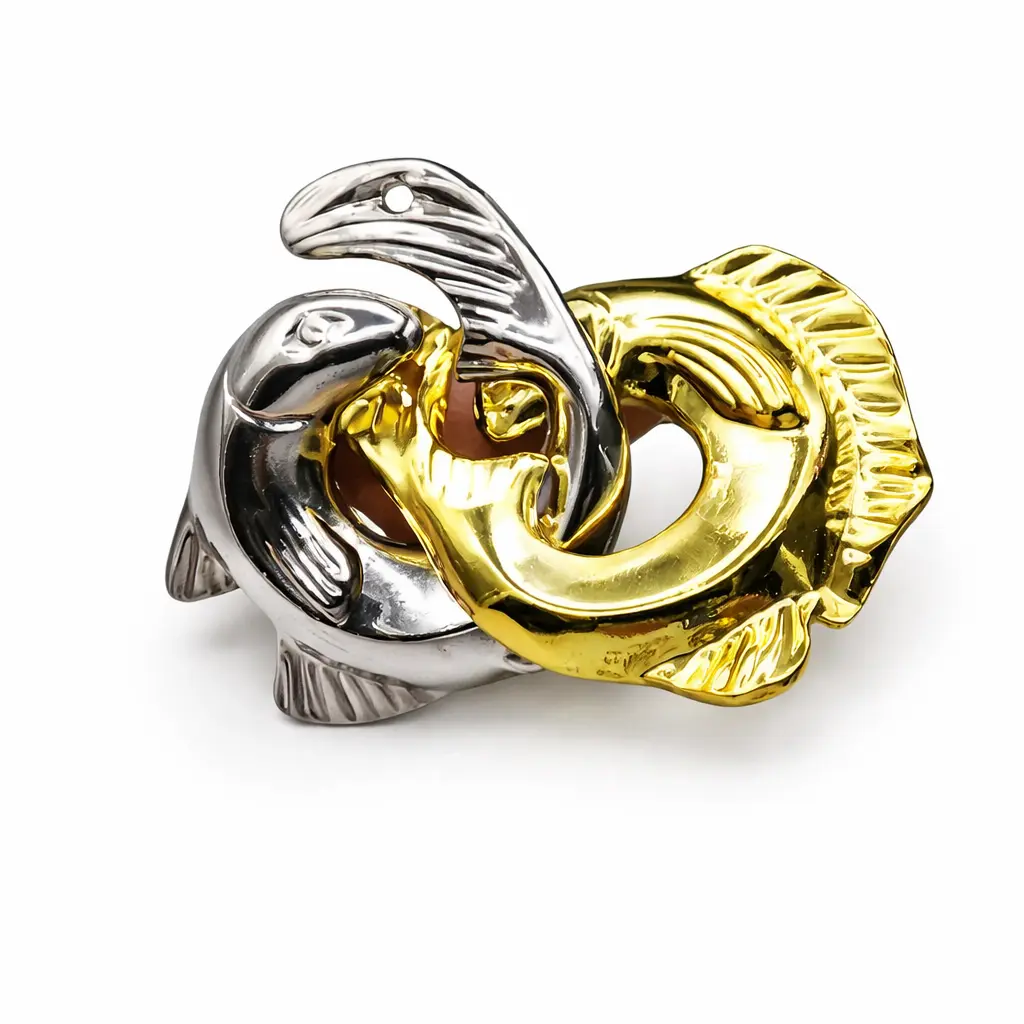
If you’re asking, “Is this the same as the Einstein fish puzzle?”—usually, no. That’s a common point of confusion. The “Einstein Fish” is a different, single-piece puzzle. The “double fish metal puzzle” is its more accurate name. And to answer another immediate question: its difficulty is rated as moderate by enthusiasts. Your first solve will likely take between 10 and 30 minutes of focused tactile experimentation. It’s a perfect step for someone who enjoys Hanayama puzzles and is looking for a new interlocking challenge.
This isn’t a decorative figurine. It’s a mechanical problem disguised as art. The goal is purely to find the single, precise sequence of slides and rotations that frees one fish from the other. There are no moving parts in the traditional sense, only the subtle interplay of curves and negative space. Recognizing this is your first step out of the search engine confusion and toward the satisfying snick of a solved puzzle. For a deeper dive into what makes this specific puzzle tick, our complete guide to the gold silver fish metal puzzle breaks down its design lineage. And when you’re ready to attempt the solve, our dedicated step-by-step solution to the double fish puzzle walks you through the logic.
More Than a Trinket: The World of Cast Metal Brain Teasers
Recognizing the double fish puzzle as a specific type of logic problem is the key to navigating the marketplace. This isn’t a standalone novelty; it belongs to a respected category of adult puzzles known as cast metal brain teasers or disassembly puzzles, a formal niche within the broader world of mechanical puzzles. These are precision-machined objects designed for a single, elegant purpose: to be taken apart and reassembled through the application of spatial reasoning and tactile intuition. Unlike decorative trinkets, their entire value is locked in that silent, interlocking geometry.
You hold a solid mass of metal—typically a zinc alloy weighing between 40 and 70 grams—that feels both substantial and impeccably smooth. The goal is never brute force. It is a silent conversation between your fingers and the puzzle’s engineered constraints. You apply gentle pressure, test for shifts in weight, and listen for the faintest click or scrape that signals a potential path. This is the core appeal for enthusiasts: the transformation of an inert, beautiful object into a dynamic 3D problem. The gold and silver double fish you’re seeking operates on these exact principles. It is an adult metal puzzle fish in the truest sense, demanding patience and a systematic mind, not childish play.
This genre answers the question, “Is this suitable for a Hanayama fan?” with a resounding yes. In fact, if you enjoy the cool heft and clever mechanisms of a Hanayama Cast Puzzle, the double fish will feel instantly familiar. It shares the same DNA of minimalist design concealing complex mechanics. The puzzle community often rates these challenges on a scale, and the double fish typically lands in a satisfying “moderate” zone, making it a perfect next step for someone who has conquered a few entry-level disentanglement puzzles. It’s a collectible metal brain teaser first, a desk ornament second.
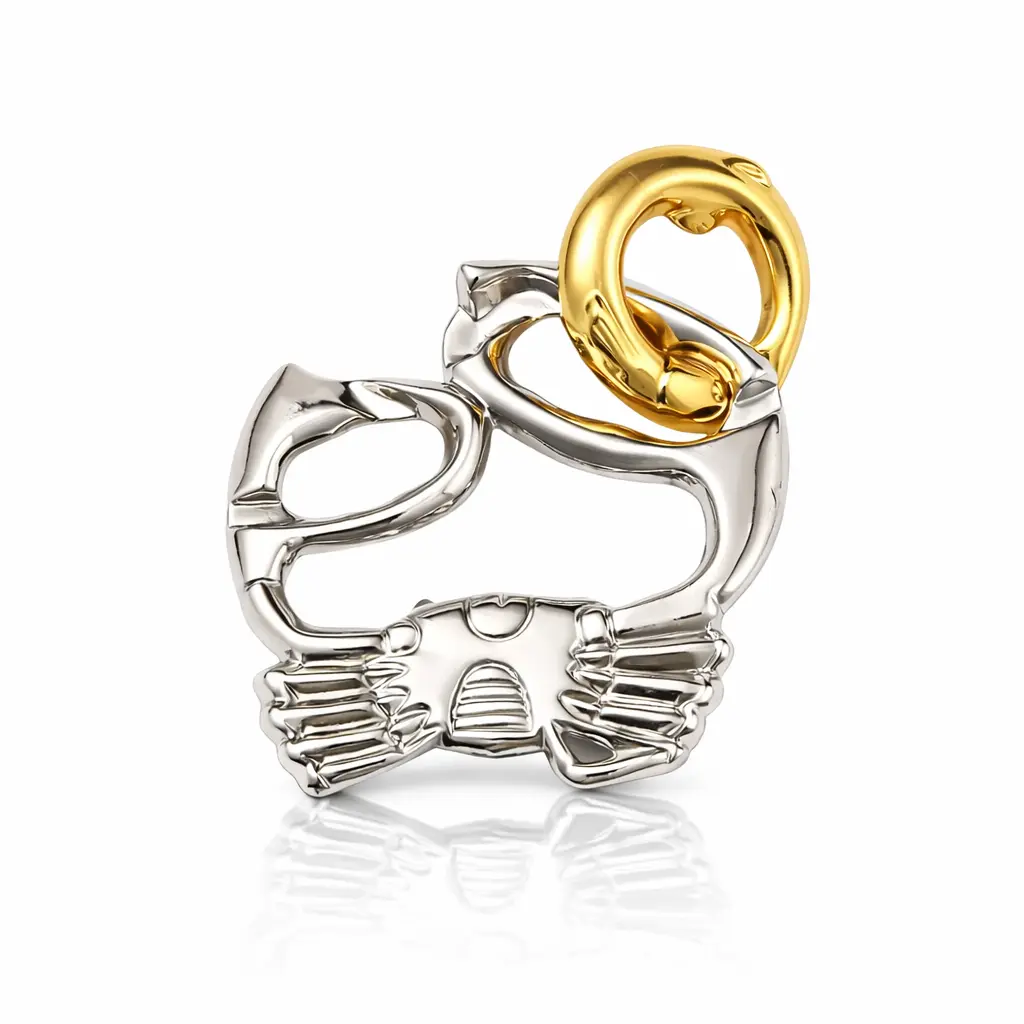
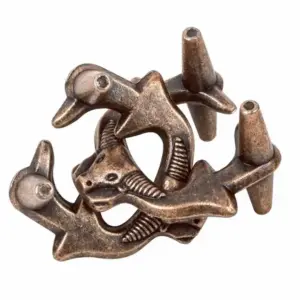
Consider the crab puzzle above. It’s a different shape, but the same school of thought. A creature forged in metal, interlocked with a ring. The pleasure is identical: deciphering the locked relationship through manipulation. This is the world you’re entering. These puzzles are often mislabeled as cast iron fish puzzle items, though true cast iron is rare due to brittleness; the heavier, smoother feel usually comes from that zinc alloy or similar metals, electroplated for contrast and sheen.
So, is it suitable for a clever 12-year-old? Absolutely, provided they have the fine motor skills and patience for non-digital problems. The inherent fidget factor—the satisfying, repetitive motion of testing solutions—can be deeply engaging. But its primary audience is the adult who appreciates engineered objects. It’s a tactile respite from screens, a pocket-sized gym for your spatial reasoning. For a broader look at this captivating category, our guide to the best metal disentanglement puzzles judged by a machinist dives deeper into what makes these puzzles stand apart.
Understanding this context is crucial for your search. When you know you’re hunting for a “cast metal disassembly puzzle,” you can instantly filter out the noise of children’s jigsaws and plastic toys. You begin to look for the right retailers, the proper terminology, and the hallmarks of quality. The double fish isn’t just a pair of intertwined animals; it’s an entry ticket into a quiet, focused hobby where the only victory is a soft, metallic snick of separation. To decoding cast metal puzzle disentanglement, from their heft to their hidden solutions, is an essential primer.
The First Solve: A 45-Minute Coffee Table Session, Decoded
That promise of a metallic snick is the entire goal. So, how hard is the gold silver disentanglement puzzle to crack? Based on enthusiast scales, it’s a solid 6/10—moderate, but not trivial. Your first successful separation will likely take between 10 to 30 minutes of focused experimentation, a perfect span for a single coffee or a determined train ride. The challenge isn’t brute force; it’s a precise, three-dimensional logic problem held in your palm.
It begins with the weight. The cool, dense alloy—typically a zinc base—is immediately grounding. This isn’t a flimsy trinket. Your thumbs naturally find the smooth, rounded bellies of the two fish, your fingers cradling the intertwined tails and snouts. The gold silver double fish puzzle has a polished, almost liquid feel under your fingertips, the electroplating providing a seamless, slightly slick surface that encourages sliding and rotation. For the first few minutes, you simply turn the united form over and over, mapping the geometry. The fish are locked in three planes, and the initial assumption that they simply pull apart is your first mental roadblock. They don’t.
This is where the engineer’s mindset engages. You stop looking at the fish as decorative objects and start analyzing them as precision-machined components. You search for clearance, for an axis of rotation that isn’t immediately obvious. The puzzle emits faint clicks and shifts as parts graze each other, a form of tactile feedback that becomes your primary data stream. I spent a good 15 minutes in what I call the “fumbling phase,” applying gentle pressure in every conceivable direction, feeling for the one movement that wasn’t just friction, but a designed step in the sequence. It’s a process of systematic elimination, a physical conversation with the object. As explored in our guide on why your hands lie and the real way to solve metal puzzles, your initial instincts about force and direct pulling are almost always wrong.
The breakthrough is quiet. There’s no dramatic click, but a sudden, unexpected slack in one particular orientation. One fish will drop, perhaps just a millimeter, relative to the other. That’s the “aha” moment—the discovery of the key movement, the hidden vector. The remainder of the disassembly puzzle is often a swift, elegant unfolding from that point. You rotate, you slide, and then, with a final, crisp motion, the two pieces come free. That’s when you get the snick. It’s a clean, definitive sound of metal disengaging under perfect alignment, a deeply satisfying auditory confirmation of success.
Reassembly is its own separate, and often equally engaging, challenge. It is not simply the reverse. Without the tension of the intertwined state guiding you, fitting the pieces back together requires you to mentally reconstruct the final locked position and work backwards. For many, this second act takes nearly as long as the first solve. It confirms the puzzle’s integrity as a proper brain teaser, not a one-trick novelty. You can take it apart and put it back together easily—once you’ve mapped the sequence into your muscle memory.
Where does this place it among difficult metal puzzle fish options? It sits comfortably in the middle tier. It’s more approachable than the truly devious, abstract knots in the Hanayama catalog, but significantly more substantial than a simple wire loop-and-hoop. Its fidget factor is high. Even after solving, the smooth, rhythmic process of taking it apart and reassembling it becomes a meditative, hands-on activity. The weight and the seamless finish make it a pleasure to handle repeatedly. It’s a desk objet d’art that invites interaction, not just decoration.
Is it suitable for a bright 12-year-old? If they have patience and strong spatial reasoning, absolutely. The puzzle requires no strength, only logic and dexterity. It teaches perseverance and non-linear problem-solving in a way screens cannot. For the adult enthusiast, especially one who appreciates Hanayama-level puzzles, the double fish offers a satisfying, elegant solve with a distinct aesthetic charm. It’s a testament to the fact that in the world of cast metal brain teasers, the most beautiful objects often hide the cleverest mechanisms.
Why It’s Weirdly Hard to Find: Navigating the Retail Maze
You’ve just been walked through the satisfying heft and clever mechanics of the solve. Now you’re hooked. You need to own it. So you open a new tab, type ‘gold silver double fish puzzle where to buy’, and are instantly plunged into the very confusion that likely brought you here. The search is weirdly difficult because this specific cast metal brain teaser is a niche object hiding in a world built for mass-market products. The single biggest hurdle is algorithmic misclassification: search engines and marketplace categories overwhelmingly file the term “fish puzzle” under children’s jigsaws and wooden toys. Expect up to 90% of initial results to be completely irrelevant.
Your journey from generic search to precise product is a classic case of moving from a visual description to its true taxonomic classification. You’re not looking for a fish puzzle. You are looking for a metal disassembly puzzle, specifically one from the “IQ Metal Puzzle” series or its direct equivalents. This is the crucial key. On sprawling platforms like Amazon or Etsy, the product exists, but it’s buried under layers of misaligned tags and low-quality knock-offs. A search for ‘double fish metal puzzle’ might yield a few listings, but they’re often sandwiched between plastic children’s games and decorative figurines. The product photos can be dubious, the descriptions vague, and the brand—if listed at all—unverifiable.
This brings us to the retail landscape, which splits into three distinct tiers.
Tier 1: The Niche Puzzle Specialists (The Ideal Source).
These are online stores run by and for puzzle enthusiasts. Think Puzzle Master, Grand Illusions, or Brilliant Puzzles. Here, the double fish brain teaser is correctly categorized under “Metal Puzzles” or “Disentanglement Puzzles.” These retailers understand the product. They will often provide a genuine difficulty rating (often 4/10 or similar), list the manufacturer, and sometimes even include community solve times or tips. Buying from them is purchasing from a curator. You are guaranteed to get the precision-machined, properly plated version you seek. The price here ($15-$25) reflects that curation and quality assurance. This is where you’d look if you appreciate Hanayama-level puzzles and want the correct item, full stop.
Tier 2: The Mass-Market Platforms (The Convenient Gamble).
Amazon and Etsy are the digital bazaars. They have stock, often with Prime shipping. The risk is variability. You might be buying the same OEM product sold by the specialists, or you might be getting a poorly cast, sharp-edged imitation where the gold plating wears off in days. Success here requires detective work: scrutinize product images for the “IQ Metal Puzzle” logo on the packaging, read reviews specifically mentioning build quality and heft, and be wary of sellers with names that are a string of letters and numbers. The ‘where to buy Hanayama fish puzzle’ search often leads here, but Hanayama is a specific, respected brand; this double fish is often an unbranded or generically branded piece from a different foundry. For a deeper dive on navigating quality on these platforms, our guide to the Hanayama puzzle buy guide outlines the scrutiny required.
Tier 3: Generic Toy & Gift Shops (The Unlikely Find).
You will almost never find this puzzle in a big-box toy store. It’s not a volume product. Your only chance here is a boutique, intellectually-minded gift shop or a science museum store. Even then, it’s a lucky discovery, not a reliable purchase pathway.
So, the navigation map is clear. Your confusion is not a bug in your searching skills; it’s a feature of a fragmented market. The path to confidence is to stop searching for the object’s appearance and start searching for its category. Seek the terms the enthusiasts use: “IQ metal puzzle fish,” “cast iron fish puzzle,” or “adult metal disassembly puzzle.” This linguistic shift cuts through the algorithmic noise and leads you directly to the reputable shelves—both digital and physical—where this specific, satisfying handful of metal awaits.
The Trusted Purchase Pathways: From Puzzle Purists to Prime Shipping
There are two primary, trustworthy paths to ownership: the curated puzzle specialist route and the savvy mass-market dig. The first prioritizes authenticity and enthusiast-grade quality, typically in the $15-$22 range, while the second trades some certainty for the convenience of platforms like Amazon, where prices can dip to $12 but require more scrutiny.
Now that you understand what you’re looking for and why it’s been hiding, the final step is choosing your portal. This isn’t a random “add to cart.” It’s a strategic decision based on whether you value the guarantee of a vetted puzzle or the immediacy of a major marketplace.
Route 1: The Puzzle Specialist — Buying from the Connoisseurs
This is my preferred path. Purchasing from a dedicated puzzle retailer is like buying a chef’s knife from a cutler instead of a department store. You’re getting a product selected by experts for its mechanical integrity and satisfying solve.
Shops like Puzzle Master (Canada) and SeriousPuzzles (US) are staples in the community. They don’t just sell “toys”; they catalog puzzles by brand, type, and a consistent difficulty rating (often 1 to 10). Your double fish metal puzzle will likely be listed under “Disentanglement Puzzles” or “IQ Metal Puzzles,” with a difficulty marked as a 5 or 6—moderate, but not trivial. This rating is invaluable. It tells you this is a legitimate cast metal brain teaser, not a trinket.
Pros: You get authenticity. The plating is correct, the machining is precise, and the weight will match the specs (expect that solid 40-70 grams). Descriptions are accurate, and these sites often have solution guides or active forums if you truly get stuck. You’re supporting a niche ecosystem.
Cons: Shipping can be slower and costlier than Prime. Inventory for specific items can fluctuate. You won’t find deep discounts.
The transaction is clean, informed, and respectful of the object’s purpose. You buy with the confidence that what arrives will be the exact desk toy metal fish puzzle you intended—a precision interlocking fish puzzle.
Route 2: The Mass-Market Trawl — A Tactical Guide to Amazon & Etsy
Platforms like Amazon and Etsy are bazaars. The genuine item is there, swimming in a sea of look-alikes. Success here requires a hunter’s eye.
First, refine your search. Use the enthusiast keywords: “IQ metal puzzle two fish” or “Hanayama-level fish puzzle.” This filters out children’s jigsaws. Scan the results for listings that state specific materials: “zinc alloy with gold/silver electroplating.” Look for the key dimensions (2-3 inches long) and weight in the description. A legitimate seller will provide these key facts.
Scrutinize the seller. On Amazon, check if the seller is “fulfilled by Amazon” or ships from a generic warehouse. Read the critical reviews, not just the star rating. Reviews mentioning “flimsy,” “paint chipping,” or “not as heavy as expected” are major red flags. A trustworthy seller might be “Puzzle Master Store” or “Brain Teaser Pros” selling via Amazon Marketplace—this bridges Route 1 and 2.
On Etsy, look for sellers specializing in “metal puzzles” or “brain teasers” with consistent, positive feedback. Message them to confirm materials and origin. Be wary of listings using only marketing shots; genuine sellers often show the product in hand.
Pros: Potentially faster, cheaper shipping (especially with Prime). Possibly a lower price point.
Cons: High risk of getting a sub-standard alloy knock-off with poor plating that wears off. Descriptions are often copied and inaccurate. The “fish puzzle amazon” experience is a gamble without this tactical filter.
Your Buyer’s Checklist (For Either Route)
Before you click “buy,” ensure the listing explicitly or implicitly confirms these points. If it misses more than two, move on:
* Material: Zinc alloy (or “cast metal”), electroplated, not painted.
* Size: ~2.5 inches / 6-7 cm in length.
* Weight: Listed as ~50+ grams.
* Vocabulary: Uses terms like “disassembly,” “brain teaser,” “for adults,” “IQ puzzle.”
* Avoids: Phrases like “fun for kids,” “educational toy,” or “amazing gift” as primary descriptors.
Choosing the specialist route is an investment in guaranteed tactile satisfaction. Choosing the mass-market route is an exercise in applied scrutiny, rewarding patience with convenience. Both will get you the iconic gold silver disentanglement puzzle. One simply comes with a solved piece of mind, the other with the thrill of the hunt.
What You’re Actually Buying: The Zinc-Alloy Truth & Quality Checks
You’ve narrowed your pathway. Now, before committing to a specific listing, it’s crucial to understand the physical object itself. The checklist you’re about to apply isn’t arbitrary—it’s a direct translation of material science into buyer confidence. When you buy the double fish puzzle, you are not buying “gold and silver” in a precious sense; you are buying a precisely shaped weight of zinc alloy, electroplated for color and feel. This technical truth defines its durability, heft, and tactile satisfaction—and it’s the primary divider between the puzzle you desire and a disappointing knock-off.
That satisfying, cool weight in your palm? That’s the zinc alloy (often Zamak). It’s a dense, castable metal favored for small, intricate objects because it can capture fine detail without the cost of machining from solid billet. The gold and silver finishes are electroplated coatings, a molecular-thin layer bonded to the base metal, not paint. This is why a quality version feels uniformly smooth and cool to the touch. A cheap alternative might use a lighter, porous “pot metal” that feels gritty, or worse, painted plastic that feels hollow and toy-like. The difference is night and day in your hands.
This material choice directly answers two critical user questions. First, “What’s the difference from a cheap puzzle from China?” The difference isn’t always country of origin—it’s specification. A cheap version often uses inferior alloys with more impurities, leading to a lighter, slightly brittle feel. Its plating may be thinner or applied poorly, leading to the second question: “Does the gold color rub off with handling?” With proper, thick electroplating, it should not. The color is part of the metal’s surface. If a seller’s photos show worn edges or descriptions mention “antique finish” that may reveal base metal, that’s a red flag for a substandard coating that will degrade with friction.
So, how do you translate this into actionable scrutiny? Your buyer’s checklist becomes a forensics tool.
- Material: “Zinc alloy” or “cast metal” is good. “Electroplated” is excellent. “Metal puzzle” is vague but passable if other points align. “Alloy” alone is a warning to look closer.
- Size & Weight: The 40-70 gram range for a 2-3 inch puzzle is your benchmark. Lighter often means thinner walls or a different, less dense material. A listing that omits weight but shows the puzzle dwarfed by an adult hand in a photo is useful context.
- Finish & Precision: Look for close-up photos. Edges should be clean, not ragged. The curves of the fish should be smooth, with no visible casting seams or spru marks. The plating should appear even and deep in color, not blotchy. This is the precision-machined look versus a crude casting.
- Vocabulary: As before, “disassembly puzzle” and “brain teaser” signal the right niche. Descriptions that dive into the tactile feedback and fidget factor often come from sellers who understand the product’s appeal beyond mere decoration.
Think of it as engineering a purchase. You are specifying a component: a palm-sized disassembly puzzle with specific mass and surface treatment requirements. This mindset filters out the noise. For a deeper dive into why these material choices matter in puzzle design, resources like this analysis of puzzle design through the lens of material science articulate what we, as enthusiasts, feel instinctively.
Ultimately, the zinc-alloy truth is liberating. It grounds the object in reality. You’re not buying a trinket; you’re buying a specific, physical desk objet d’art engineered for manipulation. When you find a listing that transparently communicates these facts, you’ve found a vendor who respects the puzzle—and you, the solver. The final step is deciding which version of that vetted object is meant for you.
Avoiding the Lookalike Trap: This Is Not That Fish Puzzle
Search for a metal fish brain teaser, and you’ll quickly meet its famous doppelgänger. The Gold Silver Double Fish puzzle—our two intertwined, separable fish—is a different species entirely from the single-piece, contorted “Einstein Fish” puzzle. The confusion is rampant, especially on platforms like Einstein fish puzzle amazon listings, where both appear. Knowing the difference is crucial to avoid buying a puzzle you didn’t want.
The distinction is in the fundamental problem. The Double Fish is a disassembly puzzle. Your goal is to separate the two independent, interlocking fish. The Einstein Fish, in contrast, is a single, cleverly bent piece of metal designed to look impossibly knotted; the challenge is understanding its continuous, non-interlocking shape. One is a problem of separation, the other of visual perception. They require completely different solving logics and offer different tactile feedback. The double fish has that satisfying ‘snick’ of release; the Einstein fish has a silent ‘aha’ moment of spatial recognition.
This mix-up matters because your search intent is specific. If you were captivated by the image of two sleek fish locked together, receiving a single, twisted bar will feel like a letdown. The solves are not interchangeable. The Double Fish is a hands-on, mechanical operation. The Einstein Fish is a mind-bending, visual illusion. For the enthusiast who enjoys the physical manipulation of cast metal parts sliding against each other, only the double-fish format delivers.
So, how do you spot the difference at a glance?
* Number of Pieces: The Double Fish is always two distinct fish. The Einstein Fish is one continuous piece.
* The “Lock”: Our puzzle has a clear, mechanical point where the fish fins or tails hook together. The Einstein Fish has no such joint—it’s an unbroken loop.
* Product Photos: Double Fish listings almost always show the pieces separated, side-by-side. Einstein Fish photos typically show the single piece from confusing angles to highlight its paradoxical shape.
Why does this mix-up happen? Algorithmic categorization. To a retail platform’s AI, both are “metal fish puzzles.” Sellers often tag listings with every related keyword to catch searches, inadvertently funneling both puzzles into the same results. This is a prime example of why the curated buyer’s map from a puzzle specialist site is valuable—their categorization is based on mechanic, not just imagery.
If you’re a fan of Hanayama-level puzzles, both are excellent, but they satisfy different itches. The Double Fish is for the solver who loves probing for the precise axis of rotation and release. The Einstein Fish is for the thinker who enjoys holding an object and mentally rotating it until the impossible becomes clear. One is a lock to pick; the other is a knot to see through.
For the searcher specifically asking about the gold silver double fish puzzle, this clarification is your final filter. You now have the precise terminology, the material understanding, the trusted vendor pathways, and the visual knowledge to sidestep the most common purchasing error. You’re not just buying a puzzle; you’re procuring the exact desk objet d’art that caught your eye, ensuring the 45-minute coffee table session you’re anticipating is the one you actually get.
For the Gift-Giver or Collector: More Than a Mere Brain Teaser
Your decision to procure this specific desk objet d’art is a smart one, but its true value unfolds long after the first triumphant “snick” of separation. This isn’t a consumable challenge; it’s a 40-70 gram anchor for curiosity that lives on a shelf or desk, offering layers of engagement for months. As a collectible metal brain teaser, its worth lies in its enduring presence—a perpetual invitation to a satisfying tactile loop of disassembly and reassembly.
For the gift-giver, this is where the puzzle shines brightest. It’s a profoundly thoughtful present because it speaks to multiple facets of a person: their intellect, their appreciation for design, and their hands. Is it suitable for a bright, patient 12-year-old? Absolutely. It’s perfect for the young mind that thrives on spatial reasoning over screen time, offering a tangible reward for quiet concentration. But its appeal is ageless. For the engineer or architect, it’s a study in elegant interference and clearance. For the designer, it’s a minimalist sculpture with a secret. For anyone prone to fidgeting during a long call, its cool, smooth surfaces and precise movements offer superior tactile feedback. To choose the right puzzle for someone, understanding what 9 of gift givers don’t know about puzzle selection is key.
Once solved, it transitions into a different role. Displayed on a bookshelf or coffee table, the intertwined fish become an instant conversation piece. Guests will pick it up, drawn by its weight and shine. You’ll explain it’s a puzzle, and watch as they turn it over, their brows furrowed—a miniature social experiment and a shared moment of engagement you’ve facilitated. This is the gift that keeps giving interaction.
For the collector, the gold and silver double fish is a compelling entry point or addition. It sits firmly within the tradition of Hanayama-level puzzles—a recognizable, well-executed piece from a broader world of cast metal brain teasers. Its moderate difficulty makes it an accessible yet respectable part of a collection, a benchmark against which others can be measured. The durable zinc alloy and electroplating mean it will retain its look even with frequent handling, resisting the wear that plagues cheaper, painted knock-offs.
And if this puzzle resonates, it opens a door. It’s part of a series, a genre of silent, mechanical poetry. The same focused craftsmanship and devious design principles apply to countless other forms.
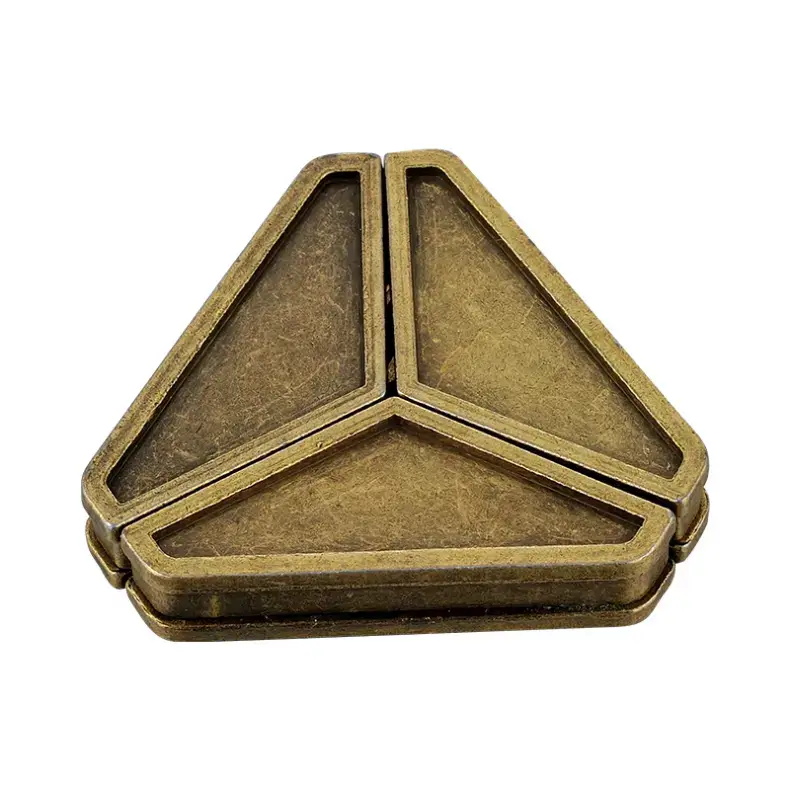
Alloy Triangle Lock Puzzle — $11.88
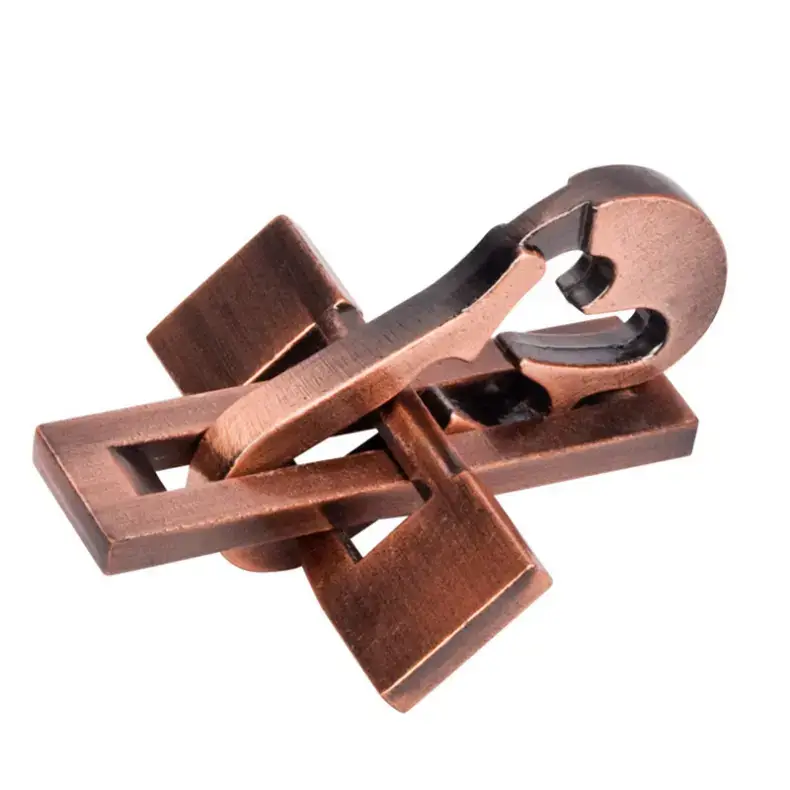
Yangqin Lock Puzzle — $12.66
This is the final, satisfying weight of the purchase. You started with a fleeting glimpse of two intertwined fish, navigated a confusing retail sea, and arrived here: equipped not just to buy a puzzle, but to select a lasting artifact of thoughtful design. You’re choosing the cool, substantial handful of metal that begs to be turned over and over. The precise, interlocking promise of a quiet, triumphant moment. Your next step is clear. Visit a curated collection from a trusted specialist, secure your piece, and prepare a spot for it on your desk. The rest is a tactile, satisfying story you’re about to begin.