Ditch the Flannel Shirts: The Quiet Crisis of the ‘Guy Gift’
The quiet crisis hits about a month before any birthday or holiday. You’re staring at a mental inventory of past presents—the unworn flannel shirts, the novelty socks, the “experience” gift cards for activities he’ll never book. For the boyfriend who seems to have everything, or at least everything he wants, the well of traditional ideas runs dry, fast. This is especially true for the ones with an engineer’s mind, the over-thinkers and tinkerers for whom a standard gift feels like empty calories. You need a gift with substance, a challenge, and a story. You need to pivot from predictable to profound.
Forget generic “guy stuff.” Imagine handing him a cold, dense object that fits in the palm of his hand. There’s a weight to it—a literal heft that signals this is not a disposable toy. The surfaces are smooth, the seams precise. It sits there, silent and enigmatic, a geometric conversation piece that promises a private victory. This is the antithesis of the boring gift: a metal puzzle demands engagement. It’s a personal test of logic and patience wrapped in a beautiful, tactile package. You’re not giving an object; you’re giving an experience, complete with the inevitable, satisfying click of the solution heard from the next room.
I came to this world through my engineer father, who handed me a Hanayama Cast Vortex on a long train ride. Its nickel-plated zinc alloy felt like a tiny engine component, cool and complex. The goal was simple: take it apart and put it back together. The path was not. For ninety minutes, I turned it over in my hands, feeling for catches, listening for shifts in the impossibly tight tolerances. When the final piece slid free with a quiet, definitive snick, the triumph was visceral. It wasn’t just about solving a puzzle; it was about understanding a mechanism. That “solve-feel” is what separates a true desk trophy from a forgettable trinket.
As a former industrial design student and now a hobbyist machinist, I judge these things harshly. I’ve built a small collection of over fifteen, ranking them not just by difficulty, but by the quality of their rotation (buttery-smooth vs. gritty), their auditory feedback (a sharp click vs. a dull thud), and their post-solution life as a fidget object. This guide isn’t another list of products. It’s a diagnostic tool born from that obsession. We’re going to move past the question of “what’s a good metal puzzle?” to the more useful one: “what’s the right metal puzzle for his specific problem-solving brain?”
Because giving a disentanglement puzzle to a sequential thinker is like giving a crossword to a Sudoku fan. The goal is the same, but the path to gratification is all wrong. The flannel shirt crisis ends here. What begins is the search for a perfect, personalized challenge.
More Than a Puzzle: Why a Machined Object Hooks the Engineer’s Mind
That transition from gift-giving panic to quiet triumph hinges on a fundamental truth: a well-machined metal puzzle isn’t just a game, it’s a kinetic sculpture that speaks directly to a tinkering, analytical mind. It satisfies a craving for mechanical intimacy that a flannel shirt or a new video game simply cannot. For the person who disassembles gadgets just to see how they work, the appeal lies in three distinct layers: the undeniable heft of a physical object with precise tolerances, the silent, fidget-ready feedback loop it provides, and its lasting identity as a desk trophy that telegraphs a solved challenge.
The initial grip is everything. A proper metal puzzle has a dense, cool weight—typically between 50 and 200 grams—that signals intent. This isn’t disposable plastic. Brands like Hanayama often use cast zinc alloy for complex shapes, offering good detail at a mid-range weight, while premium pieces might employ stainless steel or brass for a more substantial, jewelry-like feel. (Zinc alloy can sometimes feel slightly ‘greasy’ straight from the box; a quick wipe with isopropyl alcohol fixes this.) The difference is in the tolerances: the microscopic gaps between moving parts. Superior machining means parts slide with a buttery, authoritative smoothness, not a grating, reluctant scrape. That tactile precision is the first hook. It tells the solver that the challenge is fair, that the solution lies in logic and dexterity, not in forcing poorly-made components.
But the interaction goes deeper than a one-time solve. For the chronic fidgeter—the one who clicks pens and dismantles paperclips—a solved metal puzzle transforms into a sanctioned desk puzzle for fidgeting. The rhythmic rotation of Hanayama’s Cast Vortex, the sequential clicking of a puzzle lock’s components, the back-and-forth shuttle of a disentanglement ring: these become subconscious focusing tools. They provide a silent, satisfying sensory input that can order chaotic thoughts. It’s a focused, repeatable physical ritual. The ‘solve-feel’ is permanent; once you know the solution, your hands can execute it for the pure pleasure of the mechanism’s confirmation—a series of clicks, shifts, and final releases that never gets old.
This leads to its final, passive role: the desk trophy. Once conquered, the puzzle sits as a monument to a private victory. It’s a conversation piece with a built-in story. Unlike a static figurine, it invites interaction. A colleague picks it up, struggles, and you get to witness that familiar, furrowed-brow concentration. Its presence says something about its owner: here is someone who enjoys a systematic challenge, who appreciates clean design and tangible results. It has the permanence of a tool or an artifact. And because most are rated for ages 14+ due to small parts and non-obvious solutions, with solve times genuinely ranging from ten minutes to ten hours over multiple sessions, they carry a weight of sophistication. They are deliberately not for all ages. They are for his age, and his mind.
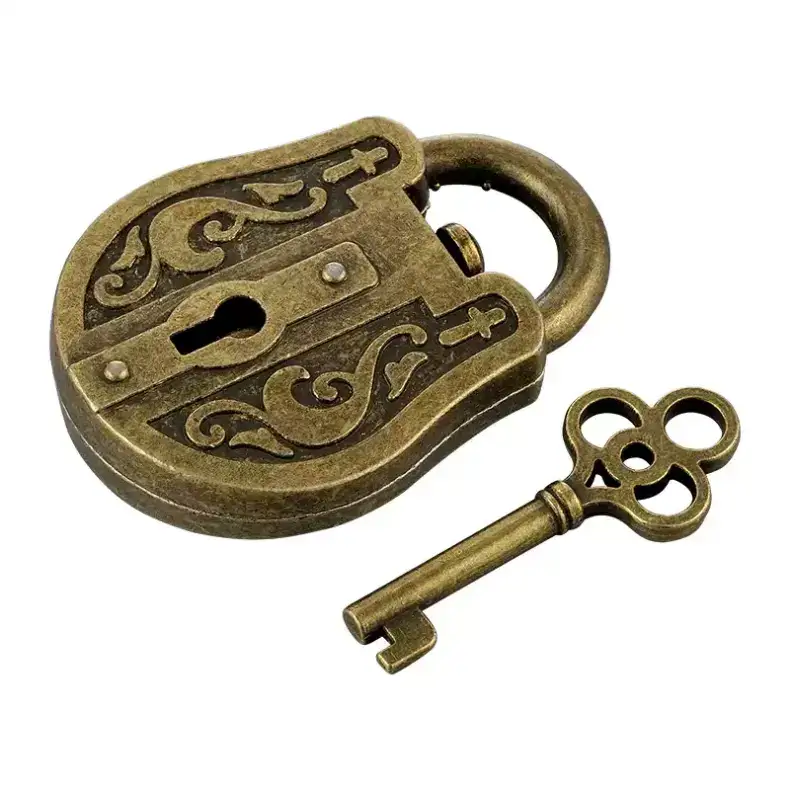
Consider the Divine Power Puzzle Lock. It’s a prime study in this layered appeal. At first glance, it’s a handsome, enigmatic lock. The heft is immediate. But its genius is in how it channels that fidget impulse into a multi-stage, sequential discovery process. You don’t just pull; you probe, shift, and listen. Each micro-movement has a consequence, teaching you its internal logic through touch and sound. It’s a tactile puzzle gift that turns fidgeting into forensic investigation. If he gets truly stuck, a resource like our divine power puzzle lock solution guide exists, but the joy is in the blind pursuit.
So, when you wonder if he’ll get bored after solving it once, the answer is found in this trifecta: the initial conquest of the mechanism, the subsequent fidget-friendly operation of that mechanism, and the permanent display of the object itself. It’s a cycle of engagement. The puzzle becomes a pet with a simple, satisfying trick. It offers a specific type of mental relief—the kind that comes from manipulating a finite, logical system in a world full of messy, open-ended problems. For more on the deep-seated psychology behind this, our exploration of the 4000-year-old fidget delves further. The right puzzle doesn’t just kill time. It validates a way of thinking.
The Puzzle Personality Matrix: Matching His Mind to the Mechanism
Choosing the right metal puzzle isn’t about picking the hardest one; it’s about matching the puzzle’s mechanical soul to his problem-solving temperament. After analyzing countless solves and fidget sessions, I’ve found that enthusiasts fall into four core archetypes, each with a puzzle category that feels like it was machined just for them. This matrix cuts through the noise, directing you to the mechanism that will resonate most deeply with how his mind works.
The Tinkerer (The “How Does This Work?”)
His instinct is deconstruction. He’s the one who fixes the loose hinge on a cupboard door just to see the mechanism. For him, the joy is in the journey of discovery, not just the destination. The perfect match is the Sequential Discovery Puzzle. These are less about a single “aha” and more about a series of small, logical revelations. He’ll manipulate the object, hear a faint click, discover a hidden compartment, find a tool, and use that tool to progress. It’s a narrative in metal. His satisfaction comes from reverse-engineering the designer’s intent, piece by piece.
The Over-Thinker (The “Analyst”)
He approaches problems methodically, with a touch of elegant paranoia. He trusts logic over intuition and can get stuck in mental loops. His greatest gift is patience, and his ideal puzzle must reward it. Enter the High-Tolerance Disentanglement or Assembly Puzzle. The solution path is often counterintuitive, requiring a precise sequence of movements. The analyst thrives here because the system is closed and finite; the answer exists, and his meticulous process will eventually brute-force the logic. The payoff is a profound, quiet click that validates his careful approach. He’s a prime candidate for the best metal puzzles for over-thinkers.
The Spatial Savant (The “3D Thinker”)
He sees shapes and their relationships in his mind’s eye. His thinking is rotational and topological. For him, the most satisfying challenges are Cast Puzzles and Burrs. Solving them requires visualizing internal channels, understanding how shapes can pass through one another in 3D space. The pleasure is almost purely spatial—a kinetic, tactile understanding of geometry. The weight and heft of the metal add a crucial physical dimension to the mental model he’s building.
The Fidgeter (The “Kinetic Mind”)
His hands are never still. He clicks pens, drums on tables, and needs an outlet for restless energy. A puzzle that sits solved on a shelf is a dead puzzle to him. He needs something with Fidget-Friendly Re-solvability. Look for puzzles with smooth, repeatable motions. The initial solve is important, but the secondary life is critical. The object must transition from a brain teaser to a desk trophy with a function: a legitimate, office-appropriate fidget toy, a category formally recognized even by Wikipedia’s entry on fidget toys.
Of course, most people are blends. Use this matrix not as a rigid box, but as a diagnostic starting point. It answers the core anxiety: “Will he actually like this one?” By focusing on the type of challenge, you move past arbitrary difficulty levels and into the realm of personal resonance. For a hands-on guide to this matching process, see our resource on choosing the right metal brain teaser.
In the next section, we’ll attach specific, tested puzzles to each of these profiles—the exact models whose solve-feel aligns perfectly with each mindset.
A Curated Deep Dive: Five Categories That Define the Craft
The matrix gives you the map; now, let’s explore the territory. The world of metal puzzle gifts for men is vast, but nearly every quality piece falls into one of five archetypes. Understanding these categories—defined by their core mechanism and solve-feel—is more useful than any ranked list.
1. Iconic Cast Puzzles (The Gateway Drug)
These are the monolithic, often artistic pieces you likely picture: two or more intricately machined parts cast as a single, seemingly impossible unit. This category is dominated by Hanayama, whose puzzles are rated on a 1-6 difficulty scale. The appeal is in their desk trophy presence and the profound, singular click of victory. The solve-feel is one of patient manipulation, discovering hidden axes of rotation. For a first metal puzzle, this is the place to start.
Exemplars: The Hanayama Cast Vortex (Level 4) is my personal benchmark. Its two spiraling pieces have a magnetic, almost fluid interaction—a buttery-smooth rotation that gives way to a perfect, silent separation. For something denser, the Cast News (Level 3) mimics a folded newspaper. Its heft is surprising, and its solution involves a deceptively simple slip-and-separate motion that delivers immense satisfaction.
2. Sequential Discovery Boxes (For the Tinkerer’s Soul)
If he loves taking things apart, this is his category. These are miniature systems you exploit. You’ll use the pieces on each other, discover hidden tools, and trigger internal mechanisms through a precise sequence. The solve-feel is narrative—it feels like cracking a safe or defusing a bomb. This is where metal vs wooden puzzles diverges sharply; metal allows for the tiny, precise tolerances and hidden chambers that make these work. They are a quintessential boyfriend gift for engineer types.
Exemplars: The Craighill Tension is a modern classic. It looks like a minimalist aluminum box. The journey involves finding its hidden rhythms—slides, clicks, and releases that feel immensely deliberate. The Solve from True Genius is another stellar option. It presents as a solid steel cube with a single, cryptic hole. The process is purely deductive, tactile, and immensely rewarding for the patient analyst.
3. Deceptive Disentanglements (Spatial Sleight of Hand)
These puzzles appear straightforward: separate a ring from a loop, or a horse from a fence. The genius lies in the path, which is always longer and more twisted than your brain first allows. They are pure 3D spatial reasoning tests, a classic form of disentanglement puzzle. The solve-feel is often one of slight frustration followed by a gasp-inducing “oh, that’s how it moves” moment.
Exemplars: The Yangqin Lock Puzzle is a prime example. It presents as a traditional padlock, but the key is not for turning. The solution is a clever series of alignments and shifts that feels like outsmarting a stubborn old mechanism. For a full walkthrough of its charm, our Yangqin lock puzzle guide details its intricacies.
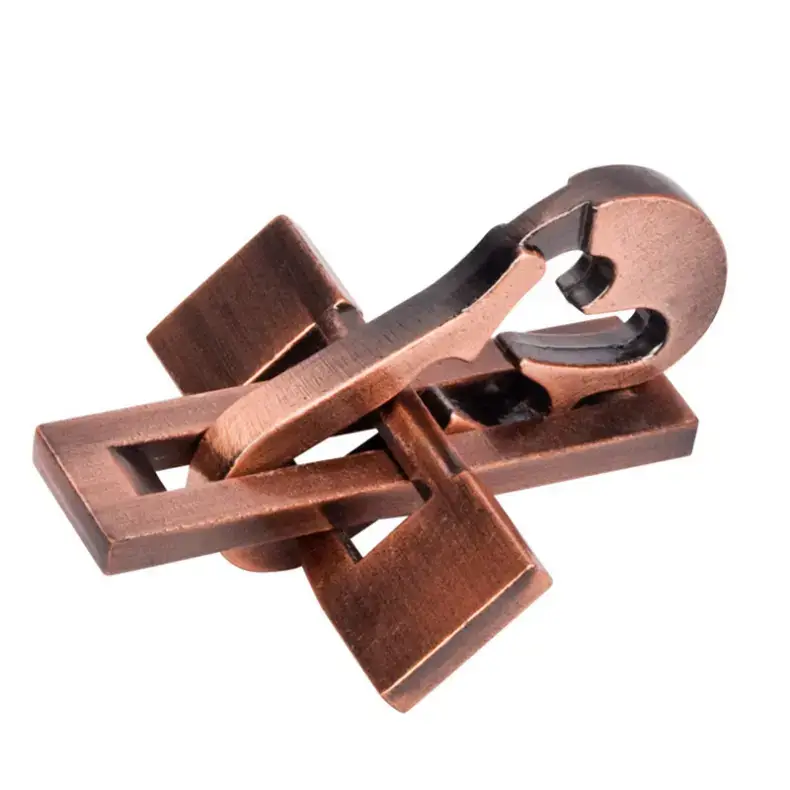
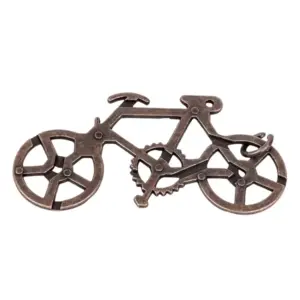
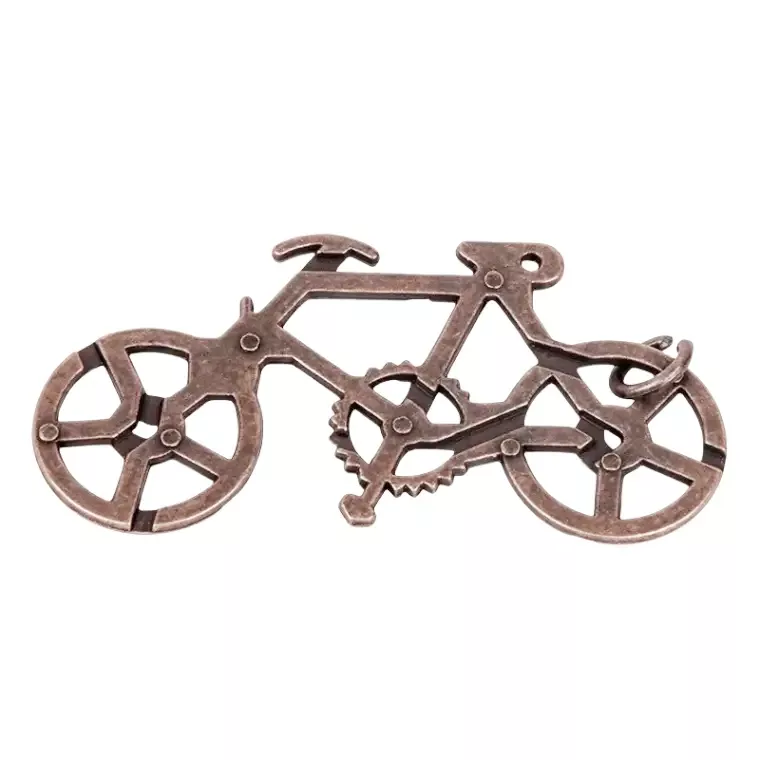
Similarly, the Intelligent Bike Lock Puzzle builds on a familiar real-world object to create a wonderfully misleading challenge. Its parts interact in a non-intuitive way that perfectly captures the “aha” spirit of this category.
4. Kinetic Fidget Puzzles (The Infinite Loop)
This is the answer to “Is there a metal puzzle that’s also a fidget toy?” Absolutely. These are puzzles designed for perpetual motion, where the solution path is a pleasing, repeatable cycle. The solve-feel transitions from puzzle to premium tactile toy, offering a satisfying click or smooth spin on demand.
Exemplars: The Hanayama Cast Chain (Level 2) is three interlocked links. Solving it is quick, but endlessly cycling the links through each other is a tactile meditation—a soft, metallic shush-shush-shush. For something more complex, the Bolt Puzzle (sometimes called the “Russian Bolt”) is a classic. Once solved, the act of screwing it together and apart becomes a rhythmic, mechanical ritual.
5. Abstract Assembly Challenges (The Architect’s Test)
Think of these as 3D jigsaw puzzles made of metal. You’re given a set of geometric pieces and the goal is to assemble them into a specified solid form. This category, a sub-genre of broader mechanical puzzles, tests pure spatial reasoning and patience. The solve-feel is one of quiet, methodical construction.
Exemplars: Six-Piece Burr Puzzles are the kings here. Six notched bars must interlock into a stable cube. The sound of the final piece sliding home with a solid thunk is unparalleled. The Devil’s Hoof or similar “packing” puzzles, where you fit oddly shaped pieces into a frame, also fall here. They are among the most difficult metal brain teasers, often with only one solution hidden amongst thousands of false configurations.
Each category offers a different flavor of challenge. Choose the genre that matches his mental playlist.
The First Unboxing: What His Hands and Eyes Will Notice
After identifying his puzzle personality, the abstract becomes physical. The first unboxing is a critical sensory audit—where a well-machined artifact separates itself from a frustrating trinket. A quality metal puzzle, upon first contact, will immediately communicate its worth through a specific heft (typically 100-300 grams for cast pieces), a cool, consistent finish, and an absence of rough casting seams.
The box, or lack thereof, tells the first story. Premium brands often use minimalist, magnet-clasp boxes that feel like a presentation case. Mainstream Hanayama puzzles come in distinctive clamshell plastic cases with the solution sealed in a separate envelope—a tacit promise that the struggle is intentional. The cheap multi-packs from generic retailers often arrive in a flimsy cardboard sleeve, which sets a different, more utilitarian expectation.
Then, his fingers take over. This is the quality checkpoint. He’ll lift it. The weight should feel dense and deliberate, not hollow. He’ll run a thumb along every edge and seam. This is non-negotiable: they should be burr-free and smooth. Any catch or sharp flash is the mark of rushed post-processing. He’ll then test any moving parts. A disentanglement ring should slide along its path with a consistent, if snug, resistance—not grind or bind. A cast puzzle’s pieces should separate and come together with a precise, satisfying click, not a mushy ambiguity. (A pro tip: if a mechanism feels gritty but is otherwise well-made, a single drop of lightweight silicone lubricant on a pinhead can work wonders.)
His eyes will scrutinize the finish. A bead-blasted matte texture hides fingerprints and feels sophisticated. Look for consistency—does the color or sheen vary? The tolerances—the gaps between moving parts—are a hallmark of quality. They should be tight and even. A puzzle that rattles loosely in the hand often signals a sloppy solve experience. For the true enthusiast, understanding this level of precision is akin to appreciating the 0.002mm gap between art and agony.
This moment is where your choice is validated. A puzzle that passes this tactile audit isn’t just a brain teaser; it’s a well-engineered object that commands respect before the first move is even attempted. It transforms the gift from a task into an experience, building anticipation for the quiet challenge ahead. For more on the ceremony of it all, the ethos of treating these as serious objects is captured in resources like our guide on unboxing brain teasers.
This first impression is your final assurance. You’ve not only bought a puzzle; you’ve vetted a piece of machining. When his hands close around that cool, dense metal and feel the seamless movement, the unspoken message is clear: this was chosen with understanding.
The Buyer’s Machinist Checklist: Tolerances, Weight, and That ‘Click’
Now that you’ve imagined the first impression, it’s time to make the final call. Moving beyond categories and personality matches, this is the machinist’s evaluation—the three core specs that translate directly to solving satisfaction. A great puzzle gift balances heft, precision, and calibrated frustration.
1. Material & Heft: The Desk Presence Test.
This is about mass and feel. A satisfying puzzle has a dense, substantive weight. Zinc alloy is the industry standard—it’s heavy, casts well, and has a pleasant, cool-to-the-touch feel. Aluminum is lighter. Steel is the premium choice, offering unmatched density and a silky-smooth finish. A good rule of thumb: a palm-sized puzzle should have enough heft to feel deliberate, not hollow. If a product listing doesn’t specify the metal, assume it’s a lighter, cheaper alloy. Those Amazon multi-packs? They’re almost always lightweight aluminum or thin plated zinc—fine for a fleeting fidget, but lacking the gravitas of a true collector’s piece.
2. Tolerances & Movement: The Precision Audit.
Tolerances—the engineered gaps between parts—are everything. They define the “solve-feel.” Perfect tolerances are neither too tight (causing binding) nor too loose (creating slop). You’re looking for that elusive mechanical silence; parts should move with a buttery, frictionless glide, not a gritty scrape. A puzzle with poor tolerances feels like a fight against the object itself, not the logic it represents.
3. Difficulty Calibration: Beyond the Number.
A manufacturer’s “Level 5” is subjective. Here’s the translation: Levels 1-3 (Hanayama’s ‘Beginner’ to ‘Intermediate’) are often solved in under an hour. The satisfaction here is in the smooth, logical discovery. Levels 4-6 (‘Hard’ to ‘Expert’) demand patience. A Level 5 represents a logarithmic jump in complexity. For a first major puzzle, a solid Level 4 is the sweet spot—it promises a multi-session engagement without despair. The “click” of the solution after this struggle isn’t just auditory; it’s a full-body release of tension. That’s the moment you’re engineering for him.
This checklist is your insulation against disappointment. It filters out the poorly cast and the deceptively simple. When you can evaluate a puzzle not just as a gift, but as a piece of machining, you guarantee that cold weight in his hand carries the silent, respected promise of a perfect challenge.
Sourcing the Solvable: Specialist Retailers vs. The Amazon Gamble
Armed with your checklist, you now face the final, practical hurdle: where to actually buy. Your sourcing decision will impact everything from the puzzle’s machining quality to his long-term engagement with the hobby.
The specialist retailer is your safeguard. Sites like Puzzle Master or Serious Puzzles offer a critical mass of information—official difficulty ratings, solution times, and detailed photos. More importantly, they vet their inventory. You’re buying a known entity with a specific design heritage. This is where you find the full series for the collector, and where you’ll get a straight answer if you email to ask about a puzzle’s solve-feel. They understand that a puzzle is an experience, not just a SKU. For navigating the most popular brand, a dedicated Hanayama puzzle buy guide is invaluable.
The Amazon gamble is a different equation. You can absolutely find legitimate, brand-new Hanayama puzzles here. But you are also one click away from opaque multi-packs of unbranded puzzles. Those sets can be a fine, low-cost entry point, but they are a minefield for the purist. The tolerances are often looser, the alloy can feel gritty, and the “difficult” designs are frequently just frustratingly ill-conceived.
So, when to choose which path? Follow this rule: If your match from the Puzzle Personality Matrix points to a specific, respected brand or category, go to a specialist. You’re investing in the intended experience. If you’re testing the waters with a broad-stroke gift—say, for a fidgeter who might enjoy a handful of puzzles to fiddle with—a well-reviewed Amazon multi-pack can be a cost-effective experiment. Just manage expectations.
This distinction matters most for the post-solution life. A puzzle from a specialist often comes with a lineage. Solving a Hanayama Level 6 feels like joining a quiet, global club. It’s a display piece with a story. The cheap, unbranded puzzle from a multi-pack, once solved, often loses its intrigue; its mechanisms are rarely refined enough to make the re-solve satisfying.
Finally, a practical answer to a common worry: replacement parts. For major brands, yes, parts can often be sourced through the retailer or manufacturer. For an off-brand Amazon puzzle, they are almost certainly irreplaceable. This isn’t just about losing a piece—it’s about the long-term viability of the object as a fidget-ready desk trophy.
Life After the ‘Aha!’ Moment: The Puzzle as a Permanent Companion
The initial solve is a lightning strike of insight, but the true test of a great metal puzzle is what happens after. Contrary to the common worry, a well-machined brain teaser doesn’t become a forgotten trinket; it transitions into a fidget-ready desk trophy or a collection cornerstone.
That first triumphant separation is just chapter one. The object’s secondary life begins. For the fidgeter, the solved state is often just a reset point. A puzzle like the Hanayama Cast Nutcase becomes a kinetic sculpture for the hands, its movements now understood but no less satisfying. (Timing your re-solves becomes its own meta-game.)
Other puzzles, especially intricate sequential discovery boxes, become stories to tell. Their solved form is a conversation piece that invites the question, “What is that?” This allows him to recount the journey—the false leads, the sudden reveal of a hidden tool, the final, satisfying click. It’s a narrative object.
And for the mind that craves completion, one puzzle is rarely the end. Brands like Hanayama design their cast puzzles as a cohesive collection. Gifting a Level 4 like the Cast Vortex can seed an entire pursuit, transforming a birthday present into a years-long hobby of hunting down and conquering an entire graded series.
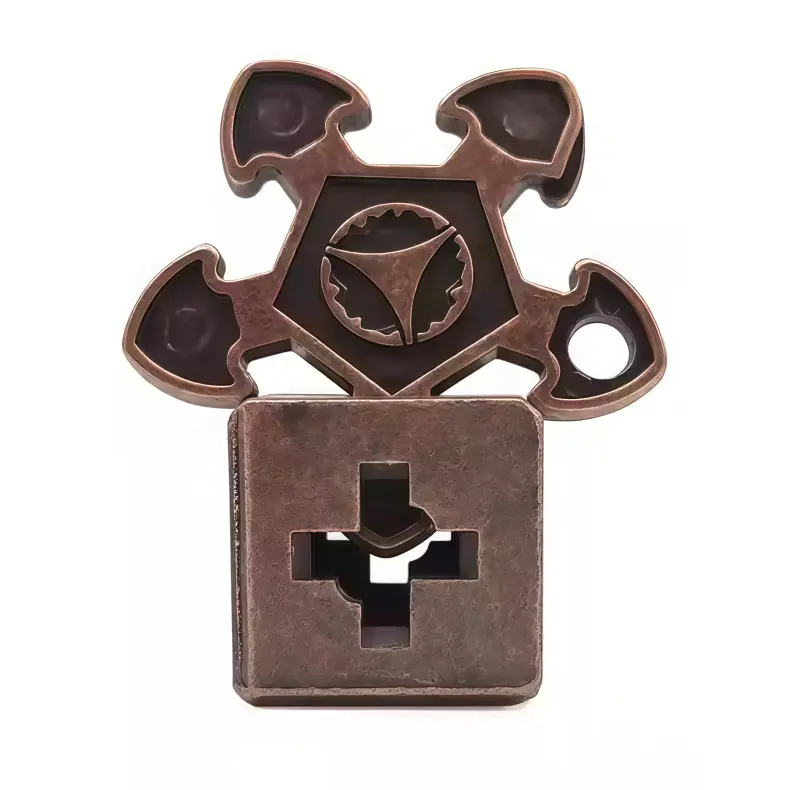
Take a piece like the Shuriken Dart Edition Gear Puzzle. Its post-solution life is one of perpetual motion. The interlocking gears offer a buttery-smooth rotation that’s pleasurable to manipulate idly, long after the solution path is memorized. It’s a prime example of a puzzle designed not just to be solved, but to be handled.
So, when the closet of flannel shirts looms in your memory, remember this: the right metal puzzle defies the gift-giving cycle of use and discard. It becomes a fixture. A familiar weight in the palm during a long call. A polished artifact on the shelf that signifies a quiet victory. The final step isn’t wrapping the box—it’s casually asking, weeks later, “So, which one should we try next?” For a deeper look at this evolution from challenge to ritual, consider the perspective in when a puzzle becomes a practice.