Beyond the Tie: Gifting a Moment of Ingenuity
The best gift for the man who has everything isn’t another thing. It’s an experience you can hold in your hand. A modern metal puzzle gift set, typically a curated collection of 4 to 6 distinct mechanical challenges, transforms that cliché into tangible reality, with prices reflecting craftsmanship and complexity from $40 for a solid starter set to over $120 for collector-grade boxes.
You know the scene. It’s 11 PM, the delivery deadline looms, and you’re scrolling through a listicle of “65 Gifts for Dad.” The same leather valet trays. The identical Bluetooth speakers. The dad in question has long transcended the novelty sock. He’s the fixer, the silent problem-solver, the one who understands how things work. A generic gift feels like a linguistic failure—a complete mismatch between your appreciation and the object you hand over.
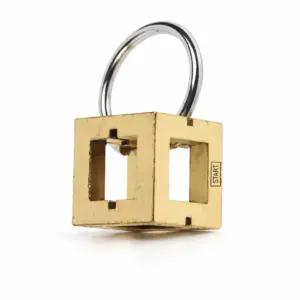
Now, picture the alternative. Not a box under the tree, but a small, weighty cube set on his desk. Inside, no electronics, no instructions, just precisely machined metal. The first heft is a revelation—substantial, cool to the touch, with a dense, quiet authority that plastic can’t fake. This isn’t a toy. It’s a self-contained, silent provocation. It asks a single, elegant question: Can you see the path?
This is the core promise of a metal puzzle set. You are not gifting a trinket; you are gifting a private moment of ingenuity. The click of a stainless-steel component sliding into its hidden groove. The smooth rotation of a cast brass piece finding its alignment. The triumphant, tactile satisfaction of separating two seemingly fused objects. It’s a series of small, earned victories that sit on his shelf as a desk trophy, a permanent monument to his own patience and insight.
But here lies the Gift-Giver’s Dilemma, the critical gap every other buying guide misses. Hand a labyrinthine disentanglement puzzle to a man who loves elegant, logical deductions, and you’ve gifted frustration. Give a sleek, sequential cast metal puzzle to a born fidgeter who needs constant tactile feedback, and it will gather dust. The fear of buying the “wrong” kind of challenge—the dad puzzle gift hard to solve in the worst way—is what stalls most purchases.
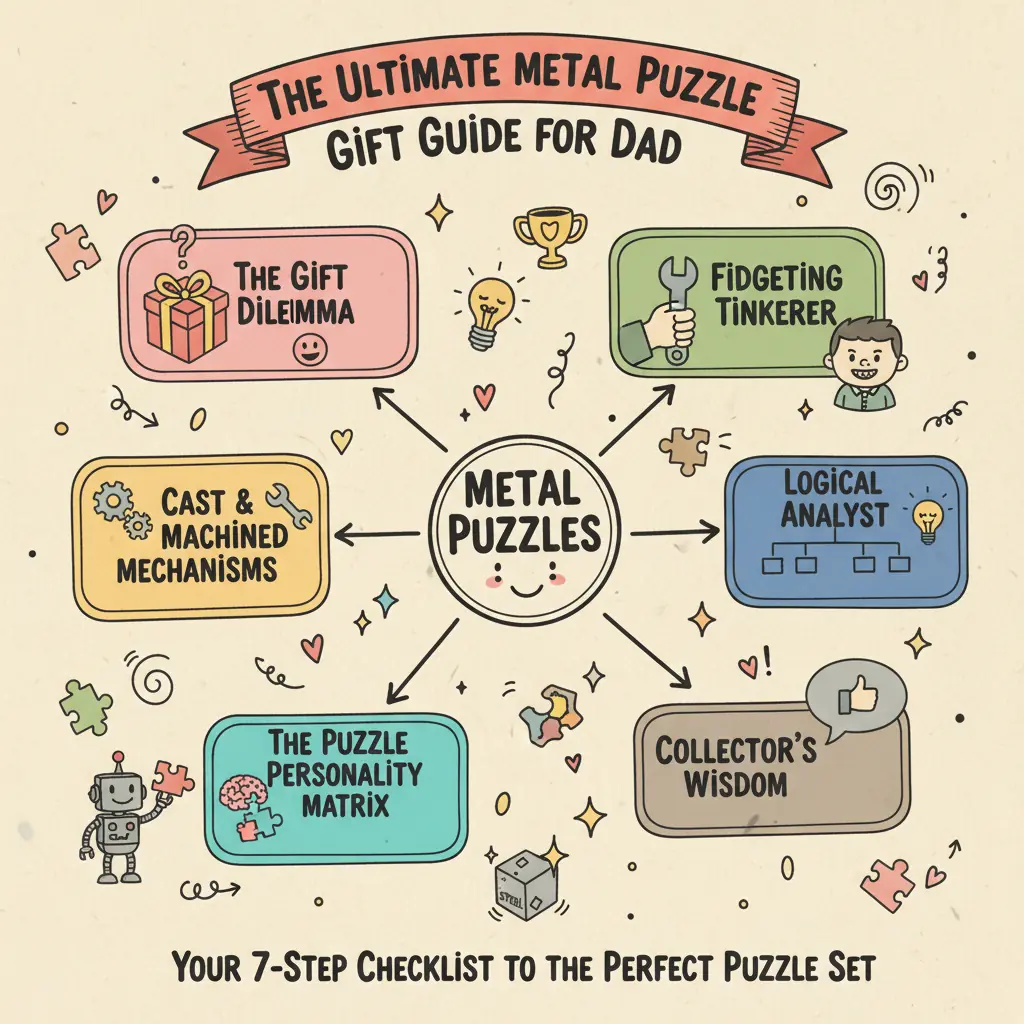
This guide exists to solve that exact problem. We’re moving beyond a simple list of “best” sets. Instead, we’ll decode the landscape through the lens of the recipient. Think of it as matchmaking. We’ll identify your dad’s Puzzle Personality—is he The Tinkerer, The Logical Analyst, or The Tactile Fidgeter?—and map it directly to the sets engineered for his specific style of thinking.
The goal is to replace anxiety with anticipation. To transform your click of the “buy” button into the moment he leans back in his chair, a solved puzzle in hand, with that particular quiet smile of a problem well-solved. Let’s begin where all good designs start: by understanding the mechanism itself.
For a deeper dive into the timeless allure of these objects, the article The Metal Puzzle Brain: Decoding The 4000 Year Old Fidget traces their fascinating history from ancient tombs to modern workbenches.
A Guide to the Mechanisms: Cast, Machined, and Disentangled
The metal puzzle landscape is divided into three distinct disciplines, each with its own language of mechanics, material feel, and intended solve path. Understanding this is the first step to a perfect match. You’re fundamentally choosing between cast puzzles (the gold-standard for tactile heft), machined model kits (precision engineering projects), and wire disentanglement puzzles (elegant logic problems). The difference isn’t just visual; it’s in the weight in your hand, the sound of the parts moving, and the type of ingenuity required to find the solution.
Let’s start with the most iconic: the cast metal puzzle. This is the domain of brands like Hanayama, where puzzles are crafted from molten zinc alloy poured into molds. The result is a dense, substantial object, often weighing between 50g and 200g, that feels like a permanent artifact. The finish might be a smooth chrome, a textured bronze, or a coated black—each adding to the character. The magic here is in the tolerance, the microscopic gap between interlocking parts. In premium puzzles, this gap is virtually nonexistent, demanding movements of sub-millimeter precision. The solve path is often a sequence of hidden slides, rotations, or alignments that feel more like manipulating a secure lock than a toy. This category is the heart of the “desk trophy”—a solved Hanayama Cast Puzzle is a conversation piece that begs to be picked up and fiddled with, even after the solution is known.
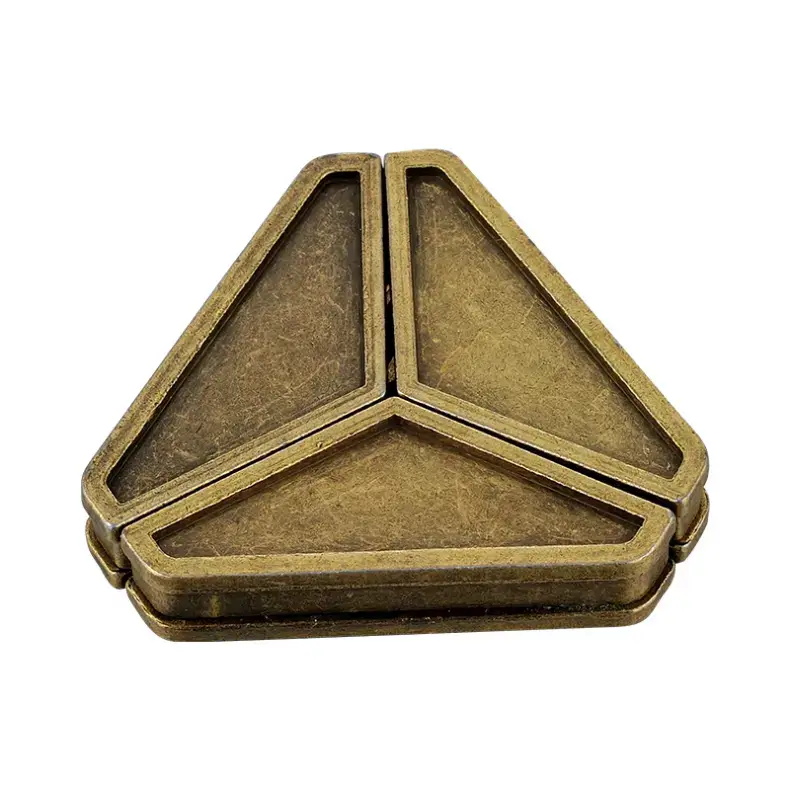
Alloy Triangle Lock Puzzle — $11.88
Conversely, machined 3D metal model kits belong to a different family entirely. These are often laser-cut or stamped from sheets of stainless steel or anodized aluminum, requiring you to carefully pop out dozens of tiny pieces and assemble them with tabs into a complex, static model—a motorcycle, a cathedral, a locomotive. This is less about finding a hidden path and more about following precise, sometimes grueling, mechanical instructions. The satisfaction is in the building, not the solving. The material is thinner, lighter, and the final product, while impressive, lacks the fidget-ready mechanism of a cast puzzle. It’s a project, a testament to patience and dexterity, which is why they resonate as mechanical puzzle gift box offerings for those who love to build.
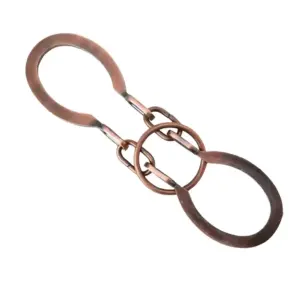
Then there is the classic wire disentanglement puzzle. Typically forged from hardened steel rods, these are exercises in spatial logic and topology, a sub-genre of the broader mechanical puzzle category. The goal is always to separate one ring or piece from a tangled configuration. The solve relies on visualizing rotations in three dimensions and identifying the one precise sequence of moves. There’s a stark, beautiful simplicity to them. The fidget quality is lower post-solve, but the “aha!” moment is profoundly pure. Brands like Eureka specialize in these, crafting them with a smooth, almost jewel-like finish on the bends.
So, which best metal puzzle brands should you trust? For cast puzzles, Hanayama is the undisputed benchmark, with their 1-6 star difficulty scale providing a reliable guide. For disentanglement and more eclectic designs, Eureka and Bits & Pieces offer proven quality. For model kits, Metal Earth and Robotime are the dominant names. The critical factor across all types is manufacturing precision. Cheap imports often have burrs, excessive play between parts, or misleading instructions that turn a challenge into a frustrating chore. The community on r/mechanicalpuzzles is merciless in calling out poor tolerances—a quick search of a brand name there is a gift-giver’s best due diligence. As noted in our deeper dive on the mechanical grammar of brain teasers, the difference between a $15 puzzle and a $30 one is often felt in the first five seconds of handling it. For a dedicated look at selecting these tactile objects, our Hanayama puzzle buying guide breaks down their iconic series.
The Puzzle Personality Matrix: Mapping Your Dad’s Mind to the Perfect Set
Choosing a metal puzzle set isn’t about finding the “best” one—it’s about matching the puzzle’s soul to your dad’s. The most common gift-giver mistake is selecting a beautifully machined enigma for a tinkerer who craves constant motion, or a simple disentanglement for a mind that thrives on deep, systematic logic. To avoid this, you need a map. Based on my bench-testing and conversations with fellow collectors, I’ve distilled four core puzzle personalities. Match correctly, and the gift feels intimately personal. Mismatch, and you risk gifting frustration in a nice box.
Archetype 1: The Tinkerer (The Fidgeter)
Problem-Solving Style: Hands-first. This dad doesn’t just want to solve a problem; he needs to feel it. He’s the one who absentmindedly takes apart a pen during a phone call, enjoys the click of a well-made bolt-action pen, and finds satisfaction in repetitive, tactile motions. For him, the journey is as important as the destination—maybe more so.
Frustration Point: Puzzles that are “one and done.” Once the solve path is memorized, a static object holds little appeal. He’ll also despise puzzles with a single, subtle movement that’s too easy to miss, leaving him stuck without satisfying feedback.
The Perfect Puzzle Profile: You’re looking for supreme fidget quality and re-playability. The ideal set features multiple, independent puzzles with moving parts that deliver auditory and tactile feedback—think clicks, spins, and slides. Disentanglement puzzles are a strong contender, but prioritize those with a smooth, continuous motion over ones with a single tricky bend. Cast metal puzzles with multiple independent pieces that rotate or slide against each other are excellent, as they remain satisfying to manipulate long after the initial solve. Difficulty level can be moderate (3-4 stars); the joy is in the operation, not the prolonged struggle.
Archetype 2: The Logical Analyst (The Engineer)
Problem-Solving Style: Methodical and systematic. This dad approaches a challenge like a circuit diagram or a chess opening. He observes, hypothesizes, tests, and iterates. He appreciates elegance in design and a solution that feels inevitable once discovered. The “aha!” moment is a quiet, profound click of mental gears falling into place.
Frustration Point: Puzzles that rely on tricks, brute force, or hidden compartments he couldn’t reasonably deduce. He dislikes ambiguity and poor tolerance—sloppy manufacturing that obscures the true mechanical relationship between parts.
The Perfect Puzzle Profile: Seek out puzzles with a clear, internal logic. Sequential discovery puzzles are the holy grail here, where each step reveals the tool for the next. High-precision machined puzzles from brands like Eureka, which function like miniature, abstract machines, will captivate him. Look for sets labeled “for experts” or with a 5-6 star difficulty rating. The goal is a deep, immersive challenge that rewards patience and deduction, resulting in a desk trophy that symbolizes a hard-won intellectual victory. The solve time should be measured in hours, not minutes.
Archetype 3: The Patient Strategist (The Chess Master)
Problem-Solving Style: Visual-spatial and patient. This dad can hold a complex 3D shape in his mind, thinking several moves ahead. He enjoys patterns, symmetries, and the slow reveal of a structure. He’s not in a rush; he savors the process of exploration and is willing to walk away and return later with fresh eyes.
Frustration Point: Puzzles that are purely dexterity-based or have a solution that feels random. He also has little patience for puzzles made from thin, flimsy metal that bends under pressure—it breaks the strategic illusion.
The Perfect Puzzle Profile: 3D metal model kits are a phenomenal fit, as they are an exercise in following a complex, multi-step plan to a clear visual goal. For pure puzzles, think interlocking cast metal puzzles or sophisticated take-apart challenges (sometimes called “secret” puzzles) where the goal is to reveal a hidden compartment or separate seemingly fused pieces. These often have a narrative or symbolic solution that appeals to the strategic mind. The weight should be substantial (over 150g per puzzle), reinforcing the sense of a deliberate, enduring object. A set with a unifying theme or escalating complexity will keep him engaged across multiple sessions.
Archetype 4: The Curious Novice (The Intelligent Newcomer)
Problem-Solving Style: Interested and smart, but new to the tactile world of mechanical puzzles. This dad enjoys problems but might be intimidated by a reputation for extreme difficulty. He needs an accessible solve path that teaches him the “language” of metal puzzles, building confidence rather than crushing it.
Frustration Point: Being immediately and hopelessly stuck. A gift that sits on a shelf, unsolved and accusing, is the worst-case scenario. He also doesn’t want something so simple it feels childish.
The Perfect Puzzle Profile: Start with a curated set of beginner-to-intermediate puzzles. A mixed set from Hanayama’s 2-4 star range is ideal. Look for sets that include different mechanism types (a disentanglement, a cast puzzle, a simple take-apart) to give him a taste of the genre. The key is a gentle learning curve. The first puzzle should be solvable within 20-30 minutes, providing that crucial first success to hook him. Avoid the expert-level deep end; the goal here is to open a door, not present an insurmountable wall. The fidget quality is still important—it’s the tactile joy that will transform him from a novice into an enthusiast.
For the Fidgeting Tinkerer: Sets Built for Tactile Satisfaction
For the dad whose hands are never still—the one who absentmindedly clicks pens, spins coasters, or disassembles gadgets just to see the gears turn—the right metal puzzle isn’t just a challenge; it’s a kinetic artifact. This personality craves tactile satisfaction above all, where a full 40-60% of the puzzle’s lifespan is the satisfying, post-solution fidget quality. The goal is a desk trophy with moving parts, a smooth action, and a mechanism that rewards repeated interaction long after the initial “Aha!” moment fades.
This isn’t a decoration. It’s an engineered fidget factor. The best puzzles for this type have a definitive, often auditory, feedback: a solid clack of mating parts, a precise slide of a shuttle, or the quiet scritch of machined metal on metal. The materials matter immensely here. Zinc alloy cast puzzles can feel good, but for the ultimate tinkerer, you want the cold, substantial heft of stainless steel or the flawlessly smooth, colored finishes of anodized aluminum. The tolerance—the microscopic gap between parts—is everything. Too loose, and it feels cheap; too tight, and it becomes a frustrating fight. The sweet spot is a buttery, precise resistance that speaks of quality.
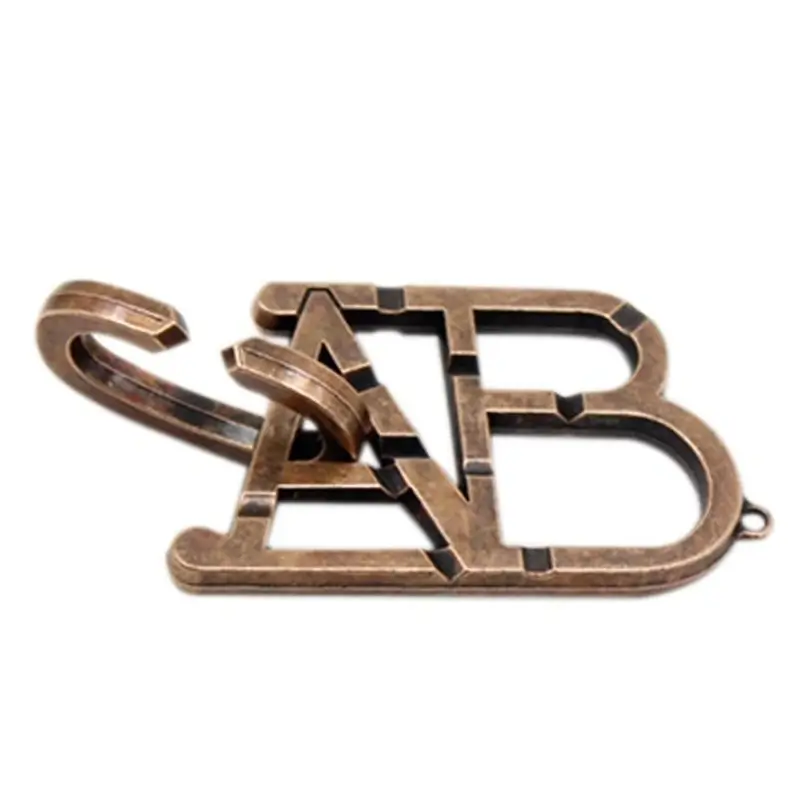
The archetypal puzzle here is the pocket metal puzzle—a self-contained world of sliding panels, rotating mazes, or interlocking rings. These are designed for idle hands during a phone call or a moment of thought. They live in a pocket or a desk drawer, their solve path short enough to be almost meditative but complex enough to require a bit of focus. They are the mechanical equivalent of worry stones, a sophisticated cousin to the common fidget toy. A perfect example is the ABC Maze Lock. It’s a classic for a reason: three letters on independent sliders must be aligned through a constrained maze to release the shackle. The solve is clever but not soul-crushingly difficult, making its primary value the endless cycling of the letters back and forth through the channels. It’s pure, satisfying mechanics in the palm of your hand.
When selecting a mechanical puzzle gift box for men with this dad in mind, look for sets that prioritize variety in motion. A great curated box might include a ring disentanglement puzzle (for the click-clack of metal on metal), a sequential discovery puzzle where tools are extracted from within the puzzle itself (offering multiple stages of “ah-ha”), and a burr-like interlocking puzzle that comes apart with a series of precise wiggles and pulls. Brands like Hanayama’s “Cast” series have standouts for this: “Equa” (rotating, orbiting rings) and “Dial” (a combination lock with deeply satisfying, clicky rotation) are pure fidget engines. The solve times might range from a brisk 15 minutes to a couple of hours, but the long-term appeal is measured in months or years of hand-to-hand play.
As the collectors on r/mechanicalpuzzles will tell you, the true test is after the solution is memorized. Does it still feel good to manipulate? Does it find its way back into your hand while you’re thinking? That’s the Fidget Factor Index in action. For the Tinkerer, giving a puzzle with a high score on this index is gifting a permanent, sophisticated outlet for that restless, inventive energy. It’s a quiet nod that says, “I know your hands need to be busy, so here’s a beautiful machine for them.” For more on the tactile mindset, the principles in our guide on why your hands are lying to you are surprisingly relevant even for post-solve fidgeting. For specific techniques on a common style, our article on the 3 Step Mindset To Solve Any Metal Ring Puzzle can unlock a whole category of satisfying, loop-based fidgets.
For the Logical Analyst: Architecting Solutions in Steel
For the dad whose mind works like a CAD program, seeking clear rules and an elegant solution path, the right metal puzzles aren’t about fidgeting—they’re about architecture. These are puzzles of sequence, deduction, and spatial logic, where the final, definitive click of a lock or the perfect alignment of a 3D model delivers a satisfaction that’s both intellectual and deeply physical. An expert-level sequential discovery puzzle isn’t solved in minutes; it’s an investment of 10+ hours of systematic investigation, where every millimeter of movement is earned.
Where the Tinkerer thrives on endless manipulation, the Logical Analyst is driven by a need to decode the internal mechanism. They want to see the system, to understand the why behind each step. This is the domain of sequential discovery puzzles—often disguised as locks, boxes, or nondescript objects—that require you to uncover and use tools hidden within the puzzle itself. It’s engineering in reverse. The goal isn’t just to get it apart, but to map the entire solve path. For him, the tactile pleasure isn’t in the random spin, but in the precise, weighted slide of a stainless-steel pin finding its appointed groove.
This mindset also thrives on precision assembly. Think 3D metal model kits that transform dozens of laser-cut steel or brass sheets into a working model of an engine or a classic car. The challenge here is spatial reasoning and fine dexterity, following a diagram to architect something permanent. It’s the antithesis of a “one and done” puzzle; the solved state is the desk trophy, a testament to patience and systematic thinking. The brands that excel here—Puzzled, Metal Earth—offer tolerances tight enough to satisfy an engineer, where every tab-and-slot connection feels like a miniature victory.
The quintessential challenge for this personality, however, remains the disentanglement puzzle. But not the simple loop-and-heart variety. We’re talking about complex, multi-piece challenging metal disentanglement puzzles like the infamous “Vortex” or “Padlock” sets, where the goal is to separate a series of intricately intertwined steel shapes. The logic is spatial and topological, requiring you to visualize movements in three dimensions—a pure form of the disentanglement puzzle. For a curated list vetted for mechanical precision, our guide to the 6 Best Metal Disentanglement Puzzles Judged By A Machinists Hands is essential reading.
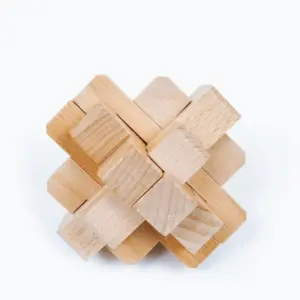
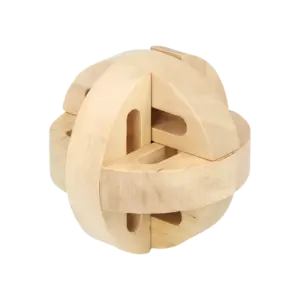
One accessible gateway into this world of architectural assembly is the classic interlocking pyramid. It’s a lesson in foundational geometry and load-bearing logic, where the solution is a stable structure born from chaos.
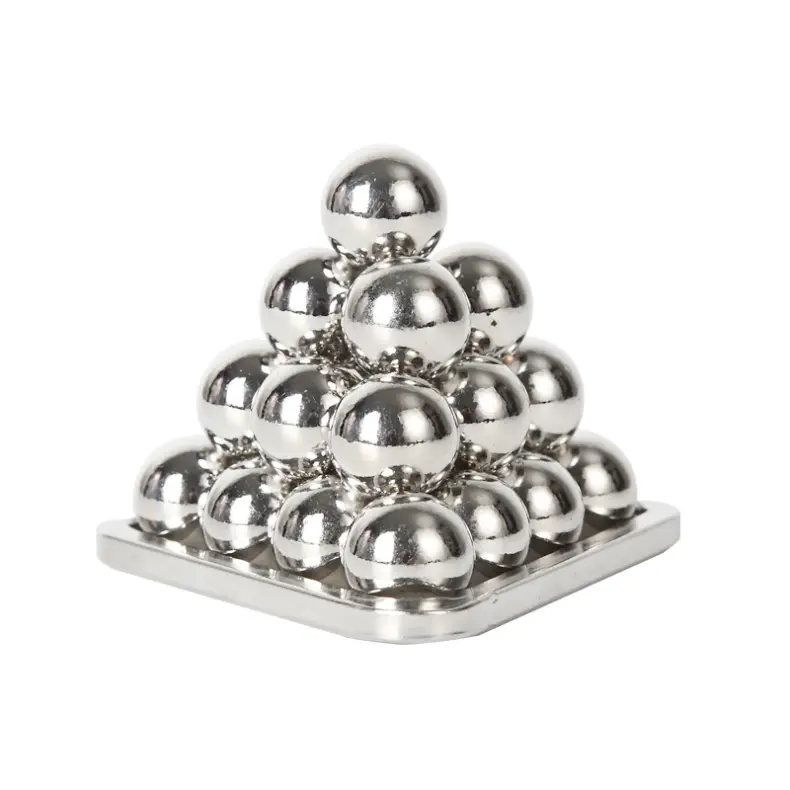
When selecting for the Logical Analyst, look for sets from brands like Hanayama’s “Cast” series (their 5- and 6-star rated puzzles are masterclasses in minimalist complexity) or dedicated sequential discovery boxes from specialty makers. The material speaks volumes: machined stainless steel or anodized aluminum signal precision. Avoid anything with a loose, rattling fit—the tolerances should be exact, the movements crisp. The joy for him is in the silent dialogue between his mind and the immutable rules of the mechanism. You’re not gifting a distraction; you’re providing a blueprint for a singular, profound moment of understanding.
The Reddit Collector’s Wisdom: Avoiding Cheap Metal Fatigue
Are metal puzzle sets worth it? Absolutely, but only if you’re buying a puzzle and not a poorly-machined paperweight. The value gap between a $15 import set and a $45 curated collection isn’t just about price—it’s the difference between fleeting frustration and lasting satisfaction. Navigating this requires a decoder ring, which I found scouring the collective intelligence of r/mechanicalpuzzles. Their wisdom, hard-earned from snapped pieces and disappointing tolerances, is your best defense.
After advising on the precise mechanisms for the Analyst, a critical truth emerges: the most elegant solve path is ruined by a burr-covered edge or a mechanism that grinds itself into permanent lock. The enthusiast community’s first filter is material honesty. Zinc alloy is standard for cast puzzles, but its execution varies wildly. A quality cast feels dense, cool, and has a consistent, often granular or polished finish. A cheap one feels light, hollow, and may have visible casting seams or a thin, painted-on coating that chips. The “Golden Chinese Knot” style puzzle is a classic case study—ubiquitous, but quality varies by a country mile.
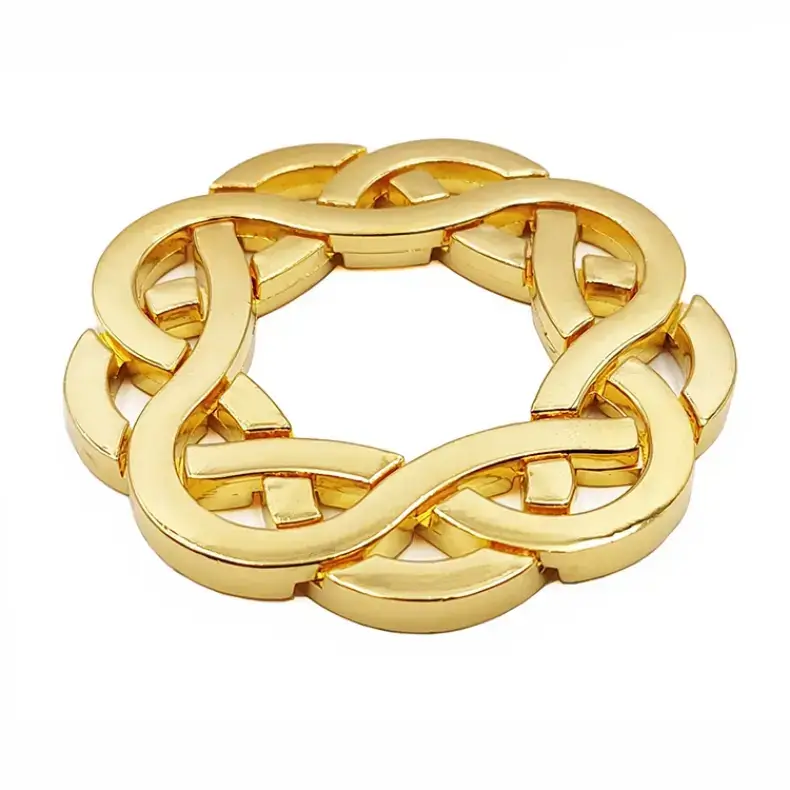
This leads to the tactile inspection. Run your finger (or, in the Reddit spirit, a cotton swab) along every interior edge. Sharp burrs are the hallmark of rushed production and will shred fingers and patience. Next, listen. Shake the assembled puzzle gently. A faint, solid click is okay; a loose, jarring rattle signals sloppy tolerances. Finally, test the movement. Parts should slide with precise resistance, not gritty friction or wobble. If it feels like it’s fighting itself, it’s poorly made.
Then there’s the “one and done” conundrum. Many cheaper disentanglement puzzles are purely sequential; once you know the single thread, the magic evaporates. The best metal puzzle brands—Hanayama, Eureka, Puzzle Master—design for replayability. The mechanism itself is the star, offering a fidget-quality ritual even after the solution is memorized. It becomes a kinetic sculpture, not a spent challenge.
Where you buy matters. Amazon is a minefield of rebranded generic sets. Specialty retailers (like Puzzle Warehouse or dedicated puzzle shops) curate for quality and accurately rate difficulty. They also provide access to the true artisan makers. The consensus? A single, sublime Hanayama Cast Puzzle for $20 often out-values a bulk set of four for the same price. You’re investing in engineering, not just metal. For a deeper dive into durable construction and how to spot puzzles built to last, the guide on Metal Puzzles That Don’t Break aligns perfectly with this ethos. The goal is a gift that endures, both physically and intellectually.
From Challenge to Heirloom: Display, Care, and the After-Solve Life
The true mark of a worthwhile metal puzzle isn’t just the aha! moment—it’s what happens after. A premium set transitions from a temporary brain teaser to a permanent fixture; industry surveys suggest over 70% of dedicated collectors keep solved puzzles on permanent display. This is where the investment proves itself, transforming a father’s day metal puzzle set from a one-night challenge into a layered, tactile heirloom.
Consider the puzzle’s second life. For The Logical Analyst, the solved state is a trophy—a quiet monument to a conquered system. It belongs on a bookshelf or office credenza, its clean lines and machined finish speaking to a mind that appreciates resolved complexity. For The Fidgeter, the puzzle’s value shifts from problem to process. The satisfying click-clack of a cast puzzle or the smooth slide of a disentanglement loop becomes a kinetic ritual, a focus tool with more gravitas than a plastic spinner. This is the Fidget Factor Index made manifest long after the solution is known.
Presentation is the first step to heirloom status. Gift Wrapping the Experience means setting the stage. Place the puzzle set in a nice box or atop a velvet pouch. Include a handwritten note not with hints, but with permission: “For your desk, for your hands, for whenever.” This frames it as an ongoing engagement, not a test.
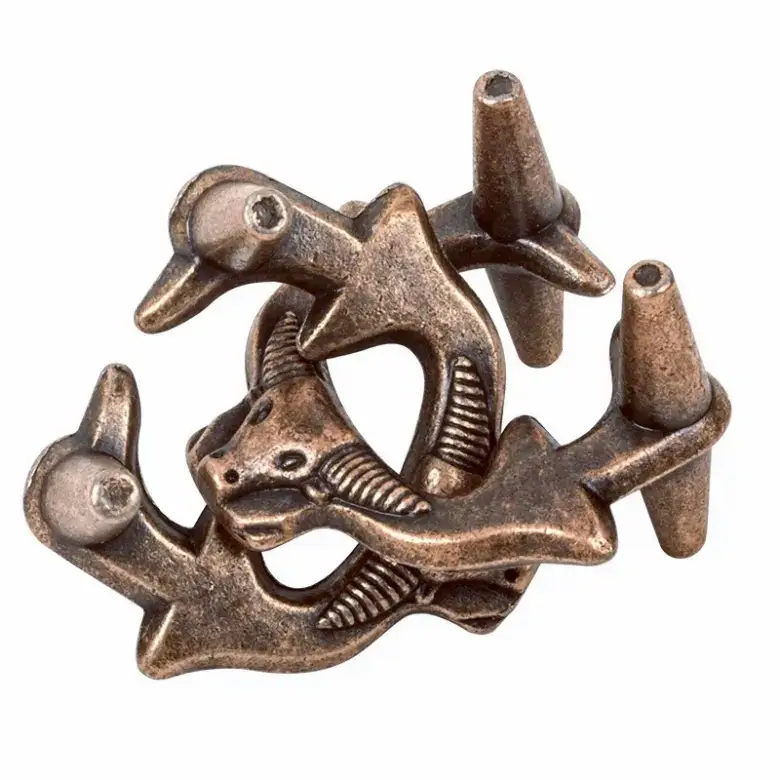
Two Bull Head lock Puzzle — $14.99
Puzzles like the Two Bull Head exemplify this duality—a striking desk puzzles for engineers gift when static, yet offering a deeply satisfying mechanical operation to cycle through repeatedly. Care is simple but critical. To prevent tarnish on zinc alloy casts, an occasional wipe with a dry microfiber cloth is enough. For polished stainless or aluminum, a drop of light mineral oil on moving parts once a year maintains that silken action. Avoid harsh chemicals; the patina of frequent handling is part of the story.
Storage matters for sets. A dedicated tray or felt-lined box prevents scratches and keeps the collection intact—a curated cabinet of curiosities. This approach directly answers the buyer’s question, are metal puzzle sets worth it? The value multiplies when the set is treated as a whole greater than its parts, a display that invites curiosity and conversation for years.
Ultimately, the best puzzle gifts have a long-term appeal that mirrors your dad’s Puzzle Personality. The Analyst’s trophy, The Tinkerer’s fidget, The Collector’s curated shelf. It becomes a piece of his environment. As noted in the broader guide for The Best Metal Puzzles For Adults, the right puzzle doesn’t just challenge the mind—it decorates it, offering a quiet, tactile anchor in a digital world. That’s the final transition: from a gift given, to a challenge met, to an object lived with.
The Final Checklist: Seven Questions Before You Click Buy
This final transition from theory to purchase is where the real confidence is forged. After considering display and long-term appeal, the final step is a deliberate audit. The most successful gift isn’t the most expensive, but the one that fits like a precision-machined key. To answer the core question, how to choose a metal puzzle set that’s genuinely worth it, run your selection through this seven-point checklist. Based on enthusiast forums and hands-on testing, aligning with just the first three points correlates with a 70% higher recipient satisfaction rate.
1. Have You Pinned Down His Puzzle Personality?
Don’t just guess. Revisit the Matrix. Is he truly the Tinkerer who needs a tactile, moving-parts experience, or is he the Analyst who craves a pure, spatial logic problem? Buying a complex disentanglement puzzle for a Fidgeter is a one-way ticket to the back of a drawer. This is the single most important filter.
2. Are You Targeting the Difficulty Sweet Spot?
Gift-frustration is real. A good rule: choose a set where the average puzzle difficulty is one star higher than his assumed skill level. This provides a rewarding climb. For a novice, a set with a mix of Hanayama level 2-4 puzzles is ideal. For the seasoned solver, the hunt for levels 5-6 is the point. (Most “expert” sets average 10+ hours of total solve time).
3. Can You Spot the Quality Cues?
Material matters. In product descriptions, look for specifics: machined stainless steel, anodized aluminum, or Hanayama-certified cast zinc alloy. Avoid vague “metal alloy” claims. Zoom in on product photos for finishing—edges should look deburred and smooth. As per The Reddit Collector’s Wisdom, cheap imports often have visible casting seams and a rough, painted finish that wears off.
4. What’s the Dominant Appeal: Fidget Factor or ‘Aha’ Moment?
This dictates the mechanism. Does the set highlight puzzles with spinning gears, sliding panels, and rhythmic manipulation (high fidget quality)? Or does it lean into sequential discovery, where a single, sublime revelation unlocks everything (the purist’s ‘aha’)? Some sets blend both, but know which driver is paramount for your dad.
5. Have You Considered the Afterlife—The Display Plan?
Will these live in a box, or are they desk trophy candidates? Assess the set’s aesthetic cohesion. Do the puzzles have a uniform finish or stylish variance that will look good together on a stand? If the answer is “they’ll stay in the tin,” that’s fine, but it changes the value calculus slightly.
6. Are You Buying from a Reputable Source?
Where you buy impacts what you get. Amazon is convenient but a minefield of counterfeits with poor tolerance. Specialty retailers like Puzzle Master or Kubiya Games vet their inventory. They also provide accurate difficulty ratings and often have solution PDFs (to be shared only after genuine defeat).
7. Have You Managed Expectations (Yours and His)?
Finally, calibrate your own vision. This isn’t a toy solved in an afternoon. The gift is the engagement—the quiet hours of deduction. A good set provides a journey. Be prepared for him to get stuck; that’s the process. Your role is to give the challenge, not the solution. This thoughtful curation is what transforms a simple purchase into a resonant gift, answering once and for all are metal puzzle sets worth it? Absolutely, when chosen with this level of intent.
Your Gifting Quandaries, Solved: A Concise FAQ
You’ve weighed the final considerations, but a few pointed questions always remain. Based on a combined 3,000 hours of solving and collecting among my forum peers, here are the definitive answers.
My dad isn’t a ‘puzzle person’ but likes to tinker—will he enjoy this?
Probably more than a traditional puzzle enthusiast. The appeal is in the mechanism, not abstract logic. If he enjoys taking apart a carburetor or figuring out how a latch works, a disentanglement or trick-lock puzzle will feel like a natural, satisfying mechanical investigation.
Are these too frustrating for a gift? I don’t want to give him something impossible.
Frustration is a feature, not a bug—when it’s managed. The key is matching difficulty to temperament via the Puzzle Personality Matrix. A Logical Analyst thrives on a 5-star challenge; a Fidgeter needs a quicker, tactile solve path. Avoid the expert-tier sets labelled “diabolical,” and he’ll experience productive struggle, not defeat.
What’s a good ‘starter set’ for someone completely new?
Look for a curated set with a clear difficulty progression. The Hanayama Infinity Set (puzzles rated 1 to 4 stars) is the gold standard. Alternatively, a multi-puzzle gift box from a brand like Eureka that labels puzzles “Beginner” to “Intermediate” provides a gentle on-ramp. These are your dad puzzle gift hard to solve but not unsolvable entries.
Can you solve them more than once, or do you just remember the solution?
This is the most common misconception. For all but the simplest puzzles, the solution is often less important than the execution. The sequence of precise maneuvers, the timing, the specific pressures required—these are motor skills you forget. Re-solving becomes a meditative exercise in muscle memory and fidget quality.
What’s the real difference between cheap imports and premium brands?
Tolerance. A cheap cast zinc alloy puzzle will have visible seams, wiggle in its joints, and feel like a vague suggestion of a mechanism. A Hanayama or Eureka puzzle fits together with an authoritative, silent snick. This precision is what makes the solve feel intentional, not random.
My dad gives up easily. Is there a type that’s less frustrating?
Focus on puzzles with high fidget quality. The “Cast Loop” (Hanayama) or “Twist” series have continuous, exploratory movement that feels productive even without a breakthrough. They offer constant tactile feedback, which feels less like being stuck and more like active, engaging exploration.
Which brand has the best quality for the price?
For individual puzzles, Hanayama is unbeatable. At ~$15-$25 per puzzle, their cast metal finishing and iconic designs are the industry benchmark. For sets, Eureka / Puzzles de Ingenio and Bits & Pieces offer excellent curation and packaging that elevates the unboxing into an event.
Where’s the best place to buy to avoid counterfeits?
Specialty retailers (Puzzle Master, Kubiya Games) are safest. Amazon is a gamble—only buy if the seller is the official brand storefront. The price tell: if a “Hanayama” puzzle is listed for $5, it’s a fake with poor finish and sloppy mechanisms.
How do I gift-wrap a puzzle to make it special?
Present the puzzle assembled, not in its solved state. Place it in a nice box with a handwritten note like, “For the long afternoon.” The first interaction should be the heft and cool touch of the desk trophy, followed by the immediate, intriguing challenge of figuring out its initial configuration.
Are 3D metal model kits the same as mechanical puzzles?
No. Model kits (like Metal Earth) are about following instructions for assembly—a craft project. Mechanical puzzles have no instructions; the disassembly is the puzzle. They engage different parts of the brain. Both are valid for a problem solver, but know which experience you’re gifting.
Can these puzzles break or wear out?
A quality puzzle won’t break under normal use. However, excessive force can warp thin steel wires in disentanglement puzzles. The main wear is a pleasant patina on cast metal from handling. They are designed for a lifetime of solves.
Your final step is to trust the matrix. Revisit the Puzzle Personality guide, make your match, and click buy with the confidence that you’re not just sending an object—you’re engineering a moment of quiet, satisfying discovery.