You’re Holding It Right Now. Let’s Get It Apart.
You’re holding the Gold Silver Double Fish puzzle. You’ve twisted, turned, and pulled. The two metal fish seem permanently, impossibly fused. The specific solution you need involves exploiting a single, non-intuitive seam—a one-move transition most guides miss, which is why generic “wiggle it” advice fails. This is a dedicated, movement-by-movement guide for this exact object.
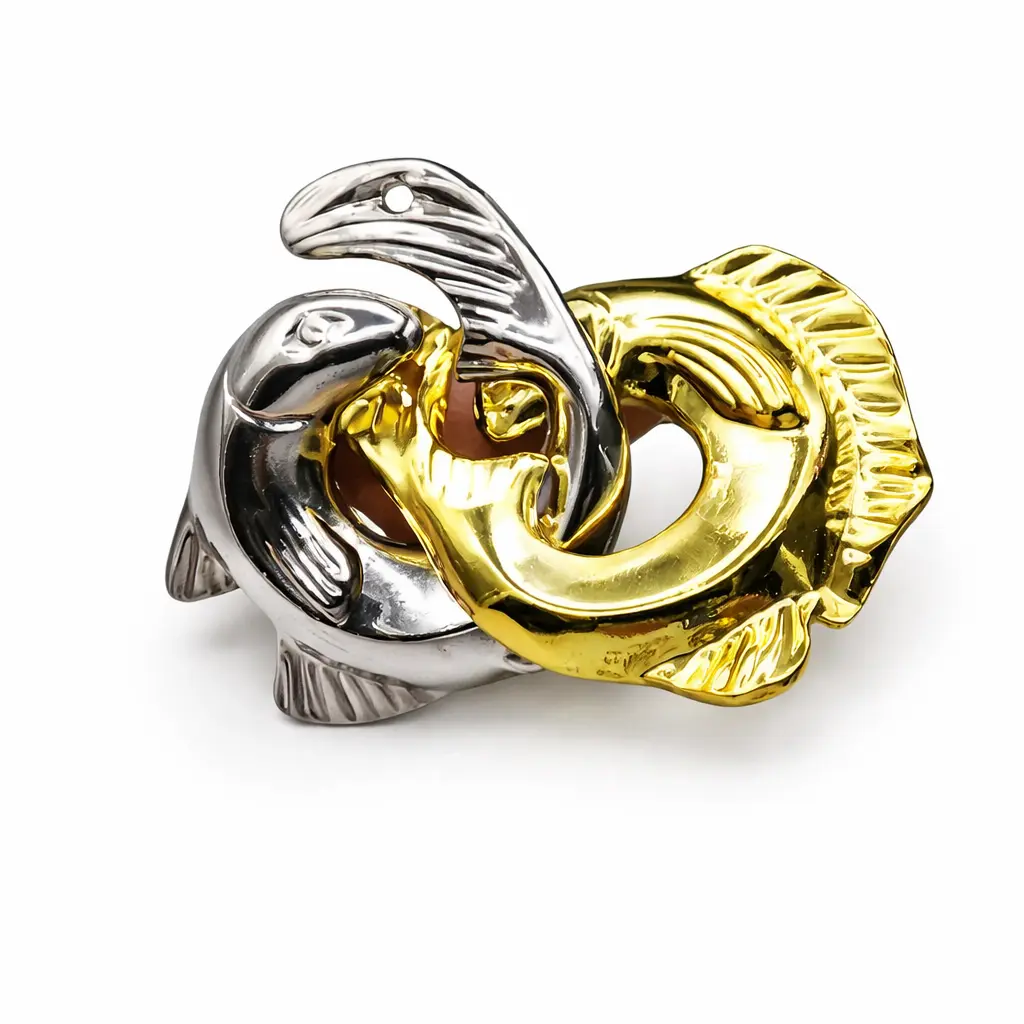
First, confirm you have the right puzzle. You should be holding two distinct, solid metal fish: one gold (often brass) and one silver (often zinc alloy). They are cold, heavy, and intricately interlocked, forming a compact, symmetric knot. This is not a Hanayama Cast puzzle or the simpler “Love Puzzle”; it’s its own specific two fish metal puzzle solve.
If that’s what’s in your hands, you’re in the right place. Generic disentanglement strategies won’t work here because the gold silver double fish solution depends on a precise sequence of rotations, not just persistent wiggling. I spent an afternoon mapping its movements because I, too, hit that frustrating dead end. The path out is clearer than you think.
Stop forcing it. The key is not strength, but finding the moment of slack. The following steps will guide you there. If you’ve twisted it into a strange configuration, don’t worry. We’ll start with how to reset it to the standard starting position—the first critical step everyone overlooks. Then, we execute the sequence. For those who process information better visually, you can cross-reference these steps with our complete video guide.
The Core Principle: It’s About the Seam, Not the Force
Resetting the puzzle gets you to the starting line, but understanding its mechanical grammar is what will let you run the race. The principle is this: your goal is not to pull the fish apart, but to align and pass a specific, shared opening—the seam—through each other’s captive loop. This puzzle is mechanically a ‘P-loop’ disentanglement, where one piece (the P) has a closed ring and an extended tail, and the other piece (the loop) is a closed shape with an internal gap. The solution is a precise, four-step path through a shared state space.
Think of the two fish not as tangled objects, but as mirror images sharing a single plane of movement. Their bodies are designed so that only one specific rotational alignment creates a viable exit path. When you force them, you’re jamming the geometry. When you find slack, you’ve hit the correct alignment. The cold, heavy tactile feedback of the zinc alloy is your guide; listen for the faint, smooth scrape of metal on metal, not the jarring clunk of a dead end.
Here’s the critical visualization: each fish has a seam—the narrow, longitudinal gap where the two halves of the metal casting meet, running along the belly and back. This seam is your visual and tactile landmark. The core move involves rotating one fish so that its seam faces directly into the open loop of the other fish’s tail section. You are not trying to escape the body, but to navigate the tail of one fish through the open ring formed by the head and body of the other. This is the ‘magic mirror’ trick: you must make the fish face each other in a specific, symmetrical pose to unlock the path.
This is why pushing harder is the enemy. Force deforms the natural path, masking the moment of slack—that half-millimeter of give where the pieces transition from locked to mobile. Your job is to systematically test rotations until you feel that slack, then follow it. It is a search through a finite number of states, which is why a random walk fails. The puzzle can exist in two primary configurations (often called Type A and Type B in puzzle theory), one solvable and one a perfect lock. The steps we will execute are a direct transition from the locked state to the solved state.
For those seeking a metal puzzle solution video, the mental model is more valuable than mimicking hand motions. If you only memorize a twist without understanding why the seam alignment works, you’ll be lost the moment the puzzle falls into a different state. The following steps are the physical execution of this principle: aligning the seam, finding the slack, and navigating the captive segment through its one permissible exit. To understand this logic as it applies to a wide range of puzzles, delve into the mechanical grammar of brain teasers.
Reset Protocol: Getting Back to the Standard Starting Tangle
If your fish are in a jumbled, seemingly unsolvable state, you’ve likely maneuvered them into Type B—the perfect lock. This isn’t a failure; it’s a natural fork in the puzzle’s state space. Resetting is a straightforward, 7-step process to return to the classic, interlocked Type A position, which is the solvable starting point for the one-move solution.
Think of this as a forced reload to the puzzle’s title screen. You need to create a specific, symmetrical overlap where the fish are nested head-to-tail, forming the recognizable ‘X’ shape. The goal is to have the gold fish’s head resting in the silver fish’s body loop, and vice-versa, with their noses pointing in roughly opposite directions. This is the standard starting tangle shown in product photos and the position from which all solution guides (including the next section) begin.
Follow these steps precisely, using clock positions for orientation.
- Identify the Pieces. Hold one fish in each hand. Designate one as your “anchor” (e.g., the gold fish) and the other as the “mobile” piece (the silver fish).
- Create Parallel Bodies. Manipulate the fish so their bodies are parallel to each other, sliding them until they are side-by-side. You will feel a lot of slack here. This is the “neutral” position.
- Form the ‘X’. Now, cross the fish to form an ‘X’. Place the silver fish on top of the gold fish so their bodies cross at a 90-degree angle. The intersection point should be near the middle of both fish.
- Nest the Heads. This is the critical tactile move. Slide the silver fish along the gold fish’s body until the head of the silver fish drops into the large, open loop formed by the gold fish’s body and tail. You will feel and hear a faint metallic click as it settles into place. The silver fish’s head is now captive within the gold fish’s loop.
- Repeat the Mirror. Without disturbing this new connection, now rotate and slide the gold fish. Your objective is to drop the head of the gold fish into the corresponding loop on the silver fish’s body. This often requires a slight pivot. You are mirroring the action of step 4.
- Check Symmetry. Once both heads are nested in the opposite fish’s body loop, you should have the classic intertwined pose. The fish should be symmetrically locked, with their noses pointing away from each other (one roughly at 9 o’clock, the other at 3 o’clock). There is no strain; they rest together.
- Verify the Seam. Look at the point where the two fish cross. You should see the long, continuous seam formed by the edge of one fish running alongside the body of the other. This is your visual confirmation of the Type A, solvable state.
If you hit a dead end, you likely tried to nest a tail into a loop instead of a head. Back up to the parallel position (Step 2) and try again, paying close attention to which end of the fish you are maneuvering. The goal is head-in-body-loop, not tail-in-body-loop. A static image of this starting position can be found in our guide to the gold silver fish puzzle, but these steps provide the dynamic sequence to reliably achieve it from any messed-up configuration. Now, with the puzzle correctly reset, you are ready for the solution.
Step-by-Step: A Movement Map for Your Hands
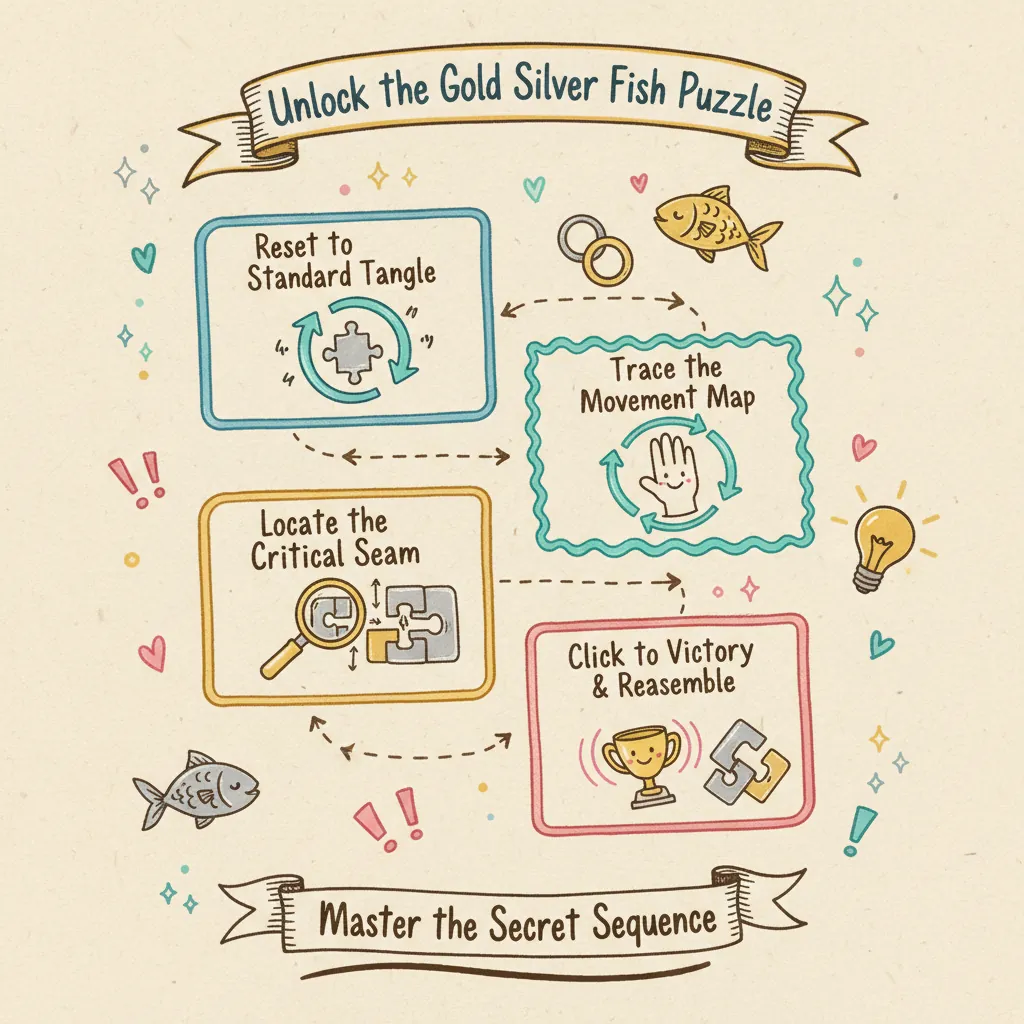
Here is the definitive, movement-by-movement sequence to separate your Gold Silver Double Fish puzzle. The entire process revolves around seven precise maneuvers that transition the puzzle from its Type A intertwined state to freedom. It is not about pulling; it’s about aligning the single, hidden seam through a series of controlled rotations.
You have successfully reset the puzzle. The two fish are now symmetrically interlocked in the solvable starting position, with one nose at 9 o’clock and the other at 3 o’clock, forming that clean seam where their bodies meet. This is your launch point. Hold the puzzle so the gold fish’s nose points to your left (9 o’clock) and the silver fish’s nose points to your right (3 o’clock). The gold fish will be your primary reference frame; you will move the silver fish relative to it.
Establish Grip and Axis. Pinch the body of the gold fish firmly between the thumb and forefinger of your non-dominant hand. Your grip point should be just behind its gills. Hold it perfectly horizontal and still. This is your anchor. With your dominant hand, pinch the silver fish by its tail.
Initiate the Primary Slide. Keeping both fish horizontal, slowly slide the silver fish directly toward the gold fish’s head (to the left). You will feel the inner curve of the silver fish’s body loop slide along the gold fish’s body. Continue until the silver fish’s head nestles snugly inside the gold fish’s body loop, right up against the gold fish’s own head. You will hear a faint metallic click as the heads meet. (A common dead end here is sliding the silver fish’s tail into the loop—ensure it’s the head.)
Execute the 90-Degree Pivot. This is the first critical transition. Maintain your grip on the gold fish. With the silver fish’s head nested in the gold loop, rotate the entire silver fish 90 degrees counter-clockwise (as viewed from above). The silver fish’s body will swing down, so its nose now points toward the floor (6 o’clock). The gold fish remains horizontal. You are creating a perpendicular cross.
Find the “Slack” and Rotate the Loop. Here is the moment most people miss. With the silver fish pointing down, shift your focus to the gold fish’s body loop. You will now see a clear gap. Insert your free finger into that loop and rotate the gold fish itself 180 degrees clockwise (around its long axis). Imagine turning a key. Do this slowly. You will feel the internal geometry shift and a distinct moment of slack—the tension between the pieces will ease. The gold fish’s nose will now point to the right (3 o’clock), and the silver fish, still pointing down, will be on the far side of it.
The Second Slide and Alignment. With the new slack, slide the silver fish again, this time upward and slightly away from the gold fish’s head. Guide its body along the path opened by the slack. Your goal is to bring the silver fish back to a horizontal position, but now its nose should point to the left (9 o’clock), directly opposite the gold fish’s nose. Their bodies will now be parallel but offset.
Clear the Final Obstruction. The fish are nearly free, linked only by the final point of contact at their tails. Hold the gold fish steady. You will see the silver fish’s tail is now caught under the gold fish’s tail. To clear this, perform a slight, simultaneous two-part move: gently lift the silver fish’s tail up while you tilt the gold fish’s tail down. This is a scissoring motion of less than an inch. The metal will emit a soft scrape.
Separate. The obstruction is cleared. The two pieces are no longer interlocked. Simply pull the silver fish directly away from the gold fish along their now-parallel paths. They will come apart with satisfying, clean separation. No force required.
(The Critical ‘Gotcha’ – Hitting a Dead End): If you reach Step 4 and find no slack, or the rotation feels completely blocked, you likely started from a Type B state despite the reset. The puzzle has two near-identical-looking but geometrically distinct locked states. If stuck, return to the Reset Protocol: force the heads through each other’s loops once to flip the state, then re-sync to the parallel, nose-to-nose position. This “state transition” is the one-move difference between impossible and solvable that most guides never mention.
You have just navigated the puzzle’s state space. The solution isn’t a random wiggle; it’s a specific sequence that exploits the one-dimensional seam between the pieces, a concept often discussed in resources like our guide on solving the Cast Hook puzzle, but applied here to the unique contours of the fish. Remember: victory is found in the tactile feedback—the click, the slack, the final scrape. Now, with the pieces separate, the final challenge remains: can you put them back together?
The Critical ‘Gotcha’: Diagnosing and Fixing the Type B Dead End
You followed the steps. You synced the noses, found the seam, and rotated the silver fish. But nothing gave. The puzzle is stuck in a geometrically distinct configuration known as a Type B state—a 180-degree rotational difference that blocks the standard solution path entirely. This is the dead end that convinces most people the puzzle is broken.
The Gold Silver Double Fish puzzle exists in two primary states: Type A and Type B. They look nearly identical to a frustrated eye, but the spatial relationship between the two loops is mirrored. Starting from the wrong state makes the final separating move impossible. Your hands aren’t failing you; you’re just missing the one transition move that flips the puzzle’s internal logic. This is the core reason generic wiggle advice fails.
Diagnosis is tactile, not just visual. In the correct, solvable Type A state (the standard starting tangle from our Reset Protocol), when the fish are held parallel and nose-to-nose, the silver fish’s dorsal fin will point toward the inside of the gold fish’s loop. In the locked Type B state, that same fin points to the outside. Run your thumb over it. That subtle orientation changes everything.
If you’re here, you’re almost certainly in Type B. The symptoms are clear: you performed Step 4 from the previous section, but rotating the silver fish clockwise met immediate, solid resistance from the gold fish’s tail. No slack appeared. The pieces are jammed. This is the point where people apply force and risk bending the soft zinc alloy. Don’t. Force is the enemy.
The fix is a deliberate state transition. You must pass one fish’s head through the other’s loop again, but with intention.
Transition Maneuver (Type B to Type A):
1. Hold the puzzle in the standard parallel, nose-to-nose position you achieved after the reset.
2. Do not try the solution rotation. Instead, look at the point where the gold fish’s head loop and the silver fish’s body intersect.
3. Apply gentle, opposing pressure. Push the head of the silver fish down and through the loop of the gold fish. (You are essentially forcing them more tangled for one moment).
4. You will feel a distinct shift—a soft clunk of metal passing metal. This is the state transition.
5. Immediately return the fish to the parallel, nose-to-nose alignment. Re-check the fin orientation. The silver fish’s dorsal fin should now point toward the inside of the gold fish’s loop.
6. You are now in Type A. Proceed immediately with Step 4 of the solution: hold gold still, rotate silver clockwise. The slack you were missing will now be present.
Think of it like a video game glitch where you clip through a wall by facing a specific pixel. The geometry has a backdoor. This maneuver aligns with a core principle of disentanglement puzzles: when you’re truly stuck, you often need to deliberately complicate the tangle to find a new path, a concept explored in depth in why your hands are lying to you which discusses misleading tactile cues.
(Common Mistake Alert: If the transition feels impossibly stiff, you might be trying to push the wrong part through. Ensure you are manipulating the heads, not the tails. The head loops are the only portals that allow this state change.)
Once you execute this, the puzzle’s state space becomes clear. It’s not an infinite maze of possibilities; it’s a simple binary lock. Type A leads to separation. Type B leads to a dead end until you apply the key. This is the “one-move difference” specific to this puzzle’s design that most listicles omit. Now you possess the diagnostic skill to never be permanently stuck again. The frustration of the dead end transforms into the clarity of system mastery.
The Click of Victory – And How to Do It Again (Reassembly Guide)
Reassembly is the true test of understanding. It’s not merely reversing the steps; it’s navigating the same state space in the opposite direction, which most find 2-3 times harder because the visual cues are inverted. To confidently re-tangle your gold and silver fish from a separated state, follow this mirrored path. The entire process should take 10-20 seconds with a definitive click at the end.
Start with the two fish completely separate, lying flat on a table. The goal is to recreate the classic intertwined “X” shape you began with.
Step 1: Position for Entry.
Place the silver fish flat, belly-down. Orient it so its nose points to 12 o’clock. Now, hold the gold fish vertically, on its edge, with its nose pointing toward the ceiling. Position the gold fish directly above the silver fish’s body, just behind its gills.
Step 2: The First Engagement (Creating the Loop).
Lower the gold fish vertically so that its oval head loop passes around the silver fish’s body from above. You are essentially hooking the silver fish’s torso through the gold fish’s head. This is the foundational captive-segment link. You should now have a perpendicular “T” shape.
Step 3: The Pivot to Parallel.
Here is the core move. While keeping the silver fish flat and still, rotate the gold fish 90 degrees clockwise around the axis of the silver fish’s body. The gold fish’s head will drag along the silver’s side. Your goal is to get both fish lying flat and parallel, with the gold fish now on top of the silver. Their noses should point in the same direction (e.g., both to 12 o’clock), and the gold fish’s head loop should still encircle the silver’s body.
Step 4: The Slide and Lock.
(This is the inverse of the solution’s “slack” moment.) With the fish parallel and flat, slide the gold fish toward the tails. You will feel the interior walls of the gold fish’s head loop slide along the silver fish’s body. Keep sliding until the silver fish’s tail fin is positioned inside the gold fish’s head loop. The fish will now be offset, with the gold fish’s head near the silver fish’s tail.
Step 5: The Final Twist and Click.
Hold the silver fish firmly. Rotate the gold fish 180 degrees along its long axis (flip it over like a pancake). As you do this, the tails will cross and the heads will align. You will feel a clear point of tactile feedback—a slight resistance, then a soft click or snap as the seams and curves settle into their fully interlocked position. The puzzle is now back in its standard, seemingly impossible, starting tangle (Type A state).
(Crucial Check: If the pieces feel loose or can slide apart easily, you likely performed Step 4 incorrectly. The silver fish’s tail must be captured within the gold’s head loop before the final twist. Undo and re-slide.)
Mastering this reassembly completes your control over the puzzle’s state space. You are no longer just a solver who got lucky; you are a operator who can traverse between the solved and tangled states at will. This is the confidence phase—the moment the object’s logic lives in your hands, not just in a one-time set of instructions.
Why It Works: A 30-Second Tour of the Geometry
The solution works because the two fish form interlocked, offset loops—one at the head, one at the tail. Your hands navigate a single viable 3D path where these loops can pass through each other’s negative space. Every failed twist is a collision with the geometry; the one correct sequence is a collision-free route through a tunnel only wide enough for a specific alignment.
Think of it like a video game glitch-clip through a wall. The wall is the solid metal of the fish bodies. The glitch is the precise moment in Step 3, where rotating the gold fish 90 degrees aligns the seam on its body perfectly with the opening in the silver fish’s tail loop. For one position, the wall becomes a door.
This is the state transition you mastered. In the tangled (Type A) state, the loops are doubly obstructed. The solve path manipulates them into a temporary (Type B) alignment where only one obstruction remains, which you then bypass. All other manipulations just toggle between these two locked states—that’s why pushing harder creates a dead end.
The metal’s rigidity is essential. It creates a predictable state space. If the pieces were flexible, the path wouldn’t exist; you’d just bend them apart. The cold, hard feedback tells you when you’ve hit the geometry’s limit, guiding you toward the only route with slack. Your job was to find the glitch in the level—the one frame-perfect move that lets you slip through. This predictable rigidity is a hallmark of well-designed metal puzzles that don’t break. For a formal definition, a puzzle of this type is classified as a mechanical puzzle, where the goal is achieved through manipulation of the object itself.
Puzzle Keeper’s Notes: Sourcing, Care, and Next Steps
Now that you’ve navigated its state space, your Double Fish deserves proper care. This specific puzzle typically costs between $10-$15 and is made from a zinc alloy—durable but not indestructible. Your main job is preservation: never force a move. If you meet solid resistance, you’re in a dead end, not applying insufficient force. Forcing risks permanently bending the loops and ruining the precise geometry that allows the solution.
To find a replacement or a backup, search for “buy gold silver double fish puzzle” or “Hanayama Double Fish” online. Major puzzle retailers and marketplaces like Amazon or Etsy usually stock it. If one piece is lost, buying a new set is more practical than sourcing a single fish.
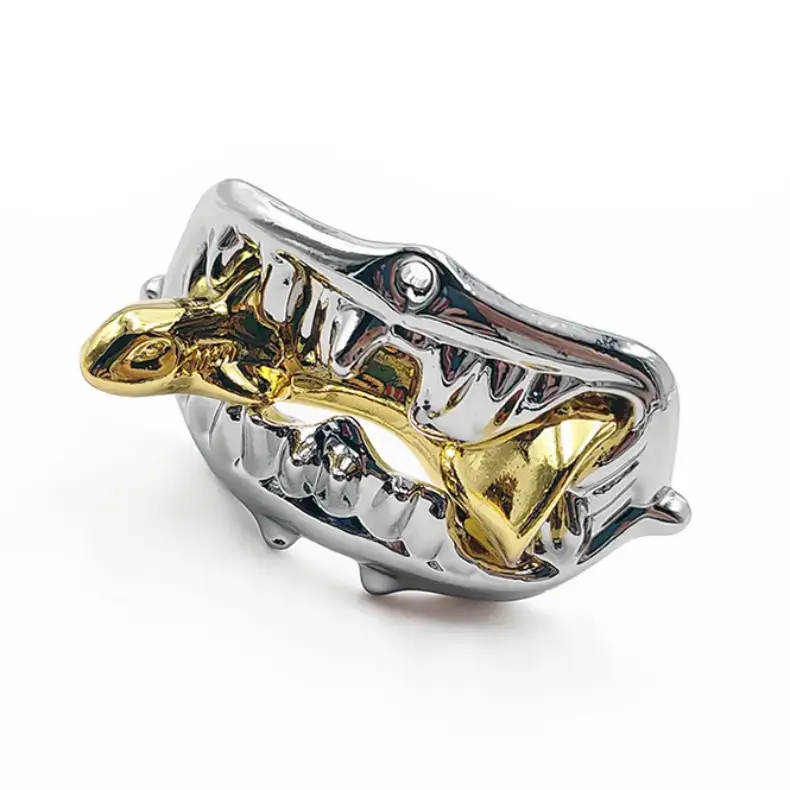
Ready for another two-piece disentanglement? The Monster Mouth Fish Escape Puzzle (above) offers a similar tactile feedback but with a different loop-and-key mechanism. It’s a logical next step to apply your newfound feel for slack and alignment.
For a more polished, collector-grade experience, explore the official Hanayama Cast series. These are the benchmarks of the genre.
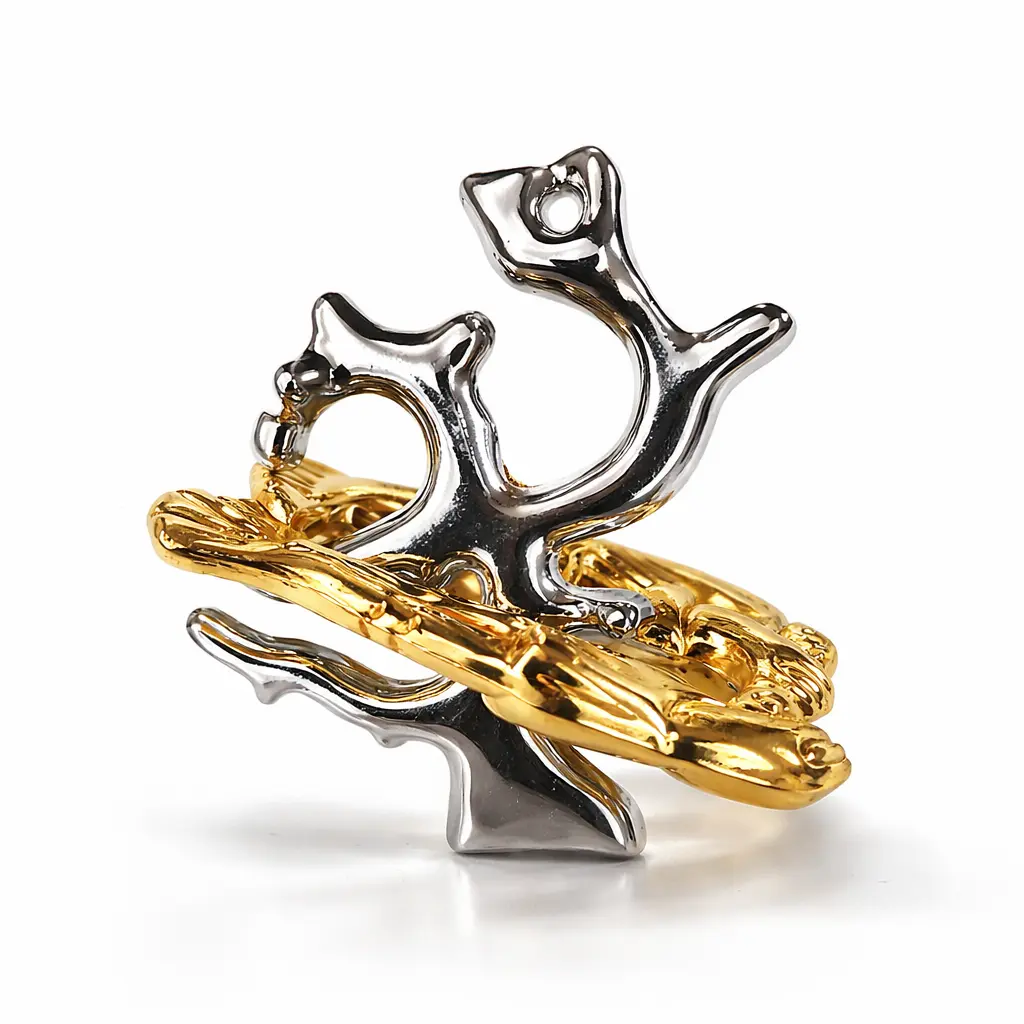
The Gold Fish & Silver Coral Reef Cast is a thematic successor with superior finishing. To explore the full range of these premium puzzles, our Hanayama puzzle guide is an essential resource. Your workbench is ready for its next inhabitant.
Solved & Satisfied: Your Questions, Answered Directly
Yes, this guide solves the exact “Gold Silver Double Fish” puzzle you’ve seen on TikTok and Reddit, where two metallic fish seem impossibly fused. The solution relies entirely on precise alignment, not force, delivering a specific click of tactile feedback when the seam disengages.
Is this puzzle the same as the one in that TikTok/Reddit post?
Almost certainly. The viral posts almost always feature the two distinct gold and silver metal fish, often from brands like “Yiwuer” or “VGEBY.” If your puzzle matches the description and images in our “Quick ID” section, this is the solution you need.
Can you solve it without forcing it and bending the metal?
Absolutely. Forcing it is the enemy. The metal is a zinc alloy—it has a cold, substantial weight but can be deformed under significant misuse. The entire solution is about finding the path of least resistance: the moment of slack. If you meet resistance, backtrack to the last known good position.
What’s the difference between this and the ‘Love Puzzle’ or other two-metal puzzles?
Mechanically, they often use similar “captive segment” or “P-loop” logic. The difference is in the obstruction shape. The fish’s curved tails and angled heads create a specific, narrow seam you must exploit. A puzzle with rings or hearts has a different geometry, making generic “twist and pull” advice useless here.
Is it called the Hanayama Double Fish?
No. Hanayama, a premier puzzle brand, makes the “Double Fish” (Cast Dolce), which is a single piece that splits into two. Our puzzle is two separate pieces from the start. They are different products, though the naming causes constant confusion.
You now possess the complete map: from the initial frustrating tangle, through the critical state transition, to the clean separation and confident reassembly. The puzzle is no longer a locked box but an understood object. For your next tactile challenge, explore our curated list in The Best Metal Puzzles For Adults: A Guide For The Over Thinker. Now, go tangle those fish back together. You’ve got this.