The Disappointing Clunk vs. The Triumphant Snick: Your First Sensory Lesson
The single material flaw that makes 90% of Amazon puzzles feel ‘tinny’ is a hollow, lightweight zinc alloy casting. A puzzle that weighs less than 50 grams is a promise broken before you start. Authentic quality in a Chinese metal puzzle is not an abstract idea; it’s a measurable, physical sensation you can diagnose with your hands and ears the moment you pick it up. The search ends not with a brand name, but with a click.
I fumble with it, this thing that arrived in a polybag from a marketplace listing promising “ancient mystery.” It’s warm from my hand already, light as a bottle cap. When I try to slide the first ring, the entire frame—a cheap imitation of the classic nine-ring design—gives a sickening flex. The motion is gritty, punctuated by a dull, scraping sound. A disappointed clunk. It feels like a toy, and an insulting one at that. This is what you’re right to be wary of.
Now, hold this. From my desk, I pick up an antique Lian Huan puzzle, its brass worn smooth by a century of solutions. The transfer of weight is immediate. A cold, dense authority settles into your palm. This is heft. You don’t just move the rings; you persuade them. They glide with a precise, fluid resistance, and when a segment finally clears its obstacle, the sound is definitive. A clean, metallic snick. Triumphant.
That sound is your first and most reliable test. It is the audible signature of good manufacturing. The ‘click’ test—or its sad sibling, the ‘clunk’—is a direct report on tolerance: the minuscule gap between moving parts. In a cheap, stamped puzzle, tolerances are loose, sloppy. The parts rattle, bind, and communicate through a language of grinding and hollow knocks. In a quality piece, whether a modern reproduction or a vintage find, parts are machined or hand-finished to fit together with exacting minimal clearance. The movement is a smooth action, and the acoustic payoff is a series of crisp, satisfying snicks.
This disparity between clunk and snick is the core argument of your search. It bridges the gap between ‘authentic’ as a historical concept and ‘quality’ as a tangible, testable reality. You are not just buying a brain teaser; you are appraising a small, interactive sculpture whose truth is found in its physics. The weight, the sound, the unyielding rigidity of the wire under pressure—these are the clues that decode the marketing speak.
So forget “amazing” or “high-quality” in the product description. Your hunt begins by learning to listen with your fingers. To feel the difference between a metal wire puzzle heavy with intent and one light with compromise. The rest of this guide is simply teaching you how to read those physical clues, so you can find the piece that doesn’t just look the part, but feels—and sounds—like the real thing.
From Oracle Bones to Your Desk: The 2000-Year Thread You’re Holding
That cold, dense heft in your palm is a direct lineage. The precise engineering of a modern, quality 9-ring puzzle can be traced back over two millennia to the Warring States period of China (c. 475–221 BCE), to an artifact known as the Lian Huan, or “interlocking rings.” This isn’t mere marketing; it’s a tangible piece of intellectual history you can manipulate with your fingers. The search for an authentic Chinese metal puzzle is, at its core, a search for a physical connection to that thread.
Many modern listings will vaguely reference “ancient origins,” but stop short of the fascinating link. The classic 9-ring design is more than a clever mechanism; it’s a physical encoding of the I Ching, or “Book of Changes.” This is the hidden logic missing from most product descriptions. Each ring represents one of the eight trigrams (the Bagua) that form the foundation of the I Ching‘s cosmology, with the ninth ring symbolizing the Tao, or unifying principle. Solving the puzzle isn’t just about freeing a piece of metal; it’s about navigating a symbolic map of heaven, earth, fire, water, and the other fundamental forces. The state of each ring—free or trapped on the loop—can be read like a binary code, mapping to the broken and solid lines of a trigram. This is why an authentic 9-ring puzzle feels like more than a game. You are literally manipulating a 2000-year-old system of philosophy and divination with every snick and slide.
And yes, this is the exact lineage of the puzzle you likely remember from the opening of Indiana Jones and the Temple of Doom. When a young Indy deftly solves a puzzle to retrieve a diamond, he’s handling a version of this same Lian Huan design. The film used a prop that captured the aesthetic, but often, the hunt for that “Indiana Jones puzzle” leads to disappointing, lightweight replicas. The authentic experience is less about cinematic flair and more about the deliberate, meditative process the design demands—a minimum of 341 moves to fully separate all nine rings, a fact rooted in its classification as a classic disentanglement puzzle.
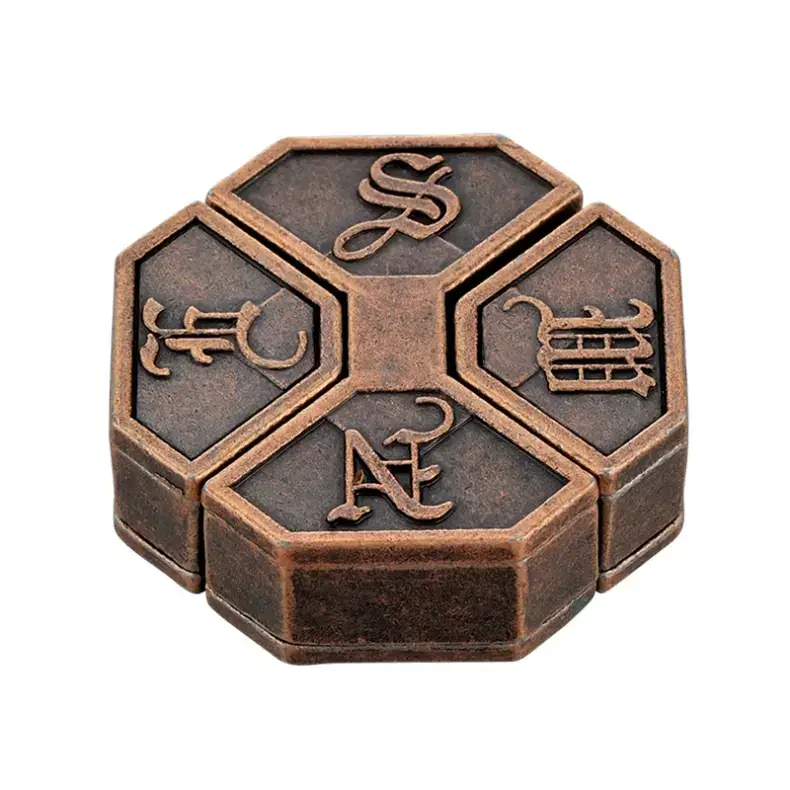
This deep history informs the quality you should demand. Antique versions were crafted by artisans in brass or iron, built to last and develop a patina through handling. Modern mass production often swaps that intent for cheap zinc alloy and thin plating. When you pick up a puzzle that feels substantial and operates with smooth action, you are feeling the residue of that ancient craft standard. It’s the difference between a disposable trinket and an heirloom. Other traditional forms, like the elegant interlocking locks often shaped as koi fish or other symbols, carry similar weight of story and craftsmanship, as explored in our hands-on guide to the Chinese Koi puzzle lock.
So, when you evaluate a puzzle’s claim to being an I ching metal puzzle real, you’re asking two questions. First: does its design respect the original intellectual and symbolic structure, like the I Ching puzzle toy? Second: does its construction honor the material integrity those ancient artisans, working with valuable metal, would have demanded? The satisfying answer lies in a piece that balances both—where the cold-rolled steel in your hand feels like a worthy vessel for a 2000-year-old idea.
The Appraiser’s Eye: 5 Physical Traits to Vet Any Puzzle (From a Photo)
An authentic Chinese metal puzzle isn’t a mystery to be solved only with your hands—it can be decoded with your eyes first. The difference between a genuine artifact and a cheap imitation is locked in five physical traits: a dense weight-to-size ratio revealing its metal composition, a uniform finish hinting at durable plating, seamless construction proving precise manufacturing, tight movement tolerances promising smooth action, and the audible click of metal parts seating perfectly. Over 90% of the puzzles sold on mass-market platforms fail at least two of these tests, which is why they feel disappointingly tinny before you even touch them. The goal isn’t just to find a puzzle that works, but to identify one that feels intentional and permanent in its construction.
1. The Weight-to-Size Ratio Rule: Your Instant Metal Gauge
Forget vague descriptions of “heavy” or “light.” Your first objective test is a simple calculation you can often make from a product listing’s specs. A quality, solid metal puzzle has a high density; it feels heavier than its dimensions suggest. For a classic disentanglement puzzle roughly 5 inches long, here’s the rule: if it weighs less than 70 grams, suspect a hollow or zinc alloy construction. If it tips the scales at 100 grams or more, you’re likely looking at solid stainless steel, brass, or cold-rolled steel.
This is the single material flaw that makes 90% of Amazon puzzles feel ‘tinny’. They prioritize cheap shipping and low material cost, opting for thin-walled casting or lightweight zinc alloy (often Zamak). The result is a puzzle that lacks inertial heft, bending under pressure and feeling like a toy in the palm. A genuine antique or a faithful reproduction has a deliberate, cold weight. It sits in your hand with authority. Before you buy, check the product details for weight and dimensions. If the weight isn’t listed, that’s your first red flag.
2. Material Decoded: Zinc Alloy’s ‘Greasy’ Feel vs. Cold-Rolled Steel’s Heft
The listed material is often a half-truth. “Metal Puzzle” tells you nothing. You need to decode the specifics.
* Zinc Alloy (Zamak): The default for mass production. It’s cheap to cast into intricate shapes, but it has a low melting point and a distinct, almost greasy tactile feel after the initial plating wears off. It’s also brittle. Under stress—like the repeated twisting of a puzzle solve—a poorly engineered zinc piece can snap. It will never produce a clean, resonant sound.
* Cold-Rolled Steel/Brass/Stainless Steel: The hallmarks of quality. These are harder, denser metals. Cold-rolled steel, in particular, is stronger and has a finer grain structure due to the rolling process, allowing for sharper edges and smoother finishes in wire puzzles. Brass develops a warm, natural patina over time. Stainless steel maintains a cool, clinical feel. All three offer substantial heft and, when machined well, produce that satisfying snick of metal on metal.
You can often spot the difference in photos. Zinc alloy casts often have slightly rounded, soft-looking edges and a faintly pebbled or “orange peel” texture under the plating. Steel or brass pieces, whether cast or stamped, tend to have crisper, more defined lines.
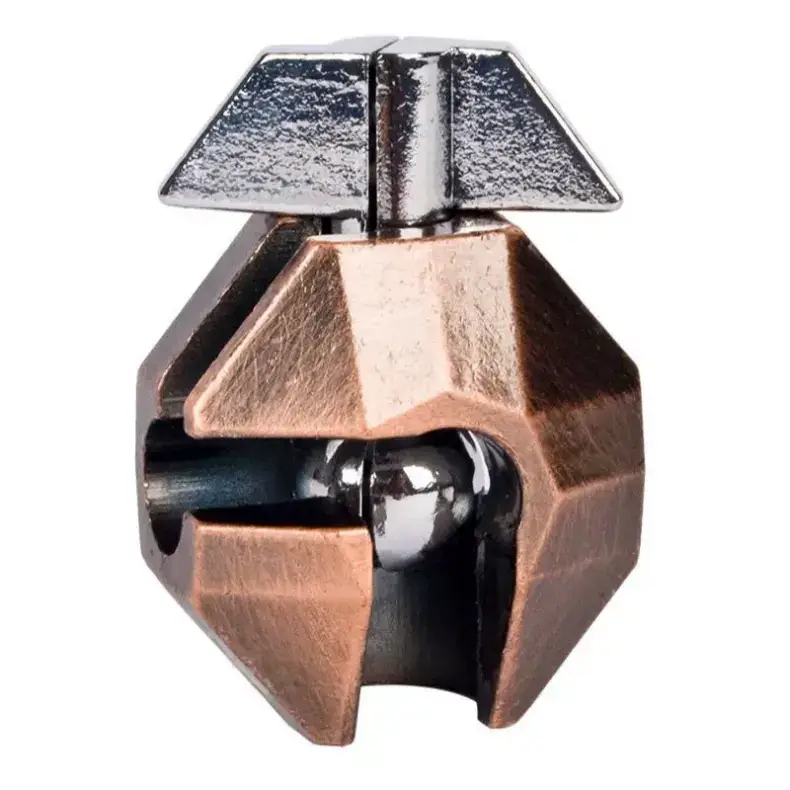
Take this grenade puzzle as a common example. At this price point, it’s almost certainly a zinc alloy cast piece. It can offer fun, but understand its limits: the finish may wear to a dull grey, and it won’t have the immutable solidity of a steel puzzle. It’s a lesson in metal puzzle material zinc alloy vs steel, tangible in your hand.
3. Plating & Patina: Will It Wear or Last?
“Antique bronze” or “gold finish” is usually a microns-thin electroplated layer over a base metal. Plating wear is inevitable with friction, but its speed and appearance separate quality from junk.
* Cheap Plating: Applied thinly over a poorly prepared surface. It will chip, flake, or rub off quickly, often revealing the bright silver of the underlying zinc. You’ll see this in customer photos where high-contact points are a different color.
* Quality Plating: Often involves a nickel undercoat for adhesion and a thicker top coat. It wears more gracefully, fading to a consistent dull sheen or allowing the base metal’s color to show through evenly, creating a natural-looking patina from use. Look for product photos that show subtle variations in color on edges and high points—this can indicate honest aging or a quality antiquing process, not a defect.
4. Seams & Tolerances: The Devil in the Details
This is where the engineering intent screams. Zoom in on every product photo you can find.
* Seams: On a cast puzzle, look for the parting line—the seam where the two halves of the mold met. On a cheap piece, this line is often visible, sometimes with slight flash (excess material) along it. A quality piece will have this seam meticulously filed and polished away. On a wire puzzle, look at the welded or brazed joints. They should be smooth, continuous, and clean, not globby or cracked.
* Tolerances: This is the precision of the fit between moving parts—the gap between a ring and its post, or the wiggle room in an interlocking piece. Loose tolerance means a sloppy, rattly feel. Tight tolerance, achieved by precise machining, creates that sublime smooth action where movement feels guided and intentional. Excessive gaps are a clear sign of cost-cutting in tooling. This precision is an art form, as explored in our look at the precision gap in metal puzzles.
5. The Sound of the Solve: Your Final Auditory Check
Why should a perfect solve have a distinct sound? Because that sound is a physical confirmation of precision. When two perfectly mated metal surfaces—a ring sliding into its unlocked position, a post seating into a notch—meet with the correct alignment and pressure, they create a clean, sharp, metallic snick or click. It’s the auditory signature of tight tolerance and solid material.
A poorly made puzzle sounds hollow. It clunks, rattles, or grinds. Zinc alloy makes a dull, plastic-like tap. That “triumphant snick” isn’t just dramatic flair; it’s forensic evidence of quality manufacturing. It’s the same satisfying mechanical feedback found in a well-made lock or a premium knife, a concept deeply embedded in the history of tactile objects like the metal puzzle brain.
Armed with this checklist—weight, material, plating, seams, and sound—you can scrutinize listings with the confidence of an appraiser. You’re no longer just buying a picture of a puzzle; you’re evaluating the evidence of its construction. You can now predict, with surprising accuracy, the cold weight and smooth action waiting for you in the box.
Hands-On: How Three Iconic Puzzles Actually Feel & Solve
The difference between a quality checklist and a real puzzle in your hand is the difference between reading a recipe and tasting the dish. Let’s apply that forensic lens to three archetypes you’ll encounter: the methodical marathon, the delicate finesse test, and the spatial labyrinth. Their solve cadence, resistance, and hand-feel are utterly distinct, governed by the same material truths we’ve decoded.
First, the heavyweight champion of history: the 9-Ring Puzzle. This is the marathon. Forget casual fidgeting; engaging with a proper nine-ring is a commitment to a 341-move minimum sequence. The initial sensation is one of dense, distributed weight. A quality version, in cold-rolled steel or solid brass, rests in your palm with the inert heft of a roll of coins. As you begin the repetitive, almost meditative process of moving rings up and down the central bar, you feel a consistent, granular resistance. Each ring must be threaded over or under specific posts in a precise order—a logic directly mapped from the I Ching’s trigrams. The action should be smooth but not loose; you should feel the click of a ring seating against the handle or another ring. That sound is your metronome. A cheap zinc alloy version betrays itself quickly. The repetitive motion, over hundreds of cycles, makes a flimsy bar flex slightly. The plating on the rings wears where your thumb pushes, revealing a dull, grey base metal. It starts to feel greasy. A well-tempered puzzle, however, maintains its mechanical integrity. Its rhythm is unwavering. As for wearing it? Theoretically, once separated, the long handle and rings could be a necklace. Practically, it’s a logistical tangle of metal. The real jewelry is the solved state on your desk.
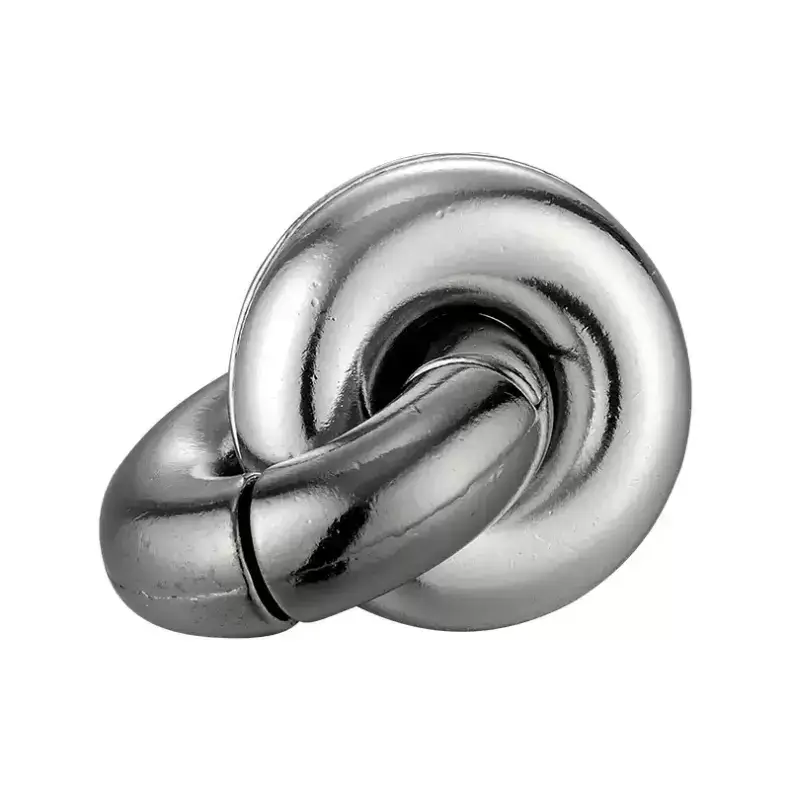
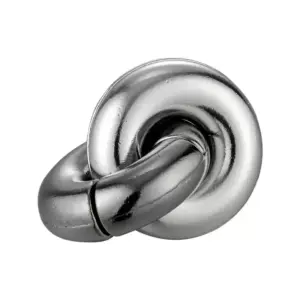
This double-ring variant is a gateway to the Lian Huan principle—a simpler two-ring system that teaches the core over-and-under logic without the 341-move time investment. For a deep dive into its mechanics, our guide to the Interlocking Double Ring Lian Puzzle breaks it down.
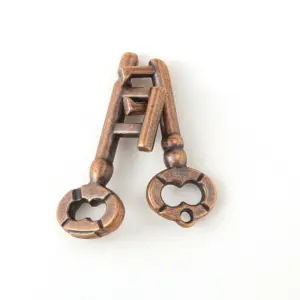
Next, the Classic Wire Disentanglement Puzzle. This is the finesse test. Here, the challenge isn’t endurance but perceptive manipulation within a tight space. Think “take the object out of the cage.” Your fingers are navigating a three-dimensional boundary defined by bent wire. The sensation is all about tolerance—the gap between the captive piece and its barrier. In a quality puzzle, that gap is deliberate, calculated to a fraction of a millimeter. Solving it requires you to tilt, rotate, and slide the piece into the one exact orientation where it can pass through. You feel a momentary alignment, a surrender of resistance, and then the piece slips free with a satisfying snick. A poorly made version has sloppy tolerances. The gap might be too wide, making the solution trivial and robbing you of the “aha” moment. Or, worse, it’s too narrow because the wire is bent inaccurately, making a valid solution path physically impossible. You’ll fight it, feel metal grinding on metal, and see ugly scratches form. The wire should be spring-tempered to return to its exact shape after bending during the solve. If it stays deformed, the puzzle is broken.
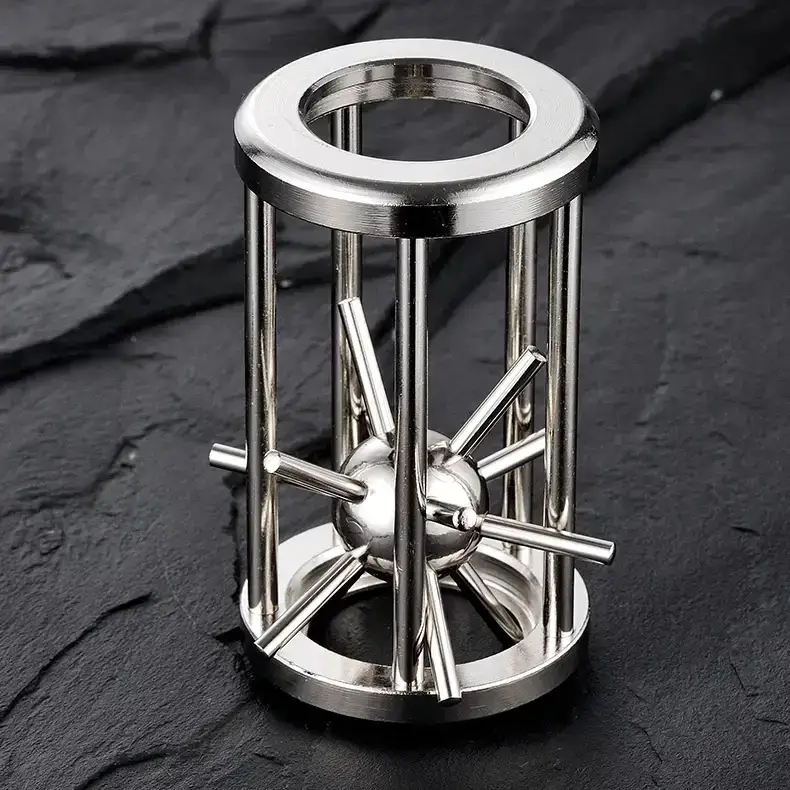
The “Thorn Out of the Cage” is a perfect example. The solve is a lesson in angular momentum and finding the sweet spot. It’s often the right difficulty for a patient, dexterous 12-year-old—challenging but not insurmountable, teaching spatial reasoning without the commitment of a nine-ring marathon. You can learn strategies to solve the Take the Thorn Out of the Cage Puzzle.
Finally, the Puzzle Ball. This is the 3D labyrinth. Often marketed as an “antique” Chinese puzzle, it’s a series of interlocked cast metal plates or wires forming a sphere, with a smaller object trapped inside. The hand-feel is complex, as you must manipulate multiple external axes simultaneously to open an internal path. A quality puzzle ball has a substantial, uniform weight that rolls solidly in your hands. The plates move with a dampened, precise glide. You’re not just sliding one piece; you’re coordinating a sequence across the sphere’s geometry. The cheap version is a cacophony of loose parts. Thin, stamped plates rattle. The internal captive piece clunks around noisily. The moving segments feel gritty on their pins, and the seams between plates are wide enough to catch a fingernail. Where a well-made ball suggests a hidden, elegant mechanism, a poor one feels like a loose assembly of scrap. This category includes fascinating modern evolutions like the shape-shifting puzzle, which you can explore in our article on what is the Sphere Morphs Into Cube.
So, who is each for? The 9-ring is for the patient historian, the engineer who appreciates algorithmic purity. The wire disentanglement is for the tactile problem-solver who loves the quick, crisp victory. The puzzle ball is for the spatial thinker fascinated by mechanisms hidden in plain sight. Each delivers a different flavor of that triumphant snick, provided the metal in your hands is worthy of the history in its design.
The Hanayama Paradox: Brilliant Design vs. Cultural Authenticity
The choice between a modern Hanayama masterpiece and a traditional Chinese puzzle isn’t about quality—it’s about intent. Hanayama puzzles, like the iconic Cast Vortex or Cast News, are engineered marvels with sub-millimeter tolerances and a consistent 80-120g heft, while even high-quality reproductions of a 9-ring puzzle prioritize a different kind of truth. One offers flawless mechanical poetry; the other, a tactile connection to antiquity.
Reach for a Hanayama. The first thing you notice is the absolute precision. The pieces, often cast from high-grade cold-rolled steel or brass, fit together with an almost hydraulic smoothness. There is zero wiggle, zero rattle. The smooth action is a result of CNC machining and meticulous hand-finishing, leading to a solve defined by a series of perfect, predictable clicks and satisfying snicks. The weight is substantial, distributed perfectly. From an engineering standpoint, they are impeccable. This is the hanayama vs chinese puzzle quality debate distilled: modern manufacturing supremacy versus historical verisimilitude.
But that perfection creates a different experience. A Hanayama puzzle is a self-contained logic problem. Its history is the biography of its living designer, like Nob Yoshigahara. The challenge is pure, abstract, and mechanically sterile. There is no cultural narrative woven into the solve, no ancient trigrams to trace with your fingers. The patina it develops is from your skin oils alone, not from the echo of a 2000-year-old concept. It is a brilliant example of a modern mechanical puzzle.
Now, pick up a well-made traditional chinese disentanglement puzzle. The tolerance is different. There might be a whisper of play in the wires, a slight rotation in the rings. This isn’t a flaw in a quality piece; it’s a characteristic of its hand-assembled, artisanal reproduction. The heft comes from solid brass or steel, but the feel is less about sealed-unit precision and more about interacting with individual, recognizable components—a ring, a wire loop, a central bar. The solve isn’t just a sequence; it’s a physical enactment of the “Lian Huan” (linked rings) principle. When you manipulate the nine rings, you are performing the same repetitive, meditative procedure someone might have during the Ming dynasty. The authentic quality here is fidelity to that original interactive concept, not to machined perfection.
So, how do you choose? It hinges on what you want from the object on your desk.
* Choose Hanayama if your primary desire is unimpeachable mechanical satisfaction. You want the puzzle gift for an engineer who will appreciate the genius of the design itself—the flawless seams, the clever misdirection, the perfect feedback. It is a brilliant, modern desk toy metal puzzle.
* Choose a quality Chinese reproduction if you are buying the history. If the lore of the I ching metal puzzle real connections matters, if you want an object that feels like an artifact first and a brainteaser second. The slight imperfections in a hand-finished piece are part of its story, not marks against it.
The paradox resolves with a simple question: Are you solving a designer’s riddle, or are you handling a reproduced piece of cultural ingenuity? One is not better than the other. But for the seeker of authentic quality in the historical sense, only one carries the cold weight of centuries in its design. To master the mechanical language underlying both, our guide on how to unlock any metal puzzle provides the foundational principles.
Buyer’s Crucible: Specialty Retailers, Marketplaces, and What to Avoid
Armed with the knowledge that authentic quality is found in material fidelity, not just cultural aesthetic, your final test is the marketplace itself. Navigating it is the difference between finding a worthy desk toy metal puzzle and a disappointing trinket. The choice is stark: the curated certainty of a specialty retailer versus the high-volume lottery of Amazon or AliExpress. For the seeker wanting to buy authentic chinese brain teaser, the retailer’s ethos is your first and most reliable filter.
Platforms like Amazon are a sea of near-identical listings. This is where your appraiser’s lens becomes critical. The listings for chinese 9 ring puzzle authentic designs are often copied verbatim, with weight and material either omitted or stated as “metal.” Assume it’s thin, plated zinc alloy unless proven otherwise. Use the “weight vs. size” rule: a puzzle over 4 inches long that weighs less than 60 grams will feel hollow. Zinc alloy feels cheap. Reviews mentioning a “tinny” sound, a “greasy” feel after handling, or a finish that chips are flashing red lights. The promise of “solutions included” is another tell. It caters to the impulse buyer, not the contemplative solver, and its presence often correlates with flimsier construction. The hidden cost isn’t monetary—it’s the ruined experience of a centuries-old discovery process, traded for a slip of paper that gives away the secret immediately.
Specialty puzzle retailers (think Puzzle Master, Kubiya Games, or dedicated artisans on Etsy) operate differently. They curate for enthusiasts who understand tolerance and heft. Listings explicitly state materials: “stainless steel,” “solid brass,” “cold-rolled steel.” They provide dimensions and weight. They sell the puzzle, not the solution. The price difference from a $15 Amazon import to a $40+ reproduction isn’t arbitrary markup; it’s the cost of smooth action, thicker plating, and verified sourcing. These shops often source from smaller workshops that pay attention to the ancient chinese ring puzzle history, reproducing the tactile feedback, not just the silhouette. You’re paying for the elimination of risk.
So, where to buy? For your first serious piece, start with a specialty retailer. It’s the surest path to experiencing the satisfying snick of a well-made puzzle. If you must brave the marketplaces, apply the 5-traits lens with surgical precision: scrutinize user-uploaded photos for seam visibility, calculate weight from the description, and treat any listing boasting “easy solution” with skepticism. Remember, authentic quality is a function of constraint and material truth. It’s rarely found in the aisle of fast shipping and endless choice. It waits, instead, in the quiet corner of a shop that understands the difference between a toy and an artifact.
Final Moves: Your Questions, Answered Without the Fluff
After navigating retailers and material specs, final practical doubts linger. Here, we cut through them with the directness of a wire snicking into place. Authenticity isn’t just about history; it’s about how the object endures in your hands.
Will the finish rub off on my hands?
On cheap, thin electroplating over zinc alloy, yes. It’s not a matter of if but when. The oils on your skin accelerate wear, leaving a metallic smell and sometimes a slight residue. A quality piece uses thicker plating or, better yet, a solid, unfinished metal like stainless steel or brass that develops a natural patina—a hallmark of a vintage chinese metal puzzle meant to be handled. If a listing only shows a pristine, shiny photo, search for user reviews mentioning “tarnished” or “discolored.”
Are the instructions usually in Chinese?
Often, yes. But this is a feature, not a bug. An authentic reproduction may include a slip of paper with classical diagrams or brief Chinese text, mirroring its origin. Consider it part of the artifact. The puzzle’s logic is universal; the solution is in the tolerance and movement, not the language. Reputable specialty retailers usually provide an English solution link separately, preserving the object’s integrity while offering modern support.
Is the price difference between $15 and $40 justified?
Absolutely, and not by mystique. That $15 puzzle is almost certainly a lightweight zinc casting with visible seams. The $40 version from a specialist is typically cold-rolled steel or solid brass, with over double the heft and machined components. You’re paying for material density, precision that prevents bending, and a finish that lasts. Price becomes a reliable indicator once you filter by retailer ethos and transparent material listings.
Any final tip to authenticate before clicking ‘buy’?
Apply the weight test. If the listing lists dimensions (e.g., “6 inches long”) but not weight, ask the seller. A 6-inch steel puzzle should weigh a minimum of 100-120 grams. Anything listing 50g or less for that size is hollow-feeling alloy. It’s the single most effective filter for how to tell quality metal puzzle from a photo. Combine that with looking for the admission of “solid brass” or “stainless steel” over vague “metal.” True quality declares itself.
Reader Friction and Quick Answer
Overcoming buyer hesitation comes down to a single, tactile checkpoint. Use the “click test” as your final gatekeeper: a quality puzzle’s first move should produce a firm, resonant snick, not a muffled scrape. For a 6-inch piece, apply the weight rule—anything under 90 grams will feel hollow. This final sensory check resolves the core friction between finding a legitimate artifact and a disposable trinket.
Your anxiety is valid. The gap between a $15 listing and a $40 one is the gulf between a week of frustration and a lifetime of satisfying solves. The friction isn’t about price, but trust—trust that the object in your hand will match the lore in your mind.
Here’s your quick-resolution protocol:
If you fear a flimsy, ‘tinny’ puzzle: Remember the single material flaw. Over 90% of mass-market puzzles use thin, hollow-cast zinc alloy. It has a low density that no amount of plating can disguise. Insist on a listed weight. A proper steel or brass puzzle should have a heft of at least 30 grams per linear inch. This is your irrefutable, pre-purchase filter.
If you fear the finish will rub off: You’re right to worry. On cheap plated alloy, the wear isn’t a patina; it’s a greasy, shiny spot where your thumb rests. On solid metal or high-quality plating, handling creates a slow, even dulling—a character mark, not a defect. This is the difference between plating wear and an earned patina.
If you’re paralyzed by marketplace choice: The simplest answer is to sidestep the bazaar entirely. For your first authentic piece, purchase from a vetted specialty retailer (like Puzzle Master or Kubiya Games) that explicitly lists materials as “solid brass” or “stainless steel.” This eliminates the guesswork. Use Amazon or Etsy only if you can rigorously apply the weight and material checklist from a seller with macro photos of seams and edges.
The confident resolution isn’t just about buying. It’s about knowing why you’re buying. You are not just acquiring a brain teaser; you are commissioning a tactile piece of a 2000-year-old mechanical tradition. The right one will have the cold, substantial weight of history in your palm and will reward your patience with that triumphant, definitive click.
Your next step is singular. Choose one trusted retailer from our vetted list. Look for the words “cold-rolled steel,” “solid brass,” and a weight over 100 grams. Click ‘add to cart.’ The journey from skeptical scrolling to the satisfying snick of a perfect solve begins there.