The Sickening Ping: When Your Cast Puzzle Breaks for Good
Yes, a cast metal puzzle can absolutely break for good. The brittle snap of a thin zinc alloy wire under modest force is the definitive end for many a cheap puzzle, a failure point measured in mere millimeters of over-rotation. This isn’t about solving difficulty; it’s about a fundamental mismatch between expected durability and actual material strength.
You know the sound. It’s not the satisfying clack of precision parts mating. It’s a sharp, high-frequency ping that instantly freezes your hands. You’ve been working on a stubborn disentanglement loop, applying gentle, exploratory pressure, and then—it happens. A slender arch, the crucial connector between two heavier cast pieces, shears clean off. In your palm, you’re no longer holding a puzzle. You’re holding a broken toy and a mild sense of betrayal.
This is the core anxiety for anyone who manipulates these objects beyond casual admiration. It’s the fear that the “metal” in the product description was a polite fiction for “metal-flavored pot metal.” The pain points are physical and emotional: the chrome plating on your favorite Hanayama that now shows brass-colored islands of wear at every friction point. The loop on a bargain-bin puzzle that arrived with a subtle bend, making solution paths feel sloppy and false. The dread of handing a puzzle to a friend with fidgety, aggressive hands, knowing its fate hinges on a single over-enthusiastic twist.
My own breaking point was a generic “Infinity” puzzle. The wire was laughably thin, the cast hubs porous. It snapped during what felt like a routine maneuver. That moment launched my quest for tank-like quality. I stopped asking, “How hard is it?” and started asking, “How is it made?” What’s the alloy? Where are the stress points? Is this milled from solid stock or cast in a mold with seams that act as fault lines?
This search revealed a stark truth the marketplace obscures: All metal puzzles are not created equal. The difference between a fragile ornament and a lifelong manipulative companion isn’t branding or price alone—it’s in the material science. A puzzle built for solving-and-resolving is an exercise in controlled stress. Every twist applies torque, every slide creates friction. A durable puzzle isn’t just strong; it’s over-engineered for the specific forces of human curiosity and impatience.
This is why the search for a “cast metal puzzle won’t break” often leads to frustration. You’re not just looking for a metal puzzle; you’re looking for one whose design acknowledges real-world physics. You need puzzles for aggressive hands, your own included. The journey from that sickening ping begins with understanding why it happened in the first place—and what truly stands in its place.
(A quick field test: the “Tap Test.” Flick a puzzle piece with your fingernail. A cheap zinc alloy gives a dull thud. Solid stainless or brass rings with a clear, bright ping—a tiny bell of quality. It’s the first clue you’re holding something different.)
Metal vs. Metal: Why All ‘Cast Puzzles’ Are Not Created Equal
The fundamental difference in durability comes down to material choice and manufacturing process. Over 95% of mass-market “cast” puzzles, including the famous Hanayama line, are made from a zinc alloy (often Zamak) that is die-cast and then plated. A small fraction from independent makers are milled from solid stock of stainless steel or aluminum—a distinction that creates a vast gulf in longevity, heft, and resistance to wear.
Zinc alloy is chosen for its excellent ability to capture fine detail in a mold and its low melting point, making it cheap to produce. But this affordability trades off with material integrity. Zamak is inherently brittle; it has little ductility, meaning it prefers to snap rather than bend when forced past its limit. The plating—chrome, gold, black oxide—is a microns-thin skin for aesthetics and minor corrosion resistance. With aggressive fidgeting, this plating wears off at high-contact edges and stress points, revealing the dull grey alloy beneath. This is the notorious “cast puzzle plating wear” documented in countless Reddit threads, especially on models like the Hanayama Equa with its sliding mechanisms. The material underneath is also susceptible to oxidation if the plating is compromised, leading to a powdery white patina of zinc oxide.
Now, hold a puzzle milled from solid stainless steel. The difference is immediate. Stainless doesn’t plate. It is. Its strength and corrosion resistance are intrinsic properties of the solid material. There is no skin to wear through; any scratch or scuff is just a mark on the same consistent metal. This is the core appeal of a solid metal disentanglement puzzle from a maker like LESONG or bespoke machinists. The stainless steel brain teaser puzzle is often heavier (“heft” is your friend here), and because it’s machined from a block, it lacks the potential weak points of casting seams. Aluminum, while lighter, offers similar benefits of homogeneity and excellent strength-to-weight ratio, and it develops a natural, even oxide layer that protects it.
The manufacturing method is telling. “Cast” implies pieces formed by pouring molten metal into a mold. “Machined” or “milled from solid stock” means a block of metal was carved into shape by a CNC machine, resulting in superior machining tolerances and density. A cast piece can have internal porosity or subtle warping; a machined piece is predictably solid. (An insider tip: many high-end puzzles are actually investment cast and then precision machined to perfect the interacting surfaces—the best of both worlds for detail and strength.)
So, how can you tell before you buy? Beyond the spec sheet, use the Tap Test. With your fingernail or a pen, gently flick a component. A plated zinc alloy piece will produce a dull, dead thud. A solid stainless, brass, or aluminum piece will answer with a bright, resonant ping—a tiny bell of quality. It’s a direct audio cue of material density.
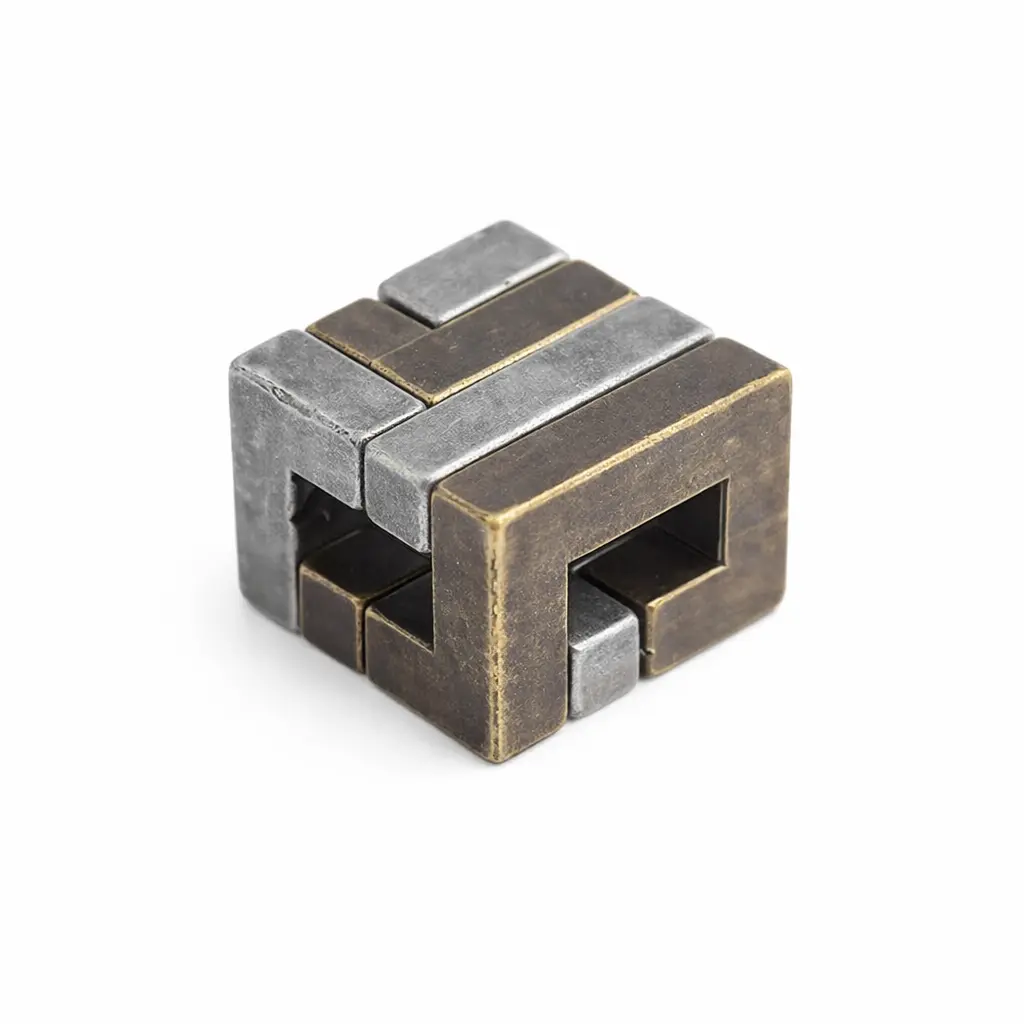
Cast Coil Pocket Puzzle — $18.99
Consider the Cast Coil above. Its intricate, twisted design is a perfect example of a shape made for casting. While fun, the thin, looped wires common in such disentanglement puzzles are precisely where the brittleness of zinc alloy becomes a liability under torque. For a deeper dive into this category from a hands-on perspective, our guide on the machinist’s review of metal disentanglement puzzles underscores this point through a professional lens.
Ultimately, the choice isn’t about good vs. bad. Plated zinc puzzles like Hanayama’s offer incredible design variety and accessibility, and many will last for years with careful handling. But for the user seeking a metal puzzle that doesn’t bend, that feels indestructible in the hand, and whose finish won’t degrade with decades of use, the path points directly to solid, unplated metals. It’s the difference between buying a puzzle and investing in a tool for thought—one whose physical form is as permanent as the solution is elusive. With this material foundation laid, we can now build our Durability Matrix to evaluate specific puzzles not just by what they’re made of, but by how they’re put together.
The Anatomy of an Unbreakable Puzzle: A Metallurgy Primer
The durability of any cast puzzle hinges on three interlocked factors: the intrinsic strength of its material, the precision of its construction, and the intelligence of its mechanical design. A truly unbreakable puzzle isn’t just thick metal; it’s a synergy where, for example, a high-tolerance mechanical puzzle in solid stainless steel (density ~7.5+ g/cm³) distributes stress away from thin, vulnerable joints. The difference between a puzzle that lasts a week and one that lasts a lifetime is often a millimeter of thoughtful engineering.
Material choice is the bedrock. As we established, not all metals are equal. Zinc alloy, while excellent for capturing fine detail in casting, is relatively soft and brittle. It can be durable—many classic Hanayama puzzles prove this—but its limits are lower. A puzzle made from this, especially one with thin protrusions, is susceptible to bending if forced and may snap at a stress point under extreme torque. This is the core failure behind the “metal puzzle that doesn’t bend” search. The answer, often, is moving up the periodic table.
Solid stainless steel and aluminum represent the heavy-duty cast puzzle ideal. Stainless doesn’t plate. It is. Its resistance to corrosion and superior tensile strength mean it can be machined thinner without sacrificing integrity, and it will develop a wear patina, not flaking chrome. Aluminum, while lighter, offers excellent strength-to-weight and is often used in thicker, chunkier profiles for a satisfying, fidget-proof heft. These materials are more expensive to source and machine, which is why they’re the domain of independent makers or specialized series. The question “Is stainless steel worth it?” boils down to your definition of value: it’s paying upfront for a tool that will never degrade in your hands.
But material is only half the story. How the metal is formed is critical, answering a key user question. A ‘cast’ puzzle is created by pouring molten metal into a mold. This is cost-effective and allows for incredibly complex, organic shapes. However, the process can introduce microscopic porosity (tiny voids) that weaken the structure, and the as-cast surface often requires grinding or plating, which can wear. A ‘machined’ puzzle, conversely, is milled from solid stock—a block of metal. This is the essence of over-engineered. Machining removes material to create the form, resulting in a denser, more homogeneous piece with superior strength and breathtakingly precise, sharp edges. The tolerances—the gaps between moving parts—are typically far tighter in a machined puzzle. This doesn’t just make solving more precise; it eliminates “play” or wiggle, which is the primary cause of long-term wear and finish degradation as pieces rub.
This brings us to Joint Integrity and Stress Points. A puzzle’s design is its destiny. Examine any puzzle. Where are the thin necks, the small loops, the sharp corners? These are stress concentrators. A brilliantly difficult puzzle might rely on a hair-thin wire or a delicate hook; by nature, it is fragile. Durability-minded designs avoid these or make them thick enough to withstand human force. Look for generous radii on corners and robust cross-sections on any load-bearing element. The best heavy-duty cast puzzle designs feel inevitable in your hand—there are no obviously frail elements, and the motion feels constrained by design, not by fear of breaking.
Finally, consider the finish—the surface you touch. There’s a stark divide here. Plating (chrome, gold, gunmetal) is a thin coating electrochemically bonded to the base metal. Under constant friction—the endless twisting of a solve—it will wear, especially on high-contact edges. Reddit threads are filled with users showing their Cast Equa’s worn-down chrome to a brass-like shine. Patina, on the other hand, is the metal itself changing color. On brass, bronze, or untreated steel, handling creates a natural, even darkening that many collectors cherish. It’s not damage; it’s a history of use. A powder coat or thick enamel is another durable option, though it can chip if the underlying metal is struck.
So, how do you apply this in a store? Use the Tap Test. Hold the puzzle loosely in your palm and tap a piece with a fingernail or a key. A plated zinc puzzle will produce a higher-pitched, tinny tink. A solid stainless or thick aluminum piece will respond with a dull, low-frequency thud—the sound of density and mass. That’s the sound of durability. (For more on evaluating puzzles from a hands-on perspective, our veteran’s guide to metal puzzles that don’t break builds on this tactile approach.)
Understanding this anatomy turns you from a passive buyer into an informed evaluator. You’re no longer just looking at a shiny object; you’re assessing grain structure, load paths, and wear characteristics. This knowledge empowers you to see past the marketing and directly address the core anxiety of breakage. With this metallurgical primer as our foundation, we can now construct a meaningful framework to judge specific puzzles—not by their difficulty stars, but by their real-world resilience.
The Durability Matrix: Ranking Brands by Build, Not Just Difficulty
Armed with the fundamentals of material science, we can now move beyond theory and apply a critical lens to the brands on the shelf. The key question shifts from “What is this made of?” to “How will this hold up in my hands over the next decade?” To answer this, I developed a Durability Scorecard based on three core pillars: Material Density (mass and alloy integrity), Joint Integrity (the soundness of connections and moving parts), and Finish Longevity (resistance to wear, tarnish, and plating loss). This matrix ignores difficulty stars to focus purely on physical robustness, a gap no existing guide fills.
Let’s apply the scorecard. We’ll judge not by marketing, but by the cold, hard reality of machining tolerances and metal fatigue.
Hanayama Cast: The Mass-Market Benchmark (With Caveats)
As the dominant brand, Hanayama sets expectations. Their puzzles are almost exclusively cast zinc alloy, plated for finish. This is where the Durability Scorecard reveals stark differences within a single brand line.
* Material Density: Moderate. Zinc alloy is decent, but the heft comes more from clever, hollow design than solid metal. It feels substantial but not indestructible.
* Joint Integrity: Variable, and this is critical. Puzzles with interlocking loops or thicker components, like Cast Laby or Cast News, are famously robust. However, puzzles reliant on thin wires or small, pressure-fitted pins are known failure points. Reddit is littered with reports of the Cast Equa’s slender chrome-plated loops developing “play” or even snapping under persistent, misdirected force. The intricacy that makes a puzzle difficult often directly compromises its joint integrity.
* Finish Longevity: The brand’s Achilles’ heel for collectors. The chrome, gold, or antique finishes are electroplated coatings. With vigorous fidgeting, a high-tolerance mechanical puzzle like Cast Marble will show wear on its high-contact ridges within months, revealing the softer, silvery zinc beneath. This isn’t a defect—it’s the nature of plating. As one Reddit user put it, “My Equa looks battle-worn, which is cool, but I wish I knew the ‘antique bronze’ wasn’t the base metal.”
Huzzle & Beepuzzled: The Plated Contenders
These brands often occupy a similar price and design space to Hanayama. The beepuzzled vs hanayama durability debate is nuanced.
* Material & Construction: They typically use similar zinc alloy casting. The difference often comes down to plating thickness and quality control. Some Huzzle models feel marginally thicker in the hand, but without specification sheets, it’s a gamble. Their joint integrity faces the same fundamental limitations as any thin, cast zinc piece.
* Key Insight: Don’t assume a higher price point within this tier buys more durability. It often pays for licensing (e.g., movie-themed puzzles) or more complex casting, which can introduce more stress points.
Independent Metal Smiths: The “Buy It For Life” Tier
This is where the paradigm shifts. Makers like Creative Crafthouse, PuzzleMaster’s in-house machined line, or artisans on Etsy work in solid materials: milled from solid stock stainless steel, aluminum, or brass.
* Material Density: High to Exceptional. A puzzle milled from a solid block of 304 stainless isn’t just heavy; it has a monolithic feel. There are no hollow cavities. Stainless doesn’t plate; it is. Its corrosion resistance is inherent.
* Joint Integrity: Supreme. Machining allows for over-engineered connections. Pins are thicker, loops are integral to the piece, and tolerances are so tight that wear over time is negligible. The solve is often harder because there’s no “slop” to guide you falsely—a sign of enduring quality.
* Finish Longevity: Unmatched. A brushed or polished stainless steel or aluminum surface may scratch microscopically, but it won’t wear off. It develops an honest user patina vs. plating wear. Some makers, like those crafting solid metal disentanglement puzzles, even offer a lifetime warranty—a claim impossible for plated zinc.
* The Trade-off: Cost and availability. You’re paying for raw material weight and precision CNC machine time, not mass casting.
The “Heavy-Duty” Niche: LESONG and Tactical Alternatives
Brands like LESONG, which market 9-packs as “step-resistant,” represent a fascinating hybrid. They often use heavy-duty 4.5 stainless steel wire and beech wood. Their Durability Scorecard is lopsided:
* Material Density: High for the metal components.
* Joint Integrity: Moderate. Construction is often via welding or mechanical fasteners, which can be points of failure if poorly executed.
* Finish Longevity: High (again, stainless is stainless).
They are puzzles for aggressive hands and might be the only cast puzzles safe for kids who are rough, but they often sacrifice elegant design and sophisticated solving for pure brute-force resilience.
The matrix clarifies a crucial hierarchy. If your goal is an indestructible desk puzzle you can solve and fidget with for a lifetime without a hint of wear, your path points to machined stainless steel from an independent maker. If you desire iconic design with the understanding that a patina of use is part of its story, Hanayama’s more robust models are excellent. But you now know to avoid their delicate-wired designs if durability is your prime concern. This framework transforms a confusing marketplace into a clear set of engineering trade-offs, finally providing the confidence to choose based on build, not just bragging rights.
(For a curated list of puzzles that excel under this harsh, durability-focused lens, our guide to ruthless cast puzzles for connoisseurs applies this matrix to select only the most resilient contenders.)
The Over-Engineered Five: In-Depth Reviews of ‘Indestructible’ Contenders
After applying the Durability Matrix, five puzzles emerge as champions of resilience, each representing a different philosophy of “indestructible.” They share one key trait: their designs prioritize structural integrity over cost-saving, often being milled from solid stock. This isn’t a ranking, but a curation for specific, durability-minded use cases.
For the Constant Fidgeter: The 6-Piece Steel Ball Pyramid
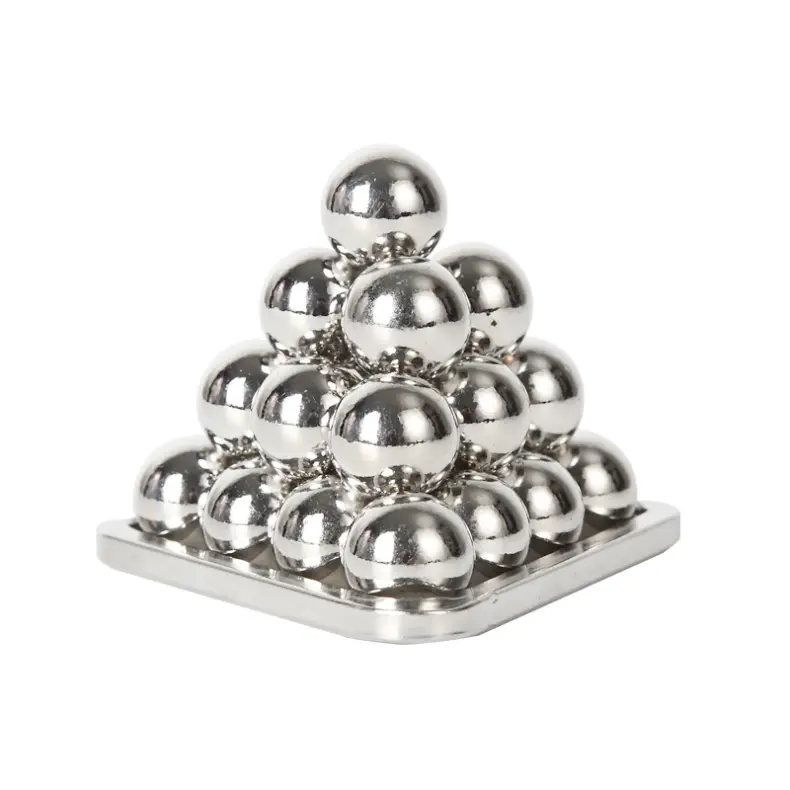
This is the quintessential indestructible desk puzzle. Its durability comes from a brutally simple premise: six solid stainless steel balls and a pyramidal frame. There are no thin wires, no plating to wear, and no seams. It’s milled from solid stock, leaving machining marks that speak to its raw, unfinished strength. The solving mechanism relies on gravity and geometry, not fragile interlocks. As a fidget object, it’s peerless; you can roll it in your palm, spin the balls in their tracks, and even (gently) drop it on a hardwood surface with only an authoritative clunk. It’s the definition of fidget-proof. The only “wear” you’ll ever see is a natural, even polishing on the contact points of the balls—a patina earned through play, not a flaw.
For the Collector Seeking a Patina: Hanayama Cast Marble
If you must know: this is the most durable Hanayama puzzle. The answer lies in its sublime simplicity. Two thick, labyrinthine plates of solid Mazac (zinc alloy) are sandwiched with a steel ball bearing inside. There are no protruding wires, no delicate interlocking hooks. Its stress points are the massive, rounded edges of the plates themselves. The factory finish is a matte, almost gritty coating that, over years of handling, wears down to a soft, shiny bronze on the high points, revealing the alloy beneath in a beautiful, earned gradient. Reddit users don’t report breakage with the Marble; they report a satisfying evolution. It’s a tank disguised as an elegant artifact.
For the Stress-Tester: The LESONG 9-Pack
This is the brute-force option. Marketed as throw and step-resistant, this set answers the question: “Are there any cast puzzles safe for kids who might be rough with them?” The pieces are heavy-duty 4.5mm stainless steel and beech wood. The durability here is in sheer material thickness and simplistic weld-point construction. They are not finely machined; tolerances are looser, which actually prevents metal-on-metal galling under force. They’re clunky, loud, and lack finesse, but you can solve them, toss them in a drawer, and forget about them for a decade. They are the wrench in a toolbox—functional, resilient, and utterly without pretense.
For the Machining Purist: The Four-Square Lock
This puzzle is a lesson in high-tolerance mechanical puzzle engineering. Made from solid aluminum and stainless steel pins, it’s milled from solid stock, not cast. This means zero porosity, uniform grain structure, and incredible strength for its size. The precision is such that the pieces slide with a hydraulic smoothness—a sign of perfect surface finish and alignment. This eliminates the “wiggle” that leads to wear in cheaper puzzles. The anodized aluminum finish is one of the hardest available, resistant to scratches and oils from your skin. It feels less like a toy and more like a component from a satellite. (It’s the sophisticated answer to the classic “burr” puzzle, which you can explore more in our guide to decoding cast metal puzzle disentanglement).
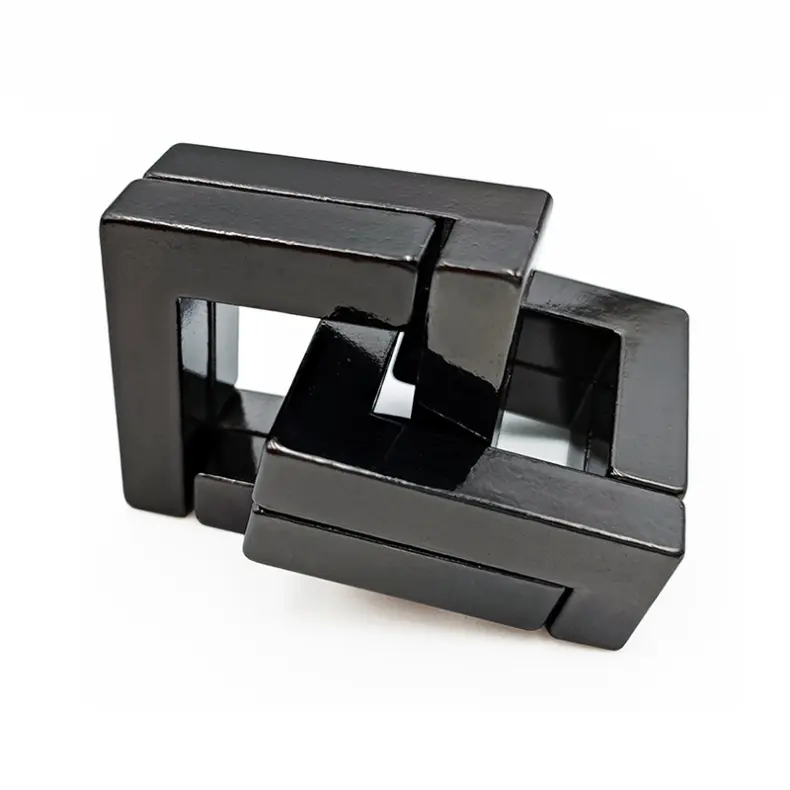
For the Heirloom Builder: A Solid Stainless Steel Knot
Sourced from independent metal-smiths on platforms like Etsy or dedicated puzzle shops, these are the apex. A puzzle like the classic “Vortex” or “Infinity Loop” machined from solid stainless steel is the final word in durability. Stainless doesn’t plate. It is. The entire piece has a uniform hardness and corrosion resistance. The machining tolerances are so tight that the “click” of alignment is both auditory and tactile. They have heft that defies their size, a coolness that never warms in the hand. You buy this not for a challenge to solve, but for a challenge to destroy. It is an heirloom, a piece of functional art that will literally outlive you, its story told not through wear, but through its unchanging, stoic presence on a desk for generations. This is the ultimate destination of the durability quest, a perfect fusion of form and immutable function, much like the ideals discussed in choosing your metal brain teaser puzzle.
The Fragility of Genius: Why Some Difficult Puzzles Are Surprisingly Delicate
The search for an heirloom-grade puzzle reveals a critical, counterintuitive truth: a higher difficulty rating is often a warning flag for physical fragility, not a guarantee of robustness. The most maddeningly complex designs frequently rely on components machined to under 2mm thick—precise enough for their elegant solution, but prone to permanent deformation under the force of a frustrated twist.
This is the fundamental engineering trade-off. To create a movement that feels magical—a piece sliding through an impossibly small slot, or a loop rotating within a cage—the designer must reduce material to its absolute minimum. That intricate, wire-thin arm or wafer-like plate is the puzzle’s genius and its Achilles’ heel. In the Durability Matrix, these puzzles score high for cleverness but dangerously low for Joint Integrity and Material Density. Where an “over-engineered” puzzle uses bulk and simple mechanics to create challenge, a fragile genius uses precision and finesse, placing the stress point directly in your hands.
Consider the archetype: the disentanglement puzzle (Wikipedia). The goal is to separate a captive ring from a convoluted web of bent wire. The solution path requires bending, compressing, or threading the ring through a specific, tortuous route. The wires themselves, however, are often made of hardened steel that can withstand the intended flex. The real vulnerability? The soldered or welded joints where those wires meet the central body. A moment of forceful, misguided manipulation can concentrate stress at that microscopic seam, leading to a clean snap. (This is a common failure point reported on forums for cheaper models of the classic “Horseshoe Nail” or “Double Hearts” styles).
Even within reputable lines like Hanayama, this principle holds. Their Cast Vortex (difficulty 6) is famed for its complex, interlocking spirals. While solid, its challenge comes from aligning minute channels; the parts themselves are relatively stout. Contrast this with a design built around a thin, cantilevered hook or a delicate clasp mechanism—these can bend irreversibly if forced. The perceived “sturdiness” of metal is an illusion when the geometry is working against the material’s strength.
So, how do you identify a delicate genius before purchase? First, scrutinize product photos for obviously thin members. Second, read reviews for words like “flimsy feel,” “bent easily,” or “careful not to force.” Third, apply the Tap Test conceptually: if you can visually identify a part that looks like it could bend between your fingers, it probably can. Your goal is to match the puzzle not just to your mind, but to your handling temperament. For aggressive hands or fidgeting, the robust, mechanically simple designs from our previous section are sanctuaries. For the patient solver who appreciates precision and treats the puzzle like a surgical instrument, the fragile genius offers a different, more cerebral reward—one that demands gentle confidence, not brute force. For a deeper dive into the extreme precision of these designs, consider the principles explored in the 0.002mm gap between art and agony in metal puzzles.
Preservation Without Glue: Caring for Your Metal Heirloom
Choosing a well-made puzzle is only half the battle for permanence; the other half is stewardship. Unlike glued cardboard, preserving a metal heirloom is a fight against chemistry and friction, not disintegration. For zinc alloys, a simple wipe-down every few months prevents corrosive tarnish, while stainless steel can go years with just casual handling—its passive oxide layer is its own protection.
Your first line of defense isn’t a cabinet, but your hands. The oils and acids on your skin are the primary engine of tarnish and plating wear. The collector’s approach is to handle with intention, not absent-minded fidgeting. (This is where the fidget-proof puzzles from our Matrix earn their keep—they’re engineered for this kinetic stress.) Before a long solving session, wash and dry your hands. This single habit does more to preserve a plated finish than any polish. For puzzles you truly cherish, consider it a ritual, like cleaning a workbench before a project.
When cleaning is necessary, material dictates method. For plated zinc alloys (most Hanayama puzzles): Use a soft, dry microfiber cloth. If fingerprints or oxidation persist, lightly dampen a cloth with distilled water or isopropyl alcohol. Never use abrasive jewelry cleaners or pastes—they will strip the thin plating faster than decades of use. For solid stainless steel, aluminum, or titanium: These can handle more. A drop of mild dish soap in warm water, a gentle scrub with a soft toothbrush for machined grooves, and a thorough dry is sufficient. The goal is to remove oils, not to scour.
Storage is about controlling environment, not just containment. Humidity is the enemy of all metals except perhaps stainless. Avoid bathrooms or damp basements. A simple silica gel packet tucked into a display case or drawer is a cheap guardian against moisture. For display, avoid direct sunlight, which can degrade certain platings and finishes over time. Felt-lined trays or individual soft pouches prevent scratches when puzzles are stacked or stored together—even over-engineered pieces can be marred by being rattled against each other in a box.
What about when prevention fails? A bent piece on a steel or aluminum puzzle can sometimes be coaxed back. The key is to use broad, evenly distributed pressure, never a pinch-point. Nestle the bent component in a soft-jawed vise or between two flat blocks of wood and apply slow, incremental pressure. For a snapped piece on a zinc alloy casting, repair is rarely structural. Superglue can reattach, but the stress point will remain forever compromised. This is when contacting the retailer for a replacement piece—a service offered by some like Puzzle Master—becomes the true solution, a reminder that even the most durable objects benefit from a ecosystem of support.
Ultimately, care is what transforms a durable product into a personal artifact. The slow development of a patina on bare brass or the subtle sheen of a stainless piece from constant, clean handling are badges of honorable use. They are the opposite of the plating wear that reveals cheap substrate; they are a story in the metal itself. For the deeper philosophy of interacting with these objects, the principles in the real way to solve metal puzzles apply not just to solving, but to a lifetime of preservation. Your puzzle isn’t breaking down; it’s settling in.
The Final Turn: How to Choose Your Future-Proof Puzzle
Choosing a durable cast puzzle comes down to matching your intended use-case to a puzzle’s material and construction DNA. For aggressive fidgeting, prioritize milled from solid stock stainless steel with a simple, robust mechanism; for a pristine collection, a high-quality plated Hanayama with careful handling will last for decades. The data from our Durability Matrix shows that puzzles machined from solid metal stock consistently score higher in Joint Integrity and Material Density than their cast zinc counterparts, a decisive factor for long-term survival.
You began this journey with the memory of a breaking puzzle—a failure of material under pressure. You’ve since learned to distinguish the hollow feel of thin plating from the dense inertia of solid stainless, and to identify the stress points in a design that no amount of care can fully safeguard. This knowledge transforms the purchase from a gamble into a specification. You are no longer just buying a puzzle; you are commissioning a durable good for your hands.
Let’s crystallize that knowledge into a final decision tree. Ask yourself:
* Is this for aggressive, daily fidgeting? Your path is singular: seek out solid, machined metal. Think stainless steel brain teaser puzzles from independent makers or the industrial-grade offerings like LESONG’s heavy-duty sets. Avoid anything with protruding wires, thin cast loops, or decorative plating. You need a monolithic piece of engineering that can withstand subconscious torque and the occasional desk drop.
* Is this for a satisfying, occasional solve you wish to preserve? The world of high-tolerance, plated puzzles opens up. A Hanayama Cast like Harmony or Radix, with their simpler forms and thicker components, will endure beautifully with mindful handling. Appreciate them for their precision and finish, but understand their limits. This category rewards a gentle touch with decades of elegant service. A comprehensive Hanayama puzzle buying guide can help you navigate this iconic line.
* Is this for a household that includes curious, forceful hands? You need over-engineered simplicity. Look for solid metal disentanglement puzzles with ring diameters over 10mm and made from a softer, bend-resistant metal like aluminum. The goal isn’t just to survive, but to survive without becoming a delicate artifact that causes anxiety. Durability here means peace of mind.
Your final step is internalizing the philosophy we touched on in the 4000-year-old metal puzzle brain: these are not disposable amusements, but kinetic sculptures built for interaction, a form of mechanical puzzle with ancient roots. The right one doesn’t fight your use-case; it endorses it. A future-proof puzzle is one whose material truth aligns perfectly with your reality—be it the constant, seeking motion of a restless mind or the deliberate, appreciative engagement of a collector.
So, pick up your final candidate. Perform the Tap Test. Assess its heft. Examine its machining tolerances. You now know what to look for. The anxiety of the broken piece is replaced by the confidence of understanding. The only puzzle left to solve is which perfectly suited, unbreakable companion you’ll bring into your life first. Make the choice, and turn that first, solid, satisfying piece with the certainty that it was built to last.