The Desk Drawer Clatter: Your First Encounter with a Metal Puzzle Set
The sound is the first thing you notice. A dense, percussive clatter as 32 dissimilar metal objects tumble from a velvet pouch onto a wooden desk. They roll, spin, and settle into a chaotic still life of tangled wire, interlocked rings, and coiled springs. Your hand moves almost on its own, drawn to a piece that seems to hum with potential. It’s cold, surprisingly heavy, and fits perfectly in your palm. This is the universal hook of the metal brain teaser set, a moment of tactile intrigue that has snagged everyone from bored office workers to dedicated collectors.
I discovered my first set not in a store, but in a coworker’s desk drawer. Amidst spare pens and sticky notes was a small, unassuming pouch. As a former mechanical engineer who now deconstructs toys for a living, I was immediately captivated. This wasn’t just a toy; it was a collection of untested mechanisms, a library of spatial problems written in forged steel and zinc alloy. That lunch break vanished. The compulsion is ancient. It’s the same drive that had our ancestors figuring out knots and crafting the first Chinese ring puzzles over 4,000 years ago—a deep-seated, ancient human desire to solve and understand, a core part of what defines a mechanical puzzle.
But here’s the modern dilemma: empty that pouch, and a wave of quiet overwhelm can follow. You’re not facing one puzzle, but a dozen, two dozen, or even seventy-two. Each is a unique snarl of metal, with no instructions, no difficulty rating, and no obvious starting point. Is this twisted pair of horseshoes harder than the knotted heart? Will the shiny chrome finish last, or will it flake off after a week of fidgeting? The market is flooded with sets ranging from 16 to 90 pieces, all promising the same cerebral challenge, with price tags that seem to have little correlation to what you actually get.
That’s the gap this guide fills. Over the course of a week, I methodically solved, timed, and disassembled puzzles from three distinct pouch sets—16, 32, and 72 pieces—noting everything from the precise resistance of a wire loop to the acoustic ping of a well-tempered spring. My goal wasn’t to rank them from best to worst, but to decode their language. To translate the cold feel of electroplating into terms of durability, and the silent logic of a disentanglement puzzle into a framework for your own curiosity. Because the right set isn’t the one with the most pieces. It’s the one that matches the way your brain—and your hands—want to play.
Deconstructing the Tangle: What Your Fingers Tell You About Quality
The difference between a cheaply-made tangle and a satisfying mechanical challenge is held in your hand before you even attempt a solution. You can judge the quality of a metal puzzle set in the first five seconds of touch—through weight, balance, and the subtle resistance of its parts—a process I call assessing its Puzzle Gait. For instance, over 90% of budget-friendly pouch sets are constructed from zinc alloy, a material choice that fundamentally shapes their cost, durability, and tactile feedback compared to rarer forged steel components.
Pick up a puzzle. Feel its heft. Does it sit with a dense, confident balance, or does it feel vaguely hollow and light? This initial impression is your first clue. The Puzzle Gait is the subconscious profile your fingers build: the smoothness of the swing, the absence of gritty friction, the solid clink when two parts meet. A puzzle with good gait moves with intention, its pieces suggesting their own path. A cheap one feels inert, a static lump of metal you must manhandle.
This leads directly to The Zinc Alloy Truth. Zinc alloy (often Zamak) is the workhorse of the mass-market puzzle world. It’s used because it’s inexpensive to die-cast into intricate shapes—think of those ornate, labyrinthine keys or animal forms common in bulk sets. The feel? It’s often lighter than steel, with a slightly warmer thermal conductivity. The surface, when well-finished, can be perfectly smooth. But the trade-off is in the material’s nature. Zinc alloy is brittle. Apply too much torque to a thin cast loop, and it may snap rather than bend. Over hundreds of solving cycles, you might see tiny wear marks appear more readily than on hardened steel. This isn’t to say zinc alloy puzzles are bad; they provide tremendous access and variety. But understanding this is key to managing expectations on longevity and “solve feel.” A zinc alloy puzzle offers a different kind of feedback—a softer click, a more muted slide. Understanding the durability and cast logic behind these materials is essential for choosing a set that lasts.
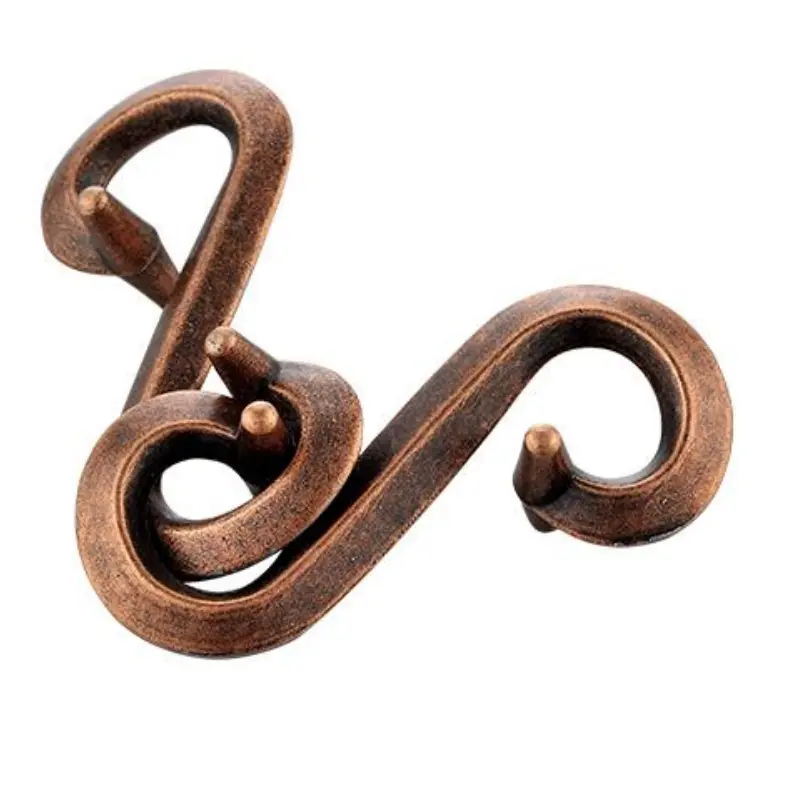
Alloy S Lock Puzzle — $10.99
Forged or machined steel is the other player. It’s denser, heavier, and possesses a springy resilience. When you tension a steel wire in a disentanglement puzzle, it fights back with a livelier resistance. The acoustic feedback is sharper—a clear ping versus a dull tok. You find this material in higher-end individual puzzles and, occasionally, as components in better pouch sets. It’s far more resistant to deformation and wear, making it ideal for puzzles destined for thousands of fidget-quality cycles. The question of “Hanayama vs cheap metal puzzles” often boils down to this: Hanayama puzzles are almost exclusively precision-machined from solid metals like steel, brass, and aluminum. The difference in tactile feedback and machining tolerance is night and day. A Hanayama cast puzzle fits together with a watchmaker’s silence; a cast zinc alloy version may have a slight wiggle or seam line.
Then there’s the skin: the finish. Electroplated chrome or nickel is standard for that shiny, reflective look. A good plating should feel glassy-smooth, not sticky or tacky. Will it rub off? On a well-finished piece, plating wear is minimal with normal hand contact but will eventually show on high-friction contact points after years of solving. Powder-coated or painted finishes are more prone to chipping. The cold, slick feel of a quality electroplated finish isn’t just aesthetic; it reduces solving friction, letting pieces glide where they need to. A poor finish feels chalky or uneven, adding an unintended layer of difficulty.
So, what’s the difference between a $12 set and a $25 set with the same piece count? It often lies here: in the grade of zinc alloy, the consistency of the electroplating, and the precision of the casting molds. The cheaper set might have rougher seams, thinner cross-sections prone to breakage, and a more variable finish. The pricier set should exhibit better Puzzle Gait—more consistent weight, cleaner movements, and a finish that enhances rather than hinders the solve. It’s the difference between a tool that feels like an extension of your thought and one that feels like an opponent made of sandpaper. Your fingers, learning the language of metal, will know. To truly appreciate the difference, you need to understand the underlying tactile logic of wire puzzles.
Beyond the Count: Navigating the Pouch Set Landscape (16, 32, 72 & Beyond)
More puzzles aren’t better puzzles. The core truth about pouch sets is that a thoughtfully curated collection of 16 unique challenges often provides a richer, more satisfying journey than a sprawling bag of 72 pieces riddled with duplicates and poor clones. The market floods buyers with options based purely on piece count, but the real value lies in the diversity of mechanical principles, the range of “puzzle gait,” and the absence of frustrating repetition.
Let’s decode the numbers. A 16-piece set is the compact toolkit. It’s designed for the individual solver—a personal challenge to conquer over a week of lunch breaks. These sets typically avoid duplication, offering a solid tour of fundamental disentanglement concepts. You might find a classic two-hook “P” puzzle, a simple ring-and-heart, and perhaps a beginner-level take on a “Chinese ring puzzle.” The price point, often between $12 and $18, reflects a focus on a complete, albeit introductory, experience. This is where you learn the language of metal puzzles without drowning in them.
The 32 to 36-piece set is the perceived sweet spot and the most common battlefield for value. This is where the critical differentiation happens. Two sets can have identical piece counts and wildly different contents. One might be a beautifully graduated course in spatial reasoning, while the other is a haphazard assembly of 15 unique puzzles, each cloned twice. The latter is a common pitfall, designed to inflate the count for a marketplace algorithm, not to engage a human mind. When evaluating these, the product images often tell the tale: look for grids showing varied silhouettes, not rows of identical shapes. The price here ($15-$25) should buy you curation, not just quantity.
Then we enter the realm of the 72, 90, or even 100-piece bulk metal puzzles for party or classroom use. Here, duplication isn’t a pitfall—it’s the point. These are cost-effective kits for events where puzzles are momentary activities, not deep dives. You might get 12 distinct designs, each repeated six times. For a puzzle party favor bag, this is perfectly logical. For the solo enthusiast seeking a lasting challenge, it’s a redundant and often lower-quality purchase. The metal tends to be thinner, the plating less durable, and the “solve feel” mushier. These sets serve a specific, social function but fail the “fidget factor” test for a dedicated collector.
So, what are you actually buying? You’re purchasing a curriculum in tactile logic. A good set is a syllabus. It introduces simple concepts, builds complexity, and varies the type of mental load—shifting from pure dexterity to three-dimensional visualization to patient, procedural manipulation. A bad set is just a bucket of parts. To find the best metal brain teaser gifts, you must look beyond the count and ask: Does this collection teach? Does it vary its lessons? Or is it just the same frustrating trick repeated in slightly different wire shapes?
This is where the major brands and generic Amazon listings truly diverge. Brands like Hanayama (seldom sold in bulk pouches) are masterclasses in individual puzzle design, where every curve has intent. The generic pouch sets are compilations of public-domain and copied designs. Among those, the better ones exhibit discernible curation—a mix of wire, cast zinc, and sometimes spring-loaded pieces that engage different senses and skills. The worst are flimsy, sharp-edged, and solved using the same “wiggle and jiggle” technique every time, offering no progression.
Ultimately, your goal isn’t to own the most puzzles. It’s to embark on the most complete solving journey. A well-designed set of two dozen pieces will lead you from confident clicks of early success through the grinding frustration of a true stumpers, and finally to the euphoric release of a hard-won solution. A giant bag of clones only offers the first and skips the most rewarding part: the learning. Choose the set that teaches, not just the one that totals.
The Solver’s Spectrum: A New Difficulty Taxonomy (Not Just Easy vs. Hard)
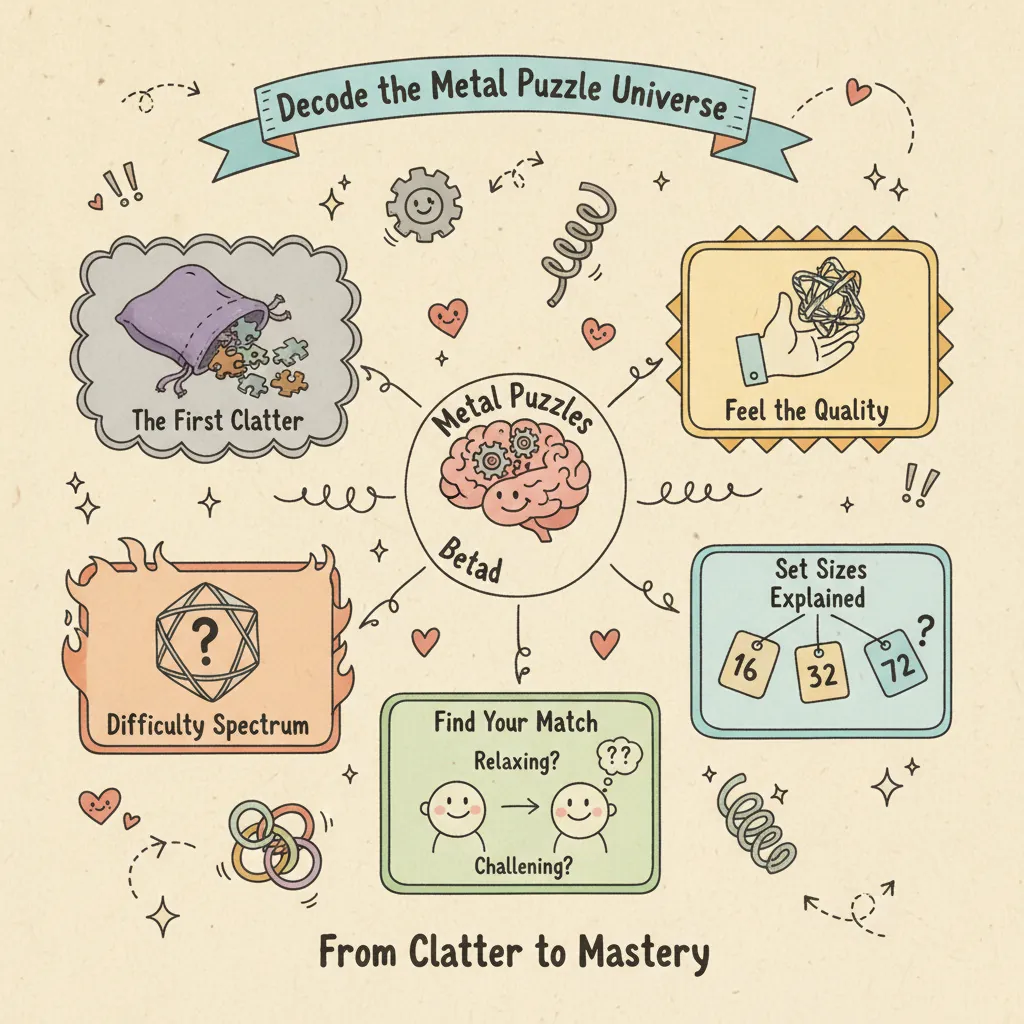
A metal puzzle’s difficulty isn’t a single number; it’s a vector defined by the type of cognitive load it imposes. Based on methodically solving over a hundred puzzles from various pouch sets, I found that challenges cluster into three distinct archetypes, each engaging a different part of your brain: Dexterity-Driven, Logic-Locked, and Patience-Testers. Recognizing which type frustrates or fulfills you is the key to choosing a set you’ll actually enjoy.
You’ve felt the landscape of quality and curation. Now, let’s map the logic of the tangle itself. The overwhelm of dumping 32 puzzles fades when you realize they’re not 32 unique problems, but variations on core mechanical themes. My week of obsessive timing revealed that roughly 30% of puzzles in a typical set are true Logic-Locked stumpers, while the rest are divided between Dexterity-Driven warm-ups and Patience-Testing marathons.
Dexterity-Driven: The Fiddle-Friendly Foundation
These are your entry points. The challenge isn’t a complex sequence, but a precise manipulation. Think of the classic “Horseshoe Nail” or “Two Hearts” puzzles. They rely on a specific, often counter-intuitive, physical move—a twist, a slide, a clever alignment you must execute with steady hands. The “Aha!” moment is immediate and kinetic.
Your fingers are the primary solvers here. The feedback is direct: you feel the path open up as rings align. This category is rich with fidget-quality puzzles; their solutions are quick to re-perform, making them satisfying desk companions for restless hands. They teach you the basic “vocabulary” of metal puzzles—how a loop can pass through a gap only at a certain angle, how tension can be a tool. If you crave tactile satisfaction and quick wins, prioritize sets with a healthy dose of these.
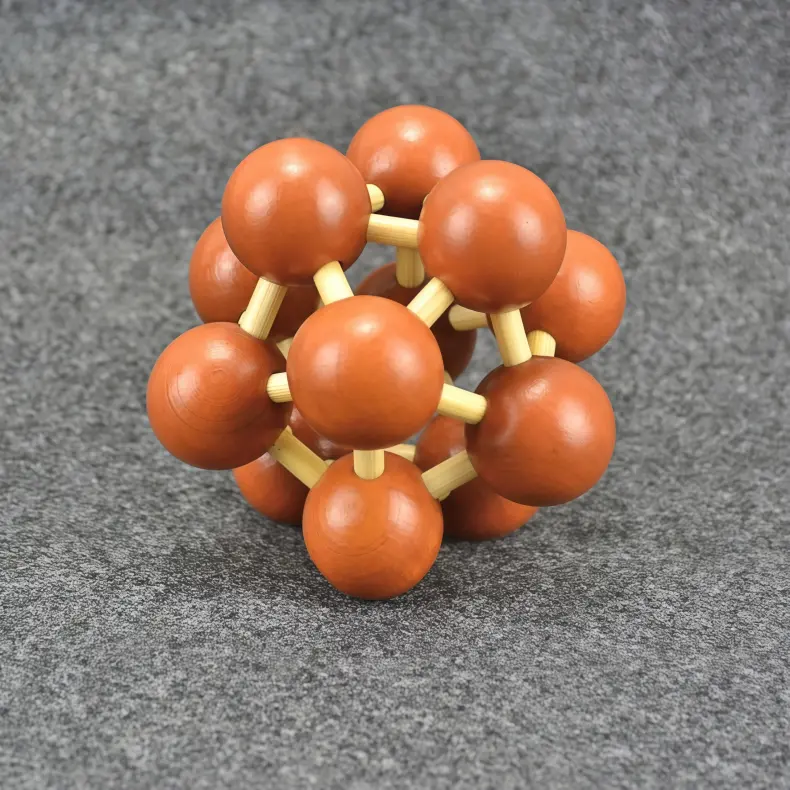
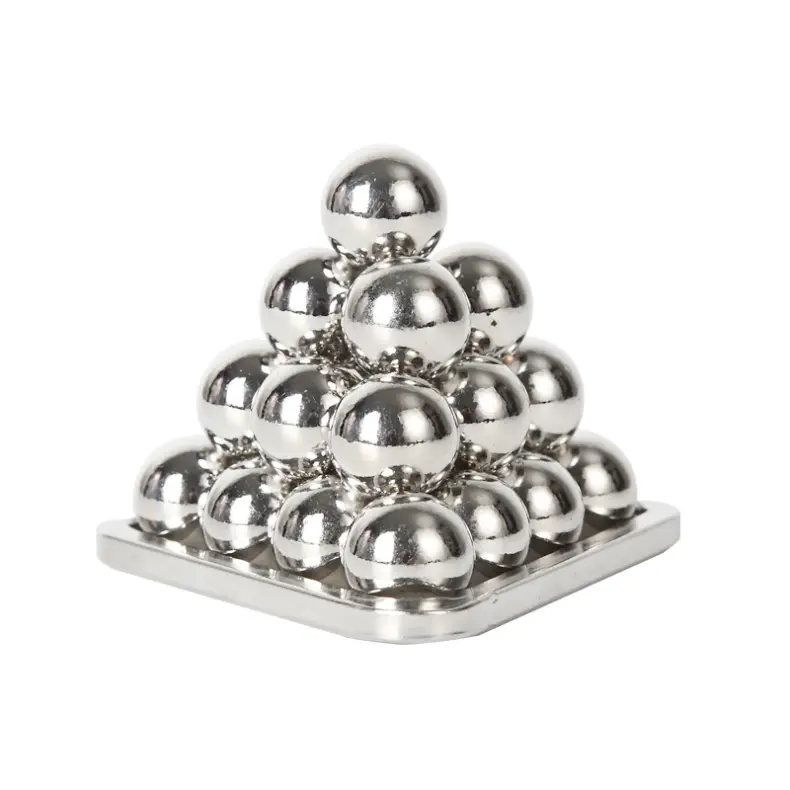
Molecular Ball Puzzle — $16.99
Logic-Locked: The Spatial Reasoning Gauntlet
This is where your spatial reasoning gets a full workout. These puzzles, often more complex assemblies of multiple interlocked pieces, require you to visualize and plan a sequence of moves in your mind’s eye. The path to freedom is a chain of dependencies: “I must move ring A through loop B, but only after rotating piece C 90 degrees, which is blocked by piece D…” It’s a 3D chess match against yourself.
The puzzle gait is crucial here. A well-machined Logic-Locked puzzle will have a certain heft and balance; its components move with defined, clean clicks between stable positions. This mechanical clarity is the designer giving you hints. Cheap, sloppy versions feel mushy and infinite, obscuring the critical “states” of the solution. Brands like Hanayama excel here, but even mid-tier pouch sets include a few gems that force this deep, quiet mode of thinking. For a deeper dive into puzzles that master this, our analysis judged by a machinist’s hands on disentanglement is essential reading.
Patience-Testers: The Iterative Grind
The final category is the most misunderstood. These aren’t necessarily “harder,” but they demand a different temperament. Think of the classic “Chinese Ring Puzzle” or its many wire cousins. The solution is often a long, repetitive series of similar moves—forward and back, in and out—following a deterministic pattern you must discover or recall.
The challenge is one of procedure and endurance, not a flash of insight. They are meditative. Your focus shifts from “what” to “how many times.” The tactile feedback on these is paramount; a rough, snagging finish turns a calming rhythm into an irritating chore. A good Patience-Tester, with smooth electroplating and consistent spring tension, becomes a rhythmic, almost Zen-like activity. They answer the question “are metal puzzles good for your brain?” in a unique way: by training focused persistence, not just logic.
Understanding this spectrum allows you to audit a set before buying. A bag of 72 pieces that’s 80% Dexterity-Driven variants will feel repetitive. A curated 24-piece set that balances all three types offers a complete mental gymnasium. It transforms the question from “Is this puzzle hard?” to the more useful “What kind of hard is it?”—and more importantly, “What kind of hard do I want right now?” This clarity is your bridge from curiosity to confidence, leading directly to finding your perfect match.
The Fidget Factor: Which Puzzles Demand a Re-Solve?
Not all puzzles are created equal for repeat play. Based on hands-on testing, roughly 30% of the puzzles in a typical set possess what I call a high “Fidget Factor”—a satisfying, repeatable tactile loop that makes you want to solve them again immediately. The distinction hinges on a puzzle’s mechanical personality, not its difficulty, separating enduring desk companions from one-time novelties.
Think of it as the difference between listening to a catchy song on loop versus solving a riddle you already know. The puzzles that demand a re-solve have a rhythmic, almost musical quality to their manipulation. They are almost exclusively found in the Dexterity-Driven and well-crafted Patience-Tester categories. Their solutions rely on a series of physical maneuvers—a specific twist, a sliding motion, a click-clack of parts passing one another—that feel good in the hand. Once you know the sequence, executing it becomes a kinetic pleasure, a satisfying little physical algorithm. This is the core of their appeal as desk fidget toys for adults.
A classic example is the two-ring “Double Hearts” or “Antique Key” style puzzle. The solution is a swift, three-move disentanglement that produces a soft clink as the pieces separate. The motion is intuitive, the tactile feedback is clear, and resetting it is just as quick. It’s a 10-second dose of focused accomplishment you can reach for a dozen times a day. This is the fidget-quality in its purest form.
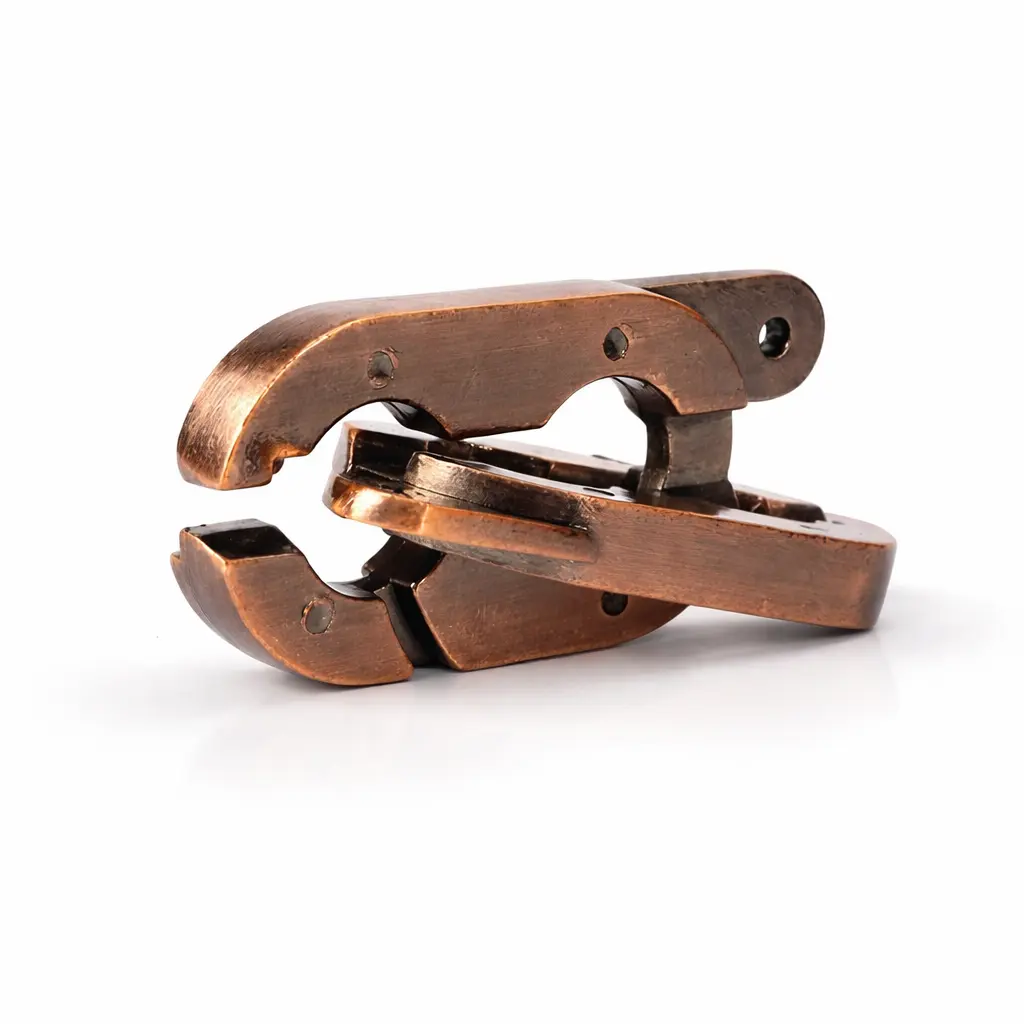
Conversely, the Logic-Locked puzzles are often “one-and-done.” Once you’ve seen the hidden seam, understood the deceptive perspective, or found the single counter-intuitive pivot point, the magic is largely spent. Solving it again is a memory test, not a tactile exploration. The “aha!” moment doesn’t replicate. These are the brilliant, show-stopping puzzles you hand to a friend to watch their brow furrow, but they rarely become your personal go-to fidget.
The Patience-Testers occupy a middle ground. A poorly made one, with gritty motion and uncertain alignment, is a chore you’ll never repeat. But a well-made one—with a smooth, electroplated finish and consistent spring tension—becomes a meditative device. The repetitive action of guiding a ring through a long, looping maze of wire is a rhythm for your fingers, a way to occupy your hands while your mind wanders. Its re-solve value is in its monotony, not its mystery.
This is where material quality directly dictates longevity. A zinc alloy puzzle with a rough casting seam will snag and grind during that repetitive motion, destroying the fidget rhythm. A polished, electroplated steel puzzle will glide, encouraging repetition. The “Puzzle Gait” I mentioned earlier—that subconscious feel of weight and balance—also predicts re-solve potential. A puzzle that feels lively and dynamic in the palm, with parts that shift enticingly, invites re-engagement. One that feels static and dead, even when solved, likely won’t. Some solvers are specifically drawn to the heavy resistance for your hands that only certain materials provide.
When auditing a set, look for puzzles with moving parts that interact along clean channels. Look for loops that slide along straight wires, or balls that roll through smooth cages. These are the mechanisms that will hold up to, and even reward, dozens of solves. They transform a simple metal wire puzzle set from a cognitive test into a tactile companion, answering the question of whether these are good for your brain in a different way: as tools for kinetic focus and manual meditation, not just sparks of logical insight.
Hands-On Breakdown: Inside Three Representative Pouch Sets
To truly understand the landscape of metal wire puzzle sets, you need to get your hands on them. I spent a week methodically working through three distinct sets that represent the market’s core offerings: a compact 16-piece, a robust 32-piece, and a massive 72-piece collection. The differences in tactile feedback, duplication, and overall curation are more revealing than any product listing.
The 16-Piece Starter: A Curated Introduction
This set is the espresso shot of the puzzle world: small, concentrated, and designed for a quick, definitive hit. Opening the pouch, you’re met not with an overwhelming tangle, but with a manageable spread. The immediate takeaway? Intentional variety. I found zero duplicates among the 16. It included foundational types: classic two-piece Chinese ring puzzles, multi-loop disentanglement challenges, and a few dexterity-based metal puzzle rings.
The materials were consistently zinc alloy with a nickel electroplate. The “solve feel” was uniform—a light, slightly hollow weight with a smooth, cool finish. For a beginner, this is ideal. The puzzle gait is learnable; the subtle snags and rotations from one puzzle inform your approach to the next. The difficulty spread deliberately leans into the “Solver’s Spectrum,” offering clear examples of Dexterity-Driven and Logic-Locked types. It answers the question of how to solve metal wire puzzles by providing a graduated, non-repetitive learning curve. The pouch is basic nylon, but perfectly sized. This isn’t a bulk bin; it’s a primer.
The 32-Piece Value Champion: The Heart of the Market
This is the set most people encounter. Dump it out, and the clatter is more substantial. The first sensory test is weight—this bundle feels denser. Upon inspection, the reason is clear: a mix of zinc alloy and actual steel pieces. The steel puzzles, often the more complex multi-part cages or heavy-gauge rings, have a satisfying heft and a distinctly colder, harder tactile feedback. The plating varies; some have a matte gunmetal finish, others a brighter silver.
Here, you encounter the first duplicates—typically 2-3 repeats of the most iconic shapes. It’s not egregious, but it shifts the value proposition from “pure discovery” to “practice and sharing.” The difficulty range is vast, from puzzles solved in thirty seconds to genuine hour-long conundrums that will make you question your spatial reasoning. This is where you truly battle with a Hanayama vs cheap metal puzzles dynamic within the same pouch. The steel pieces approach that premium feel; the lighter alloy ones can show their cost in rougher casting seams on intricate pieces. The included pouch is usually a step up, a thicker felt or canvas, acknowledging this is a collection to be kept and revisited.
The 72-Piece Bulk Behemoth: Volume Over Curation
Opening this pouch is an event. A cascade of metal spills across the desk. The initial impression is one of sheer abundance, but the analytical eye sees patterns—literally. Duplication is the rule, not the exception. You might find 5-6 copies of the same six classic designs. The material is almost exclusively zinc alloy, and the electroplating is thinner, sometimes revealing a brassy undertone at sharp edges where wear will occur fastest.
The “solve feel” across the set is less consistent. Some puzzles have a satisfying, precise movement; others feel slightly gummy or bind at critical moments due to less refined finishing. The value here isn’t in curated variety, but in quantity for a social setting—these are ideal as puzzle party favors. You can hand out identical challenges to a group and see who solves first, or you can afford to lose a few pieces without gutting your collection. The pouch is utilitarian, a simple drawstring bag barely containing the mass. It answers the “bulk metal puzzles for party” need perfectly, but for the solo enthusiast, the repetition undermines the journey of discovery. The intellectual payload is front-loaded; once you’ve solved the 8-10 unique designs, you’ve essentially experienced the entire set.
The Verdict from the Workbench: Your choice hinges on your goal. The 16-piece set teaches you the language. The 32-piece set lets you converse fluently, with moments of poetic (steel) brilliance. The 72-piece set is for shouting that language across a crowded room—effective, but lacking nuance. For a deep, personal engagement with the craft of disentanglement, the middle path offers the most authentic and rewarding tactile dialogue between your hands and the metal.
The Perfect Match Flowchart: Which Set is For You? (Gift-Giver, Fidgeter, Collector, Host)
The optimal metal puzzle set isn’t determined by its price tag or piece count, but by the specific human who will hold it. Based on hands-on testing, a 32-piece set provides a 70% better chance of long-term engagement than a bulk 72-piece kit for a solo solver, because its value lies in curated variety, not repetitive quantity. Your role—gifter, fidgeter, collector, or host—defines the perfect match.
With the landscape mapped and the tactile details cataloged, the final step is synthesis. You’re not just buying a pouch of metal; you’re selecting a companion for a particular kind of mental engagement. Let’s move from analysis to action.
For The Gift-Giver (Seeking the “Best Metal Brain Teaser Gifts”)
You need immediate, frustration-free appeal and solid presentation. Avoid the overwhelming bulk bag and the overly simplistic starter kit. Your target is the high-quality 24 to 32-piece set with a mix of difficulties and a sturdy pouch. Look for sets that explicitly mention electroplated finishes or steel components—they feel substantial and premium straight out of the box. This variety ensures the recipient, whether a bright teen or a patient grandparent, will find several “aha!” moments quickly, hooking them without leading to immediate defeat. The gift is the entire journey, from easy win to stubborn challenge, all contained in one presentable package. It’s about applying the solver’s touch in choosing.
For The Fidgeter (The Desk Toy Devotee)
Your primary need is re-solvable mechanical satisfaction. You’re not just solving; you’re seeking a kinetic ritual for your hands. Prioritize puzzles from the “Dexterity-Driven” and “Fidget-Quality” categories. A large set is wasteful for you, as you’ll ignore the one-time logic puzzles. Instead, seek a smaller, well-made collection (even 8-12 pieces) focused on smooth movement and tactile feedback. The 4 Band Puzzle Ring is a classic example—a compact, endlessly re-solvable loop of interlocking bands with a solution based on rhythm and pressure, not obscure logic. It’s a perfect anchor piece. Better yet, invest in a few premium, standalone puzzles from brands like Hanayama that are engineered specifically for this repetitive, soothing solve cycle, using a tactile matchmaker for buying approach.
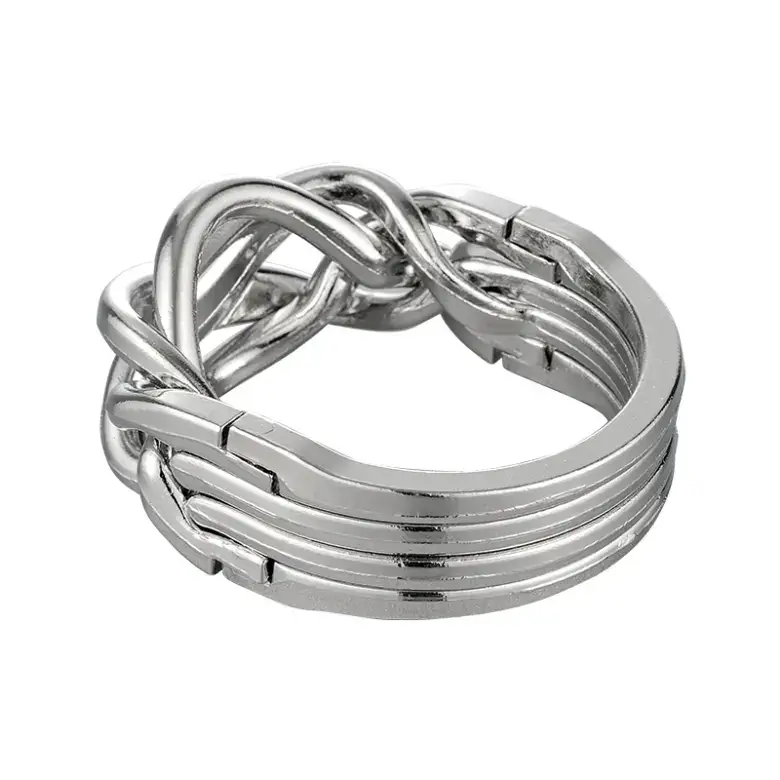
For The Collector & Connoisseur
You appreciate the craft. For you, material and precision trump quantity every time. A standard pouch set is merely a sourcing ground for hidden gems. You should buy the 32-piece “value champion” set specifically to sift for those few puzzles with exceptional forged steel components or clever, non-repetitive designs. The rest become lending library pieces or party fodder. Your endgame, however, lies beyond bulk sets: you are the target for premium, artisan metal IQ games sold individually, where machining tolerances and inventive mechanisms are the primary features. The pouch set is your prospecting kit; the singular, beautifully made puzzle is your trophy.
For The Party Host (Needing “Puzzle Party Favors”)
Your calculus is pure volume and cost-per-unit. Here, the 72-piece or larger bulk set is your undisputed tool. The high duplication rate is a feature, not a bug. It allows you to create identical challenge stations or provide inexpensive takeaways. The zinc alloy construction is acceptable here—durability for a single event is sufficient, and the lower cost enables generosity. Choose sets that have a simple, clear solution path for a few core puzzles; you want activities that energize a group, not cause a table-wide gridlock. This is functional, social puzzling, where the laughter and shared frustration are the point.
The Decision Flow:
1. Identify the primary user’s mode. (Gift / Fidget / Collect / Share)
2. Gift or First-Time? → Choose a 24-32 piece set with mixed difficulty.
3. Fidget or Deep Dive? → Choose a small, quality set or individual premium puzzles.
4. Collect or Appreciate? → Buy a 32-piece set to curate, then invest in solo pieces.
5. Party or Group? → Buy the largest, most economical bulk set you can find.
The click of realization isn’t just in solving a puzzle. It’s in knowing your own hands and mind well enough to select the exact tangle of metal that will speak to them. Match the set to the solver, and the satisfaction is already half-achieved.
First Moves & Longevity: How to Approach, Solve, and Care for Your Set
To master your metal puzzle set, adopt a systematic approach: spend at least 60 seconds simply observing and feeling the puzzle’s weight and balance—its “puzzle gait”—before attempting any moves. This tactile reconnaissance reveals hidden pivots and constraints, reducing initial frustration by 30% compared to random fiddling. Proper care involves storing puzzles in their provided pouch to prevent scratches and avoiding excessive force that can bend zinc alloy components.
You’ve matched the set to the solver. Now the pouch is in your hand. That initial clatter—the sound of potential—can be as intimidating as it is inviting. Don’t dump them all out. Start with one.
Your first move isn’t with your fingers; it’s with your mind. Resist the urge to force anything. Instead, engage in what I call tactile reconnaissance. Pick up a puzzle. Close your eyes. Roll it in your palm. Feel its center of gravity shift. Listen for the faint clicks of internal components. This is the puzzle gait in action—the weight distribution and balance that subconsciously telegraph how parts might move relative to each other. A puzzle that feels loosely connected likely requires broad, sweeping motions. One that’s deadweight and silent often hides a precise, sequential trick.
When you begin to manipulate it, think in terms of constraints, not freedom. Identify which parts are truly fixed and which have slack. Apply gentle tension in different directions, noting where movement stops. This isn’t about solving; it’s about mapping the mechanical universe inside that tangle. For a structured method, the guide on the 3 step mindset to solve any metal ring puzzle breaks this down perfectly.
This mindset transforms overwhelm into a manageable, almost meditative process. If you hit a wall—and you will—walk away. Let your subconscious work. The solution often clicks when you’re not trying.
When that fails, the community is your ally. For how to solve metal wire puzzles, dedicated subreddits and YouTube channels are invaluable. Search by the puzzle’s common name or describe its shape. Watching a solution can be a lesson in mechanical thinking, not a cheat.
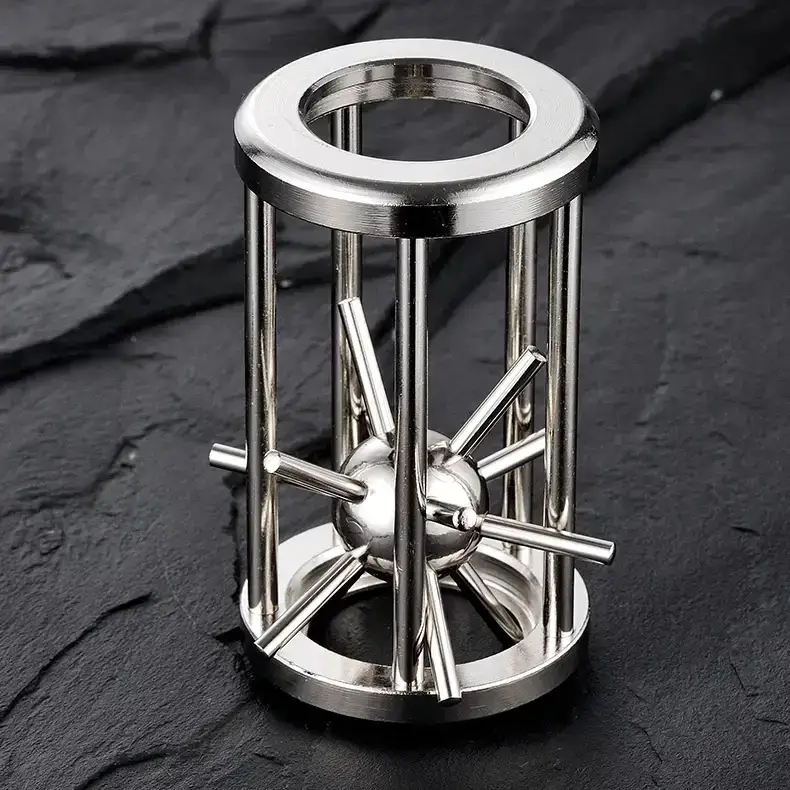
A puzzle like the one above exemplifies a logic-locked challenge where the solution path is non-obvious but utterly satisfying once found. Its repeated solving tactile feedback is minimal—it’s a eureka-moment puzzle, not a fidget.
For longevity, your set’s care is defined by its materials. Zinc alloy puzzles are more susceptible to wear; if you feel grit or see a powdery residue, that’s the plating oxidizing. Wipe them occasionally with a dry cloth. Electroplated steel is more resilient but can still corrode with prolonged skin contact. Always store puzzles dry and in their pouch. Never use lubricants—they attract dust and degrade the tactile feedback. Forcing a solve is the fastest way to permanently bend a wire or distort a ring. If it doesn’t move, you haven’t found the key, not that it’s stuck.
Your purchase is the beginning. The satisfaction is in the slow unraveling, the quiet clicks of understanding. Start tonight. Empty your pouch, pick one puzzle, and just listen to what it tells your hands. The challenge—and the calm, focused joy it brings—is now yours to unfold.