The Cold Click in Your Palm: A Universal Invitation
A disentanglement puzzle is a physical object, typically made of metal or rope, designed with the single, clear goal of separating one piece from another without bending or cutting them. This rule is absolute. It transforms simple loops and links into a world of stubborn, satisfying problems.
Your fingers close around it. Cold. Hard. The weight is surprising for its size—a dense, forged iron knot or a sleek tangle of brass wire. You turn it over. A faint, solid click as two parts meet. You see the path immediately: just lift this ring up and over that crooked elbow. It doesn’t budge. You tilt it. You pull. A wire binds everything tight. A smile touches your lips. You have to figure it out. This impulse is ancient, universal, and it’s why these objects exist.
Long before screens offered infinite distraction, these puzzles lived on tavern tables, in sailors’ ditty boxes, and in the pockets of blacksmiths. They were known, fittingly, as tavern puzzles. Someone would fish a twisted pair of horseshoes or a maze of bent nails from their apron and slide it across the wood. “Free the heart,” they’d say. Or “Separate the devil from his fiddle.” For the price of a drink, you could borrow a conundrum. Your hands worked while your mind chased loops in three dimensions. It was a quiet contest, a tactile conversation. This was never just a game. It was folk topology—mathematics made physical by necessity and craft.
Topology is the study of shapes that persist even when stretched or bent, where a coffee mug and a doughnut are the same because each has one hole. The blacksmith bending a hot nail into a convoluted loop wasn’t thinking about mathematical fields. They were creating a tangible truth about connectedness. They were building a question you could hold: Are these two pieces fundamentally linked, or can they come apart? The puzzle is the proof.
That cold object in your palm is an invitation to that proof. It asks you to see the space around the metal, not just the metal itself. The goal is never brute force. It is navigation. To solve a disentanglement puzzle is to discover a sequence of moves—slides, rotations, passages through gaps—that respects the rigid, unbending nature of the pieces. When you finally find it, the release is both physical and intellectual. A satisfying snick as the ring clears the last obstruction. The quiet click of two parts settling, now separate in your hands.
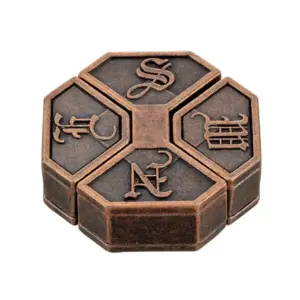
You’ve just met a Vexier, a classic subtype of twisted wire entanglement. You’ve held a piece of a history that spans continents, from Japanese kumiki and Chinese puzzle locks to the cast brass “Brain Twisters” of 19th-century Europe. The modern iterations, like the intricate metal starfish of the I Ching puzzle toy that teaches patience, are direct descendants. They all speak the same silent language of loops and constraints.
That initial, smiling frustration you felt? That’s the doorway. It leads past the simple goal, into a world of material, history, and invisible rules. Let’s trace the path.
A Knot in Time: From Tavern Tables to Mathematicians’ Desks
The name “tavern puzzle” is not a modern marketing term but a direct line to its 18th-century origins. These were the portable challenges of blacksmiths, farmers, and sailors—folk artifacts crafted from the materials at hand: a bent carpenter’s nail, a discarded horseshoe, a length of rope. Their purpose was social and tactile, a test of wits and patience shared over a drink long before the digital age offered distraction. This history explains both their enduring physicality and their global spread, from English pubs to the workshops of Japanese and Chinese master craftsmen.
Pick up a simple two-piece wire puzzle, and you’re holding a piece of folk topology. Its design wasn’t conceived in a laboratory but emerged from the manipulation of everyday objects. A blacksmith with a spare moment and a length of iron rod might twist it into an intriguing shape, then forge a ring or a second piece that seemed hopelessly linked to it. The goal was never merely to perplex, but to engage. In taverns and on sailing ships, these objects passed from hand to hand, becoming a currency of camaraderie and quiet competition. They were puzzles born from idle hands and curious minds.
Consider the Horseshoe Lock Puzzle. Its form is instantly recognizable, a direct descendant of puzzles made from actual, oversized horseshoes. The design plays on the familiar, leveraging our understanding of a horseshoe’s shape and the apparent impossibility of removing the linked shackle without bending the iron. It is a perfect example of the genre’s humble beginnings.
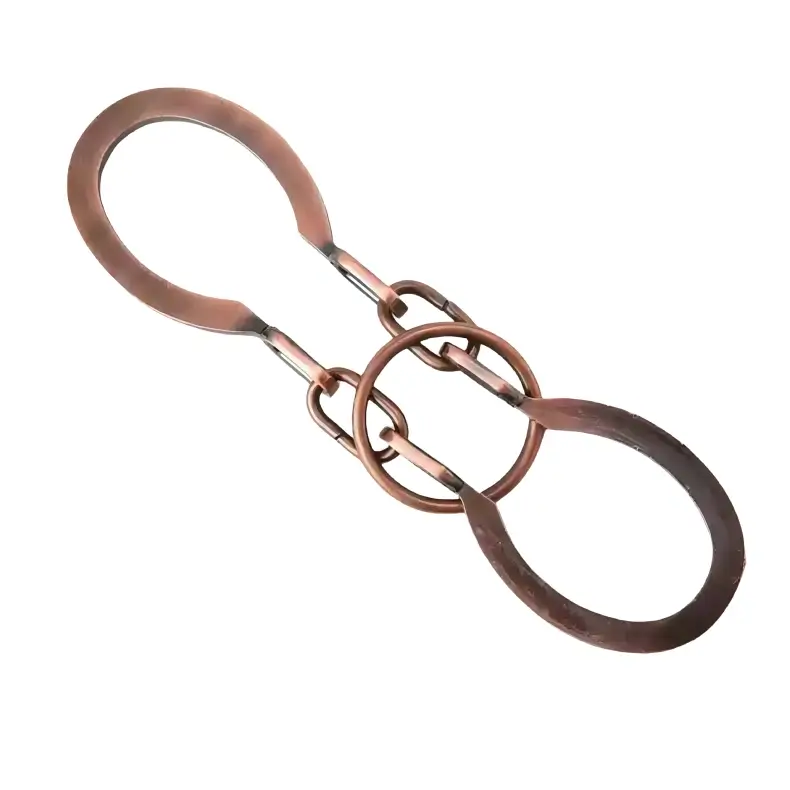
Some of these folk designs gained legendary status, their names hinting at the frustration they elicited. “The Devil’s Horseshoe” is a classic example, a design so notoriously tricky it feels like a bargain struck with a mischievous spirit. This tradition of “impossible” or trick puzzles—objects designed with no solution at all—reveals another layer of their history: as humorous provocations, physical jokes meant to confound the overly confident. You can explore a famed descendant of this tricky lineage in our deep dive on the Devil Cast Puzzle, a 1905 brain teaser that continues to baffle.
As these objects circulated, they inevitably caught the attention of more scholarly minds. By the 19th century, the crafted whimsy of the tavern was being studied by mathematicians interested in knot theory and topology—the study of properties that remain unchanged under stretching or bending. What was a folk pastime became a tangible illustration of abstract principle. The simple command “solve it without bending or cutting” is, in fact, the core rule of topological manipulation. The puzzle is a fixed, rigid knot in three-dimensional space, and the solver must find the path that was deliberately woven into its design.
This intersection birthed a more refined class of disentanglement puzzle: the Vexier (from the German for “to vex”). These were often precision-cast in brass or zinc alloy, sold in boxes with elegant labels, and collected by the burgeoning middle class. They represented the folk artifact’s journey to the gentleman’s study. Meanwhile, parallel traditions flourished globally. Intricate Chinese puzzle locks used interlocking mechanisms and hidden releases that operated on similar principles of sequential movement and misdirection, while Japanese craftsmen created elegant wooden kumiki puzzles that shared the same spatial logic. Our guide to the exquisite historical Chinese Koi puzzle lock showcases this functional artistry.
So, the object that began as a bent nail on a tavern table ended up on a mathematician’s desk. It bridges two worlds: the intuitive, tactile world of the craftsman and the analytical, abstract world of the scholar. This dual identity is what gives a disentanglement puzzle its unique depth. You aren’t just manipulating metal; you’re handling a piece of cognitive history, a universal question made solid.
Forged Iron to Slick Alloy: A Material Guide to Types
That journey from tavern to study is etched not just in history books, but in the physical materials of the puzzles themselves. Disentanglement puzzles are defined by their two core categories—Wire/String puzzles and Plate/Ring puzzles—with the twisted metal Vexier representing a refined, often modern, subset of the former. The key sensory difference lies in the hand: a hand-forged iron puzzle from the 19th century feels ten times heavier and bears tool marks, while a modern, precision-cast alloy version feels slick and sings with a cleaner, resonant snick when solved.
Wire and String Puzzles are the primordial, most prolific family. This is where you find the classic tavern puzzles forged from a single piece of iron rod, the elegant Vexiers of interwoven brass, and the humble rope disentanglement puzzle. Here, the goal is almost always to free a linked piece—a ring, a shackle, a heart—from an intricate cage of bends and loops. The material tells a story of purpose. Antique wrought iron examples have a substantial, grounding heft. You can feel the blacksmith’s hammer strikes in their imperfect, organic curves. They are cool to the touch and have a matte, almost stony texture. Solving one produces dull, solid clinks.
Modern wire puzzles, like those from brands such as Hanayama, are a study in contrast. Machined from zinc or aluminum alloys, they are lighter, with a smoother, almost slippery finish. Their movements are precise; the “satisfying snick” of a ring clearing a perfectly radiused corner is a hallmark of this engineered era. This is not to say one is inherently harder than the other—a simple three-piece forged nail puzzle can be devilish—but the experience differs radically. The antique puzzle feels like a tool, the modern one like a precision instrument.
Plate and Ring Puzzles form the other major branch. Instead of a cage of wires, you manipulate one or more plates—often with notches, holes, and slots—to navigate a ring or bead along a constrained path. These feel more like unlocking a silent, mechanical logic. They are often made from laser-cut steel or stamped sheet metal, giving them a flat, planar feel. The interaction is more about sliding and aligning than rotating through 3D space. Resetting one is typically a matter of reversing your steps with deliberate precision, a process often easier than the initial solve as you now know the critical alignments.
The term Vexier puzzle specifically refers to those elegant, often compact puzzles made from two or more interlinked pieces of cast or machined metal. They are a subset of wire puzzles, distinguished by their closed-loop designs and frequent use of non-intuitive, topological solutions. Where a simple bent-nail puzzle might have an obvious “hook,” a Vexier’s solution path is hidden within the loops themselves, requiring you to fold space in your mind. They are the quintessential “pocket puzzle,” designed for contemplative fiddling.
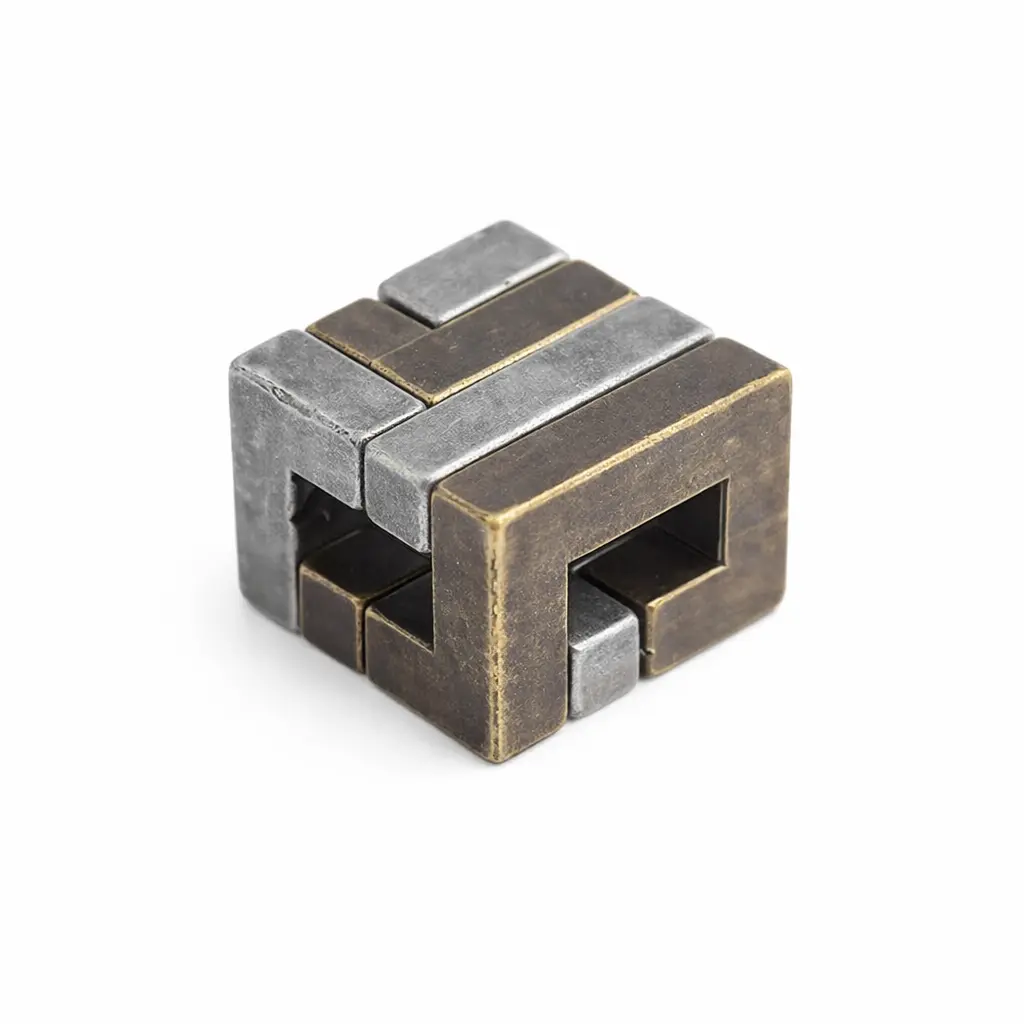
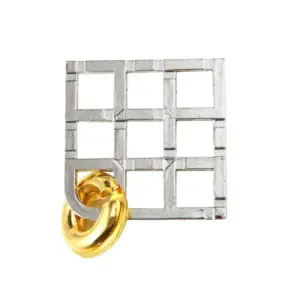
This cast coil puzzle is a perfect example of the modern Vexier ethos. It presents a clean, visually simple form that belies a deeply considered topological problem. Choosing between a modern cast puzzle like this and a traditional wire one often comes down to desired experience. Modern cast puzzles, including the renowned Hanayama series, offer graded difficulty levels and flawless, repeatable action—ideal for learning the language of loops. Antique or artisan-forged puzzles provide a raw, historical tactile sensation that many collectors crave, a direct link to the folk artifact origin. For a deeper dive into this tactile comparison, our guide to the best metal disentanglement puzzles judged by a machinist explores the nuances of modern metal puzzles in detail.
And what of rope puzzles? They are the soft, organic counterpart. Made from hemp, leather, or nylon, they rely on knots, loops, and hidden pockets within woven spheres. The feedback is muted, the moves are more about tension and slack than rigid angles. They remind us that the principle of disentanglement is universal, applied to fiber long before it was formalized in metal.
Understanding these types demystifies the reset. For most wire and Vexier puzzles, the solution is reversible—you simply retrace the sequence. Plate puzzles require careful backward navigation. The true “trick” puzzles, often historical, might require a deceptive starting orientation or a move that feels like cheating, cementing their legacy as clever jokes in physical form. The material, whether forged iron or slick alloy, is your first clue to the age, intention, and character of the challenge waiting in your hand.
The Invisible Rules: Why You Can’t Just Bend It Free
Holding a cold, twisted piece of forged iron, the immediate temptation is to force it. The gap looks just wide enough. A little pressure might slip the ring past the bend. This is the moment you confront the single, defining rule that separates a disentanglement puzzle from a piece of scrap metal: the solution must be found without bending, cutting, or deforming the pieces. This constraint, formalized by mathematicians in the 19th century but understood intuitively by blacksmiths for centuries, transforms a physical object into a playground of pure topology—the study of shapes and spaces where only continuous movement matters.
That prohibition is not arbitrary cruelty. It is the entire point. It shifts the challenge from your muscles to your mind’s eye. The puzzle is not about what you can do, but what the geometry allows. In topological terms, the pieces are considered rigid and undeformable; the only valid operations are sliding, rotating, and translating them through space without passing one through another. This is why they are a core subtype of mechanical puzzles. The goal isn’t to break the rules, but to discover the choreography hidden within them.
This is the essence of what makes a disentanglement puzzle a topological puzzle. Think of it like a dance. Two partners (the ring and the wire) must separate, but their path is constrained by the shape of the ballroom (the puzzle’s geometry) and the rule that they cannot break hold in an illegal way. Every loop, every twist in the wire creates a topological constraint—an invisible barrier that dictates which moves are possible. Solving one is an exercise in visualizing these constraints, in seeing the empty spaces and pathways that aren’t immediately obvious.
This also clarifies a common point of confusion: the difference between a disentanglement puzzle and an interlocking puzzle. Both are mechanical, but their goals and rules differ fundamentally. An interlocking puzzle, like a traditional burr puzzle, consists of several notched pieces that are assembled into a stable, locked solid. The challenge is one of construction and spatial assembly. A disentanglement puzzle, by contrast, starts with pieces that are already linked or entangled. The challenge is one of separation—to free one component from another by navigating a path through a maze of loops and obstructions. One is about putting together, the other about taking apart.
So, how do you solve one without bending it? It feels impossible only until you internalize the topological viewpoint. The solution always exists in the manipulation of loops and the clever use of slack. A ring isn’t trapped by a solid wall of metal, but by the relationship between the wire’s curves. Often, the key is to reposition the entire puzzle, flipping it or rotating it so that a seemingly blocked opening becomes the main avenue of escape. The puzzle’s state isn’t just the position of the ring on the wire; it’s the global orientation of every element relative to your hands and to gravity.
And what of those infamous disentanglement puzzle impossible solution claims? Some historical puzzles, like certain “Devil’s” themed designs, were created as trick objects. They exploit a psychological or visual blind spot, not a physical impossibility within the rules. One piece may have a subtle, non-obvious detour, or the starting position may be a deceptive dead end that requires a counterintuitive first move. These aren’t violations of topology, but clever manipulations of the solver’s assumptions. They are the jesters in the court of mechanical puzzles, reminding us that the rules are rigid, but our thinking about them must be fluid.
This understanding is your most powerful tool. It turns frustration into focused inquiry. When you hit a wall, you don’t ask, “How can I force this?” You learn to ask, “What is the true shape of the space I’m working within?” It is a silent conversation between your fingers and a geometric truth. For a deeper exploration of the foundational moves behind this conversation, our resource on unlocking the mechanical grammar of brain teasers dissects the core maneuvers that make these solutions possible. With this mindset, you’re ready to move from respecting the rules to strategically navigating them.
Thinking in Loops and Pathways: Foundational Strategies
The transition from understanding the rigid, invisible rules of topology to actually navigating a puzzle is where your hands learn a new language. While every disentanglement puzzle is unique, over 80% of solutions rely on a shared grammar of three to five core maneuvers. The key is not memorizing moves, but learning to see the loops and pathways hidden in the metal or string.
Start by holding the puzzle still. Your first instinct is to wiggle and pull, but a true solver begins by mapping. Trace the entire length of each piece with your eyes and a fingertip. Identify closed loops—the rings, the figure-eights, the heart-shaped contours. Then, identify the gates: the openings in those loops, or the narrow gaps between wires. The goal is almost always to guide a captive piece through a series of these gates by manipulating slack, not force. This is the foundational shift in thinking. You are not pulling things apart; you are conducting a careful, spatial negotiation.
The most powerful, universal concept is the use of slack. No piece is ever truly “stuck” unless it’s physically welded; it is merely out of position. Your job is to gather the available length of a wire or rope into the precise area where you need it to create an opening. Imagine you’re trying to get a large ring over the hooked end of a twisted wire. You can’t stretch the metal, so you must push and slide the ring to the very bottom of the hook, pooling all available wire on the other side of the ring. This creates just enough temporary space for the ring to slip off. It’s a game of redistributing fixed resources.
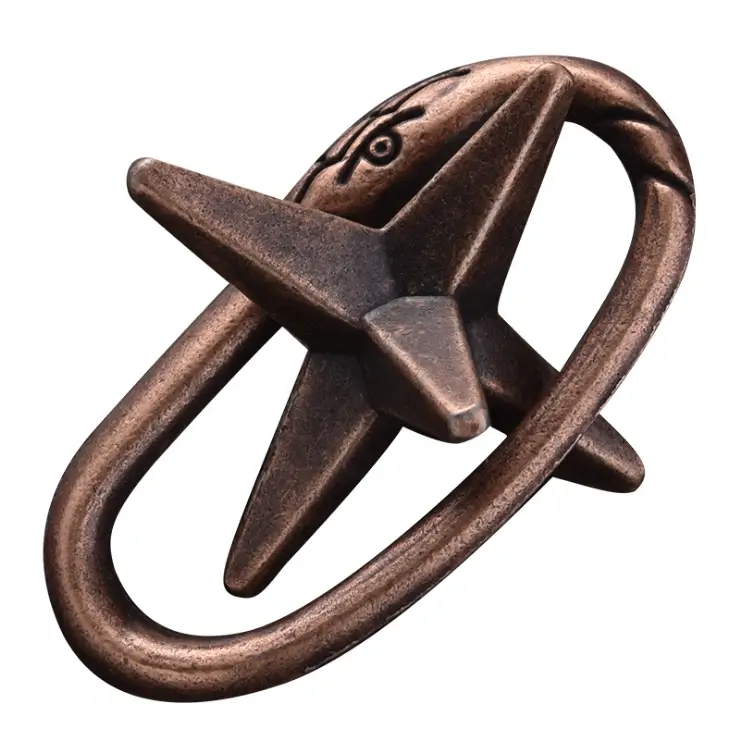
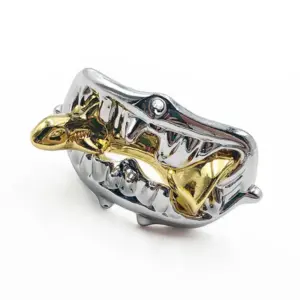
Snake Mouth Escape Puzzle — $13.99
A puzzle like the Snake Mouth Escape exemplifies this beautifully. The ring isn’t trapped; it’s on a path. Your task is to find the sequence of rotations and slides that aligns the ring with the serpent’s open jaw—the ultimate gate. It teaches you to treat the entire coiled form as a convoluted track.
When mapping fails, think in reverse. This is the second universal strategy. If you cannot see how to get the piece out, ask: “How would I put it back in?” Often, the reassembly path, worked backwards, reveals the critical disassembly move you missed. Many classic Vexier puzzles, those twisted wire duets, are solved not by pulling the pieces directly apart, but by rotating one in a specific axis, following a phantom path you’d use to intertwine them in the first place.
Finally, learn to recognize false constraints. Your brain will tell you a piece cannot pass through another solid piece. Topologically, it can—if there is a large enough gate and a viable path. The constraint is only that the materials themselves cannot deform. This is where you practice the delicate, ballet-like motions: tilting, rotating, transferring slack from one hand to the other. The satisfying snick of release is the sound of a pathway completing itself.
These strategies form a tactile toolkit. They transform a baffling object into a structured spatial story. For a more detailed breakdown of this mindset, the principles behind the 3-step mindset to solve any metal ring puzzle are directly applicable here. You begin to see not a tangled mess, but a sequence of decisions waiting to be discovered. It’s a quiet logic, held in your hands.
Choosing Your First Tangled Companion: A Sensory Buyer’s Guide
The quiet logic of thinking in loops becomes its own reward, a private satisfaction held in the palms. Once you understand the rules of the game, the natural impulse is to find a piece of this folk topology to call your own. The best first disentanglement puzzle is not the most difficult, but the most instructive: it should feel solid and deliberate in your hand, with a clear, attainable goal. For most, this means a single-piece objective (free one ring, separate two twisted wires) in a medium where every move is perceptible to the touch. A good starting weight is between 100 and 300 grams—substantial enough to feel intentional, but light enough for comfortable, prolonged manipulation.
Material is your first and most telling choice. It defines the entire experience. An antique forged iron puzzle, often a tavern puzzle from a blacksmith, carries a palpable heft and a matte, textured finish that grips your fingers. Its moves feel granular, sometimes requiring a firm but careful coaxing through aged tolerances. Modern cast alloy puzzles, like those from brands such as Hanayama, offer a different pleasure: a slick, precise feel with a satisfying snick as components glide past one another. They are exercises in geometric clarity. For a beginner, a modern cast puzzle provides consistent, predictable feedback, reducing variables as you learn to read spatial relationships.
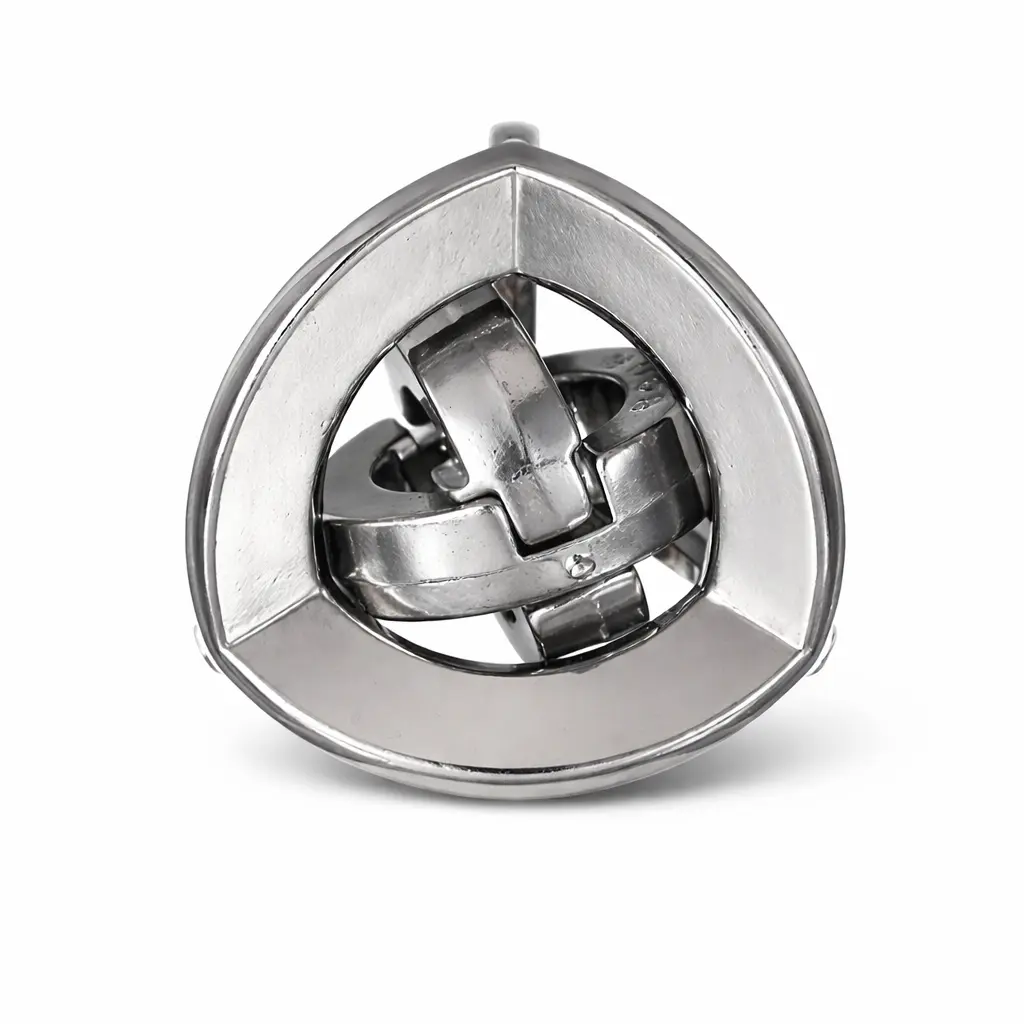
This modern cast piece, for instance, embodies the accessible end of the spectrum. Its clean lines and smooth finish eliminate the distraction of rust or roughness, focusing your attention purely on the path of the ring. As explored in our guide on the solver’s touch in choosing your metal brain teaser, this focus on material feedback is crucial for building foundational spatial reasoning.
Era is your next consideration, and it dictates where you look. Authentic antique puzzles are folk artifacts, found at flea markets, estate sales, or specialist auctions. They come with history and often unique imperfections. A 19th-century bent-nail puzzle feels like holding a carpenter’s moment of whimsy. However, they can be expensive, fragile, and sometimes unsolvable due to damage. For a first purchase, excellent modern reproductions or contemporary designs are the pragmatic choice. Companies like Hanayama or independent makers on craft platforms offer graded puzzles, often with a difficulty rating from 1 to 6. Start at level 2 or 3. Level 1 might be too trivial; levels 4-6 often introduce complex, multi-stage sequences better tackled with experience.
Avoid the siren call of the “impossible” right away. While disentanglement puzzle impossible solution is a tantalizing search term, many such puzzles are literal trick objects with no solution, designed for jest. Others are solvable but require a fiendish insight that can frustrate rather than educate. Seek out puzzles described as “classic” or “traditional”—the Devil’s Horseshoe, the Double M, or a simple two-Vexier loop. Their solutions are well-documented, offering a solvable archetype to study. The goal for a first puzzle is not to stump yourself, but to successfully apply the strategies of seeking slack, tracing loops, and working backwards. This builds the confidence to later tackle more obscure designs.
So, where to begin your search? For modern puzzles, online marketplaces and specialty puzzle retailers offer the widest selection, complete with difficulty ratings and community reviews. For the tactile experience of an antique, set up saved searches on auction sites for “tavern puzzle” or “antique disentanglement puzzle,” but be prepared to patiently sift through listings. A final, crucial tip: before purchasing, always verify that the puzzle is solvable and resettable. A good seller will state this clearly. The joy of a disentanglement puzzle is a cycle—the tangle, the release, and the deliberate, knowing re-tangle, ready for the next curious hand. Choose a companion that invites you into that cycle, one satisfying snick at a time.
The Craft of the Impossible: Trick Puzzles and Psychological Design
After learning the foundational strategies and seeking out a solvable first companion, you might confidently assume every twisted mass of metal conceals a logical escape. Not always. Among the world of disentanglement puzzles, a small but significant subset—perhaps one in twenty historical examples—is engineered with no solution at all. These are the trick puzzles, crafted not to train the mind in topology but to confound it, serving as joke objects or tests of stubbornness. Their existence speaks directly to a darker, more mischievous corner of the “folk topology” tradition.
Historically, these were the pranks of the puzzle world. A blacksmith might forge an impossible entanglement from a single, cleverly bent nail and leave it on a tavern table to watch a patron struggle in vain. Sailors, adept at knotwork, would devise rope puzzles that appeared solvable but contained a fatal flaw in their threading. The goal wasn’t enlightenment through spatial reasoning, but the shared laugh (or friendly bet) that followed the eventual revelation: “It doesn’t come apart.” This transforms the object from a mechanical puzzle into a social artifact, a physical punchline whose tactile experience is one of mounting, then releasing, frustration.
The psychological design of these objects is fascinating. They exploit our hardwired assumption of solvability. When we pick up a disentanglement puzzle, our brain immediately engages its pattern-finding modules. We seek slack, trace loops, and mentally rotate pieces—all strategies you’ve now learned. A well-made trick puzzle will offer just enough false promise to keep you engaged. It may have a loop that looks like it should pass through a gap, or a sequence of moves that seems to progress before hitting an absolute, immovable dead end. The designer’s craft lies in building this plausible path to nowhere. The true “aha” moment is not a satisfying snick of release, but the meta-realization of the trick itself. It’s a lesson in questioning the fundamental constraints of the problem.
This tradition continues with modern, precision-made puzzles. Some are marketed explicitly as “impossible” or unsolvable, their appeal shifting from deception to a form of masochistic admiration for the design. Consider the infamous Zirel Metal Puzzle, often noted for a purported 0.002mm gap that promises freedom but delivers only agony. It represents the trick puzzle evolved: no longer a crude joke but a meticulously machined expression of futility, appealing to collectors who appreciate the engineering as much as the experience. A deeper look into the Zirel metal puzzle’s tiny gap between art and agony reveals this modern craft in detail.
Ultimately, these puzzles hold up a mirror to our drive to solve. They prove that the impulse to untangle is as powerful as the satisfaction of succeeding. In a collection, a single, elegantly crafted impossible solution puzzle serves as a crucial counterpoint. It reminds us that not every problem posed has an answer, and that within the history of folk artifacts, there was always room for wit, subversion, and a well-made joke in wrought iron.
More Than a Solution: As Artifact, Teacher, and Meditation
Ultimately, these objects of futility and triumph are more than a pastime. For every collector, educator, or mind in search of focus, a disentanglement puzzle serves a purpose beyond its solution, with institutions like the Victoria and Albert Museum holding hundreds of historical specimens, affirming their status as tangible cultural artifacts. In a hands-on collection, they become a physical library of folk topology.
As folk artifacts, they are tactile documents. A worn, hand-forged iron tavern puzzle from the 19th century carries the weight of countless attempts in smoke-filled rooms. A smooth, cast alloy Vexier from a mid-century German manufacturer speaks to industrialized precision applied to play. To collect them is to preserve a history of human ingenuity expressed not in words, but in twisted wire and cunning loops. They offer a window into the history of mechanical puzzles, a lineage of hands-on thinking.
As a teacher, their value is direct. They are unplugged trainers for spatial reasoning, demanding one physically manipulate mental models. Educators and cognitive therapists have long used them to develop non-verbal problem-solving skills, precisely because they enforce the strict topological constraint of “no bending, no cutting.” This rule forces a deeper, more patient engagement with the structure of the problem itself.
And as a meditation, they are a perfect, self-contained practice. The focused attention required to trace a wire’s path, to feel for the subtle alignment that allows a ring to slide free, quiets the noise of the world. It is a repetitive, almost ritualistic engagement with a physical object that, unlike a screen, offers definitive, satisfying tactile feedback—a snick, a drop into the palm, a quiet click of resolution. This mindful engagement is what we explore in the reflection on when a puzzle becomes a practice.
So, having chosen your first companion and understood its logic, where does the journey lead? Perhaps to a curated shelf, a display of these silent teachers. Or perhaps to a simple habit: reaching for that cool piece of metal not when you need to be challenged, but when you need to be grounded. The final piece of advice is this: Go see them in person. Visit a museum’s puzzle collection, or a maker’s stall at a craft fair. Pick one up. Feel its heft, its texture, its potential for quiet revelation. That is where the tangled truth truly resides.