The Hand-Feel Test: Your First Clue to a Deeper Divide
The most immediate difference between a cast puzzle and a wire puzzle is density. A cast puzzle sits in your palm with the cool, substantial weight of a machined component, typically 3-6 ounces of solid metal that demands deliberate, exploratory rotation. A wire puzzle feels like an airy sculpture, often weighing under 2 ounces, its open structure inviting your fingers to probe and slide along its visible paths. This fundamental contrast in mass and form dictates your entire approach from the very first grip.
Pick up a cast puzzle. Your hand closes around a smooth, enigmatic object. Your first instinct is to turn it, to examine every face and curve, seeking seams or clues in its monolithic exterior. The feedback is subtle: a faint internal rattle, a barely perceptible shift in weight, the smooth glide of one piece against another within a tolerance of thousandths of an inch. You are trying to perceive the invisible.
Now, pick up a wire puzzle. Your fingers immediately slot into the gaps of its bent-steel framework. Your instinct is to thread and maneuver—to guide one loop through another, to slide a ring along a straight length of rod. The feedback is visual and auditory: you can see the clearances (or lack thereof), and you hear the distinct skritch-skritch of metal on metal as components interact. The path is laid bare, but the rules of navigation are not.
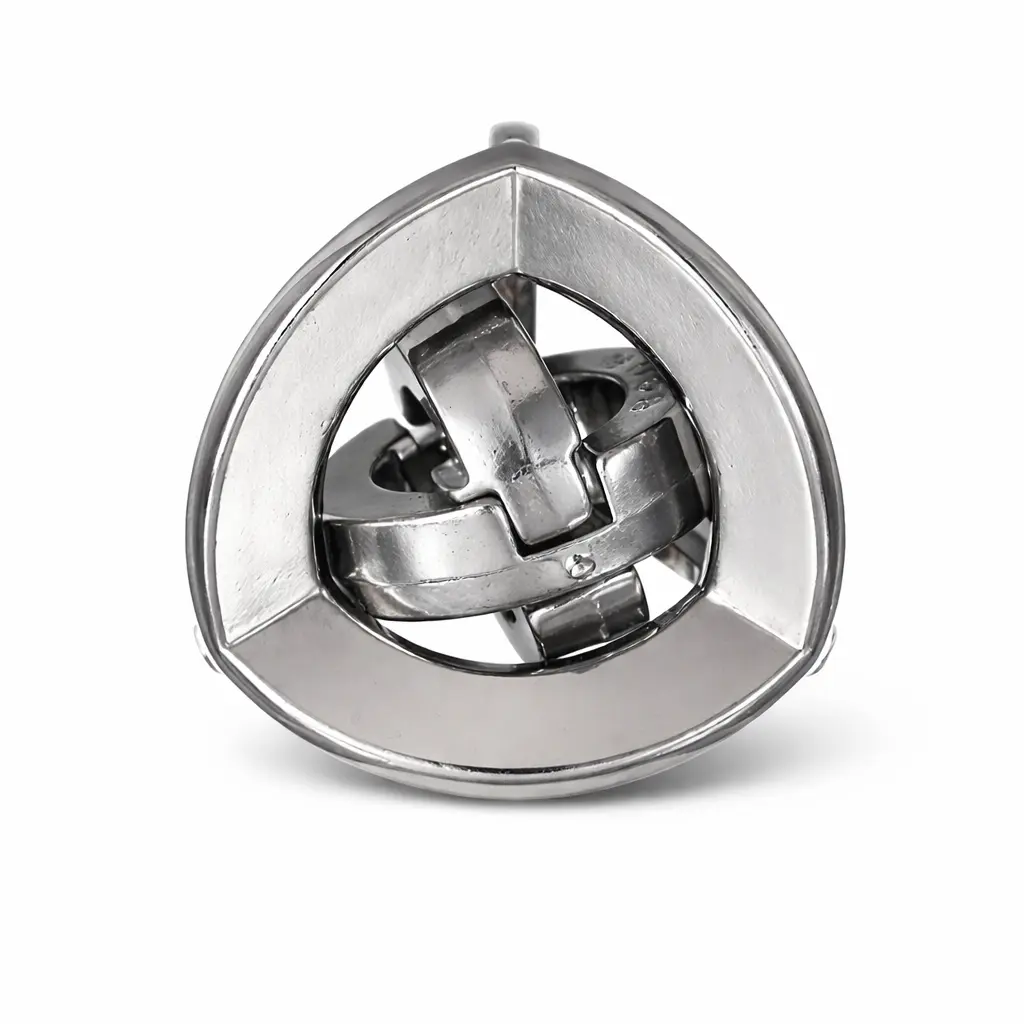
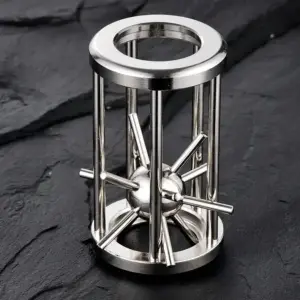
Consider the Metal Orbit Ring Cast Puzzle shown above. In your hand, it feels like a single, polished artifact. The goal—separating the ring—is obvious, but the mechanism is completely hidden within that solid, rotating form. Solving it requires building a mental map of internal channels and alignments you cannot see, relying on tactile and auditory clues. It’s the quintessential cast metal puzzle experience.
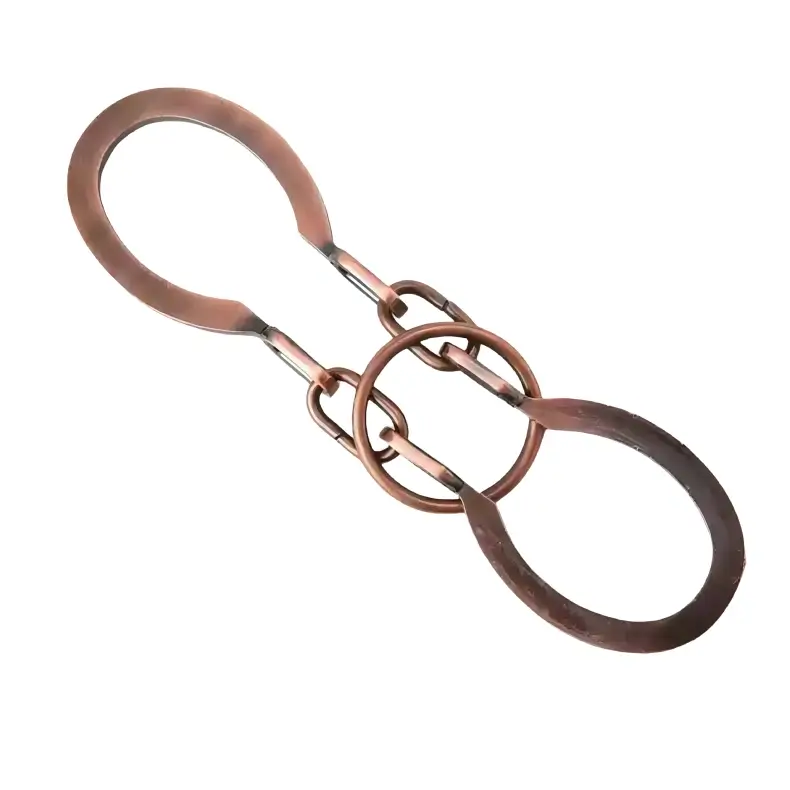
Horseshoe Lock Puzzle — $13.00
Now, hold the Horseshoe Lock Puzzle. Your eyes instantly trace the two intertwined wires and the shackle. The problem is completely visible—you can see every intersection and potential opening. The challenge is topological: figuring the exact sequence of twists, turns, and passes to free the loop without forcing it. This is the classic wire disentanglement puzzle dynamic, a subcategory of the broader mechanical puzzle family.
This initial “hand-feel test” is far more than a superficial observation. It is the direct result of how these objects are forged and bent, and it foreshadows everything about the solver’s journey: the primary senses you’ll use, the type of mental model you must build, and even the nature of the satisfying “click” at the solution. That visceral difference in your palm is the gateway to five key axes of comparison: Manufacturing & Form, Sensory Input, Required Mental Model, The ‘Aha!’ Moment, and Ideal User Profile.
If you’ve ever felt intuitively that solving these two types engages different parts of your brain, you were correct. Let’s dissect why, starting at the very beginning: how a lump of metal becomes a cast puzzle, and how a straight rod becomes a wire puzzle. For a deeper dive into selecting based on this tactile feedback, our guide on how to choose a Hanayama puzzle and our a skeptic’s guide to wire brain teasers explore these initial impressions in detail.
Forged vs. Bent: The Manufacturing Divide That Defines Everything
The tactile difference you just experienced—solid mass versus open air—is not an accident of design but a direct consequence of foundational manufacturing. A cast puzzle begins its life as molten metal poured into a mold, creating a solid object with hidden internal channels, while a wire puzzle is born from a straight rod bent into a deceptive path you can see but cannot immediately navigate. This core distinction in anatomy dictates every aspect of the solving experience, from the precision of its machined tolerances to the type of mental map you must build.
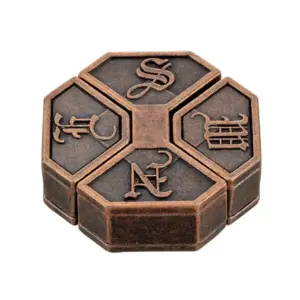
Cast puzzles are forged into being. Typically made from a zinc alloy, the metal is heated until liquid and poured into a precision mold. This process creates a dense, often pocket-sized object with a satisfying heft. The magic—and the mystery—lies in what the mold creates: internal voids, slots, pins, and channels that are completely invisible once the piece cools and is finished to a smooth, sometimes coated, surface. Your only clues are the seams, subtle shifts in weight, and the faint lines where components meet. The high cost of creating precise, durable molds and the need for exceptional finishing (to avoid rough edges and ensure smooth movement) creates a significant barrier to entry. This is why the premium cast puzzle market is overwhelmingly dominated by Hanayama, whose puzzles are typically priced between $10 and $20. Their reputation is built on tolerance—the microscopic gap between moving parts. A perfect cast puzzle moves with a precise, silent slide when aligned correctly, and grinds to an absolute halt when it is not. It’s a lesson in spatial alignment you feel in your fingertips.
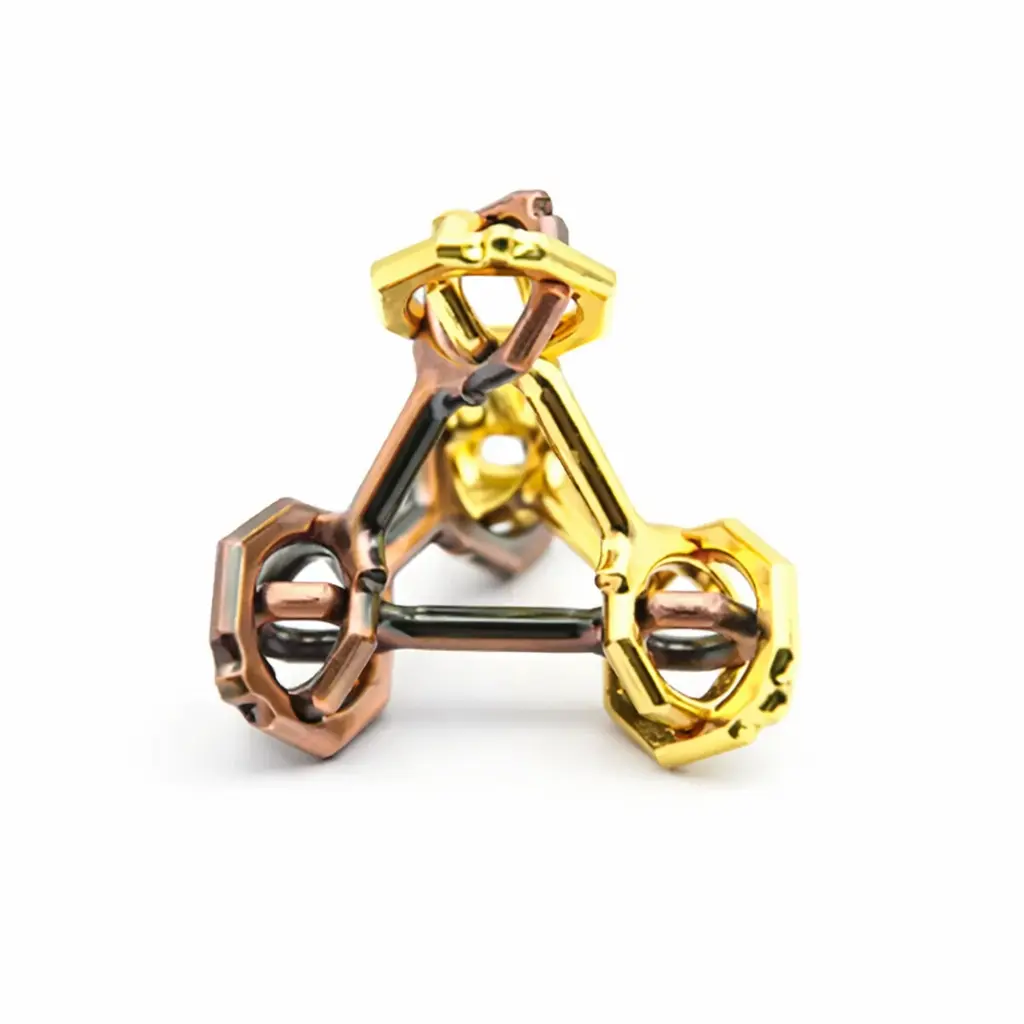
Cast Coil Triangle Puzzle — $25.99
In stark contrast, wire puzzles are bent into shape. They are generally fashioned from steel or brass wire of varying gauges, manipulated by machine or hand into interlocking loops, cages, and frames. The entire topological path is laid bare for your eyes to see from the moment you pick it up. The challenge isn’t discovering a hidden chamber; it’s deciphering the correct sequence of rotations and translations to navigate a clearly visible but obstinately blocked route. Manufacturing is less about secret molds and more about consistent bend angles and smooth joins. This lower barrier to production results in a vast, chaotic landscape. You’ll find timeless classics reproduced for decades, often at lower price points ($5-$15), alongside a sea of cheap knockoffs where poor finishing leads to sharp burrs that snag and frustrate. A well-made wire puzzle, however, offers a clean, predictable glide along its prescribed path.
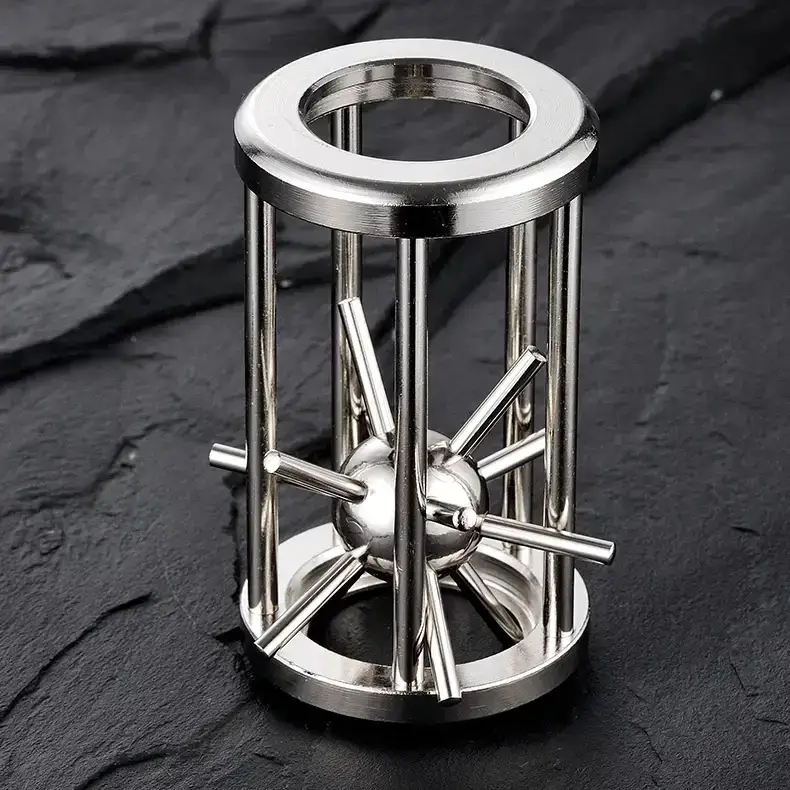
This manufacturing divide answers a key user question: Why are Hanayama puzzles so expensive compared to some wire puzzles? You’re paying for the R&D, precision tooling, and flawless finishing of a miniature mechanical system you cannot see. A cast puzzle is a locked vault; a wire puzzle is a tangled but open gate. The former demands you deduce the lock mechanism; the latter challenges you to find the one keyhole in a fence you can already see over. Understanding this fundamental anatomy—the invisible maze versus the visible labyrinth—is the first step in choosing your battlefield. For those drawn to the enigmatic solid form, our guide to ruthless cast puzzles for connoisseurs explores the pinnacle of this craft, while our analysis of decoding cast metal puzzle disentanglement breaks down the experience further.
Sight vs. Sound: The Solver’s Divergent Sensory Toolkit
If understanding the manufacturing divide tells you what you’re holding, then decoding its sensory language tells you how to solve it. The core distinction is this: wire puzzles are solved primarily with your eyes (about 70% visual, 30% tactile), while cast puzzles demand you to listen and feel for hidden alignments (closer to 40% visual, 60% tactile/auditory). Your dominant sense must switch the moment you pick up a new type of metal brain teaser.
With a wire puzzle, your eyes are your primary tool. The solving path is, in theory, fully visible. Your job is to trace the continuous line of each wire, mapping how its bends and loops interact with other components, like a ring or a second wire frame. You are navigating a topological path—a sequence of moves where the object must pass through specific openings in a strict order. The feedback is visual and continuous: you can see the ring slide along a straight section, catch on a bend, or clear a loop. This often encourages a rhythmic, almost meditative manipulation—the fidget factor is high. You enter a state of repetitive testing, not because you’re stuck, but because you’re actively scanning the visible geometry for the one correct sequence. (This is where most people brute-force a wire puzzle for an hour, only to realize they missed a simple rotation in the first three seconds.)
The sensory input from a cast puzzle is fundamentally different. You are often holding a sealed, opaque object. Your eyes can see the exterior shapes and maybe a seam or a hole, but the critical interactions—the internal channels, blind slots, and interlocking teeth—are hidden. Your primary feedback shifts to your fingertips and your ears. You learn to interpret minute vibrations, changes in resistance, and the subtle audible click of a internal latch engaging. Solving becomes an exercise in building a mental model of the invisible interior through tactile feedback. You rock pieces, apply gentle torque in different axes, and listen for sounds that betray internal alignment. A long, contemplative pause is often required to hypothesize the hidden mechanism, followed by a deliberate, exploratory manipulation to test the theory. The satisfying, weighty clunk of a cast puzzle piece sliding into its final position is a sound earned by deduction, not visual tracing.
This divergence answers a key user question: Are wire puzzles just for fidgeting, or do they require real thought? They require rigorous thought, but of a different kind. The fidgeting is the process of visually exploring a constrained system. The “aha!” moment in a wire puzzle is spotting the overlooked visual clue—the one bent segment that acts as a gate. In a cast puzzle, the “aha!” moment is a hypothesis confirmed by a sound or a sudden, smooth movement you couldn’t predict by sight alone. For a deeper dive into the universal rules behind this feedback, our guide to the mechanical grammar of brain teasers is essential reading. If the wire puzzle’s tactile-pathway approach intrigues you, the methodology outlined in our 3-step mindset to solve any metal ring puzzle applies directly to that visible, thread-the-needle struggle.
In short, ask yourself at the start: Am I solving a visible maze, or am I blindfolded in a locked room, feeling for the keyhole? Your senses will tell you which game you’re playing.
Spatial Maze vs. Topological Map: The Required Mental Model
Your instinctive reliance on sight or sound isn’t arbitrary; it’s a direct result of the fundamentally different cognitive software each puzzle type forces you to run. To solve a cast puzzle, you must construct and navigate a precise spatial model in your mind. To solve a wire puzzle, you must deduce and follow a topological path governed by logical rules. This is the core reason why being adept at one type offers almost zero transferable skill to the other—it’s like trying to use your fluency in chess strategy to win at a game of 3D pool.
A cast puzzle is a locked, opaque container. You cannot see the internal channels, pins, and cavities. Your task is to deduce their existence, dimensions, and alignment through indirect feedback. This forces you into a cycle of hypothesis and tactile testing. You develop a mental blueprint: “If I tilt this piece 30 degrees and slide it against this internal wall, a gate should align.” You are, effectively, blindfolded inside a finely machined labyrinth. Your success depends entirely on the accuracy of your internal 3D simulation. This is pure spatial reasoning—the ability to visualize, manipulate, and predict the relationships between objects in space. When you finally solve it, the victory is one of precision engineering: your mental model matched the physical reality.
A wire puzzle, by stark contrast, presents all its information visually. You can see every intersection, loop, and bend. The challenge is not discovering the geometry, but understanding the rules of motion within it. This is topological problem-solving. Topology is often called “rubber-sheet geometry”; it’s concerned with properties that remain unchanged under continuous deformation—like connectivity, loops, and knots. Your goal isn’t to align hidden features, but to find a continuous pathway for the ring or key to traverse the wire structure without breaking the (often invisible) rules. The critical question is never “Is it aligned?” but “Is this sequence of moves topologically possible?” This aligns with academic classifications, where wire puzzles are a classic form of disentanglement puzzle.
This distinction explains the classic puzzle solving strategies that emerge. For a cast puzzle, the strategy is systematic exploration: methodically testing each axis of rotation and translation, listening for changes in resistance, feeling for new tactile feedback. You are mapping the void. For a wire puzzle, the strategy is visual trace and rule-checking: “If I pass the ring through this loop, does it create a new, inescapable knot based on the wire’s fixed bends?” You are analyzing a visible network. (This is where most people get stuck for hours—they see a possible path but fail to recognize the topological dead-end it creates two moves later.)
So, which cognitive muscle are you exercising? The cast puzzle solver is a submarine navigator in a dark cave, plotting a course by sonar pings (the audible clicks and scrapes). The wire puzzle solver is a city planner analyzing a one-way street system, figuring out how to route a car from point A to B without ever making an illegal U-turn. One deals with the concrete certainty of volume and alignment; the other deals with the abstract logic of pathways and permissions.
Answering a key user question: I’m good at spatial reasoning—which puzzle type should I try? If you excel at reading blueprints, assembling furniture without instructions, or have a knack for 3D video games, your mind is pre-wired for the blind navigation of cast puzzles. Your ability to rotate objects mentally will be your greatest asset. If, however, you thrive on logic puzzles, untangling necklaces, or following complex procedural rules, the topological rule-set of wire puzzles will feel more intuitively native. Recognizing your innate preference here is the fastest route to selecting a puzzle that feels less like frustrating work and more like a fluent, satisfying conversation with a cleverly designed system.
The ‘Aha!’ Moment: Precision Alignment vs. Pathway Discovery
The climax of a mechanical puzzle—that final, triumphant move—is categorically different between cast and wire types. For a cast puzzle, success is a definitive event, often a single, perfect spatial alignment that produces a satisfying audible click. For a wire puzzle, it’s a process finale, a smooth, unobstructed slide along a now-clear topological path. This difference is the physical manifestation of the divergent mental models we just explored.
The wire puzzle solver, after mapping the convoluted rules of loops and posts, executes a sequence of maneuvers that culminates in a single, often graceful, disengagement. There is rarely a secret final step; the solution is the logical end state of the pathway you’ve been tracing. The “Aha!” is the realization that the last obstruction has been cleared, and the piece can simply leave. It’s a moment of release and open space.
In stark contrast, the “Aha!” of a cast puzzle is almost always a moment of connection, not release. These puzzles are not typically fully disassembled into a pile of separate components. (Answering a key user question: Can you take apart a cast puzzle completely? Usually, no. Most cast puzzles separate into two or three interlocked sub-assemblies that reveal the ingenious internal channels, but a stopping point is designed into the mechanism). The climax is the discovery of the one exact orientation where all internal obstructions simultaneously align, allowing a key piece to translate or rotate into its solved position. This is where you experience that weighty, machined solidity—the profound ‘clunk’ or seamless slide that feels earned. You’ve not just followed a path; you’ve constructed a temporary, perfect tunnel within the solid metal itself.
This leads directly to another user question: are cast puzzles harder than wire puzzles? Using Hanayama’s own 1-6 (C to B) difficulty scale as a rough benchmark, the nature of the difficulty is more punishing. With a wire puzzle, you can usually see your error; a loop is visibly blocked. In a cast puzzle, you can be a fraction of a millimeter off in an axis you can’t visually verify. The tolerance is unforgiving. Your feedback is the absence of movement, a silent rejection. This makes the final alignment profoundly satisfying but can also create longer periods of stuckness where you know you’re close but lack the sensory data to proceed. The difficulty in wire puzzles is conceptual (finding the sequence); in cast puzzles, it’s often executional (achieving the precise alignment once the concept is understood).
So, which “Aha!” resonates more? If you crave the tactile, conclusive feedback of parts mating together with engineered perfection—that tangible proof of spatial hypothesis—the cast puzzle’s climax is your reward. It’s the sound of being definitively correct. If your satisfaction comes from seeing a plan executed to completion, from systematically removing complexity until only simplicity remains, the wire puzzle’s final, effortless separation will deliver a clean, logical euphoria. One is a key turning in a lock; the other is the last knot slipping free.
Difficulty Spectrums and Brand Ecosystems: Navigating the Landscape
The profound satisfaction of that final “clunk” or smooth separation leads directly to the practical question: how do you find more puzzles that match your skill and provide that feeling? This is where the paths of cast and wire puzzles diverge into two distinct worlds: one of curated order and one of creative chaos, each with its own logic for communicating difficulty.
In the cast puzzle universe, Hanayama is the de facto standard—and for good reason. They have engineered not just puzzles but an entire, user-friendly framework. Their 1 to 6 difficulty scale (marked C=1, B=6 on the packaging) is a genuine, reliable benchmark. A level 2 (like Nutcase or O’Gear) introduces core mechanics with forgiving tolerance, while a level 6 (like Enigma or Radix) demands absolute spatial precision and often hides its mechanisms completely. This scale is the single most useful tool for a beginner asking ‘what is a good first cast puzzle?’ Start at level 2 or 3. This systematization explains the price point ($10-20): you are paying for consistent, machined quality, meticulous design that ensures a logical (if difficult) solution, and that satisfying, solid finish. Hanayama’s dominance is near-total because their process—from design to forged metal casting—creates a premium, reproducible product that’s hard to match.
Wire puzzles, by contrast, are a sprawling, untamed frontier. There is no universal difficulty scale. A classic like the “Horseshoe” puzzle might be considered a beginner disentanglement puzzle, while the “Devil’s Halo” can stump intermediates for hours. Difficulty is poorly indicated on packaging, often relying on subjective terms. Furthermore, quality varies wildly. You can find a beautifully welded, smoothly plated brass puzzle for $15 and a nearly identical-looking version for $5 made from sharp, poorly bent steel wire that snags and frustrates. This variability directly answers the user question about Hanayama’s price: you are investing in design consistency and manufacturing tolerance. A cheap wire puzzle isn’t just easier or harder—it’s often broken, with solutions made impossible by sloppy bends. This landscape is well-documented in resources like this Mechanical Puzzle Category Spotlight, which highlights the enduring classics.
This leads to the core difference in navigating their landscapes. With cast puzzles, you choose a trusted brand and select a difficulty level. The exploration is vertical, climbing the ladder of complexity within a controlled ecosystem. The puzzle inside the box will match the designer’s intent perfectly. With wire puzzles, the exploration is horizontal. You seek out classic, well-proven designs from reputable manufacturers or puzzle shops that curate for quality. The risk of a dud is higher, but so is the potential for discovering ingenious, lesser-known designs.
So, which type is harder? It’s the wrong question. A Hanayama level 6 is differently hard than a fiendish wire puzzle like “Vortex” or “Eclipse.” The cast puzzle’s difficulty is often condensed into a single, precise maneuver—a barrier of pure execution. The wire puzzle’s difficulty is elongated, a convoluted sequence where one misstep forces total backtracking. Beginners might find early-success wire puzzles more approachable due to visual feedback, but hit a steeper conceptual wall later. Cast puzzle beginners might feel blind initially, but the structured difficulty progression offers a clearer path to improvement.
Therefore, your entry point matters. For a best metal puzzle for beginners in cast, start with Hanayama’s ‘Cylinder’ (Level 2) or ‘Key’ (Level 3)—they teach foundational alignment without brutal frustration. In wire, seek out a well-made ‘Double M’ or ‘Horseshoe’ puzzle from a specialty retailer; these are the equivalent of training modules for topological thinking. They provide a clear, solvable path to build confidence before you step into the wilder, unmarked territory of the wire puzzle world. This understanding of the ecosystems themselves becomes the final piece of knowledge you need before answering the ultimate question: which type are you?
The Decision Matrix: Which Puzzle Type Matches Your Mind?
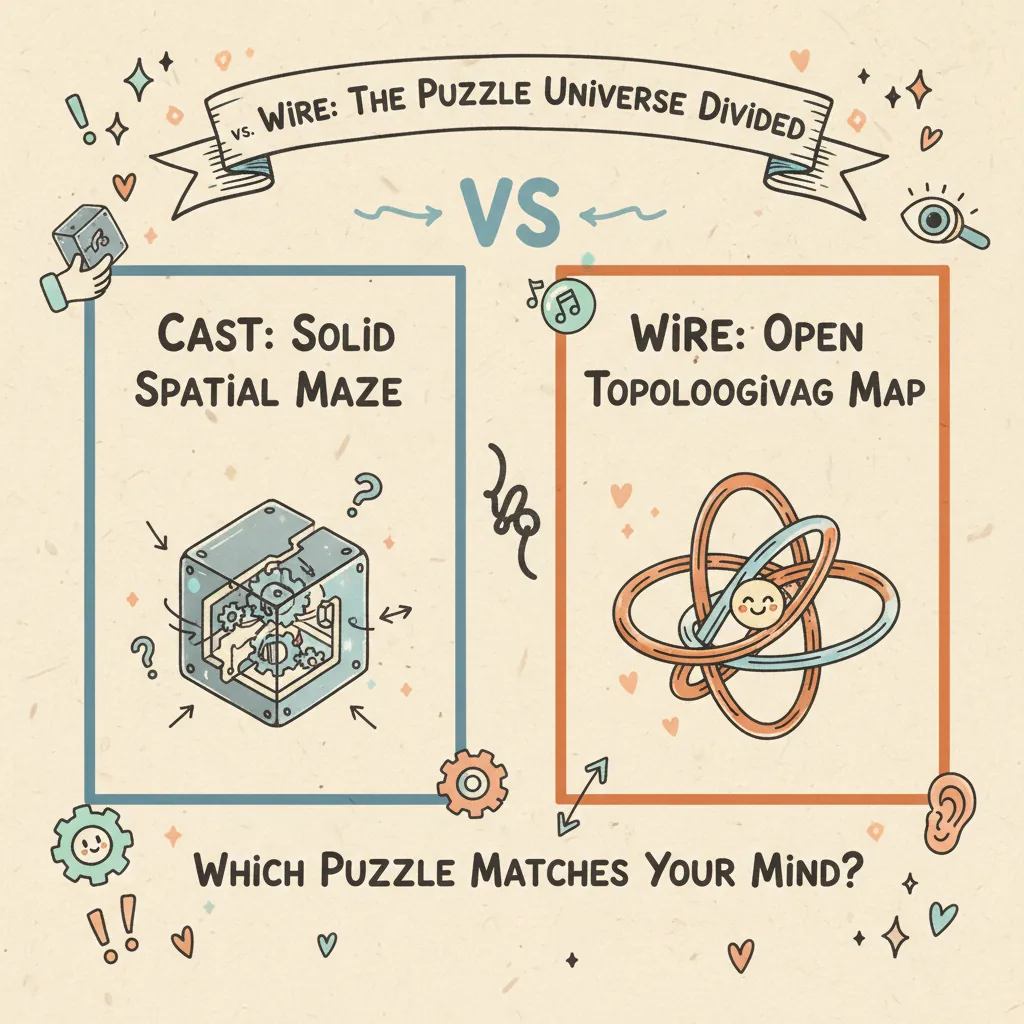
Choosing your ideal metal brain teaser isn’t about which is objectively harder—it’s about matching the puzzle’s engineered demands to your native cognitive wiring. The most significant predictor of your enjoyment and success is whether your problem-solving style aligns with the spatial alignment focus of cast puzzles or the topological pathfinding of wire puzzles.
Having navigated both ecosystems from beginner to expert, I’ve distilled the choice into a simple diagnostic. Forget difficulty ratings for a moment. Answer these questions about your own instincts.
Your Primary Cognitive Strength:
* Do you instinctively rotate objects in your mind’s eye to see how they might interlock? Do you enjoy 3D modeling, assembly instructions, or fitting luggage into a car trunk with geometric precision? This spatial visualization aptitude is the core fuel for cast puzzles.
* Do you excel at tracing routes, untangling knots, or following complex, step-by-step procedures? Are you a systematic planner who maps out dependencies? This sequential, path-oriented thinking is the native language of wire puzzles.
Your Tolerance for “The Unknown”:
* Can you work confidently with limited feedback, trusting subtle tactile shifts and faint sounds to guide you? Cast puzzles often require committing to a movement based on a hypothesis about an invisible internal channel you cannot see.
* Do you prefer a visually verifiable problem state at all times, where every obstacle and potential opening is laid bare (even if it’s deceptive)? Wire puzzles offer this sight-line clarity, trading hidden mechanics for complex rule-based navigation.
Your Sensory Preference in Feedback:
* Is your satisfaction deeply tied to a definitive, mechanical conclusion—the profound audible click and solid clunk of a heavy piece sliding perfectly home? This is the catharsis of the cast puzzle.
* Do you derive pleasure from the rhythmic, almost meditative process of manipulation itself—the smooth glide of metal on metal, the gradual progression of a loop along a topological path? This is the fidget factor and flow state of the wire puzzle.
Profile A: The Cast Puzzle Mind
You are likely an architect or an engineer at heart. You value precision, elegance, and definitive outcomes. You don’t mind—and may even prefer—long pauses of contemplation, analyzing the artifact from every angle, developing a complete internal model before testing it. Your frustration tolerance is high because you view being “stuck” as a data-gathering phase. When you finally execute the solution, it feels like proving a theorem. For your buying first metal brain teaser, you want a tangible object that feels machined and substantial. Start with a Hanayama rated 2-3 to learn the language of internal alignments without overwhelming ambiguity. When you’re ready to advance, a veteran’s guide to cast puzzle logic will help you tackle the more ruthless designs.
Profile B: The Wire Puzzle Mind
You are likely a strategist or a tactician. You enjoy processes, sequences, and dynamic problems. You think in terms of steps, constraints, and reversible maneuvers. You appreciate immediate visual feedback, even if it presents a complex web. Your patience is applied to systematic trial and error, mapping the permissible moves. The “aha!” moment for you is less a single event and more the realization of a key transition in the sequence that unlocks the next phase. For your first foray, choose a classic, well-constructed disentanglement puzzle type like the ‘Double M’ or ‘Horseshoe’. Avoid flimsy, poorly-finished versions; good tactile feedback is crucial even here.
The Verdict: If you see yourself more in Profile A, begin with cast. If Profile B resonates, start with wire. The ultimate enthusiast will, of course, cultivate both skill sets—they train complementary parts of the mechanical mind. But your entry point should play to your cognitive strengths, transforming initial curiosity into a confident, satisfying solve that will have you reaching for the next one.
First Steps & Hybrid Curiosities: Where to Begin Your Journey
Based on your decision matrix profile, your ideal entry point is a puzzle that matches your cognitive strengths. For Profile A (the spatial reasoner), begin with a Hanayama cast puzzle rated C-1 or C-2 for a 20-40 minute satisfying, confidence-building solve. For Profile B (the tactical mapper), select a classic, well-made wire puzzle with a defined goal, like separating two linked components.
For the Cast Mind: Start with Internal Geometry
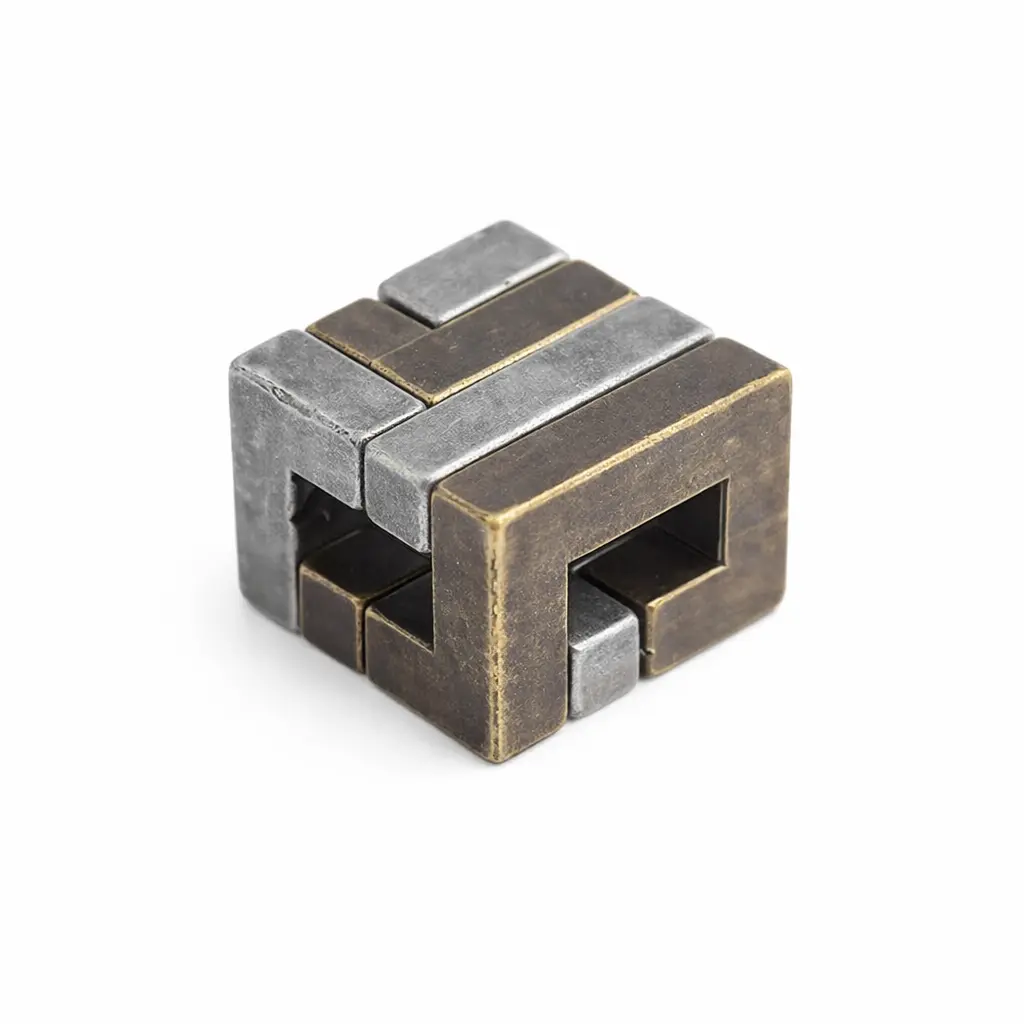
If the cast puzzle profile resonated, your goal is to build an intuitive feel for internal channels and hidden alignments. Begin with puzzles that have clear, limited axes of movement and offer good tactile feedback. The Hanayama ‘Nutcase’ (C-1) is a canonical first choice: two pieces with an obvious—yet initially inaccessible—seam, teaching you to feel for rotational alignment. Slightly more complex is the ‘Cylinder’ (C-2), which introduces a simple sliding mechanism within a deceptively smooth exterior. Both train the essential skill of relying on audible clicks and shifts in weight rather than sight. (A pro tip: solve it once, then immediately try to reassemble it. This reverse-engineering cements the mental model). If you ever find yourself truly stumped by a specific level, resources like our Hanayama cast puzzle solutions by level can provide structured hints without spoiling the full journey.
For the Wire Mind: Start with Pathway Logic
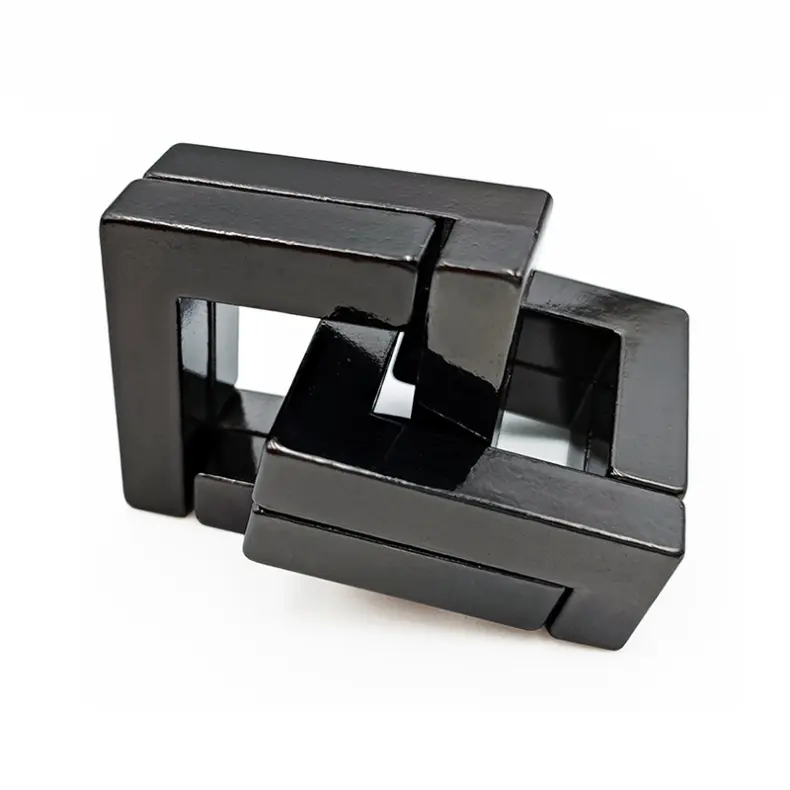
If you identified with the wire puzzle mind, seek puzzles with cleanly bent, sturdy wire that won’t snag. The classic ‘Horseshoe’ or ‘Double M’ (Devil’s Halo) puzzles are perfect. They present a clear objective—free the ring—and their entire topological path is visible, demanding you logically sequence moves around constraints. The ‘Four-Square Lock’ is another excellent beginner choice, introducing the concept of interacting loops and sequential positioning. The key is to avoid cheap, plated puzzles with poor tolerance; sharp edges and wobbly bends destroy the experience.
On Instructions, Hybrids, and Your Next Move
Do you need instructions? Absolutely not for your first puzzle. The entire point is the self-contained deduction. If you eventually get truly stuck, set it aside for a day; the subconscious works wonders. After mastering the classics, you’ll encounter hybrids—puzzles that blend cast elements with wire-like threading components, challenging both your spatial and topological faculties.
Your journey begins by honoring that initial hand-feel test. Revisit your decision matrix, select your corresponding recommendation, and make the first, deliberate move. The solid clunk of a cast piece seating home or the smooth slide of wire through a loop awaits. That moment of empowerment—knowing precisely why a puzzle works and that you chose it for your mind—is the final, and most satisfying, piece of the puzzle.