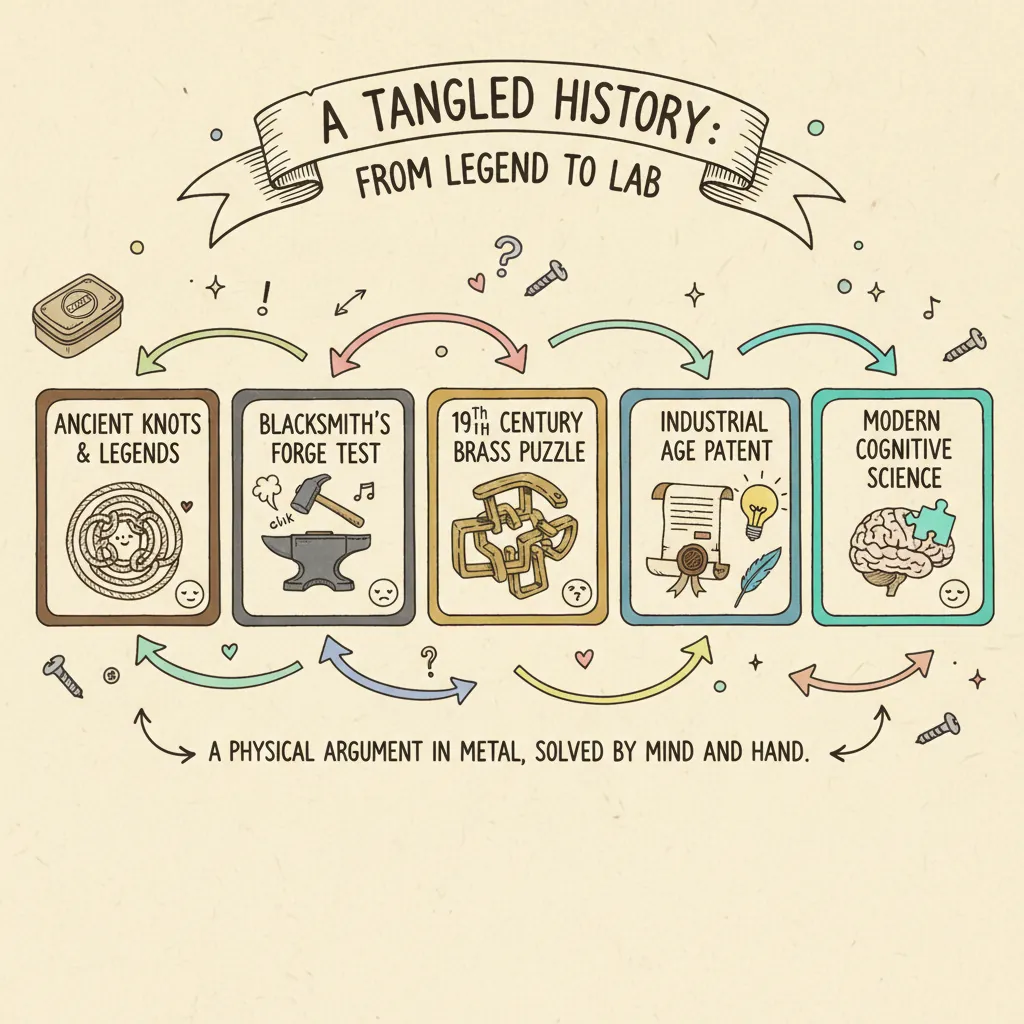
The Question Cast in Metal: A Flea Market Find
My own hunt for them begins in the murmur of a flea market, fingers brushing past costume jewelry and worn tools, searching for a specific cold weight. It’s there, nestled in a tin of loose screws: a tarnished brass loop snared on a twisted, double-ended spear of metal. A “Devil’s Needle.” It costs less than a cup of coffee. Its value is something else entirely.
Your palm receives its history first. The cold. The surprising heft of hand-forged metal, a density modern stamped steel lacks. Then, the eyes confirm: a faint, uneven patina, darker in the deep bends where generations of thumbs have pressed, seeking a path. You turn it. The loop slides with a soft, scraping drag, then catches. A sharp, musical clink. It is a sound of finality. It cannot be forced.
This isn’t just twisted wire; it’s a question cast in metal. A physical argument about space, freedom, and constraint. Who first conceived such a thing? Not as a digital abstraction, but as an object to be wrought on an anvil or bench, demanding tangible solution? The puzzle in my hand, a classic 19th-century patience puzzle, is a descendant. But the family tree winds back through locked rooms of science, the soot of blacksmith forges, and into the haze of legend.
The appeal is primal. It engages a deeper layer of cognition than a flat puzzle on a page. It is spatial reasoning made literal. The tactile feedback—the slide, the catch, the release—is the conversation. You are not just thinking about the solution; you are negotiating with it. This direct, often frustrating dialogue is the thread that connects the weekend hobbyist to the apprentice smith and the theoretical physicist. Each is listening to what the metal says.
In my workshop, among shelves of similar enigmas, this flea-market find takes its place. Its minor imperfections—a small file mark here, a slightly asymmetrical bend there—are its biography. They whisper of individual craft, of pre-production runs, of an era when such puzzles were often one-offs or made in small batches by locksmiths or tinsmiths. Before they were commodities, they were tests.
So we begin here, with the cold weight of a simple, stubborn question. To understand it, we must untie a much older knot.
Before Wire: Knots, Legends, and the First Impossible Task
That simple, stubborn question in metal form—how to separate the inseparable—finds its most ancient and powerful echo not in forged iron, but in knotted fiber. The oldest and most defining precursor to all disentanglement puzzles is the legendary Gordian Knot, a problem documented as early as the 4th century BCE that established the core psychological template: an apparently impossible tangle demanding a radical, often non-linear, solution.
The story, as recounted by historians like Arrian, is itself a kind of cultural puzzle. In the city of Gordium, an ox-cart was tied to a post with a knot so complex and its ends so hidden that no one could untie it. An oracle prophesied that whoever loosened it would rule all of Asia. For centuries, it defied solvers, accumulating the weight of impossibility. It was a public test of patience and cunning, a literal and metaphorical bind. Then came Alexander the Great. Confronted by the knot, he did not patiently pick at its loops. He drew his sword and sliced through it. The solution was violent, direct, and utterly lateral. He did not disentangle; he disrupted the fundamental premise of the problem. This act cemented the knot’s legacy not as a mere curiosity, but as the archetype of the intellectual impasse that requires a shift in perspective—a principle that lives on in every modern wire puzzle that cannot be solved by force, but only by understanding the hidden pathway in its configuration space.
The genius of the legend is that it captures the full emotional arc of facing a true disentanglement challenge: the initial intrigue, the growing frustration, the moment of cognitive breakthrough that feels almost like a transgression. It moves the problem from the realm of pure dexterity into the realm of myth and intellect. While no physical example of the Gordian Knot survives (if it ever existed materially), its pattern is replicated in every “impossible” patience puzzle that follows. It established the tangle as a symbol of political, personal, and philosophical complexity. For a blacksmith’s apprentice centuries later, or a philosopher in a study, the lesson was the same. It cannot be forced. You must listen, and then you must change the rules of engagement.
The leap from mythical rope to handheld metal is smaller than it seems. Before mass-produced wire puzzles, there were practical knots—ship riggings, livestock tethers, intricate bindings used in construction and ritual. Mastering these was essential craft knowledge. The transition from untying a frozen, weather-hardened maritime knot to manipulating two linked iron rings is a transition of material, not of concept. The core dialogue of tension, slack, and sequential movement remained. The tactile feedback simply became colder and more precise.
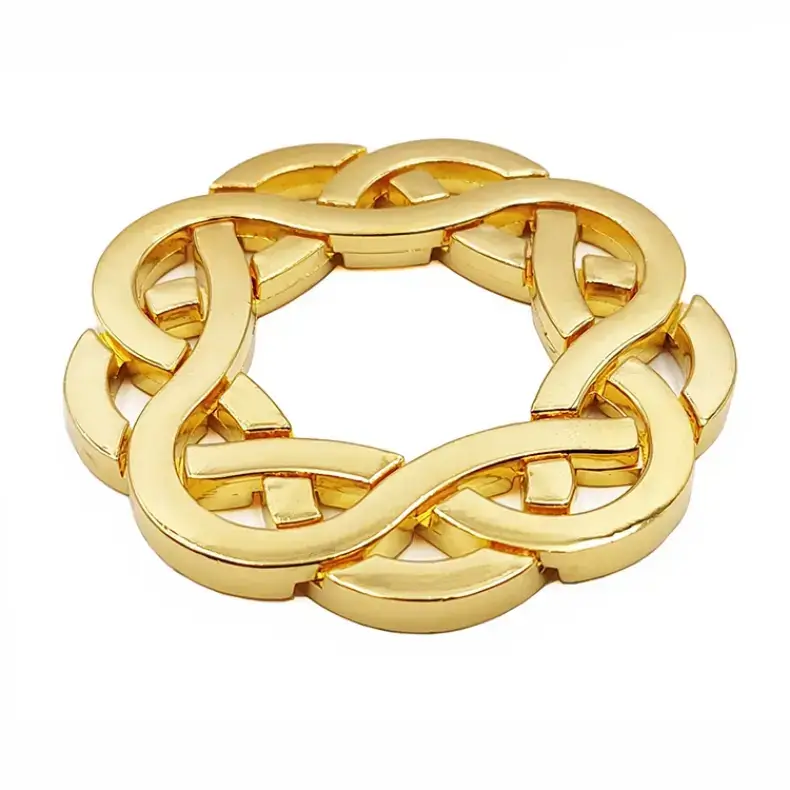
A modern piece like this is a direct descendant of this lineage. It is not a literal knot, but its form evokes the endless loops and intertwined paths of cordage, fossilized into polished metal. It serves as a bridge, reminding us that the appeal is primal. To solve it is to engage with a shapeshifted version of the same ancient problem. This continuity is why the Gordian Knot disentanglement puzzle remains a powerful reference point; it is the story we tell about the moment of insight that every solver seeks. The puzzle is no longer a prophecy on a cart, but a small, cold object in the hand. The promise is no longer an empire, but a quieter, personal victory—the satisfying click of separation, the echo of a sword-stroke in miniature. It’s a perfect illustration of why every wooden puzzle is a 2500-year-old argument, a concept that applies just as powerfully to metal.
From this legendary foundation, the puzzle would soon take more concrete form, moving from the public square to the apprentice’s bench and the scholar’s desk.
The Apprentice’s Trial: From Blacksmith Forges to Scholar’s Desks
The legend of the Gordian Knot spoke to empires and destiny, but the disentanglement puzzle’s tangible history begins in a far more humble and practical setting: the blacksmith’s forge. From at least the late medieval period onwards, master smiths across Europe presented apprentices with simple, hand-forged iron puzzles—a ring captured on a distorted hook, or two horseshoes improbably linked—as a final, silent test. This was the true transition from myth to material culture; the puzzle was no longer a metaphor, but a calibrated tool for training spatial reasoning and manual dexterity. The answer to whether puzzles trained blacksmiths is a definitive yes, with evidence pointing to their use as apprenticeship tools for centuries before they became parlor amusements.
A young apprentice, his hands already toughened by hammer and heat, would be given a seemingly fused mass of iron. The goal was not brute force, which would only gall the soft metal and draw a reproachful glance from the master. It was to understand the object’s configuration space—the hidden pathways within its constraints—through tactile feedback alone. To solve it, he had to learn to read the metal: to feel for the slight dip in a curve, the precise angle where a loop could pass through a slot if held just so. This was not play; it was pedagogy. A blacksmith who could mentally navigate the convoluted paths of a blacksmith puzzle was a smith who could visualize the internal mechanisms of a complex lock, the assembly of articulated armor, or the elegant joinery of a wrought-iron gate. The puzzle was a miniature, an abstraction of the craft itself. It cannot be forced.
This philosophy of patient, observational solving migrated from the smoky forge to the scholar’s study, most magnificently in the form of the Chinese Rings puzzle, known historically as Lianhuan (连环) or Jiu Lian Huan (九连环). While often grouped with modern wire puzzles, its origins are distinct and profound. References to its design appear in a 16th-century Chinese text, attributed to the polymath strategist Hung Ming. This was not mere entertainment. The puzzle, typically a series of interconnected rings on a linked bar, was used both as a sophisticated logic trainer and a tool for divination. Its solution sequence follows a recursive, binary pattern—a concrete manifestation of algorithmic thinking centuries before computer science gave it a name. Manipulating its rings was a meditative practice, a physical working-through of complex, interlinked problems. The term patience puzzles, which would become common in 19th-century Victorian catalogues, finds a deep resonance here. It was not merely that solving required patience, but that the act of solving cultivated it.
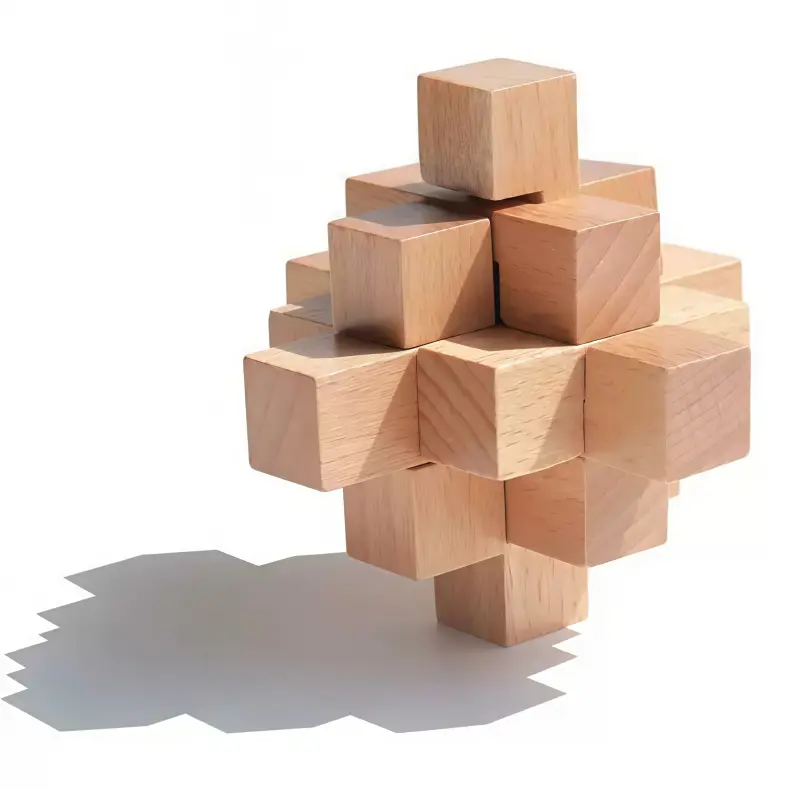
Modern interpretations like the Jiutong Lock carry the spirit of these ancient Chinese Rings puzzle history into the present day. They are descendants of that same intricate, sequential logic, echoing the enduring golden Chinese knot puzzle in their cultural longevity. For collectors, understanding this lineage is key; a true antique Chinese puzzle lock is a marvel of craftsmanship, often part of a larger tradition documented in guides like a detailed collector’s guide to ancient Chinese puzzle locks. By the 19th century, this dual stream—the European folk tradition of the forge and the Eastern tradition of scholarly logic—converged in the drawing rooms of the West. Mass-produced in brass and stamped steel, these objects were marketed as “patience puzzles” for the parlor, a respectable test of one’s composure and intellect. The patience puzzles 19th century boom democratized the apprentice’s trial, turning every gentleman or lady into a solver tasked with their own miniature, polite ordeal.
The silent question posed by the blacksmith’s master and the Chinese scholar’s rings was the same: Look closer. Think in pathways, not force. This foundational principle—that the solution is embedded in the object’s structure, waiting to be discovered rather than invented—would soon captivate a new class of thinkers. The puzzle was ready to leave the realm of craft and enter the world of formal science, where its twisted wires would become models for understanding the very fabric of space and matter.
Patent Pending: The Commercial Tangle of the Industrial Age
The transition of the disentanglement puzzle from a master’s test or a scholar’s tool to a living-room commodity was formalized, quite literally, on paper. The pivotal moment arrived on June 14, 1910, when the United States Patent Office granted Patent No. 961,089 to one Walter S. Jenkins of Peoria, Illinois, for a “Puzzle in Nails.” This single document marks the definitive shift from folk craft to industrially reproducible product, capturing the precise moment a blacksmith’s trial was codified for mass appeal.
In the preceding decades, the patience puzzles 19th century market had blossomed. What had been forged one at a time by an apprentice was now stamped by the thousand in small factories. Puzzles were sold at stationers, tucked into catalogs, and advertised as wholesome exercises for the modern mind. The material changed: hand-forged iron gave way to uniform, plated steel wire. The tactile feedback softened; the satisfying heft of a hand-wrought ring was replaced by the lighter, springier feel of machine-bent components. The puzzle was no longer a unique artifact but a reproducible unit of intellectual play.
Walter Jenkins’s patent is a fascinating case study. He called it a “Puzzle in Nails,” though its form was that of two interlocked, squared wire frames. His application language is dry, technical, a world away from the lore of the Gordian Knot: “The object of my invention is to provide a new and improved puzzle which is simple and durable in construction and which is adapted to afford considerable amusement and entertainment to the one trying to separate the two parts.” Here, the ancient “impossible task” is rebranded as “amusement and entertainment.” The solution is a byproduct of the manufacturing process, not the culmination of a craftsman’s intent. It cannot be forced. But now, it could be bought.
Examining a Jenkins-style puzzle today reveals this industrial ethos. The bends are sharp, standardized. The patina, if present, is from age and handling, not from the variable heat of a forge. To hold one is to hold the early 20th century’s approach to leisure: structured, packaged, and democratized. Collections like those at the mechanical puzzle museum of the Smithsonian National Museum of American History are filled with these patented offspring—Object NMAH_694593, a triad of twisted metal, is a cousin in this commercial family, documented alongside other patented designs like the “Puzzle, A Problem in Nails”.
This era’s legacy is the wire puzzle as we most commonly recognize it. The focus shifted from profound spatial reasoning to clever, patentable configuration. Inventors tinkered with minimal moves, deceptive symmetries, and the pleasing clink of steel on steel, designing for the moment of revelation on a parlor table. The history of wire puzzles is, in part, a history of these patents—a tangle of legal claims over clever twists.
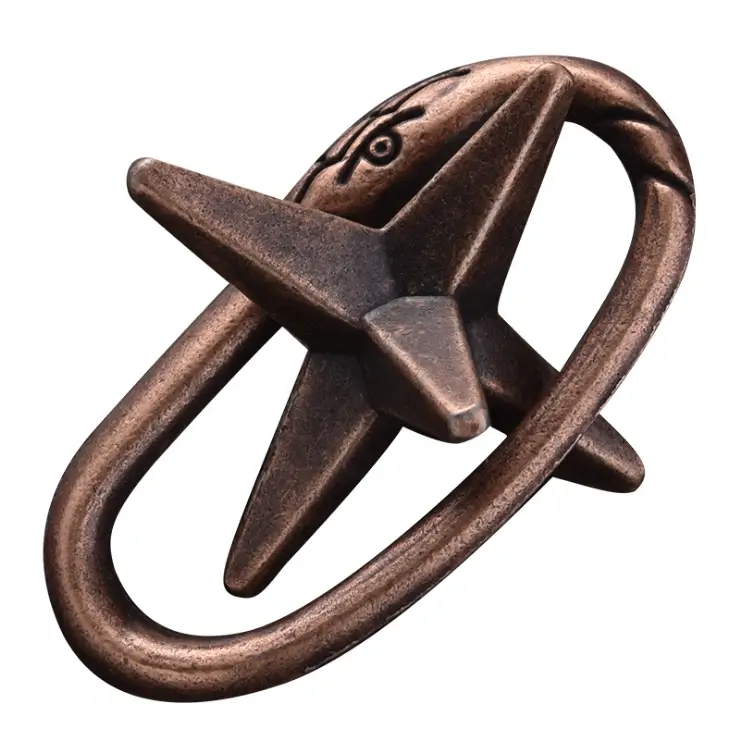
The modern Snake Mouth Escape Puzzle is a direct descendant of this patented lineage. Its whimsical name and laser-cut precision are far from Jenkins’s nails, yet its essence—a defined goal, a sequence of non-destructive moves, a satisfying disassembly—is the same commercial principle at work. It is a puzzle designed first to be sold, its charm accessible, its challenge calibrated. For a deeper dive into its specific mechanics, one might consult a comprehensive guide to the Snake Mouth Escape puzzle, but to understand its place in history is to see it as part of this century-long chain of commodified contemplation.
This commercialization had a curious double effect. It diluted the deep, often solitary, connection between maker and solver, turning the puzzle into a product. Yet, it also disseminated these objects far and wide, placing them into the hands of millions who might never have entered a blacksmith’s shop or a mathematician’s study. The Walter Jenkins bent nail puzzle and its countless imitators created a shared cultural experience of frustration and triumph. The puzzle was no longer a secret of the guild or the academy. It was on the shelf, waiting. The next great leap would come when the scientists, finding these mass-produced puzzles on their own shelves, began to see in their twisted paths a map for understanding the universe itself.
The Metal Mind: Puzzles in the Halls of Science
In the early 20th century, the mass-produced disentanglement puzzle, having left the forge and the patent office, found a new home on the desks of theoretical physicists and mathematicians. Here, its convoluted pathways were recognized not just as tests of patience, but as elegant physical models of abstract principles. By the 1920s, Danish physicist Niels Bohr was using a specific type known as Tangloids—two identical, interlinked wooden boards—to demonstrate the confounding rotational symmetries and spin properties at the heart of quantum theory.
Bohr’s use was profoundly practical. Quantum spin is not intuitive; an electron’s state doesn’t correspond to everyday notions of rotation. The Tangloids puzzle provided a tactile analogy. To solve it, one must rotate one piece through a 720-degree turn to separate it from its partner, not the 360 degrees that classical intuition suggests. Bohr would hand these to baffled colleagues and students, letting their fingers grapple with a paradox their minds resisted. The puzzle was no longer a pastime; it was a pedagogical instrument, a three-dimensional thought experiment cast in wood. Its solution was a silent lecture on a universe governed by unfamiliar rules.
This scientific adoption signaled a deeper truth: these puzzles were always mathematical objects waiting to be formally understood. Their solutions exist in an abstract realm mathematicians call configuration space—a conceptual landscape mapping every possible position of the puzzle’s components. A solution is not a random walk, but a specific, optimal path through this landscape. The frustration of trial and error is the feeling of wandering this map in the dark. The “aha!” moment is the sudden illumination of the path. Modern analysis uses topology, the study of properties preserved through stretching and bending, to classify puzzles. Topology cares not about the rigid angle of a wire bend, but about the fundamental loops and entanglements that make separation possible or impossible. It proves that some puzzles are truly impossible disentanglement puzzles, their solution a logical zero, a closed door, as explored in academic surveys of the category like this Mechanical Puzzle Category Spotlight.
This mathematical framework moves solving beyond guesswork. It provides a logic, a grammar for the silent language of wires and rings. The question, “Can you solve them using math or logic?” transforms. The puzzle is a piece of embodied mathematics. Manipulating it is performing a physical proof. The cognitive benefit, then, isn’t a vague “brain training”—it’s the rigorous exercise of spatial reasoning and systems thinking, the same muscles flexed by architects, surgeons, and engineers. It teaches a specific form of focus: the world reduces to the relationship between two objects in space. It cannot be forced. It must be understood.
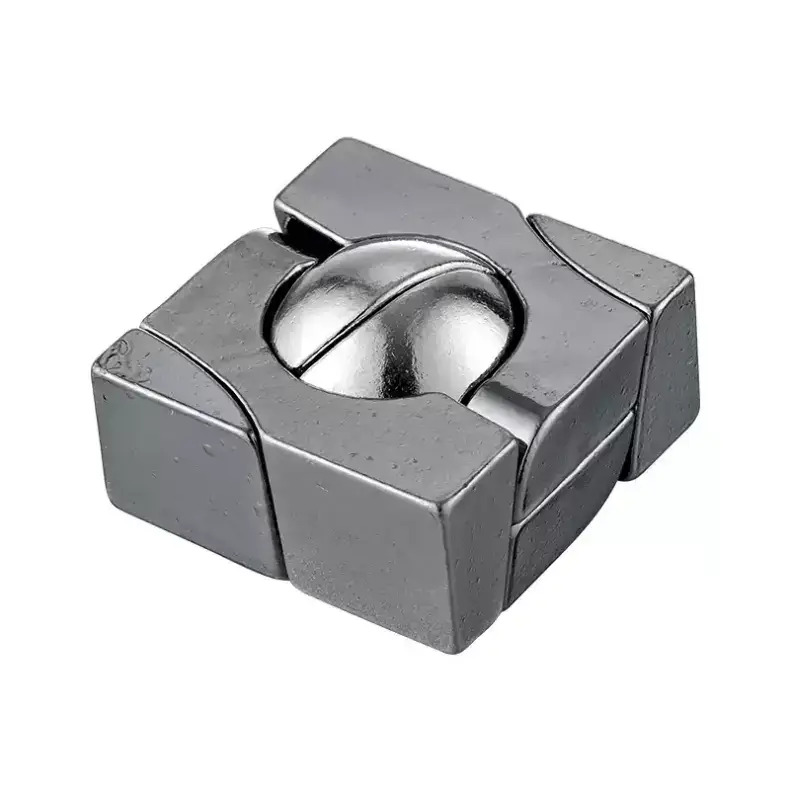
Sphere Morphs Into Cube — $12.00
A modern puzzle like the Sphere Morphs Into Cube is a direct descendant of this lineage. While not a classic wire disentanglement, its transformation leverages the same topological principles—the continuous deformation of space, the conservation of certain properties. It makes the abstract palpably fun, a concept explored in its own guide. It is a mathematical model you can hold, a cousin to the logical challenges posed by classic wire metal brain teasers.
The journey from Bohr’s desk to today’s puzzle shelf is a continuum. When you pick up a tangled set of rings, you are not just confronting a game. You are handling a tool once used to illustrate the fabric of reality. The cold metal carries the weight of that history. You trace the path not just to freedom, but to understanding. It is a map. First drawn by smiths, then chartered by scientists, now followed by your own curious hands.
A Taxonomy of Tangles: Reading the Forms of Frustration
Having traced the journey of these puzzles from philosophical models to scientific tools, a natural question arises: how do we make sense of their bewildering variety? While a collection may seem like a chaos of twisted metal, three fundamental forms—wire-and-string, plate-and-ring, and the so-called impossible objects—emerge, each representing a distinct historical application and topological problem. Understanding this taxonomy is less about cataloging and more about reading the intent of the puzzle-maker, preserved in the geometry of the object itself.
The wire-and-string family is the most populous and ancient, a direct descendant of the apprentice’s practice ring and the Chinese Rings. Here, the goal is always separation: to free a loop of string, or a captive ring, from an intricately bent wire frame. Their design is a lesson in constraints. The path to solution is a precise sequence of moves within a confined configuration space, where a single wrong turn often necessitates backtracking. The feel is one of navigation. You guide the loop through cavities, over smooth bends, and past cleverly placed barriers. The material speaks volumes; a heavy, hand-forged example from the early 20th century feels deliberate and stubborn, its tactile feedback offering subtle, grudging clues. A lighter, stamped modern version might feel more slippery, a faster but less nuanced conversation.
In stark contrast, the plate-and-ring puzzle presents a different class of obstacle. Emerging from the practical world of locksmithing and blacksmithing, the challenge isn’t about threading but about clearance. A ring or linked set of rings is trapped on a central plate or within a forged frame with oddly shaped openings. The plate and ring puzzle origin lies in the literal dismantling of hardware—understanding how to remove a washer from a distorted axle or a ring from a complex shackle. Solving one relies less on dexterous maneuvering and more on a profound understanding of object orientation and rotation in three dimensions. It is a test of pure spatial reasoning. You must mentally rotate the ring, visualize its path through a seemingly smaller aperture, and discover the one exact angle of escape. It cannot be forced.
Then, there are the impossible disentanglement puzzle designs. These are the philosophical endpoint, the modern Gordian Knots cast in steel. Often comprising two or more identical, interlinked pieces that appear utterly inseparable, they exploit our cognitive biases about rigid objects. Mathematically, their solution lies in a counterintuitive path through their shared configuration space—a sequence that feels like pushing the metal through itself. They are less historical tools than deliberate provocations, designed to break one’s mental model. When you ask, “What’s the hardest disentanglement puzzle ever made?” the answer is inevitably among these. Their difficulty isn’t brute complexity, but elegant deceit. They embody the principle that the obstacle is not the puzzle, but the solver’s own assumptions.
Classifying by form, therefore, is not mere sorting. It is decoding the puzzle’s ancestry. A wire-and-string puzzle asks you to trace a path it already contains. A plate-and-ring commands you to see a new space within fixed limits. An impossible object demands you first unknot your own mind. Each form is a different language of frustration, a distinct chapter in the long material history of posing questions in cold, unbending metal.
The Grammar of Wear: How to Read an Antique Puzzle’s Story
After classifying a puzzle’s form, you must learn to read its material biography. Every scratch, patina, and imperfection is a word in its story. Reading this grammar of wear involves analyzing three primary elements: the metal’s composition, the marks of its making, and the patterns left by human hands. Institutions like the Smithsonian meticulously catalog these details; their object NMAH_694593 is defined not just as “three bent metal pieces,” but by its specific steel alloy, tool marks, and oxidation layers, much like the closely related “Disentanglement Puzzle, Question Puzzle”.
Begin with the metal itself. Cold, tarnished brass speaks of the 19th or early 20th century, often found in European and American “patience puzzles.” Its yellow glint, now muted under a brown or green patina, was chosen for its resistance to corrosion and its pleasing heft. The smell of old metal. Hand-forged steel, blackened by fire and time, points to an earlier, functional origin—perhaps a blacksmith’s apprentice tool. It feels denser, more solemn. Thin, tin-plated iron that rings hollow when tapped is the voice of mass production, often post-1920s, designed for penny arcades and broad distribution. Each alloy is a historical timestamp.
The method of manufacture leaves its own signature. Run your fingertip along a weld or seam. A rough, irregular blob of solder or a hammer seam visible to the eye indicates hand-forging. This is pre-industrial craftsmanship. Look for the minute file marks used to smooth a cut end—a sign of individual attention. In contrast, the clean, sharp edges of a stamped or wire-formed piece, often with a uniform diameter and perfectly rounded bends, signal machine production. These came later, following patents like Walter Jenkins’ 1910 “Bent Nails,” which explicitly detailed designs for factory reproduction. The transition from forge to press is etched in the metal’s finish.
Most eloquent are the wear patterns. These are not flaws, but a record of spatial reasoning enacted over decades. A high-polish shine on specific wire segments, particularly on interior curves or the tip of a hook, maps the solution path. It shows where countless fingers have pushed and guided the piece to freedom. Conversely, deep, isolated scratches or nicks often betray moments of frustration—attempts to force a solution where none exists. It cannot be forced. Examine the places where pieces clasp or bear weight. Symmetrical wear on opposing faces suggests respectful, persistent solving. Asymmetrical deformation hints at mishandling or a long period of being jammed in a misguided state. This tactile feedback is the puzzle’s lived experience.
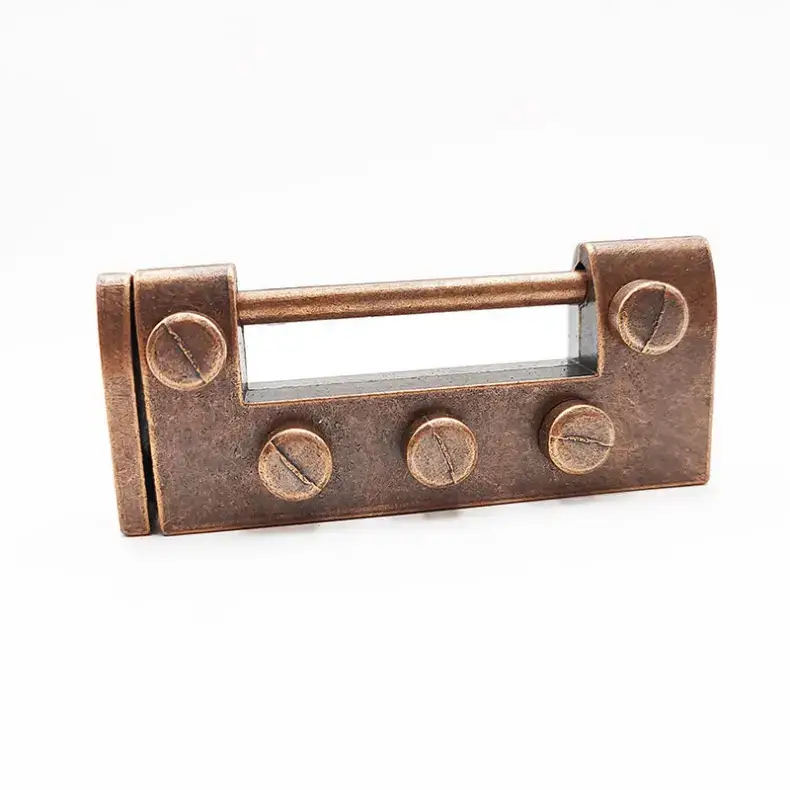
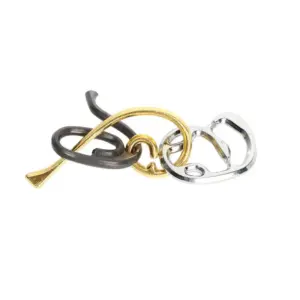
Antique Lock Puzzle — $11.99
Modern reproductions, like the Antique Lock Puzzle shown, offer a tactile entry point, but they lack this narrative depth. Their wear is your own. To study authentic historical pieces, seek out mechanical puzzle museum collections. Beyond the Smithsonian, dedicated institutions like the Lilly Library at Indiana University or private collections hold troves. When considering where to buy antique wire puzzles, provenance is key. Reputable auction houses, specialized puzzle dealers, and sometimes flea markets (where our story began) are the primary venues. Expect to pay for history. Handle any prospective purchase with the questions above in mind: What is the metal telling you? Are the wear patterns consistent with solved use? Does the craftsmanship align with its purported age? Holding a true antique is to hold a solidified dialogue between maker and centuries of solvers—a chapter of material culture you can finally turn in your hands, a skill that begins with unlocking antique lock puzzles of all kinds.
The Modern Revival: From Cognitive Labs to Your Hands
The patina on a puzzle tells one story, but the neural pathways it forges in a modern solver tell another, far older one. The contemporary revival of disentanglement puzzles is less about nostalgia and more about rediscovery, as cognitive scientists now use fMRI scanners to map the very spatial reasoning that blacksmiths once honed by feel. In labs, disentanglement tasks are deployed to study problem-solving heuristics and mental rotation, quantifying the moment of insight with a precision that would have delighted Niels Bohr. They measure what cannot be seen, providing a scientific basis for the enduring appeal captured in the broad history of disentanglement puzzles.
This scientific validation has spurred a quiet renaissance, bridging the gap between the mechanical puzzle museum collection and the workshop of the independent maker. To engage with this history, one must first learn to look. Visit the Smithsonian National Museum of American History, where objects like the three-piece bent metal puzzle (Accession NMAH_694593) are preserved not as toys, but as specimens of American ingenuity. Archival holdings at institutions like the Lilly Library offer deeper dives into patents and prototypes. These are the libraries of this material culture.
For those seeking to hold a piece of this continuum, the question of where to buy antique wire puzzles requires a curator’s patience. Specialized auction houses and a handful of reputable dealers are the primary channels. Provenance is everything. When an antique piece is found—perhaps a tarnished, early 20th-century Walter Jenkins bent nail puzzle—approach it as an artifact first. Before attempting a solution, examine it. Is the wear symmetrical, indicating frequent, fond handling? Are the bends consistent with hand-forged imperfection or machine precision? This initial study is a form of respect.
The modern maker, often an artisan-metalsmith, continues the tradition, producing objects where the tactile feedback of cold-rolled steel or the warm drag of brass is calculated. They are creating the heirlooms and study pieces for future historians. To solve a modern reproduction is valid, but to solve an antique is to participate in a chain of frustration and triumph that may span a century. Your fingers occupy the same configuration space as a long-gone apprentice or a contemplative physicist.
So, the next step is this: Find a puzzle. Any puzzle. But pause. Let it lie heavy in your palm. See it not as a challenge to be conquered in minutes, but as a question cast in metal, one that has traveled from forge to philosopher, from marketplace to laboratory. Trace its loops as you would the lines of a historical document. Then begin. The history is not behind the puzzle; it is unlocked, one deliberate move at a time, in your hands.