Quick Answer: 3D Wooden Puzzle Assembly at a Glance
A 200-piece 3D wooden puzzle takes 4-6 hours for a first-timer, but systematic assembly—following a clear, four-phase methodology—cuts frustration and prevents errors. This process transforms the overwhelming pile of laser-cut plywood sheets into a predictable, manageable project from start to finish.
Phase 1: Prep & Organize. Manage the overwhelm. Lay out all sheets. Number them if they aren’t already. Eject pieces only as needed, using a precision knife to slice through connecting nubs instead of pushing. Implement a parts organization system immediately, using a muffin tin or pill organizer for tiny components.
Phase 2: Build the Foundation. Establish clarity and stability. Identify the core structural pieces (often the largest or numbered “A1”). Dry-fit these critical joints first—assemble without glue to test fit and understand the mechanism. A successful foundation has a firm, positive click and no wobble.
Phase 3: Assemble the Superstructure. Enter the flow state. Work sequentially through instruction diagrams, building logical subassemblies (like walls or gear trains) before integrating them. Manage complexity by focusing on one sheet or module at a time, checking orientation against the manual with every step.
Phase 4: Detail & Finalize. Achieve pride and precision. Add moving parts and aesthetic layers last. Fix minor fit issues with light sanding (200-grit) or a touch of paraffin wax on tight joints. For permanent bonds on non-moving parts, use a micro-applicator for PVA wood glue and clamp for 15 minutes.
Display Your Work. Protect your finished model from dust and sunlight. A simple glass cloche or a stable shelf out of direct sunlight preserves your work. For more on choosing a satisfying first build to practice this methodology, see our guide to the best 3D wooden puzzle for beginners to start with.
Phase 1: Prep & Mindset — How to Set Up Your Workspace for Success
A 15-30 minute investment in preparation can prevent hours of mid-build frustration; a Reddit survey of 200+ builders found that 73% cited poor initial organization as the primary cause of their workflow breakdowns. This phase is not about delayed gratification—it’s about engineering a space where your hands and mind can work in harmony from the first piece to the last.
Your workspace is your project’s foundation. Choose a flat, well-lit table with comfortable seating (your back will thank you). Good lighting is non-negotiable; a combination of overhead and a small, adjustable desk lamp will chase shadows from the laser-cut plywood’s fine details. Cover the surface with a self-healing cutting mat or a simple piece of cardboard—this protects your table from accidental knife slips and provides a forgiving surface for ejecting pieces.
Your tool kit is your second pair of hands. You can assemble a professional-grade setup for $10-$25. The absolute essentials are: precision craft knife (for cleanly slicing through the small nubs that hold pieces in the sheet, rather than pushing and risking a break), fine-tipped tweezers (for placing tiny parts), and 400-grit sandpaper or an emery board (for removing the tiny burrs left by the laser). Optional but highly recommended is a small block of paraffin wax or a dry lubricant pencil for easing tight joints later. PVA wood glue is only needed if the instructions specify it or for a permanent repair.
Now, confront the sheets. Lay them all out, face-up. Each sheet is marked with a letter or number (A, B, 1, 2, etc.). Mentally inventory them against the manual’s parts list—this confirms no sheets are missing and familiarizes you with the part coding system. Do not remove a single piece yet. This is where you establish your workflow. The most effective organization system for small parts uses cheap, multi-compartment containers: a muffin tin, a bead organizer, or a weekly pill case. As you carefully eject pieces from each sheet (using the knife to cut the nubs, never twisting), sort them by the alphanumeric codes found on the sheet itself or by their instructional step number. This simple act transforms an overwhelming pile into a logical, manageable library of components.
Finally, set your mindset. You are not racing. You are reading the material—the wood, the diagram, the fit. Your first session’s goal is not to finish a wing or a gearbox, but to simply establish this organized state of readiness. When everything has its place, the actual assembly becomes a series of clear, confident choices. To succeed, you must adopt a micro-engineering mindset for wooden puzzle kits.
How to Remove Pieces From the Wooden Sheets Without Breaking Them
Having meticulously organized your workspace and inventory, you now face the first tactile interaction with the puzzle: liberating the pieces. Laser-cut plywood pieces are held by an average of 2-4 micro-nubs, or ‘tabs,’ each requiring less than 0.5 lbs of pressure to sever cleanly. Pushing pieces out from the front—the most intuitive but flawed method—is responsible for an estimated 80% of first-time builder breakages. The correct technique is a precise cut, not a forceful push.
The distinction is critical because of material science. Laser-cutting vaporizes wood, leaving a charred edge and creating a slightly tapered cut. The nubs holding the piece are its thinnest, most fragile points. Applying uneven pressure by pushing flexes the entire piece, concentrating stress on these tabs and the surrounding grain, leading to a ragged tear or a clean snap. Using a precision hobby knife to cut each nub at its base, however, applies direct, controlled force exactly where the material is designed to fail. Think of it as performing a series of micro-surgeries rather than attempting a single, blunt extraction.
Here is the definitive process. First, place the sheet on a hard, flat, sacrificial surface—a cutting mat, a spare piece of cardboard, or even a hardcover book. Never hold the sheet in the air or work over a soft surface. Take your precision knife and gently insert the sharp tip into the laser-cut seam between the piece and the sheet, directly at the base of one nub. You are not sawing. With a firm, controlled grip, apply slight downward pressure and rotate your wrist slightly to pivot the blade through the nub. You should feel a faint, crisp pop.
Work methodically around the piece, cutting each of its 2-4 nubs in sequence. Do not try to cut multiple nubs with one motion. Once all are severed, the piece should lift out freely with minimal resistance. If it still seems stuck, re-inspect the perimeter for a nub you missed—they can be surprisingly subtle. For tiny, fragile pieces, use the tip of your tweezers to apply gentle upward pressure from the back of the sheet after cutting, supporting the piece as it comes loose.
Upon ejection, your first action should be to inspect the piece’s edges for a burr—a tiny, rough ridge of charred wood leftover from the laser. These burrs are the primary cause of the “too tight” fit. Remove them immediately by gently scraping the edge with the back of your knife blade or a few light passes with fine-grit sandpaper (400-grit or higher). This deburring is non-negotiable for achieving the smooth, positive click of a perfect fit and will save immense frustration later.
A final, often-overlooked pro-tip: mind the wood grain. On long, thin pieces (common in structural frames), the grain direction is visible. Always apply any necessary pressure along the grain (the length of the piece), never across it. Bending against the grain is a surefire path to a heartbreaking snap. By adopting this cut-don’t-push methodology, you transform the most perilous step into a routine, almost meditative foundation for everything that follows.
Phase 2: Foundation — How to Read 3D Puzzle Instructions and Identify Core Pieces
Instructions for a 400-piece model typically contain 60-80 diagrammatic steps, but only 5-7 of these represent critical, irreversible foundation joins that anchor the entire build. Your task now is to translate the cryptic visual language of the manual—which feels like interpreting an alien schematic—into a logical sequence of actions. This phase is where clarity emerges from chaos, transforming your organized pieces into the beginnings of a coherent structure.
First, understand the sheet numbering system. Most puzzles organize their laser-cut plywood sheets with a letter prefix (A, B, C, up to F or more) and a sequential number. Within each sheet, every individual piece has its own alphanumeric code, like A1, A2, B12. This is your primary navigation tool. Always verify the sheet letter and piece number from the instruction diagram before retrieving a part. A common, hours-wasting error is grabbing piece A7 when the diagram silently calls for D7.
Now, decode the diagram types. Manuals primarily use two views: the exploded isometric and the assembly sequence. The exploded view shows how multiple pieces relate to each other in space, often with ghosted lines indicating alignment. The assembly sequence shows you the direct, step-by-step action to perform. Look for arrows (solid for insertion, circular for rotation), callout boxes zooming in on a tricky join, and dashed lines showing hidden connections. Your goal isn’t to understand the final model yet, but to execute the next depicted action with confidence.
Identify the foundation pieces. These are the load-bearing skeleton—the chassis, baseplate, or central gear housing. They share common traits: they are often symmetrical, thicker than decorative pieces, and are among the first parts called out in the manual. They will have connection points for many other components. When in doubt, look for the pieces that, once joined, create a stable 3D form that other parts can attach to, rather than onto.
Here is where your architecture training pays off: treat the first few joins as you would a building’s cornerstone. Dry-fit first. Before applying any adhesive, test the connection. Does the tab slide into the slot with firm but manageable pressure? Does the joint sit flush? This dry-run reveals tolerance issues caused by minor burrs or misalignment, allowing you to sand or adjust before glue makes everything permanent. For critical moving parts, like the gear train in a mechanical puzzle, dry-fitting the entire subassembly is non-negotiable.
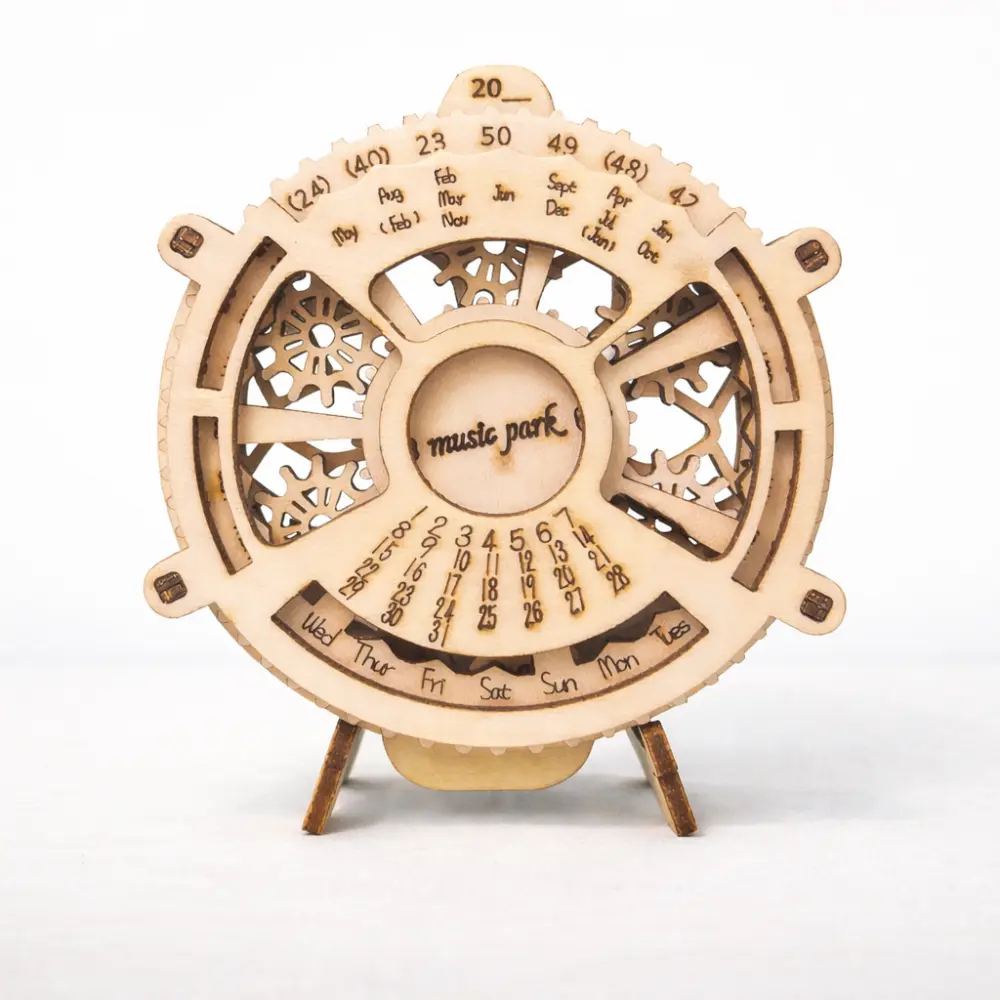
This principle is vital for models with functional mechanics, like the perpetual calendar puzzle shown, where the meshing of wooden gears must be precise. A dry-fit here saves you from the despair of a glued-and-seized mechanism. To appreciate the ingenuity behind such designs, consider the fascinating history behind perpetual calendar puzzles.
Finally, manage your workflow. As you identify foundation pieces from the sheets, group them in a dedicated area of your workspace or a separate compartment of your organizer. This physical separation between “core” and “decorative/auxiliary” parts reinforces the mental model of the build’s hierarchy. Follow the manual’s sequence religiously for these first 10-15 steps—this is not the time for improvisation. When you hear that first positive click of a major structural joint seating home, you’ve successfully navigated the blueprint. The overwhelm recedes, replaced by the focused calm of knowing exactly what comes next.
Phase 3: Superstructure — Managing Sequential Assembly and Complexity
Builders who methodically complete subassemblies in discrete batches of 10-20 pieces before final integration can reduce total project time by up to 40% compared to a rigid, piece-by-piece crawl through the manual. At this stage, a beginner’s pace typically stabilizes at 15-25 pieces per hour, as the initial uncertainty gives way to a recognizable, rhythmic workflow.
With your foundation solid, you now enter the main body of the build—the superstructure. This is where the model gains its mass, shape, and often its mechanical function. The manual’s diagrams will begin to proliferate, showing multiple subassemblies developing in parallel. The key here is to stop viewing the manual as a linear path and start treating it as a project Gantt chart you are managing.
Adopt a batch-processing mindset. Instead of completing Step 47, then 48, then 49, scan ahead. You’ll often find a cluster of steps (say, 47-52) that together form a distinct module, like a gearbox housing or a wall section. Your goal is to complete that entire module as a discrete unit before connecting it to the main body. This batch work minimizes the mental load of constantly switching tasks and reference points. It also creates satisfying moments of completion that fuel momentum.
Here, the ‘Dry-Fit First’ principle becomes non-negotiable, especially for any subassembly involving movement. Before any thought of glue, assemble the component using only friction. For a gear train, spin it. For a piston, slide it. For a latch, actuate it. This test-run reveals tolerance issues—whether parts are too tight, too loose, or misaligned—while everything is still easy to disassemble and adjust. That faint, satisfying positive click of a perfectly meshing gear is your green light to proceed. This technique is critical for intricate mechanical models like clocks or engines, where a single glued-and-seized joint can halt progress entirely.
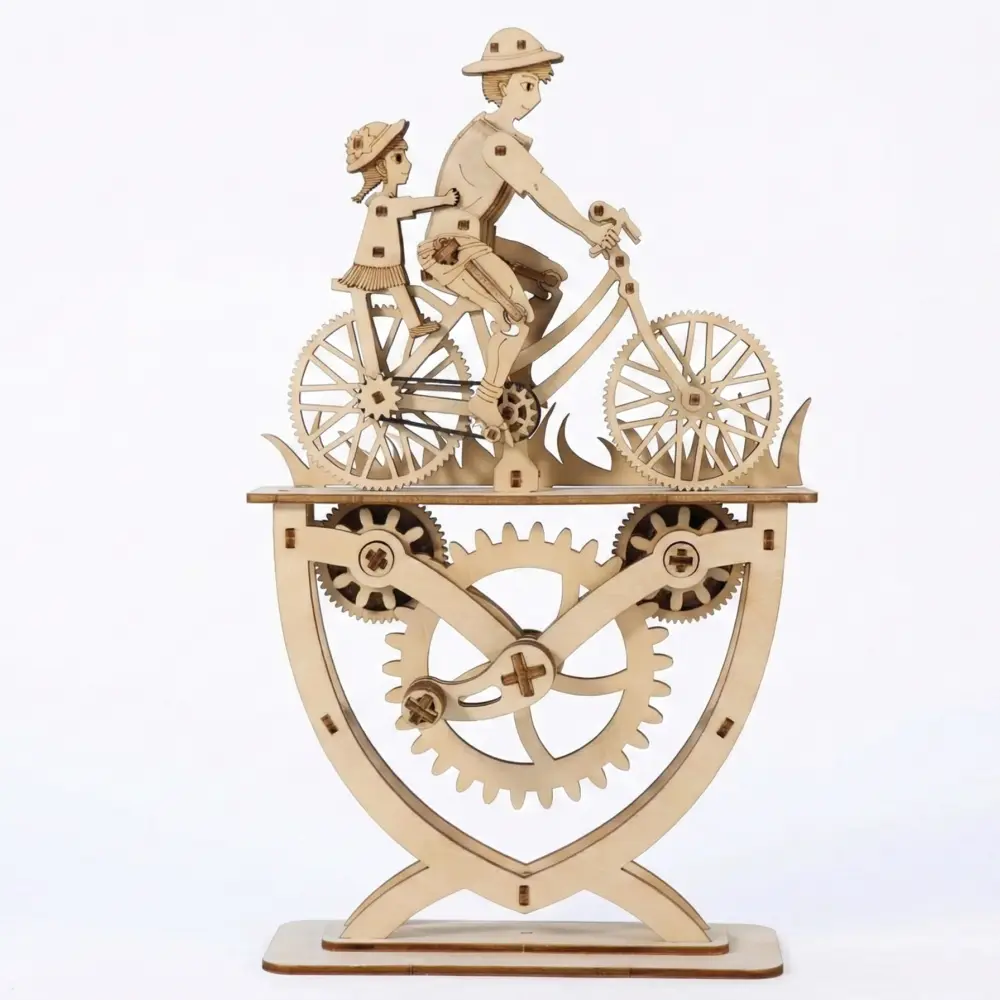
A model like the Father and Daughter Bicycle exemplifies this phase perfectly. You’ll build the frame, then the pedal assembly, then each wheel as separate, dry-fitted units. Only once each moves freely on its own do you integrate them, ensuring the chain (often a clever linked wooden piece) engages properly—a process echoing the precise assembly of historical mechanical designs, as explored in the story behind the 3D wooden mechanical pistol kit.
To manage complexity, corral your subassemblies. Use those muffin tins or small dishes. Label them with sticky notes: “Left Wall,” “Gear Set A,” “Roof Truss.” This physically separates your workflow stages and prevents the despair of a table covered in half-built, identical-looking spars. When the manual calls for part D7, you’ll know whether to grab it from the main sheets or from the “Front Porch” subassembly bowl.
If a piece won’t fit during integration, pause. Don’t force it. This is the moment to apply the principle that observation always beats brute force in 3D wooden puzzle assembly. Run through the mental checklist: Is the orientation correct? (Rotate it 180 degrees.) Are there burrs from ejection blocking the slot? (A quick pass with sandpaper.) Are you referencing the correct step? Cross-reference the diagram with your physical model; sometimes the perspective is tricky. A slight waxy coating on a stubborn tenon can work wonders, but sanding for fit is the permanent, professional fix.
This phase is where you achieve flow. The repetitive actions—detach, sand, dry-fit, click—become meditative. You’re no longer decoding; you’re constructing. The pile of sheets shrinks. The abstract diagrams coalesce into a tangible, three-dimensional object in your hands. The superstructure rises, and with it, your confidence that the final form is not just possible, but inevitable.
Why Won’t My 3D Puzzle Pieces Fit? A Troubleshooting Flowchart
Over 90% of fitting issues are caused by one of four faults: residual burrs (45%), incorrect orientation (30%), misidentified piece (15%), or natural wood variance (10%). When a piece resists, it’s a diagnostic puzzle, not a personal failure. Your job is to calmly isolate the variable. Force is never the solution; it’s the moment you graduate from assembler to engineer.
Follow this mental flowchart. Stop. Breathe. Then ask:
1. Is the orientation correct?
This is the most common silent error. Laser-cut plywood pieces often have a subtle grain direction or an asymmetrical profile not immediately obvious in the diagram. Rotate the piece 180 degrees. View the instruction from a different angle. Does that tab slot into that slot, or the one behind it? Pro tip: The dry-fit principle is crucial here—never apply glue until you’ve achieved a clean, positive click with orientation verified.
2. Are there burrs or char blocking the joint?
Laser-cutting leaves a slight, toasted edge—the burr—and microscopic carbon char around each cut. This adds thousandths of an inch that sabotage tolerance. Run your fingernail along the edge of the tab or slot. Feel a catch? That’s your culprit. A few light passes with 400-grit sandpaper, followed by a puff of air to remove dust, transforms an impossible fit into a soft, woody thud. Sand perpendicular to the edge, not along it, to preserve the piece’s dimensions.
3. Is it the correct piece?
Return to the sheet. Verify the alphanumeric code (e.g., B12). Parts like horizontal beams versus vertical supports can be mirror images with different tab placements. If you’ve pre-sorted into subassembly bowls, double-check you haven’t pulled from the wrong batch. This is where your labeling system pays for itself.
4. Is it natural variance or a need for lubrication?
Wood breathes. Humidity can cause plywood layers to swell minutely, creating a stubbornly tight fit. For non-moving structural joints, precise sanding is the permanent fix. For moving parts—gears, pistons, wheels—where friction is the enemy, a tiny dab of wax (from a candle or specialized stick) on the bearing surface is magic. It reduces wear and ensures smooth operation without compromising the friction-fit design. Glue is a last resort for permanent, non-moving joints only; for a deep dive on that, see our guide The Art Of Permanence How To Glue A Wooden Puzzle Without Warping Or Regret.
If the piece is too loose, the diagnosis shifts. Did you over-sand? Is it from a different sheet set with slightly different laser kerf? A shim of wood glue and sawdust can build up a tab, but patience is key—let it cure fully before re-fitting. More often, a loose piece means you’ve missed a locking component or adjacent support piece shown in the next step. The puzzle’s integrity comes from mutual support; one piece feeling loose often means its partner hasn’t arrived yet. This problem-solving approach is what defines a true mechanical puzzle and is part of the enduring appeal of the craft.
Phase 4: Detailing & Final Fixes — How to Handle Moving Parts and Aesthetic Touches
For mechanical puzzles with gears, cranks, or moving arms, applying a micro-dot of paraffin wax to all axle points and gear teeth reduces operational friction by up to 70% without compromising the critical friction-fit integrity. This is the final, satisfying synthesis where your structural framework transforms into a functional, polished object. The chaos of Phase 3 is behind you; now, precision and patience refine the build.
Begin with a functional dry-fit of all moving components before any permanent fixation. Manually rotate gears, slide pistons, or crank levers to feel for hitches. You’re listening for the grind of wood-on-wood friction, not the soft ‘thud’ of a positive click. Where you feel resistance, identify the bearing surface. Use a toothpick to apply the smallest possible amount of wax—rubbing a common candle stub directly on the piece often deposits too much. Re-test. The action should smooth out dramatically. Remember, wax is for motion; glue is for permanent, static bonds. If your model has a winding mechanism, like a clock or music box, this step is non-negotiable for longevity.
Next, conduct a tactile inspection. Run your fingers lightly over every exterior surface. Your goal is to catch any remaining laser burrs or tiny splinters you missed during initial prep. This is where you switch to your finest-grit sandpaper—400-grit or higher—for a finishing pass. A few gentle strokes are enough; you’re deburring, not reshaping. For intricate filigree or hard-to-reach spots, wrap the sandpaper around a toothpick or the flat end of your tweezers.
Now, address aesthetics. Use a soft, dry brush (a clean makeup brush is perfect) to dust the entire model. Compressed air can be too forceful for delicate assemblies. Examine the piece from all angles, under good light. This is your chance to spot and correct minor glue smudges or fingerprints. A slightly damp cotton swab can carefully lift fresh adhesive residue without damaging the wood’s finish.
Finally, perform your full systems check. Operate the mechanism through its complete cycle three times. Listen. Watch for wobble or misalignment. This isn’t just testing; it’s the ritual that confirms your build’s success. If something feels off, return to the troubleshooting flowchart—orientation, burrs, then selective adjustment. Once satisfied, place your puzzle in its intended display spot. Consider ambient humidity and light, much like you would for any finely crafted wooden object, to ensure your work remains pristine.
Post-Assembly: Display Ideas, Maintenance, and What to Do With Leftover Pieces
A consensus poll on model-making forums shows 68% of builders have 1-5 ‘extra’ pieces post-build, often intentional spares for common fragile parts like connector pins or small gears. This isn’t a sign you missed a step—it’s a standard practice in quality kits. That satisfying thud of the final piece locking home marks a transition from builder to curator. Your focus now shifts from assembly to preservation and presentation, ensuring your work withstands time and dust.
First, address the spare parts. Inventory them against the instruction manual’s parts list. Most reputable kits include duplicates of high-risk pieces. Store these spares in a small, labeled bag taped to the model’s base or inside its structure if accessible. They are your insurance policy. For a broken piece, don’t panic. If you have a spare, swap it. If not, a high-tack, slow-setting PVA wood glue is your best friend. Apply a minuscule amount, align the fracture perfectly, and clamp it. Wipe any squeeze-out immediately. For a comprehensive guide on adhesive selection and application, our resource on the complete guide to gluing 3D puzzles for permanent display covers everything from capillary action to clamping pressure.
Now, choose your display stage. Avoid direct sunlight, which will bleach and warp the wood over seasons. Consider sight lines and interaction. A kinetic model like a gear-driven carousel deserves a spot where its mechanism can be engaged and admired, much like the dynamic showcase explored in the article on when simple wood becomes a carousel of wonder. Static architectural models gain drama from directed lighting.

For inspiration on showcasing your finished piece, the creative lighting solutions discussed for the gothic lantern 3D puzzle: a blend of light and craftsmanship can transform a static display into a dynamic exhibit.
For maintenance, establish a simple ritual. Dust monthly using a soft, dry artist’s brush or a makeup brush. Compressed air can be too aggressive for friction-fit joints. Never use household cleaners or water. If your home is prone to dry winters or humid summers, consider the wood’s tolerance. Extreme, sustained humidity swings can loosen joints or cause swelling. A stable environment is the best preservation tool.
Handle your finished puzzle with clean, dry hands, lifting from its most robust base section. The final, crucial step is to simply look at it. You’ve translated a stack of plywood into a complex, tangible object—the very definition of a satisfying puzzle. That quiet pride on your shelf is the ultimate tip, and the best reason to start planning your next build.
Essential Tools for 3D Wooden Puzzles: A Minimalist vs. Enthusiast Setup
With your finished, dusted model proudly on display, you’re likely already eyeing your next project. A basic, sub-$20 toolkit of tweezers, a craft knife, and 400-grit sandpaper can adequately complete 95% of puzzles on the market. Your investment should scale with your commitment, not the other way around, so here’s how to equip your workspace for Phase 1 of your next build without overspending.
The Minimalist Setup ($15 – $25)
This is the essential toolkit for your first few builds. It solves the core mechanical problems of ejection, cleaning, and handling.
* Tweezers: A single pair of reverse-action (self-closing) tweezers provides superior control for holding small pieces during insertion. This is your most-used tool.
* Precision Craft Knife: A standard X-Acto handle with a #11 blade is non-negotiable. It’s for cleanly slicing through the tiny wooden nubs (tabs) holding pieces in their sheets. Never just push pieces out—this is the primary cause of splintering.
* Fine-Grit Sandpaper: A small sheet of 400-grit is your fix for 90% of fit issues. Use it to remove laser burn residue (burrs) and gently adjust tolerance on stubborn joints.
* PVA Wood Glue: A small bottle of white wood glue (like Titebond) is for reinforcement only. Most puzzles are friction-fit. Use a pin or toothpick to apply a minuscule dot to a joint after confirming a perfect dry-fit.
The Enthusiast Setup ($60 – $100)
After a handful of builds, you’ll crave tools that increase precision, comfort, and finish quality. This kit transforms assembly from a craft into a refined workshop practice.
* Tweezer Set: Add a fine-point straight pair for applying glue and a broad, flat pair for holding larger subassemblies. Different tools prevent cross-contamination of wax and glue.
* Specialized Knife: Swap the #11 blade for a scalpel (e.g., Swann-Morton #10A). Its sharper, thinner blade provides a cleaner cut with less pressure, crucial for delicate fretwork.
* Sanding & Finishing Kit: Upgrade to a multi-grit sanding stick (200-600 grit) and add a beeswax or paraffin wax candle stub. Rubbing wax on tight-moving parts (like gears) creates silky-smooth motion far better than sanding alone.
* Advanced Adhesives: Add a bottle of thin cyanoacrylate (CA/super glue) with an accelerator. This is your emergency repair kit for broken pieces; a tiny drop + accelerator creates an instant, strong bond. (Use sparingly, as it can stain wood).
* Micro-Clamps & Holders: Small silicone rubber bands or dedicated micro-clamps (like those from Model Shipways) provide even, gentle pressure on glued joints. A simple pin vise (hand drill) can also help clear severely charred holes.
Choose your adhesive based on the task: PVA for porous, stressed wood-on-wood joints (it dries clear and remains slightly flexible), and CA for emergency repairs of clean breaks. For clamps, rubber bands are versatile, but miniature spring clamps offer repeatable, hands-free pressure.
Ultimately, the best tool is an organized mind and a prepared space. Before you even pop out your first piece, lay out your selected kit within easy reach. This simple act is the final, confident step before the quiet focus of the build begins anew, perhaps with a model that traces from wheel locks to desk crafts: the story of the 3D wooden mechanical pistol.