The First Click: Why a 3D Puzzle Box Isn’t Just a Box
That first wooden click is a promise. It’s the sound of a piece finding its mate, a faint scent of laser-cut birch in the air. Follow it with another, and another, until a final, solid thunk resonates in your palm. A hidden lock you didn’t even see has just engaged. The box, once inert, is now a sealed secret. This is the moment of truth. Is it a puzzle? A box? Or a secret-keeping machine?
A true 3D puzzle box is all three. It’s a tactile, mechanical conversation. Forget static display pieces or simple containers with a tricky latch. We’re talking about an engineered object where the process of revealing its interior—or progressing through its sequence of compartments—is the entire point. The box itself is the puzzle. Your hands are the solver.
This tradition isn’t new. It finds its elegant roots in the Japanese puzzle box, or Himitsu-Bako (secret box). Craftsmen have been designing these intricate wooden containers since the 19th century, where sliding panels in a precise, non-obvious sequence are the only way to access a small, cherished space inside. They are studies in minimalist, mechanical deception, a testament to the long history of the puzzle box.
The modern evolution of this concept is what we call sequential discovery. This is the heart of the allure. It’s not just about finding a key or sliding a panel; it’s a journey where each solved step reveals the tool or clue needed for the next. A magnet hidden in an earlier movement becomes a lever. A newly exposed compartment holds a gear that must be turned. The box teaches you its own language as you go. This transforms it from a simple brain teaser into a narrative experience—an escape room at home contained in your hand. It’s a powerful example of why your brain craves the mechanical click of a well-designed mechanism.
So, what separates the classic from the contemporary kit? The traditional Japanese secret box is often a finished, lacquered object, its mechanism born from precise woodworking joints and disguised seams. Solving it is a quiet, meditative dance of pushes and slides. The modern 3D wooden puzzle box kit, however, invites you into the creation of that mechanism. You build the deception yourself from hundreds of interlocking pieces, often with no glue needed. The satisfaction is twofold: the pride of assembly followed by the thrill of the solve. You don’t just learn how to open it; you understand, intimately, why it opens.
Whether it’s a centuries-old design or a laser-cut kit fresh from a digital file, the core appeal is identical. It’s the click. The silent “aha.” The weight of a secret puzzle box with hidden compartment that only you, for this moment, know how to reach. It’s a private conversation between you and a cleverly crafted object. And that conversation is just beginning.
Mapping the Territory: The Three Tribes of Puzzle Boxes
Once you’ve felt that satisfying click and heard the quiet thunk of a hidden lock, a natural question arises: where do I find more of this? The landscape can feel like an unmarked forest. Is every intricate box the same? Far from it. The world of 3D puzzle boxes divides, roughly, into three distinct tribes, each with its own language, tools, and kind of satisfaction. Understanding this taxonomy is your map out of the overwhelming product listings and into the territory that fits your hands.
The Wooden Kits: Builders of the Mechanism. This is where most modern journeys begin. Think brands like ROKR, UGEARS, or Robotime. You’re not buying a finished secret box; you’re buying the raw, potential form of one, typically in the form of laser-cut plywood sheets. The value here is in the journey of assembly. Over a few hours (or a few evenings), you’ll pop out hundreds of precisely cut pieces and follow instructions to slot them together, often with no glue needed. The process is meditative, almost like building a fine-scale model of a lock itself. You witness the birth of gears, levers, and sliding panels from flat sheets. When you finally turn the last key or slide the last panel, the pride isn’t just in solving the puzzle—it’s in having constructed the puzzle. These kits are fantastic for the hands-on hobbyist who finds calm in methodical building and wants to physically understand how the mechanical puzzle works from the inside out. Prices for a substantial kit with moving parts and a hidden compartment typically start around $45.
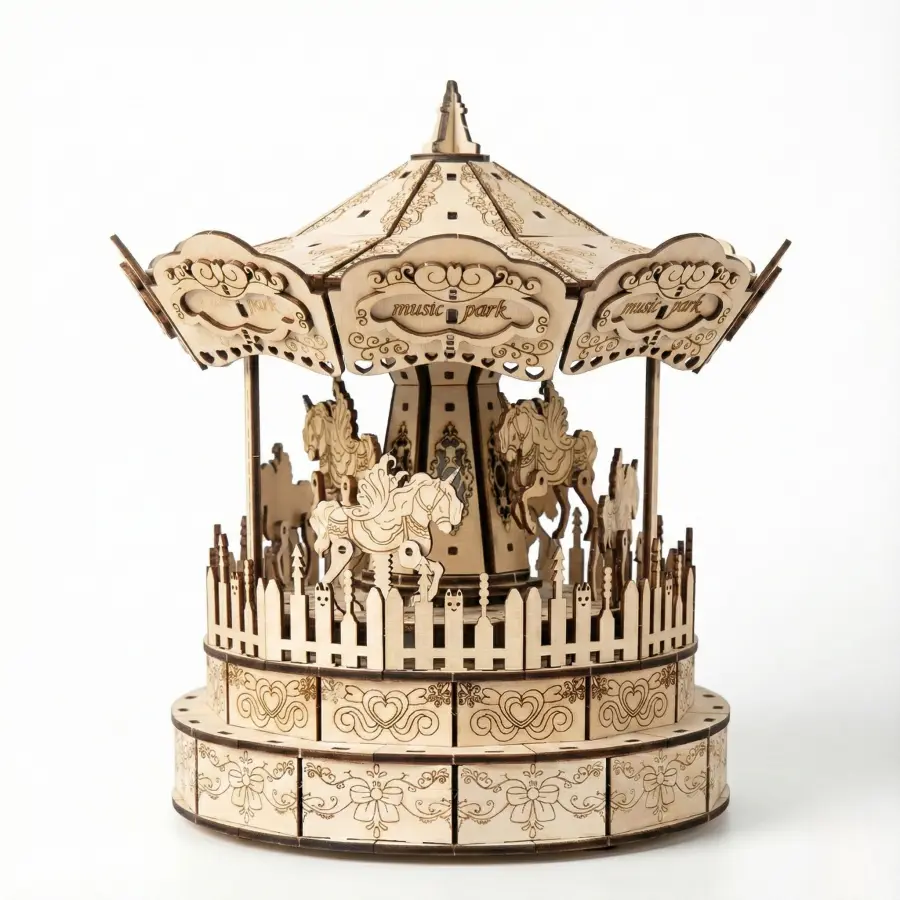
A kit like the 3D Wooden Carousel Music Box exemplifies this tribe. It’s a three-dimensional jigsaw puzzle that results in a functional, charming object with a hidden puzzle layer—you build the beautiful facade and the secret it contains. If you get stuck, the community often has resources; for instance, a guide on how to solve the 3D wooden carousel music box without losing your mind can be a helpful companion.
The 3D-Printed Designs: The Digital Frontier. This is the tribe completely missed by typical retail guides. Here, you aren’t buying a physical product or even a kit. You’re downloading STL files—digital blueprints—from maker hubs like Printables.com or Cults3D. Your raw material is a spool of filament, and your factory is your 3D printer. The magic word here is print-in-place: astonishing designs where interlocking gears, hinged lids, and sliding mazes print fully assembled, in one go, requiring no manual assembly. The value is pure mechanical ingenuity and accessibility. Designs range from simple twist boxes to devilishly complex sequential discovery contraptions with multiple stages. For the tinkerer who already has a printer humming, this world offers an endless, often very affordable, stream of challenges. The difficulty level is baked into the design itself, not the assembly. It answers the question, “Where can I find free STL files for a good 3D printed puzzle box?” with a vast, open-source library.
The Premium Secret Boxes: Finished Craftsmanship. This tribe venerates the puzzle box as a collectible art object. Think of the legendary Japanese puzzle box (Himitsu-Bako) tradition or the exquisite creations from modern masters like the Karakuri Group in Japan. These are complete, finished items. The wood is often fine and lacquered, the movements buttery smooth, and the puzzles elegantly subtle. There is no assembly. The entire experience is the solve. The value is in the ownership of a masterpiece of deceptive woodworking, a secret box that feels like a timeless artifact. This is the territory for the connoisseur, where prices reflect artistry and can climb into the hundreds. It’s the answer to “what is the best 3d puzzle box to buy?” when the priority is heirloom-quality craftsmanship and a deeply satisfying, purely logical challenge.
So, do you want the satisfaction of building (the kit), the thrill of printing and solving a clever mechanism (the STL), or the possession of a polished work of art (the finished secret box)? Your answer places you in one of these three tribes. And from there, the real exploration begins.
Your Decoder Ring: Choosing Your First (or Next) Box
So you’ve glimpsed the three distinct tribes of puzzle boxes out there. Now comes the crucial part: navigating from curiosity to that first satisfying thunk of a lock disengaging. Forget “best” or “most popular.” The right choice is the one that fits you—your workshop, your patience, and the specific itch you’re trying to scratch. Think of this as your decoder ring for the puzzle box world, a framework built on three simple questions.
1. The Skill & Tools Audit: What’s Already on Your Bench?
Your starting line isn’t the same as everyone else’s. Be honest about what you have and what you enjoy.
- The Digital Workshop: If you have a 3D printer, your gateway is wide open. Your primary tool is patience for calibrating and slicing. The magic of print-in-place mechanisms means you can download an STL file from Printables.com and, with a well-tuned machine, produce a complete, working mechanical puzzle with interlocking gears and sliding panels right off the build plate. No assembly. Just post-processing and the solve. The barrier is not woodworking skill, but comfort with digital files and printer nuances. If your printer hums in the background, the world of 3D printed puzzle box designs is your oyster.
- The Analog Hands: If your happiness comes from the tactile feel of wood grain and the methodical process of construction, a wooden puzzle box kit for adults is your calling. The great leveler here is that most kits require no glue needed and no special tools—just your hands and careful attention to the instruction diagrams. Your “skill” is a willingness to follow steps meticulously. It’s less about carpentry and more about focused assembly, a deeply meditative ritual of creating order from a pile of laser-cut plywood pieces.
- The Pure Solver: If you own neither printer nor the desire to build, but are captivated by elegant mechanisms and intellectual deduction, your path leads directly to finished secret boxes. Here, your only tool is your mind. Your investment is in the craftsmanship and the purity of the sequential discovery challenge.
2. The Experience You Crave: Ritual, Revelation, or Tinker?
What do you actually want to do? The experience varies wildly.
- The Assembly Ritual: For many, the journey is the destination. The 4-6 hours spent assembling a complex kit like a UGEARS or ROKR model is a mindful escape. The final, functional box is a trophy of your patience. It’s a project with a definitive end and a physical reward.
- The Pure Solve: This is the classic appeal. You start with a sealed, enigmatic object. Your goal: open the box. This experience is concentrated in premium Japanese puzzle boxes and many 3D printed puzzle box designs. It’s all about observation, hypothesis, and the eureka moment. The time investment is in thinking, not building. For a structured approach, a complete guide to opening a puzzle box can help reframe the challenge.
- The Design Tinker: This is the maker’s next step. After solving a few, you might start peering inside, wondering, “How could I modify this?” This curiosity bridges communities, leading a wooden kit enthusiast into 3D modeling to tweak a design, or a printer hobbyist into sketching their own hidden compartment. It’s about moving from consumer to creator.
3. The Difficulty Rubric: Beyond “Easy” and “Hard”
“How difficult are these for a complete beginner?” The answer lies in defining what type of difficulty. A so-called difficult 3d puzzle box might be hard for three different reasons.
- Logical Complexity (The “Aha!” Factor): This measures the obscurity of the solution path. A high-score here means a sequential discovery puzzle box with many non-obvious, interlocking steps. It’s a test of spatial reasoning and deduction. A Japanese puzzle box often excels here with elegant, deceptive simplicity.
- Mechanical/Fine Motor Demand (The “Fingers” Factor): Some puzzles require precise alignment, gentle pressure, or the manipulation of tiny, hidden components. A kit with 300+ pieces tests your dexterity and organization during assembly. A 3D printed puzzle box with tight tolerances tests your patience during the solve. This is often the hurdle for beginners, not the logic.
- Sheer Scale (The “Persistence” Factor): This is pure piece count or time commitment. A 50-piece kit is a weekend project; a 250-piece monster is a week of evenings. It’s less about tricky steps and more about sustained focus.
For the complete beginner, start low on at least two of these three axes. Choose a kit with clear instructions and a sub-100 piece count, or a printed design tagged “beginner” with a known, logical solve. This builds confidence and teaches the “language” of puzzles.
And what about the practicalities? Can you actually store things inside them? It depends. Many intricate secret boxes have wonderfully sized hidden compartments for a ring or a USB drive. Most large assembled 3D wooden puzzle box kits, however, are primarily mechanical demonstrations—their interior is filled with gear trains and clever linkages. They are the treasure. If storage is a goal, seek out designs that explicitly advertise a usable compartment.
By cross-referencing your Tools, your desired Experience, and your honest appetite for these types of Difficulty, you will find your coordinates on the map. You won’t just be buying a puzzle; you’ll be choosing an experience perfectly tailored to your workshop and your curiosity. For a more detailed look at navigating the wooden kit world specifically, our guide to choosing wooden puzzle boxes for adults offers another layer of insight.
Curated Picks: From Weekend Project to Obsession
Now that you’ve mapped your tools, appetite, and desired experience, let’s put names and faces to those categories. Think of this not as a ranked list, but as a gallery of potential new obsessions, each with its own personality waiting for the right solver. Here are curated picks spanning the entire spectrum, from your first satisfying click to a project that will live on your workbench for months.
1. The Wooden Kit Gateway
For Whom: The tactile learner or the cautious beginner. This is for you if you want the heft of real wood and the joy of assembly, but aren’t ready to decode a mysterious mechanism. Your goal is a beautiful, functional object you built with your own hands, with a clear, guided path to get there.
The Experience: You’re not just assembling; you’re reverse-engineering a lovely little machine in real-time. Kits from brands like ROKR or UGEARS fit here—think of a small treasure chest with a visible gear train or a music box with a crank. The instructions are pictorial and clear, the piece count is manageable (under 150), and the payoff is immediate: you turn the key or crank the handle, and the thing works. It’s a masterclass in basic mechanics and offers that profound “I made this” satisfaction. The build is the primary puzzle, and the final function is your reward.
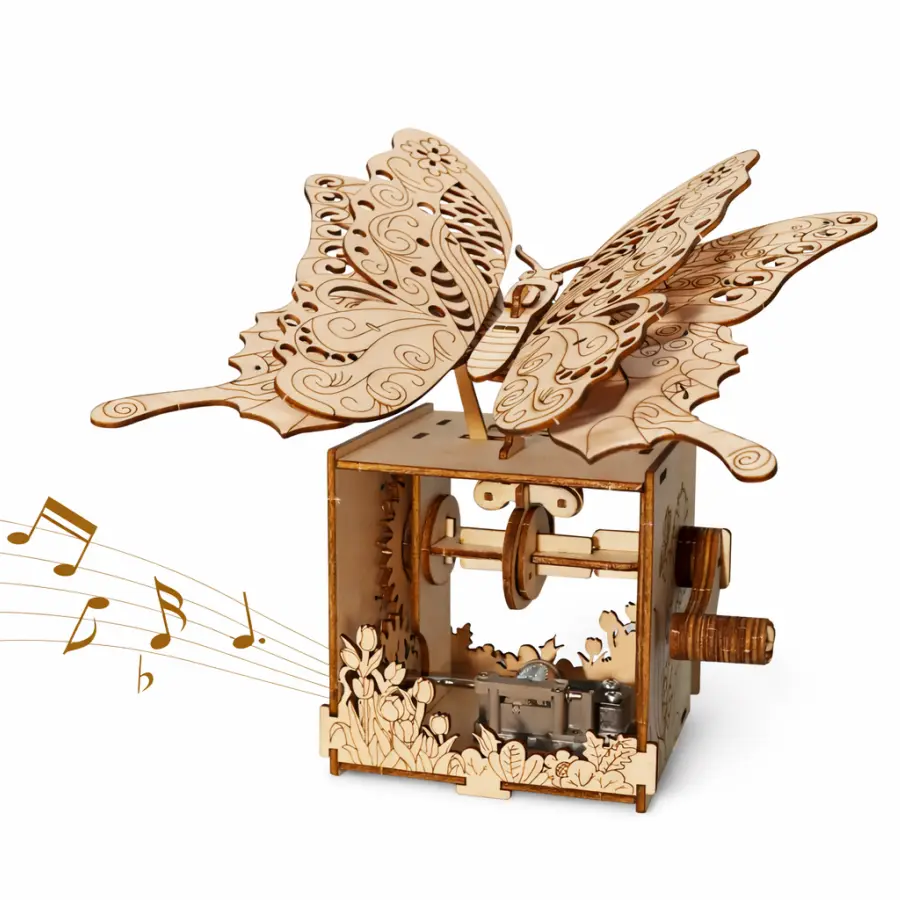
This is where a piece like the Layered Butterfly Wooden Music Box shines. It’s a project that focuses on the beauty of layered laser-cut assembly, culminating in a functional, wind-up music box. The “puzzle” is in the precise, satisfying construction, leading to a decorative and delightful result. For a closer look at this specific type of project, check out our hands-on guide to the layered butterfly music box.
2. The Wooden Kit Deep Dive
For Whom: The seasoned hobbyist who finds zen in complex assembly. You’ve built a few kits, your fingers are accustomed to the snug fit of laser-cut plywood, and you crave a multi-stage challenge. You want a sequential discovery puzzle box where the assembly is the first layer of the solve.
The Experience: This is a week-long relationship with a stubborn, brilliant object. Brands like Robotime produce intricate 3D wooden puzzle boxes that may have you building internal compartments, hidden latches, and interlocking panels before you even attempt to open the finished box. The instructions test your spatial reasoning. The final product is a dense, weighty artifact that doesn’t just look impressive—it demands to be solved. You’ll fumble with it for days, hearing faint clicks and sensing slight shifts, until the final mechanism reveals itself with an authoritative thunk.
3. The 3D-Printed Starter STL
For Whom: The maker with a 3D printer who’s new to puzzles. You want to test the waters without a financial commitment, and you value the community aspect of shared designs.
The Experience: Head to Printables.com or Thangs and search for “puzzle box.” Filter by “Beginner.” You’ll find designs like simple sliding-panel boxes or twist-lock containers. Download the STL files, slice, and print. The challenge here is dual: ensuring your printer is calibrated well enough to produce parts that move smoothly, and then logically working through the solve, which is often elegantly straightforward. The victory is in the self-sufficiency. You sourced, manufactured, and solved your own secret box. It’s a potent gateway drug.
4. The 3D-Printed Marvel
For Whom: The experienced printer-puzzler. You understand tolerances, love print-in-place magic, and seek mechanisms that defy traditional manufacturing.
The Experience: This is where the digital maker community truly shines. Designers create impossible contraptions: boxes where gears, latches, and panels print fully assembled, locked inside a single, solid-looking cube. The solve involves discovering the precise sequence of twists, presses, and slides that these integrated parts allow. The print-in-place aspect is pure sorcery—watching a fully functional, multi-part mechanism emerge from the build plate in one go. The difficulty is high, both in print success and solve, but the bragging rights are unparalleled. It’s a testament to what’s possible when puzzle design is unshackled from traditional material constraints.
5. The Escape Room in a Box
For Whom: The narrative-driven solver. You love the story of an escape room game and want that “aha!” moment tied to a tangible object. You’re looking for a sequential discovery puzzle box with a purpose beyond just opening.
The Experience: This category blends physical mechanical puzzle craftsmanship with game design. Companies or projects found on Kickstarter create boxes that are chapters in a story. You’re not just finding a hidden compartment; you’re uncovering clues, solving riddles, and manipulating the box to progress through a narrative. It’s a layered experience: first the tactile build (if it’s a kit), then the cerebral solve, all wrapped in a compelling theme. The box becomes a prop in your own personal adventure.
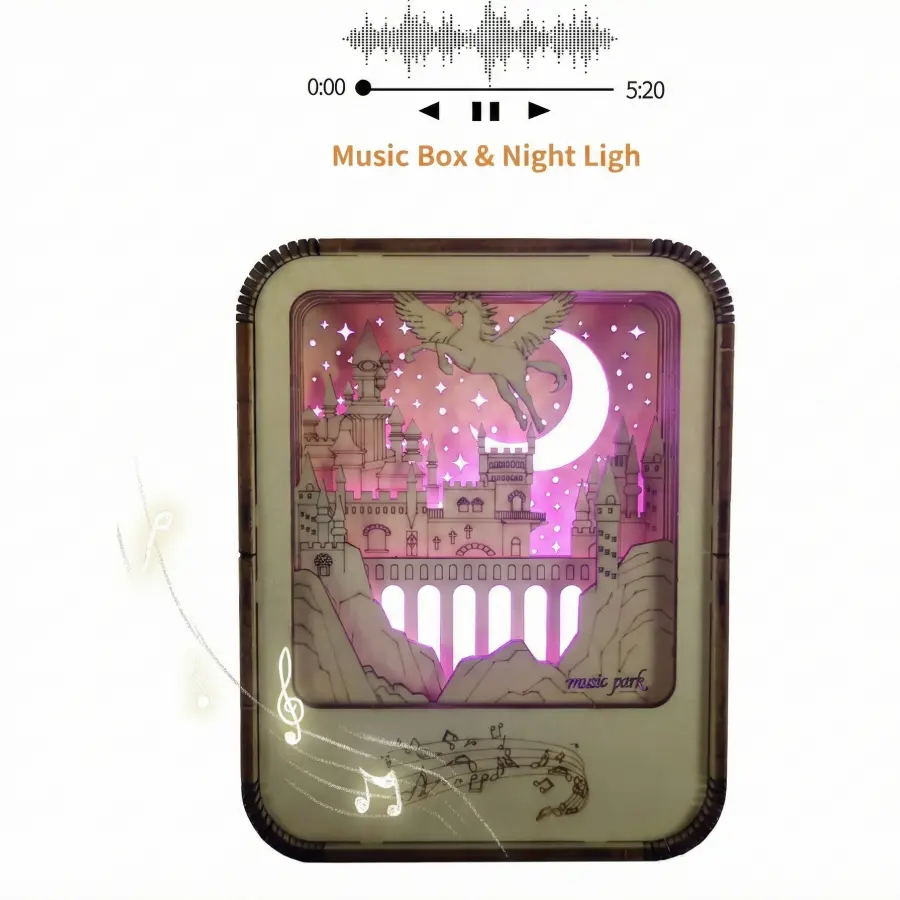
For those drawn to this narrative and atmospheric style, a kit like the DIY Castle Music Box Night Light Shadow Box Kit offers a taste. It combines architectural assembly with a functional, moody result—building the environment becomes part of the story.
Each of these paths offers a distinct flavor of satisfaction. The right one isn’t the “best”—it’s the one that calls to your hands and your curiosity right now.
The Maker’s Gateway: Demystifying 3D-Printed Puzzle Boxes
Choosing a pre-cut kit is one path—the path of the assembler. But what if you want to be the origin point? To hear the hum of your own machine creating a complex, interlocking object from a digital ghost? That’s the frontier of 3D-printed puzzle boxes, a world most buying guides completely ignore. If the curated picks feel like choosing a novel to read, this is about learning to write.
Here, the “kit” is an STL file—a 3D model blueprint. Your printer builds it, layer by microscopic layer, often in a single, mind-bending operation called print-in-place. This isn’t assembly; it’s alchemy. A completed print-in-place box slides, twists, and opens right off the build plate, all moving parts already seamlessly integrated. The first time you print one and a tiny, internal gear train you never touched begins to turn, you’ll feel that specific magic. It enables mechanisms—spiraling threads, ball bearings in captive tracks, nested rotors—that laser-cut wood struggles to replicate, pushing the boundaries of the classic three-dimensional jigsaw puzzle.
So, do you need a printer the size of a mini-fridge? Not usually. Most clever 3D printed puzzle box designs are engineered for common desktop printers (like an Ender 3 or Prusa). Designers are adept at breaking larger boxes into sub-assemblies that fit a standard 200x200mm plate. The real requirement isn’t size, but calibration. A wobbly axis or uneven bed will turn a delicate, interlocking mechanism into a permanent, monolithic paperweight. Dial in your printer first on simple tests; then challenge it with puzzles.
The treasure hunt for STL files is its own puzzle. Start on dedicated repositories like Printables.com and Cults3D. Search for “sequential discovery” or “secret box.” The beauty here is the spectrum: thousands of free designs sit alongside premium, intricately modeled files for a few dollars. How do you evaluate a design? Don’t just look at the final render. Read the comments. A good designer will note:
* Print Orientation: Which side down ensures strength for sliding parts?
* Supports Needed: Minimal supports mean less post-processing and smoother internal surfaces.
* Tolerances: Are they designed for a well-tuned printer (0.15mm clearance) or a more forgiving one (0.3mm clearance)?
* A Logical Solve: The best files come with a cryptic clue or a solution sheet, honoring the puzzle tradition.
This is the purest form of DIY puzzle box endeavor. It bridges digital design with physical, tactile surprise. You’re not just a consumer; you’re the workshop. And when you finally hold that first successful print, a secret already hidden inside its layers, you’ve graduated from solver to maker. A fantastic, free starting point is the “Cassette Box” by maker iDig3Dprinting on Printables—a brilliant, print-in-place design that mimics a retro audio cassette and teaches you everything about clearance and moving parts.
Ready to go from downloading files to contemplating your own designs? The journey from assembler to creator is a continuous thread. For a foundational look at the principles that make these mechanical secrets work, our guide on how to build a puzzle box explores the core mechanics behind the magic.
From Consumer to Creator: The Path to Designing Your Own
That first successful print, a secret already coiled inside its plastic layers, marks a subtle but profound shift. You’ve graduated from solver to maker. But the workshop hum of your printer often asks the next logical question: “What if it were my secret in there?”
This is the natural progression. You assemble a few wooden puzzle box kits, learning how sliding panels and interlocking catches create rhythm. You print a few STL files, marveling at the engineering required for a print-in-place mechanism. Eventually, you start reverse-engineering not just the solution, but the design philosophy itself. You begin to see the empty space on your desk not as a spot for another kit, but as a place for your own mechanical puzzle.
The bridge from consumer to creator is built on understanding a few core principles that turn a box with a lock into a story with steps.
First, tolerances are the grammar of your design. In wood kits, the laser’s precision and the material’s give handle this for you. In digital design, you are the legislator of gaps. A moving pin needs clearance—typically 0.2mm to 0.3mm for FDM printers. Too little, and parts fuse during printing; too much, and the mechanism becomes sloppy, robbing the solve of its satisfying click. Your first designs will likely be conversations with your printer, learning its specific dialect of precision.
Second, sequential discovery is narrative engineering. It’s the art of pacing. A simple hidden compartment might have one “aha!” moment. A true sequential discovery puzzle box is a short story where each solved step provides the literal key—a revealed rod, a shifted panel, a dropped weight—for the next chapter. When designing, you work backward from the final reveal, planting tools and clues along the path. The goal is a logical, almost inevitable progression that feels clever, not arbitrary.
So, where do you start sketching? For 3D design, beginner-friendly software like Tinkercad is a fantastic sandbox for combining basic shapes into simple sliding trays or lid mechanisms. When you’re ready for more precise parametric control—where changing one dimension automatically updates a linked part—tools like Fusion 360 become indispensable. This is where you can truly mimic the complex, integrated gears you might see in an escape room puzzle box kit, but with your own spin.
The most vital tool, however, isn’t software. It’s community. The same maker ecosystems on Reddit (like r/3DPuzzles or r/MechanicalPuzzles), Discord servers, and forums where you found STL files are filled with designers who love to talk shop. They’ll troubleshoot your stubborn sliding lock, suggest better support strategies for an overhang, and offer feedback on the “readability” of your puzzle’s clues. This is where the DIY spirit truly thrives.
Your first original design doesn’t need to be a 50-step epic. It can be a small trinket box with a single, clever locking mechanism you’ve never seen before. The thrill isn’t in scale, but in authorship—in hiding a secret in a contraption that didn’t exist in the world until you willed it into being. It’s the ultimate expression of the mechanical puzzle as a personal craft.
For a deep dive into the foundational concepts—thinking about chambers, blockers, and movers—our guide on how to make a puzzle box from first principles breaks down the anatomy of a secret. It’s the perfect next read when the itch to create moves from your brain to your fingertips, and the only puzzle box left to solve is the one waiting in your design software.
Life After the Solve: Display, Community, and the Next Secret
You’ve aligned the last gear, felt the final, satisfying click, and the secret box yields its hidden compartment. The initial thrill of the solve fades, and a quiet question emerges in its wake: now what? This moment isn’t an ending, but a pivot point. That box you’ve just spent hours, maybe days, with is no longer just a puzzle. It’s an artifact of your focus, a mechanical trophy. So, you treat it like one.
First, display. That intricately assembled 3D wooden puzzle box or glossy 3D printed puzzle box begs to be seen. Treat it as functional sculpture. On a bookshelf, it becomes a conversation piece; on a desk, a tactile reminder of patience rewarded. Some boxes, like elegant Japanese puzzle box designs, are minimalist works of art. Others, especially those from an escape room puzzle box kit, tell a story with their theme. The goal is to honor the craftsmanship—both the designer’s and your own in assembling it. A simple, well-lit spot elevates it from clutter to curated object.
Then, there’s the practical afterlife. Many puzzle boxes, once solved, are perfectly usable containers. That clever sequential discovery mechanism you mastered becomes your personal security system for small treasures—a flash drive, a special coin, a note. It transforms the object from a one-time challenge into a daily ritual. The act of opening it becomes a small, private pleasure, a reaffirmation of the secret you now share with the box itself.
But perhaps the most powerful next step is to pass it on. Gifting a solved puzzle box is a nuanced and deeply personal gesture. You’re not just giving an object; you’re handing someone a curated experience, a challenge you’ve already vetted. It’s a way to share a specific kind of intrigue. Reset the mechanism, and it becomes a Trojan horse for focus, carrying the same potential for flow you experienced. For more on this thoughtful approach to gifting, our piece on why the best puzzle box is a Trojan horse for focus delves deeper.
This act of sharing connects you to the global community of puzzle enthusiasts—the true “next level” after the solve. Online forums, subreddits like r/mechanicalpuzzles, and dedicated Discord servers are bustling with adults dissecting mechanisms, trading hints, and organizing puzzle exchanges. Here, a box you’ve finished can find a new life with another solver, and you might receive a completely foreign mechanical puzzle in return. It’s a library of tactile challenges, constantly circulating. Designers frequent these spaces too, offering insights or seeking beta-testers for new creations, blurring the line between solver and creator we explored earlier.
This is the final, confident turn of the key. Your first box was a gateway. It taught you the language of hidden panels, sliding locks, and misdirection. Whether it now sits on your shelf, guards a secret, or is en route to its next solver, it has done its job. It has transformed curiosity into capability. The world of mechanical intrigue is vast, from century-old traditional designs to cutting-edge DIY creations shared as STL files. Your solved box isn’t a finale. It’s your decoder ring, proving you’re ready for the next secret waiting to be found—or made.
Reader Friction and Quick Answer
So, you stand at the threshold, decoder ring in hand, but perhaps one final, practical hesitation remains. After all this talk of mechanisms and communities, the original, simple questions can still echo: Is this for me? What if I get stuck? Let’s cut through that final bit of friction with direct answers.
First, the evergreen question: How difficult are these for a complete beginner? The answer lies in your chosen entry point. A 3D wooden puzzle box kit from a brand like ROKR or Robotime, labeled for beginners (often sub-100 pieces), is an exercise in mindful assembly, not esoteric logic. The challenge is spatial reasoning and following diagrams—a satisfying, build-focused project. The true difficulty level spikes with sequential discovery puzzles, where you must solve to proceed. For those, start with a design noted for its clear, logical hints. The frustration point isn’t usually the solving; it’s starting in the wrong category.
Can you actually store things inside them? Almost always, yes. Even the most intricate secret box has a primary compartment, however small. That’s the delightful paradox—these are functional secret-keepers. A solved Japanese puzzle box becomes a beautiful vault for a single meaningful object. A printed DIY design with multiple compartments invites you to create a personal time capsule. They are never just for show.
And the final, practical hurdle: What do you do after you’ve solved it once? A solved puzzle box is a story solidified in wood or plastic. It becomes a conversation piece, a testament to patience. It can be reset and gifted, passing the experience to a friend—the ultimate gift idea for fellow curious adults. Or, it becomes your first entry into that circulating library of mechanical puzzles, traded within the community for your next unknown challenge.
Your confident next step is this: Revisit the landscape with these answers in hand. Choose not the “best” box, but the right first box for your hands and your curiosity. Pick a category. Assemble, print, or purchase. Then, listen for that first, satisfying click. It’s the sound of the first secret giving way.