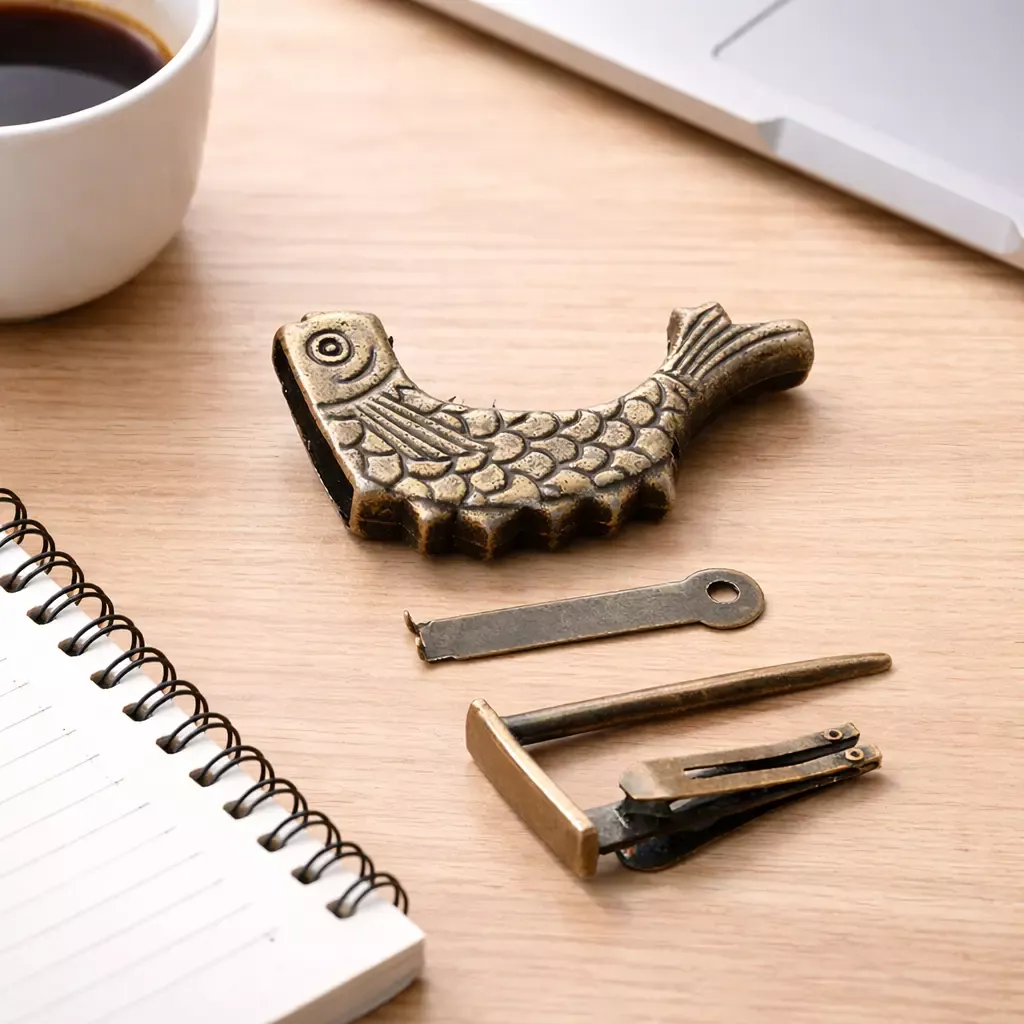
The key slides into the side slot—not the top, not the bottom, but the narrow opening along the fish’s belly. You push gently. Nothing happens. You rotate the key slightly, expecting the familiar tumbler resistance of a modern padlock. Still nothing.
Then you remember: this isn’t a Western lock. You apply lateral pressure—a sideways nudge rather than a twist—and suddenly: click. The curved shackle releases from the koi’s body with a crisp snap that travels through your fingernails and settles somewhere satisfying in your brain.
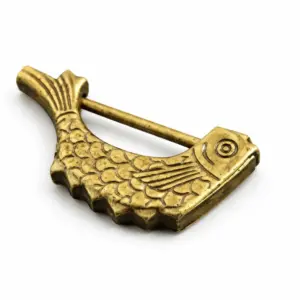
That moment—when you stop fighting the mechanism and start working with it—is what separates the Chinese Koi Puzzle Lock from decorative replicas that look the part but don’t actually function. This 59mm fish-shaped padlock uses the same horizontal-opening design Chinese locksmiths developed centuries ago. The mechanism is simple. The satisfaction is not.
At $16.99 (currently discounted from $27.99), this sits in the territory of “small beautiful things you didn’t know you needed.” It’s not a high-security device—the product page is refreshingly honest about that. It’s a working piece of cultural craftsmanship that fits in your palm and catches light like something pulled from an antique shop in Shanghai.
What You Actually Get: Grounded Unboxing
Before we dive into mechanism theory or cultural history, here’s exactly what arrives when you order the Chinese Koi Puzzle Lock from Tea-Sip’s Metal Puzzles collection:
Package Contents (Per Product Page)
- 1 × Fish-shaped Chinese padlock
- 1 × Traditional flat rod key
Physical Specifications
- Material: Zinc Alloy
- Finish: Antique Bronze Patina
- Lock Size: 59mm × 31mm (roughly thumb-sized)
- Shackle Opening: 28mm × 8mm
- Weight: Approximately 45g
- Key Style: Traditional Flat Rod
The antique bronze finish isn’t painted on, according to the product description—it’s the natural patina of the zinc alloy itself. This matters if you plan to handle the lock frequently or display it where guests might pick it up. Painted finishes chip and wear. Natural patina develops character.
The fish design features individually carved scales and defined fin details. The koi shape is modeled after traditional Chinese carp locks—the type historically found on jewelry boxes, merchant chests, and heirloom furniture. It’s small enough to feel precious, substantial enough to feel real.
What’s not specified on the product page: Exact difficulty rating, recommended age range, estimated opening time for first-time users. Based on similar traditional Chinese locks, many first-time users figure out the mechanism within 2-5 minutes; the “puzzle” is understanding the technique rather than solving a complex sequence.
The Unlock Journey: Step-by-Step Reality
This is the core of the experience. Unlike true puzzle locks that require multiple steps and spatial reasoning to solve, the Chinese Koi Puzzle Lock operates on a single mechanism—but one that runs counter to Western lock intuition. Here’s what actually happens when you try to open it:
Step 1: Locate the Keyhole
What you see: A fish-shaped body with a curved shackle emerging from one end. The surface is covered in detailed scale work. No obvious keyhole on top.
What you try: Looking for the keyhole where you’d expect it—at the top, near the shackle.
What goes wrong: There’s no keyhole there. Traditional Chinese broad locks (horizontal locks) place the keyhole on the side or bottom of the lock body, not the top.
The fix: Examine the sides of the fish. You’ll find a narrow rectangular slot along the body—this is your keyhole.
Mini-checkpoint: If you can identify the side slot, you’re past the first barrier. If you’ve been trying to insert the key vertically into the top of the lock, you now know why nothing was happening.
Step 2: Insert the Flat Rod Key
What you do: Slide the flat rod key into the side slot. The key should go in smoothly, with minimal resistance.
What you feel: Almost nothing—and this is correct. Unlike modern pin tumbler locks where you feel pins lifting and setting, traditional barbed-spring mechanisms don’t provide feedback during key insertion. Research published in Mechanical Sciences describes these as “barbed-spring padlocks”—the typical lock design used in ancient China.
Common mistake: Expecting clicking or catching sensations. The smooth insertion can feel “wrong” to users conditioned by modern locks.
Mini-checkpoint: Key is fully inserted, sitting flush with the lock body. If the key stops partway, check your angle—the flat orientation must match the slot.
Step 3: Attempt to Open (The Wrong Way First)
What you try: Rotating the key clockwise or counterclockwise, like a modern padlock.
What happens: Nothing. The key might wiggle slightly, but the shackle stays firmly locked.
Why this fails: This lock doesn’t use a rotating cylinder mechanism. According to Historical Locks, Chinese broad locks with shackle and ward springs have been documented since the Jin era (265–420 AD)—long before the invention of the pin tumbler lock. The opening principle is fundamentally different.
What you learn: Rotation ≠ operation for this mechanism. Time to try something else.
Step 4: Apply Lateral Pressure (The Actual Technique)
What you do: With the key fully inserted, push it sideways—toward or away from the fish’s body, perpendicular to the key’s length.
What you feel: Resistance at first, then a yielding sensation as internal springs compress.
What happens mechanically: Inside the lock body, leaf springs (sometimes called “barbed springs” or “splitting springs”) grip the shackle stem. When you apply lateral pressure with the key, the key bit compresses these springs, releasing their grip on the shackle. This is the “spring-loaded shackle mechanism” mentioned in the product description.
The result: Click. The curved shackle releases and can be pulled free from the fish’s body.
Mini-checkpoint: If the shackle released, you’ve successfully operated the lock. If it didn’t, adjust your key angle and try varying the direction of lateral pressure—some locks respond better to pushing versus pulling.
Step 5: Re-Lock (No Key Required)
What you do: Simply push the shackle back into the lock body until you hear a click.
What happens: The internal springs re-engage, gripping the shackle stem and securing the lock. Unlike opening, re-locking doesn’t require the key—the springs catch automatically.
Common realization: This means if you lose the key while the lock is closed, you cannot open it. Keep the key in a designated spot.
The “A-Ha” Moment: When It Finally Clicks
Most people who’ve operated modern locks for decades carry deeply ingrained muscle memory. Insert key. Rotate clockwise. Maybe jiggle. That pattern works for car doors, front doors, storage units, bicycle locks—virtually every locking mechanism most Westerners encounter in daily life.
The Chinese Koi Puzzle Lock demands you unlearn that pattern. The moment you shift from “rotate harder” to “push sideways”—and feel the springs compress—something shifts mentally too. You’re not fighting the mechanism anymore. You’re working with a design philosophy that prioritizes simplicity and directness over the complexity of modern tumbler systems.
Many first-time users describe this as surprisingly satisfying. Not because the lock is hard to open (once you know the technique, it takes seconds), but because discovering the correct approach feels like solving a small puzzle. That experiential discovery is part of what separates this from purely decorative locks.
Troubleshooting Common Stuck Points
Problem: Key won’t enter at all.
Cause: Wrong slot (trying top instead of side) or incorrect key orientation.
Fix: Locate the side slot; align the flat key with the rectangular opening. The key should slide in smoothly—if you’re forcing it, you’re in the wrong spot.
Problem: Key is in but nothing happens with any movement.
Cause: Key not fully seated, or springs are stuck from manufacturing residue.
Fix: Ensure key is completely inserted. If new, try gentle repeated compressions to work the mechanism. New zinc alloy locks sometimes have slight manufacturing residue that loosens with use.
Problem: Shackle releases but won’t re-engage when pushed back.
Cause: Misalignment between shackle stem and spring gripper.
Fix: Rotate shackle slightly while pushing; ensure it’s entering straight, not at an angle. The springs need to catch the stem ridges properly.
Problem: The click feels weak or inconsistent.
Cause: Spring tension varies between individual locks; some have firmer springs than others.
Fix: This is normal manufacturing variation. As long as the shackle locks and unlocks properly, the mechanism is functioning correctly.
Building Muscle Memory: Practice Sequence
If you want to become fluent with the lock (useful if you’re demonstrating it as a gift or using it regularly):
- Slow practice: Open and close the lock 10 times slowly, paying attention to the exact moment the springs compress and release.
- Eyes closed: Try operating the lock without looking. This forces you to rely on tactile feedback rather than visual confirmation.
- One-handed: Practice opening with just your dominant hand, then your non-dominant hand. This reveals how much of the operation is grip versus key manipulation.
- Speed run: Once comfortable, see how quickly you can open and close the lock. Most users plateau at 2-3 seconds for the full cycle.
This practice sequence isn’t necessary for casual use, but it deepens your appreciation for how the mechanism works—and makes for a better demonstration when you inevitably show someone else how to open it.
Why It Gets Stuck: The Mechanics You Can Feel
Understanding why this lock behaves differently from modern padlocks helps you work with it rather than against it. The Chinese Koi Puzzle Lock uses what engineers and lock historians call a “barbed-spring” or “splitting-spring” mechanism.
How Barbed-Spring Mechanisms Work
Inside the lock body, thin metal springs are positioned to grip the shackle stem when the shackle is inserted. These springs have angled “barbs” or teeth that catch against ridges on the stem—easy to push in (the barbs flex), hard to pull out (the barbs dig in).
The key’s job isn’t to rotate a cylinder. It’s to physically compress or spread these springs apart, releasing their grip. According to research published in Scientific Reports, “The development of barbed-spring locks in ancient China has a history of more than 2000 years” and these mechanisms form the foundation for increasingly complex puzzle locks developed from the 17th century onward.
Why Lateral Pressure Instead of Rotation
In a modern pin tumbler lock, rotating the key aligns pins at a shear line, allowing a plug to rotate. The mechanism is rotational.
In a traditional Chinese spring lock, the key bit must physically push against the springs to compress them. This requires linear force—pushing the key sideways, not spinning it. The flat rod key design is specifically shaped to slide along and press against the internal springs.
This is why people familiar only with modern locks struggle initially: their muscle memory says “rotate,” but the mechanism demands “push.”
The Satisfying Click: What’s Actually Happening
When you hear and feel that click upon opening, you’re experiencing the spring suddenly releasing its grip on the shackle. The shackle, which was held under slight tension by the compressed springs, jumps slightly as the grip releases. That small movement, amplified through the metal body, creates the tactile and audible feedback.
It’s the same principle that makes old-fashioned light switches satisfying to flip—a sudden state change after building tension.
Comparing to Modern Lock Mechanisms
To fully appreciate what makes this lock different, consider how a standard modern padlock works:
Pin tumbler mechanism (modern): A series of spring-loaded pins of varying heights sit inside a cylinder. When the correct key is inserted, it pushes each pin to exactly the right height, aligning them at a “shear line” that allows the cylinder to rotate. Wrong key = wrong heights = pins block rotation. The system relies on precision cutting of both key and pins.
Barbed-spring mechanism (traditional Chinese): Leaf springs grip a stem through friction and angled barbs. The key doesn’t need to match precise heights—it just needs to physically push the springs aside. The system relies on direct mechanical force rather than precision alignment.
The modern system is more secure (more possible combinations, harder to pick) but also more complex to manufacture and more prone to failure from dirt, rust, or worn components. The traditional Chinese system is simpler, more robust, and easier to make by hand—which explains why it remained the dominant lock design in China for centuries.
Why Traditional Chinese Locks Outlasted Western Designs in China
When Western traders brought pin tumbler locks to China in the 19th and 20th centuries, adoption was slow. According to lock historians, traditional Chinese locks continued to dominate everyday use well into the mid-20th century. Several factors contributed:
- Repairability: A blacksmith could repair or rekey a barbed-spring lock with basic tools. Pin tumbler locks required specialized knowledge and parts.
- Reliability in harsh conditions: Spring mechanisms tolerate dust, moisture, and temperature changes better than precision pin systems.
- Cultural familiarity: Generations knew how to operate traditional locks intuitively. The “rotate the key” motion of Western locks felt foreign.
- Cost: Traditional locks could be produced locally with existing metalworking skills. Western locks required imported technology.
The Chinese Koi Puzzle Lock represents this heritage—a design philosophy optimized for different priorities than the Western approach.
Craft and Origin: Where the Koi Lock Sits in Puzzle History
The fish shape on this lock isn’t arbitrary decoration. It connects to one of the most enduring legends in Chinese mythology—and understanding that context transforms the lock from “cute trinket” to “meaningful object.”
The Dragon Gate Legend
According to Chinese mythology documented on Wikipedia, carp would swim upstream in the Yellow River each year, battling currents and waterfalls. At the legendary Dragon Gate (Longmen), a massive waterfall blocked their path. The legend states that any carp capable of leaping the falls would transform into a dragon—a symbol of power, success, and divine recognition.
This motif became deeply embedded in Chinese culture. As the Cooper Hewitt, Smithsonian Design Museum notes, the carp’s journey became a metaphor for scholars facing imperial examinations—grueling tests that could transform a commoner into a government official. Passing the exams was called “climbing the Dragon Gate.”
The San Diego Zoo Wildlife Alliance explains that koi symbolism extends to “good fortune, success, prosperity, longevity, courage, ambition, happiness, and perseverance”—qualities the fish demonstrated by swimming against the current.
Why Fish Appear on Traditional Locks
From the 17th century onward, Chinese locksmiths began creating padlocks in figurative shapes: animals, musical instruments, people, and symbols. Historical Locks documents that “locks with gently curved bodies and inscriptions meant to bring good fortune” became common, with animal shapes often linked to the Chinese zodiac or auspicious symbols.
A fish-shaped lock carries the Dragon Gate association: perseverance, transformation, fortune. Giving someone a koi lock is, implicitly, wishing them success against their own obstacles.
Traditional vs. Decorative: What Makes This One Different
Many fish-shaped “locks” sold online are purely decorative—they look like locks but have no functioning mechanism. The Chinese Koi Puzzle Lock, according to the product page, uses a “spring-loaded shackle mechanism [that] actually functions.” This places it in the category of working traditional hardware rather than decorative replica.
For collectors and enthusiasts, the distinction matters. A functioning mechanism connects you to the actual craft tradition; a decorative replica just references the shape.
The Role of Animal-Shaped Locks in Chinese Culture
Fish aren’t the only animals represented in traditional Chinese locks. Historical Locks documents padlocks shaped like lions (guardianship), tigers (strength), and all twelve zodiac animals. Each shape carried meaning beyond mere decoration:
- Fish (carp/koi): Perseverance, transformation, success against obstacles
- Lions: Protection, guarding valuables and thresholds
- Tigers: Strength, warding off evil spirits
- Butterflies: Joy, marital happiness (common on “wedding locks”)
- Musical instruments: Refinement, scholarly pursuits
Choosing a fish-shaped lock wasn’t arbitrary—it was a statement about what the owner valued or wished for. A merchant might choose a fish lock for a strongbox, symbolizing hope for business success. A scholar might receive one as a gift before examinations. A parent might place one on a child’s keepsake box, wishing for their future achievements.
This context transforms the Chinese Koi Puzzle Lock from “cute fish-shaped thing” to “object with layered cultural meaning.” Whether you engage with that meaning or simply appreciate the craftsmanship is up to you—but the meaning is there if you want it.
Material Evolution: From Bronze to Zinc Alloy
Historical Chinese locks were crafted from bronze, brass, iron, or occasionally silver. Each material carried different associations:
- Bronze: Durable, develops distinctive green patina over time. Associated with antiquity and permanence.
- Brass: Bright golden color, resists corrosion. Associated with prosperity.
- Iron: Strong but prone to rust. Common for utilitarian locks.
- Silver: Precious, reserved for valuable items or gifts. Associated with purity.
Modern reproductions like the Chinese Koi Puzzle Lock use zinc alloy—a practical choice that enables the antique bronze aesthetic while remaining economically accessible. Zinc alloy casts well, holds fine detail, and accepts various finishes. The “antique bronze patina” on this lock mimics the aged appearance of genuine antique bronze without the centuries of oxidation required to develop it naturally.
This isn’t a criticism—it’s a practical reality of producing traditional-style objects at accessible prices. The mechanism is authentic; the material is modern. For collectors seeking genuine antiques, the search continues. For those wanting the experience of operating a traditional lock without antique shop prices, zinc alloy reproductions serve the purpose.
Who This Is For (and Who Should Skip It)
Based on the product specifications, stated use cases, and mechanism characteristics, here’s an honest assessment of who will appreciate this lock—and who will be disappointed.
Ideal For:
Collectors of Curious Objects
If you maintain a shadow box, curio cabinet, or “weird little things” shelf, this belongs there. At 59mm × 31mm, it’s genuinely small—a miniature that rewards close inspection. The detailed scale work and functioning mechanism justify display.
Journal and Diary Keepers
The 28mm × 8mm shackle opening fits most leather journal straps and notebook hasps. If you want something more distinctive than a generic diary lock—something with character and history—this works. Just measure your strap first to confirm fit.
Asian Decor Enthusiasts
Place it in a ceramic dish on a bookshelf, next to incense holders or tea sets. The antique bronze finish and koi symbolism create visual harmony with Asian-themed spaces. Unlike decorative items that only look authentic, this one actually functions like its historical ancestors.
Unique Gift Seekers
When candles and mugs feel too generic—for housewarmings, Lunar New Year, or “thinking of you” moments—this works. It’s memorable without being expensive or oversized. The Dragon Gate symbolism adds meaning for recipients who appreciate cultural context.
Escape Room and Puzzle Enthusiasts
Add to a DIY puzzle box or gift-wrapping challenge. The non-intuitive opening mechanism creates genuine (if brief) engagement. For puzzle enthusiasts seeking greater challenge, Tea-Sip offers true puzzle locks like the Three Brothers Lock Puzzle (rated 4.80/5) or ABC Maze Lock (rated 4.70/5), which require multiple steps to solve.
Skip This If:
You Need Actual Security
The product description is explicit: “This is a decorative collectible and functional trinket—not a high-security device.” It will keep a journal casually private. It will not protect valuables from anyone determined to access them.
You Want a Complex Puzzle Challenge
Once you understand the lateral-pressure technique, opening takes seconds. The “puzzle” is learning the mechanism—not an ongoing challenge. If you want locks requiring multiple steps and extended problem-solving, explore Tea-Sip’s Metal Puzzles category, where true puzzle locks offer sustained difficulty.
You Expect Something Larger
59mm × 31mm is genuinely small. Roughly thumb-sized. If you’re imagining a substantial padlock, check those measurements against a ruler before ordering.
You Dislike Non-Intuitive Mechanisms
If the learning curve of “why isn’t rotating working?” sounds frustrating rather than interesting, this might not be for you. The appeal is partly in discovering the mechanism; if you want immediate operation, a modern padlock is more straightforward.
Buying Decision Framework + What to Do Next
Before purchasing, verify:
- Purpose Match: Display? Actually locking something? Gift? Each use has different requirements.
- Size Verification: 59mm × 31mm against your intended use. For journal locking, measure your strap against the 28mm × 8mm shackle opening.
- Security Expectations: Decorative security only—stated clearly on the product page. Accept this before purchasing.
- Mechanism Interest: Does the traditional spring-loaded operation appeal to you, or does it sound like unnecessary friction?
- Cultural Resonance: Does the koi symbolism and Dragon Gate meaning add value for you or your recipient?
If You’re Ready to Purchase
Find the Chinese Koi Puzzle Lock at Tea-Sip. Current price: $16.99 (reduced from $27.99). Free worldwide shipping on orders over $100; 30-day returns available.
If You Want Something Similar But Different
The Chinese Old Style fú Lock ($19.99) uses the same traditional mechanism in a rectangular form, featuring the 福 (fortune) character. For deeper exploration of traditional Chinese locks, read Chinese Puzzle Lock – Antique Brass: A Traditional Fú Fortune Lock That Actually Works on the Tea-Sip blog.
If You Want a Harder Challenge
Browse the full Puzzle Toys collection. True puzzle locks like the Three Brothers Lock Puzzle require solving multiple interlocking components—genuine brain teasers rather than technique demonstrations.
Questions?
Visit Tea-Sip’s Customer Help page or contact them directly. Learn more about the company on their About page.