The key slides into the side slot with barely a whisper of resistance. You apply gentle sideways pressure—nothing happens. A slight rotation, then a nudge forward. Suddenly: click. The curved shackle releases from the body with a crisp, definitive snap that travels up through your fingernails. For a Chinese puzzle lock this small—roughly the size of a large postage stamp—you’ve just experienced a moment of genuine mechanical satisfaction that modern combination locks simply can’t deliver.
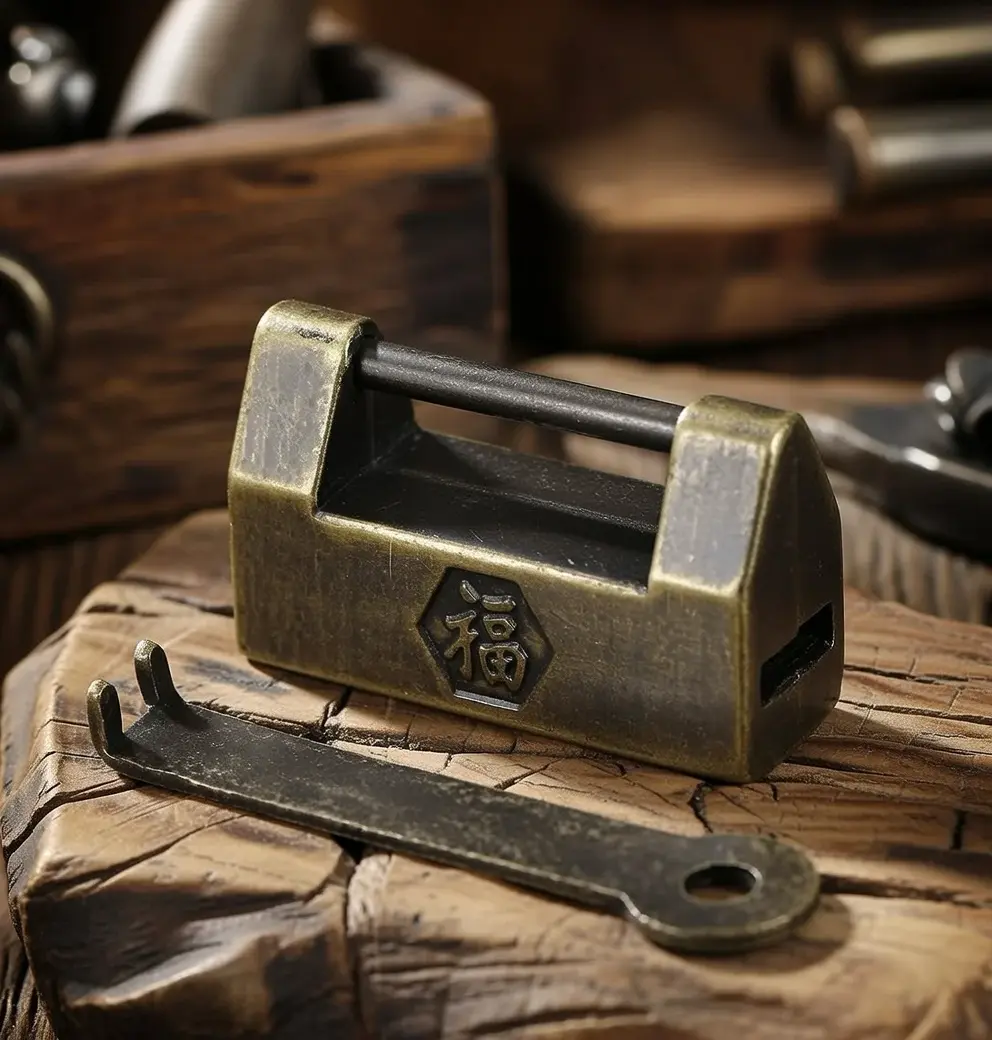
This particular Chinese puzzle lock in antique brass finish represents a specific category of traditional Asian locks that Western collectors often struggle to find. Unlike decorative replicas designed purely for display, this miniature padlock uses a functional spring-loaded mechanism that Chinese metalworkers developed centuries ago. The embossed 福 (fú) character on the front face—meaning fortune and blessing—places this lock within an authentic cultural tradition where everyday objects carry wishes for prosperity.
What Makes This Chinese Puzzle Lock Different
When searching for a Chinese puzzle lock, buyers typically encounter two categories: true puzzle locks requiring multiple steps to solve, and traditional working padlocks with historical mechanisms. This antique brass fortune lock falls into the second category—it’s a functional padlock whose “puzzle” lies in understanding the traditional opening technique rather than solving a complex mechanical riddle.
The antique brass finish isn’t painted on. According to the product specifications, it’s the natural patina of zinc alloy, meaning the weathered bronze appearance won’t chip or peel over time. This matters for anyone planning to handle their Chinese puzzle lock regularly or display it where guests might touch it.
Physical Specifications
- Material: Zinc Alloy with Antique Brass/Bronze Patina
- Lock Dimensions: 30mm × 17mm × 10mm
- Shackle Opening: 20mm × 4mm
- Weight: Approximately 25g
- Key Style: Traditional Flat Rod
- Package Contents: 1 × Lock, 1 × Key
At 30mm across, this Chinese puzzle lock sits comfortably between thumb and forefinger. The 4mm shackle opening fits most journal straps and small hasps—a detail worth checking if you’re planning to secure a leather diary or notebook.
How to Open a Chinese Puzzle Lock: The Traditional Mechanism Explained
Understanding how to operate a Chinese puzzle lock requires abandoning modern lock assumptions. There are no pin tumblers, no rotating cylinders. This antique brass lock uses what scholars call a “barbed-spring” or “splitting-spring” mechanism—the same design Chinese craftsmen employed for centuries.
Step 1: Locate the Keyhole
What you see: A rectangular body with the 福 character embossed on one face. The curved shackle emerges from the top. On one side—not the top or bottom—there’s a narrow slot.
Common mistake: Many first-time users of Chinese puzzle locks expect the keyhole on top or attempt to insert the key vertically. Traditional broad locks feature side-mounted keyholes.
Step 2: Insert the Flat Rod Key
What you do: Slide the flat rod key into the side slot. It goes in smoothly without the clicking or catching you’d experience with modern locks.
What you feel: Almost nothing—and that’s correct. The absence of resistance tells you this Chinese puzzle lock operates on different principles than Western tumbler mechanisms.
Step 3: Compress the Internal Springs
What you try: With the key fully inserted, apply gentle lateral pressure—a push or tilt rather than rotation.
What happens mechanically: Inside the lock body, leaf springs grip the shackle stem. Your key compresses these springs, releasing their hold. Research published in Mechanical Sciences documents these barbed-spring padlocks as the typical locks used in ancient China, with variations including open-keyhole, hidden-keyhole, and blocked-keyhole designs.
Step 4: Release and Re-Lock
The result: With springs compressed, the shackle slides free with the satisfying click mentioned in the product description. To re-lock, simply push the shackle back until you hear it engage—no key required for locking.
Troubleshooting Your Chinese Puzzle Lock
If your antique brass lock won’t open:
- Key won’t enter: Confirm you’re using the side slot, not attempting top/bottom insertion.
- Key is in but nothing happens: Stop trying to rotate. Apply sideways pressure instead.
- Shackle won’t release: Springs aren’t fully compressed. Adjust key angle; use steady, gentle pressure.
- Won’t re-lock: Push shackle firmly until you hear the engagement click.
The History Behind Chinese Puzzle Locks
The Chinese puzzle lock tradition extends back centuries. According to Historical Locks, a resource dedicated to padlock history, Chinese box-shaped padlocks with shackle and ward springs have been documented from at least the Jin era (265–420 AD).
The horizontal-opening style—sometimes called “broad lock” in English—was one of several forms that emerged. From the 17th century onward, Historical Locks notes that more varieties appeared, including locks with “inscriptions meant to bring good fortune.” The 福 character on this antique brass lock places it directly within that cultural tradition.
The 福 Symbol: Why It Matters
The character stamped on this Chinese puzzle lock—福 (fú)—is one of the most recognizable symbols in Chinese culture. According to Wikipedia, it means “fortune” or “good luck” and has been displayed during Chinese New Year since at least the Song dynasty (960–1279 CE).
The symbol appears on red envelopes, on doorways during Lunar New Year, and often hung upside down (because “inverted” sounds like “arrived” in Mandarin, so an upside-down 福 means “fortune has arrived”). A Chinese puzzle lock bearing this character transforms from purely functional object into one carrying traditional blessings.
Why Antique Brass Zinc Alloy?
Traditional Chinese locks were crafted from brass, bronze, or iron. This modern reproduction uses zinc alloy—a practical manufacturing choice that enables the antique brass aesthetic while remaining economically accessible.
According to Britannica, zinc alloy die castings have good dimensional stability and surface quality, making them suitable for small decorative hardware. The Zamak family of zinc alloys has been used for decorative items since the 1930s—they cast well, hold fine detail, and accept various finishes including the antique brass patina on this lock.
Who Should Buy a Chinese Puzzle Lock
The Tea-Sip product listing identifies several audiences for this Chinese puzzle lock in antique brass:
Ideal Buyers:
Journal and Diary Owners: The 4mm shackle opening fits most journal straps. If you want something more distinctive than a generic diary lock, this antique brass Chinese puzzle lock provides both function and aesthetic character.
Miniature Collectors: At 30mm × 17mm, this qualifies as a genuine miniature while remaining fully functional. Shadow box enthusiasts and curio cabinet collectors appreciate pieces that are both displayable and operational.
Asian Decor Enthusiasts: Place it in a ceramic dish on a bookshelf near incense holders or tea sets. The antique brass finish and 福 symbol create authentic visual harmony with Asian-themed spaces.
Unique Gift Seekers: A Chinese puzzle lock makes an unusual housewarming gift, stocking stuffer, or “thinking of you” present. It’s memorable without being expensive or oversized—the kind of small gift that prompts conversation and questions.
Escape Room and Puzzle Enthusiasts: Add this to a DIY puzzle box or gift-wrapping challenge. The non-obvious opening mechanism creates genuine (if brief) engagement for recipients.
Skip This Chinese Puzzle Lock If:
You need real security: The product description explicitly states: “This is a decorative and functional trinket—not a security device.” The lock works, but won’t resist determined attack.
You want a complex puzzle challenge: Once you understand the mechanism, opening takes seconds. For true puzzle locks requiring multiple steps, consider options like the ABC Maze Lock or Three Brothers Lock Puzzle from Tea-Sip’s Metal Puzzles collection.
You expect something larger: 30mm is genuinely small. Check that measurement against a ruler before ordering.
Chinese Puzzle Lock vs. True Puzzle Locks: Understanding the Difference
The term “Chinese puzzle lock” can refer to two distinct categories, and understanding this difference prevents purchase disappointment:
Category 1 – Traditional Working Padlocks: Functional locks using historical mechanisms (like this antique brass fú lock). The “puzzle” is learning the technique; once mastered, operation is instant.
Category 2 – Mechanical Puzzle Locks: Brain teasers requiring specific sequences of movements to open. The Three Brothers Lock Puzzle (rated 4.80/5) exemplifies this—three interlocking rings must be separated through observation and spatial reasoning.
This antique brass Chinese puzzle lock falls into Category 1. It’s valued for its traditional mechanism, cultural symbolism, and aesthetic appeal rather than sustained puzzle-solving challenge.
Buying Decision Framework
Before purchasing this Chinese puzzle lock, verify:
- Purpose match: Display? Actually locking something? Gift? Each use case has different requirements.
- Size verification: 30mm × 17mm against your intended use. For journal locking, measure your strap against the 4mm shackle opening.
- Security expectations: Decorative security only—stated clearly on the product page.
- Mechanism interest: Does the traditional spring-loaded operation appeal to you?
- Cultural resonance: Does the 福 symbol and its meaning add value for you or your recipient?
Ready to Purchase?
Find this Chinese puzzle lock in antique brass at Tea-Sip’s product page. Current price: $19.99 (reduced from $25.99), with free worldwide shipping over $100 and 30-day returns.
For additional questions, visit Tea-Sip’s Customer Help. Browse the full Puzzle Toys collection or learn about the company on their About page.
For deeper reading on collectible puzzles, the Tea-Sip blog offers insights on what makes certain pieces worth collecting.