The first thing I notice isn’t the gold. It’s the weight.
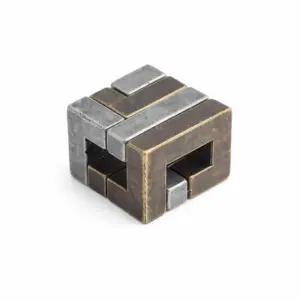
I’m holding what looks like a miniature sculpture—three gold bars intersecting with three copper-toned bars, forming a compact tetrahedron about the size of a clementine. The product photos suggested decorative object, maybe a paperweight. My palm says otherwise. This thing has presence. Nearly 270 grams of die-cast zinc alloy, and every gram announces itself the moment you pick it up.
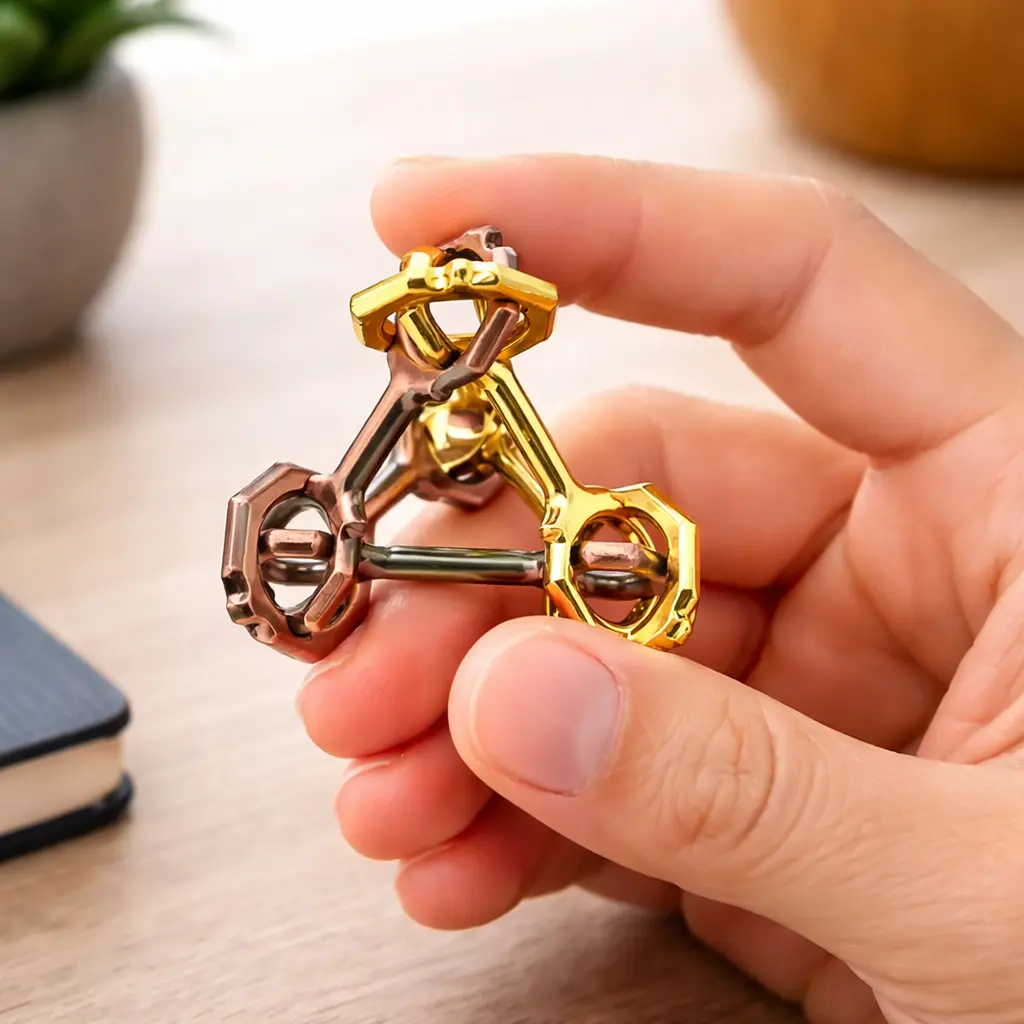
I rotate it under my desk lamp. The dual-tone finish does something photographs can’t capture: where the gold bars cross the copper ones, the colors don’t clash—they converse. The gold catches direct light; the copper absorbs it, giving the whole piece a warmth that single-tone puzzles lack. It looks expensive. It looks like something you’d find in an architect’s office or a design museum gift shop.
Then I try to take it apart.
That’s when the conversation turns into an argument.
Six Pieces, Zero Mercy
Here’s what the product page doesn’t tell you: metal interlocking puzzles give no feedback.
Wooden burr puzzles flex. You can feel when a piece almost moves, when you’re close to the right orientation. This triangle? Pure indifference. Every wrong move meets the same response—nothing. No give, no hint, no encouragement. Just six bars of machined zinc sitting there, perfectly assembled, perfectly silent.
I spend fifteen minutes doing what everyone does first: grabbing opposite bars and pulling. Pushing. Twisting with brute enthusiasm. The puzzle tolerates this like a cat tolerates a toddler. It doesn’t resist dramatically; it simply doesn’t participate.
The mechanism, I eventually realize, isn’t about force. It’s about geometry.
Each of the six bars interlocks with four others at precise angles. The notches that allow them to mesh are cut with tolerances you’d expect in industrial equipment, not desk toys. According to the Zinc Die Casting Association, die-cast zinc alloys achieve dimensional consistency measured in hundredths of a millimeter. That precision is your enemy here. The pieces won’t slide past each other until every angle aligns simultaneously.
Finding that alignment takes me 26 minutes.
The Breakthrough
The secret isn’t in any single piece—it’s in the triangle’s edges.
Each edge of the assembled puzzle is formed by two bars meeting at a vertex. I’d been treating the six bars as individual pieces. Wrong. They function as three pairs, and each pair shares a movement axis along its edge.
When I finally stumble onto this—holding the puzzle by one edge, applying gentle outward pressure while rotating maybe two degrees—everything shifts at once. Not dramatically. Not with a click or a pop. Just a collective millimeter of travel that announces: here’s the door.
The next three minutes are almost comically fast. Once the coordinated slide begins, maintaining it is intuitive. Rotate and pull along the same axis. Feel the friction—zinc on zinc runs at a friction coefficient around 0.1 to 0.15, according to tribology research in ScienceDirect—smooth enough to glide, sticky enough to control. One bar clears its neighbors and suddenly I’m holding a single gold piece while the other five dangle, structure compromised.
They cascade apart in seconds. Without that sixth piece, the internal pressure that held everything together vanishes. The puzzle doesn’t disassemble; it collapses.
I sit there with six bars scattered on my desk, feeling the specific satisfaction of a problem solved—and the dawning awareness that I now need to put it back together.
Reassembly: A Different Puzzle Entirely
Here’s the cruel joke: disassembly requires finding one technique. Reassembly requires remembering six orientations.
Each bar has asymmetrical notches. Some face inward, some outward. Some bars go over their neighbors, some under. Get one wrong and the puzzle assembles to 80%—then locks up, refusing to close, the final piece hovering a millimeter from completion with nowhere to go.
My first reassembly attempt takes 45 minutes and ends in failure. I’d flipped one copper bar 180 degrees from its correct orientation. No amount of forcing could compensate.
By the fifth solve, I’d developed a system: start with the two gold bars sharing the bottom edge, add the copper bar that bridges them, build outward from there. Time dropped to under ten minutes. By week two, I could do it during conference calls without looking—which, honestly, might be this puzzle’s highest use case.
For anyone stuck mid-reassembly: if pieces bind at 80% completion, one bar is oriented wrong. Look for the piece with the most asymmetrical notch pattern. Flip it 180 degrees. Try again.
What’s Actually Happening Inside
The mechanism belongs to a family that puzzle historians call “interlocking” or “INT” puzzles—objects where, as the Hordern-Dalgety Classification at Puzzle Museum defines it, “one or more pieces hold the rest together, or the pieces are mutually self-sustaining.”
That mutual self-sustaining part is key. Unlike sequential puzzles where you remove pieces one at a time, this triangle demands coordinated release. Every piece contributes to the stability of every other piece. Remove any one and the system fails—which is why it’s so stable when assembled and so unstable the moment you succeed.
The material choice reinforces this behavior. Zinc alloys (likely Zamak 3, the most common formulation) deliver Brinell hardness between 82-86 HB and tensile strength around 283 MPa according to NADCA industry specifications. Translation: these pieces don’t flex, don’t deform, don’t forgive. The CNC finishing after die-casting removes microscopic surface irregularities, giving that smooth, almost buttery glide when pieces finally move correctly—and that absolute refusal to budge when they don’t.
The dual-tone finish isn’t just aesthetic, either. Having visually distinct pieces (three gold, three copper) makes orientation tracking during reassembly dramatically easier than single-tone versions where every piece looks identical. It’s form serving function, even if that wasn’t the primary design intent.
A Lineage of Beautiful Frustration
This puzzle’s ancestors are Chinese.
The interlocking bar mechanism traces back to the Luban Lock (鲁班锁), named for Lu Ban, a legendary carpenter from the 5th century BCE credited with inventing the saw and the carpenter’s plane. According to ChinesePuzzles.org, these puzzles were originally teaching tools for apprentice carpenters—exercises in spatial reasoning and precision joinery disguised as entertainment. (Tea-Sip carries several traditional Luban lock designs if you want to explore the wooden originals.)
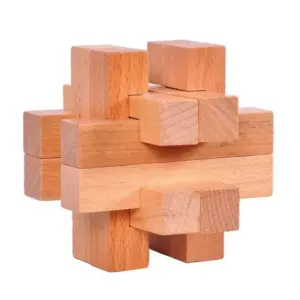
The six-piece burr puzzle, documented in Western sources as early as 1698 and referenced in a Chambers’s Cyclopaedia engraving, follows the same principle: notched sticks that interlock without glue or fasteners, stable when assembled, cascading apart once the key piece moves.
This triangle is a geometric cousin. Same principle (coordinated interlock), different shape (tetrahedron versus cube), modern material (zinc versus wood). What’s gained is precision and durability. What’s lost is the wood’s tactile warmth and the slight flex that hints at progress. Trade-offs, not improvements.
I don’t know who designed this specific variant—the product page doesn’t say, and I won’t invent attribution. But the mechanism is a clear descendant of principles that Chinese artisans understood two millennia ago.
Who Should Buy This (And Who Shouldn’t)
Let me be specific.
This puzzle works for:
The desk fidgeter who’s graduated from stress balls. If you need something in your hands during video calls that doesn’t look childish and doesn’t make noise, this delivers. Once you’ve solved it a few times, the reassembly becomes meditative—occupying hands without demanding attention.
The mechanical keyboard person. I don’t know why this overlap exists, but it does. If you own a $200+ keyboard and appreciate precision manufacturing, you’ll understand what’s happening inside this puzzle at an intuitive level. The tolerance, the fit, the machined finish—it speaks the same language.
The gift-giver hunting originality under $25. Secret Santa for an engineer colleague, birthday for a puzzle-loving uncle, white elephant that isn’t another candle. It photographs well, solves eventually, and doesn’t require batteries or explanation.
The intermediate puzzler. If you’ve conquered wire disentanglement toys but find Hanayama Level 6 puzzles more frustrating than fun, this sits in productive middle ground. Challenging without being punishing.
This puzzle does not work for:
The impatient. If your entertainment threshold is five minutes, you’ll abandon this in a drawer. The first solve takes 20-40 minutes of attentive trial and error. If that sounds like torture, skip it.
Kids under 12. The 14+ rating is realistic. Younger kids lack the patience for trial-and-error without visible progress, and the small pieces pose choking hazards anyway.
Anyone wanting a pocket puzzle. At 270 grams and 7-8cm per side, this is technically portable but practically a desk object. It’ll weigh down a jacket pocket uncomfortably. For EDC, look elsewhere.
People who hate puzzles without solutions. No guide ships with this. No QR code to a YouTube tutorial. If the concept of figuring something out through pure experimentation makes you anxious, this will frustrate rather than satisfy.
The Verdict
I’ve had this puzzle on my desk for three weeks now. It sits next to my monitor, catching afternoon light, occasionally getting picked up and solved during tedious emails. It’s been disassembled probably forty times.
Here’s what I’ve concluded:
Compared to four-piece triangle puzzles flooding Amazon and eBay at lower price points: the six-piece construction creates genuinely different (and harder) mechanics. Four identical pieces means one technique repeated; six pieces with asymmetrical notches means actually thinking about orientation. The dual-tone finish also solves the “which piece goes where” problem that plagues single-color versions.
Compared to Hanayama cast puzzles in similar price range: less design pedigree, comparable build quality, different challenge profile. Hanayama excels at ingenious mechanisms compressed into two or three pieces. This triangle excels at coordination—making six pieces work together feels different in your hands.
Compared to wooden burr puzzles: gains precision and durability, loses tactile warmth and forgiving feedback. Personal preference territory.
The price-to-satisfaction ratio is strong. If you want a single object that works as desk decoration, fidget device, and genuine puzzle—without any one role dominating—this earns its shelf space.
I’m keeping mine.
If you’re drawn to the interlocking mechanism but want something slightly easier, the Alloy Triangle Lock Puzzle uses fewer pieces with a similar aesthetic. For those building a collection of geometric metal puzzles, the 6 Piece Steel Ball Pyramid Puzzle offers a different shape with comparable challenge. And if you’re shopping for a gift, our brain teaser gift guide covers options across price points.
Browse our full metal puzzles collection for more options.