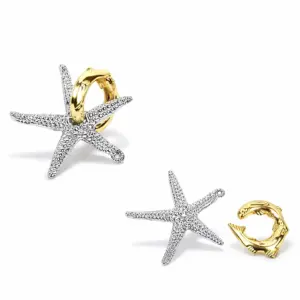
The two fish sit in your palm like a small metallic sculpture. One gold, one silver, interlocked in a tight embrace — tails curving around each other’s bodies, heads tucked against fins. Your first instinct is to pull. Don’t. That satisfying metallic resistance you feel isn’t a sign you’re close to solving it. It’s the puzzle telling you that you’ve already gone wrong.
I spent the better part of a week with this cast metal fish puzzle on my desk before I cracked it. Not because the solution is complicated — it’s actually elegant once you see it — but because the mechanism exploits a blind spot in how most people think about three-dimensional movement. The interlocking design creates what puzzle designers call a spatial displacement lock: the two pieces occupy each other’s negative space in a way that makes linear separation impossible. You need to think in arcs, not lines.
This particular design traces its lineage to a family of cast metal disentanglement puzzles that emerged from Japanese puzzle engineering in the early 2000s. The marine-themed series drew inspiration from an aquarium observation — two fish of different species tangled together, unable to blend in with their surroundings. That poetic origin became the design brief for a puzzle that looks organic but operates on precise geometric principles.
What Makes the Two-Fish Design Deceptively Hard
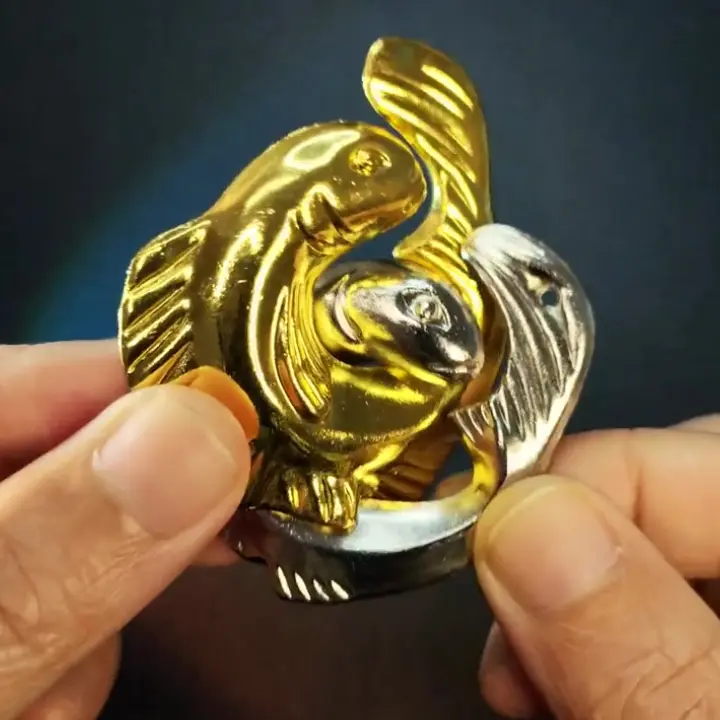
Show Image The puzzle in its initial locked state — the gold and silver fish intertwined.
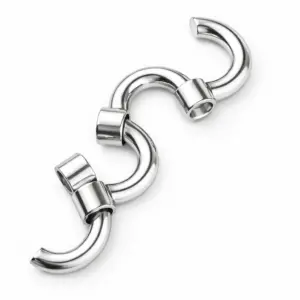
Pick up the puzzle and rotate it slowly. You’ll notice the two fish aren’t simply stacked or side-by-side. Each fish’s body curves into a C-shape, and the opening of one C passes through the body of the other. The tails, fins, and heads create visual noise that obscures the actual geometry underneath. Strip away the fish details mentally, and you’re looking at two interlocking curved hooks — not unlike two carabiners clipped through each other at specific angles.
The weight is the first thing that surprises people. At roughly 65 grams and 60 millimeters across, it has the heft of a few stacked coins. The zinc alloy construction gives it a density that feels expensive in the hand. The gold and silver plating isn’t just cosmetic — it serves a functional purpose during solving. The color contrast helps you track which piece is moving relative to the other, a genuine advantage when you’re rotating pieces through tight tolerances.
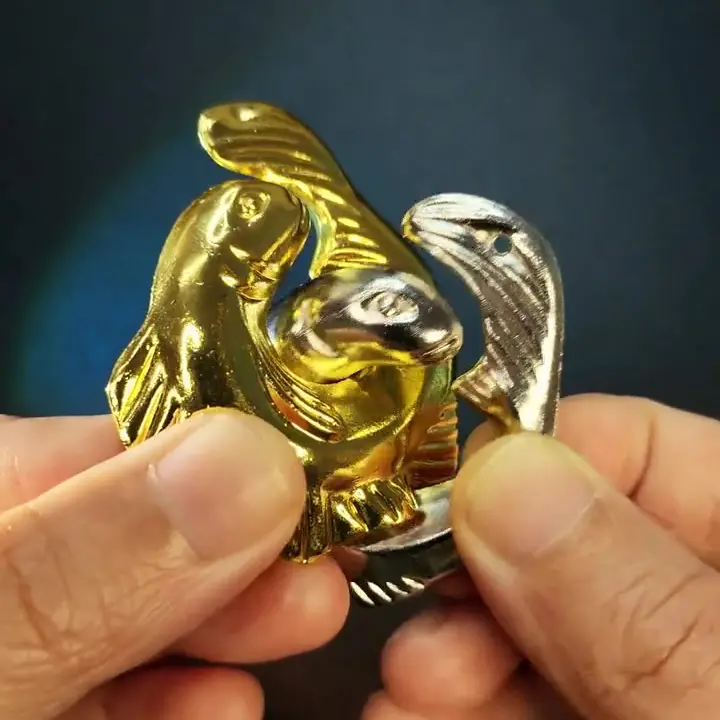
Show Image Close observation reveals the angles between the two fish are precisely engineered to mislead.
Through careful observation, I discovered that the angle design of the two fish is deliberately tricky. The curves that look like they should provide clearance for separation are actually decoys. The bodies taper at points that seem like exit paths but are fractionally too narrow. This is where the puzzle earns its reputation — reported by some Chinese universities as a lateral-thinking exam question, the challenge isn’t finger dexterity. It’s perception.
The Mistake Nearly Everyone Makes First
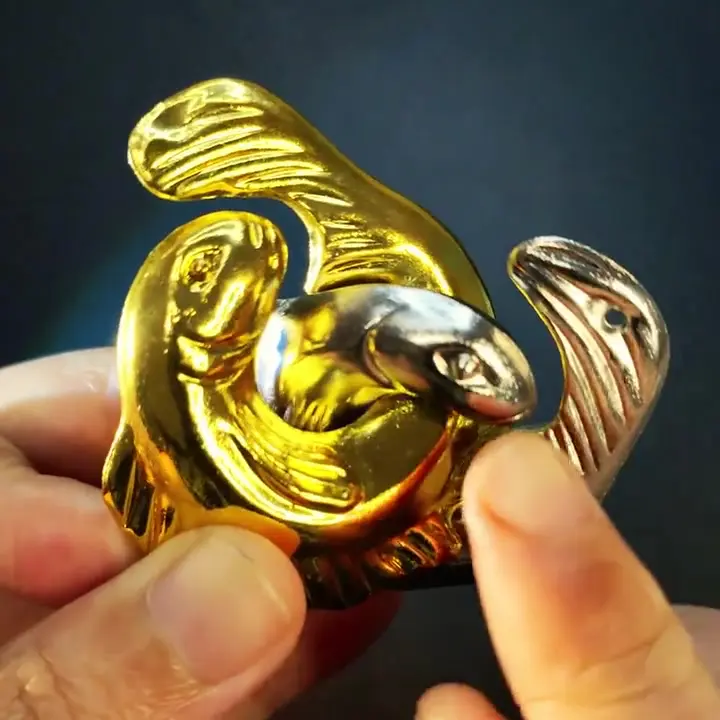
Show Image Most people assume the silver fish exits through the gap near the gold fish’s tail. It doesn’t.
Here’s what happens: you hold the puzzle, spot a gap near the tail section, and assume that’s where one fish slides through. You try pulling the silver fish toward that gap. It moves slightly, encouraging you. So you apply more force, rotating and wiggling. The pieces shift — then lock tighter than before.
Ninety-nine percent of first-time solvers make this exact mistake. The tail gap is a red herring built into the design geometry. The fish can rotate into that space just enough to feel like progress, but the curvature of the opposing body prevents full passage. You end up in a position that’s more locked than where you started, with the pieces wedged at an angle that requires backtracking before you can try anything else.
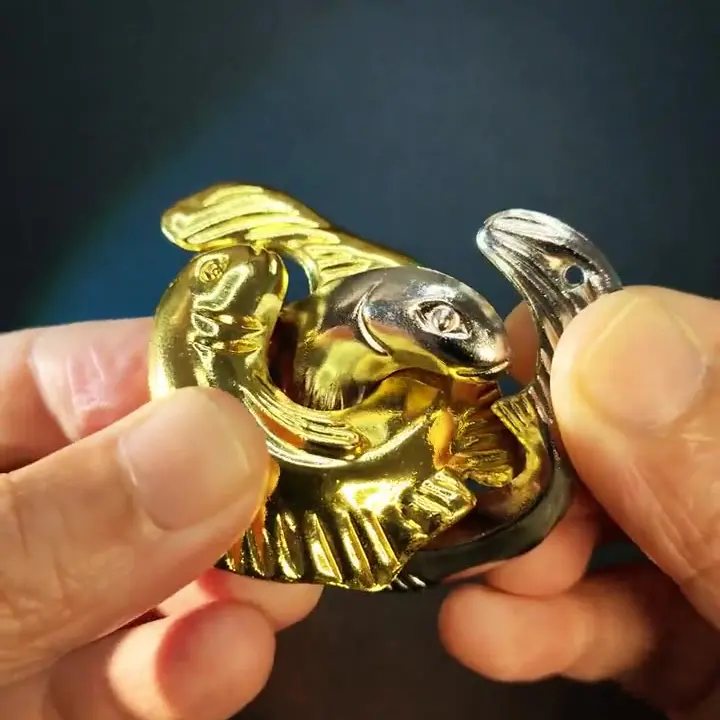
Show Image The key insight: how to maneuver the pieces out is more important than where.
The real question isn’t where the fish separate — it’s how they navigate around each other. The solution uses what Chinese puzzle terminology calls 空间错位法 (kōngjiān cuòwèi fǎ), or the “spatial displacement method.” Rather than sliding one piece out of the other, you rotate both pieces through a specific sequence of angular movements that temporarily aligns their openings. Think of it like threading a needle, except the needle and thread are both curved in three dimensions.
The Complete Solution: Step by Step
After days of thinking and constant trial and error, I finally found the correct sequence. Here it is, broken down into discrete movements. I recommend reading through all the steps before attempting them — understanding the full arc of movement matters more than any single step.
Step 1: Anchor the Gold Fish
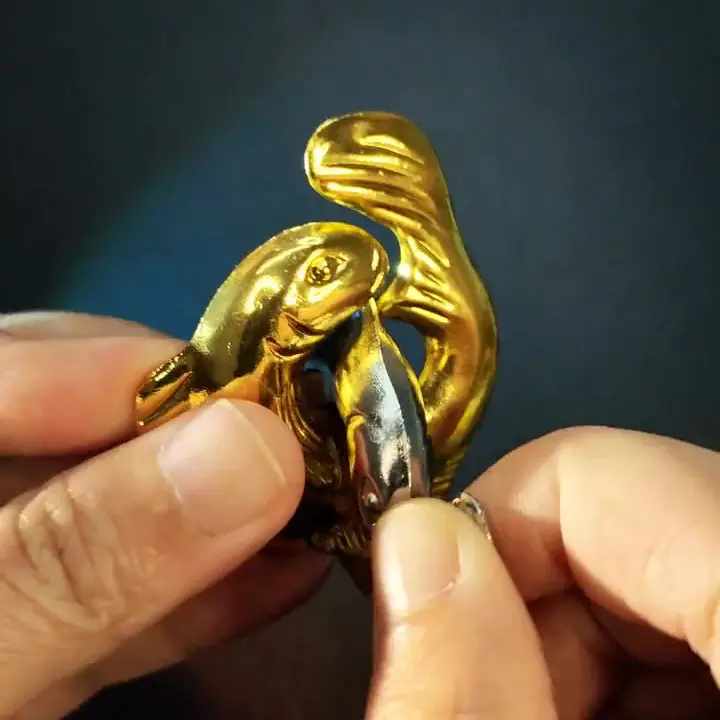
Show Image Hold the gold fish firmly in your right hand. It stays stationary throughout the first phase.
With the puzzle facing you in its natural orientation (both fish heads visible, tails curving upward), grip the gold fish securely with your right hand. Your thumb and index finger should hold the body — not the tail, not the fins. The gold fish is your anchor. It does not move during the next three steps. All movement comes from the silver fish.
This is counterintuitive for most people, who instinctively try to move both pieces simultaneously. Resist that urge. One piece stays fixed; the other does all the work.
Step 2: Rotate the Silver Fish Downward 90 Degrees
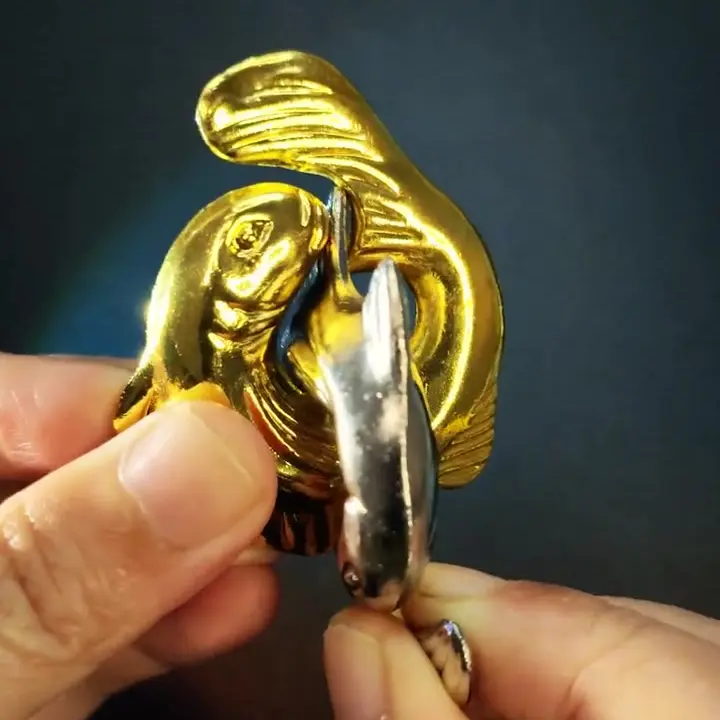
Show Image Pinch the silver fish with your left hand and rotate it downward 90 degrees.
With your left hand, pinch the silver fish’s body between your thumb and forefinger. Now rotate it downward — toward the floor — by 90 degrees. You’ll feel resistance about halfway through. That’s normal. The silver fish’s fin is passing through the gap in the gold fish’s body curve. Keep the rotation smooth and steady. Don’t force it.
At the end of this movement, the silver fish should be hanging roughly perpendicular to the gold fish, pointing downward. The two pieces will feel looser than they did at the start. That’s your first confirmation you’re on the right track.
Step 3: Rotate Counterclockwise 180 Degrees
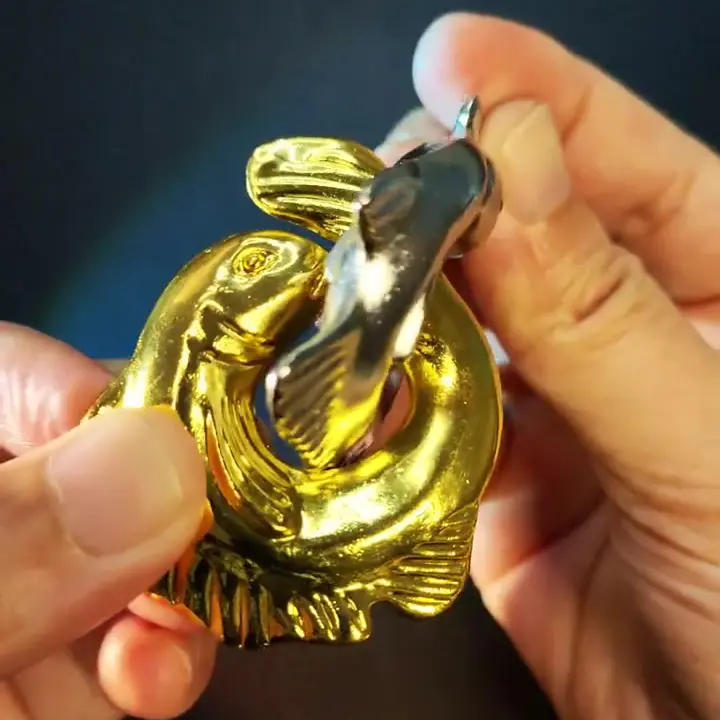
Show Image Continue rotating the silver fish counterclockwise 180 degrees around the connection point.
This is the critical move. From the 90-degree-down position, continue rotating the silver fish — but now in a counterclockwise sweep — through a full 180 degrees. The silver fish swings from pointing down, through a horizontal position, and up to the right side. During this arc, the silver fish’s body passes through the only opening in the gold fish’s geometry that allows full clearance.
The motion should feel fluid. If you hit a hard stop, you’ve either started from the wrong angle in Step 2 or you’re rotating in the wrong direction. Back up and try again. The correct path has consistent mild resistance throughout — never a sudden block.
Step 4: Position Head to Head, Tail to Tail
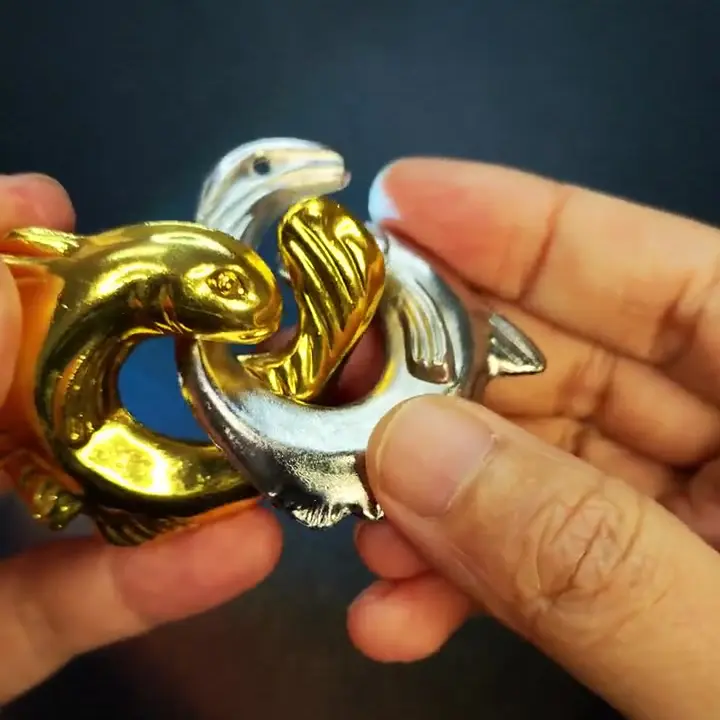
Show Image The two fish are now arranged head-to-head and tail-to-tail, lying side by side.
After the 180-degree rotation, lower the silver fish to the right side. You should now see both fish lying roughly in the same plane, arranged head-to-head and tail-to-tail. They’re still connected at the center — the curved hooks are still interlocked — but the geometry has fundamentally changed. The fish that were embracing each other are now facing opposite directions, like a yin-yang symbol laid flat.
Step 5: Spatial Displacement — The Final Rotation
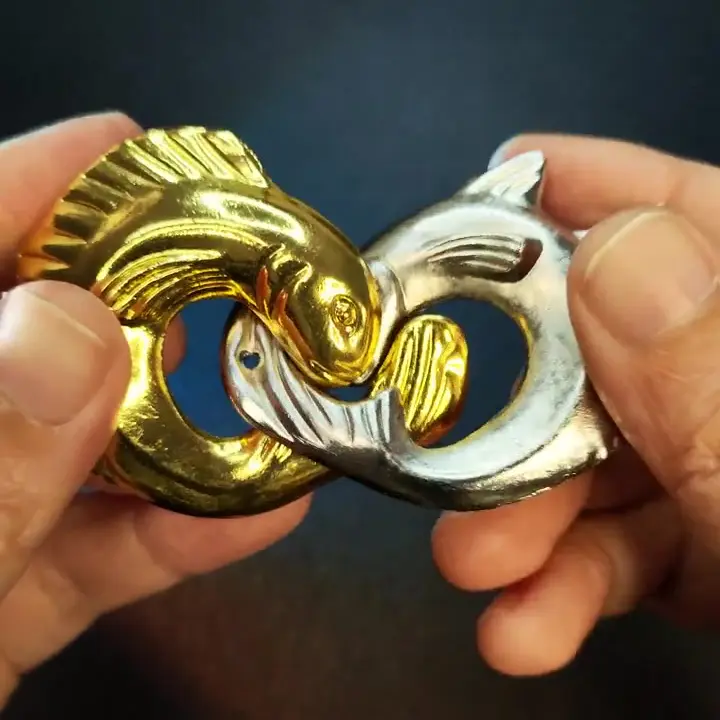
Show Image Using the connection point as the center pivot, rotate both pieces using the spatial displacement method.
Now, using the connection point as your center pivot, apply the spatial displacement rotation. Hold one fish in each hand and rotate them like opening a book — each piece sweeps outward in opposite directions. The interlocking hooks slide through each other’s openings as the pieces rotate in the plane. You’ll feel the moment the geometry clears: a sudden looseness, a slight drop in resistance.
Step 6: Separation
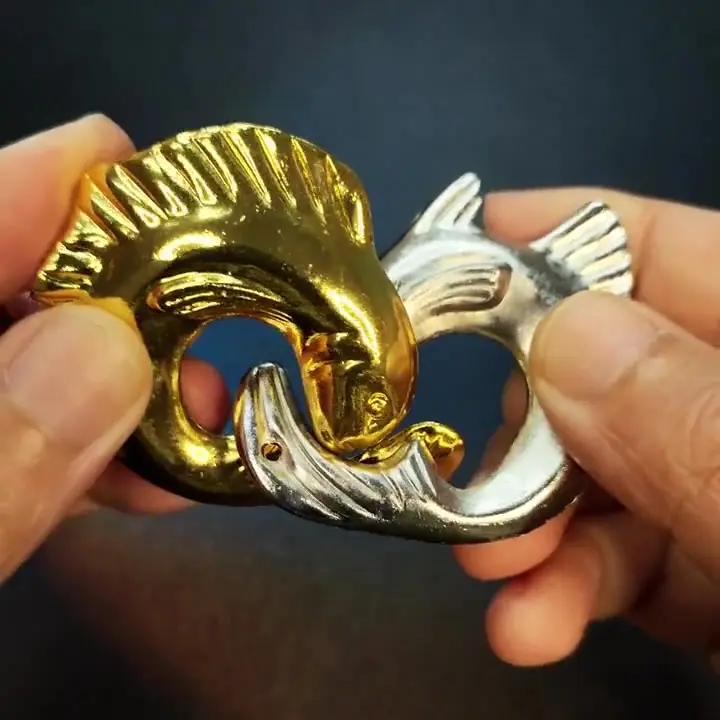
Show Image The two fish come apart — gold and silver, fully separated.
The two fish slide apart. Each piece, now isolated, reveals its full shape: a complete fish form with a circular opening through its body where the other fish used to sit. The gold fish and the silver fish, freed from their embrace, each look like a small metallic sculpture — a ring with fins.
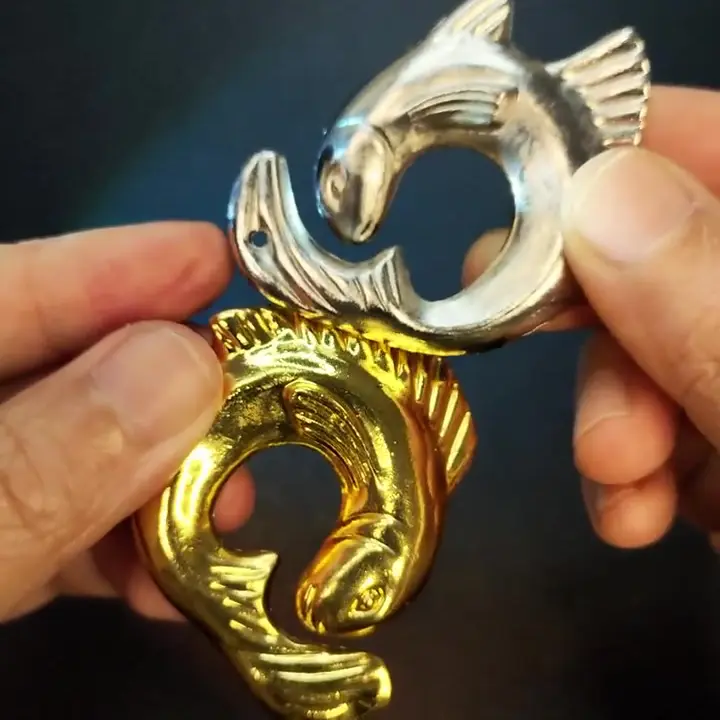
Show Image The solved state: two individual fish pieces, each with a distinctive C-shaped opening.
Reassembly: The Harder Challenge
Separating the fish is the first puzzle. Putting them back together is the second — and many solvers find it significantly harder. The reassembly follows the solution steps in reverse, but without the tactile memory of the separation path, you’re essentially solving a new puzzle. My advice: reassemble immediately after your first successful separation, while the movements are still fresh in your muscle memory. Wait a day, and you’ll likely spend another hour figuring it out.
The trick to reassembly is starting from Step 5 in reverse. Position the two fish side by side, head-to-head, and thread the hooks through each other using the same rotational plane. Then work backward through the counterclockwise rotation (now clockwise) and the 90-degree lift (now a 90-degree tilt).
Why This Puzzle Rewards Patience Over Force
Cast metal disentanglement puzzles operate on a principle that cognitive scientists at institutions like MIT’s Department of Brain and Cognitive Sciences have studied extensively: spatial reasoning under constraint. Unlike jigsaw puzzles, which reward pattern recognition, or logic puzzles, which reward deductive reasoning, disentanglement puzzles demand a specific kind of three-dimensional mental rotation that most adults rarely practice.
Research published by Vanderbilt University’s Spatial Cognition Lab suggests that regular engagement with spatial manipulation tasks — including physical puzzles — improves performance on standardized spatial reasoning assessments by measurable margins. The gold and silver fish puzzle, with its compound rotational solution, exercises precisely this cognitive skill.
The puzzle also teaches an important meta-lesson about problem-solving: the most obvious path is often wrong. That tail gap that beckons you during your first attempt? It’s a designed trap — a mechanical illustration of confirmation bias. You see an opening, assume it’s the exit, and commit to a strategy that leads nowhere. Solving the puzzle requires abandoning your first hypothesis entirely and approaching the geometry from an angle you hadn’t considered.
Who This Puzzle Is Actually For
The fish design and approachable size make this puzzle look like a casual desk toy. It is not. The mechanism sits at what I’d estimate as a moderate difficulty level for experienced puzzle solvers — roughly 15 to 45 minutes for a first solve without hints. For someone who’s never handled a cast metal disentanglement puzzle, expect to spend an hour or more, potentially across multiple sessions.
It works well for teenagers and adults with patience for trial-and-error problem-solving. I’ve watched it circulate through an office and noticed a pattern: engineers and musicians tend to solve it faster than average, possibly because both disciplines train spatial-sequential thinking. People who approach it with brute force give up fastest.
As a gift, it hits a sweet spot. The two-tone gold and silver finish looks deliberate and premium — this doesn’t read as a cheap novelty. The fish motif carries positive symbolism in multiple cultural traditions (prosperity in Chinese culture, abundance in Japanese culture), which gives it a layer of meaning beyond the mechanical challenge. At roughly the same price point as a nice candle or a paperback book, it delivers far more engagement per dollar.
Who Should Not Buy This Puzzle
I want to be direct about this:
If you have limited patience for open-ended challenges with no instructions, this will frustrate you. There’s no step-by-step guide in the box. The puzzle expects you to figure it out through experimentation, and that process can feel aimless for people who prefer structured problem-solving.
If you need instant gratification from your downtime activities, pass on this. The average first-solve time is measured in tens of minutes, not seconds. Some people spend days.
If you’re buying it for children under twelve, reconsider. The small size and metal construction make it inappropriate for young children, and the cognitive demand exceeds what most pre-teens find enjoyable. Teenagers fourteen and up are the youngest demographic I’d recommend.
The Mechanism Behind the Beauty
The two-fish design belongs to a broader family of cast metal puzzles that use what puzzle taxonomists classify as rotational disentanglement — a subset of mechanical puzzles where the solution requires rotating pieces through specific angular sequences rather than sliding, pulling, or flexing them. This distinguishes them from wire disentanglement puzzles (which rely on threading through loops) and from sequential-movement puzzles (which require specific ordered steps like lock-picking).
The material choice matters. Zinc alloy casting allows for the precise tolerances that make the puzzle work. If the curves were even half a millimeter wider, the puzzle would have multiple solutions — or worse, pieces that separate too easily and rattle loosely when locked. The casting process also enables the detailed fish sculpting (scales, fins, eyes) that makes each piece feel like a small work of art rather than an abstract geometry exercise.
The gold and silver electroplating adds roughly 5–10 microns of finish over the base alloy. That’s thin enough to not affect the puzzle’s tolerances but thick enough to provide distinct visual tracking during solving — and to resist tarnishing during the hundreds of manipulations a dedicated solver will put it through.
A Note on the “Peking University Exam” Claim
You’ll encounter a popular claim that this puzzle (or a variant of it) was used as an entrance exam question at Peking University. I cannot verify this claim through any published academic source. What I can say is that disentanglement puzzles have a documented history in Chinese educational contexts — the Nine Linked Rings puzzle, for instance, involves binary counting principles that were studied by Chinese mathematicians as early as the Song Dynasty. Whether this specific fish puzzle appeared in any university’s admissions process remains an appealing but unconfirmed story.
What is verifiable: cast metal puzzles of this type are used in cognitive assessment research. A 2019 study from the University of Tokyo’s Graduate School of Education examined how puzzle-solving performance correlates with executive function in adults, finding that success on rotational disentanglement tasks predicted performance on novel problem-solving challenges better than traditional IQ measures.
Comparing Puzzle Types: Where Do the Double Fish Fit?
Metal brain teasers span a wide spectrum. Wire disentanglement puzzles — the bent-nail and horseshoe-ring type you find in novelty shops — operate on simpler principles and typically require fewer moves to solve. They’re excellent entry points for beginners. Cast metal puzzles like the gold and silver fish sit higher on the complexity scale, using three-dimensional geometry rather than two-dimensional wire paths.
Sequential lock puzzles, like the Three Brothers Lock or grenade-style mechanism puzzles, represent yet another category — they require discovering and executing a specific ordered sequence of moves, often involving hidden catches and spring-loaded elements. These tend to be harder but also more mechanical in nature, rewarding systematic exploration.
The fish puzzle occupies an interesting middle ground. It’s not as purely logical as a sequential lock, but it’s more spatially demanding than a wire disentanglement. If you’ve solved basic wire puzzles and found them too easy, the gold and silver fish are a natural next step. If you’ve been stumped by sequential locks and want something more approachable, the fish offer a challenge that’s difficult but never cruel.
For those who enjoy collecting puzzle types across the spectrum, Tea Sip’s metal puzzle collection provides a range from entry-level wire designs to expert-level lock mechanisms. The Snake Mouth Escape Puzzle makes a particularly good companion to the fish — similar price point, different mechanism type, and a complementary aesthetic that looks striking displayed together.
Care, Display, and Long-Term Durability
The zinc alloy base is resistant to corrosion under normal indoor conditions. I’ve been handling mine daily for testing purposes and see no wear on the plating where fingers contact the metal. The gold finish shows fingerprints more readily than the silver; a quick wipe with a microfiber cloth restores the shine.
For display, the locked position is more visually interesting than the separated state — the two fish intertwined suggest movement and tension that works well as a desk object. Some owners use a small acrylic stand (sold separately by various retailers) to elevate the puzzle and show off the three-dimensional form.
Don’t leave it in direct sunlight for extended periods. The alloy won’t degrade, but the plating color can shift slightly under prolonged UV exposure. A drawer or shelf away from windows is ideal for long-term storage.
Frequently Asked Questions
How long does it take to solve the gold and silver fish metal puzzle for the first time? Most first-time solvers report anywhere from 20 minutes to several hours. The average sits around 30–45 minutes for someone with moderate puzzle experience. Complete beginners may take significantly longer. The video solution can be completed in under two minutes once you know the steps, but discovering those steps independently is the real challenge — and the real fun.
Can I solve the fish puzzle without a solution guide? Absolutely. The puzzle is designed to be solved through experimentation and observation. Look for the widest clearance points between the two fish bodies, test rotational movements rather than linear pulls, and pay attention to which directions feel less resistant. The solution is mechanical, not trick-based — there are no hidden buttons, springs, or magnets.
Is the gold and silver fish puzzle suitable as a gift? It’s one of the strongest gift choices in the cast metal puzzle category. The fish motif reads as thoughtful rather than generic, the two-tone finish looks premium, and the difficulty level is accessible enough that most recipients will eventually solve it (with persistence). It works well for birthdays, holidays, and “thinking of you” occasions.
What age group is this puzzle appropriate for? I recommend it for ages fourteen and up. Younger teens may enjoy it with adult supervision, but the small size and moderate difficulty make it less suitable for children under twelve. For younger kids, simpler wire-based disentanglement puzzles offer a more age-appropriate entry point.
How does this compare to other cast metal fish puzzles on the market? The gold and silver double fish uses a rotational disentanglement mechanism. Other fish-themed metal puzzles on the market use different approaches — some are wire-based, some use a ring-removal mechanism, and some are multi-piece assembly puzzles. The double fish is distinctive for its two-piece interlocking design and the aesthetic quality of its cast finish.
Will the gold plating wear off with heavy use? The electroplated finish is durable under normal puzzle-solving conditions. After several weeks of daily handling during my testing, I observed no visible wear. The plating may show micro-scratches under magnification over many months, but this actually enhances the patina rather than detracting from it.
What’s the best strategy if I’m completely stuck? Put it down. Seriously. Spatial puzzles benefit enormously from incubation — the unconscious processing your brain does while you’re doing something else. Many solvers report their “aha moment” coming after they’ve set the puzzle aside for a few hours or overnight. When you return, try movements you haven’t tried before, particularly rotations rather than linear pulls.
Can this puzzle be used for educational purposes? Yes. It’s an effective tool for teaching spatial reasoning and three-dimensional thinking in informal educational settings. Some STEM educators use cast metal puzzles as warm-up activities to prime students for geometry and engineering concepts.
Does the puzzle come with a solution? Tea Sip’s version does not include a printed solution, which is standard for this category of brain teaser. The step-by-step guide in this article, complete with photographs from a solution demonstration, provides the most detailed English-language walkthrough currently available.
What material is the puzzle made from? The base material is zinc alloy (zamak), die-cast into the fish shapes and then electroplated — gold tone on one fish, silver tone on the other. Zinc alloy is the industry standard for cast metal puzzles because it allows precise tolerances, takes plating well, and provides satisfying weight without being overly heavy.
The Verdict
The gold and silver double fish puzzle is one of those rare objects that works on multiple levels simultaneously. As a mechanical challenge, it’s genuinely clever — the rotational disentanglement solution rewards spatial thinking in a way that feels fair rather than arbitrary. As a physical object, it has the weight and finish quality of something you’d display rather than toss in a drawer. As a conversation piece, the two intertwined fish provoke questions from anyone who spots them on your desk.
I keep mine assembled on my workspace, partly because the locked form looks better than the separated pieces, and partly because I enjoy handing it to visitors and watching them make the same mistake I did — pulling toward the tail gap, feeling the false promise of progress, and slowly realizing they need to rethink their entire approach.
That moment of realization is the puzzle’s real gift. Not the mechanical solution, but the cognitive shift required to find it.
The gold and silver fish puzzle is available at Tea Sip for $13.99 with worldwide shipping.