Before You Twist: The Mindset That Unlocks the Cube
Look at the 3×3 cube in your hands. All those colors, hopelessly mixed. It feels impossible, doesn’t it? I know that feeling. I spent years believing the Rubik’s Cube was a mechanical puzzle for geniuses—until one day, on a long, boring commute, I decided to try one more time. The moment that final corner clicked into place, with a solid snap, I didn’t feel like a genius. I felt like I had just unlocked a door I’d been knocking on for ages. That’s the feeling we’re after today: not speed, but dawning comprehension.
First, let’s demystify the object itself. This is the single most important concept you’ll learn: The center pieces do not move relative to each other. Look at your scrambled cube. Find any center square. Notice how it’s attached to the core? The white center is always opposite the yellow, red opposite orange, and blue opposite green. These six fixed anchors are your true north. Every solve starts by trusting these centers. You’re not just moving colored stickers; you’re guiding moving pieces—the edge pieces (with two colors) and corner pieces (with three colors)—back to their correct homes around these fixed centers.
Think of it this way: The cube is a busy apartment building. The centers are the building’s structural pillars, unmovable. The edges and corners are the tenants. Your job is just to get everyone back to their correct apartment. That’s it.
Now, about those 43 quintillion possible permutations. That staggering number, dreamed up by inventor Ernő Rubik in 1974, is meant to overwhelm you. But here’s the secret: every single one of those states can be navigated back to solved with a learnable system. You are not facing randomness. You are learning a path.
Two big questions probably just popped into your head. Let’s answer them.
“Do I have to be good at math to solve a Rubik’s cube?”
Not at all. You need pattern recognition and a bit of procedural memory—like learning the steps to tie your shoes or make a favorite recipe. It’s a skill for your hands as much as your brain. If you’re feeling mentally blocked, sometimes approaching a different type of puzzle, like how to solve a puzzle cube without losing your mind, can build the right problem-solving mindset.
“How long does it take to learn to solve for the first time?”
For most people following a clear beginner method, it takes a few focused hours spread over several days. Your first complete solve might take 5, 10, even 20 minutes. And that’s perfect. Speed is a story for another day. Today is about completion.
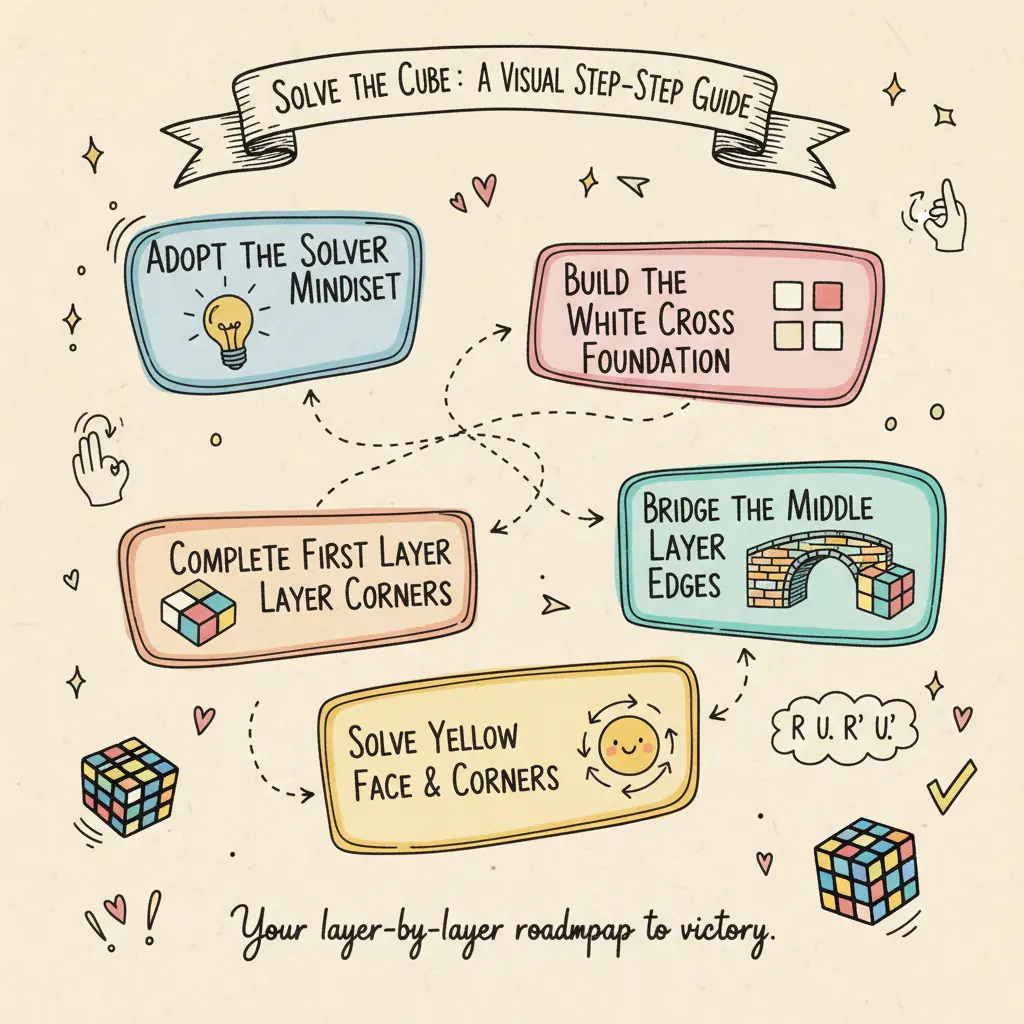
This journey has a clear emotional map. Right now, you’re at Defeat (scrambled cube). By the end of this guide, you’ll land on Triumphant Elation. The bridge between them is built on small, logical wins. We’ll use the most common road map for a first-timer: the layer by layer method. It breaks the monumental task into seven manageable stages, starting with a white cross.
You are not memorizing a magic trick. You are learning a tangible skill. And you can absolutely do this. Let’s start by learning the universal language that will tell your hands exactly what to do next.
The Cube’s Alphabet: Learning to Read (and Speak) R U R’ U’
You’ve just learned the most important thing about your 3×3 cube: the centers are anchors. That’s a huge win. Now, how do we turn that knowledge into action without getting lost in a sea of “turn this, then that”? We need a simple, universal language—a recipe card for your hands. That language is called cube notation.
Think of it this way: you wouldn’t bake a cake by following instructions that say “twisty-thing move” and “flippy-bit over there.” You need precise, clear terms. Cube notation is exactly that. It looks cryptic at first—just a string of letters like R U R’ U’—but in five minutes, it will feel like reading a simple dance for your fingers. This is the alphabet that every algorithm (our word for a memorized sequence of moves) is written in.
Here’s the entire basic alphabet. Hold your twisty puzzle so one face is pointed at you.
- F = Front face (the one facing you) – Turn it clockwise 90 degrees.
- B = Back face (the one opposite you) – Turn it clockwise.
- R = Right face – Turn it clockwise.
- L = Left face – Turn it clockwise.
- U = Up face (the top) – Turn it clockwise.
- D = Down face (the bottom) – Turn it clockwise.
“Clockwise” always means from the perspective of looking directly at that face.
But what if you need to turn a face the other way? That’s where the apostrophe ( ’ ) comes in. It’s pronounced “prime” and simply means counter-clockwise.
- R’ = Right face, turned counter-clockwise.
- U’ = Up face, turned counter-clockwise.
Finally, a number 2 after a letter means turn that face 180 degrees (a half-turn).
- F2 = Front face, turn it halfway around.
Now, let’s speak our first word. This is the most important trigger move you’ll learn today. Pick up your cube. We’re going to do the sequence R U R’ U’.
- R: Turn the Right face up (clockwise).
- U: Turn the Up (Top) face to the left (clockwise).
- R’: Now turn the Right face down (counter-clockwise, reversing the first move).
- U’: Finally, turn the Up face back to the right (counter-clockwise, reversing the second move).
Do it slowly. Feel the rhythm: R (up), U (left), R’ (down), U’ (right). What’s happening here is that you’re cycling three corner pieces around the top layer without disturbing the all-important center pieces. This little four-move sequence is a fundamental building block of the beginner method—it’s the core of inserting first layer corners and fixing second layer edges. Practice it a few times until your fingers start to remember the pattern. (Yes, this is the start of muscle memory!)
This notation isn’t a barrier; it’s a superpower. Instead of describing “take the top-right-front corner and move it around the…” we just say the algorithm and our hands know what to do. Every single step by step instruction in the guide that follows will use this clear, concise language. You are now fluent in the first phrase of Cube-lish. With this tool in hand, we’re ready to build our foundation: the iconic white cross.
The Big Picture: Your Layer-by-Layer Roadmap to Victory
Now that your hands know a phrase of Cube-lish, let’s see the whole conversation. You’ve felt the mechanics, and you know the language. What’s next? The strategy. The goal isn’t to solve 54 stickers; it’s to build the cube back up, one stable layer at a time.
Think of it this way: your scrambled 3×3 cube is a chaotic building. We’re not going to try to fix all the windows at once. Instead, we’ll construct a solid ground floor (the first layer), then add a perfectly aligned second floor (the second layer), and finally cap it all off with the roof (the last layer). This is the layer by layer method, the most reliable path for your first solve. Here is your seven-step roadmap to victory:
- The White Cross: We’ll start by getting the four white edge pieces around the white center piece, forming a ‘daisy,’ then snapping them down to align with the side centers. This is your foundation.
- White Corners & First Layer: Using that trusty R U R’ U’ move you just practiced, we’ll place the four white corner pieces to complete the entire white face and the first ring of colors around it. Your first layer is done.
- Second Layer Edges: Next, we’ll insert the four middle edge pieces—the ones that belong between the first and last layers—using a mirrored pair of algorithms. Now two-thirds of the cube is solved and stable.
- The Yellow Cross: On the unsolved top (yellow) face, we’ll form a yellow cross. This doesn’t worry about where the yellow edges are yet, just that they are facing up.
- Positioning Yellow Edges: Once we have the cross, we’ll slide those yellow-edged pieces into their correct spots around the yellow center.
- Placing Yellow Corners: We’ll then move the final four corner pieces into their correct locations (though they might be twisted wrong).
- Orienting Yellow Corners: The final turn! We’ll twist those last corners into place, completing the puzzle.
Why start with white? You don’t have to—you can start with any color. But every beginner method guide does, so we all speak the same visual language. The white side is simply our agreed-upon “bottom” for this lesson. By solving it first and putting it on the bottom, we have a clear, unmoving foundation to build upon.
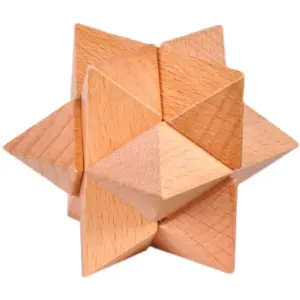
The most important thing to understand about this step by step process is that each stage preserves the work you’ve already done. The moves for the second layer won’t wreck your finished first layer. The last layer algorithms won’t scramble the two layers below. It’s a system, not a series of desperate, hope-for-the-best twists. That daunting final scramble? It’s not magic; it’s just the logical conclusion of this system. Stick with the steps, trust the process, and that final, triumphant click is inevitable. For a different perspective on breaking down a complex puzzle into layers, you can see this logic applied to a different type of cube in our guide on cracking a wooden cube puzzle solution.
Step 1: Building Your Foundation – The White Cross
Now you understand the roadmap. It’s time to pick up the cube and take your first real, physical step. This is where hope turns into a tangible result. You’re going to build the famous white cross, the universally recommended starting point for the beginner method.
Think of this step as setting the four cornerstones of a building. We’re not just getting white stickers around the white center. We must also match the side color of each white edge piece with the center piece of the adjacent face. A solved white cross looks like a white plus sign on the white face, with each arm perfectly aligned to the red, blue, orange, and green centers.
To get there without getting overwhelmed, we use a clever intermediary pattern: the Daisy. A Daisy is a yellow center with the four white edges surrounding it. It’s purely a visual helper to get all the white edges to the top layer, facing up, where we can easily see and work with them.
Your Action Plan:
Make the Daisy: Hold your cube with the yellow center on top. Now, look around the middle layer (the equator of the cube) for white edge pieces. When you find one, turn the middle layer to bring it up to the top, next to the yellow center. If a white edge is on the bottom layer, turn the bottom layer to position it directly below an unsolved daisy petal spot, then turn that side 180 degrees to bring it up. Keep going until you have four white edges (forming the petals) around the yellow center.
Transform Daisy to Cross: Here’s the visual logic. Look at one of your white daisy petals. Notice the other color on that edge piece. Let’s say it’s a white-and-red edge. Now, look at the middle layer. Turn the top layer until the red side of your white-red petal is directly above the red center piece. Now, hold the cube so that red center is facing you. Turn the front face 180 degrees. The white petal will drop down and snap into place, perfectly aligned between the white center (now on bottom) and the red center (on the front).
What’s happening here is simple: you’re sending each white edge home. Its home is between its two centers. You just used the fixed centers as your anchor points. Repeat this for the green, orange, and blue petals. Turn the top to align an edge’s side color with its matching center, then hold that center face toward you and give it two solid clicks down. When you’re done, flip the whole cube over. You should see a perfect white cross on the bottom, with each arm touching its matching colored center on the sides.
Troubleshooting: “My white edge is stuck in the wrong spot!”
This is the most common “oh no” moment here. Don’t panic—nothing is broken. You might find a white edge piece already in the bottom layer, but flipped wrong (white is on the side, not the bottom), or in the correct spot but with the side colors mismatched. The fix is the same: we need to get it out so we can put it back in correctly.
Hold the cube so the misplaced white edge is on the bottom layer in the front-right position. Now, perform this little lift-and-replace move: R U R’. That’s Right face up, Top face right, Right face down. Watch that piece. It will get ejected from the bottom layer and pop up to the top, becoming a new daisy petal. Now you can align it properly with its side center and send it home with a 180-degree turn. This R U R’ sequence is your first real algorithm—a reliable move that produces a specific, useful result. You’ll use this “ejection” idea again and again.
This step might feel a little fiddly, but it’s pure pattern-finding, not memorization. You are teaching your hands and eyes how the pieces move. When that white cross finally clicks into place, solid and correct, that’s your first real win. It’s no longer a scrambled block; it’s a puzzle with a solid foundation. Take a second to appreciate it. Then, flip the cube over and let’s build the first full layer on top of that foundation.
Step 2: Filling in the Corners – Completing Your First Full Layer
Flip that cube over. Your beautiful white cross is now on the bottom, acting like the solid foundation of a house. Your white centers are fixed, and the four colored arms of the cross are neatly aligned with their side centers. This is your base camp. Now, we’re going to build the entire first floor—the first full layer—by placing the four white corner pieces into their homes right above the cross.
Each white corner piece has three colors: white plus two others. Your job is to find each one and slot it into the spot where its three colors match the three face centers (white on bottom, and the two side colors). Think of it like making a perfectly layered sandwich: the bread (white) goes on bottom, and the specific fillings (the two side colors) need to be in the correct order.
Here’s the wonderful part: you can do this whole step with one fundamental trigger move and its mirror image. This is the heart of how to solve a Rubik’s cube without memorizing much. You’re not learning four new things; you’re learning one pattern and seeing how it works from different angles.
The Core Move: The Right-Hand Trigger (R U R’ U’)
This sequence is the Swiss Army knife of beginner cubing. You already used part of it (R U R’) to eject a bad edge in the last step. Now we’ll use the full version. Let’s break down what it does: It takes a corner piece from the top layer, tucks it into the bottom-right front position, and then returns the top layer. Practically, it’s our primary tool for inserting a corner.
Here’s how we use it. We’ll always be looking at the top layer for our white corners.
- Find a white corner piece on the top layer. Look at its two non-white colors.
- Turn the top layer (U) until that corner is positioned above its “home” on the bottom layer. Its home is the spot directly between the two side centers that match its two non-white colors. For example, if your corner piece has white, red, and blue, its home is the front-right-bottom slot, between the red and blue centers.
- Hold the cube so the corner’s home is in the front-right-bottom position. The white face (your cross) stays on the bottom.
- Now, look at the white sticker on your corner piece. It can be in one of three positions on the top layer:
- Case A: White sticker is on the RIGHT side of the cube. Perform the move: R U R’. That’s it. The corner should pop right into place.
- Case B: White sticker is on the FRONT face. Perform the move: U’ R U R’. This rotates the corner into the “white on right” position and then inserts it. (Think of it as “set up, then do Case A”).
- Case C: White sticker is on the TOP. This one needs the full trigger. Perform: R U R’ U’ — and then do it one more time: R U R’ U’. Two full repetitions of the trigger will seat the corner perfectly.
What’s happening here is beautiful: you are using a reliable, repeating cycle of moves to maneuver one piece into its spot without messing up your precious white cross. The moves are designed to temporarily move other pieces out of the way and then bring them back.
Troubleshooting: “My corner is in the bottom but it’s twisted wrong!”
Don’t panic. This is the most common “oh no” moment in this step. If a white corner is sitting in its correct spot (between the right centers) but the white sticker is not on the bottom, you need to eject it back to the top to try again. Remember our ejection move from Step 1? Hold the cube so the messed-up corner is in the front-right-bottom spot and do R U R’. It will come back up to the top layer. Now you can reposition it using one of the three cases above.
Work through each white corner piece on the top layer one by one. Sometimes, all four white corners will already be on the top. Sometimes, one might be hiding in the bottom layer but twisted wrong (use the ejector!). Just be patient and methodical.
When you slot in that final corner and look at the cube from the side, you’ll see a complete, pristine white layer with a band of solved color all the way around. This is your Confidence Boost. You haven’t just placed some stickers; you’ve solved one-third of the entire 3×3 cube. It’s a tangible, solid victory. Give the top layer a spin and admire your work. You’ve mastered the logic of positioning corner pieces relative to fixed center pieces.
This first layer is proof you can do this. You’re not just twisting randomly; you’re building. Now, let’s use that confidence to tackle the second layer.
Step 3: The Bridge – Solving the Second Layer’s Edges
Look at that solid first layer. It’s proof you can command this mechanical puzzle. Now, we build the bridge. Our goal here is to solve the four edge pieces of the second layer, creating a complete middle band between your white bottom and the unsolved top. This is where many solvers hit a wall, and that’s perfectly okay. We’re moving from intuitive placement into your first real, repeatable algorithm. Think of it less as memorizing code and more like learning a simple dance for your fingers—a pattern that moves pieces in a predictable, useful way.
First, the big picture: we will only work with the four edge pieces that belong in the middle layer (they have NO white or yellow on them). Find one on the top layer. Look at its two colors. Your job is to line it up so its top color matches the center piece of the face it’s touching. This creates a “T” shape.
Now, you have a choice: does this edge need to slot into the second layer to your left or to your right? Your move depends on the answer. This is your first real ‘if-this-then-that’ decision in your solve.
We’re going to learn two mirror-image moves. They’re built from our friendly ‘ejector’ trigger move (R U R’) and its backwards cousin. They are the backbone of countless step by step instructions.
Case 1: The edge needs to go to the LEFT.
Hold the cube so the edge’s top color is matched to its front face center. The destination for this edge is the front-left slot. The algorithm is: U’ L’ U L U F U’ F’
Let’s break down what’s happening: we’re moving the target slot up out of the way, bringing the edge down, and then tucking everything back into place. (Yes, this feels fiddly the first few times—stick with me.)
Case 2: The edge needs to go to the RIGHT.
Again, match the top edge color to the front face center. This time, the destination is the front-right slot. The algorithm is: U R U’ R’ U’ F’ U F
See the symmetry? It’s the same idea, just mirrored. Practice this one a few times on its own. Do R U R’ U’ a few times—that’s the core of it—and you’ll see how it gently guides an edge piece from the top layer into the side.
Your process:
1. With white on bottom, find a top-layer edge with NO yellow.
2. Rotate the entire top layer (U) to match that edge’s side color to its center, forming the “T.”
3. Look at the edge’s top color. Look at the center piece on the front face. Do they match?
4. If YES: The edge is lined up. Now, look at the top color again. Is it the same as the center piece on the LEFT face or the RIGHT face? That tells you which algorithm to use.
5. Execute the correct algorithm. The edge will slide perfectly into place in the second layer.
6. Repeat for the other three non-yellow edges.
🚧 Troubleshooting the Second Layer
What if the edge I need is already in the second layer, but it’s in the wrong spot or flipped?
This is the most common “oh no” moment. Don’t panic. You can’t slot a new piece into a space that’s occupied. The fix is simple: you need to evict the incorrectly placed piece first. How? Use either of the two algorithms above to take that piece out and put it back up into the top layer. It doesn’t matter which one you use—just perform the algorithm that would slot a piece into that specific slot. Out it pops! Now you have a solvable edge on top again, and you can proceed.
This step requires Frustration/Patience. You will lose your place. You might put a piece in backwards. That’s all part of the learning. Your hands are learning a new language. Focus on the logic: find a piece, line it up, send it home. One by one, the middle band will fill in.
When you finish, you’ll have a solved white face and two pristine solved layers—a massive chunk of the cube. You’ve just completed what speedcubers call the First Two Layers, or F2L. This bridge is sturdy. Take a breath. The final layer awaits, and with it, your Breakthrough. For more insights on moving pieces systematically between layers, you might appreciate a real-world wooden block puzzle cube solution that uses similar logical principles.
Step 4 & 5: The Yellow Face Breakthrough
Look at your cube now. Two full, pristine layers are solved, a testament to your patience and growing skill. The unsolved chaos is now isolated to just that final, stubborn yellow face—the last layer. This is your Breakthrough moment. Where before you saw impossible complexity, you can now see a clear, two-step finish line: first, make a yellow cross, then get those yellow edges into their correct spots. These steps are the heart of the beginner method for the last layer.
Think of it this way: you built the foundation (white cross), the walls (first layer corners), and the second floor (second layer edges). Now, you’re putting on the roof. And just like a roof, you frame it first (the cross), then you shingle it (the edges and corners). We’ll handle the cross and edge positioning here. The final corner steps come next.
First, a vital, calming fact: There is no unsolvable “parity” on a standard 3×3 cube. If you follow the steps and your cube is mechanically standard, the solution will appear. The fear that you’ve broken it somehow is universal. You haven’t. Trust the system.
Step 4: Creating the Yellow Cross
Your goal is to transform the yellow face from any pattern of yellow edges into a plus sign, ignoring the yellow corners for now.
1. Diagnose Your Yellow Face.
Look only at the yellow center and the four edge pieces around it. You will see one of three patterns:
* Dot: No yellow edges are facing up (just the yellow center).
* “L” Shape: Two yellow edges form a small “L” in one corner.
* Line: Two yellow edges form a straight line across the middle.
2. Apply the “Yellow Cross” Algorithm.
This is your first algorithm for the last layer, and it’s a powerful one. It uses a trigger move you already know from the second layer (R U R' U') but bookends it with two F moves.
Hold your cube so the yellow face is UP. Perform this sequence:F R U R' U' F'
F: Turn the Front face clockwise (toward you).R U R' U': Perform the familiar trigger move.F': Turn the Front face counter-clockwise (away from you).
3. The Process:
* If you have a Dot, do the algorithm once. You will now have an “L” Shape. Rotate the entire cube (keeping yellow on top) so the “L” is in the top-left corner (like a backwards 7). Do the algorithm again. You should now have a Line. Rotate the cube so the line is horizontal. Do the algorithm a third time. Yellow cross achieved.
* If you have an “L” Shape, rotate the cube to position it in the top-left corner. Do the algorithm once. You’ll likely get a Line. Rotate the line to horizontal and do the algorithm once more. Cross achieved.
* If you have a Line, just rotate it horizontal and do the algorithm once. Done.
What’s happening here? The F move brings an unsolved yellow edge into play from the front. The R U R' U' trigger shuffles it into the correct orientation on the top, and the F' move completes the setup. You’re not randomly twisting; you’re systematically cycling yellow edge pieces into an upward-facing position.
🚧 Troubleshooting the Yellow Cross
What if my cross looks right but the side colors of the edges don’t match the centers below?
Perfect! That’s exactly what we expect. The cross is only oriented (yellow side up), not positioned. Positioning is Step 5. You’re right on track.
Step 5: Positioning the Yellow Edges
Now you have a yellow plus sign, but the arms of the plus likely don’t line up with the side centers. Your goal is to swap these edge pieces around the yellow center until each one sits between its two matching side centers (e.g., the yellow-red edge sits between the red and yellow centers).
1. Check for a “Good” Arm.
Rotate the entire top layer (U) and look at the side colors of your yellow cross edges. You need to find a position where at least one of the four arms has its side colors matching the centers of the two faces it touches. This is a “good” edge in the right spot.
2. Position and Execute.
* Once you have one good edge, hold the cube so that good edge is on the Back face (pointing away from you). The other three edges will need to be cycled.
* Perform this algorithm to rotate the three remaining edge pieces clockwise around the yellow center:R U R' U R U U R' U
Read that carefully: R U R' U R U U R' U. (Note: U U means turn the Up face two times, or 180 degrees). This sequence is longer, but it’s just a series of the simple moves you know. Go slow. Focus on accuracy over speed.
3. Check and Repeat.
After the algorithm, your yellow cross is still there, but the edges have shifted. Check the sides. You should now have all four edges positioned correctly. If not, you might have started with zero “good” edges. If that’s the case, just do the algorithm above once from any position. This will create one good edge. Then position that good edge to the back and do the algorithm a second time.
Congratulations. The yellow cross is not only formed but now locked into its proper place. This is a huge Breakthrough. The yellow face is no longer a mystery; it has structure and order. You’ve mastered the two most common goals people ask about when learning how to solve last layer of Rubik’s cube. The final act—sorting out those four yellow corners—is all that remains between you and a fully solved 3×3 cube. For a more advanced look at navigating complex last-layer scenarios, a veteran’s guide to the puzzle cube can offer deeper strategic insights.
Step 6 & 7: The Final Puzzle – Positioning and Twisting the Yellow Corners
You’ve done it. The yellow cross is perfect, its arms matching the side centers. Now, those four yellow corners are staring back at you, a mix of misplaced and mis-twisted colors. This is the final puzzle within the mechanical puzzle. Take a breath. This phase is pure, focused logic—your determined focus before the final, triumphant click. The final two algorithms you’ll learn are beautiful because they work with you, cycling pieces without wrecking the two solved layers below.
Think of these as the last two chapters of the same book. We’ll tackle them in order:
1. Positioning the yellow corners (getting them into their correct locations around the yellow center).
2. Orienting the yellow corners (twisting them in place so the yellow sticker faces up).
Step 6: Positioning the Yellow Corners (The “Sune” Algorithm)
Look at your corner pieces on the yellow face. Our first goal is to get at least one corner into its correct spot. A corner is in the correct spot if the three colors on it (yellow plus the two side colors) match the three center colors of the faces it touches, even if the yellow isn’t facing up yet.
Check: Do you already have one corner in the correct spot? If yes, fantastic. Hold the cube so that correctly placed corner is in the front-right-top position (the corner closest to your right hand). If no corner is in the right spot, that’s perfectly fine. Just hold the cube any way and proceed—the algorithm will create one for you.
Now, perform this sequence. It has a name among cubers: the Sune.R U R' U R U U R'
Read it slowly: R U R’ U R U U R’. (Remember, U U is a 180-degree turn of the Up face). This is your final new pattern to learn. It will rotate the three corners around the yellow face. Do it carefully.
What’s happening here? This algorithm is a controlled dance. It swaps corners in a triangular cycle on the top layer while carefully preserving the yellow cross and the first two layers. After doing it once, check your corners again. You likely now have one corner correctly positioned. If not, do the Sune one more time from any orientation. Once you have that one good corner, put it in the front-right-top spot and perform the Sune one final time.
Result? All four yellow corners should now be in their correct locations around the yellow center. They may look hopelessly twisted—yellow stickers on the sides—but they are home. This is the last major piece of the layer by layer structure falling into place.
Step 7: Orienting the Yellow Corners (The Final Twist)
Now for the grand finale: making all the yellow stickers face up. For this, we use a gentle, repetitive trigger move you’ve actually seen before. It’s the core of the R' D' R D pattern.
Here’s the plan: We will work on one corner at a time, using a sequence that twists it in place without moving it out of its correct spot. The solved layers will look scrambled during the process, but trust the sequence—it all comes back.
- Hold the cube so the yellow face is Up. Find a corner whose yellow sticker is not on top. Position this “unsolved” corner in the front-right-top spot.
- Now, execute this gentle trigger repeatedly:
R' D' R D. Do it slowly. Watch that front-right-top corner. You will see its yellow sticker “walk” around—from the front, to the right, to the down face, and finally… up. - Here’s the key: Keep doing
R' D' R Duntil the yellow sticker on that specific corner moves to the top face. It may take 2, or even 5 repetitions. Just watch that one piece. - Once that corner is solved (yellow up), here’s the magic: Without rotating the whole cube, turn only the Up (yellow) layer to bring the next unsolved corner into the front-right-top position.
- Repeat. Do the
R' D' R Dtrigger until that new corner is oriented. Then rotate the U layer again to the next unsolved corner. Your first two layers will look like a disaster. This is normal. Do not panic.
Why this works: The R' D' R D sequence only affects the very pieces in the front-right column. By turning the U layer between solves, you are effectively using that same “tool” on each corner, one after the other. When the last corner is twisted into place, every single piece on the cube will snap back to its solved state.
Troubleshooting & Triumph
- What if all corners are positioned but already oriented? You lucky soul, you’re already done! Put the cube down and celebrate.
- What if I get lost during the final
R' D' R Dstep? Pause. Ensure the yellow face is always on top. Ensure you are only turning the U layer to move new corners into position, not twisting the whole cube. The solved white layer at the bottom will be a mess—ignore it. Focus only on fixing one top corner at a time.
And then… it will happen. After orienting that final corner, every side will be a solid color. The 3×3 cube in your hands will be solved.
That feeling—the triumphant elation—is what this is all about. You didn’t perform a magic trick. You learned a tangible skill. You understood a system. You started with a scrambled cube and, piece by piece, layer by layer, you restored order using logic, patience, and a few powerful patterns. This is the complete beginner method. You are now a person who can solve a Rubik’s Cube. To see how these final, precise twists are applied in other intricate puzzles, check out this wooden puzzle cube solution guide.
You Did It! Now, Let’s Do It Again (And Get Faster)
That triumphant elation—the solid colors, the final click—is yours. You held the scrambled chaos and restored order. This is the moment my own cube-frustrated self on that long commute felt a door swing open in my mind. But here’s the secret to making this skill truly yours: don’t stop now.
Scramble it.
Right now. Give it a good, random mix. The 3×3 cube in your hands is no longer a mystery. It’s a system you understand. Solving it a second time immediately is the single best way to cement that layer-by-layer logic from a frantic mental checklist into calm, tactile memory. Don’t aim for speed. Aim for recognition. See if you can spot the pieces you need a little sooner.
Once you can reliably solve it with the beginner method, the path to getting faster—speedcubing—is just about refining these stages. You’re already doing Cross, then First Layer Corners, then Second Layer Edges, then the Last Layer. That’s the skeleton of the most popular speed method, called Beginner CFOP (Cross, F2L, OLL, PLL).
- F2L (First Two Layers): Instead of the cross, then four separate corners, then four separate edges, you learn to pair a corner and its edge in the top layer and slot them down together. It’s more intuitive and cuts your move count almost in half.
- OLL (Orienting the Last Layer): One algorithm to make the entire yellow face, not just the cross.
- PLL (Permuting the Last Layer): One algorithm to position all the last-layer pieces correctly at once.
This is your natural progression. Master one concept at a time.
Practice Tips for Your Hands: Smoothness beats frantic speed. Turn deliberately. As you finish one algorithm, let your eyes start hunting for the next piece you’ll need (“looking ahead”). And that user question, “My cube is cheap and doesn’t turn well—is that why I’m struggling?” The answer is a gentle yes. A modern, magnetic speed cube isn’t about gimmicks; it’s about predictable, fluid movement that lets your brain focus on solving, not fighting the hardware.
The journey from your first solve to your first sub-minute solve is incredibly rewarding. You’re not just memorizing; you’re building pattern recognition in your fingers and eyes. You’re joining a global community that celebrates every personal best, organized by bodies like the World Cube Association. For a broader look at solving guides for various puzzles, our how to solve the puzzle cube guide hub is a great next stop.
So, what’s your next step? Scramble your cube. Solve it again, and this time, notice the flow. Then, maybe, time that second solve. That number is your personal baseline—your starting line for a whole new kind of fun. Welcome to the world of twisty puzzles. If your curiosity for intricate, hands-on challenges grows, you might explore the precision of the best metal puzzles for adults or the beautiful complexity of a crystal Luban lock set deep dive.
Congratulations, solver. You did it.