Before You Force It: The Puzzle Box Mindset
You’re holding a beautifully crafted wooden box. It won’t open. You’ve pushed, pulled, shaken, and maybe even Googled “how to open a puzzle box” in quiet desperation. The urge to grab a thin file or a hammer—like the Redditor who gently pried a drawer loose after some “persuasion”—is real. I get it. But before you resort to force, take a breath. You’re not just opening a box; you’re solving a puzzle, and that requires a shift in mindset.
Puzzle boxes are a subcategory of mechanical puzzles, designed to challenge your logic and dexterity, not your strength. The core philosophy is simple: observation before action, deduction before force. The creator has hidden the solution in plain sight, using seams, sounds, weights, and slight movements as your only clues. Your first job is to become a detective, not a demolition expert.
Broadly speaking, most puzzle boxes fall into two categories, and knowing which you have changes your entire approach:
- Sequential Discovery Boxes (e.g., Japanese Puzzle Boxes): These are the classic, elegant boxes often from places like Hakone, Japan. Opening them requires moving panels in a precise, non-obvious sequence—sometimes 4 moves, sometimes 50. The mechanism is internal and hidden; you can’t see the locks. Success depends on patience, memorizing subtle “clicks,” and moving pieces in the correct order and direction. It’s a meditative, step-by-step process.
- Trick Mechanism Boxes: These boxes open via a single, clever hidden action. Common tricks include:
- Gravity Locks: You must tilt or orient the box in a specific way to allow an internal weight (like a ball bearing) to fall out of the way, releasing the lid. As one frustrated user on r/puzzles discovered, tipping the box in every orientation while trying to slide the lid is often the key.
- Secret Slides or Buttons: A panel that looks decorative might slide, or a specific spot needs to be pressed while you pull.
- Inertial Locks: The infamous “high-five” or slap method mentioned in many guides—a sharp, precise impact can jiggle a internal latch loose.
The Reddit threads are filled with people who skipped this diagnostic phase. Someone receives a beautiful box as a gift, gets immediately stumped, and the frustration mounts. They miss the intended “Aha!” moment entirely. The goal isn’t just to access the hollow space inside; it’s to experience the satisfaction of outsmarting the designer.
This mindset is crucial for a box like the 3D Wooden Puzzle Treasure Box. It’s not a container you raid; it’s an interactive artifact.
Approaching it with patience and systematic thinking transforms the experience from frustrating to fulfilling. You’ll learn to listen for faint clicks, feel for fractional movements, and spot the one piece that doesn’t look quite like the others. Set your expectation: this will take focused attention. Put the tools down. Your primary tools are now your eyes, ears, and fingertips. Let’s start the investigation.
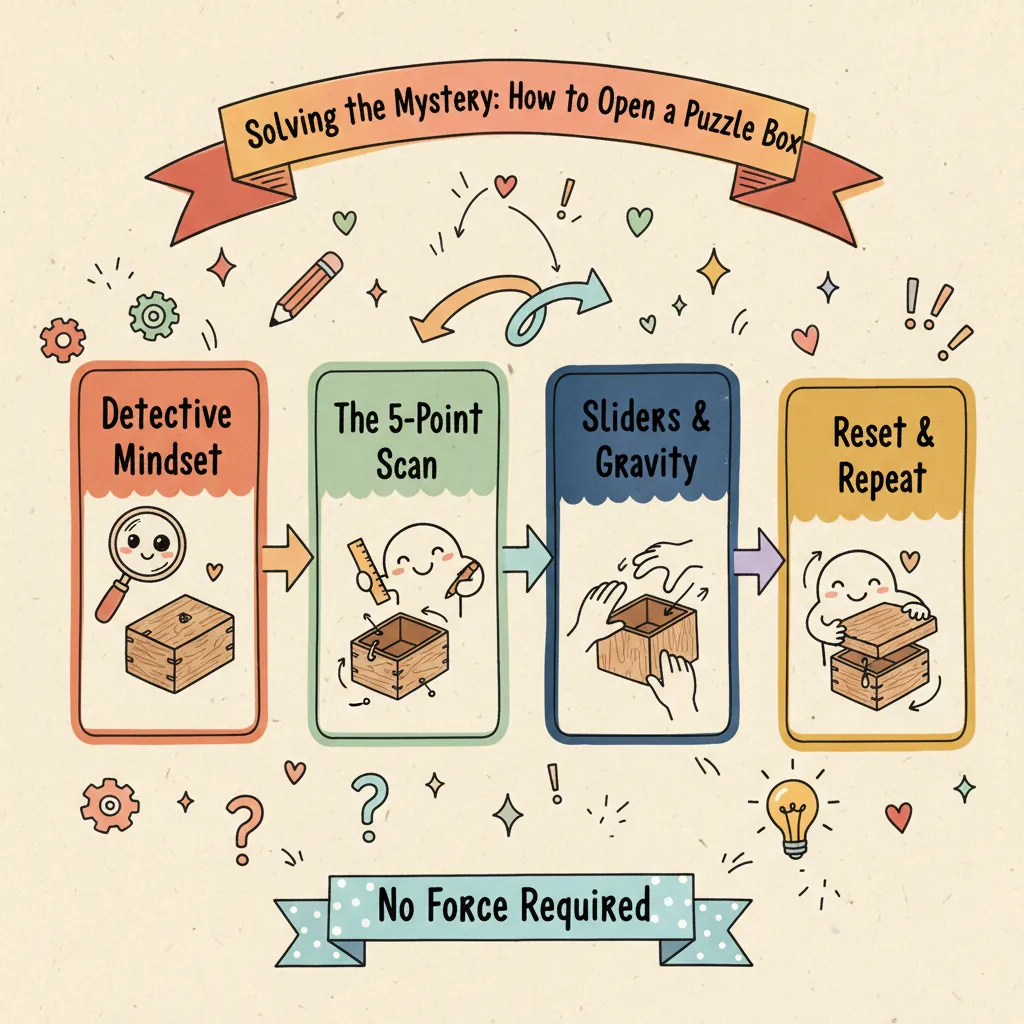
Your First Inspection: The 5-Point Diagnostic
Now that you’re in the right headspace, it’s time to become a detective. Put the box on a clean, well-lit table. Your goal in this first inspection isn’t to open it, but to gather every clue it’s willing to give you. Forget random poking and prodding. Follow this systematic 5-point diagnostic to build a complete profile of your puzzle box.
1. The Visual Scan: Seams, Beams, and Markings
Start with your eyes. Look at the box from every angle—top, bottom, all sides.
* Trace the Seams: Where do the wood pieces meet? Are all seams uniform, or is one slightly wider, darker, or misaligned? A common trick is a “false seam” that looks decorative but is actually a sliding panel.
* Count the Beams: As noted in the wikiHow guide, many classic puzzle boxes have horizontal wooden beams encircling them. Count them. A 4-beam box often indicates a more complex, multi-step Japanese-style puzzle, while a box with 2 or 3 beams might have a simpler sliding mechanism. This is your first major clue to the box’s complexity.
* Spot the Odd One Out: Look for any piece of wood with a unique grain pattern, a tiny dot, a different finish, or a slight protrusion. Designers often hide the key piece in plain sight by making it visually distinct.
2. The Auditory Test: Shake, Tip, and Listen
Close your eyes and use your ears. Gently pick up the box.
* The Internal Rattle: Carefully tilt and rotate the box. Do you hear something loose inside? A faint rolling or clicking sound often means there’s a ball bearing or a free-moving weight. This is a dead giveaway for a gravity lock or maze lock. The goal is to navigate that internal component to a specific spot to release the latch. Many frustrated Reddit users, after shaking a box with a ball inside, realize, “oh, it’s one of those kinds of puzzles.”
* The Subtle Click: As you manipulate the box, press lightly on different panels. Listen for a faint, dry click or tock. This could be a latch engaging or disengaging, or a panel shifting a millimeter.
3. The Tactile Survey: Push, Pull, Slide, and Press
This is where your fingertips become your most sensitive tools. Apply gentle, focused pressure.
* Test Every Surface: Don’t just push—try different motions. Can any panel slide forward, backward, or sideways? Even a fraction of a millimeter of movement is a huge clue. Try pressing corners or the centers of panels. Does anything depress like a button?
* Feel for Magnetic Resistance: Slowly move your fingertips across the surface. Do you feel a slight “grab” or change in resistance at a specific point? This could be a magnetic catch holding a panel in place. A small, powerful magnet might be the key.
* Check for “Give”: Apply even pressure to the lid or sides. Does it have a tiny amount of flex or play when pressed in a specific spot? This can indicate a hidden pivot point or a panel under tension.
4. The Orientation Check: Tilt and Rotate
Some boxes only unlock in a specific position. This is a classic feature of many commercial puzzle boxes.
* Methodical Tilting: Hold the box firmly and slowly tilt it to one side, then another, while gently trying to slide the lid or a panel. Listen and feel. The internal ball or weight must fall into its correct channel or hole. As one Redditor suggested for a ball-bearing box: “try tipping the box in every orientation while trying to open the sliding lid.”
* The “High-Five” Method: If your visual and tactile checks reveal no moving parts, you might have an inertial lock. The infamous solution from many guides is to hold the box flat on your open palm and, pretending to give it a high-five, slap it down firmly with your other hand. The sharp impact can jiggle a internal latch. Use caution: this is a last-resort test for sturdy boxes, not delicate heirlooms.
5. The Deductive Conclusion: Profile Your Box
Combine your clues to identify the likely mechanism type.
* No moving parts + Internal rattle = Gravity/Maze lock.
* Sliding panel + Beam count = Sequential move puzzle (like a Japanese puzzle box).
* Magnetic feel + Single moving part = Magnetic catch or lock.
* No visible seams or movement = Possibly a sequential push-panel box or a rare trick opening.
This diagnostic isn’t a one-time event. As you learn more, come back to it. The box that seemed inert might reveal a tiny slide after you’ve tilted it just so. This process is the core of the puzzle.
For a masterclass in this diagnostic thinking, consider practicing on a dedicated puzzle object like the 6 Piece Wooden Puzzle Key. It’s not a box, but its solution relies entirely on the same principles: identifying unique grain patterns, finding the one piece with different movement, and discovering the precise sequence of manipulations. Solving it trains the exact sensory and deductive skills you need for a full puzzle box. For a deeper dive into this systematic approach, our guide on How To Solve A Puzzle Box Without Losing Your Mind builds directly on this diagnostic foundation.
Armed with the clues from your inspection, you’re no longer guessing. You’re ready to move from diagnosis to action, starting with the most common family of puzzle boxes.
Cracking Common Mechanisms: From Sliders to Gravity Locks
Your diagnostic inspection gave you clues. Now, let’s match those clues to the most common lock types you’ll encounter. Think of this as your field guide to puzzle box mechanics. Each type requires a different approach, so identifying it is half the battle.
1. Sliding Panels & Secret Drawers
This is the classic “it slides open” mechanism mentioned in Amazon Q&As. The box appears seamless, but one entire face or a smaller panel is a hidden drawer. The trick is finding the release.
- What to look for: A side or end with a slightly different grain pattern, a tiny gap on one edge, or a panel that feels ever-so-slightly recessed.
- How to solve: Apply firm, direct pressure with your thumb. Don’t wiggle—push straight along the plane of the panel. Try all six faces. If it’s a corner drawer, you may need to push on a specific corner. The motion should feel like overcoming a magnetic or friction latch. If it’s stuck, try the “high-five” tap method (see #4) to jostle the internal latch.
2. Sequential Moves (Japanese-Style Boxes)
Referenced by sites like Hakone Maruyama, these boxes require a precise sequence of slides, often in a specific order and direction. One panel won’t budge until another has been moved first.
- What to look for: Multiple panels with visible seams. The box may have a “beam” or “strip” construction. You might get one piece to slide a few millimeters and then hit a dead stop.
- How to solve: Patience and mapping. Start by gently trying to slide every piece you can identify. Note which one moves first and in what direction (e.g., “the top panel slides left”). Return it and try a different piece. Your goal is to discover the first step. The sequence is often a loop: A left, B down, C right, A right, etc. Write it down as you discover it. For a classic step-by-step guide to this process, see our article on How To Open A Wooden Puzzle Box: A Step By Step Guide To Solving The Secret.
3. Gravity Locks & Ball Bearings
This directly answers those frantic Reddit threads about a box with “a ball inside.” The box contains a loose ball bearing or weight that blocks a internal latch unless it’s rolled into a specific position.
- What to look for: You’ll hear a distinct rattle or roll when you tilt the box. The main lid or drawer might seem completely stuck.
- How to solve: This is a tilt-and-test puzzle. Slowly and deliberately tilt the box in every possible orientation—end over end, side to side, corner to corner. While holding it at each angle, try the primary opening method (e.g., sliding the lid). You’re trying to guide the ball into a channel or hole that retracts the locking pin. Listen for a faint click or feel for a sudden release of resistance.
4. Inertia or “Tap” Opens (The wikiHow Slap)
The infamous “high-five your hand” method. This mechanism uses a loose internal weight that, when struck, swings to retract a latch via momentum.
- What to look for: A solid, often cube-shaped box with no visible moving parts. It feels heavy for its size and you might hear a dull thunk from inside if you shake it.
- How to solve: Hold the box firmly in your dominant hand. With a quick, sharp, but controlled motion, slap the box down onto the open palm of your other hand. The impact needs to be sudden to make the internal weight swing. You’re not trying to break it; you’re delivering a crisp jolt. You should hear a definitive click or pop. If one face doesn’t work, try slapping it with a different face down.
5. Hidden Latches, Buttons, and Levers
These are discrete triggers camouflaged in the box’s design. A decorative inlay might be a button, a seemingly fixed knot might pivot, or pressure on a specific corner might release a catch.
- What to look for: Any element that looks or feels different: a wood plug, a darker knot, a section of trim that seems separate. Run your fingernail around every edge and ornament.
- How to solve: Apply focused pressure. Push, don’t slide. Press every suspicious element individually. Sometimes the trigger is a combination: you must hold down a hidden button on the bottom while sliding the top.
Mastering these mechanisms builds your intuition. For a challenging synthesis of these concepts, a box like the 3D Wooden Puzzle Safe with Combination Lock is excellent practice. It combines sequential sliding moves (to access the dial) with a hidden, multi-step combination mechanism, forcing you to apply diagnostic logic repeatedly. The satisfaction comes from hearing each internal click and knowing exactly which rule you’ve just unlocked.
Remember, a single box can combine multiple types. You might need to tilt it (gravity) to free a panel you can then slide (sequential) to reveal a button (hidden latch). When you’re truly stuck on a trick box, our focused guide on How To Open A Trick Wooden Puzzle Box Without Breaking It dives deeper into advanced composite mechanisms. The key is to isolate each problem and apply the correct technique. Now, let’s put it all together into a universal opening procedure.
When You’re Truly Stuck: Smart Troubleshooting Without Force
You’ve inspected, you’ve tried every tilt and slide, and the box still won’t budge. This is the exact moment of frustration echoed in forums: “How the F#%! does this open!?!?!? i have spent so much time.” Before you reach for a hammer or a file—like the Reddit user who eventually pried a drawer open—stop. Force is the enemy of craftsmanship and often the end of your puzzle. Instead, deploy these smart, non-destructive troubleshooting techniques.
First, check your environment. Wood is a living material. High humidity can cause it to swell, making sliding pieces fit impossibly tight. If the box was in a damp basement or a humid climate, move it to a dry, air-conditioned room for a day. Conversely, extremely dry conditions can sometimes cause subtle warping. Environmental factors are a frequently overlooked culprit.
If swelling is suspected, or if a panel feels almost movable, use a gentle, even persuasion tool. Forget knives or screwdrivers; they will gouge the wood. Instead, reach for a thin, rigid card—a library card, a laminated gift card, or a guitar pick. Slide it carefully into the seam you believe should open. Apply gentle, wiggling pressure to work it deeper, which can help redistribute any minor binding or unstick a vacuum seal. The goal isn’t to pry, but to act as a shim and a subtle extension of your finger.
Sometimes the problem is you. Frustration leads to frantic, forceful pushing, which can jam mechanisms further. The ‘Walk Away’ reset is a legitimate technique. Put the box down for an hour—or a day. When you return, your mind will be clear, and your hands will be gentle. Start from the very beginning with your diagnostic inspection. You’d be surprised how often a fresh perspective reveals a hidden seam or a push panel you dismissed earlier.
When all logical, gentle methods fail, and you’re certain the box is a simpler, mass-produced type (not a fine Japanese or heirloom piece), you may consider a controlled last resort. This is only for boxes where you’ve accepted potential cosmetic damage. The principle is to apply minimal, targeted force to unstick a component, not to smash it open. If a drawer is stuck, gently tap the sides of its housing with the rubber handle of a screwdriver, not the drawer itself, to try and vibrate it loose. The Reddit user who used a file did so “gently” and only after repeated attempts to loosen the mechanism. This is a risk, not a solution.
True puzzle mastery involves embracing the stuck phase as part of the process. For a deeper exploration of this mindset, our article on Stop Forcing The Solution: What Three Ancient Principles Teach About Puzzle Solving is invaluable. It teaches patience, observation, and systematic thinking over brute force.
If you want to practice advanced troubleshooting on a puzzle that demands absolute precision and patience, consider the Big Pineapple Yellow Emperor Puzzle Lock. This intricate lock mechanism requires flawless alignment and a deep understanding of internal tolerances. If you force it, you will permanently break it. Solving it teaches the ultimate lesson: being “truly stuck” is usually a sign you’ve missed a subtle alignment or a prerequisite step, not that the puzzle is broken. The solution always lies in cleverness, not coercion.
The Art of the Reset: How to Close a Puzzle Box Properly
You’ve finally done it. After careful inspection, patient sliding, and maybe a few strategic tilts, the lid slides open or the drawer pops free. The victory is sweet. But now you’re holding an open box, and a new, surprisingly common panic sets in: “How do I get this thing closed again?”
This is the most overlooked step in puzzle box ownership, and forcing it shut is where most accidental damage happens. The internal pins, levers, and slides that you so cleverly aligned to open must now be perfectly reset. Slamming it closed is like trying to re-lock a deadbolt with the door already shut—it won’t work, and you’ll strip the mechanism.
Closing a puzzle box isn’t just about reversing the steps; it’s about re-engaging the lock. Here’s how to do it properly:
1. Retrace Your Steps in Reverse.
Literally. If opening required you to slide panel A left, then panel B down, then tilt the box, your closing sequence is: hold the box in the tilted position, slide panel B up, then slide panel A right. Do it slowly and deliberately. You should feel each component click or settle back into its resting position. If something feels gritty or refuses to move, stop. You’ve likely missed an intermediate step.
2. Listen and Feel for the “Home” Position.
A well-made puzzle box has positive feedback. When a sliding piece is fully in its “locked” position, it will often seat with a soft click or a definitive stop. Don’t just push until it’s flush; push until it engages. If a panel is wobbling or feels springy, it’s not locked. This is often the cause of a box that seems closed but then falls open unexpectedly.
3. Never, Ever Force It.
This bears repeating. If the lid or drawer won’t close with gentle pressure, the internal mechanism is misaligned. Forcing it can shear off delicate wooden pins, crack thin panels, or permanently jam a slide. The frustration you feel is a signal to stop, not push harder. Open the box fully again, ensure all internal components are in their default “start” state, and begin the closing sequence from the beginning.
4. Why This Matters: Longevity and Reusability.
A puzzle box isn’t a one-time trick. It’s a functional object—a secret vault for small treasures. Proper closing ensures it remains a satisfying puzzle for years, not a broken trinket after one use. It preserves the precise tolerances the maker engineered. For more on the craftsmanship behind these hidden seams, our guide on How To Open Wooden Puzzle Boxes: The Art Of The Invisible Seam delves into the why behind the how.
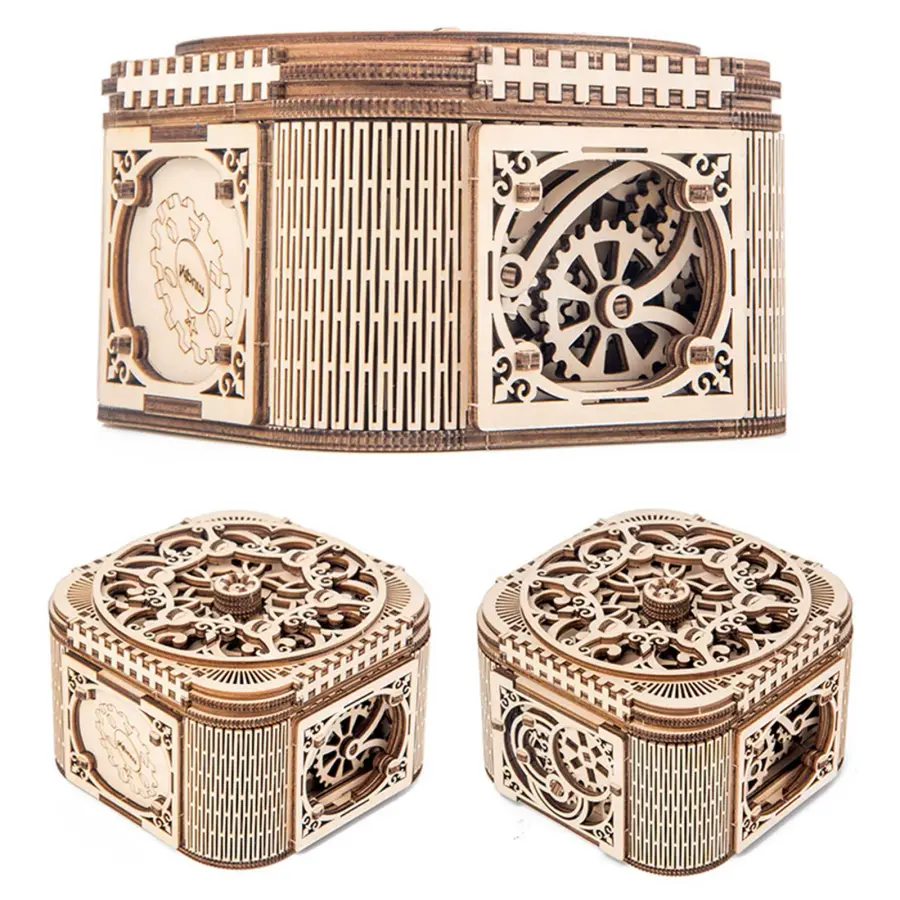
Mastering the reset is the true mark of a puzzle solver. It turns a momentary victory into lasting ownership. A perfect box to practice this art of opening and closing is the 3D Wooden Puzzle Treasure Box. Its multi-step mechanical process is designed to be cycled—opened to store a ring or keepsake, then closed to secure it. Successfully resetting its intricate slides and locks without force is the final, satisfying click of mastery. It teaches you that the puzzle isn’t solved when it’s open; it’s solved when it’s securely closed, ready to challenge you (or a friend) all over again.
Beyond the Basic Box: Understanding Japanese Puzzle Boxes (Himitsu-Bako)
If the puzzle boxes we’ve covered so far are clever riddles, a traditional Japanese puzzle box, or himitsu-bako (秘密箱), is a master’s thesis in wood and wit. Originating from the Hakone region over a century ago, these are not mere trick boxes with a single sliding panel. They are sequential discovery puzzles, where the solution is a precise, multi-move ceremony. As Kubiya Games notes, the parts “move easily and smoothly if you do it the right way”—the emphasis is on the right way, a deliberate sequence known as “steps.”
The “steps” (4, 7, 15, or even 50+) refer not to physical stairs but to the number of discrete sliding movements required to release the lid. Each action unlocks the possibility for the next, often in non-linear directions—slide a panel right, tap the box to shift an internal weight, then slide a different panel down. The official site for Hakone Maruyama explains it perfectly: “You must move the pieces in the proper sequence and the right direction to open the box.” This transforms opening from a task into a ritual.
Why are they a different category? It’s in the craftsmanship and intent. Generic trick boxes often rely on a hidden magnet or a single clever latch. A himitsu-bako is a geometric artwork, typically made from varied woods like zebrano and walnut in the yosegi marquetry technique. The puzzle mechanism is integral to the construction, born from precise interlocking joints and channels carved into thin wood slats. The goal isn’t just to hide a compartment; it’s to create a meditative, tactile experience that honors patience and observation. For a visual tour of this artistry, our curated list of 7 Japanese Puzzle Boxes That Will Humble Your Iq And My Desk showcases the stunning diversity.
So, how do you approach solving a multi-step box when there’s no obvious starting point? Forget force and adopt a methodical mindset:
- The Calm Inspection: Hold the box in good light. Run your fingers over every surface, feeling for the slightest gap, a panel with a different grain direction, or a piece that seems fractionally recessed. There are no buttons or levers; the moving parts are the panels themselves.
- The Gentle Probe: Apply light, even pressure to every face and panel. Try sliding, pushing, or tapping. Listen and feel for the faintest click or sense of internal movement. A common first step in many boxes is to slide a long-side panel that seems perfectly flush.
- Embrace the Sequence: When a piece moves, don’t immediately try to open the lid. Observe what new movement it has enabled. Has another panel become loose? Can you now slide something in a perpendicular direction? The sequence is a chain; you must complete each link.
- Mind the Orientation: Many boxes require specific tilts or turns between steps to engage gravity locks (like the ball-bearing maze mentioned in user threads). If you’re stuck mid-sequence, try gently rotating the box and testing the panels again.
- Reset and Practice: Once open, study the internal mechanism if visible. Then, close it and run through the sequence again. Mastery comes from understanding the “why,” not just memorizing the “how.”
This philosophy of sequential, interlocking logic isn’t confined to boxes. It’s the core of traditional Chinese and Japanese joinery puzzles, where the fun lies in the journey of discovery as much as the final reveal.
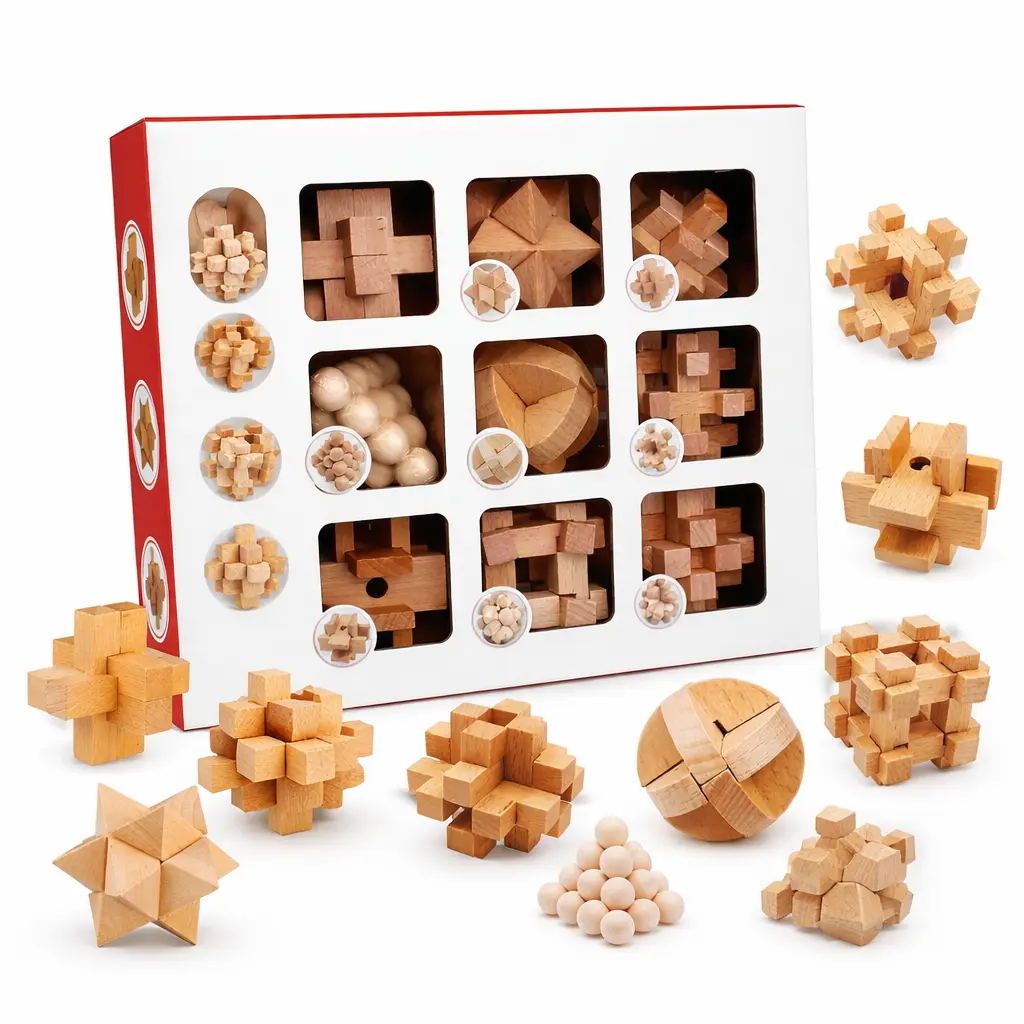
Luban Lock Set 9 Piece — $39.99
For those intrigued by this step-by-step, mechanical logic, the journey doesn’t end with boxes. The Luban Lock Set 9 Piece embodies the same spirit. These 3D interlocking puzzles, rooted in ancient carpentry, challenge you to deduce the precise sequence of movements to disassemble and reassemble intricate wooden shapes. Solving them trains the exact systematic thinking required to conquer a multi-step himitsu-bako—patience, observation, and a deep appreciation for how pieces interact in a precise, silent dance.
In short, a Japanese puzzle box is less about “opening” and more about “unfolding.” It rewards a slower, more observant approach, turning frustration into a profound appreciation for the hidden mechanics and cultural artistry locked within the wood.
Frequently Asked Questions (FAQ)
My box has a ball inside and a sliding lid that won’t move. What do I do?
This is a classic “ball bearing maze” or “gravity lock” puzzle. The ball is blocking a latch. Gently tilt and rotate the box in all directions—upside down, on its sides, at angles—while simultaneously applying light pressure to the sliding lid. You’re trying to guide the ball out of a notch or channel that’s locking the mechanism. Listen for the ball to roll and feel for the moment the lid loosens. Avoid shaking it violently.
Is it okay to use a tool to pry it open?
Almost never. Using a knife, screwdriver, or file to force it will almost certainly splinter the wood and permanently damage the delicate internal latches. The only exception is if you’ve confirmed it’s a cheap, non-mechanical “novelty” box with a simple, stuck drawer (as mentioned in some Reddit threads), and even then, use a thin, flexible tool like a guitar pick or plastic spudger with extreme care. For a true puzzle box, force is the enemy.
I lost the instructions. How do I find the solution?
First, identify your box. Look for a maker’s mark, brand name, or a distinctive design. Search “[Brand Name] puzzle box solution” on YouTube—it’s the best resource for visual guides. For generic boxes, search by description (e.g., “wooden cube puzzle box 4 beams” or “Chinese money box solution”). Websites like Puzzle Box Solve also archive solutions for common types.
How many moves should it take?
It varies wildly. A simple magnetic or slider box might open in 2-3 moves. A classic Japanese himitsu-bako is defined by its number of steps (e.g., a 4-step, 15-step, or even 50+ step box). The “steps” are the number of precise sliding movements required before the lid can be removed. Count the visible panels on the top; often, the number of moves corresponds to the number of pieces you must slide.
Are all puzzle boxes opened the same way?
No, this is the core of the challenge. Mechanisms include: sliding panels, hidden magnets, gravity locks, sequential discovery (where one move reveals a tool for the next), screw mechanisms, and combination locks. A “high-five” slap might work for one specific magnetic box but will do nothing for a sequential slider. Always start by observing and experimenting gently.
What’s the difference between a puzzle box and a regular locked box?
A puzzle box has no external keyhole or obvious lock. The opening mechanism is integrated and concealed within the design itself. Solving it requires manipulating the box’s components (sliding, tilting, pressing) in a specific, non-obvious sequence, as defined by the broader category of mechanical puzzles. You can learn more about their history and variations on the puzzle box Wikipedia page.
Can I ruin the puzzle by doing the steps wrong?
For most well-made boxes, no. You can’t “break” the sequence; you’ll just hit a dead end. If a panel won’t slide, you’re likely going the wrong way or haven’t completed a prior step. The only way to cause damage is by applying excessive force. If stuck, retrace your movements to the starting position and try a different sequence.
Why won’t my box close after I’ve opened it?
You likely haven’t fully reset the internal mechanism. Every move you made to open it must be reversed in the exact opposite order. Ensure all internal compartments are pushed in, all sliders are back to their original starting positions, and the lid is seated perfectly before attempting to re-lock it. Rushing this is a common mistake.
Are puzzle boxes meant to hold things?
Traditionally, yes. Japanese himitsu-bako were used for small valuables or sentimental items. Modern puzzle boxes are functional containers. However, the joy is primarily in the solve. If you want a decorative box that also offers a building challenge, consider a kit.
For a project that combines the satisfaction of building a complex mechanism with a beautiful, functional result, the Wooden Ferris Wheel Music Box Kit is a fantastic choice. You assemble the intricate gear and puzzle-like structure yourself, creating a music box that stores small treasures in its base. It teaches you how internal mechanisms interact, which is excellent training for solving standalone puzzle boxes.
Is there a trick to feeling for hidden slides?
Yes. Run your fingertips lightly over every surface. Feel for slight temperature differences (glue lines can feel cooler), minute gaps, or panels that sit ever so slightly proud or recessed. In a dim light, look for subtle shadow lines. Press gently on every face and listen for clicks or feels of give.
What if I’ve tried everything and it’s still stuck?
Walk away. Seriously. Frustration blinds you to subtle clues. Set it down for hours or a day. When you return, start from scratch with a systematic inspection as if you’ve never seen it before. Often, the solution you overlooked becomes obvious with fresh eyes and calm hands.
Where can I learn more about the history of these boxes?
The Wikipedia entry on puzzle boxes provides a solid overview of the history, particularly the Japanese tradition. For deeper dives into specific styles and artisans, look for specialty puzzle retailer blogs and museum collections focused on folk art or mechanical puzzles.
Your Next Challenge: From Solving to Building
You’ve mastered the patient inspection, the gentle slide, the sequential logic, and the satisfying click of a puzzle box opening. The thrill of discovery is addictive. So, what’s next? The natural progression for any true puzzle enthusiast isn’t just to solve more complex boxes—it’s to understand them from the inside out. To build one.
Think about it: solving a puzzle reveals a designer’s intent. Building one reveals the fundamental principles of mechanics, geometry, and clever deception. It’s the difference between reading a brilliant novel and learning to write one. The skills you’ve honed—patience, spatial reasoning, and a feel for sequential movement—are the exact same skills required for the ultimate hands-on project: constructing a functional, mechanical art piece.
This is where the journey evolves from passive solving to active creation. And the perfect bridge is a project that combines puzzle-like assembly with a beautiful, lasting result.

Consider the Wooden Ferris Wheel Music Box Kit. This isn’t just a model; it’s a 400+ piece 3D wooden puzzle that functions as a real, crank-operated music box. Building it applies every lesson you’ve learned from puzzle boxes on a grander, more rewarding scale.
Why This is the Logical Next Step:
- Sequential Logic in 3D: Just like a Japanese himitsu-bako requires moves in a precise order, this build has a mandatory sequence. You can’t install the gear train after the outer walls are sealed. The build process itself is a giant, spatial puzzle where each step unlocks the next.
- Mechanical Intuition: As you assemble the planetary gear system that turns the Ferris wheel’s gondolas, you’ll see firsthand how hidden internal mechanisms—similar to those in a puzzle box—transfer motion and create magic from simple parts. You’re not just following steps; you’re engineering a kinetic sculpture.
- The Patience Payoff: The focus and calm required to solve a stuck box are the same virtues needed here. The reward, however, is magnified. Instead of finding an empty compartment, you culminate your effort with a turn of the crank, watching the wheel spin gracefully to the tune of a music box melody. You’ve built an heirloom.
- From Solver to Storyteller: A solved puzzle box is a private victory. A completed Ferris Wheel Music Box is a centerpiece. It’s a conversation starter that allows you to say, “I built this,” sharing the joy of mechanical wonder with others.
Your Path Forward: Recommendations Based on Your Journey
Whether you’re looking for a personal challenge or a meaningful gift, here’s how to proceed based on what you’ve already accomplished.
For the Gift-Giver (Who Now Understands the Appeal):
You’ve seen the frustration and triumph a simple puzzle box can bring. Gifting a build kit like the Ferris Wheel is the profound next act. It says, “I believe you have the brilliance and patience to create something magnificent.” It’s a shared experience waiting to happen, offering dozens of hours of engaging, screen-free fulfillment. Pair it with a simple note: “The ultimate puzzle isn’t just to open it—it’s to build it.” For more gifting inspiration, explore our list of 11 Puzzle Boxes For Adults That Actually Reward Your Patience.
For the Hobbyist (Ready to Level Up):
If you’ve solved a few boxes and are hungry for a deeper dive, this is your project. It translates abstract puzzle-solving into tangible craftsmanship. You’ll use similar tools (a light touch, careful alignment, systematic thinking) but on a larger canvas. The detailed guide provided acts like a solution key, but the physical act of assembly—feeling the gears mesh, the axles turn—provides a tactile education no solution video can match. For a primer on the mindset, our guide How To Build A Puzzle Box: A First-Timer’s Guide To Crafting Your Own Mechanical Secret lays the philosophical groundwork.
For the Collector (Seeking Depth):
Your shelf holds solved puzzles. Now, add a piece you authored. The Ferris Wheel becomes the crown jewel of your collection, representing not just an object of intrigue but a testament to your skill. It expands the definition of a “puzzle” from a secret to be uncovered to a complex system to be synthesized. To appreciate the full scope of such a project before you begin, explore The Wooden Ferris Wheel Music Box Kit: Your Complete Guide To A Puzzling Musical Build for a full breakdown of the build stages and mechanics.
The core truth of puzzles is that the greatest satisfaction comes from engaging your mind and hands to overcome a clever challenge. You’ve graduated from finding secrets to appreciating the architecture of secrecy. The final, most rewarding step is to learn that architecture yourself. Choose a project that respects the intelligence and patience you’ve cultivated. Build something that moves, delights, and endures. Your journey from solver to creator begins with the first piece.