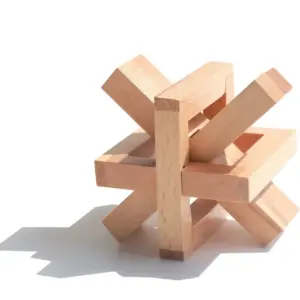
You pick up the Six-Way Cross—the simplest puzzle in the set according to the product description—and rotate it between your fingertips. Three wooden bars, interlocked at perpendicular angles. The beechwood is smooth, not slippery. The finish is described on the product page as “natural wood grain, smooth sanded,” and that’s exactly what you feel: wood that’s been prepped for handling, not lacquered into something artificial.
You push one bar. Nothing moves. You try another direction. Still locked. Then—almost by accident—you apply pressure at a different angle, and one piece slides a few millimeters. That slight give is the entire puzzle’s vulnerability. Push harder in that exact direction, and the piece exits with a controlled “shuck” sound. The other two bars fall apart in your palm.
Disassembly took maybe fifteen seconds once you found the key piece. Now reassemble it.
That’s when you understand why the product page says “Disassembly takes seconds. Reassembly? That’s where things get interesting.”
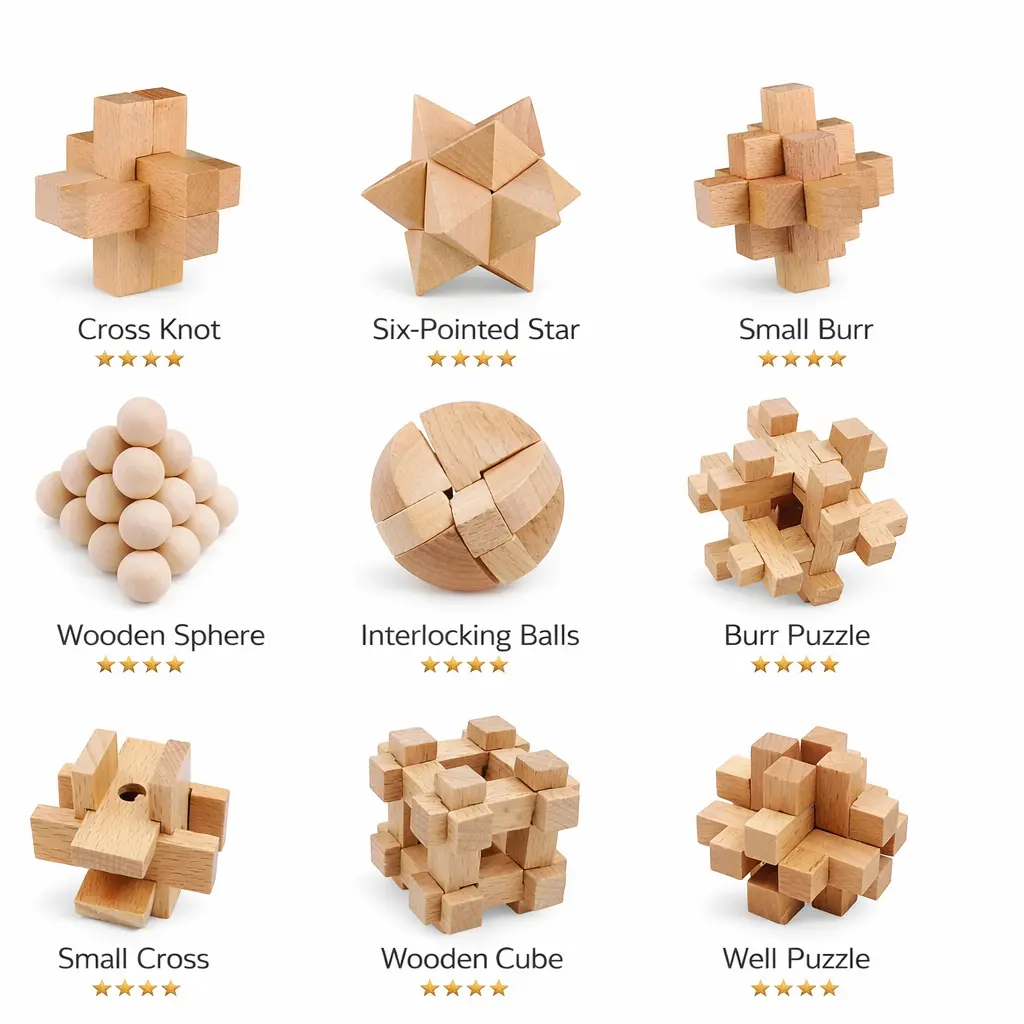
This is the Luban Lock Set – 9 Piece. Nine distinct interlocking puzzles, each roughly 4.5 cm per side, organized by difficulty from Level 1 to Level 4. The product page explicitly states that the joinery uses “no nails, no glue, just wood against wood, held by geometry alone.” That’s not marketing hyperbole—it’s a mechanical constraint you can verify the moment you touch these pieces.
What You Actually Get: Page-Verified Unboxing
The following facts come directly from the official product page. I’ve noted where information is not specified.
Set Contents (On-Page Text)
- 9 wooden interlocking puzzles (varied designs)
- Presentation box with clear window
Materials and Dimensions (On-Page Text)
- Material: Natural beechwood
- Finish: Natural wood grain, smooth sanded
- Individual Puzzle Size: ~1.8 × 1.8 × 1.8 in (4.5 × 4.5 × 4.5 cm)
- Packaging Size: 8.7 × 7.9 × 2 in (22 × 20 × 5 cm)
- Weight: Not specified on product page
The Nine Puzzles (Named on Page with Difficulty Levels)
Level 1 (Beginner):
- Six-Way Cross (Six-Direction Lock) – “Three interlocking bars forming a symmetrical cross. The simplest design in the set.”
Level 2 (Intermediate):
- Hexagonal Star (Six-Pointed Gem) – Six identical pieces with angled edges
- Pineapple Lock (Small Pineapple) – Hides “internal voids that misdirect your assumptions”
- Ball Pyramid (Pyramid) – Wooden spheres stacked in a tetrahedral shape
Level 3 (Advanced):
- Luban Ball (Luban Sphere) – Curved segments forming a smooth sphere; “no obvious seams, no visible key piece”
- Capture the Ball (Ball Removal Lock) – Cage trapping a loose ball; “extract the ball without breaking anything”
- Six-Piece Burr (Six-Piece Lock) – The iconic six-notched-sticks design
Level 4 (Expert):
- Cage Lock (Cage Burr) – “Hollow lattice structure with internal supports”
- Grid Lock (Cross Pattern Lock) – Dense interlocking bars; “high piece count means more potential false moves”
Additional Specifications (On-Page Text)
- Joinery Type: Mortise-tenon (nail-free interlocking)
- Recommended Age: 6+ years
- Safety: Eco-friendly ink, non-toxic new PVC material
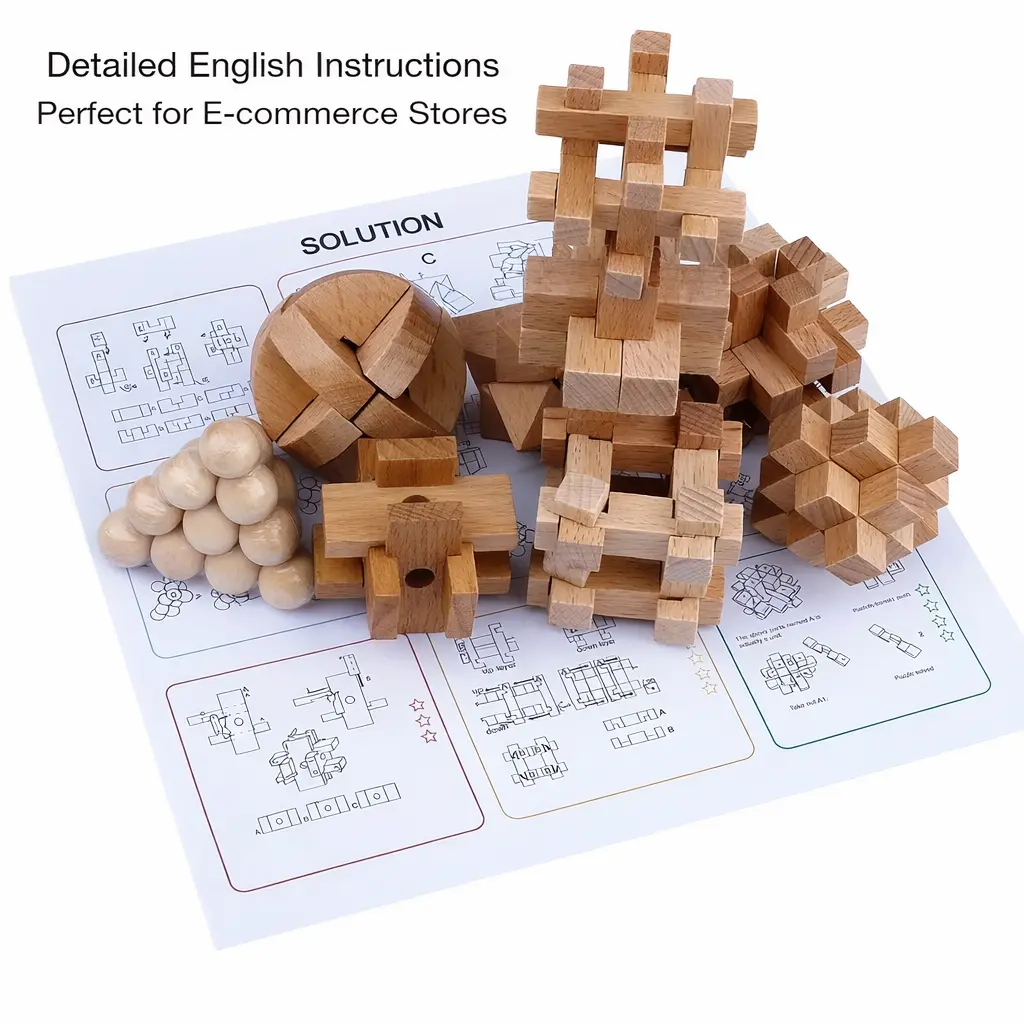
- Instructions: Not included – “No instruction manual included. That’s traditional.”
- Estimated Solve Time: Not specified on product page
The Unlock Journey: Step-by-Step Reality
This is the core of the puzzle experience. I’ll walk through the general unlock and reassembly process, using the mechanics described on the product page and standard burr puzzle handling rules. Important note: the product page does not specify exact internal notch patterns for each puzzle, so I’m focusing on principles that apply across mortise-tenon interlocking designs.
Phase 1: Initial Assessment (Applies to All 9 Puzzles)
Step 1: Pick up the assembled puzzle and rotate it slowly in your hand.
What you feel: The product page describes the material as “natural beechwood” with a “smooth sanded” finish. In practice, this means dry wood-on-wood contact—no slippery coating, no artificial friction. The pieces fit tightly but not so tight that they bind.
What typically goes wrong here: Many people immediately try to pull pieces apart at random. This never works on interlocking puzzles because every piece prevents at least one other piece from moving. The product page puts it clearly: “Pull the wrong piece first, and nothing budges.”
Mitigation: Don’t pull. Don’t force. Apply light exploratory pressure to each visible piece, testing multiple directions. You’re looking for the one piece that has a few millimeters of give.
What you learn: Interlocking puzzles are about sequencing, not strength. The geometry creates a mechanical deadlock that only releases when you find the key piece.
Phase 2: Finding the Key Piece
Step 2: Systematically test each piece with gentle sliding pressure along its axis.
What you feel: Most pieces won’t move at all—they’re blocked by neighboring pieces. But one piece (the “key”) has slightly different internal notching that allows it to slide in one specific direction without collision.
What you’re listening for: Not a click. A slight reduction in resistance—the feeling of friction dropping as the geometry aligns. If you’re pressing hard enough to make noise, you’re pressing too hard.
What typically goes wrong here: People apply too much force and mistake wood flexion for actual movement. Beechwood is dense but not infinitely rigid; you can bow pieces slightly under pressure without actually finding the key.
Mitigation: Use fingertip pressure, not palm pressure. Test each piece in at least two directions (along its axis and perpendicular). The key piece will feel distinctly different—it moves; everything else resists.
What you learn: The key piece isn’t hidden by complexity. It’s hidden by subtlety. The difference between “locked” and “unlocked” is often a matter of millimeters.
Phase 3: First Disassembly
Step 3: Slide the key piece completely out.
What you feel: A controlled “shuck” as wood slides against wood. Then—depending on the puzzle—either immediate structural collapse or a secondary loosening that allows other pieces to shift.
What typically goes wrong here: If you’re working on a hard surface, pieces can scatter when the structure releases. Small wooden components (4.5 cm per side, per the product page) can roll under furniture.
Mitigation: Work over a towel or felt mat. Even better: photograph the assembled puzzle before you start disassembly. That reference image will be invaluable during reassembly.
What you learn: Disassembly is the tutorial. It teaches you which piece is the key and roughly how the geometry interlocks. The real test is whether you can reverse the process.
Phase 4: Reassembly (Where Most People Get Stuck)
Step 4: Attempt to reverse the disassembly sequence.
What you feel: Confusion. You now have 3-6+ loose wooden pieces that look similar. The product page notes that instructions are intentionally not included—”discovery-based solving”—so there’s no diagram to follow.
What typically goes wrong here: People try to insert pieces in random order. But mortise-tenon geometry is sequence-dependent. If you insert Piece A before Piece B, and Piece A blocks Piece B’s path, you’ll have to start over.
Mitigation: For most burr-style puzzles, start by identifying the two pieces that form the central axis. Position them first—usually partially interlocked. Then add surrounding pieces in opposing pairs. The key piece (the one you removed first) typically goes in last.
What you learn: Reassembly is the actual puzzle. Disassembly is reconnaissance.
Mini-Checkpoint: Where Are You Stuck?
Use this self-diagnostic:
- Can’t find the key piece at all? → You’re pressing too hard or testing too few directions. Reduce force; increase systematic coverage.
- Found the key, but other pieces still won’t move after removal? → Some Level 3-4 puzzles (like Cage Lock) have multi-step release sequences. The first piece to move may not be the first piece to exit.
- Disassembled successfully but can’t reassemble? → You’re likely trying to insert pieces in the wrong order. Reset by identifying which pieces form the core axis.
- Pieces fit partway then jam? → Check rotational orientation. Each piece typically has only one correct orientation. A 90° or 180° rotation error will cause internal collision.
Difficulty-Specific Notes (Based on Product Page Descriptions)
Six-Way Cross (Level 1): The product page calls this “the simplest design in the set” and says “the puzzle falls apart in three moves.” This is your warmup—use it to learn the basic key-finding technique before attempting harder puzzles.
Hexagonal Star (Level 2): The product page notes that “final assembly requires positioning multiple pieces simultaneously.” Unlike sequential-insertion puzzles, this one may require you to hold several pieces in alignment and seat them together.
Six-Piece Burr (Level 3): The product page references Bill Cutler’s computer analysis showing over 35 billion theoretical six-piece burr configurations. Your set uses one specific configuration. Without the exact notch pattern, you’re reverse-engineering it from scratch. Expect this one to take significantly longer than Level 1-2 puzzles.
Cage Lock and Grid Lock (Level 4): The product page describes these as having “multiple pieces must move in coordinated sequence” and “longer solution paths.” These aren’t puzzles you’ll solve in one sitting unless you have prior interlocking puzzle experience.
Why It Gets Stuck: The Mechanics You Can Feel
Understanding the physics helps you solve faster.
Mortise-Tenon Joinery
The product page states that these puzzles use “mortise-tenon joinery: no nails, no glue, just wood against wood, held by geometry alone.” This is the same technique used in traditional Chinese timber-frame architecture, which UNESCO inscribed on the Representative List of the Intangible Cultural Heritage of Humanity in 2009.
Here’s how it works mechanically: a mortise is a recessed slot carved into wood. A tenon is a projecting piece cut to fit that slot. When they interlock, the joint is held purely by geometry and friction—no fasteners. In puzzle form, each piece has multiple mortises and tenons arranged so that they pass through each other’s paths at the point of intersection.
The result is a mechanical deadlock. Every piece blocks at least one other piece. Remove the wrong piece first, and the geometry still holds. Remove the right piece (the key), and the deadlock breaks.
Friction and Tolerance
Beechwood has a tight grain structure that creates consistent surface friction. The product page describes the finish as “natural wood grain, smooth sanded”—meaning the wood isn’t coated with wax or lacquer that would reduce friction. This is intentional: the friction is what holds the puzzle together in its solved state.
Tight tolerances (the precision of the cuts) determine how smoothly pieces slide. Well-made interlocking puzzles have tolerances tight enough to eliminate wobble but loose enough to allow movement without forcing.
Sequencing Dependency
The product page describes Cage Lock as requiring “multiple pieces must move in coordinated sequence.” This is a defining characteristic of higher-level interlocking puzzles: they’re not just about finding one key piece. They’re about finding a sequence of moves—sometimes 5, 10, or 12 moves—before the first piece can exit.
Bill Cutler’s analysis of six-piece burrs (referenced on the product page) found that the highest-level puzzles require 12 moves to remove the first piece. That’s 12 coordinated slides and shifts before anything comes free. At Level 4, you’re working with puzzles that approach this complexity.
Craft and Origin: Where “Luban Lock” Sits in Puzzle History
The product page provides historical context worth examining.
Lu Ban (c. 507–444 BCE)
The product page states: “Lu Ban—the godfather of Chinese carpentry—allegedly invented [these puzzles] to test his son’s spatial reasoning around 500 BCE.” Historical records credit Lu Ban, a master craftsman from the State of Lu during China’s Spring and Autumn period, with inventing the saw, the carpenter’s plane, and the chalk line. He’s considered the patron saint of Chinese carpenters.
The legend of Lu Ban creating interlocking puzzles as teaching tools is well-established in Chinese craft tradition, though specific documentary evidence from the 5th century BCE is naturally limited.
Kongming Lock (Alternate Name)
The product page mentions that these puzzles “also carry the alternate name ‘Kongming Lock,’ after Zhuge Liang (181–234 CE), the legendary military strategist from the Three Kingdoms period.” Zhuge Liang’s courtesy name was Kongming, and his reputation for clever problem-solving led to the naming association—whether or not he personally designed puzzle variants.
The “Burr Puzzle” Designation
Internationally, these are called “burr puzzles.” According to Wikipedia, the term first appeared in Edwin Wyatt’s 1928 book Puzzles in Wood, though the text implies it was already in common use. The name comes from the assembled shape resembling seed burrs.
Mortise-Tenon Antiquity
The product page claims mortise-tenon joinery “appears in Chinese architecture as early as 7,000 years ago at the Hemudu site in Zhejiang province.” This is supported by archaeological evidence: the Hemudu site, a Neolithic settlement discovered in 1973, contains some of the oldest known examples of mortise-tenon joinery in East Asia.
UNESCO Recognition
The underlying craft—traditional Chinese timber-frame construction using mortise-tenon joints—was inscribed on UNESCO’s Representative List of the Intangible Cultural Heritage of Humanity in 2009. The product page also notes that “in 2020, the craft of making these puzzles was designated a Shandong provincial intangible cultural heritage item.”
Who This Is For (and Who Should Skip It)
Strong Fit
Mechanical engineers, architects, and woodworkers: The product page describes these as “physical representations of interlocking joint theory.” If you’ve designed tolerance stacks or debated dovetail angles, you’ll appreciate the precision.
Desktop fidgeters who want weight and durability: At 4.5 cm per side in solid beechwood, these have more heft than injection-molded plastic fidget toys. The product page notes “solid beechwood beats injection-molded plastic stress toys.”
Parents and teachers seeking screen-free engagement: Recommended age is 6+ per the product page. Start children with the Six-Way Cross (Level 1) and progress upward. No batteries, no notifications.
Gift-givers who want a conversation piece: The product page suggests specific gift contexts: engineering students, retired professionals, “anyone who claims ‘I’m good at puzzles.'” There’s a story behind these objects—2,500 years of Chinese craft tradition—that elevates them above generic desk toys.
Weak Fit
Anyone expecting instructions: The product page is explicit: “No instruction manual included. That’s traditional.” If you require step-by-step guidance, you’ll need to seek online resources independently.
People who need quick wins: Level 3-4 puzzles can take hours. If you don’t have patience for extended problem-solving, stick to Level 1-2 or consider single-puzzle options from the wooden puzzles category.
Those with limited hand dexterity: The 4.5 cm scale is compact. For larger pieces, explore alternatives like the 6-in-1 Wooden Brain Teaser Set.
Buying Decision Framework + Where to Go Next
Before purchasing, confirm you’re comfortable with the following:
- ✓ You accept that Level 3-4 puzzles may require multiple sessions to solve
- ✓ You understand no instructions are included—this is intentional design
- ✓ You (or your recipient) have patience for spatial reasoning challenges
- ✓ You’re fine with 4.5 cm per-puzzle scale (roughly golf-ball sized)
- ✓ You prefer solid wood over plastic construction
If all boxes are checked, the Luban Lock Set – 9 Piece delivers genuine interlocking puzzle engineering at desktop scale. Price at time of writing: $39.99.
Looking for alternatives?
- Browse the full wooden puzzles collection for additional difficulty levels and styles
- Check metal puzzles for different tactile properties
- See all puzzle toys for the complete selection
Questions?
- Visit Customer Help for support
- Review the Shipping Policy for delivery timelines
- Learn more about the brand at About Tea-Sip