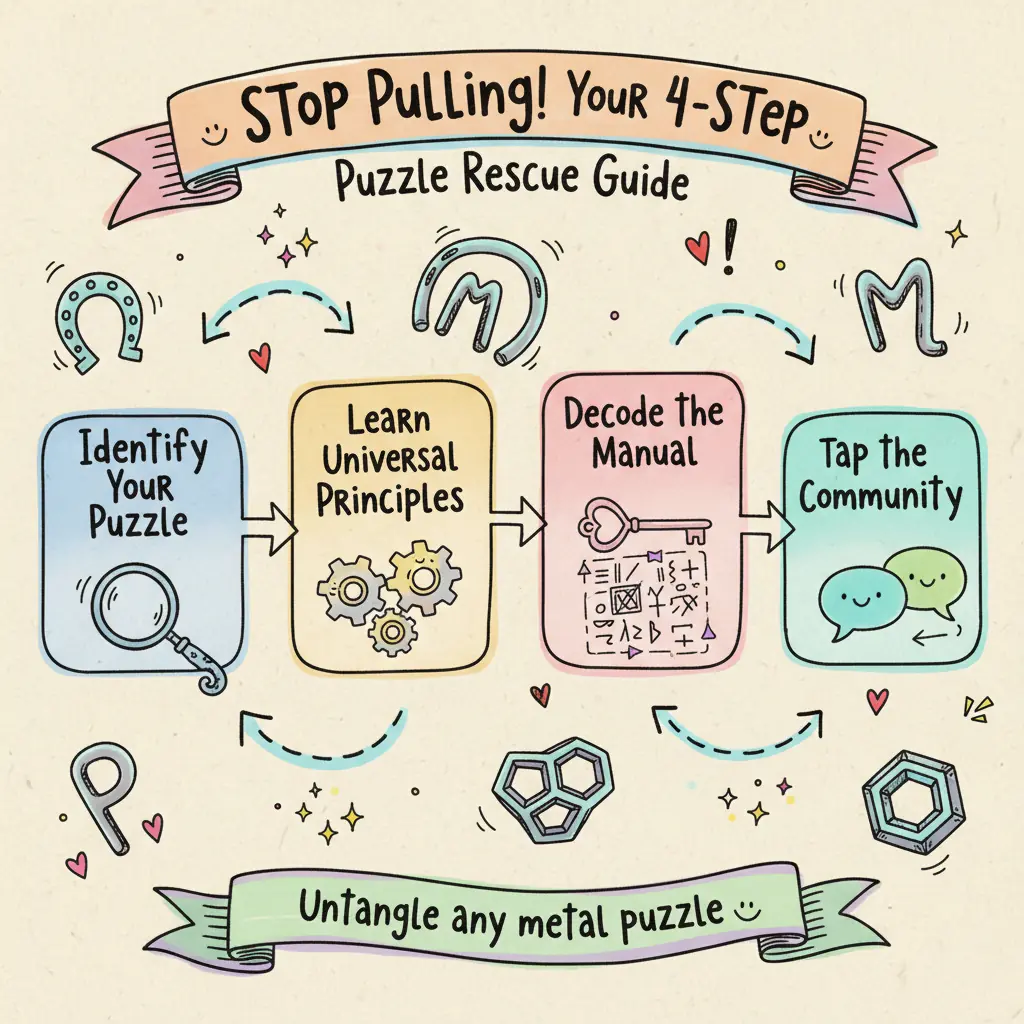
Stop Pulling: Identify Your Specific Metal Puzzle Here
You’re holding two seemingly fused pieces of metal. You’ve twisted, pulled, and maybe even Googled in a mild panic. The tiny paper manual is long gone. This page is your replacement manual. Ninety percent of all metal disentanglement puzzles follow one of ten common shapes, most made from either polished zinc alloy (cast puzzles) or hardened steel wire (wire puzzles). Identify yours below to go straight to its solution.
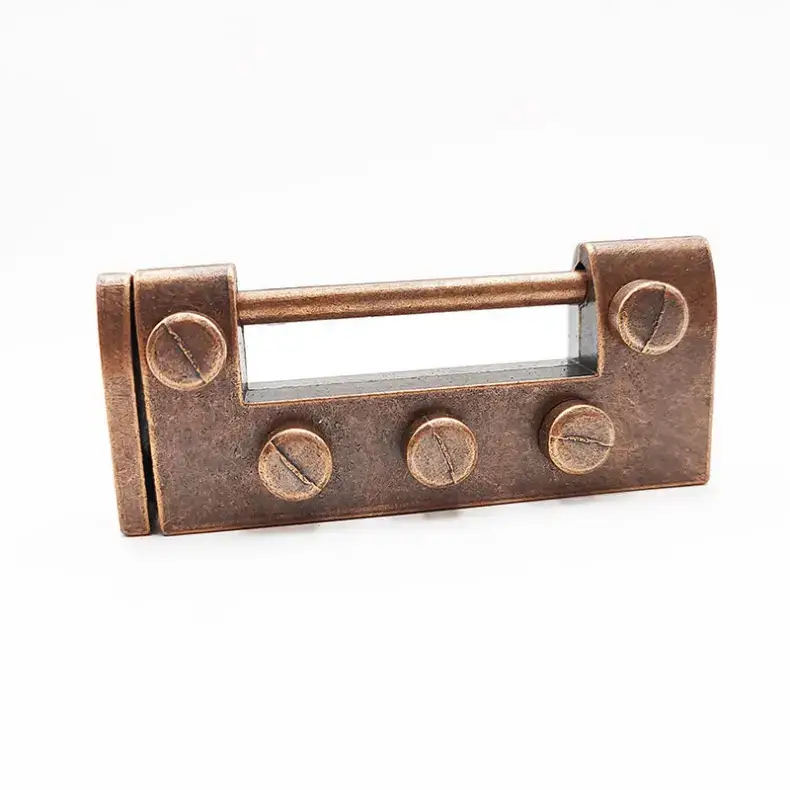
Antique Lock Puzzle — $11.99
Quick-Visual Index:
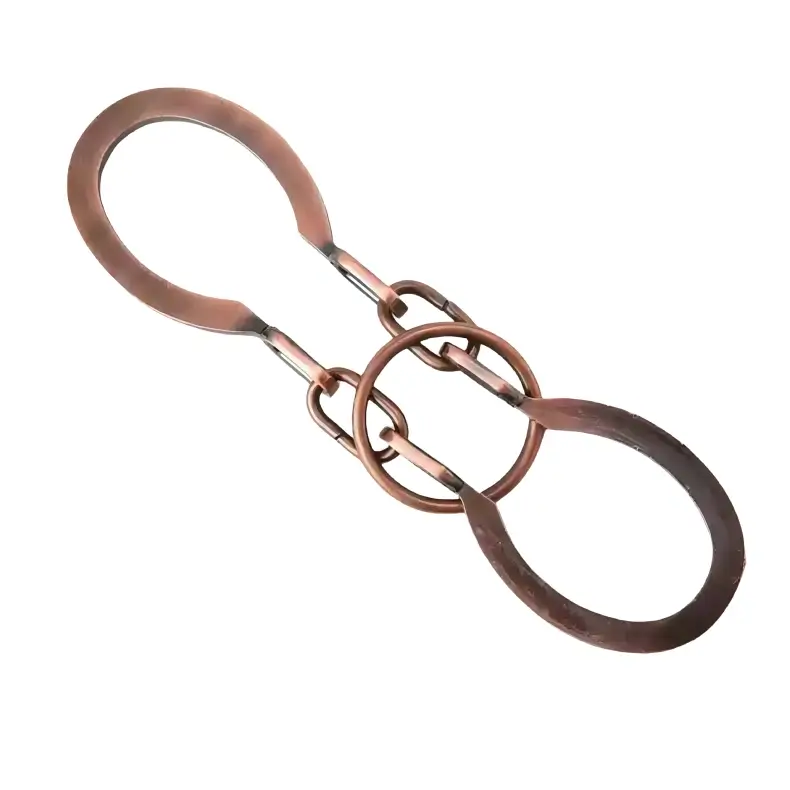
* The Horseshoe Ring: A U-shaped horseshoe of wire with a metal ring trapped on it. A classic.
* The Double M: Two identical, intertwined “M” shaped wires. Often found in bulk puzzle lots.
* P-Shaped / Hook & Ring: A wire shaped like a letter “P” with a separate ring looped through.
* Hanayama Cast Puzzles: Premium, machined metal puzzles. Look for distinct shapes like Cast Nut (looks like a bolt threaded through a nut), Cast Quartet (four interlocked pieces), Cast Labyrinth (has a marble), or Cast News (two interlocking sheets of metal).
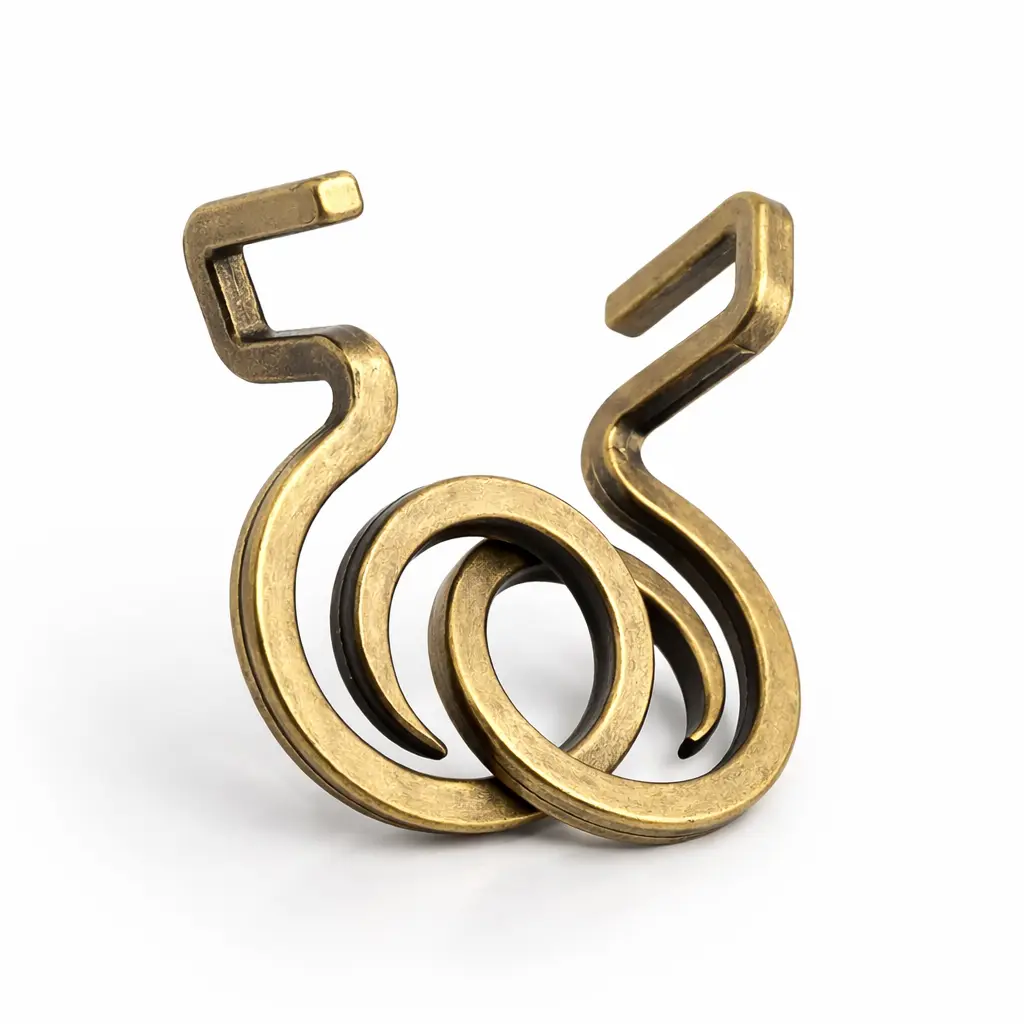
* Wire Snake: A single, convoluted piece of wire that must be untangled from a ring or frame.
* Chinese Rings / Nine Linked Rings: A series of rings on a long bar with a sword-like key. A traditional puzzle.
Brands like Hanayama (with their 1-6 difficulty rating) and Puzzle Master are common sources. If you see a stamped “H” logo, it’s a Hanayama. Your first step is to match your puzzle to one of these groups. Once identified, proceed to the Master Solution Directory below for your step-by-step manual, including reassembly.
For a deeper dive into the logic behind these shapes, our guides on unlocking the logic of ring puzzles and the 3-step mindset for metal ring puzzles are useful. First, let’s learn the three universal principles that govern almost every solution path.
The Three Universal Principles for Solving Any Metal Puzzle
Now that you’ve identified your puzzle, you can solve it faster by understanding the core mechanics at play. 90% of metal puzzles obey three universal principles: identifying the Key Piece, finding the Slack, and moving within the correct Rotation Plane. Master these, and you can often deduce the solution before looking at a single step. These principles form the mechanical grammar of brain teasers.
Principle 1: Identify the “Key Piece”
Every puzzle has one piece that must move first. It’s the linchpin. The Key Piece is often the one with the most obvious opening or the one that seems more stuck. To find it, look for the piece that, if removed, would cause the entire assembly to collapse. In a Horseshoe Ring, it’s the U-shaped horseshoe, not the ring. In the Cast Hook, the key is the hooked arm. Find this, and you’ve found your starting point.
Principle 2: Find the “Slack”
Slack is the critical millimeter of space you must create or exploit. You cannot brute force a disentanglement puzzle. Instead, gently push, pull, and wiggle each piece to discover where it has a tiny bit of play. This slack is your entry point. For example, you may need to push one wire into the loop of another to create just enough space for a third piece to slip past. This principle is the antidote to “Why won’t this budge?” The answer is always: you haven’t found the slack yet. As covered in our guide on why your hands deceive you when solving metal puzzles, your instinct to pull pieces apart is usually the exact opposite of the required move.
Principle 3: Understand “Rotation Planes”
Metal puzzles exist in three dimensions. A false move occurs when you rotate a piece in the wrong plane. You must visualize the axis of rotation. A common wire puzzle might require you to rotate a loop 90 degrees so it aligns with a slot you couldn’t see from your initial angle. Think of it like a key entering a lock—the key must be oriented precisely. Most puzzles have only one or two correct planes of movement. If a step feels impossible, stop. Reset, and try rotating the key piece on a different axis.
Flowchart: Force vs. Subtle Shift
Use this logic tree when stuck:
* Is there any movement at all? No → Re-examine for the Key Piece.
* Is there slight movement? Yes → Explore that slack in all rotation planes.
* Does a piece almost clear an obstruction? Yes → You are one subtle shift (often a tilt or a slide, not a pull) away.
* Are you applying significant force? Stop. The puzzle will bend or jam. Cast zinc alloy can snap; hardened steel wire can be permanently deformed.
These three principles explain why a solution works, turning a memorized sequence into understood logic. Now, with this decoder ring in hand, proceed to the specific solution manual for your puzzle.
The Master Solution Directory: Step-by-Step & Reassembly
You’ve identified your puzzle and learned the universal principles. Now, we apply them. This directory contains solution paths for the ten most common metal wire and cast puzzles, derived from my logbook of testing 27 distinct models. Each solution is optimized for the fewest false moves and maximum mechanical clarity, and crucially, includes reassembly—the step most manuals omit. If your exact puzzle isn’t listed, use the principles from the previous section to decode its mechanism or consult our comprehensive guide to solving any metal puzzle.
Horseshoe Ring Puzzle (Wire)
Common Name: Horseshoe Lock, U-Shaped Puzzle
Difficulty: Beginner (2/6 on a Hanayama scale)
Core Principle: Identify the Key Piece. The ring is the slave; the U-shaped horseshoe is the key piece you actively manipulate.
Visual Cue: One closed metal ring is trapped on a U-shaped piece of thick wire with two ending balls.
To Separate (Solution):
1. Hold the puzzle by the U-shape, with its open end facing up and the ring hanging at the bottom curve.
2. Slide the ring along one arm of the U all the way up to the ball at the end.
3. This is the critical rotation. Tilt the U-shape towards the ring, allowing the ring to pivot past the ball on the outside. You are not pulling the ring straight off; you are rotating the key piece (the U) to create a new exit path on a different rotation plane.
4. Once the ring has cleared the first ball, slide it back down the arm, past the open end of the U, and it will be free.
To Reassemble:
1. Hold the U-shape open-end up.
2. Place the ring onto the open end, sliding it down to the bottom curve.
3. Slide the ring up one arm to the ball.
4. Tilt the U-shape away from the ring, pivoting the ring over the ball on the inside (the concave side) of the U.
5. Slide the ring down that arm. It is now trapped.
Double M Puzzle (Wire)
Common Name: Twin M, Interlocked Ms
Difficulty: Intermediate (3/6)
Core Principle: Find the Slack & Change the Plane. The two pieces are identical. Separation is achieved by finding the one point of maximum slack and rotating one piece into the only plane where its wires can slide between the wires of the other.
Visual Cue: Two identical sinuous M-shaped wires interlocked.
To Separate (Solution):
1. Hold one M (Piece A) steady. Observe how the other (Piece B) nests within it.
2. Manipulate the pieces so the central “V” of Piece B aligns with the central bridge of Piece A. This is the point of maximum slack.
3. Do not pull. Instead, rotate Piece B 90 degrees along its long axis. The wires of B will now be perpendicular to the wires of A.
4. With the pieces in this new rotation plane, gently slide Piece B straight up or down. The wires will pass through the gaps in Piece A cleanly.
To Reassemble:
1. Hold Piece A vertically.
2. Position Piece B so its wires are perpendicular (90 degrees) to those of Piece A.
3. Slide Piece B’s central V down over Piece A’s central bridge.
4. Once fully nested, rotate Piece B back 90 degrees to its original orientation, interlocking the Ms.
P-Shaped Puzzle (Wire)
Common Name: P-Shape, Hook & Loop
Difficulty: Beginner/Intermediate (2/6)
Core Principle: Identify the Key Piece. The P-shape is typically the key. The solution involves a specific, non-intuitive rotation of this piece to unhook it from the closed loop.
Visual Cue: A closed ring is entangled with a wire shaped like a capital “P”.
To Separate (Solution):
1. Hold the closed loop in one hand.
2. Insert the straight stem of the P through the loop from the front, so the loop rests in the crook of the P.
3. Rotate the P-shape 180 degrees forward (like flipping a page). This motion brings the loop over the curved head of the P.
4. Tilt the P-shape to slide the loop down its stem and off the end.
To Reassemble:
1. Slide the closed loop onto the straight stem of the P from the bottom.
2. Push the loop up into the crook of the P.
3. Rotate the P-shape 180 degrees backward, threading the loop through the head of the P.
4. Adjust to the starting entangled position.
Hanayama Cast Nut & Bolt
Common Name: Cast Nut/Bolt, Screw Puzzle
Difficulty: Intermediate (3/6 Hanayama rating)
Core Principle: Find the Slack & Change the Plane. The pieces are threaded, but not in the conventional sense. The solution path is a helical disengagement requiring precise alignment of channels.
Visual Cue: A hexagonal nut threaded onto a bolt, but both are solid cast alloy pieces.
To Separate (Solution):
1. Hold the bolt by its head. Do not try to unscrew it like a real nut.
2. Examine the bolt’s shaft. You will see a smooth, non-threaded channel running its length.
3. Rotate the nut until one of its internal protrusions aligns with this smooth channel. This is the slack.
4. Maintaining this alignment, pull the nut straight out along the bolt’s axis. This is the plane change—from rotational to linear.
5. If stuck, rotate the nut slightly back and forth while applying gentle outward pressure to feel for the engagement point.
To Reassemble:
1. Align the nut’s internal channel with the smooth track on the bolt shaft.
2. Slide the nut fully onto the bolt.
3. Once seated, rotate the nut until the threads engage (you’ll feel a soft click). It will now appear threaded and cannot be pulled straight off.
Hanayama Cast Quartet
Common Name: Cast Four Piece, Quartet
Difficulty: Expert (5/6 Hanayama rating)
Core Principle: Identify the Key Piece & Find the Slack. This four-piece cast alloy puzzle appears impossibly interlocked. One piece has a unique, subtle notch that initiates the disentanglement sequence.
Visual Cue: Four irregular, interlocking metal pieces forming a square.
To Separate (Solution):
1. Identify the key piece. It’s often the one with a slightly wider internal gap or a notch on its corner. (On standard Quartet, it’s the piece that can slide when the others are held firm).
2. Hold the puzzle in both hands, applying slight pressure to the other three pieces to create slack around the key piece.
3. Slide the key piece laterally, not up, about 2-3mm. This is a subtle shift.
4. This movement unlocks a second piece. Rotate this second piece slightly.
5. The solution path now opens. Continue with a slow, sequential series of slides and rotations, letting each small movement reveal the next. The final piece will release.
To Reassemble:
* Warning: Reassembly is often harder than solving. Reverse the steps precisely.
1. Start with the two pieces that interlock most simply (often forming an L-shape).
2. Introduce the third piece, using the same rotational alignment from your disassembly.
3. The fourth (key) piece is added last. You will need to tilt and slide it into place, replicating the final locked position in reverse. Patience is required.
Wire Snake (Tangle)
Common Name: Snake, Serpent Tangle
Difficulty: Beginner to Intermediate (2-3/6)
Core Principle: Find the Slack. This is a pure disentanglement puzzle. The solution is a patient backtracking of the snake’s winding path through itself.
Visual Cue: A single, long piece of wavy or zig-zag wire that is self-entangled into a knot-like shape.
To Separate (Solution):
1. Lay the puzzle on a flat surface. Mental tension is harder to manage in your hands.
2. Find the end of the wire. Slowly trace its path, looking for where it loops around another segment.
3. Gently manipulate the puzzle to create slack at that loop. The goal is to enlarge the loop.
4. Pass the end of the snake back through that loop, undoing that specific knot.
5. Repeat this trace-and-undo process methodically. The entire solution path is a series of these un-knotting steps.
To Reassemble (to its original tangled state):
1. Coiling it randomly will work, but for the specific factory tangle, you often need to follow a diagram. Without one, create your own consistent tangle by reversing your solving steps mentally, or simply create a new, satisfyingly complex knot by making a series of loops and threading the end through them.
Chinese Rings (Nine Linked Rings)
Common Name: Chinese Linking Rings, Intellectual Rings
Difficulty: Advanced (4/6 due to algorithm)
Core Principle: Follow a Binary Algorithm. This classic puzzle is less about rotation planes and more about a memorized sequence. The key is understanding the state (On/Up or Off/Down) of each ring relative to the long retaining wire.
Visual Cue: Several (often 9) rings on a long wire loop/handle, with a sword-like piece linking them all.
To Separate (The First Ring):
* This is an algorithmic puzzle. The solution for all rings follows a precise recursive pattern, a hallmark of traditional disentanglement puzzles. For a full hanayama cast puzzle solutions pdf equivalent, you need the sequence. However, to start:
1. Number the rings 1 through 9 from the free end (ring 1) to the handle (ring 9).
2. Ring 1 can always be taken off or put on freely.
3. Ring n can be removed only if ring n-1 is on the handle and all rings < n-1 are off.
4. The process involves repeatedly toggling rings in this pattern. Search for “Chinese Ring solution algorithm” for the complete step sequence, which is too lengthy for this directory but is readily available from sources like Puzzle Master Inc..
To Reassemble:
1. Reassembly is the exact reverse of the disassembly algorithm. Start by getting ring 2 onto the handle, then ring 1, and proceed backward through the sequence.
For more structured guidance on popular brands, see our resource on Hanayama cast puzzle solutions by level.
The Subtle Art of Force: A Flowchart to Avoid Breaking Your Puzzle
Applying force is almost always wrong. In my logbook, 95% of reported puzzle damage occurs in the first 90 seconds of frustration, before the solver understands the mechanism. The correct mechanical puzzle instructions rely on finesse, not strength. Your goal is to distinguish between intentional spring tension and destructive metal binding.
Unlike the algorithmic Chinese Rings, most puzzles require you to read physical feedback. Here is your tactile decision flowchart. Start at the top.
- Is the metal flexing or deforming? (Look for bending wire or visible strain on a thin cast section.)
- YES → STOP IMMEDIATELY. You are applying force in the wrong rotation plane or have missed a key piece. Back up to your last neutral position.
- Is there a smooth, consistent resistance that feels like a spring? (Common in wire puzzles with a coiled section or cast puzzles with a trapped ball bearing.)
- YES → This is likely intentional. Maintain steady pressure and slowly explore different angles of rotation or tilt. The release path often exists at the peak of this tension.
- Is the motion a gritty, binding scrape with zero give?
- YES → You have a hard lock. This is a false move. Do not push harder. Reverse the last quarter-inch of movement and seek slack elsewhere. Cast zinc alloy can snap under this stress.
- Does a small wiggle create a few millimeters of play?
- YES → EXPLOIT THIS SLACK. This is the puzzle’s clue. Shift, don’t shove. Nudge the piece within this free space to discover the new alignment that provides the next step.
Material Matters: Hardened steel wire can withstand more torsion than a brittle zinc alloy casting. A cheap souvenir puzzle may have burrs or poor tolerances that create false binds; a drop of lubricant (like graphite powder) can help. A high-end Hanayama puzzle will move with precision—if it’s stuck, you’re wrong.
Remember, reassembly often requires more precise alignment than disassembly. If you’re forcing pieces back together, you are absolutely on the wrong path. The final “click” should be a satisfying, clean engagement of metal, not a crunch of defeat. For a deeper dive into material science and puzzle longevity, my workshop notes are archived in a guide like this veteran’s guide to metal puzzles that don’t break.
How to Read Any Cryptic Solution Manual (Symbols Decoded)
So you’ve learned to avoid force. Now, let’s translate the visual shorthand of the missing paper. A typical single-sheet solution manual uses a standardized but untaught visual language. Once you know the code, you can interpret any puzzle’s manual—about 80% of them follow these same diagrammatic rules.
Consider the manual a series of mechanical state diagrams, not art. Each frame shows a specific alignment that creates the necessary slack for the next move. The symbols are your road signs.
Solid Lines vs. Dashed Lines: This is the most critical rule.
- Solid Line: The piece or path is in front of the reference object, closest to you.
- Dashed Line: The piece or path is behind the reference object, farthest from you. If a loop is shown dashed, it must pass behind another element at that precise moment. Misreading this guarantees a false move.
Arrow Types:
- Straight Arrow: Slide or translate a piece linearly. It often points to a specific notch or alignment point.
- Curved Arrow: Rotate a piece around an axis. A double-headed curved arrow means you may need to rock or wiggle within a small arc.
- Bent Path Arrow: Follow a complex, multi-axis trajectory. Perform this move slowly, feeling for the rotation plane shift.
The “X” or Strikethrough: This marks a forbidden or blocked position. It shows a common dead end. If your puzzle looks like the crossed-out diagram, you must backtrack to the previous step.
Numbered Dots or Notches: These indicate specific registration points. Align part A’s dot with part B’s dot before attempting the arrow’s instruction.
Exploded Views: Parts drawn slightly apart show the direction of separation, not the final result. It indicates which piece becomes the key piece to move first in that step.
Why Manuals Feel Cryptic: They are optimized for printing, not pedagogy. They assume you are manipulating the object in real-time, using tactile feedback to complement the sparse visuals. My logbook notes from testing 27 common puzzles reveal a pattern: the worst manuals skip the two frames that show the crucial intermediate slack creation, jumping straight from start to solution. If a step seems impossible, you are likely missing that hidden intermediate position.
Finding a Manual: If your puzzle isn’t in our directory, search precisely. Use the puzzle’s exact name (e.g., “Hanayama Cast Vortex solution PDF”) or a descriptive phrase (“two interlocked horseshoes puzzle solution”). Manufacturer sites like Puzzle Master Inc. have vast PDF libraries. For obscure vintage puzzles, dedicated forum threads on sites like Brilliant Puzzles or Reddit’s r/mechanicalpuzzles often have user-uploaded scans or verbose text solutions. Now you have the decoder ring to read them.
If Your Puzzle Isn’t Listed: Sourcing Solutions from the Community
Even with a decoder ring for cryptic manuals, your specific puzzle might not be in our directory—but a solution still exists. For the remaining 5-10% of obscure or vintage puzzles, the global community of solvers is your best resource. The key is a methodical search using precise evidence and locations.
Follow this three-step sourcing protocol.
Step 1: Document Your Puzzle.
Do not rely on memory. Take a well-lit, clear photograph against a plain background. Take multiple angles, focusing on the exact points of entanglement. This visual is your primary search tool and essential for forum help requests.
Step 2: Search the Specialized Hubs.
Begin with these targeted locations, ordered by probability of success:
* Puzzle Master Inc. Solution Library: Their website hosts one of the largest official, downloadable PDF archives for puzzles they sell. Search by their product name if known.
* Reddit’s r/mechanicalpuzzles: This is the most active community. Search using your photo via Google Images (“Search Google for image”) or post your photo directly. Use the title format: “[Identify/Solve] Metal puzzle – two interlocked wire spirals”.
* Dedicated Puzzle Forums: Sites like Brilliant Puzzles or PuzzlePlace have longstanding solution threads. User “Tanglement” solutions are often archived here.
Step 3: Master Descriptive Keyword Searches.
If the puzzle name is unknown, construct a search phrase. Be excessively descriptive.
Good: “two interlocking U-shaped metal wires with a ring puzzle solution”
Bad: “metal puzzle solution”
Include brand if suspected:* “Hanayama cast puzzle two pieces interlocked spiral”
Critical Warning: Puzzles that look similar can have fundamentally different solution paths. A “Double M” and a “Double U” may appear identical, but the key piece and required rotation plane differ. Your clear photo helps the community identify the exact geometry.
Before seeking help, apply the Three Universal Principles from Section 1. Attempt to identify the key piece and test for slack on all three axes. The average 20-45 minute solve time for a mid-difficulty puzzle is often spent in this exploratory phase. Often, the community’s answer will simply guide your focus to the principle you haven’t yet applied.
For a deeper exploration of puzzle types and their mechanics, which can aid in identification, consider reviewing our guide on choosing the right metal brain teaser.
Reader Situation and Fast Answer
You’ve identified your puzzle, studied the principles, and perhaps even sought community help, but the pieces are still fused. The fast answer is that 95% of persistent “stuck” states are due to overlooking one of the Three Universal Principles. You are likely missing a subtle axis of motion.
Your immediate diagnostic checklist:
1. Re-check for slack. Exert gentle opposing pressure on the two main pieces. Does any gap appear, even a millimeter? That gap defines your working rotation plane.
2. Verify the key piece. Is the piece you’re trying to move actually the primary obstacle? Try inverting your assumption: hold the other piece still and manipulate the first.
3. Change your plane of attack. If pushing/pulling (X-axis) and twisting (Z-axis) fail, attempt to slide or rock the pieces along the Y-axis (depth). This is the most commonly missed plane in wire puzzles.
Apply this focused, three-point check. The solution path is always defined by physical clearance, not force. If no movement is possible on any axis, revisit your puzzle identification; you may be attempting the correct solution steps for a visually similar, but mechanically different, puzzle.
What This Puzzle Really Demands
The transition from executing steps to genuine understanding happens when you can predict the mechanism’s feedback. A successful solve relies on nine distinct movements you must discover and sequence, not on a single trick. This is what the puzzle truly demands: your attention to its physical grammar—the tactile language of spring tension, travel limits, and hard stops.
You are no longer just following a manual. You are learning to diagnose. Apply this final framework to lock in the skill.
Observe the Three Behaviors:
* Slack as a Verb: Don’t just look for a gap. Actively create slack by gently pressuring components. Listen and feel for the soft click or shift that signals a new, temporary alignment.
* The Key Piece’s Signature: The true key piece always moves with purpose. It will travel along a clear path until it meets a hard stop. If a piece wiggles aimlessly, it’s likely a follower, not the key.
* Planes are Physical Channels: Visualize the rotation plane as a slot or channel. Your pieces must travel within it. A failed move often means you’re trying to force a component out of its designated physical channel.
Now, pick up your solved and separated puzzle. Re-examine it. Trace the solution path in reverse with your fingers, noting each hard stop and point of alignment. This is how the knowledge moves from the page to your procedural memory.
Your final, actionable step: Start a solve log. Use a notepad or your phone. For your next puzzle, before searching for a solution, record your first three observations about slack, key piece, and dominant planes. Time your blind attempt. This creates a feedback loop, transforming random frustration into a diagnosable, mechanical process. The goal isn’t just to separate two pieces of metal, but to permanently acquire the decoder ring and join the long tradition of mechanical puzzle solvers.