
Cast Spiral Metal Puzzle: A 5-Piece Precision Brain Teaser That Fits in Your Palm
What You’re Holding (and Why It Won’t Let Go)
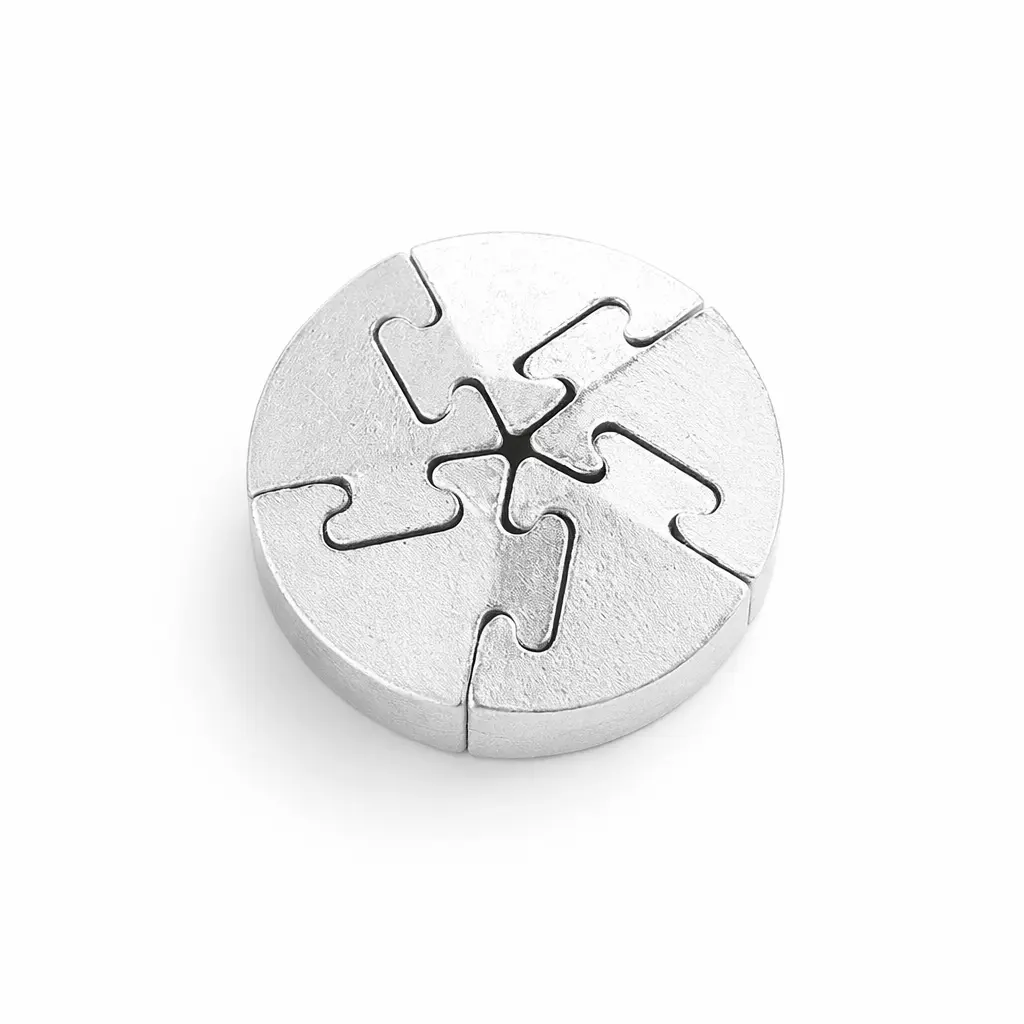
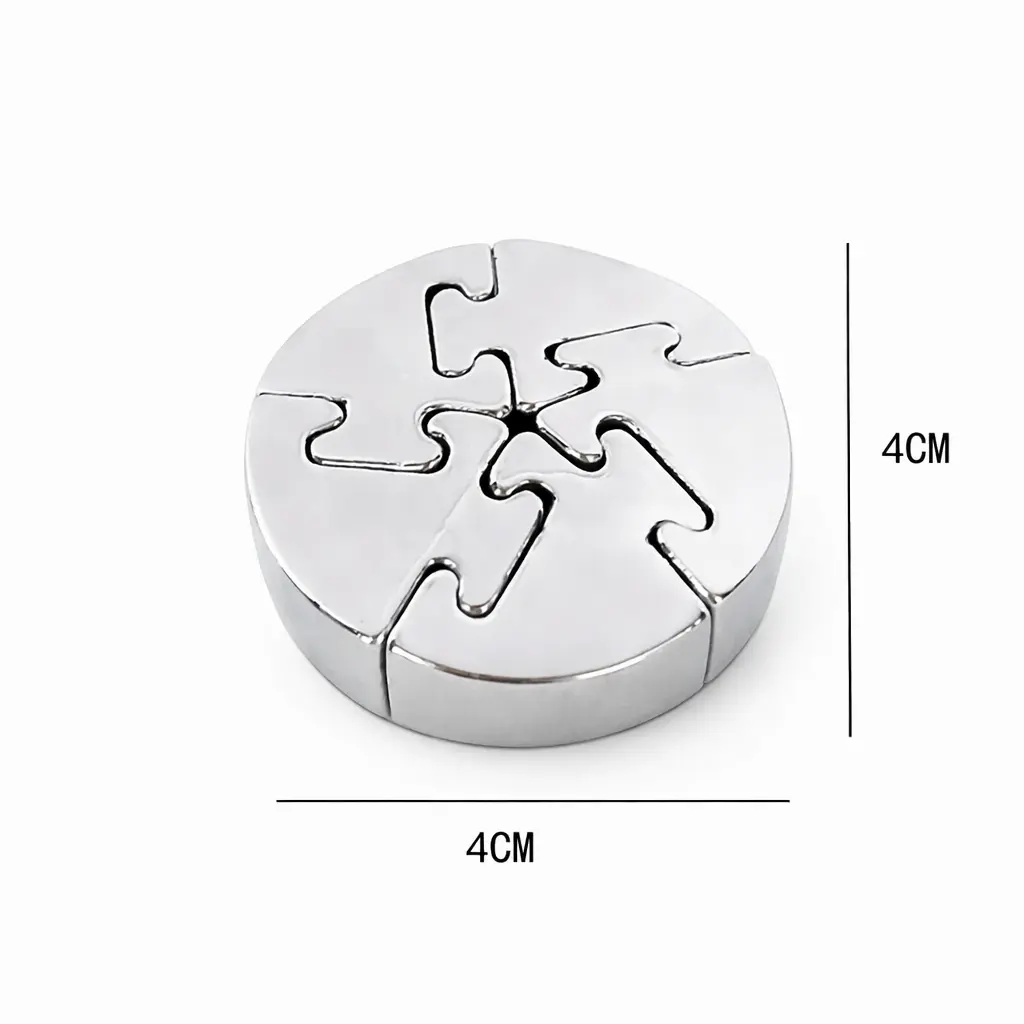
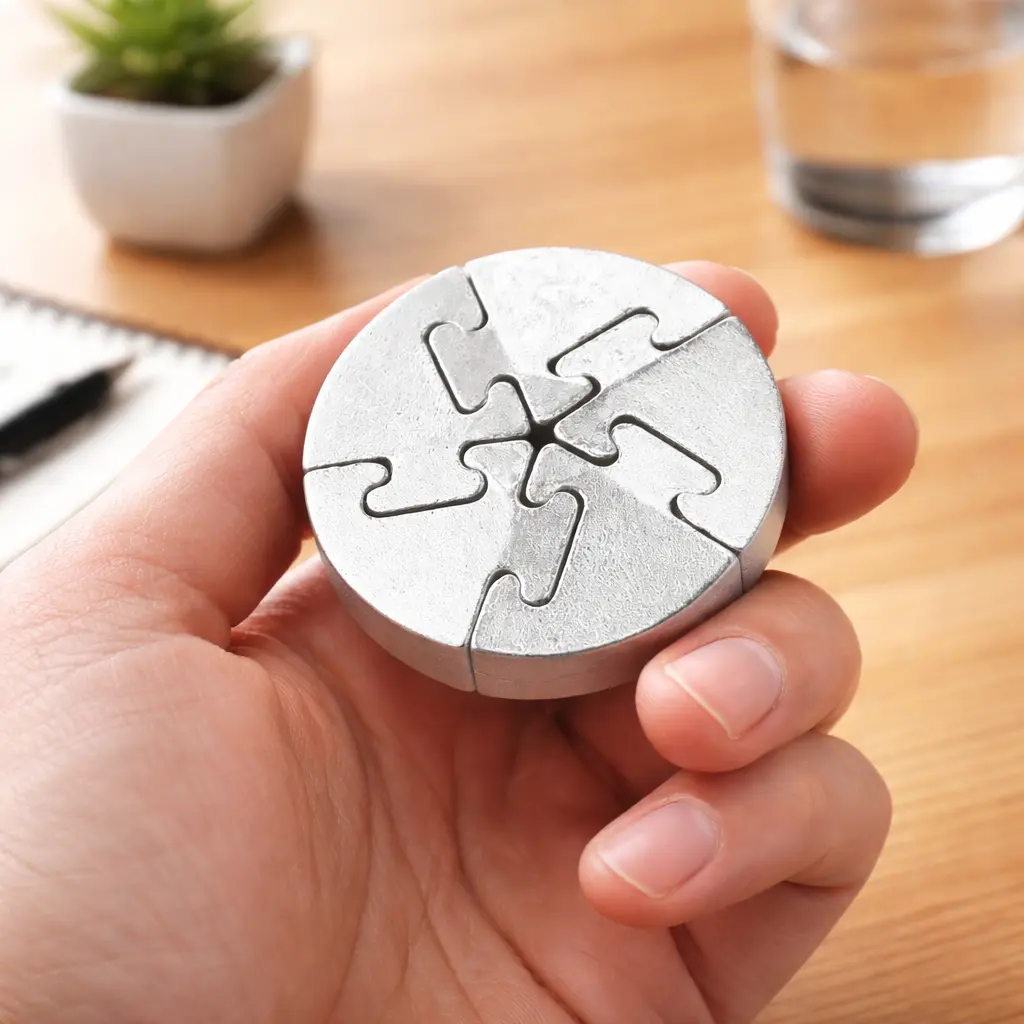
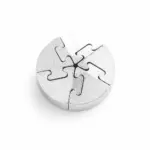
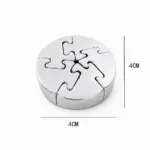
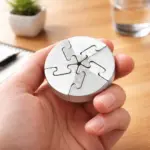
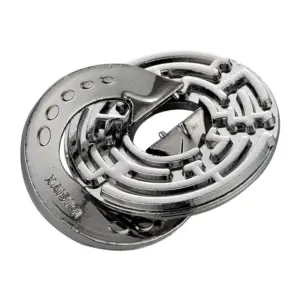
The Cast Spiral looks like a small silver coin. Pick it up, and you’ll notice it’s heavier than expected—solid metal, about 4 centimeters across, with a satisfying weight that settles into your palm. Five wedge-shaped pieces interlock in a spiral pattern radiating from the center, their joints so precise they seem fused together.
Then you notice the seams. Curved lines trace from edge to center like the arms of a galaxy. The pieces move. Slightly. You push one. It doesn’t budge the way you expected. You try another angle, and something shifts—just enough to make you wonder what else is possible.
This is where most people get hooked.
The Cast Spiral belongs to a category of metal puzzles designed for manipulation rather than force. No hammering. No prying. Just observation, rotation, and the slow realization that the solution was always there—you just weren’t seeing it yet.
In restlessness, there is always a still point—a place where the mind settles simply because you showed up.
That’s what this puzzle offers. Not a race to solve, but a reason to pause.
The First Minute with Cast Spiral
Disassembly—Easier Than It Looks
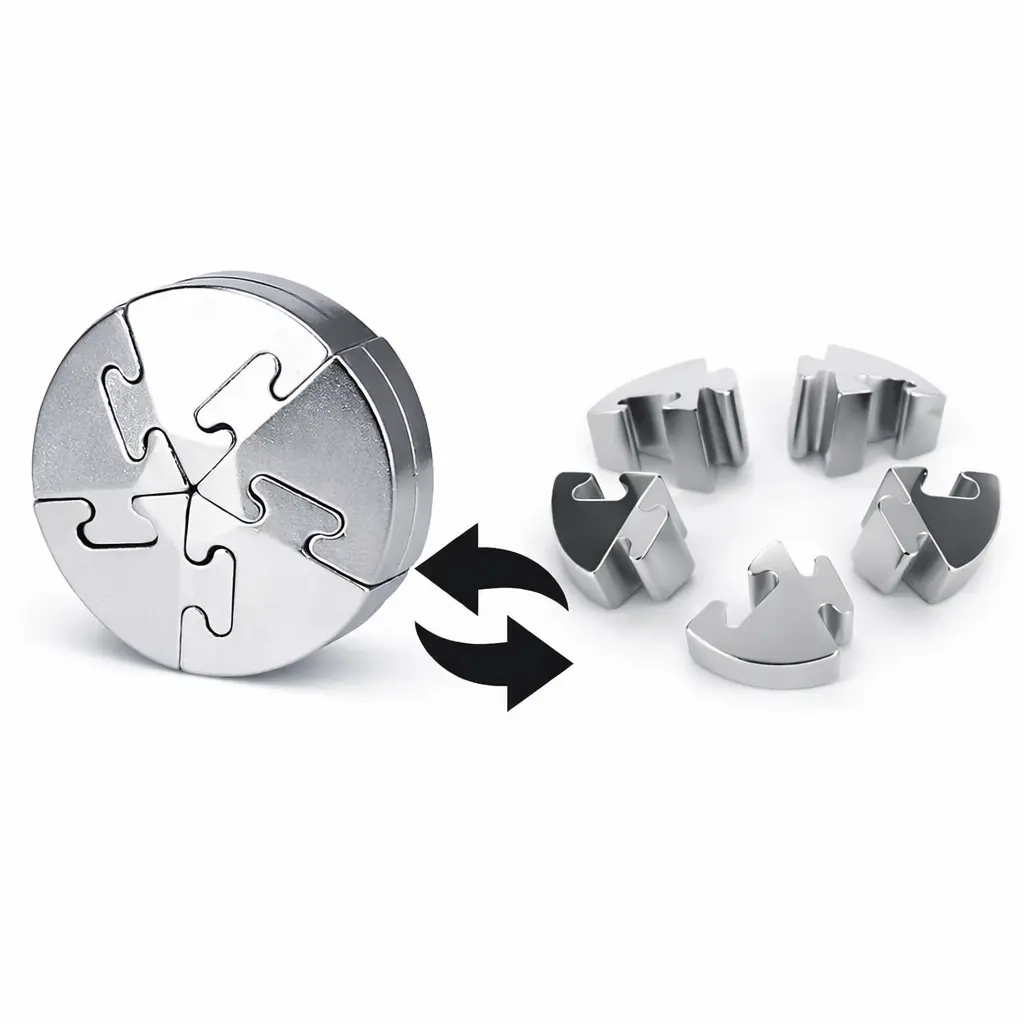
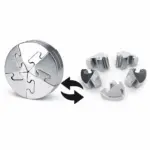
Your first goal is simple: take it apart. The five pieces separate into individual wedges, each one shaped like a slice of pie with interlocking nubs and voids along the edges.
Most solvers figure out disassembly within 10 to 20 minutes. The trick isn’t strength—it’s direction. The edges are tapered, meaning pieces only slide apart one way. Push in the wrong direction, and they lock tighter. Find the right angle, and they glide free with almost no resistance.
Here’s what to expect:
- Minutes 0–3: You’ll rotate the puzzle, testing each seam. Nothing moves much.
- Minutes 3–8: You’ll find one piece that wiggles slightly. Focus there.
- Minutes 8–15: The first piece separates. The rest follow quickly.
The moment the puzzle collapses into five pieces in your hand is genuinely satisfying. You’ll probably do it again immediately, just to confirm you understood the mechanism.
Reassembly—The Real Puzzle Begins
Putting the pieces back together is harder. Much harder.
The five wedges look nearly identical. Their curved edges and tapered connections create multiple ways they seem like they should fit—but only one configuration actually closes into a solid disc. This is where the puzzle assembly guide principles become valuable: patience over force, observation over assumption.
Expect reassembly to take two to three times longer than disassembly on your first attempt. Some solvers report 30 minutes to an hour before everything clicks. Others solve it in 10 minutes but can’t replicate the result the next day because they didn’t internalize the pattern.
The puzzle teaches a lesson: taking things apart is easy. Understanding how they fit together requires attention.
Four People Who’ll Love This
The Desk Fidgeter If you keep pens, stress balls, or random objects within reach during work, this puzzle belongs on your desk. It’s quiet enough for video calls, engaging enough to occupy restless hands, and small enough to tuck in a drawer when focus returns.
The Commuter Trains, planes, waiting rooms—the Cast Spiral thrives in dead time. No battery, no screen, no Wi-Fi required. Just 46 grams of precision-machined metal that fits in a jacket pocket. One solver mentioned keeping it in their bag for airport security lines: “By the time I reached the scanner, I’d solved it twice.”
The Gift-Giver Seeking Something Different Tired of giving candles and gift cards? The Cast Spiral makes an impression. It looks expensive, feels substantial, and provides genuine entertainment—unlike most novelty gifts that end up in donation bins. Check our brain teaser gift guide for pairing suggestions.
The Puzzle Collector Starting Their Journey If you own zero mechanical puzzles and want to test whether this hobby suits you, the Cast Spiral is a reasonable entry point. It’s challenging enough to feel rewarding, but not so brutal that you’ll abandon it after an hour. From here, you might explore the Alloy Triangle Lock Puzzle or the Bagua Lock for progressively complex mechanisms.
Three People Who Should Look Elsewhere
The Extreme Difficulty Seeker Let’s be honest: the Cast Spiral’s “Level 5” rating has drawn criticism from experienced puzzlers. Community feedback consistently describes it as easier than expected—closer to a Level 3 in practice. If you’ve solved dozens of metal puzzles and want something that will stump you for days, this isn’t it. Consider puzzles in the top metal puzzles guide with higher complexity ratings.
The Impatient Solver The Cast Spiral requires patience during reassembly. If you tend to force pieces, shake puzzles aggressively, or give up after five minutes, you’ll find this frustrating rather than relaxing. The mechanism jams when forced—and unjamming it adds unnecessary struggle.
Children Under 10 While there’s no small-parts choking hazard for older kids, children under 10 often lack the fine motor control and patience for this type of puzzle. The metal edges, while not sharp, can cause discomfort if pieces are gripped too tightly during frustrated attempts. Consider wooden puzzles for younger solvers.
How Cast Spiral Works (Without Spoilers)
The mechanism relies on a principle found in many Japanese-designed metal puzzles: tapered interlocking.
The Tapered Edge Principle
Each of the five pieces has edges that widen in one direction and narrow in another. Think of a drawer that only slides one way. When all five pieces are assembled correctly, they form a self-locking disc where no single piece can move without first unlocking the others.
The spiral pattern isn’t decorative—it’s functional. The curved seams create a rotational dependency. Piece A can’t move until Piece B shifts. Piece B needs Piece C to rotate first. Finding the starting point—the one piece with enough freedom to move—is the heart of the puzzle.
This is similar to the principle explored in the six-piece burr puzzle guide, where understanding sequential dependency unlocks the solution.
Why Five Pieces Instead of Six?
Odd numbers create asymmetry. With five pieces, no two are perfectly opposite. This prevents the “just push both ends” approach that simplifies even-numbered puzzles. You can’t apply balanced force across a five-piece spiral—you have to find the weak point.
For solvers who enjoy this asymmetric challenge, the Grenade Lock Puzzle offers a similar philosophy with a completely different mechanism.
Your First Solve: A Timeline
Not everyone solves puzzles at the same pace. Here’s a realistic breakdown based on community feedback and intricate puzzle experiences:
Minutes 0–5: Exploration
You’ll examine the puzzle from all angles, testing each seam with light pressure. Nothing dramatic happens. This is the observation phase—your brain is mapping the structure without conscious effort.
What to do: Don’t force anything. Let your fingers learn the shape.
Minutes 5–15: The “Almost” Phase
One piece starts moving slightly. You’ve found the key. The temptation now is to pull hard. Resist. The movement you need is rotational, not linear. Think “unscrew” rather than “pull apart.”
What to do: Follow the piece that moves. Let it guide the next step.
Minutes 15–30: Breakthrough (Or Frustration)
Either the puzzle falls apart in your hands—a sudden, satisfying release—or you’re stuck, trying the same moves repeatedly.
If stuck: put it down. Walk away. Return in 10 minutes. Fresh eyes notice details tired ones miss. This approach applies to all mechanical puzzles, as discussed in why common advice fails at stress-relief puzzles.
How Cast Spiral Stacks Up
| Feature | Cast Spiral | Typical Ring Puzzle | Typical Lock Puzzle |
|---|---|---|---|
| Pieces | 5 solid wedges | 2–4 interlocked rings | 3–6 components |
| Primary Motion | Rotational slide | Twist and separate | Sequential unlock |
| Disassembly Time | 10–20 minutes | 5–15 minutes | 15–45 minutes |
| Reassembly Difficulty | Moderate-High | Low-Moderate | Moderate |
| Portability | Excellent (pocket-size) | Good | Varies |
| Noise Level | Silent | Silent | May click |
| Replay Value | Moderate | High | Moderate |
If the Cast Spiral’s profile doesn’t match what you’re seeking, the 4 Band Puzzle Ring offers a different challenge with similar portability, while the Snake Mouth Escape Puzzle provides historical context alongside mechanical complexity.
What Goes Wrong (And How to Fix It)
Mistake 1: Forcing Pieces Apart The most common error. When pieces won’t separate, adding force just locks them tighter. Solution: release pressure completely, rotate 15 degrees, try again.
Mistake 2: Ignoring the Taper Direction Pieces only move one way. If you’re pushing and feeling resistance, you’re pushing the wrong direction. Solution: reverse your motion. What felt like “pulling apart” should become “sliding along.”
Mistake 3: Losing Track During Reassembly Once apart, the five pieces look similar. Solvers often try random combinations rather than systematic approaches. Solution: before disassembling, note which piece has the most distinctive shape. Use it as your reference point during reassembly.
Mistake 4: Expecting It to Click Unlike some traditional brain teasers, the Cast Spiral doesn’t audibly click when solved. The pieces simply… stop moving. If you’re waiting for confirmation, you might already be done.
Giving Cast Spiral as a Gift
Best Occasions
- Secret Santa / White Elephant: The $10–15 price range makes it perfect for office exchanges. It’s interesting enough to avoid the “obvious regift” category.
- Stocking Stuffer: Small, affordable, genuinely entertaining. Better than candy that disappears in a day.
- Thinking-of-You Gift: For the person who loves puzzles, adding this to their collection shows you understand their interests. Pair it with the Cupid’s Heart Chain Puzzle for a themed set.
- Recovery or Waiting Gifts: For someone facing medical recovery or extended waiting periods, the Cast Spiral provides distraction without requiring screens or heavy concentration.
Who to Avoid Gifting This To
- People who openly dislike puzzles (respect their preferences)
- Children under 10 (frustration risk)
- Anyone who needs instant gratification (this rewards patience)
- Recipients who already own 50+ metal puzzles (they likely have it or something similar)
For more gift pairing ideas, explore the gifts for logic lovers collection.
What Solvers Are Saying
[Synthesized from similar product reviews]
“Took me 22 minutes. I’m not proud of that.” — Describing the disassembly phase
“Reassembly is where the real puzzle lives. I had pieces scattered on my desk for two days before I figured out the pattern.” — Highlighting the replay challenge
“I keep it next to my keyboard. When I’m stuck on a problem, ten minutes with this resets my brain.” — The desk fidget use case
[Community sentiment paraphrase]
Many solvers note the difficulty rating seems inflated. Expectations of a brutal challenge lead to mild disappointment when disassembly comes quickly. However, those who appreciate the reassembly complexity rate the experience highly.
[Competitor review theme]
Common praise across retailers: the metal quality feels premium, the size is perfect for pockets, and the puzzle genuinely requires thought rather than just trial-and-error.
Honest assessment: If you buy this expecting to struggle for hours, you may be underwhelmed. If you buy it expecting a satisfying desk companion that rewards patience and observation, you’ll be pleased.
Frequently Asked Questions
How long does it take to solve the Cast Spiral puzzle?
Most first-time solvers disassemble it in 10–20 minutes. Reassembly typically takes 20–45 minutes initially, dropping to 5–10 minutes once you’ve internalized the pattern.
Is the Cast Spiral puzzle really a Level 5 difficulty?
Community feedback suggests it’s easier than the official rating implies. Experienced puzzlers often rate it closer to Level 3. For a more challenging metal puzzle, consider options in the Level 6 category.
Can children solve this puzzle?
Ages 12 and up can typically handle it with patience. Younger children may become frustrated due to the fine motor control required during reassembly.
What material is the Cast Spiral made from?
The puzzle appears to be cast zinc alloy with a chrome-style finish. The exact composition isn’t disclosed by most manufacturers.
Does the Cast Spiral come with a solution guide?
Most versions include a basic solution guide. However, figuring it out yourself provides significantly more satisfaction.
Can you damage the puzzle by forcing it?
Yes. Excessive force can scratch the finish and may cause pieces to jam tightly. If stuck, release all pressure and try a different angle.
How does Cast Spiral compare to the Four-Leaf Clover Puzzle?
The Four-Leaf Clover Puzzle uses interlocking rings rather than wedge pieces. Both test spatial reasoning, but the motion types differ—the Clover requires twist manipulation, while the Spiral needs rotational sliding.
Is this puzzle good for stress relief?
Yes, particularly for people who process stress through physical fidgeting. The repetitive manipulation creates a meditative rhythm. For more options, read why common advice fails at stress-relief puzzles.
What similar puzzles should I try after mastering Cast Spiral?
The Bagua Lock Puzzle offers a similar metal construction with different unlocking mechanics. The Alloy Triangle Lock introduces geometric complexity without increasing piece count significantly.
Is this a good gift for puzzle collectors?
It depends on their collection size. For someone with 5–15 puzzles, this is a solid addition. For someone with 50+, they likely own it or something similar. Check the metal and wooden brain teasers guide for alternatives.
Sometimes the greatest reward isn’t cracking the puzzle, but discovering you needed nothing cracked at all.
The Cast Spiral won’t change your life. But it might change your afternoon—and sometimes, that’s enough.
Ready to try it? Browse our metal puzzles collection or explore puzzle toys for more brain-teasing options.

Sophia Davis –
I was challenged but had fun with this cast metal puzzle, took me a while to solve it, and the feeling of accomplishment was so satisfying, though it can be a bit fiddly to handle due to its small size.
Ethan Allen –
I gave this as a gift and they loved it, the cast metal design is really nice and it’s a great value, perfect gift for anyone who likes puzzle toys