
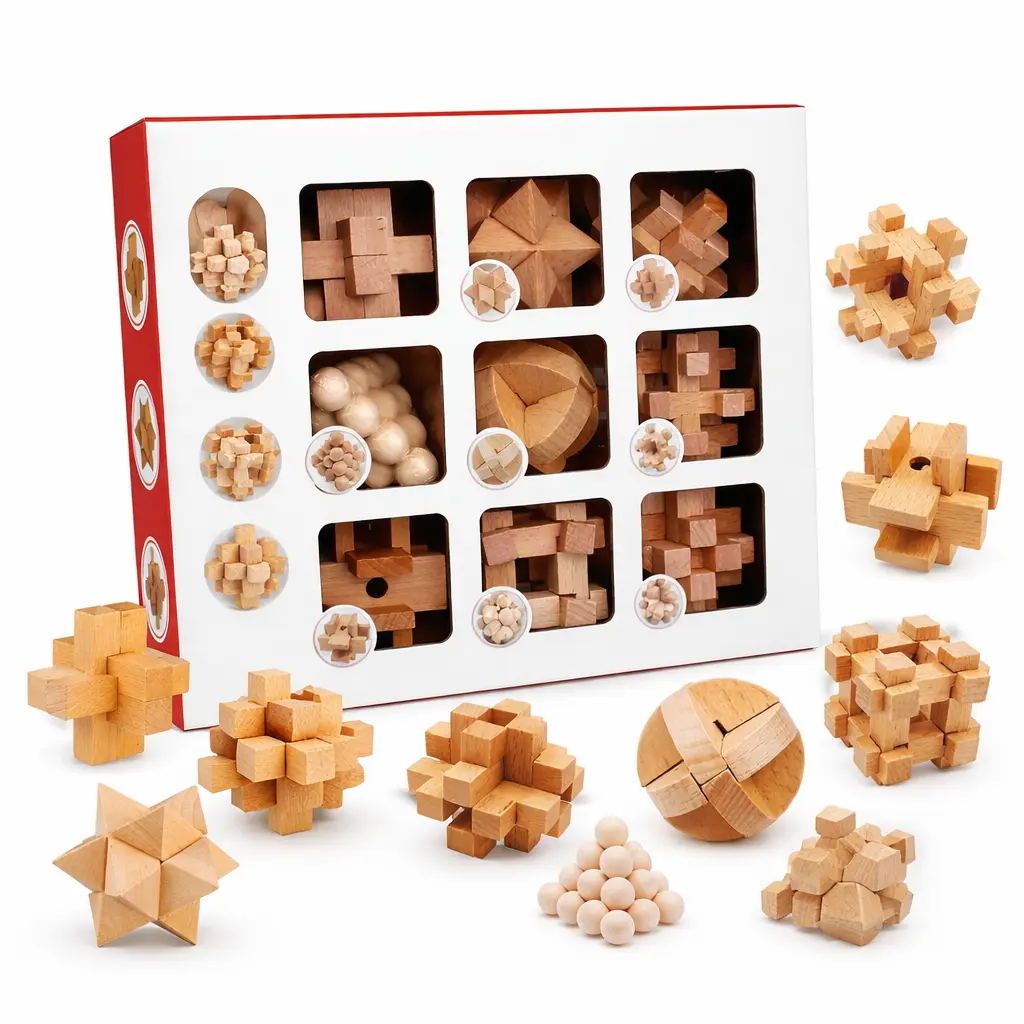
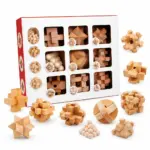
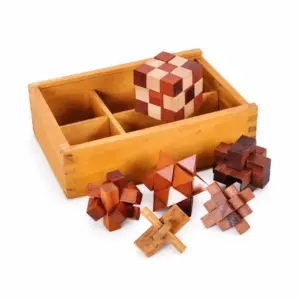
Nine Puzzles. Nine Different Ways to Outsmart You.
There’s a reason museum gift shops stock these and PhD students keep them on their desks. Luban Locks aren’t about brute force—they reward the person who stops, rotates, and thinks.
Every puzzle in this set operates on the same mortise-tenon principle that ancient Chinese builders used to construct temples without a single nail. Protruding wooden “tenons” slot into carved “mortises,” locking pieces together through friction and precise angles. Pull the wrong piece first, and nothing budges. Find the hidden key piece, slide it at exactly the right angle, and everything releases in a cascade you weren’t expecting.
Disassembly takes seconds. Reassembly? That’s where things get interesting.
What’s Actually in the Box
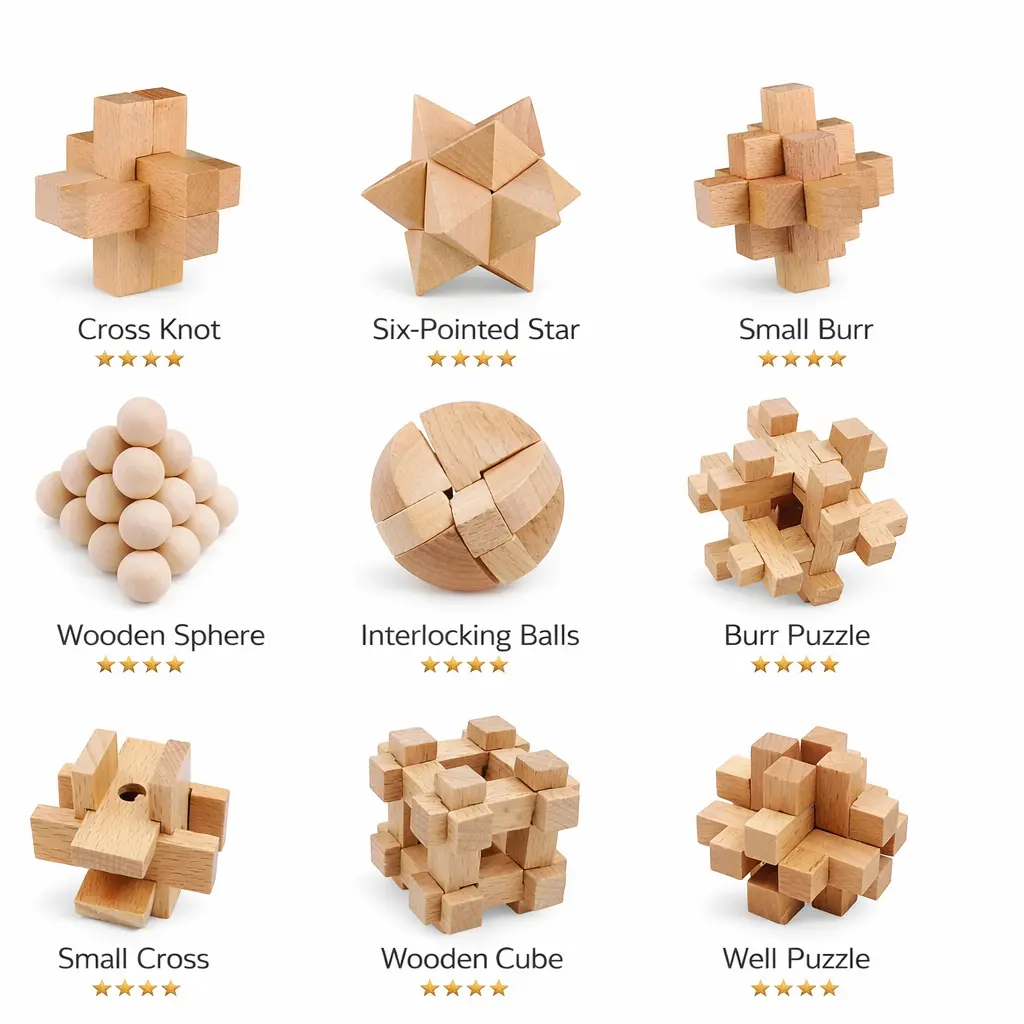
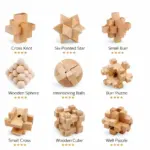
Nine distinct puzzles, each roughly 1.8 inches (4.5 cm) per side, organized by difficulty:
Level 1 (Beginner)
- Six-Way Cross (Six-Direction Lock) – Three interlocking bars forming a symmetrical cross. The simplest design in the set: once you find the key piece, the puzzle falls apart in three moves. A confidence-builder before things get complicated.
Level 2 (Intermediate)
- Hexagonal Star (Six-Pointed Gem) – Six identical pieces with angled edges that mesh into a spiky, symmetrical star. The trick: you can’t add pieces one at a time—final assembly requires positioning multiple pieces simultaneously.
- Pineapple Lock (Small Pineapple) – Named for its spiky exterior, this one hides internal voids that misdirect your assumptions about which piece moves first.
- Ball Pyramid (Pyramid) – Wooden spheres stacked into a tetrahedral shape. Unlike the angular burrs, these round pieces require rotational thinking rather than linear sliding.
Level 3 (Advanced)
- Luban Ball (Luban Sphere) – Curved wooden segments lock into a smooth sphere. No obvious seams, no visible key piece. The most elegant-looking puzzle in the set—and one of the most stubborn.
- Capture the Ball (Ball Removal Lock) – A wooden cage traps a loose ball inside. Your job: extract the ball without breaking anything. The cage itself disassembles, but only in a specific sequence.
- Six-Piece Burr (Six-Piece Lock) – The iconic design. Six notched sticks form a solid cross. Bill Cutler’s 1990 computer analysis found that six-piece burrs can be assembled in over 35 billion different configurations, but only one specific arrangement actually holds together. Your set uses one particular configuration—good luck reverse-engineering it.
Level 4 (Expert)
- Cage Lock (Cage Burr) – A hollow lattice structure with internal supports that seem to defy disassembly. Multiple pieces must move in coordinated sequence before anything comes free.
- Grid Lock (Cross Pattern Lock) – Dense interlocking bars form a tight three-dimensional grid. The high piece count means more potential false moves and longer solution paths.
The Engineering You’re Holding
This isn’t decorative folk art. It’s functional structural engineering.
Mortise-tenon joinery appears in Chinese architecture as early as 7,000 years ago at the Hemudu site in Zhejiang province. By the Spring and Autumn period (771–476 BCE), craftsmen had refined these interlocking joints to construct buildings that could flex during earthquakes rather than collapse. The Forbidden City, built in 1420, uses thousands of mortise-tenon connections and has survived over 200 recorded earthquakes—including a magnitude 7.8 event in 1976.
The puzzles in your hand use the same principle at miniature scale. No fasteners. No adhesives. Just precision-cut wood that stays locked until you understand how to unlock it.
According to Wikipedia, traditional Chinese wooden architecture components “were made to interlock with perfect fit, without using fasteners or glues, enabling the wood to expand and contract according to humidity.” That flexibility is the secret to both earthquake resistance and puzzle frustration.
Who This Is For
Be specific about who actually enjoys these:
Mechanical engineers and architects – These are physical representations of interlocking joint theory. If you’ve ever designed a tolerance stack or debated dovetail angles, you’ll appreciate the precision required to make these puzzles work.
Woodworkers and furniture makers – Lu Ban is the patron saint of Chinese carpenters, credited with inventing the saw, plane, and chalk line. This is tribute to that lineage.
Desktop fidgeters who want something with weight – Solid beechwood beats injection-molded plastic stress toys. These won’t click, squeak, or crack after a month of abuse.
History buffs and collectors – In 2014, the Chinese Premier gifted a Luban Lock to German Chancellor Angela Merkel as a symbol of craftsmanship heritage. In 2020, the craft of making these puzzles was designated a Shandong provincial intangible cultural heritage item.
Teachers and parents – These work as screen-free entertainment that actually holds attention. No batteries. No notifications. Just wood and spatial reasoning.
The Story Behind the Name
Lu Ban (c. 507–444 BCE) was a master craftsman from the State of Lu during China’s Spring and Autumn period. Historical records credit him with inventing the saw, the carpenter’s plane, the chalk line, and other foundational woodworking tools. According to legend, he created interlocking wooden puzzles to test his son’s understanding of architectural principles.
These puzzles also carry the alternate name “Kongming Lock,” after Zhuge Liang (181–234 CE), the legendary military strategist from the Three Kingdoms period. His courtesy name was Kongming, and he had a reputation for encyclopedic knowledge and unconventional problem-solving. Whether he actually designed puzzle variants or simply appreciated them remains debated—but the name stuck.
The international puzzle community calls these “burr puzzles,” probably because the assembled shapes resemble the prickly seed burrs of certain plants. The term first appeared in Edwin Wyatt’s 1928 book Puzzles in Wood, though the concept clearly predates the name by millennia.
Gift Ideas
Because “I got you a wooden thing that’s actually 2,500 years of engineering history” is a better gift story than most:
- Engineering students – Something for the desk that isn’t another textbook
- Retired professionals – Mental engagement without screens
- Kids 6+ – Screen-free entertainment that actually holds attention (start with the Six-Way Cross, work up)
- Anyone who claims “I’m good at puzzles” – Hand them the Cage Lock and set a timer
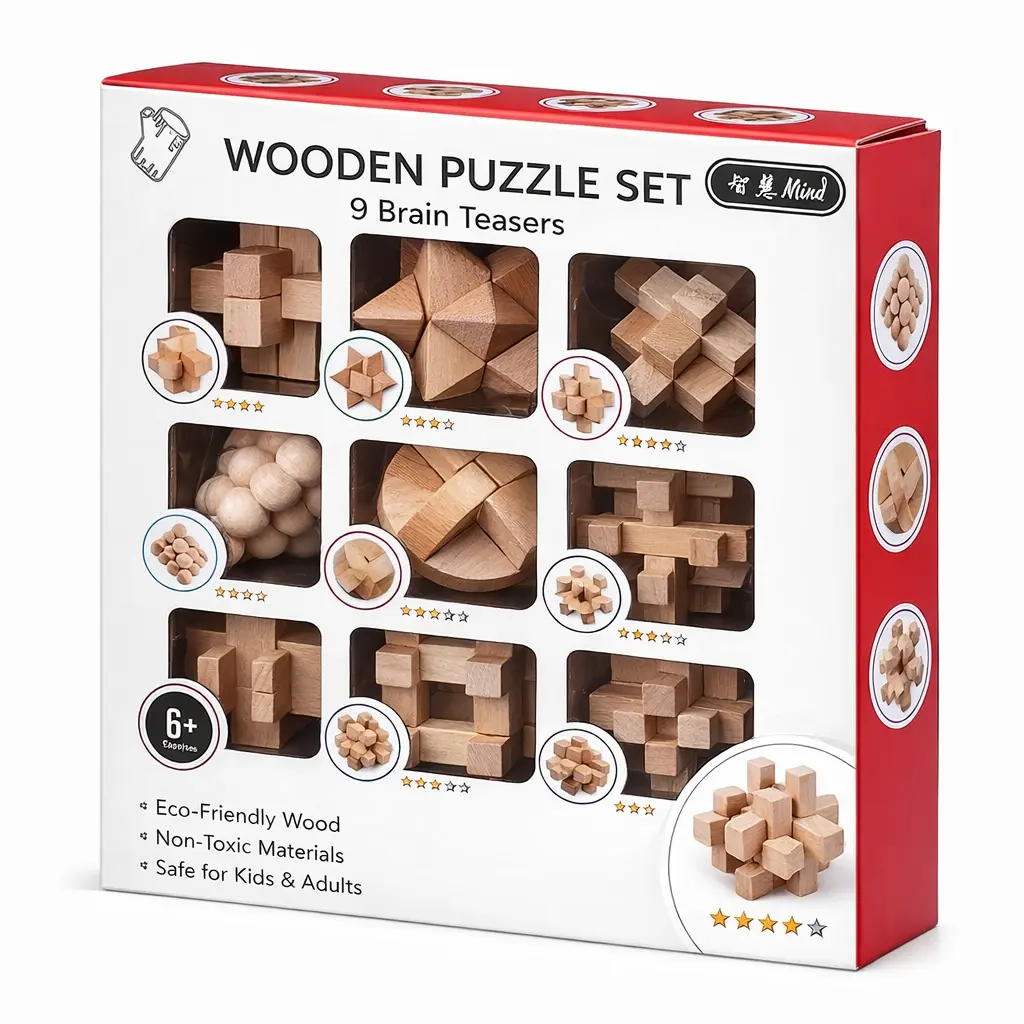
What’s in the Box
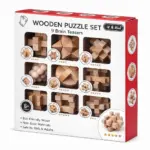
- 9 wooden interlocking puzzles (varied designs as listed)
- Presentation box with clear window (8.7 × 7.9 × 2 inches / 22 × 20 × 5 cm)
- Material: Natural beechwood
- Safety: Eco-friendly ink, non-toxic PVC packaging
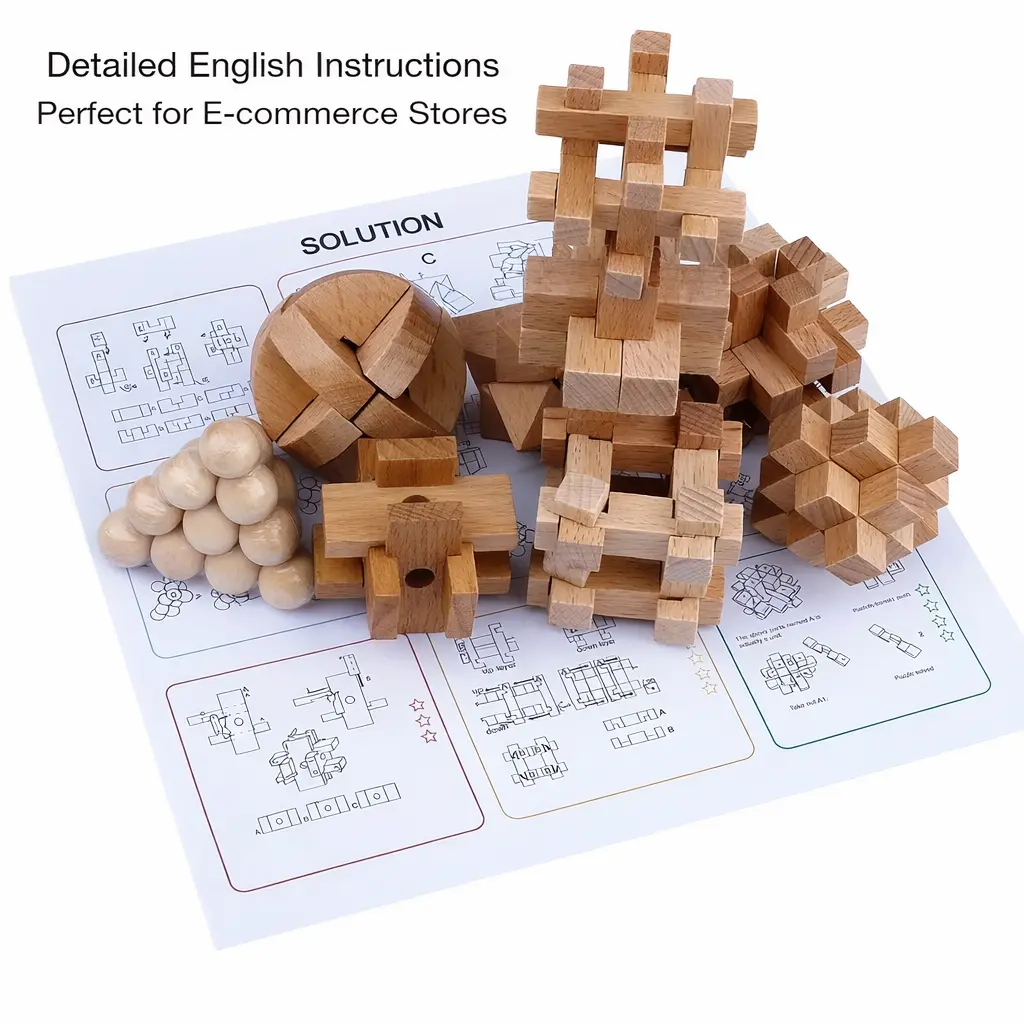
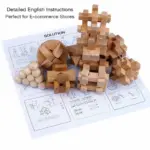
No instruction manual included. That’s traditional.
Looking for something smaller to start? Try our metal puzzle collection for single-puzzle challenges. Questions about difficulty levels? Visit our Customer Help page.
SPECIFICATIONS
| Attribute | Details |
|---|---|
| Set Contents | 9 wooden puzzles + presentation box with clear window |
| Puzzles Included | Six-Way Cross, Hexagonal Star, Pineapple Lock, Ball Pyramid, Luban Ball, Capture the Ball, Six-Piece Burr, Cage Lock, Grid Lock |
| Individual Puzzle Size | ~1.8 × 1.8 × 1.8 in (4.5 × 4.5 × 4.5 cm) |
| Packaging Size | 8.7 × 7.9 × 2 in (22 × 20 × 5 cm) |
| Material | Natural beechwood |
| Finish | Natural wood grain, smooth sanded |
| Difficulty Range | Level 1 (Beginner) to Level 4 (Expert) |
| Historical Origin | Spring and Autumn Period, China (c. 500 BCE) |
| Joinery Type | Mortise-tenon (nail-free interlocking) |
| Recommended Age | 6+ years |
| Safety | Eco-friendly ink, non-toxic new PVC material |
| Instructions | Not included (discovery-based solving) |

Lucas A. –
I found the Luban Lock Set to be a clever design, worth the challenge, and a great addition to my collection. Compared to other puzzles I’ve solved, this one is beginner-friendly and offers a nice break from more complex mechanisms.