




When Zeppelins Dreamed Bigger
Picture this: it’s 1886. Jules Verne has just published Robur the Conqueror, introducing readers to the Albatross—a fantastical heavier-than-air flying machine that circumnavigates the globe. Fourteen years later, Count Ferdinand von Zeppelin would launch his first rigid airship over Lake Constance in Germany, proving that humans really could master the skies.
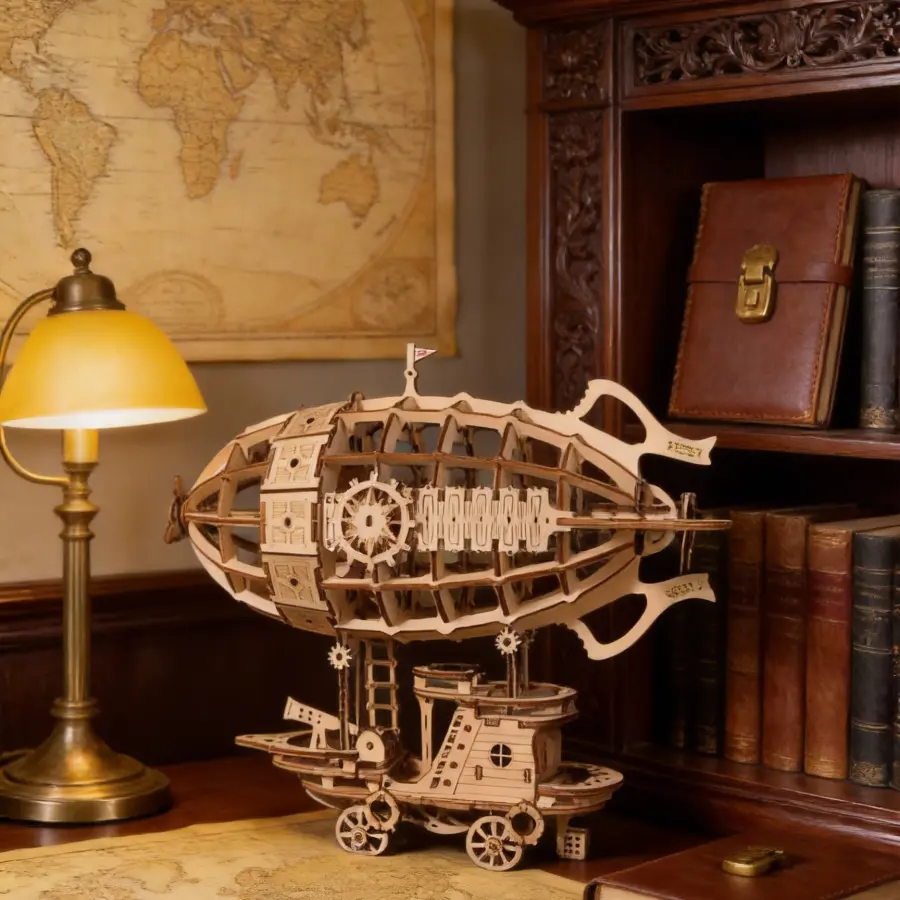
This wooden airship model lives somewhere between those two moments—half Victorian engineering, half literary fantasy. It’s what a zeppelin might look like if designed by someone who read too much Verne and thought, “Why stop there?”
What You’re Actually Building
This isn’t just a static model that sits there looking pretty (though it does that too). The finished airship has functional details that reward close inspection:
The Propeller Actually Spins. Called an “airscrew” in Victorian parlance, the rear propeller rotates freely when you give it a flick. The design echoes the two propellers that powered Zeppelin’s original LZ-1 back in 1900—though his ran on 15-horsepower Daimler engines rather than finger power.
The Wheels Roll. The gondola (that’s the cabin suspended beneath the balloon) sits on a wheeled chassis. Push the whole assembly across your desk, and it glides. These wheels would’ve been essential for ground handling—real zeppelins needed enormous ground crews to maneuver them in and out of hangars.
The Spyglass Points Forward. Mounted on the prow of the gondola, a telescope extends toward the horizon. Every airship captain needs to see what’s coming, whether that’s a mountain range or an unexpected thunderstorm.
The Storage Room Has Doors. The cabin features tiny window frames and a door you can actually open. Inside, there’s room for—well, nothing, really. But the detail sells the illusion that this vessel could carry cargo across continents.
Why Steampunk Captured the Imagination
Steampunk as a genre emerged in the 1980s, when writers like K.W. Jeter, Tim Powers, and James Blaylock started asking: What if Victorian technology had taken a different path? The aesthetic draws heavily from 19th-century industrial machinery—exposed gears, brass fittings, riveted panels, leather straps.
But steampunk isn’t just nostalgia. As the Aesthetics Wiki notes, it represents a counterculture that values craftsmanship, mechanical transparency, and the visible workings of things. In an age of sealed smartphones and incomprehensible algorithms, there’s something satisfying about a machine where you can see exactly how it works.
This airship embodies that philosophy. Every piece of the laser-cut wood skeleton is visible. The gear motifs on the balloon structure aren’t decorative afterthoughts—they’re part of the design language, suggesting machinery beneath the surface.
The Real History Behind Fantasy Airships
Count Ferdinand von Zeppelin was 62 years old when his first airship lifted off from a floating hangar in 1900. He’d spent decades developing the concept, inspired in part by observing balloon operations during the American Civil War. According to Britannica, the LZ-1 was 128 meters long and could reach speeds approaching 20 miles per hour.
Zeppelins became commercially viable by 1910, with the world’s first airline (DELAG) carrying over 10,000 passengers before World War I began. The famous Graf Zeppelin logged over 1.6 million kilometers in its career, including 144 ocean crossings.
Of course, Jules Verne imagined it all first. His 1886 novel featured an aircraft that could fly faster than any balloon, built by the enigmatic inventor Robur who declared: “The future belongs to heavier-than-air machines.” Scholars now call that book “proto-steampunk”—a term Verne never heard, but probably would have appreciated.
Who’s Going to Love This?
The Steampunk Enthusiast. If you own goggles, a pocket watch, or anything made of brass, this airship belongs on your shelf. It’s a building project and a display piece in one. Check out our About page to see how we curate products for exactly this kind of collector.
The Verne Fan. You’ve read Twenty Thousand Leagues Under the Sea. You’ve debated whether Phileas Fogg could really circumnavigate the globe in 80 days. Now you can build a flying machine inspired by the same literary universe.
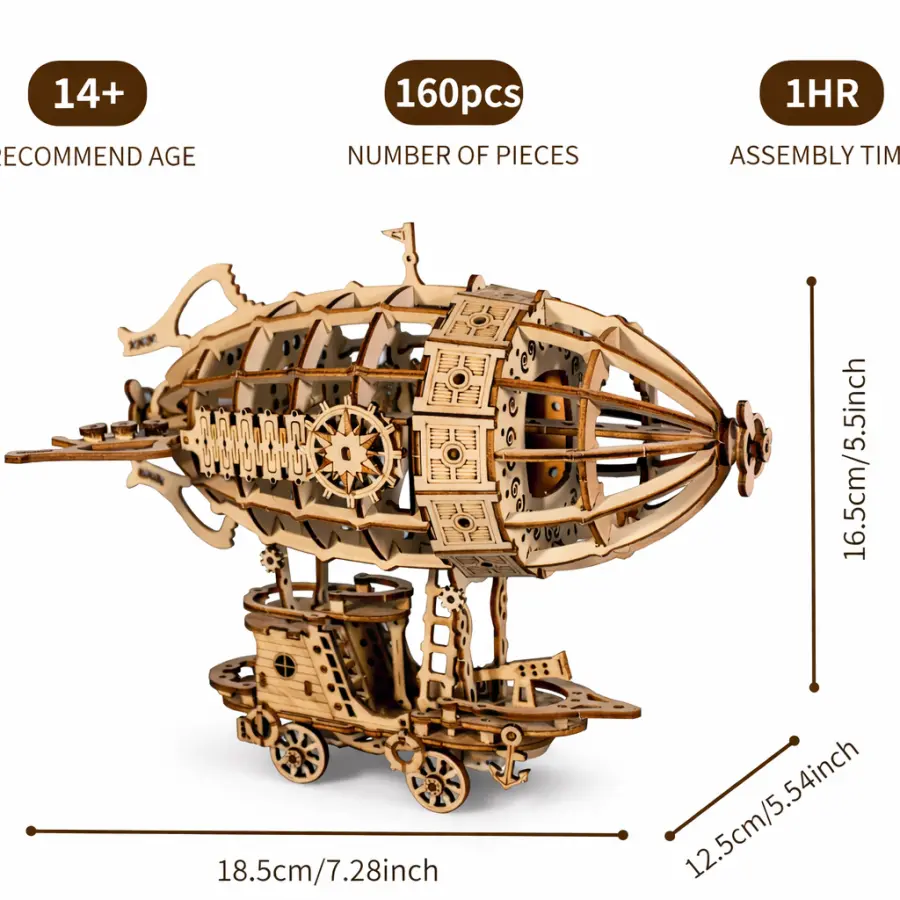
The Office Decorator. Tired of generic desk accessories? This airship sits at 16.5 centimeters tall—roughly the height of a coffee mug—and instantly becomes the most interesting thing in your workspace. Visitors will ask about it. You’ll explain it. Conversations will happen.
The Gift-Giver. Looking for something for the engineer who already has every gadget? The history teacher who makes everything interesting? The teenager who’s obsessed with Victorian aesthetics? This checks all those boxes.
The Build Experience
With 160 pieces, this puzzle sits in the sweet spot—substantial enough to feel like an accomplishment, manageable enough to complete in a single evening. Everything comes pre-cut on four laser-etched wooden boards. No glue required, no tools needed beyond the included sandpaper for smoothing any rough edges.
The pieces snap together using interlocking tabs, a technique that echoes traditional woodworking joinery. You’re essentially assembling a tiny architectural structure, with the balloon framework going together first, then the gondola, then connecting the two.
The estimated one-hour build time assumes you’re working steadily without distractions. If you’re the type who likes to examine each piece, appreciate the laser-cut detail, and maybe imagine yourself piloting this thing over the Alps—budget for two.
Materials & Quality
The wood has a natural, unfinished tone that photographs warmly and ages gracefully. Laser cutting produces remarkably clean edges, with each piece fitting precisely into its neighbors. The engineering tolerances on these kits have improved dramatically in recent years—gone are the days of forcing pieces together or finding gaps in the final assembly.
You could paint it, if you wanted to. A bronze or copper metallic finish would amplify the steampunk aesthetic. But most builders keep it natural, letting the wood grain speak for itself.
Why Tea-Sip?
At Tea-Sip, we don’t sell everything. We select items that combine doing something with meaning something—products that spark curiosity, invite conversation, and look better on your desk than another generic knick-knack.
✓ Fast Shipping: We dispatch same-day and ship worldwide. Shipping Policy
✓ Easy Returns: 30 days to decide if it’s right for you. Refund Policy
✓ Real Support: Questions? Our customer help team responds quickly. Contact us anytime.
Browse our full collection of puzzle toys to find more builds like this one.
SPECIFICATIONS
| Specification | Details |
|---|---|
| Piece Count | 160 pieces |
| Dimensions (Assembled) | 18.5cm × 16.5cm × 12.5cm (7.3″ × 6.5″ × 5.0″) |
| Assembly Time | Approximately 1 hour |
| Recommended Age | 14+ |
| Material | Laser-cut plywood |
| Tools Required | None (sandpaper included) |
| Glue Required | No |
| Package Contents | 4 wood boards, sandpaper (×1), illustrated instructions |
| Moving Parts | Propeller (spins), wheels (roll) |


CalmCollector – mindfulness practitioner –
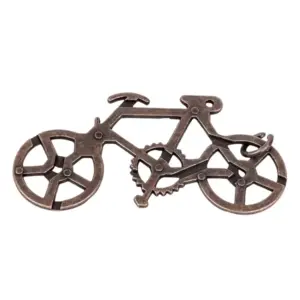
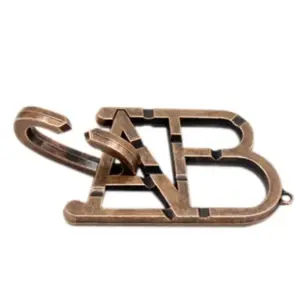
I’m delighted with the Steampunk Airship 3D Wooden Puzzle, made from durable cast metal (zinc alloy). As a mindfulness practitioner, I appreciate its beginner-friendly design and portable size, making it great for stress relief on-the-go. The interlocking design is satisfying to handle and helps me focus. For $26.66, it’s a great value, but I deducted a star due to some minor sharp edges.