








The ride that changed amusement forever (and fits on your desk)
In 1893, Chicago needed something spectacular—something to rival the Eiffel Tower that had dazzled Paris four years earlier. Engineer George Washington Gale Ferris Jr. proposed a 264-foot rotating wheel that could carry 2,160 passengers at once. Critics called it impossible. Ferris built it anyway. According to the National Endowment for the Humanities, nearly 1.5 million people paid 50 cents each (about $17 today) to ride that wheel during the World’s Columbian Exposition.
That wheel is long gone—it was demolished with dynamite in 1906—but the idea lives on in every observation wheel you’ve ever seen. And now you can build a working wooden version that does something Ferris’s original never did: it makes music.
What makes this Ferris wheel different from typical 3D wooden puzzles
Most wooden model kits sit still after you build them. This one doesn’t. Here’s the full mechanical payoff:
Turn the crank and the wheel rotates. The gear train hidden in the base translates your hand motion into smooth circular movement. Each of the eight “space capsule” gondolas rises and dips as the wheel spins, just like the real thing.
Two music movements play simultaneously. This is unusual—most music boxes use a single mechanism. Having two lets the notes layer on top of each other, producing a fuller, more orchestral sound. The movements are driven by the same crank, so the music and motion stay synchronized.
A hidden drawer slides out of the base. It’s small but functional—room for a spare key, a few coins, or a folded note. A nice bonus that adds real utility to the finished model.
How music boxes actually work (spoiler: no batteries)
If you’ve ever wondered how a tiny mechanism produces recognizable melodies, here’s the short version: a rotating cylinder studded with pins plucks the tuned teeth of a steel comb. Each tooth is cut to a specific length so it vibrates at a precise pitch when plucked. Arrange the pins in the right sequence, spin the cylinder at a steady pace, and out comes a song.
According to Britannica, the music box was probably invented around 1770 in Switzerland when watchmakers began placing these mechanisms inside pocket watches and snuff boxes. The technology peaked in the late 1800s before phonographs took over. What you’re getting in this kit is essentially a working piece of 18th-century engineering—just powered by your hand instead of a wound spring.
235 pieces, 2-3 hours, and what to expect
The parts come pre-cut on 11 laser-cut plywood sheets. You’ll pop them out, smooth any tight spots with the included sandpaper, and assemble step-by-step using the illustrated instructions (3 booklets). Screws are included for mounting the music movements; you get a screwdriver in the box as well.
The build itself has three distinct phases:
- Base and drawer — You’ll construct the housing that holds everything together, including the hidden drawer mechanism.
- Gear train and music movements — This is where the mechanical magic happens. You’ll install the two music movements and connect them to the crank shaft through a series of wooden gears.
- Wheel and gondolas — The fun part: assembling the eight gondolas (labeled “space capsules” in the images) and attaching them to the central wheel, then mounting the whole assembly on the base.
If you like following clear instructions and seeing mechanical systems click into place, this is the sweet spot: complex enough to be satisfying, but achievable in a long afternoon or a couple of focused sessions.
Who this is really for
Let’s get specific:
The engineering-minded fidgeter. You appreciate visible gear trains, exposed mechanisms, and things that move when you interact with them. You probably have strong opinions about watch movements or keyboard switches.
The history nerd with a desk. You’d rather display something that tells a story than a generic decoration. The 1893 World’s Fair angle gives you a conversation starter—Ferris, the Eiffel Tower rivalry, the 200 pounds of dynamite ending.
The gift-giver who needs something better than a candle. Buying for a collector? A teacher who loves hands-on demos? A teenager who needs a screen break? This works. It’s specific enough to feel thoughtful, interactive enough to not collect dust.
Someone building a collection of mechanical models. If you already have our Layered Butterfly Music Box or the 3D Carousel Music Box, this fits the same vibe: build it yourself, then actually use it.
What you’ll get in the box
Everything you need arrives in one package: wood boards (11 sheets), instructions (3 booklets), music movements (2 units), screws (8 pieces), sandpaper (1 piece), and a mini screwdriver (1 piece). No glue required—the pieces interlock using tab-and-slot construction with screws for the mechanical components.
Honest notes before you buy
Wood varies slightly. Laser-cut plywood has natural grain differences, so each finished model looks a little different. Some people love this; if you want uniformity, just know it’s wood being wood.
The melody may vary by batch. Many music movements use well-known tunes, but unless the listing specifies a song, treat it as a surprise.
Alignment matters for smooth motion. If the wheel feels stiff or the gears stick, double-check your spacing and use the sandpaper on snug joints. A few small adjustments usually solve any friction issues.
The sound is classic music-box volume. It’s charming and clear, not room-filling loud. Think desk companion, not speaker replacement.
Why Tea-Sip?
We stock toys that actually do something—not just sit there. This Ferris wheel hits all the marks: it’s buildable, mechanical, musical, and tells a story. Plus, our Puzzle Toys collection is curated for people who like interacting with their stuff, not just looking at it.
Questions? Our Customer Help page is there for you. Want to know about shipping timelines? Check our Shipping Policy. Need to return something? See our Refund & Returns Policy.
SPECIFICATIONS
| product | Details |
|---|---|
| Product Type | Wooden DIY mechanical Ferris wheel music box model |
| Core Feature | Hand-crank drive + dual music movements + rotating wheel + hidden drawer |
| Recommended Age | 14+ |
| Number of Pieces | 235 pcs |
| Assembly Time | 2–3 hours |
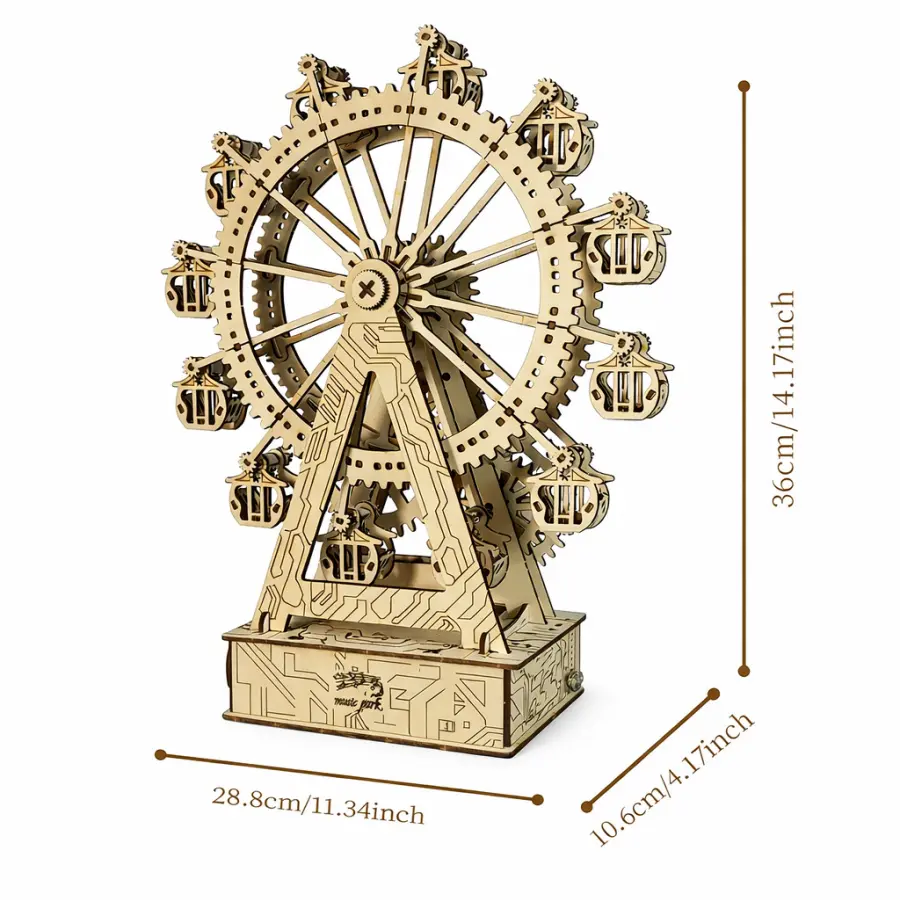
| Assembled Dimensions | Height: 36 cm (14.17″), Width: 28.8 cm (11.34″), Depth: 10.6 cm (4.17″) |
| Build Style | Tab-and-slot fit + screws for mechanism mounting |
| Included in the Box | Wood boards ×11, instructions ×3, music movements ×2, screws ×8, sandpaper ×1, screwdriver ×1 |
| Power Source | Manual hand crank (no batteries required) |
| Material | Laser-cut plywood |





Noah Williams –
I love the beautiful grain on this wooden Ferris wheel, the smooth finish is so satisfying to touch. It’s well-crafted and a great desk toy to fiddle with.
Chloe –
I keep this little ferris wheel on my nightstand and spin it before bed—such a quiet, grounding ritual. The wood feels warm, and the gentle click as it turns helps me focus when my mind races. Only minor thing: it’s so smooth, I sometimes forget it’s there and nearly knock it off the table. Worth every moment.