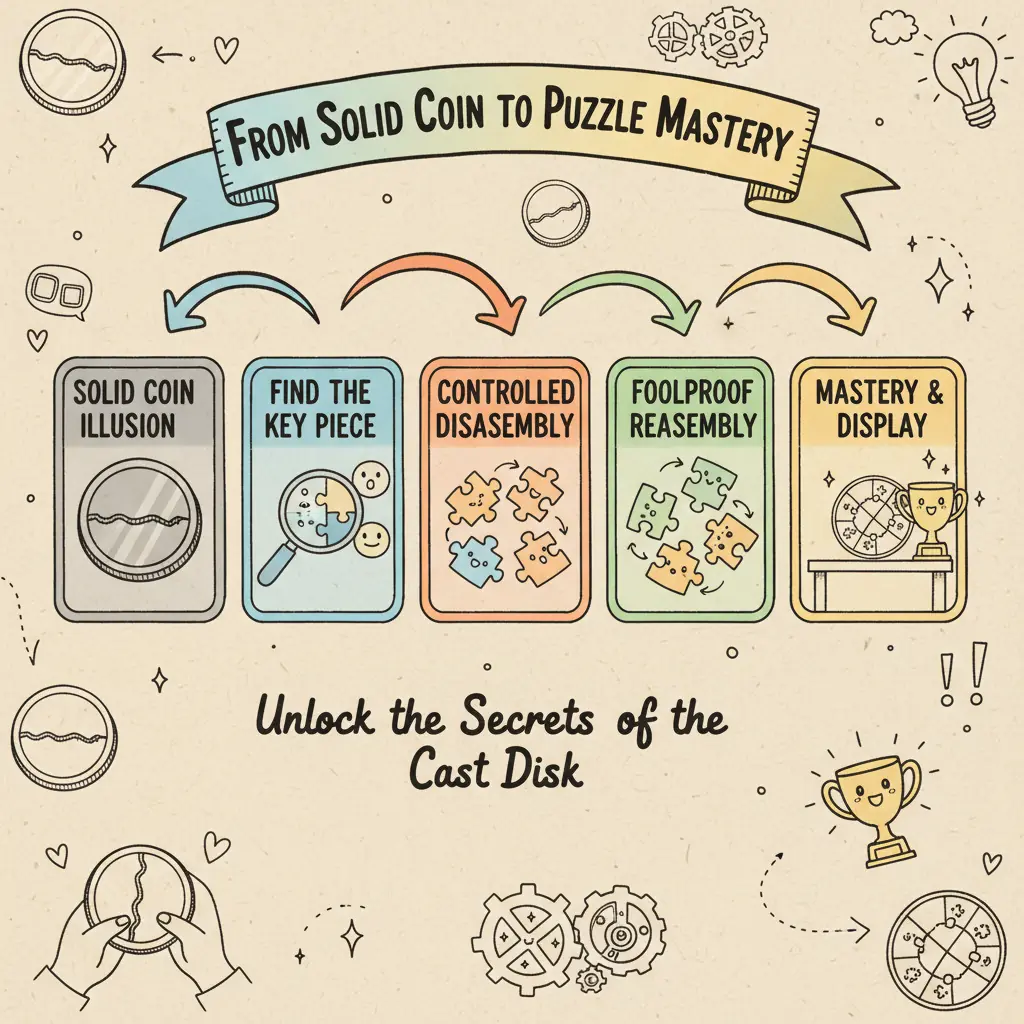
First Contact: Identifying the Solid Coin in Your Hand
You’re holding what feels like a solid metal coin, a cold, heavy disk of impossibility. But there’s a seam—a hairline fracture running through its center. You twist, you pull, nothing gives. This is the Hanayama Cast Disk puzzle, a 1.7-ounce (48-gram) masterpiece of misdirection cast in zinc alloy. Its flawless machined finish hides the secret within.
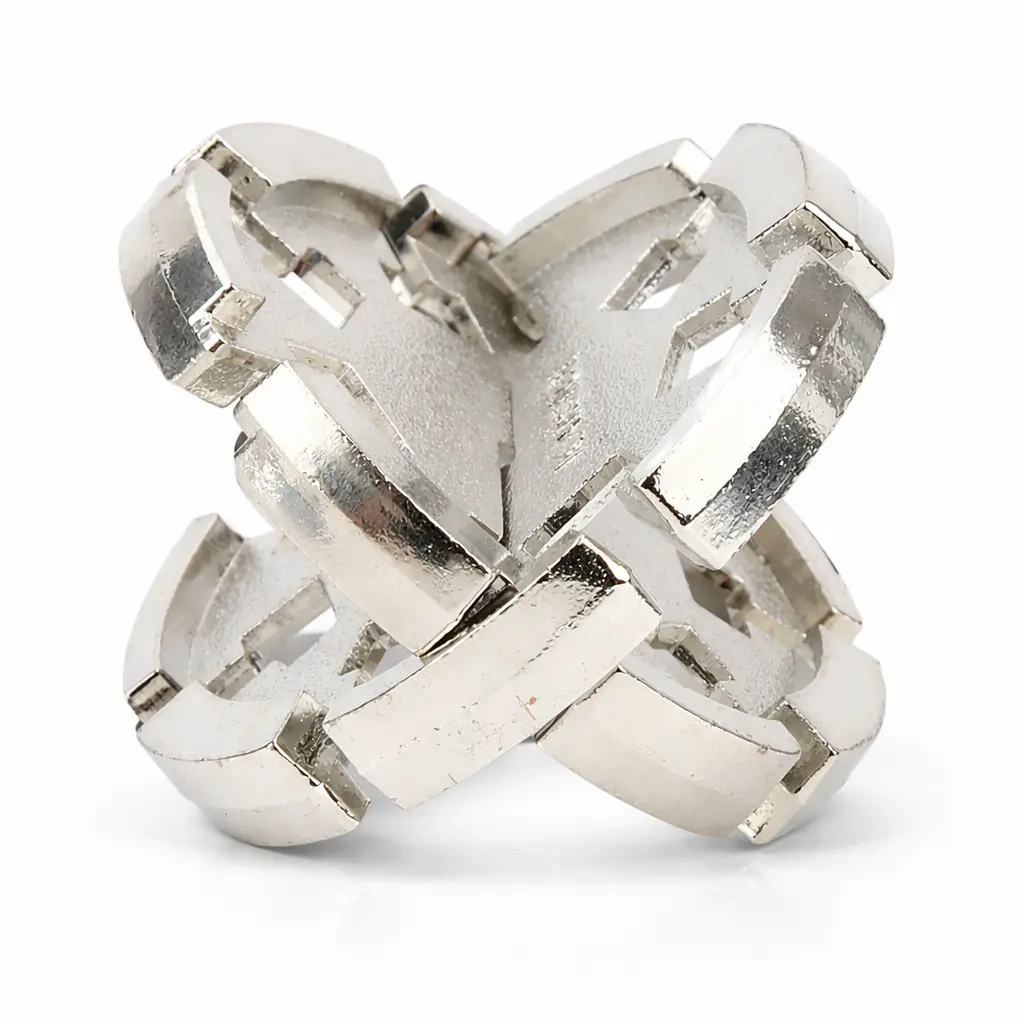
That subtle heft you feel is the first clue. It’s not a toy. It’s a precision object from the Hanayama Cast Puzzle series, designed by the prolific Oskar van Deventer. This specific puzzle, the Cast Disk, carries an official difficulty rating of Level 2 (out of 6). Don’t let that modest number fool you—the genius is in its deceptively simple form. Run your thumb over the seam. You can feel the two distinct pieces, yet they interlock with a tolerance that feels absolute.
On my workbench, this one initially registered as a fancy washer. But that seamless joinery is the whole point. The anodized or plated finish isn’t just for looks; it’s a low-friction coating that allows for the precise, quiet movement you’ll need to discover. Your initial frustration—the fruitless pulling and twisting—is the intended starting point. The puzzle is designed to feel monolithic, creating the core illusion we need to dismantle. For more on the satisfying weight and resistance of puzzles like this, see our exploration of the satisfying heft of metal brain teasers.
For deeper context on the Hanayama series and how the Disk fits among its siblings, our Hanayama puzzle buying guide breaks down the entire ecosystem. And if you’re evaluating this specific model before purchase, our in-depth review of the interlocking metal disk covers all the essential details.
Hold it between your thumb and forefinger. Feel the cool, inert weight of it. That’s the state of locked equilibrium. The solve begins not with force, but with understanding the nature of that seam. It’s not a fault line to be pried apart; it’s a guide to a hidden axis of rotation.
The Core Illusion: Why This Feels Like a Single, Solid Piece
The illusion of solidity is created by a single, perfect alignment. The two pieces of your Cast Disk are machined to interlock along a shared, hidden axis of rotation with a tolerance likely under 0.5mm—when the key slots are aligned, the pieces bind completely, presenting as one unbroken coin. The “seam” you see is merely the meeting point of two independent parts locked in equilibrium.
That dead-feeling seam is your guide. In any good mechanical puzzle, the solution path is built into the geometry. Your fruitless pulling and twisting proves the point: the primary axis of separation is not perpendicular to the disk’s faces. If it were, you’d just pull it apart. The fact you can’t tells you everything. The solution lies in discovering the alternative axis along which the pieces were originally mated—an axis that is currently invisible to you because the key features are perfectly occluded.
This is where the universal principle for puzzles like this comes in. Most physical disentanglement puzzles obey what I call the ‘Three Moves’ Rule. It’s not a literal count, but a conceptual framework: to free one object from another, you rarely pull directly apart. Instead, you execute a short, precise sequence of rotations and translations (slides) that first align internal pathways, then translate one piece along a newly opened axis, and finally rotate it free. The Cast Disk is a masterclass in this principle distilled to its purest form. It has one critical alignment, one translation, and one final rotation. Understanding this framework transforms the puzzle from a random struggle into a logical navigation of its hidden spaces. For foundational strategies, our guide on ancient principles for solving any puzzle is a great resource.
Think of it like a custom key sliding into a complex lock. Right now, the “key” piece is fully seated. The tumblers (the interlocking channels inside) are engaged. To remove it, you must first rotate it to the exact position where the tumblers retract, creating a path. This is the hidden axis—it’s not a new part of the puzzle; it’s the very axis on which the pieces were assembled, now blocked by their current orientation. Your job is to reverse-engineer that assembly path.
For a broader look at this mechanical grammar, our guide on the mechanical grammar of brain teasers breaks down these principles across dozens of puzzles.
The genius of Oskar van Deventer’s design here is in the restraint. There are no extra loops, no complex knots—just two elegantly machined slabs of metal. The interlocking coin puzzle aesthetic makes the illusion more potent because our brains don’t expect a coin to have moving parts. The substantial heft (that 45-60 grams of zinc alloy) further sells the lie of solidity. The coated finish reduces friction just enough to allow for the precise, quiet movement you’ll need, but not so much that the puzzle feels loose or cheap. Every sensory cue, from sight to touch, screams “solid object,” while the single hairline fissure whispers the truth.
So, to directly answer the implied question: your Cast Disk feels solid because its internal escape channels are perfectly misaligned, binding the pieces along every potential axis of motion except one. Finding that one free axis is the entire game. You’re not breaking a weld; you’re operating a very precise, very stiff lock with your bare hands. The satisfying ‘click’ you’re searching for is the sound of that internal channel snapping into alignment, the moment the illusion breaks and the puzzle finally admits, “Okay, you found the door.” Now, let’s find the key.
Finding the Starting Point: Locating the Key Piece and Bind Points
Now that you understand the illusion of solidity, the next step is a tactile investigation. The key piece isn’t marked; you find it by diagnosing the puzzle’s subtle bind points. On the Hanayama Cast Disk, one of the two halves has a slightly greater range of rotational freedom—about 3 millimeters of play at the seam—which designates it as your active ‘key’ for the entire solve. Your job is to identify it and learn its limits.
Look. Don’t pull. Hold the disk between your thumb and forefinger, applying gentle, even pressure across its faces. Focus on the hairline seam. Run your thumbnail along it. You’ll notice one half of the seam is perfectly flush with the other—this is a bind point, a machined wall holding everything fast. But on the opposite side of the disk, you should feel a tiny, almost imperceptible offset, a step maybe 0.5mm high. Your thumbnail might catch. This offset is your first clue. The piece on the side with this slight lip is almost always the key piece. (If you can’t feel it, look: under good light, the mismatch in the seam’s visual continuity is your giveaway.)
Here’s a diagnostic exercise. Try to rotate the two halves relative to each other, like turning a dial. Apply only rotational force, parallel to the disk’s faces. Do not pull them apart. You’ll feel a hard stop after a degree or two of movement—this is the bind point. The pieces lock solid. Now, reverse the rotation. You’ll hit another bind point. Between these two points is your only zone of free play. This zone is the puzzle’s secret corridor, and the key piece is the only one that can travel it. If you feel no movement at all, you’re squeezing the disk too tightly, clamping the pieces together. Relax your grip to a firm cradle.
Understanding this bind point is crucial. It’s not a flaw; it’s the heart of the disentanglement mechanism. When the pieces bind, their internal channels are misaligned, creating a physical stop. Your solve will involve moving the key piece to a specific position where this bind is temporarily cleared, allowing a new axis of motion. It feels like a dead end, but it’s a necessary checkpoint. Remember, the metal won’t flex. If you’re forcing it, you’re on the wrong path and risk galling the fine finish. The correct move will require firm but never straining pressure.
This phase is about building a mental map. You’ve identified the key piece by its telltale seam offset. You’ve felt the bind points that define its narrow window of motion. You now know the puzzle isn’t randomly stuck; it’s in a specific, engineered state. This knowledge transforms the object from a frustrating lock into a precise mechanism waiting for its sequence. The next move—the first of the critical three—involves positioning the key piece within that free-play zone to prepare for the escape. This is a critical shift in how your brain approaches metal puzzles, moving from confusion to structured exploration.
The Controlled Unlock: A Step-by-Step Disassembly (Without Force)
You now have a mental map: the key piece identified, its free-play zone understood, and its bind points felt. The disassembly of the Hanayama Cast Disk requires exactly three distinct, non-forced moves—a principle common to many two-piece disentanglement puzzles. The goal is to align internal channels by rotating the key piece around a hidden axis you create, not by pulling against the tolerance.
Step 1: The Preparation (Aligning the Escape Route)
Hold the puzzle in your palm, key piece facing up. Using your thumb and forefinger on opposite edges of the key piece only, give it a firm quarter-turn counter-clockwise within its free-play zone. You’ll feel it settle into a new, slightly looser position. (If it won’t turn, you’re likely gripping the entire disk; isolate your fingers on the key piece’s rim). This rotation doesn’t free anything yet. It repositions the internal channel of the key piece relative to the fixed piece’s post, setting up the geometry for the next move. Think of it as turning a dial to the first click.
Step 2: The Pivot (Finding the Hidden Axis)
This is the “aha” move. With the key piece in its new, quarter-turned orientation, you must now change its axis of rotation. Stop thinking “side-to-side” and start thinking “tilt.” Push one edge of the key piece down toward the palm of your hand, while lifting the opposite edge up toward your fingers. You’re not pulling the pieces apart; you’re cantilevering or pivoting the key piece on a diagonal axis. Apply steady, increasing pressure in this tilting motion.
As you pivot, you’ll feel the bind release. This is where the internal channel of the key piece begins to slide around the head of the fixed piece’s post, not against it. The movement is subtle—maybe 2-3 millimeters of lift on the high side. You’ll hear a faint, precise satisfying click as the head of the post clears a lip inside the key piece. (If you meet hard resistance, return to Step 1 and ensure your initial rotation was full. The bind point is unforgiving if the alignment is off by a single degree).
Step 3: The Separation (The Clean Exit)
Once the pivot is complete and the click is felt, the illusion shatters. The axis of rotation is now completely different. Simply continue lifting the now-tilted key piece straight up and away from the fixed piece. No twist, no wiggle. It will slide off cleanly. The two pieces will come apart in your hands, revealing the simple machined post and the cleverly routed channel that made it all seem impossible.
Troubleshooting the Stuck State:
If your puzzle seizes in a new, halfway position during the pivot, don’t panic. You haven’t broken it. This is a common misstep where the internal post has entered a blind alley in the channel. The fix is almost always the reverse: gently guide the key piece back along the path it came, returning to the aligned position from Step 1. The tolerance is incredibly tight, so movements must be deliberate. Forcing it will only create metal-on-metal galling. As noted in our guide on stop forcing and start solving metal puzzles, your instinct to apply more force is the puzzle’s primary defense mechanism.
The “Three Moves” Principle in Action:
The Cast Disk is a textbook example of this rule. 1) Preparation: Rotate to align the escape path. 2) Transformation: Change the plane or axis of motion (the pivot). 3) Execution: Perform the now-obvious separation. Most interlocking metal puzzles obey some variation of this sequence. Mastering it here teaches you to look for the axis change in any similar puzzle, moving beyond random fiddling to informed manipulation.
Final Check:
You’re done when you have two separate pieces: one is a flat disk with a complex, hook-like channel cut into its underside, and the other is a nearly identical disk with a small, machined post rising from its center. Study them. Run your finger over the smooth, anodized finish of the channel walls. The elegance is in how that channel uses a 45-degree twist to hide the exit, creating the perfect desk fidget once you know its secret. The heaviness in your hand is gone, replaced by the lighter click of two independent pieces. Remember this feeling—the reassembly, which we’ll cover next, requires you to retrace this sequence in reverse with even more precise alignment.
The True Challenge: A Foolproof Guide to Reassembly
Reassembly is where most solvers fail, not because it’s complex, but because it requires executing the disassembly sequence backward with perfect spatial awareness. While taking it apart might have felt like a 30-second discovery, putting the Hanayama Cast Disk back together for the first time typically takes 3-5 minutes of focused alignment. The challenge shifts from discovery to precise reversal, testing if you truly understood the mechanism or just followed steps.
You’re holding the two separate pieces. The key piece is the one with the small, central post. The other is the receiver piece with the intricate, L-shaped channel. The common frustration—trying to jam the post straight into the channel’s opening—is the root of all reassembly agony. You cannot brute-force this. You must retrace the disassembly path in reverse, which demands you find the hidden axis from a dead start.
First, get oriented. Hold the receiver piece in your non-dominant hand, channel side up. Hold the key piece in your dominant hand, post pointing down. Your goal is not to insert, but to interlock the pieces along the same 45-degree skewed plane they exited from. The entire process is a literal inversion of the three-move principle: 1) Execution: Align for entry. 2) Transformation: Pivot into the binding position. 3) Preparation: Rotate to lock.
Here is the mirrored, step-by-step process. I’ll narrate it like a sportscaster calling a precision landing.
Step 1: The Hook.
Bring the post of the key piece down to hover just above the deep, rounded end of the channel in the receiver piece (the end opposite the opening’s notch). Don’t insert it. Just make contact. This is your starting dock. (Visualize this as returning the spacecraft to the exact spot it launched from.)
Step 2: The Slide.
Now, slowly slide the key piece along the channel’s path. Move it toward the notch. You’ll feel the post glide smoothly along the machined groove. This is the reverse of the final separation move. Stop when the post hits the internal wall just before the notch opening. This is the bind point.
Step 3: The Pivot (This is the axis change).
This is the critical move most people miss. The pieces are now bound, seemingly stuck at an angle. This is correct. You must now rotate the key piece up and over the lip of the receiver piece. Gently pivot the entire key piece on that bind point, lifting its outer edge up and rotating it so the two disks begin to lie flat against each other. You are changing the plane of engagement. You’ll feel the post slide in the channel as you do this. Apply light, downward pressure with your thumb on the center of the key piece as you complete the rotation.
Step 4: The Settle and Lock.
If your pivot was correct, the two disks will now be flat together, but not fully seated. The post is in the channel, but the pieces can still slide apart. This is the home stretch. Without pulling them apart, rotate the entire assembly as a single unit. Turn it slowly. You are searching for the alignment where the post slips into the final, short leg of the L-shaped channel. When you find it, you’ll feel a distinct drop—a subtle, deep satisfying click as the pieces seat fully. The hairline seam disappears. It is once again a solid coin.
Why is this harder? Gravity and vision work against you. During disassembly, the pieces naturally want to come apart once the axis is found. During reassembly, you must actively oppose that tendency and guide them into a state of tension. You’re also working from a separated state with no visual cues on how they interlock inside.
If it’s not clicking:
* Problem: The pieces spin freely but won’t lock.
* Solution: You’re in the main channel. Reverse the pivot (Step 3) slightly, re-establish the bind, and try the final rotation again with more deliberate downward pressure during the pivot.
* Problem: The pieces bind hard and won’t rotate flat.
* Solution: You’ve misaligned the initial slide. Separate fully, realign the post at the deep end of the channel, and start Step 2 over. Never force it.
Mastering this reassembly is the final seal on your understanding. It transforms the Cast Disk from a one-time challenge into a desk fidget—a tactile ritual you can perform mindlessly, feeling for the precise tolerance and the quiet snick of completion. This ability to deconstruct and reconstruct at will is what moves you from someone who solved a puzzle to someone who commands its mechanism. Now, let’s talk about what this object really is.
Understanding Your Puzzle’s Place: Hanayama Levels & The Designer’s Touch
Commanding the Cast Disk’s mechanism, as you now can, naturally leads to a question: where does this little masterpiece of tension and tolerance sit in the wider world of puzzles? Its official designation is Hanayama Level 2 (of 6), a rating that indicates an ideal entry point—a solve focused on discovering a single, elegant principle rather than navigating a maze of them. For most solvers, a Level 2 puzzle like the Disk takes between 5 and 30 minutes of blind exploration before the aha moment clicks.
This rating can feel deceptive. If you’ve struggled, it’s likely because you were fighting the illusion of solidity. If it felt quick, you intuitively grasped the axis of rotation hidden in plain sight. Compared to another popular Level 2, the Cast Loop, the Disk is often considered the more purely conceptual challenge. The Loop presents an obvious open ring and a shackle, telegraphing its disentanglement nature. The Disk offers no such clues; its entire puzzle is convincing you a puzzle even exists. That’s the designer’s touch.
Speaking of the designer, understanding Oskar van Deventer explains the Cast Disk’s character. With hundreds of mechanical puzzles to his name, Oskar’s philosophy often leans towards elegant economy. He doesn’t just design mechanisms; he designs illusions. The Cast Disk is a quintessential Oskar move: take two simple pieces, use precise offsets and channels to create a state of perceived solidity, and hide the key in the geometry. His puzzles feel less like problems and more like physical theorems waiting to be proven in your hand. The Disk isn’t about complexity; it’s about revelation.
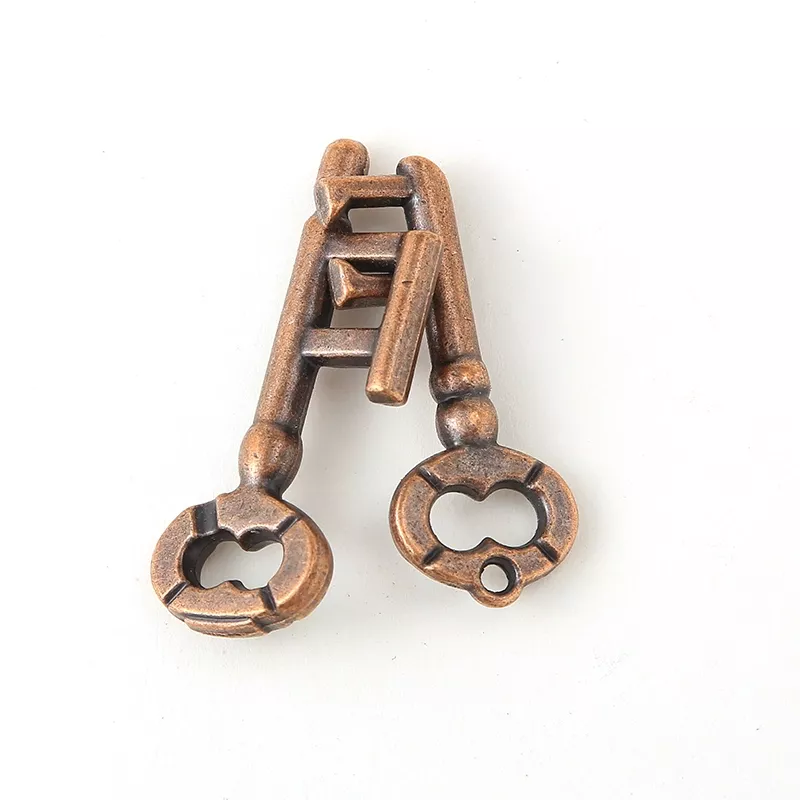
Two Key Lock Puzzle — $11.99
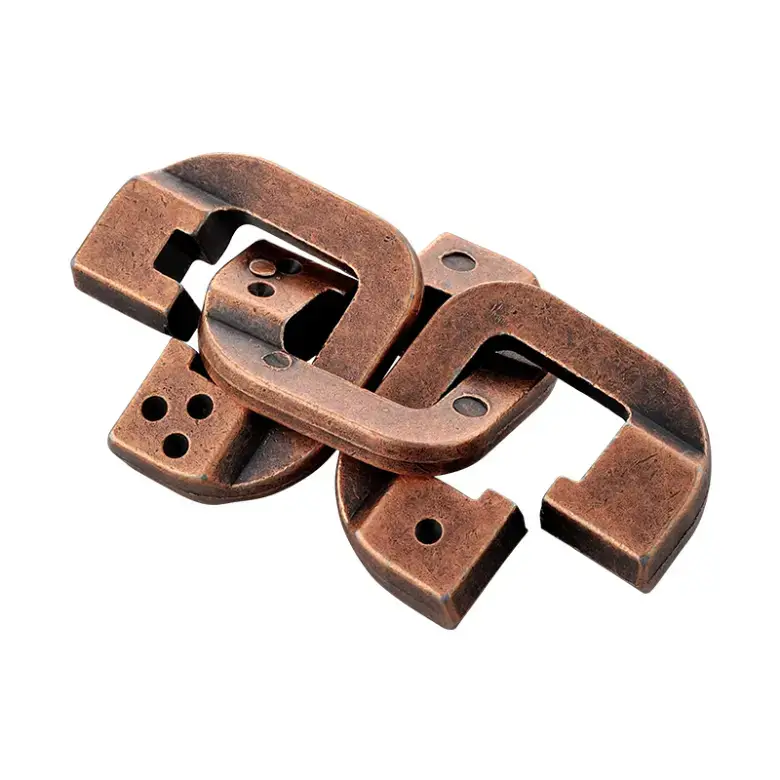
Three Brothers Lock Puzzle — $11.99
This context matters. It tells you the Cast Disk is a deliberate stepping stone. If you enjoyed the clean, single-principle solve, other Level 2 or 3 Hanayama puzzles (like Cast Loop or Cast Key) offer similar “eureka” experiences. The Level system, which we detail in our Hanayama puzzle solutions by level guide, is remarkably consistent. It’s a curriculum in spatial reasoning. Level 1 teaches basic manipulation. Level 2, where the Disk resides, teaches you to question the obvious state of the object. The puzzles don’t necessarily get harder in a linear way as you climb—they incorporate more principles, more false paths, and more intricate bind points. For more on the logic behind these designs, our veteran’s guide to cast metal puzzles offers deeper insights.
So, is the Hanayama Cast Disk hard? Not in steps. It’s deep in concept. Its satisfaction comes from dismantling an illusion, a feat you can now repeat at will. That’s the mark of great design from a bench like Oskar’s: an object that feels as good to understand as it does to solve. Now, let’s ensure it stays in that perfect, satisfying click condition for years of tactile use.
From Puzzle to Desk Fidget: The Satisfying Ritual of Mastery
You’ve graduated from solving the puzzle to understanding it. This is where the Cast Disk transforms from a one-time challenge into a permanent, satisfying object for your hands. Once internalized, the elegant three-move solution can be executed in under 10 seconds—my personal best is a quiet, methodical 3.1 seconds—but the real value isn’t speed. It’s the ritual.
The satisfaction is profoundly tactile. The initial cold heft of the zinc alloy, the subtle drag of the machined finish against your fingers, the precise moment of alignment where resistance melts away—these are the sensory rewards. It’s the satisfying click, a quiet, metallic snick, that signals perfect engagement, whether taking apart or reassembling. This isn’t a plastic toy; it’s a precision instrument for resetting your focus.
This is the desk fidget factor, elevated. Unlike a mindless spinner, the Cast Disk requires just enough cognitive engagement to break your stress loop. Your hands perform the short, memorized dance: find the offset, rotate on the hidden axis, slide. The sequence is a kinetic mantra. It clears mental static through structured, physical interaction. (This is why many collectors, myself included, keep a solved Level 2 or 3 puzzle like the Disk within arm’s reach—it’s a satisfying click of mental recalibration).
Care for this ritual is simple. The coated finish is durable, but oils and acids from your skin can, over years and thousands of solves, dull the luster. A monthly wipe with a dry microfiber cloth is all it needs. Do not lubricate it. Graphite or oil attracts dust and grime, creating a paste that will gum up the critical tolerances. The puzzle is designed to work dry. If it ever feels gritty, a gentle wash with mild soap and water, followed by thorough drying, will restore the smooth action.
Display it solved or assembled; it’s a conversation piece either way. But its true home is in your pocket or on your desk, not on a shelf. It is an object engineered for interaction. The moment of mastery isn’t when you solve it the first time. It’s the fiftieth time, when your fingers know the path better than your mind does, and you experience the pure, mechanical poetry of the thing itself. That’s the final gift from Oskar’s bench: not a problem to be solved, but a perfect, heavy, satisfying click to be enjoyed.
Preserving the Precision: Care, Handling, and Display for Your Disk
Maintaining your Hanayama Cast Disk’s flawless action is straightforward: respect the tolerance. The zinc alloy pieces are coated for durability, and with proper care, you can solve it thousands of times without wear. The rule is simple: never use lubricants like graphite or oil—they attract dust and create a paste that gums up the very tolerances that make the solve smooth.
That satisfying, precise feel depends on clean, dry metal-on-metal contact. If the puzzle ever feels gritty or sticks at a bind point (and it’s not just part of the solve), give it a gentle wash with lukewarm water and a drop of mild dish soap. Agitate the pieces, rinse thoroughly, and dry completely with a soft cloth. Let it air-dry for an hour to banish all moisture from the seam. This will restore the original drag-free slide.
Avoid dropping it on hard surfaces. While robust, a direct impact can ding the machined finish or, in a worst-case scenario, warp the pieces enough to affect the fit. Your disk isn’t fragile, but it is a precision object. Its construction shares some conceptual DNA with ancient, interlocking wooden designs like the burr puzzle, where precise fit is everything.
For display, its heft and clean lines make it a natural desk piece. Place it assembled or apart; both states tell a story. A small felt-lined tray or a dedicated spot among your tools honors it as functional art. But its true home is in hand. This is the ‘fidget factor’ realized—a tactile ritual that maintains its satisfying click for a lifetime.
If you’re wondering where to buy cast disk puzzle replacements or new challenges, stick to reputable puzzle retailers like Puzzle Master or Kubiya Games to ensure you get authentic, quality-cast pieces.
The confidence you’ve gained isn’t just in solving it. It’s in knowing you can preserve and appreciate the engineering. You started with a seemingly solid coin, frustrated by its secret. Now, you understand its heart. Your next step? Try a Hanayama Level 3. You’re ready.