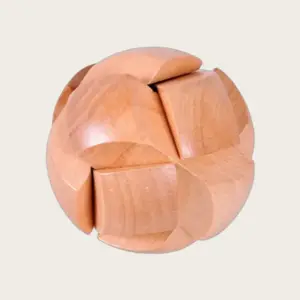
The Click and The Dread: You’ve Built It, Now How Do You Save It?
That final, perfect piece snaps into place with a satisfying click. For a glorious second, you bask in the quiet triumph of completing your wooden puzzle—a landscape of intricate, hand-cut pieces now sprawled across the table. Then, reality crashes in. Your beautiful, fragile masterpiece is blocking the dining table. It’s a delicate monolith of effort and sentiment, and a single wrong breath could send it cascading back into a pile of pieces. The panic is real. How do you move it, let alone preserve it?
This is the moment when 90% of first-timers make their critical, often irreversible mistake. They rush. They grab the nearest bottle of adhesive—often a thick wood glue—and slather it on, desperate to “lock it down.” I know this panic intimately. Years ago, that frantic impulse led me to ruin a beautiful, hand-cut maple puzzle. The aggressive glue pooled in the seams, creating permanent, raised ridges on the surface. I turned a work of art into a textured, sticky monument to my own haste.
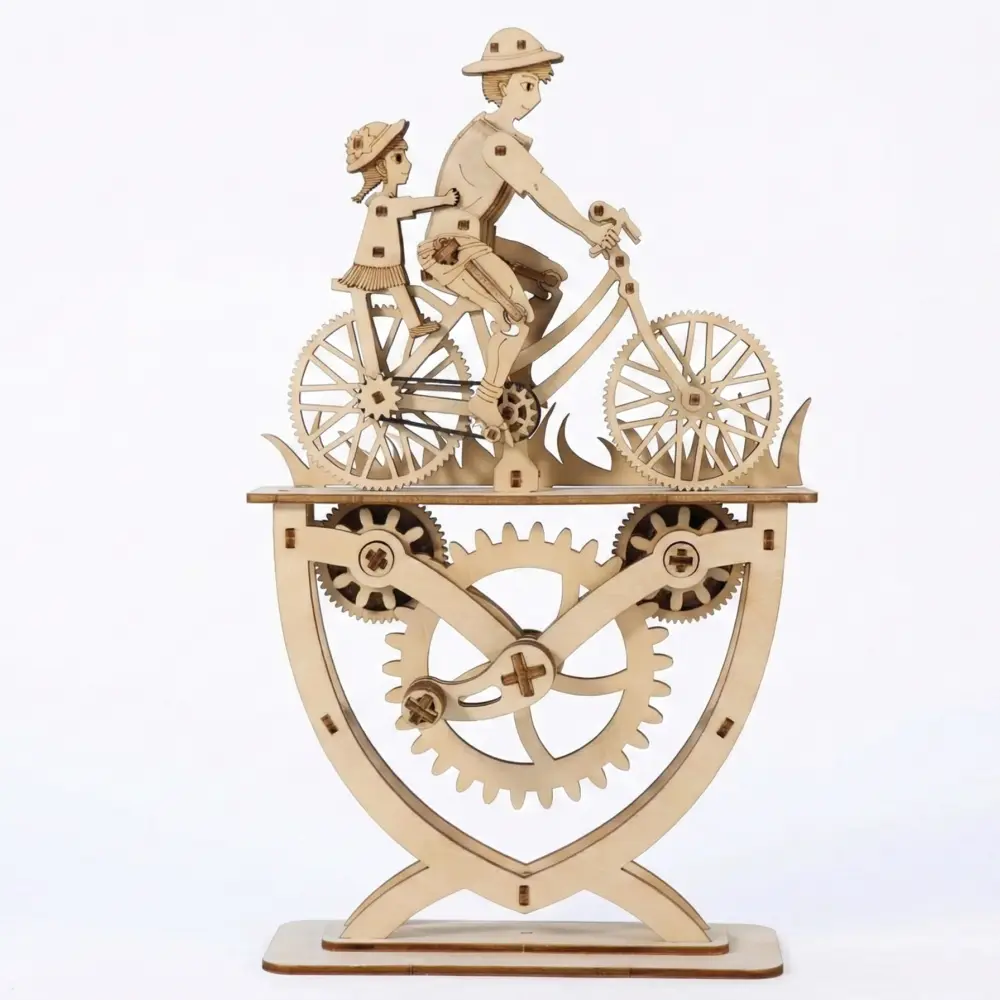
Your puzzle is more than a toy. It’s a finished work, whether it’s a store-bought treasure or a handcrafted marvel like the intricate Father and Daughter Bicycle puzzle. The goal isn’t just to stick it together; it’s to seal and strengthen it for display without causing warping or discoloration. This is where the craft of assembly ends and the art of preservation begins. The overwhelm of glue options—puzzle glue, Mod Podge, wood glue, spray adhesive—and conflicting advice online only heightens the anxiety.
Listen carefully: the path from this dread to confident display is a series of controlled, methodical steps. Your first and most important decision happens before you even unscrew a cap. It’s the decision to prepare, not panic. I’m here to guide you through that process, translating hard-won lessons and collective wisdom from countless workshop hours and forum deep-dives into a reliable methodology. Let’s replace that anxiety with clarity, one deliberate step at a time.
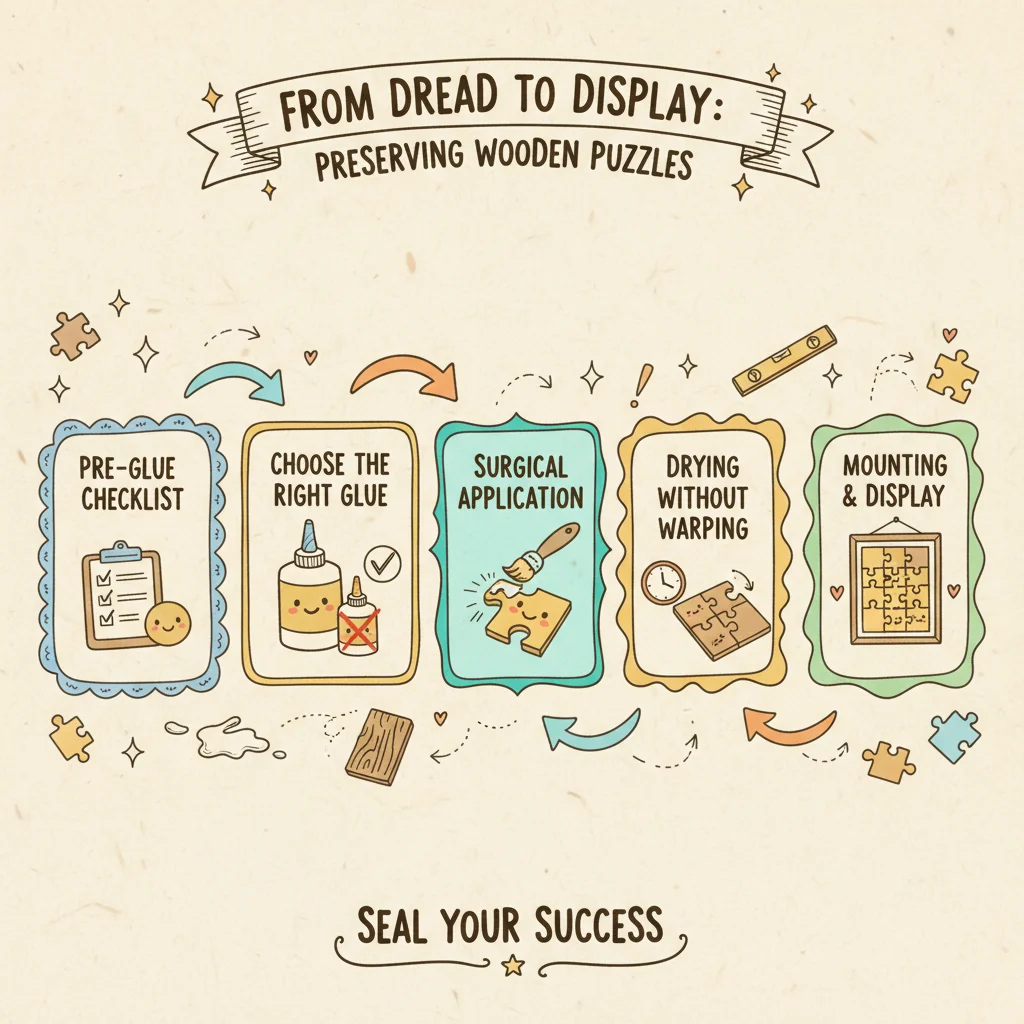
The journey ahead is straightforward, but it demands respect for the materials. We’ll start with a non-negotiable pre-glue checklist to secure your work surface, then dive into the crucial adhesive decision that will make or break your project. From there, a foolproof application process will show you exactly how to glue a puzzle without letting seepage ruin the front image. We’ll conquer the drying gauntlet to prevent warping, and finally, explore your options for a professional mount or frame. Let’s begin.
The Pre-Flight Checklist: What You Must Do Before a Single Drop of Glue
That breath of relief after the final piece clicks into place is your moment of victory. Now, hold onto that feeling, because the next few hours are about protecting it. You have a fragile, intricate object that represents hours of focus, and the single fastest way to compromise it is to rush the preparation. This isn’t just about slapping on some adhesive; it’s a controlled preservation operation. Think of this checklist as your mission brief.
First, secure your staging area. You need a perfectly flat, clean, and spacious work surface—your dining table is ideal, but it must be protected. This is where we invoke the cardinal rule of wooden puzzle preservation: Always use a non-stick barrier. Slide a large sheet of wax paper or parchment paper under the entire puzzle, extending several inches beyond each edge. This isn’t a suggestion; it’s your guarantee that your priceless puzzle won’t become a permanent fixture on the tabletop. The wax coating prevents any glue seepage from bonding to your work surface, which is the number one cause of panic during the flipping or mounting stage.
Now, with your puzzle on its protective sheet, conduct a tactile inspection. Gently run your palms over the entire surface. Feel for any pieces that sit higher than their neighbors or have a slight wobble. Press them firmly into place. Next, use a soft, dry brush or a can of compressed air to remove every speck of dust, pet hair, or debris from the cracks and the surface. Any contaminant trapped under the adhesive will create a visible blemish. This is especially critical for intricate laser-cut wooden puzzles with fine details, the kind you might encounter in advanced 3D wooden puzzles for adults.
Your tools and materials must be assembled and within arm’s reach before you open any glue container. The chaos of searching for a spreader with glue on your hands is how mistakes happen. Here’s your kit:
* Adhesive: Chosen based on the criteria we’ll cover next (but have it ready).
* Application Tool: A flat, flexible squeegee, an old gift card, or a dedicated glue spreader. For intricate, thick wooden puzzles, a small, stiff-bristled brush can help work glue into side seams.
* Weighting System: This is your anti-warping insurance. You’ll need a large, flat, rigid backing board (corrugated plastic, foam board, or thin plywood) larger than your puzzle, and uniform weights. Textbooks, large cooking pans, or dedicated weights work perfectly.
* Secondary Backing (Optional but Recommended): If you plan to mount a puzzle directly, have your final display board (like a stained wood panel or canvas) pre-cut and ready.
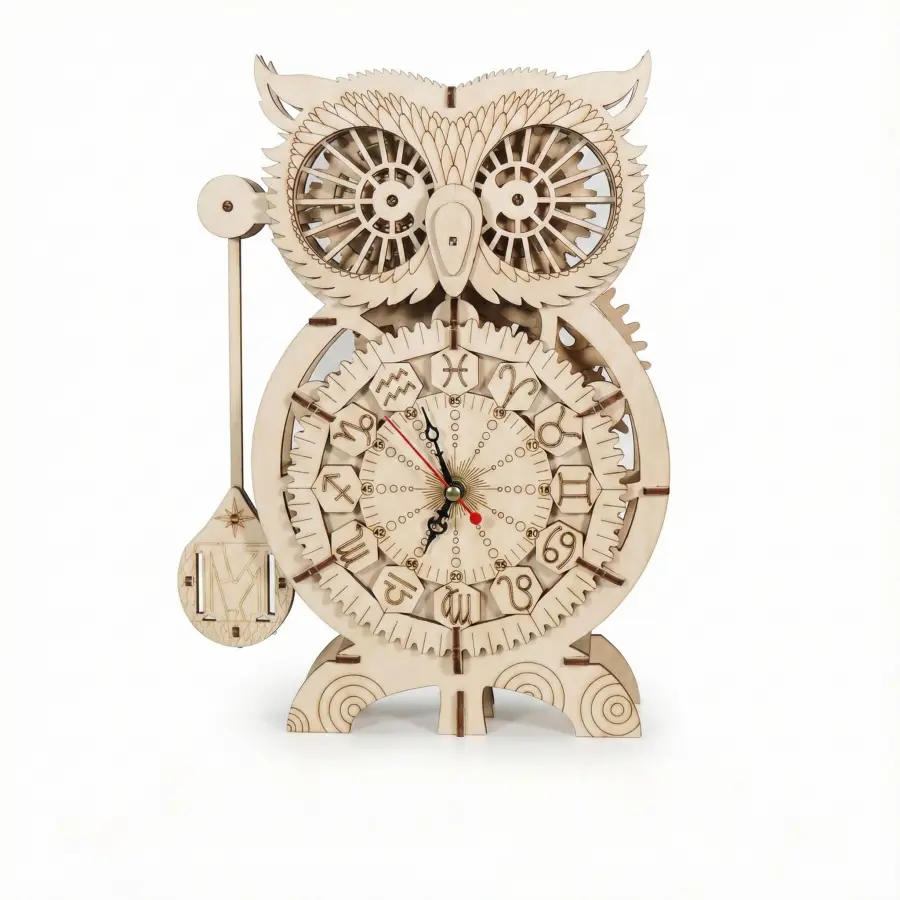
Finally, consider your environment. High humidity is the silent enemy of a flat mount. It drastically extends drying time and encourages the wood fibers to swell unevenly, leading to the dreaded curl. Work in a climate-controlled room if possible. And for intricate, multi-layered puzzles like mechanical 3D designs—which require next-level stability for display—this preparation is doubly critical. The process shares DNA with the careful alignment needed to how to solve a puzzle box without losing your mind, where every piece’s alignment affects the whole structure.
With your puzzle on wax paper, your tools lined up like surgical instruments, and a stable environment, you’ve eliminated the variables that lead to regret. You’ve moved from a state of potential overwhelm to one of controlled readiness. Now, and only now, are you prepared to make the most important decision of this project: choosing the right adhesive.
Adhesive Deep Dive: Why Wood Glue Can Be Your Worst Enemy
You’ve controlled your environment and corralled your tools. Now comes the single most critical choice you’ll make: what to use to permanently seal your puzzle. This isn’t just about sticking pieces together; it’s about selecting a material that complements the wood’s character, dries predictably, and won’t undo your hours of labor. Get this wrong, and no amount of careful preparation will save you. Let’s start with the most common, and most perilous, assumption: that the bottle of wood glue in your shop is the perfect tool for the job.
The Problem with Straight Wood Glue
On its face, it makes sense. You’re gluing wood, so use wood glue. For raw, unfinished wood pieces in a carpentry project, this is sound logic. For a finished wooden puzzle, it’s often a first-class ticket to disappointment. Why? Standard PVA (polyvinyl acetate) wood glue, like Titebond or Elmer’s Carpenter’s Glue, is designed to penetrate raw wood fibers and create a bond stronger than the wood itself. On a puzzle with a printed, varnished, or lacquered surface—which describes most high-quality puzzles—that glue cannot penetrate. It sits on top.
This leads to the two signature failures. First, as it dries and shrinks, it pulls pieces microscopically together, creating visible, recessed ridges along every seam. Your beautiful, flat image now looks like a tiled floor with grout lines. Second, if applied too liberally, it will seep through the tightest seams, staining the front image with a milky, permanent haze. This seepage is almost impossible to remove without damaging the print. So, can you use regular Elmer’s? Not straight from the bottle. But with a crucial modification, it enters the conversation.
Your Adhesive Decision Tree
Your choice should be guided by two factors: 1) Your puzzle’s surface finish (raw wood vs. varnished/lacquered), and 2) Your desired final state (rigid mount for framing vs. a flexible, preserve-in-place backing). Here is your field guide.
1. For a Rigid, Framed Display (The Gallery Standard)
This is the most permanent and professional result. Your goal is to bond the puzzle permanently to a rigid backing board (like 1/8″ hardboard or MDF).
- Thinned PVA Wood Glue (The Controlled Penetrator): This is the professional framer’s trick for a perfectly flat, rigid mount. By thinning standard white PVA glue with water (a 2:1 glue-to-water ratio is the community-tested sweet spot), you create a less viscous liquid glue that can be applied to the back. It soaks lightly into the puzzle’s substrate and into the pores of your backing board, creating a deep, stable bond that resists warping. It dries clear and remains flexible enough to handle seasonal wood movement. Best for: Puzzles you plan to mount permanently to a board. Requires careful, thin application to prevent seepage.
- Liquid Puzzle Glue (The Predictable Performer): Commercial puzzle adhesive like Ravensburger Puzzle Glue or MasterPieces Puzzle glue is essentially a pre-mixed, optimized PVA formula. It’s designed to dry clear and flexible without warping the cardboard—or wood—substrate. It’s user-friendly and excellent for applying to the front as a sealant before mounting. It provides a consistent, even coat but may not create as tenacious a bond with a backing board as thinned wood glue. Best for: Front-side sealing and for those who want a no-mix, reliable product.
2. For Preservation & Flexible Backing (The Keeper of the Piece)
Your goal is to glue the puzzle together so it can be handled, stored, or mounted on a flexible surface like foam board, without making it a rigid slab.
- Mod Podge (The Versatile Classic): To answer the user question directly: yes, Mod Podge (or ModPodge) is a very good option for wooden puzzle preservation, particularly the Matte or Gloss formulas. It’s a PVA-based sealer, glue, and finish all in one. Applied to the front with a foam brush or sponge, it seals the image and locks pieces together. It dries to a durable, clear film. For a wooden puzzle, multiple thin coats are better than one thick one. Best for: Preserving the puzzle as a cohesive, slightly flexible unit, especially when framing under glass isn’t the goal.
- Spray Adhesive (The High-Risk, High-Reward Option): Spray-on glue promises a perfectly even, thin coat. They can deliver it, but they are unforgiving. Overspray gets everywhere, and fumes are intense (ventilation is non-negotiable). A too-heavy spray will seep through seams instantly. They are best used only for mounting a pre-sealed puzzle to a board, not for the initial bonding. Best for: Experienced crafters mounting an already-sealed puzzle in a well-ventilated spray booth.
Decoding Reddit: Translating ‘Watered Down White Stuff’
Scrolling through forum advice, you’ll see countless recommendations for “watered-down Elmer’s School Glue.” This is the hive mind’s DIY version of thinned PVA. It works on the same principle as our thinned wood glue recipe but with a weaker base adhesive. For lightweight preservation, it’s a valid, low-cost path. For a heavy wooden puzzle you intend to hang, upgrading to a stronger carpenter’s glue, thinned appropriately, provides more long-term security for your display.
Remember: No adhesive compensates for a heavy hand. Your goal is to use the minimum effective amount. Whether you choose a liquid glue or a Mod Podge sealant, the next step—application—is where control defines the outcome. Pooling is the enemy. A thin, even coat is your unwavering goal.
The Application: A Surgeon’s Guide to Front vs. Back Method
You’ve chosen your adhesive, understanding its flow and cure. Now, the moment of truth: apply glue. This is where your project graduates from planning to permanence, and where the one mistake 90% of first-timers make lies in wait. That mistake isn’t choosing the wrong glue—it’s applying it with a heavy hand. The goal is not to drown the puzzle, but to seal it with a controlled, minimal bond.
The core question: front or back of the puzzle? My primary, unwavering recommendation for any wooden puzzle where you value the front image is the back-method. It is the clean, professional’s choice. The front-method is a specialized tool for specific cases, fraught with peril for the uninitiated.
The Back-Method: The Guarantee of a Pristine Front
This technique isolates the adhesive to the substrate side of the puzzle, protecting your artwork from any seepage or glossy residue. It requires a single, nerve-wracking maneuver: flip the puzzle.
Step 1: Prepare the Landing Zone.
Before you touch the puzzle, create its drying bed. Lay a sheet of wax paper or parchment paper larger than your puzzle on a perfectly flat, portable surface—a foam board, thin plywood, or even the clean lid of a plastic storage bin. This paper is your insurance policy; it prevents the puzzle from bonding to your work surface. Tape down the corners.
Step 2: Execute the Controlled Flip.
Place your second, identical portable board (or a large, rigid book) directly on top of the completed puzzle. Press down firmly with both hands. In one confident, smooth motion, sandwich the puzzle between the two surfaces and flip the entire stack over. Lift off the top board (which was your original table surface). Your puzzle is now face-down, its back exposed and ready. Breathe. The hardest part is over.
Step 3: Apply Glue with Disciplined Spread.
Pour a small puddle of your liquid glue—be it thinned PVA, commercial puzzle adhesive, or Mod Podge—onto the center of the puzzle back. Using a flat-edge spreader, a stiff gift card, or a foam brush, begin spreading the adhesive thinly outward. Work in sections. Your spreader should almost squeak with resistance; you are coaxing glue into the seams, not laying a thick coat on top. Wipe excess adhesive from your spreader frequently. The entire back should have a consistent, matte sheen. You should see the wood grain, not a milky pond. Pooling is the enemy. It guarantees warping as it dries unevenly.
Step 4: The Immediate Mount (Optional but Recommended).
If your final goal is to mount a puzzle to a permanent backing board, now is the time. While the glue on the puzzle back is still wet, apply a second, even coat to your pre-cut board (hardboard, plywood, or puzzle conservation board). Carefully align the glued puzzle onto the glued board. This creates a chemical bond stronger than attaching a dried puzzle later.
The Front-Method: A Calculated Risk
I only advise this for raw, unfinished wood puzzles where you want a clear, protective topcoat that becomes part of the finish, or for puzzles with such intricate, interlocking pieces that a flip feels impossible. The risk of seepage and a glossy, plastic-like finish is high.
If you proceed, your mantra is: thin, even, and patient.
Secure your puzzle face-up. Use a low-tack painter’s tape to mask the very edges of the image if you plan to frame it. Using a soft sponge brush or a wide, soft-bristle brush, apply your puzzle adhesive in one direction. Use less than you think you need. Let the first coat dry until tacky—this is critical. A second, perpendicular coat can then be applied to ensure full coverage. The goal is multiple microscopic layers, not one drowning flood. Any excess that pools in seams will contract as it dries, creating visible ridges and potentially pulling pieces apart. Vigilance is your only tool here.
The Universal Law: Weight for It
Regardless of method, the final, non-negotiable step is controlled drying under pressure. Once your glue is applied and, if mounting, your backing board is attached, place another sheet of wax paper over the glued surface. Then, apply even, distributed weight. Use a large, flat board as a platen, then stack heavy books evenly or place a moderate weight in the center. This pressure forces pieces into full contact with the adhesive and the backing board, counteracting any tendency to curl as the glue’s moisture evaporates. This is the professional framer’s trick for a perfectly flat, rigid mount.
Leave it undisturbed. For a thinned PVA or standard puzzle glue, this means 4-6 hours minimum before even checking. Overnight is ideal. The adhesive may feel dry to the touch, but it is still curing internally. Rushing this stage is how you create a permanent, wavy relic of your impatience. Let the preservation process run its course. Your confidence builds here, in the quiet discipline of waiting.
The Drying Gauntlet: How to Win the War Against Warping
You’ve spread your adhesive with a surgeon’s precision. Now, the real test begins. This is the stage where anxiety transforms into quiet confidence, but only if you understand one critical truth: Drying is passive, but it is not passive-aggressive. It will actively try to warp your puzzle if you give it the slightest excuse. Your job is to eliminate every variable.
First, internalize the most important distinction: dry to the touch is not cured. “Tacky” means the surface moisture has evaporated. “Cured” means the adhesive’s chemical bonds have fully set, reaching maximum strength. Rushing to move or hang your puzzle before it’s fully cured is the one mistake 90% of first-timers make. It guarantees a bowed, sad result.
The Professional’s Trick: Mastering Weight Distribution
This is the cornerstone of a perfectly flat mount. Your goal is to apply even, gentle pressure across the entire surface to counteract the inevitable pull of the contracting adhesive as it dries. Haphazardly piling books in the center will create a pivot point, guaranteeing warped edges.
Here is the failsafe system:
1. The Protective Layer: Place a fresh sheet of wax or parchment paper over your glued puzzle surface (or over the backing board if you’ve mounted it). This is non-negotiable. It prevents any accidental bonding to your weight system.
2. The Platen: Find a rigid, flat substrate larger than your puzzle. A piece of smooth plywood, MDF, a large cutting board, or even a spare shelf is perfect. This is your distribution plate.
3. The Weight: Place your platen on top of the wax paper. Now, apply weight. The best method is to use a set of identical, heavy books, laying them flat like tiles to cover the entire platen. No gaps. If using weights or clamps, place them at the four corners and the very center, over the platen—never directly on the puzzle.
A rolling pin can be used first, before weighting, to gently press out any air pockets and ensure initial contact, but it is not a substitute for sustained, distributed pressure.
Controlling the Environment: Your Drying Chamber
You are not just drying glue; you are managing moisture migration. Ideal conditions are a stable room temperature (65-75°F / 18-24°C) with moderate humidity (40-50%) and gentle airflow. Avoid these enemies:
* Damp Basements & Garages: High humidity dramatically slows curing and invites mold.
* Direct Sunlight & Heat Vents: Rapid, uneven drying is the fastest path to warping and cracking.
* Cold Rooms: Most PVA-based adhesives (like wood glue and Mod Podge) will not cure properly below 50°F (10°C).
Patience is not a virtue here; it is a requirement. For a thin application of puzzle glue or thinned PVA, plan for a minimum of 4-6 hours under weight before even considering a peek. Overnight is standard. For thicker applications, or if you’ve used a carpenter’s glue or mounting adhesive, 24 hours is your baseline. If you used a high-humidity method like the “watered down white stuff” recipe, add more time.
Walk away. Let the chemistry work. This is where your confidence solidifies, mirroring the adhesive curing beneath the weight. Your relief will come when you finally remove the platen to reveal a puzzle that is not just glued, but permanently, flawlessly sealed into a single, rigid panel—ready for the final step of proud display a puzzle.
Mounting Mastery: From Simple Backing to Gallery-Wall Ready
Your puzzle is now cured, flat, and rigid—a solid panel of preserved effort. This is where true permanence takes shape. A glued puzzle is stable, but a properly mounted one is ready for its final role: a displayed masterpiece. The right backing and hanging method transform your project from a tabletop artifact into gallery-wall-ready art. Choose your path based on weight, location, and the heirloom quality you seek.
Choose Your Backing Board: The Foundation of Display.
The substrate you select dictates the final weight, rigidity, and hanging method. For most wooden puzzles, you want a board that resists bending.
- For a Lightweight, Quick Mount: Use adhesive-backed foam board. This is the answer to “how to mount a wooden puzzle without a frame” for lighter, standard-thickness puzzles. The peel-and-stick surface provides a strong bond. Trim the board to the puzzle’s exact size with a utility knife after mounting.
- For Heirloom Rigidity & a Flush Look: Bond the puzzle directly to a panel of 1/4″ or 1/2″ medium-density fiberboard (MDF) or birch plywood. This creates a solid, warp-proof slab. Use the same wood glue or carpenter’s glue you trusted for assembly, applying a thin, even layer to the board—not the puzzle back. This is the professional framer’s trick for a perfectly flat, rigid mount.
The Bonding Process: Precision and Pressure.
Align the puzzle perfectly on your chosen backing board. You get one shot. For glue mounting, place the glued board face-up, lower the puzzle onto it carefully, and immediately apply even, heavy weight. Use your platen and books again. Cure for a full 24 hours. For peel-and-stick board, the process is the same, but pressure is still critical—roll firmly with a rolling pin from the center outward to eliminate air bubbles.
A Critical Warning: Skip the Contact Cement.
You may wonder, “Can I use contact cement or rubber cement?” The answer is a firm no for puzzle preservation. These adhesives are rigid and unforgiving; they bond instantly on contact, making alignment impossible. They also often contain solvents that can degrade puzzle finishes and paper layers over time. The risk far outweighs any perceived benefit.
Hanging Hardware: Match the Weight.
Your hardware must support the total weight of the puzzle plus its backing.
- For Foam-Backed Puzzles (Lightweight): Use adhesive picture-hanging strips. They hold securely and won’t damage walls. For a more permanent solution, screw “keyhole” hangers directly into the foam board’s edge (use washers for grip).
- For MDF/Plywood-Backed Puzzles (Heavy): Install a French cleat or “D”-rings with braided wire. Screw the hardware directly into the substrate, not into the puzzle itself. A French cleat is the gold standard, offering invisible, fail-safe support for heavier pieces.
The Framing Question.
If you desire a traditional look, you have two paths. You can mount the puzzle to a backing board and place it in a commercially available “puzzle frame,” which has a deeper rabbet to accommodate the thickness. Alternatively, for a true custom presentation, bring your mounted puzzle to a professional framer. They can fit it with a mat (to avoid glass contact, which can trap moisture) and a frame that complements the art. For a comprehensive walkthrough, our definitive guide to framing a puzzle covers all the details.
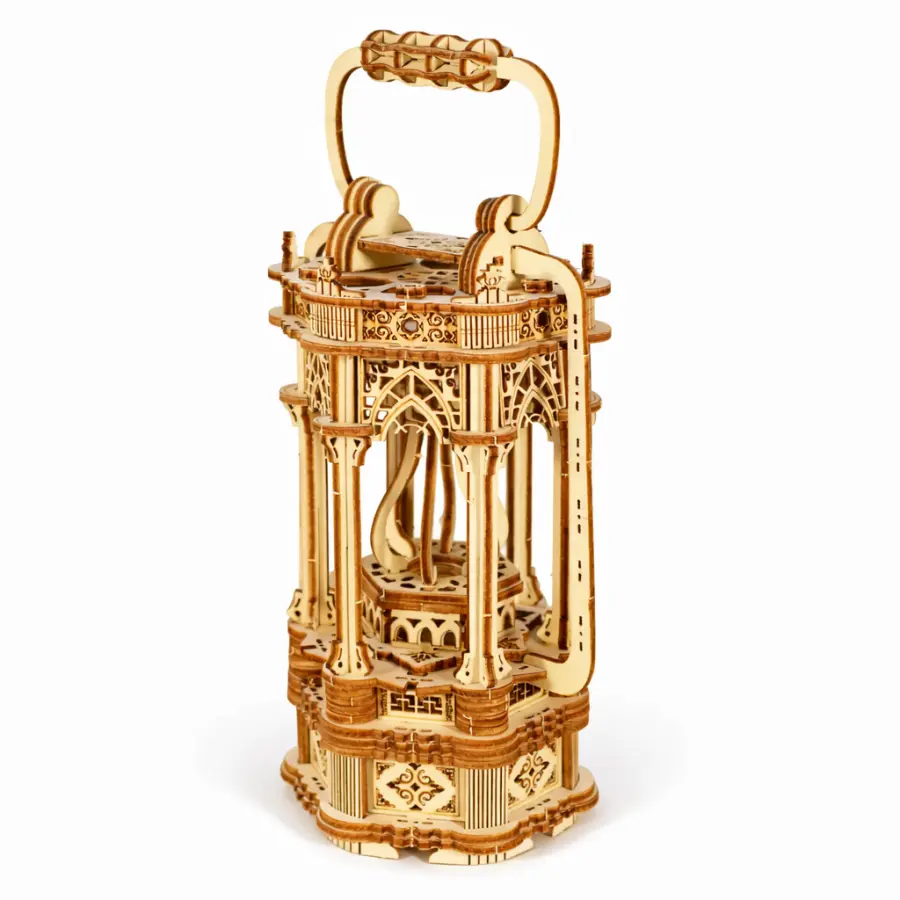
For unique, dimensional pieces like the decorative Gothic wooden lantern 3D puzzle shown above, mounting often means assembly into its final 3D form. These become self-displaying sculptures, a different but equally satisfying endpoint for your wooden puzzle preservation.
Your final step is the simplest: hang it. Step back. That tableau of anxiety on the dining table is now a point of pride on the wall, permanently sealed against time and fragility.
Salvage Ops: Fixing the Five Most Common Gluing Disasters
You’ve mounted it, planned its display, and felt that surge of pride. But sometimes, despite our best efforts, something goes wrong in the preservation process. Don’t view it as a failure—view it as a new puzzle to solve. Here’s how to decode the collective wisdom from workshop benches and forums to salvage your project.
1. Glue Seepage on the Front Image
The Problem: A sticky, cloudy film or visible lines of adhesive have seeped through the cracks, obscuring the artwork.
The Fix: Act before the glue fully cures. If the adhesive is still tacky, gently dab—don’t wipe—with a barely damp microfiber cloth. For dried, cured seepage, your options narrow. Light, dry sanding with extremely fine-grit paper (600+) on a flat block can sometimes reduce ridges, but you risk scuffing the image. The more reliable, if drastic, method is to carefully apply a high-quality, water-based varnish or clear sealant over the entire front. This can optically “melt” the seeped glue into a uniform topcoat, but test this on a scrap piece first.
2. Warping After Drying
The Problem: Your once-flat wooden puzzle has curled into a shallow bowl or lifted at the edges.
The Fix: This is a moisture imbalance. Place the warped puzzle face-up on a perfectly flat, protected surface. Cover it with a clean, dry cloth, then a flat board. Apply even, heavy weight (books, weights) across the entire surface, focusing on the raised edges. Leave it for 24-48 hours in a climate-controlled room. For stubborn warping, you may need to introduce a slight, corrective moisture to the concave side. Lightly mist the back of the puzzle (the substrate) with water, immediately cover with wax paper and a board, and weight it down. This relaxes the wood fibers. Be patient; this can take several days of weighted clamping.
3. Pooling & Visible Ridge Lines
The Problem: Applied too much glue, and now thick, plastic-like lines trace every piece junction.
The Fix: This is often the result of using un-thinned wood glue or pouring liquid glue directly on. For shallow ridges, let the adhesive cure completely. Then, using a very sharp craft blade held at a shallow angle, carefully scrape along the ridge lines to shave off the excess. Follow with a light sanding with fine-grit paper. If the ridges are severe, the front-sealing method described in Fix #1 is your best path to a smooth display surface.
4. Incomplete Adhesion (Loose Pieces)
The Problem: After drying, sections rattle or corners have lifted.
The Fix: Isolate the loose piece(s). Use a thin-gauge applicator (a toothpick, syringe, or fine brush) to introduce a minimal amount of adhesive underneath. For PVA-based glues, thin it slightly with water for better capillary action. Press the piece down firmly, wipe any squeeze-out immediately, and place a small weight (like a coin wrapped in wax paper) directly on top until it sets. The key is precision—do not re-glue the entire puzzle.
5. Choosing the Wrong Adhesive
The Problem: You used a contact cement that’s too rigid, a rubber cement that failed, or a ModPodge formula that remains tacky.
The Fix: This is the toughest salvage, but not impossible. If the bond is weak (as with old rubber cement), you may be able to carefully disassemble the puzzle and start over, using a solvent to clean the pieces. If a too-flexible glue was used, your solution is to add rigidity from the back. Mount the entire puzzle to a rigid backing board using a different, appropriate adhesive (like a PVA wood glue) to create a stable composite. Essentially, you’re using the new, correct bond to override the limitations of the first.
Remember, the core tenet of all salvage work is patience. Rushing a fix compounds the problem. Test any corrective measure on an inconspicuous area or scrap first. Your goal remains the same: to preserve your effort and end with a piece worthy of display.
Beyond the Glue: Displaying and Caring for Your Preserved Puzzle
The salvage work is done, the final squeeze-out wiped away. You’ve successfully navigated the gluing process without causing warping or seepage. Now, the true reward begins: turning your preserved wooden puzzle into a lasting display that sparks pride every time you see it.
If you followed the back-mounting method and your puzzle’s front image is on raw, unfinished wood, consider a final protective seal. A clear, matte spray acrylic or brush-on varnish adds a durable, UV-resistant layer. Apply it in a well-ventilated area. Use light, even coats, allowing full drying time between each. This seals the artwork from dust and moisture, making the piece easier to clean in the future. For puzzles with a pre-existing finish, this step is often unnecessary.
Your work now deserves a proper home. Hang it away from direct sunlight, which will fade colors over time, and away from areas of high humidity like bathrooms or above a kettle. A consistent, climate-controlled room is ideal. Dust your preserved puzzle gently with a soft, dry microfiber cloth. Never use chemical cleaners or wet wipes, as moisture can seep into seams.
For a clean, modern look that highlights the wooden puzzle as an object itself, consider a float frame or a shadow box. If you opted for a sturdy backing board, you can even use offset canvas clips or a sawtooth hanger attached directly to the board for a frameless display. The goal is to honor the effort, much like you would with any fine mechanical puzzle.
Think beyond the wall. A successfully preserved puzzle can become a functional art piece, like a stunning tray or a tabletop centerpiece protected under a glass sheet.
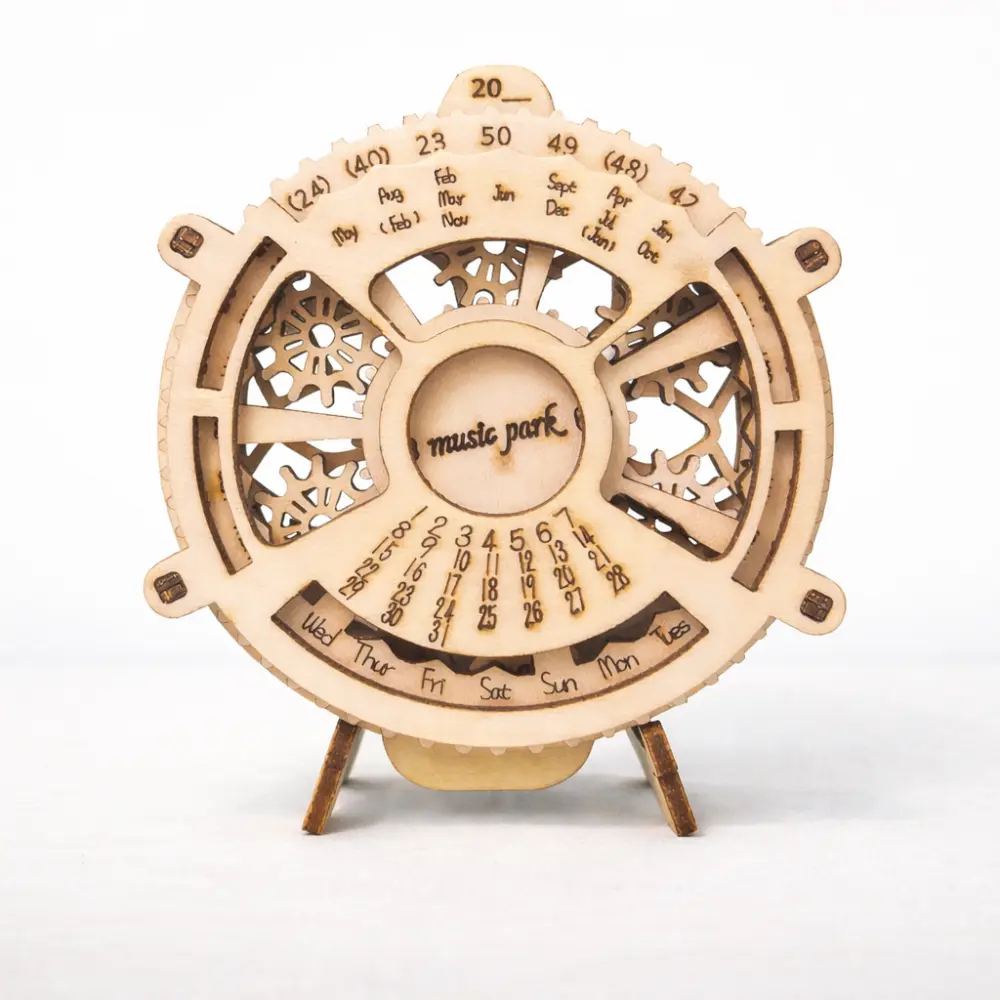
Recall that initial moment of panic—the completed puzzle vulnerable on the table. That temporary accomplishment is now permanent. You didn’t just save a puzzle; you curated an artifact of your patience and skill, joining a long tradition of crafting and preserving intricate challenges that dates back centuries, as explored in the history of the perpetual calendar puzzle. For more on creative display, explore our guide on how to display wooden puzzles properly.
Your final step? Find the perfect spot on the wall, drill the hook, and hang it. Then, step back. The dread of disintegration is gone, replaced by the quiet pride of a masterpiece, sealed and secured by your own hands, ready to be appreciated as the finished work of art it is—a true testament to the craft of the puzzle.