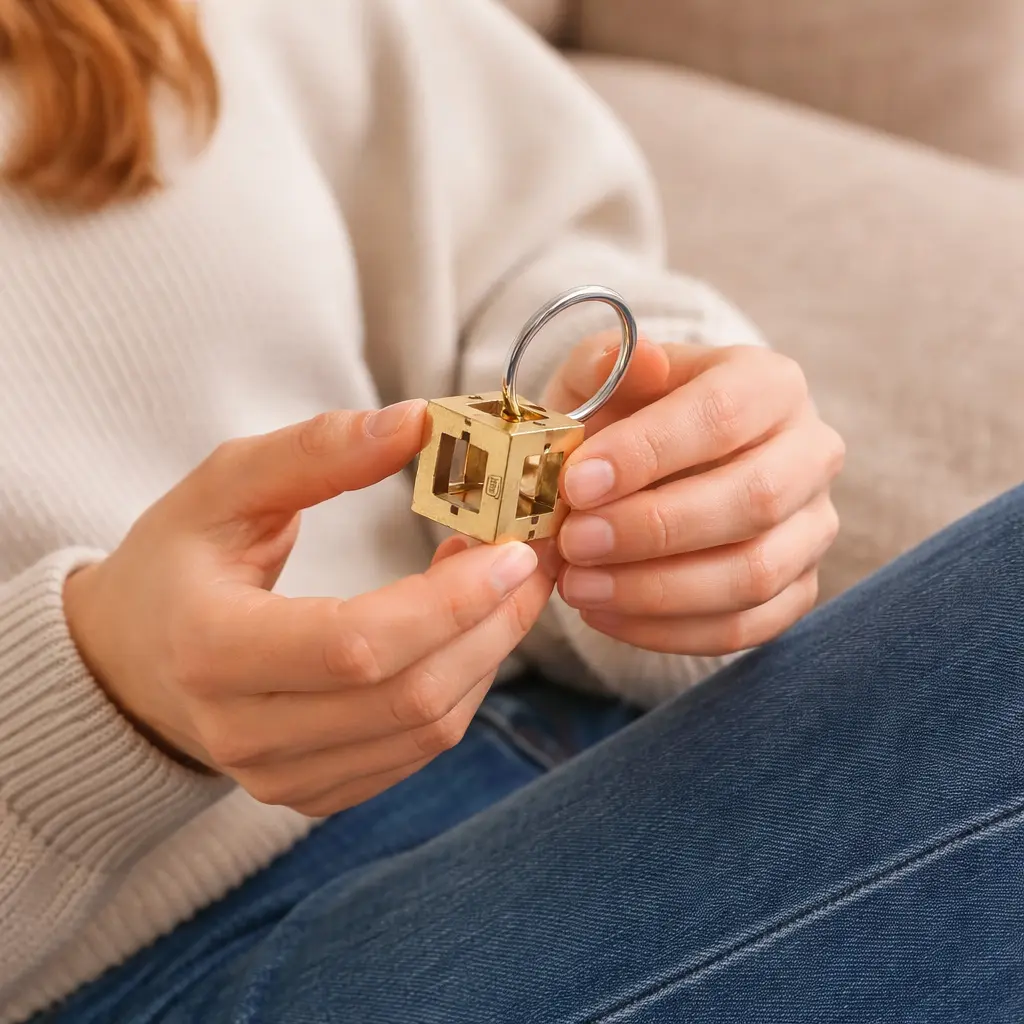
The cube arrives smaller than expected. Thirty-one millimeters per edge—roughly the footprint of a postage stamp, stacked three high. You cup it in your palm, and the first surprise isn’t visual. It’s thermal. The polished brass registers cold against your skin, dense and substantial in a way that contradicts its compact size. Within seconds, the metal warms to your body temperature, settling into that peculiar intimacy that only metal objects achieve.
Through the hollow center, you can see straight through to the other side. Six square windows, one on each face. And threading through the internal edges, locked into position by some invisible constraint: a chrome ring that refuses to leave.
This is the kind of puzzle that doesn’t explain itself.
What You’re Actually Holding
The Brass Cube Maze Puzzle Keychain belongs to a category that puzzle taxonomists call disentanglement puzzles—objects where the goal is to separate one piece from another without cutting, bending, or forcing. The category includes everything from bent-nail tavern puzzles to complex multi-ring challenges that have frustrated mathematicians for centuries.
This particular specimen sits at the approachable end of that spectrum. The mechanism is elegant in its simplicity: a cubic brass frame with notches carved into its internal edges, and a chrome split ring that must navigate those notches in the correct sequence to escape.
The cube itself features a warm, reflective gold finish—brass or brass-plated alloy, depending on production batch. The edges are smooth, with no sharp corners to catch fabric or skin. Each face presents a centered square opening, creating that distinctive see-through quality. The overall impression is jewelry-grade: something you’d expect to find in a curiosity shop, not a puzzle catalog.
The ring is chrome-finished, similar to a standard split keyring but precisely sized to fit the cube’s internal maze. The gap includes a small raised notch—a deliberate design element that prevents accidental escape and becomes crucial when navigating the final exit point.
The weight is substantial without being heavy. Comparable metal brain teasers in this size range typically weigh 30–50 grams—dense enough to feel quality, light enough for pocket carry.
The Science of the Maze
Unlike assembly puzzles that rely on hidden compartments or trick releases, this cube operates on pure spatial logic. The chrome ring can only move through specific slots carved into the cube’s internal structure. Move correctly, and you progress. Hit a dead end, and you retrace.
The mechanism shares DNA with sequential-movement puzzles—what puzzle researchers call “Gray-code” puzzles, where each state differs from the previous by a single move. The Baguenaudier (literally “time-waster” in French), documented as early as the 16th century, operates on similar principles. According to puzzle historian Jerry Slocum, these ring-and-maze designs trace back through centuries of European and Asian craftsmanship, with variations appearing in both decorative locks and tavern entertainments.
The solving process engages what cognitive scientists call visuospatial reasoning—the ability to mentally manipulate objects in three-dimensional space. A 2018 study published in Frontiers in Aging Neuroscience found that regular engagement with spatial puzzles was associated with improved cognitive flexibility and processing speed in adults over 50. The researchers noted that “lifetime jigsaw puzzles experience was associated with global visuospatial cognition” and multiple cognitive domains.
The Solving Experience
First, you’ll rotate the cube, watching the ring slide freely along the outer edges. It moves. It’s clearly not stuck. So why won’t it come off?
Then you notice the notches. Small grooves cut into certain edges, just wide enough for the ring’s gap to pass through. You try one. The ring advances. You try another. Dead end.
The maze reveals itself slowly. Certain notches only accept the ring from one direction. Others connect to longer paths. You start building a mental map—not of the cube’s physical shape, which is obvious, but of its invisible internal logic.
Most first-time solvers report 10–30 minutes to freedom. Experienced puzzle enthusiasts who’ve worked through similar disentanglement challenges may solve it faster. Patient explorers who refuse to rush might take longer.
The moment the ring finally slips free produces a quiet satisfaction—what behavioral researchers call a “completion response,” that small dopamine release that comes from finishing a defined task. A 2022 study in Basic and Clinical Neuroscience found that puzzle games “positively influence the central nervous system” and can improve sustained attention markers.
Then you realize: getting the ring back on might be harder than removing it.
That’s the second challenge. And honestly, it’s the one that keeps this puzzle on keyrings long after the first solve.
Why Brass? The Material Story
Brass isn’t a single metal—it’s a family of copper-zinc alloys, with properties that vary based on composition. The warm golden color comes from copper content; higher zinc percentages shift the tone toward silvery yellow. Most decorative brass falls in the 60-70% copper range, producing that rich, gold-adjacent hue that’s made the alloy popular for jewelry, instruments, and decorative hardware for millennia.
The material offers specific advantages for a pocket puzzle:
Thermal conductivity. Brass quickly adjusts to body temperature, which means it feels cold when you first pick it up but warms within seconds of handling. This creates a subtle sensory feedback loop—the puzzle literally responds to your touch.

Density. At approximately 8.4–8.7 g/cm³, brass provides that “heft” quality that separates premium-feeling objects from lightweight plastic alternatives. The weight registers in your palm without becoming cumbersome.
Patina potential. Brass develops character over time. The polished finish may soften with handling, developing what metallurgists call a “patina”—a thin oxidation layer that can range from warm browns to subtle verdigris. Some collectors deliberately cultivate this aged appearance; others prefer regular polishing to maintain the original shine.
According to Wikipedia’s entry on patina, this natural aging process “can provide a protective covering to materials that would otherwise be damaged by corrosion or weathering.” The patina isn’t degradation—it’s evolution.
For those who prefer the bright gold look, occasional cleaning with a soft cloth restores reflectivity. The chrome ring, meanwhile, resists tarnishing under normal use.
Who This Puzzle Fits
Fidgeters seeking purpose. If you need to keep your hands busy during calls, meetings, or passive entertainment, this delivers tactile engagement with an actual goal. Unlike stress balls or fidget spinners, you’re working toward something.
Research from Brown University Health notes that fidget tools “can be especially beneficial for individuals with diagnoses such as anxiety, attention deficit hyperactivity disorder (ADHD) or Autism Spectrum Disorders,” helping build coping skills through sensory input. A pocket maze puzzle provides structured fidgeting—repetitive enough to soothe, challenging enough to engage.
Metal puzzle collectors. This cube sits naturally alongside cast puzzles, interlocking rings, and lock-style brain teasers. The brass finish offers warm contrast to chrome and silver designs, and the mechanism differs enough from standard Hanayama-style cast puzzles to add variety to a collection.
Gift-seekers. This isn’t another generic keychain. It’s a conversation piece, a challenge, and a daily companion. The brass-and-chrome aesthetic reads as premium without the premium price point. Consider pairing with a horseshoe lock puzzle or golden Chinese knot metal puzzle for a themed gift set.
Beginners curious about mechanical puzzles. The difficulty sits in the beginner-to-intermediate range—challenging enough to require genuine thought, forgiving enough that frustration stays fun. If you’ve never solved a disentanglement puzzle before, this is an approachable entry point.
Who Should Not Buy This
Impatient problem-solvers. If five minutes feels like eternity, this will frustrate rather than satisfy. Expect 10–30 minutes of engaged exploration on your first attempt. If that sounds tedious rather than enjoyable, consider a simpler desk fidget instead.
Buyers wanting something large. At 31mm per edge, this is compact by design. It’s meant for pocket carry and keyring attachment, not desktop display. If you want a puzzle that fills your entire hand, look at larger cast metal options.
Anyone who needs included solutions. There’s no instruction sheet. Part of the puzzle’s appeal is discovery—mapping the invisible maze through exploration. If a lack of printed solution feels like a defect rather than a feature, this may not match your puzzle philosophy.
Very young children. The small size and sharp-enough edges make this inappropriate for children under 12. Older kids who enjoy mental challenges will likely appreciate it; younger ones may lose interest before the mechanism clicks.
Comparing the Category
The Hanayama Cast Box, a similar brass-and-ring puzzle from the Japanese manufacturer known for precision cast puzzles, operates on the same fundamental principle—navigate a ring through a cubic maze. Hanayama rates their version at Level 2 (on a scale of 1–6), placing it in the “challenging but not punishing” range.
Amazon reviewers of the Cast Box consistently note the quality of cast metal construction and the satisfying “click” when the ring passes through notches. One reviewer observed: “The quality of the cast metal is superb. It feels durable and solid in your hands as you work the puzzle.”
Both puzzles reward patience over force. Both develop patina over time. Both work as desk fidgets, pocket puzzles, and conversation starters.
The brass cube keychain offers a more compact footprint and explicit keyring functionality—it’s designed to live on your keys rather than in a puzzle drawer. The trade-off is less surface area for elaborate maze routing, which keeps the difficulty accessible.
Care and Longevity
Storage: Keep dry when not in use. Prolonged moisture exposure accelerates oxidation.
Cleaning: For polished brass look, wipe occasionally with a soft cloth. For deeper cleaning, mild soap and water work well—dry thoroughly afterward.
Patina: If you prefer the aged look, simply let the puzzle live its life. Handle it regularly, and the finish will evolve naturally.
Chrome ring: Resists scratching under normal use. Avoid storing loose with keys or coins if you want to maintain pristine appearance.
Durability: No batteries, no moving parts beyond the ring, no mechanisms to jam. This puzzle is as durable as the metal itself. Archaeological brass artifacts have survived thousands of years; your keychain puzzle should handle a few decades of pocket carry.
Frequently Asked Questions
How long does it take to solve? Most first-time solvers report 10–30 minutes. Experienced puzzle enthusiasts often solve faster; patient explorers sometimes take longer. Reassembly frequently takes longer than the initial solve.
Is this actually difficult? Rated beginner-to-intermediate. The maze logic isn’t complex, but discovering the path requires attention. Satisfying rather than punishing.
Will the gold finish wear off? With regular handling, the finish develops softer patina over time—normal for brass-tone metals. Polish with a soft cloth to restore shine if preferred.
Can I attach this to my actual keyring? Yes. The chrome ring functions as a standard split keyring. Clip your keys to it, or attach the puzzle to an existing keyring.
Is there a solution included? No. Discovery is part of the experience. If you’re truly stuck, the solving principles are similar to other ring-maze puzzles in the disentanglement category.
Is this suitable for children? Recommended for ages 12 and up due to small parts and patience requirements. Younger children may enjoy it with adult supervision.
Does solving it make noise? The ring produces subtle metallic clicks when passing through notches. Quiet enough for office use, satisfying enough to notice.
What’s in the Box
- 1× Brass Cube Maze Puzzle with attached chrome ring
- Keychain-ready design (no additional hardware needed)
The Verdict
The Brass Cube Maze Puzzle Keychain does exactly what it promises: it gives your hands something purposeful to do and your brain something spatial to solve. The brass finish adds warmth and character that improves with age. The mechanism rewards patience without demanding expertise.
It’s not a collector’s centerpiece or a marathon challenge. It’s a pocket companion—small enough to carry, engaging enough to return to, satisfying enough to recommend.
For $16.99, you get a well-machined metal puzzle that works as fidget, keychain, conversation starter, and genuine brain teaser. Not everything needs to be complicated to be worthwhile.
Sometimes the best puzzles fit in your pocket.
Related Picks
Looking for more metal brain teasers? Consider these:
- Cast Coil Pocket Puzzle — A coiled metal challenge for pocket carry
- Metal Starfish Puzzle Ring — Chrome meets geometry in a two-piece challenge
- Three Brothers Lock Puzzle — Traditional interlocking design
- Two Key Lock Puzzle — Deceptively simple, surprisingly tricky
- Snake Mouth Escape Puzzle — Ancient design, modern execution