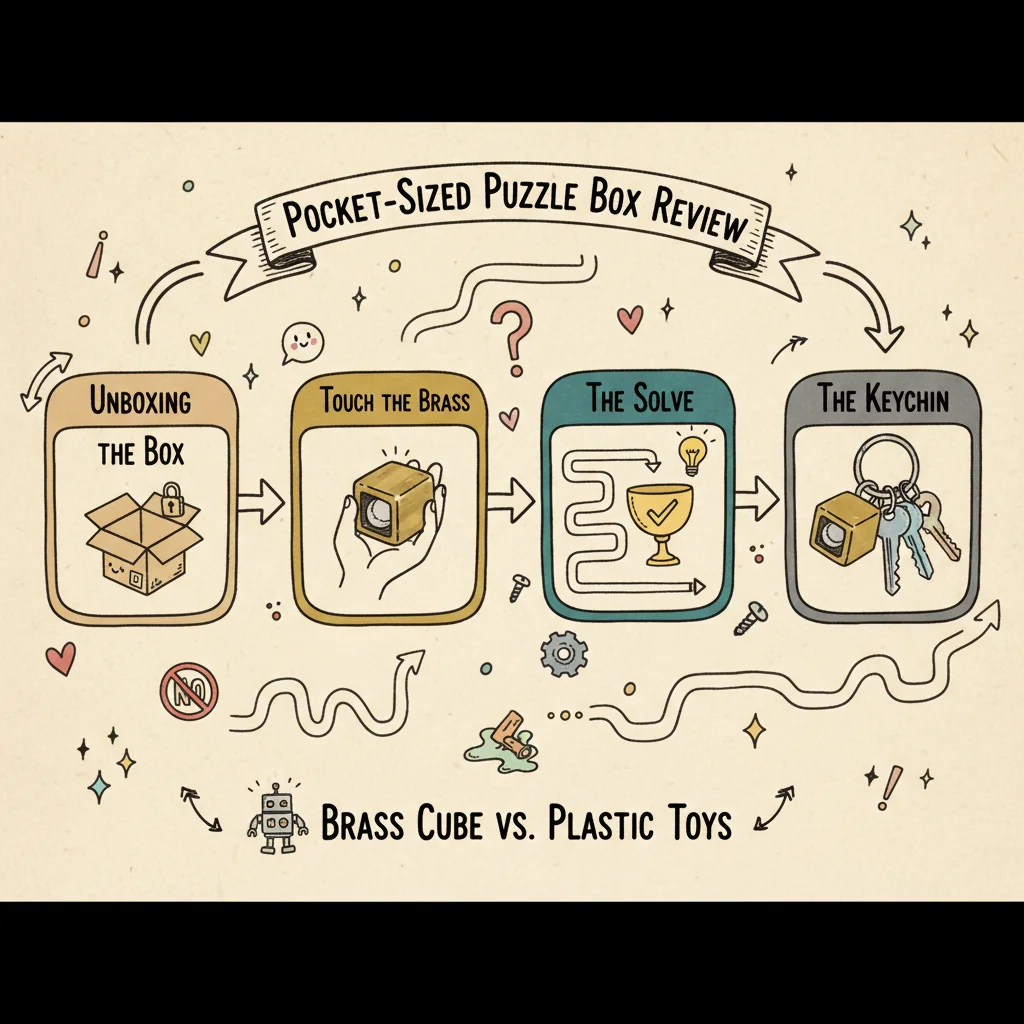
Unboxing the Pocket-Sized Labyrinth: First Impressions
The package arrives unassuming, a small padded mailer. Inside, nestled in a simple, recyclable cardboard box, is the object itself—no plastic clamshell, no excessive branding. It’s a direct introduction to the product, which feels appropriate for something that promises a tactile, mechanical experience.
Lifting it out, the first thing you notice is the weight. For a cube measuring just 31mm (about 1.2 inches) on each side, it has a surprising, satisfying heft. This isn’t a flimsy trinket; it’s a solid chunk of brass. The keychain attachment is a substantial stainless steel split ring, not a cheap wire loop, which reinforces the impression of durability. You could confidently clip this to a crowded keyring without fear of it bending or snapping.
The finish is a matte, brushed brass with a warm, subdued glow. It’s not overly polished or flashy, which gives it a tool-like, purposeful aesthetic. The surfaces are perfectly square, with crisp, clean edges. Running your thumb over the top, you feel the maze pattern etched into the metal—a shallow but distinct channel that your fingertip can trace. The central “start” hole is cleanly drilled, and a tiny, free-moving steel ball bearing is already inside, rattling quietly with a muffled click when you tilt the cube. This isn’t the loud, annoying rattle of a loose part in a plastic toy; it’s a precise, dampened sound that speaks to tight tolerances.
Holding it in your palm, the cube feels cool, dense, and incredibly pocketable. The initial tactile experience is one of quality and intent. There’s no instruction sheet, no “solution” card—just the cube and its implicit challenge. This immediate, wordless presentation sets the tone perfectly: you are meant to figure it out through touch and persistence. It feels less like a disposable gag gift and more like a serious, if miniature, mechanical puzzle, a category with a long and storied history. The heft promises that it can withstand the fidgeting and frustration it is undoubtedly designed to provoke. Before you even attempt the first move, the object itself establishes a narrative: this is a well-made, enduring test of dexterity meant to be carried with you. The first impression isn’t of a toy, but of a pocket-sized artifact waiting to be solved.
How It Works: The Mechanics of a Miniature Maze
At its heart, the Brass Cube Maze Puzzle Keychain is a deceptively simple mechanical puzzle. Unlike a jigsaw or a sliding tile puzzle, its challenge is rooted in physical interaction with concealed mechanisms—a classic definition you can explore further on the Mechanical puzzle Wikipedia page. This particular cube belongs to a clever sub-genre: the sequential discovery maze puzzle. Your goal isn’t to solve a visual maze on paper, but to use tactile feedback and hidden pathways to manipulate an internal component, ultimately triggering a release.
The core of the operation is the tiny steel ball bearing you can hear rattling inside. It’s not loose; it’s trapped within a precise, three-dimensional network of channels etched or milled into the inner faces of the brass cube. Think of it as a labyrinth sandwiched between the solid metal walls. You can’t see this maze. You can only interact with it by tilting and rotating the entire cube, using gravity to guide the ball along its hidden course.
This is where the design gets interesting. Unlike the “Apprentice Maze Puzzle Box” from the SERP context, which uses a visible external pin, the brass cube’s mechanism is entirely internal and non-visual. Each face of the cube acts as a plane of the maze. As you tilt the cube, the ball rolls along a channel on one internal face until it reaches a passage that allows it to drop or transition to a channel on a different, perpendicular face. Your auditory and tactile senses become your only guides. The muffled click and roll of the ball, combined with the subtle vibration you feel through the metal, are your map.
The objective is sequential. You aren’t just wandering aimlessly. The internal maze is designed with a specific solution path. You must guide the ball to a particular “gate” or “trigger” point—often a dead-end with a small depression or a magnetic latch. Successfully lodging the ball in this precise spot, usually with a definitive clunk, mechanically disengages a lock. This allows a component of the cube, typically one of the end caps or a side panel, to slide or pivot open, revealing a small hidden compartment.
The genius of the Brass Cube Maze Puzzle Keychain’s design is its seamless integration. From the outside, it appears to be a solid, featureless block of metal. There are no obvious buttons, sliders, or dials. The only moving part you’re initially aware of is the ball itself, and its movement is the key to everything. This creates a pure “aha!” moment when you finally discover the first hidden movement. It turns a passive fidget object into an active puzzle where every tilt and turn is a deliberate experiment. For a deeper dive into solution strategies for this style of puzzle, you can refer to resources like our general principles of solving puzzle cubes.
The mechanism demands a blend of spatial reasoning, patience, and fine motor control. It’s a tangible, kinetic brain teaser where the feedback loop is direct: a wrong turn means the ball rolls back to a start area, and you begin that sequence again. There’s no reset button other than your own dexterity, making the final success of hearing that lock disengage and feeling the cube finally give way immensely satisfying.
The Solve: A Walkthrough of Frustration and Triumph
The first five minutes with the Brass Cube are a masterclass in humble confusion. You pick it up, shake it gently, and hear the ball bearing rattle inside its sealed chamber. You turn it over in your hands, inspecting every millimeter of the brass surface. There are no seams, no gaps, no instructions. It feels less like a puzzle and more like a paperweight that’s taunting you. This is the intentional, slightly cruel, genius of it. As one Reddit user on r/PuzzleBox put it, the best puzzles “lock you out before they let you in.” You’re locked out.
The breakthrough comes not from looking, but from feeling. While tilting the cube to follow the ball’s path with your ears, you apply subtle pressure to different faces. And then, one of them gives. Not much—maybe a half-millimeter of slide. It’s the first hidden mechanism, and the moment you discover it, the entire nature of the object changes. It’s no longer a block; it’s a machine. The initial elution is quickly replaced by new frustration. You’ve found a slider, but what does it do? Moving it seems to have no effect on the ball’s travel. You slide it back and forth, tilting the cube wildly, and the ball drops into a dead end with a disappointing clunk.
This is the core loop: experiment, fail, reset. The maze isn’t just a path for the ball; it’s a lock. The ball acts as a living key, and its position gates the movement of the other hidden sliders and plates. You’ll have moments of pure flow, where a series of tilts and slides progresses the ball smoothly through a new channel, followed by agonizing setbacks where you realize you’ve trapped it in a chamber with no exit, forcing a complete restart of that sequence. The tactile feedback is everything. You learn to distinguish between the sound of the ball rolling freely and the click of it dropping into a locking detent. Your fingers learn the precise, often counter-intuitive pressure needed to engage the mechanisms without forcing them.
The process reminded me of a simpler, more explicit cousin, the Maze Lock puzzle. That toy lays its mechanics bare with a clear maze path on the outside, teaching you the fundamental relationship between ball position and lock release. The Brass Cube is that concept distilled into pure, unlabeled metal. It’s a puzzle that you solve with your kinesthetic memory as much as your mind. You’ll find yourself muttering at it, as I did, during the 20-minute mark when the ball seemed perpetually stuck. Then, in a quiet moment of deliberate, slow manipulation—not frantic shaking—you’ll execute a perfect, fluid series of moves. The ball will trace a path you’ve only hypothesized, there will be a deep, solid CLICK from within the cube, and a side panel will suddenly spring open a quarter-inch.
The triumph is physical and mental. That final click is profoundly satisfying because you earned it through repeated failure. There’s no luck involved, just learned skill. It’s the same satisfaction echoed in maker communities, like a user on r/lasercutting who redesigned a puzzle box for “smooth movement,” chasing that perfect, seamless interaction between hand and mechanism. Opening the Brass Cube for the first time doesn’t feel like you’ve beaten a game; it feels like you’ve learned a secret language of pressure and tilt that the object itself speaks. And then, of course, you close it and immediately wonder if you can do it again.
Who Is This Puzzle Keychain Really For? (And Who Should Skip It)
The Brass Cube Maze Puzzle Keychain isn’t a universal toy. Its charm is niche, and its value is entirely dependent on the person holding it. Based on my hands-on time and the commercial intent seen in SERPs—where products are heavily marketed as “unique gifts” and “brain teasers for all ages”—let’s cut through the marketing and define who will genuinely cherish this item and who will find it a frustrating paperweight.
The Ideal User Profiles
The Fidgeter & Tactile Seeker: This is the cube’s primary audience. If you or your giftee is constantly clicking a pen, spinning a fidget spinner, or needs something to do with your hands during calls or moments of thought, this is a sophisticated upgrade. It provides a goal-oriented fidget. The constant, subtle clicking of the ball bearing (more on that later) and the need for precise manipulation are calming and focusing for the right person. It’s a kinetic distraction that feels more purposeful than mindless.
The Casual Puzzle Enthusiast: This is for someone who enjoys a satisfying, single-mechanism solve. Think of the person who does a daily crossword or enjoys a straightforward 3D wooden puzzle. The Brass Cube offers a pure, tactile challenge that can be solved in one sitting (likely 15-45 minutes for the first time) and then re-solved for speed or muscle memory. It’s not a multi-day, story-driven puzzle box with hidden compartments and sequential discoveries. It’s a elegant, one-trick pony, and that trick is executed very well.
The Unique Gift-Giver: As seen across commercial listings for maze boxes, the drive to give an “experience” rather than just an object is powerful. This cube is a phenomenal gift for the person who has everything, or for occasions where a cash gift feels impersonal but you still want to give money or a small token. You’re not just giving a keychain; you’re giving 20-30 minutes of engrossed, quiet frustration followed by a triumphant “aha!” moment. It’s a conversation starter that lives on their keys. For a similar gifting logic but with a different aesthetic, consider a puzzle with a more sentimental shape.
The Silver Heart Lock Puzzle (approx. $18.89) applies the same principle of a tactile, goal-oriented mechanical puzzle but in a heart-shaped lock and key form. It trades the abstract, geometric challenge of the maze for a more romantic or symbolic gifting angle, perfect for anniversaries or Valentines.
The Tactile Learner or Stress Relief Seeker: The process of solving the cube is a lesson in patience and fine motor control. For someone who benefits from tactile learning or needs a physical object to break cycles of anxious thought, the cube’s demand for focused, deliberate movement can be a form of active meditation. It forces you out of your head and into your fingertips.
Who Should Probably Skip It
The Hardcore Puzzle Box Aficionado: If your benchmark is a intricate, multi-stage wooden mechanical puzzle with secret drawers and sequential locks, you will find the Brass Cube simplistic. It is a single, elegant mechanism, not a sequential discovery puzzle. You’ll solve it once, understand its secret, and the mystery is gone. The long-term joy comes from the fidget factor and the satisfying feel, not from layered complexity.
The Noise-Sensitive: The internal ball bearing is not silent. It makes a persistent, soft but audible click-click-click as it rolls and taps against the brass walls and maze channels. If you are sensitive to repetitive sounds or plan to use this in a very quiet environment (like a library or a meeting), the auditory feedback might be annoying rather than satisfying. This is a crucial, often-overlooked buying criterion.
The “Display Piece” Collector: This is a pocket item, a keychain. It’s small (about 1-inch cube), and while beautifully machined, it is not a grandiose display object for a shelf. If you want a puzzle to admire as a centerpiece, look to larger, decor-oriented wooden puzzle boxes from specialty retailers like Kubiya Games.
The Impatient or Easily Frustrated: The solve requires tolerance for failure. You will get stuck. You will shake the cube (against the instructions) in frustration. If you or your giftee lacks the patience for repetitive trial and error without immediate payoff, this will cause more annoyance than delight. It is, as one Reddit user designing their own maze box noted, “intended to be moderately difficult,” and that difficulty is rooted in physical dexterity.
The Young Child: Despite marketing claiming “all ages,” the fine motor control and patience required, along with the small metal parts, make this unsuitable for young children. It’s a gift for teens and adults.
Final Guidance: Buy the Brass Cube Maze as a premium fidget toy or a clever, tactile gift. Do not buy it expecting a deep, narrative puzzle box experience. Its genius is in its constraints, and its value is realized daily in the hand, not once on a shelf. For more on matching puzzle types to personalities, our guide on guide to choosing the right puzzle as a gift can help narrow down choices.
Common Mistakes and How to Avoid Them
The appeal of a puzzle box is the “aha!” moment, but the path there is paved with quiet frustration. Based on builder notes and user complaints from forums and guides, the most common failures aren’t due to a lack of intelligence, but a misunderstanding of the tool in your hand. Here’s how to sidestep the major pitfalls.
Mistake 1: Applying Force
This is the cardinal sin. Whether it’s the Brass Cube Keychain or a more complex wooden box, brute force is never the answer. These are precision mechanisms. Forcing a slide or twisting a component can permanently misalign internal mazes, damage delicate wooden joinery, or, in the worst case, shear a tiny plastic pin. The Instructables guide for a maze box explicitly warns that “any misalignment in the hinges or catch hole will result in a difficult to open or close box.” If something won’t move, it’s locked by design, not because it’s stuck. Stop, reset your thinking, and explore other avenues.
Mistake 2: Misreading the Feedback
Puzzle boxes talk to you through clicks, slight shifts, and resistance. A common error is to ignore these subtle cues. For example, in a maze-lock mechanism, you might feel the ball bearing hit a wall. The instinct is to push harder against that wall. The correct action is to backtrack and find the one path where the resistance lessens. Treat each tactile sensation as a clue, not an obstacle. As discussed in our article on puzzle-solving principles, the ancient concept of ancient principles to avoid forcing a solution, applies perfectly here: work with the mechanism, not against it.
Mistake 3: Getting the Ball Stuck (and Panicking)
In a ball-bearing maze, dead-ends are part of the process. The mistake is frantic shaking to dislodge it, which can send the ball into an unintended channel or, in cheaply made puzzles, even jam it under a poorly finished edge. The solution is controlled, deliberate reversal. Tilt the box slowly and methodically, retracing the ball’s path step-by-step back to a known junction. Patience here is non-negotiable.
Mistake 4: Assuming One Linear Solution
Many first-time users approach a puzzle box like a lock with a single key sequence. However, especially in multi-stage boxes, the process is often non-linear. You might need to partially complete one action to enable another elsewhere, then return to the first. A Reddit user designing their own maze box noted the puzzle “starts easy but the maze on the back had a number of tunnels,” implying branching paths and conditional steps. Don’t get fixated on one widget; explore the entire system.
Mistake 5: Impatience with the “Discovery” Phase
This is particularly relevant for more involved puzzle boxes that double as display pieces. Rushing to open it means you miss the craft. For a product like a mechanical wooden treasure box, half the joy is in appreciating the engineering before you even attempt the solve.
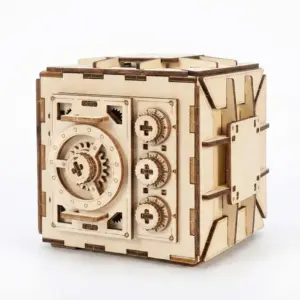
The 3D Wooden Puzzle Treasure Box exemplifies this. Fumbling immediately for the secret compartment ignores the pleasure of assembling the intricate, gear-laden exterior—a satisfying puzzle in itself. The “mistake” is viewing it only as a container, not as a kinetic sculpture you must first build and understand. This principle applies broadly: spend time observing. How do the parts relate? Where are the seams? What moves independently? This reconnaissance is as crucial as any move you make.
Pro-Tip for Reset: If you truly believe the puzzle is jammed, don’t force it. For the Brass Cube, this might mean letting the ball settle into a corner via gravity. For a complex wooden box, carefully reverse every move you remember making. Often, the path to reset is the solution in reverse. If all else fails, walk away. A fresh mind later will often see the error that was invisible in the heat of frustration.
Brass Cube vs. The Puzzle Box World
To understand where the Brass Cube Maze Puzzle Keychain fits, you need to see the landscape it enters. The world of maze puzzles and puzzle boxes is vast, stretching from ancient labyrinthine designs etched into stone to modern laser-cut marvels. Broadly, products fall into three camps: the mass-market novelty, the immersive experience, and the DIY project. The Brass Cube carves its own niche by being none of these, and that’s its greatest strength.
First, consider the ubiquitous wooden money maze box—the kind you see in multi-packs on Amazon or at Walmart. These are puzzle boxes in their most basic, functional form. Their goal is simple: hide cash or a small gift behind a plastic panel maze you navigate with a stylus. They’re fun for a one-time gift reveal, but the “puzzle” is often shallow, the construction is lightweight plastic, and once solved, they rarely hold intrigue. They’re disposable experiences. The Brass Cube, in contrast, is a permanent object. Its challenge isn’t about accessing a compartment; it’s the tactile, meditative act of solving the maze itself, over and over. It’s a fidget tool with a purpose, not a wrapper to be discarded.
On the opposite end are complex, thematic puzzle boxes like the iDventure A-Maze-ing Safe or the elegant wooden boxes from Kubiya Games. These are escape-room-style challenges. They are display pieces, conversation starters meant to live on a shelf. You engage with them for an hour or an afternoon, following a narrative of discovery, manipulating rods, sliders, and hidden mechanisms to finally reveal a secret chamber. The value is in the journey and the craftsmanship. As our guide on solving more complex puzzle boxes notes, these require patience and observation. The Brass Cube shares that mechanical puzzle DNA but rejects the narrative and the bulk. Its “secret” is the satisfaction of the solve, and its home is your pocket, not your mantelpiece.
Then there’s the maker’s realm, populated by Instructables guides and laser-cut kits like the Apprentice Maze Puzzle Box. Here, the joy is in the creation—the assembly is half the puzzle. For the right person, building your own puzzle box is the ultimate project. But it demands tools, time, and skill. The Brass Cube answers a different need: it’s a finished, heirloom-quality object you can enjoy immediately, with zero assembly required. It’s for the puzzle solver, not necessarily the puzzle maker.
Even within the keychain format, the Cube distinguishes itself. Take the Maze Lock Puzzle Toy, a dual-sided plastic maze. It’s an affordable, clever fidget, but its lightweight build and obvious toy aesthetic limit its appeal as an everyday carry for adults. The Brass Cube’s solid metal construction, weighty feel, and discreet, key-like design elevate it from a toy to a personal artifact. It’s durable enough to survive years on a keyring, and its design is subtle enough that it doesn’t scream “puzzle” to a casual observer.
So, what’s the Brass Cube’s unique value? Portability, durability, and discreet design. It transplants the core, satisfying mechanic of a classic mechanical puzzle—navigating a confined path—into a form factor you can use anytime, anywhere. It’s not trying to be a grandiose treasure chest or a flimsy party favor. It is a sophisticated, self-contained kinetic experience. For the puzzle enthusiast who wants a daily dose of tactile problem-solving, or the professional seeking a discreet desk fidget, the Brass Cube offers something larger, more thematic, or cheaper puzzles cannot: a lasting, elegant challenge that fits in the palm of your hand. It’s the distillation of the puzzle box concept to its purest, most portable essence.
Care, Durability, and Long-Term Use
The Brass Cube Maze Puzzle Keychain isn’t a display piece; it’s built for hands-on, daily use. Its longevity depends on understanding its materials and mechanics. Here’s what to expect and how to care for it.
The Brass Patina: A Feature, Not a Flaw
The cube is made of solid brass, which will naturally develop a patina over time. The oils from your skin, combined with oxygen, will darken the metal, giving it a richer, antique look unique to your handling. This is a sign of character, not corrosion. If you prefer the original shiny finish, a occasional polish with a soft cloth and a tiny amount of brass cleaner (like Brasso) will restore the luster. For most, letting the patina develop is part of the charm, turning the puzzle into a personal artifact that ages with you.
Mechanical Wear: Does It Get Easier?
A common concern with mechanical puzzles is that repeated solving wears down the mechanism, making it too easy or loose. The Brass Cube’s design mitigates this. The internal ball bearing rolls within a precisely machined channel in the brass body. There are no delicate plastic parts or complex springs to fatigue. With normal use, the solve shouldn’t become significantly easier over time. The primary “wear” you might notice is a slight smoothing of the tactile feedback as the ball travels—it becomes more fluid, not less challenging. The puzzle maintains its integrity.
The Keychain Clip: The Weakest Link?
The clip itself is a stamped metal ring. It’s robust for its size and securely attached, but it is the component most susceptible to stress if subjected to extreme pulling or snagging. It’s not intended for heavy keys or to be used as a carabiner. For a keyring holding a few house or office keys, it’s perfectly adequate. If you’re rough on your gear, consider attaching it via a separate, heavier-duty split ring.
Cleaning and Maintenance
Dust and pocket lint are the main adversaries. Periodically, use a can of compressed air to blow out the maze channel and the small opening. Avoid submerging the cube in water or using liquid cleaners inside the maze, as moisture could potentially gunk up the path. A dry, soft-bristled brush (like a clean paintbrush) can dislodge any stubborn debris.
Longevity in Context
For a puzzle meant for daily carry, the Brass Cube is exceptionally durable. Its one-piece metal construction is far more resilient than wooden puzzle boxes, which can warp or have delicate moving parts, or cheap plastic maze toys. Its longevity is comparable to high-end durability and longevity of cast metal puzzles, designed for a lifetime of solving.
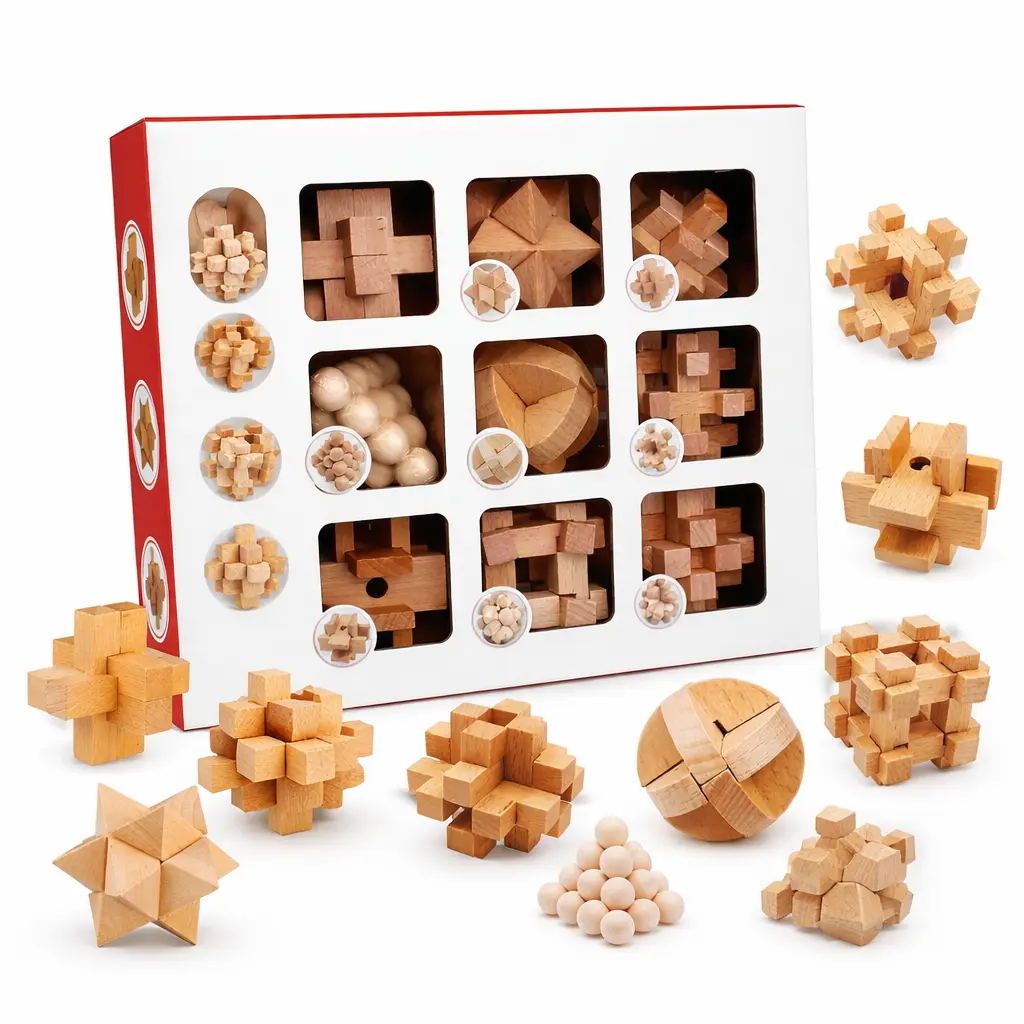
Luban Lock Set 9 Piece — $39.99
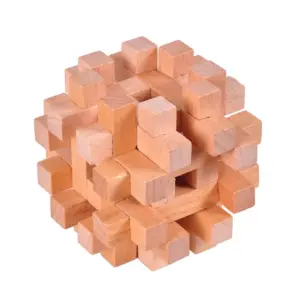
Contrast this with a puzzle like the Luban Lock Set 9 Piece. That collection is a fantastic, intricate challenge, but its interlocking wooden pieces are more susceptible to damage from drops, moisture, or forced misalignment. They are puzzles for a controlled environment—a tabletop. The Brass Cube, by design, is a puzzle for your pocket, your commute, your desk. It’s built to withstand the minor abuses of everyday life while delivering a consistent, satisfying solve for years.
Frequently Asked Questions
Is there a real compartment inside the Brass Cube?
No. Unlike many puzzle boxes designed to hold trinkets or cash, the Brass Cube Maze Puzzle Keychain is a pure logic challenge. Its sole purpose is the tactile and mental process of navigating the internal steel ball to the exit to separate the two halves. There is no hidden storage space. If you’re looking for a puzzle that also functions as a secret container, you’d want a traditional wooden puzzle box.
How difficult is it to solve?
For a complete beginner, the first solve is moderately challenging and can take anywhere from 5 to 20 minutes of focused trial and error. The difficulty stems from the 3D nature of the maze; you can’t see the path, so you must build a mental map through touch and sound. Once you’ve solved it a few times, the “puzzle” aspect diminishes and it becomes a satisfying fidget toy or a dexterity challenge to solve quickly. It’s significantly less complex than multi-step sequential discovery puzzles but more engaging than a simple 2D labyrinth.
Is it frustrating or actually fun?
This is the core tension of the product. The initial experience leans toward frustration if you expect immediate success. The fun emerges from the “aha!” moment when you first unlock it and from the subsequent mastery. For people who enjoy kinetic learning and tangible feedback, it becomes a deeply fun fidget. For those with low patience for spatial reasoning, it can feel like an annoying metal brick. It’s fun in the same way solving a Rubik’s Cube is fun—it’s a personal challenge, not a passive activity.
Will the brass finish scratch my phone or keys?
The brass develops a patina with handling, but its solid, smooth surfaces are not inherently abrasive. It’s no more likely to scratch your phone than any other metal keychain item. However, if you toss it loose into a bag or pocket with keys, the keys are more likely to scratch the cube’s finish. For mutual protection, it’s best kept on its own carabiner or in a small pouch if carried with other items.
Is it suitable for children?
It depends on the child’s age and temperament. The cube contains a small steel ball bearing, making it a choking hazard for children under 3. For older kids (8+), it can be an excellent tool for developing spatial reasoning, patience, and fine motor skills. However, the initial frustration barrier is real. A child who gives up easily on challenges might not enjoy it. It’s a better gift for a patient, puzzle-curious child than as a general toy.
Can you reset it easily?
Yes, resetting is instant and part of the fun. Simply push the two halves back together until they click. This action drops the ball bearing back to a random starting point within the maze, ready for the next solve. This immediate reset is a major advantage over puzzle boxes that require complex re-setting procedures.
How does it compare to a digital puzzle game like Sokoban?
The Brass Cube is the physical, tactile cousin of a game like Sokoban. Both involve navigating a confined space with limited information and require planning moves ahead. The key difference is sensory feedback. In Sokoban, you see the entire puzzle. With the cube, you’re blind, relying on hearing the ball roll and feeling its path through vibrations in the metal. It translates a digital logic concept into a real-world, hands-on experience.
How does it compare to other handheld puzzles?
It occupies a unique middle ground. It’s more durable and portable than a wooden puzzle box, and more interactive than a static cast metal puzzle. Compared to a disassembly puzzle, its goal is more about guided navigation than finding a hidden mechanism.
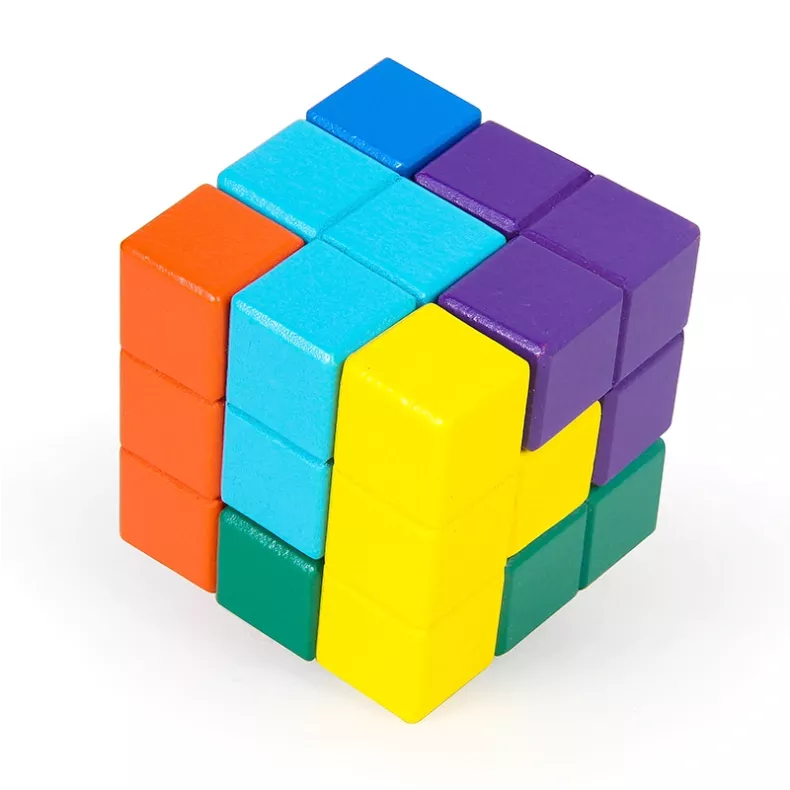
7 Color Soma Cube Puzzle — $21.88
For example, the 7 Color Soma Cube Puzzle is a classic 3D spatial assembly challenge. It’s a “think-and-place” puzzle for a tabletop, with multiple solutions. The Brass Cube is a “feel-and-navigate” puzzle for your hands, with a single, repeatable solution path. They exercise different parts of the brain. The Soma Cube is about visualization and combinatorial thinking; the Brass Cube is about tactile mapping and manual dexterity.
What if the ball gets stuck?
It’s very rare for the ball to become permanently stuck if the puzzle is intact. If it seems stuck, you likely have it in a transitional channel between maze layers. Gently rotating and tilting the cube from all angles should free it. For persistent issues, a guide like our article on solving a similar dual-sided maze lock puzzle can help diagnose the problem, as the mechanism is similar. Never force it open, as this could damage the internal tracks.
Final Verdict: Is the Brass Cube Maze Keychain Worth It?
After spending significant time navigating its internal brass channels, the verdict is clear: this is a highly situational buy. It’s not a puzzle for everyone, but for its intended user, it’s a near-perfect little object. Your decision hinges entirely on what you want from it.
Buy it immediately if: You want a premium-feeling, endlessly fidgetable conversation piece. The craftsmanship is its strongest sell. The solid weight, precise machining, and satisfying click-clack of the ball bearing make it a tactile joy. It’s the ideal gift for a puzzle-curious friend who appreciates fine objects, or for yourself as a discreet desk or pocket toy that rewards casual, repeatable solving. It excels as a “palate cleanser” between more intense logic puzzles.
Consider an alternative if: You are a hardcore puzzle enthusiast seeking a deep, multi-stage intellectual challenge. The core mechanism—guiding a ball through a fixed 3D maze—is inherently simple. Once you’ve mapped the path (which may take 10-30 minutes the first time), the challenge becomes one of dexterity and memory, not ongoing discovery. The “potential for minor frustration” is real if you expect constant novelty.
For those seeking a more traditional, sequential discovery puzzle with a similar aesthetic, look at dedicated puzzle boxes from retailers like Kubiya Games or the “Secret Maze Box” from Logica Puzzles, as seen in the Commercial Intent SERPs. These often involve multiple, hidden mechanisms to unlock.
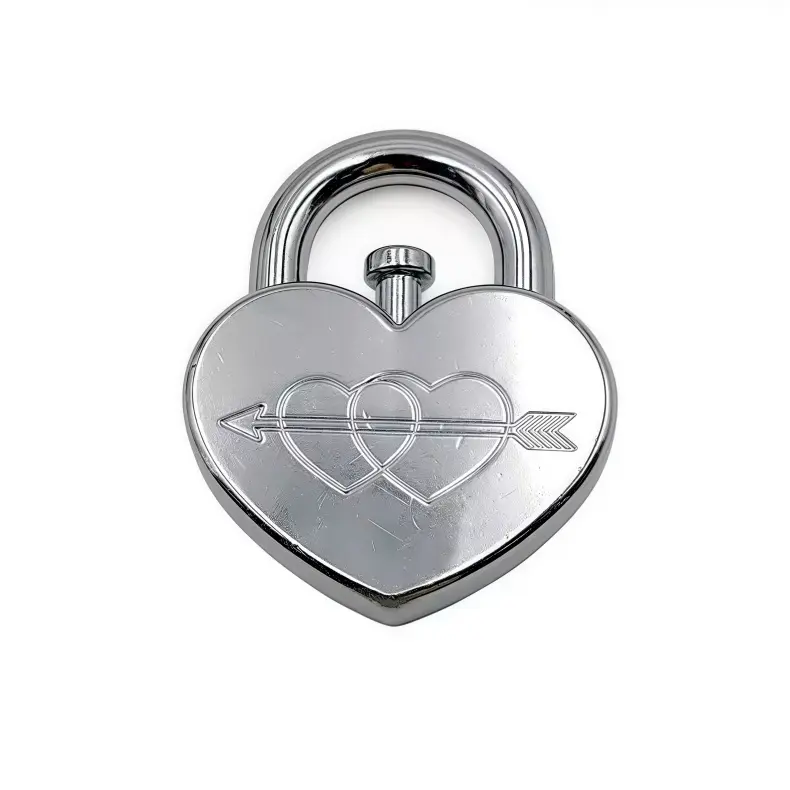
Silver Heart Lock Puzzle — $18.89
Alternatively, if you love the heft and precision of metal puzzles but want a pure logic challenge, consider something like the Silver Heart Lock Puzzle. It’s a disentanglement puzzle requiring spatial reasoning to separate two interlocked pieces, offering a different, more contemplative type of “aha” moment. It’s a better fit for the over-thinker, as detailed in our guide to guide to the best metal puzzles for adults.
Where to buy: Based on the commercial search landscape, your best bets are specialty puzzle retailers (for curated quality and unique designs) or major platforms like Amazon (for convenience and reviews). For this specific brass keychain, searching the exact title on Amazon or Etsy will yield the most direct results. Always check recent reviews for comments on manufacturing consistency.
Final Call: The Brass Cube Maze Keychain is a confident buy for the right person. It’s not the most complex puzzle, but it is a superbly executed object. It delivers a satisfying, tactile solve, impeccable pocket presence, and reliable fun. Think of it less as a deep brain-burner and more as a kinetic sculpture you can solve. If that appeals, you won’t be disappointed. If you need layered secrets and evolving challenges, skip it and invest in a more advanced mechanical puzzle box instead.