A Stubbornly Beautiful Object: The 45-Minute Standoff
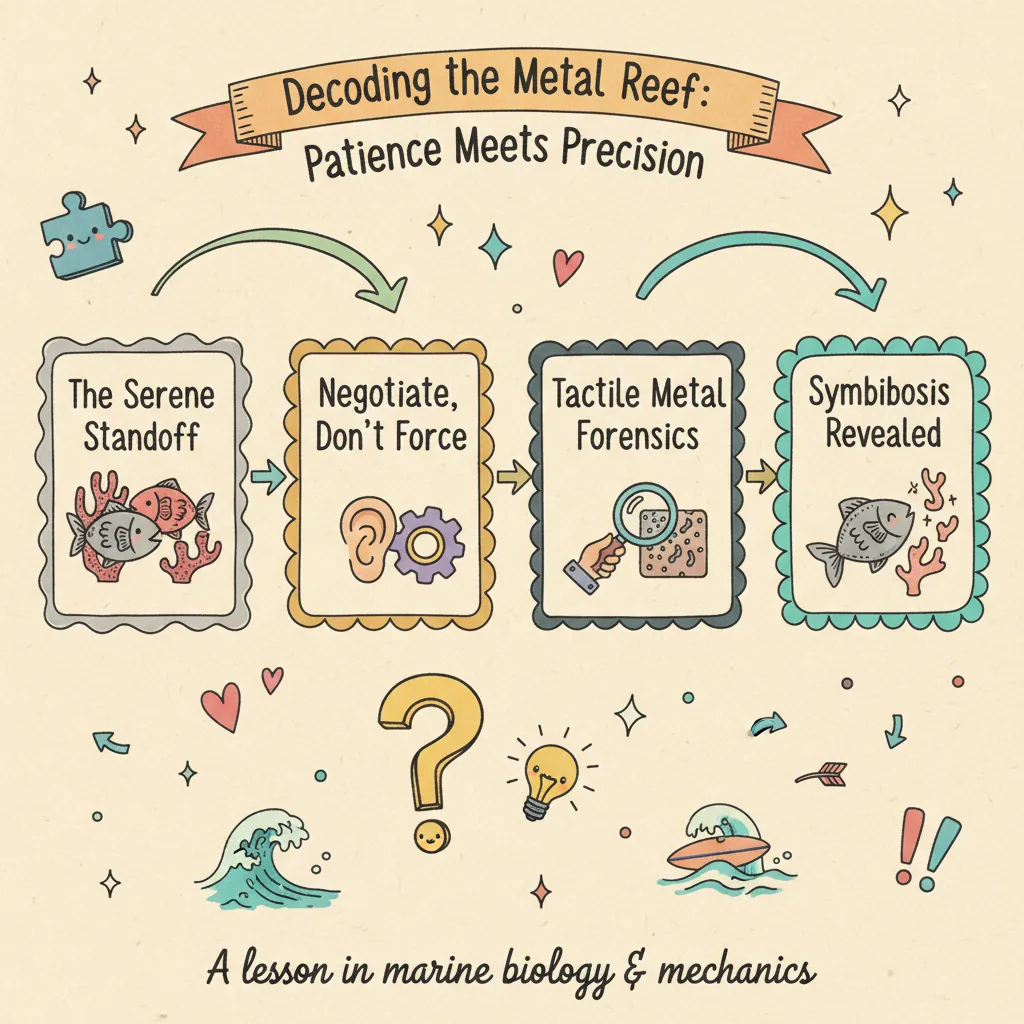
The two gold gobies sat stubbornly intertwined with the silver coral on my desk for 45 minutes. It wasn’t until I stopped trying to force them apart and instead listened for the faintest metallic whisper of a slide that the puzzle revealed its secret—it’s a lesson in marine biology, not brute strength. This first encounter with the Hanayama Cast Reef, a 3.2-ounce sculpture of anodized metal, defines its entire character: an object of serene beauty that conceals a quiet, persistent intellect.
On the mat, it looks complete. Finished. The gold fish weave through the silver coral’s branches as if frozen mid-swim. The contrast is striking. The silver is a cool, brushed pewter; the gold is a deep, warm brass. They are not painted. The anodizing is integral, a hard oxide layer that resists fingerprints. The heft is substantial for its 2.5-inch span. Dense. It feels less like a toy and more like a machinist’s sample, a tiny proof of concept for a miniature kinetic reef.
This is the core paradox of a superior cast metal puzzle. It demands to be picked up, to be turned in the hand, to have its weight and balance assessed. Yet, for nearly an hour, it gives back nothing but polite resistance. Your fingers trace the coral grooves, seeking a purchase. You test the obvious gaps, finding only dead ends. The two gold pieces—each a mirror of the other, representing a species of goby—are locked in a silent, symbiotic embrace with the silver structure. The initial intrigue curdles into a focused frustration. You are not battling a lock; you are negotiating with a system.
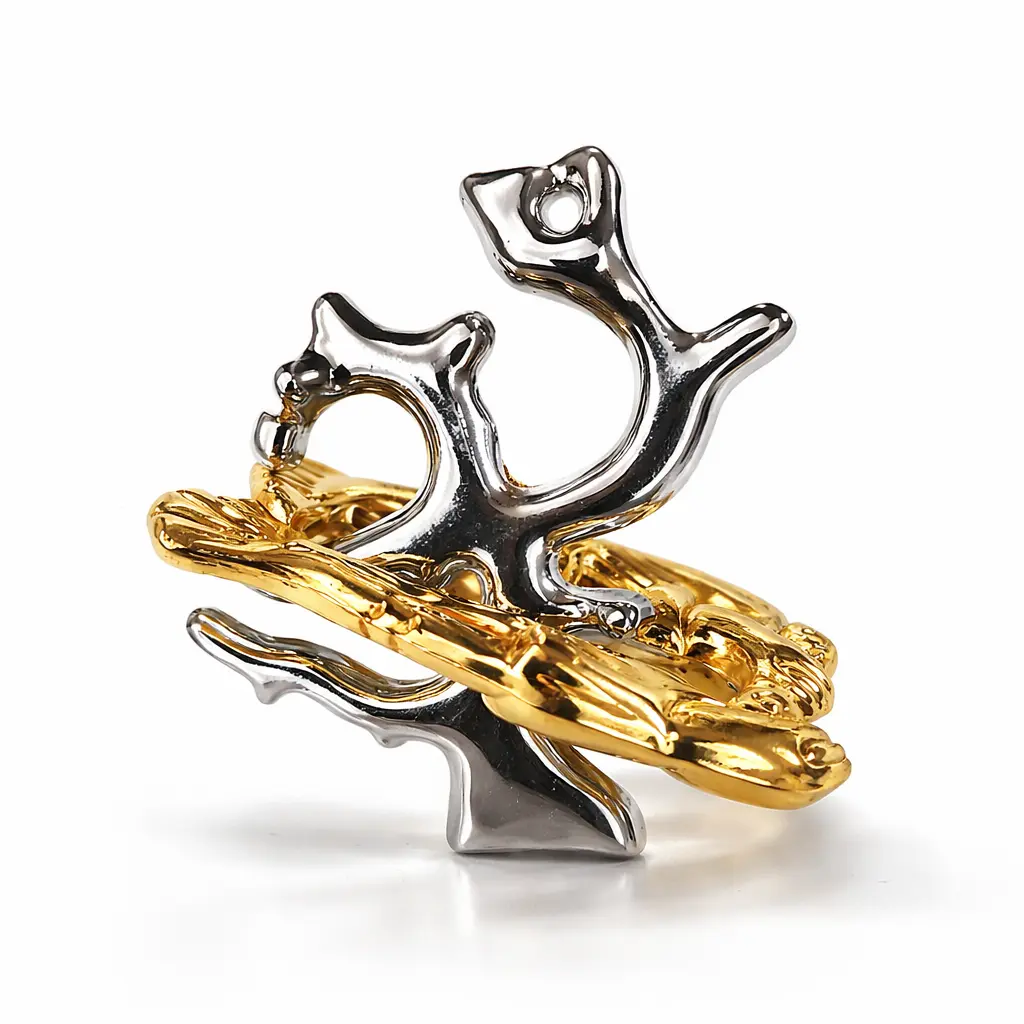
That standoff is the point. The Cast Reef is not designed to be immediately solved. It is designed to be studied. The initial failure is a necessary calibration, a resetting of expectations from a forceful disentanglement to a precise, tactile dialogue. The puzzle asks you to observe the negative space—the channels and tracks formed not by the metal itself, but by the air between the gold and the silver. It was in that quiet resignation, after the 45-minute mark, that my engineer’s mind finally stopped issuing commands and started receiving data: a slight shift in alignment, a new plane of motion. The standoff broke. The conversation began.
Akio Yamamoto’s Vision: Casting Marine Symbiosis in Metal
That transition from frustrated force to patient observation is the signature of designer Akio Yamamoto. A former graphic designer turned master puzzle craftsman, Yamamoto approaches each creation not as a mere brain teaser, but as a kinetic sculpture with a biological soul. For the Cast Reef, he draws direct inspiration from the quiet interdependence of a coral ecosystem, translating the living partnership of fish and reef into an anodized metal disentanglement of elegant, minimal moves. His work for Hanayama’s Marine series—which includes at least six other puzzles like the Starfish and the Seahorse—consistently prioritizes elegant representation over brute difficulty, a philosophy that makes the Reef a quintessential level 3.
Yamamoto’s process often begins with life, not logic. The popular anecdote, shared among collectors, is that the initial spark for the Marine series came from watching two mackerel weave through each other in a market tank—a fleeting moment of synchronized movement he sought to freeze in time and metal. For the Reef, however, the inspiration evolved from that generic motion to a specific symbiosis. Mackerel became gobies, the small, watchful fish that live in the protective branches of coral, and the tank’s water became the intricate, silver structure. The puzzle isn’t about fish escaping coral; it’s about navigating the unique geometry of their shared home. The two gold pieces aren’t identical twins, a common trick in simpler puzzles, but complementary shapes whose curves and angles are dictated by the negative space within the coral’s form.
This biological fidelity dictates the mechanical heart of the puzzle. Yamamoto’s design philosophy shuns unnecessary complexity. Where other designers might add hidden latches or false seams, he relies on clean, interlocking pathways. The challenge emerges not from deception, but from the precise alignment required to traverse the coral’s grooves. (This is why a forced solution feels so wrong—it violates the symbiotic metaphor.) The official Hanayama difficulty rating of 3 out of 6 is less a measure of step-count and more a reflection of this conceptual clarity. The solution is a short sequence, but discovering it requires understanding the relationship between the pieces. It’s a lesson in spatial reasoning through the lens of ecology.
The choice of gobies is particularly apt. In nature, these fish and their coral hosts engage in a constant, delicate dance of entry and exit, a perfect analogue for the puzzle’s objective. The gold anodized finish of the fish pieces isn’t merely for contrast against the silver coral; it evokes the shimmer of scales under water, a touch of warmth against the cool, stony metallic hue of the reef. Yamamoto’s background in graphic design shines here in the thoughtful use of color-coded pieces, which act as a subtle guide, helping the solver intuitively track which element is meant to move where. He doesn’t just build a mechanism; he builds a recognizable, almost poetic, scene where form and function are symbiotic. The Cast Reef, therefore, stands as a clear statement of his vision: a puzzle should be a beautiful object first, a thoughtful challenge second, and a story about our world always.
From Biology to Mechanism: The Goby’s Groove
The story Yamamoto embedded becomes tangible in the hand. The mechanism of the Cast Reef puzzle is a direct mechanical translation of the symbiotic relationship between a goby and its coral host, where the solution lies not in forcing separation but in navigating the defined, silver grooves of the reef with the precise combined form of the two gold fish.
In a tropical reef, certain goby fish species live in a constant, intimate negotiation with the coral. They dart in and out of its protective branches, threading their bodies through narrow, winding passageways to escape predators. The coral provides a labyrinthine shelter; the goby’s survival depends on learning its specific topology. This is not a random hiding spot but a memorized path of ingress and egress. The puzzle captures this exactly. The silver coral piece is not a static obstacle but a structured environment. Its grooves—three distinct channels on the upper face—are not decorative. They are the defined tracks. Your job as the solver is not to rip the fish free but to guide them, as a unit, along these preordained metallic pathways until the geometry of the pieces permits a clean disengagement.
This is where the critical, often missed, insight resides. The solution leverages the space between the two gold fish. Individually, each fish is captive, its fins and body caught on the coral’s protrusions. Together, however, they form a composite shape—a sort of golden key—that can engage with the coral’s track system. The narrow gap separating the two fish becomes a functional negative space, a channel that aligns with a specific ridge on the coral. You don’t manipulate one fish at a time. You manipulate their relationship to each other while moving them in concert along the silver grooves. It is a true, three-body disentanglement problem.
The tactile feedback here is instructional. As you slide the assembly, you will feel distinct dead ends. A groove will terminate, the pieces will bind, and motion will cease. This is the puzzle’s way of saying this is not the path. You must retreat, reset the orientation of the fish relative to each other by a few degrees, and attempt a different alignment with the coral’s architecture. It is a process of systematic probing, much like a goby testing different crevices in the living rock. The satisfying moment—the faint metallic whisper mentioned at the outset—occurs when all three elements (Fish A, Fish B, and the coral) find their momentarily congruent alignment. The assembly slides into a position of temporary symmetry, and one fish can be cleanly extracted. The symbiosis is broken, but only because you understood its rules.
This elevates it beyond a simple brain teaser. It is a working model. The “symbiotic” relationship is mirrored in the mechanism’s dependency: the coral defines the possible motions (the grooves), and the fish, as a coupled pair, must adapt their combined form to fit those constraints. It is a lesson in mechanical grammar, where the solution is discovered by comprehending the functional language of the pieces rather than applying random force. For the engineer-turned-collector, this is the profound satisfaction: seeing a natural principle distilled into anodized metal and a sequence of precise, logical movements. The Hanayama Cast Reef isn’t just a puzzle you solve; it’s a symbiotic system you learn to operate.
Tactile Forensics: Heft, Finish, and the Cold Click
Understanding the mechanism intellectually is one thing. Applying that knowledge in hand is another, a dialogue between mind and material. The Hanayama Cast Reef’s physicality is its primary interlocutor. It weighs 65 grams—a dense, deliberate heft for its 2.5-inch span. Compared to the brass solidity of a Cast Nut or the lighter, more playful feel of a Cast Starfish, the Reef has a balanced, substantial presence. It feels neither like a toy nor a paperweight, but a precise instrument.
The finish is cool. Dense. An immediate thermal conductivity tells you this is metal, not resin or plated plastic. The gold and silver coloration is achieved through anodizing, a hard, electrolytic oxidation process that dyes the surface layer of the aluminum alloy. This answers the common collector’s query: No, the coating does not rub off with normal handling. Anodization is integral, not a plating. It can be scratched with deliberate, abrasive force against a harder material, but a decade in and out of my puzzle pouch has left my specimen with only the faintest, honorable wear on the highest ridges of the coral—a patina of engagement, not a flaw. (This durability is a hallmark of Hanayama’s finish quality, a silent rebuttal to cheaper, painted knock-offs.)
Pick it up. Run your thumb along the silver coral’s grooves. The machining is flawless; there are no casting seams or burrs to catch a fingernail. Each channel and cleft is smooth, with crisp, perpendicular walls. This precision is non-negotiable. For the intended disentanglement, the path must be defined by geometry, not obscured by manufacturing variance. The tactile feedback is exact: you feel when a fish’s fin contacts the end of a groove—a soft, metallic stop. There is no ambiguity. It is a boundary.
Then there is the sound. This is where the cold click of the title enters. When the pieces shift correctly within their tight tolerances, they do not grind or rattle. They emit a soft, definitive click. It is a low-frequency, solid sound, the aural signature of anodized aluminum engaging with itself under precise alignment. It’s the sound of the mechanism confirming a correct step. This acoustic feedback is a crucial, often overlooked part of the solve. You learn to listen for it as much as feel for the slide.
This sensory profile distinguishes it sharply within the Marine series. Take the Cast Starfish. Also by Yamamoto, also brilliant. But its feel is different. The Starfish is a hair lighter, its five limbs creating a more complex, multi-vector tangle. Its movements are a series of smaller, interlocking shifts. The Reef, by contrast, feels more linear, more about finding and following the singular, critical track. Its feedback is more about the steady, guided slide of a fish body through a coral canyon. The Starfish chatters; the Reef whispers. Both are exceptional, but the Reef offers a more meditative, path-following tactile experience.
Holding it, you appreciate that the difficulty rating of 3 out of 6 isn’t a measure of complexity of moves, but of the perceptiveness required. The challenge lies not in manipulating many pieces, but in interpreting the subtle, high-fidelity signals the puzzle gives you—the heft that suggests gravity isn’t your friend, the cool smoothness that demands finesse, the click that rewards attention. It prepares you, through touch and sound, for the mental leap to come: discovering that the solution path isn’t on the fish or on the coral, but in the negotiated space between them all. Your fingers are now primed. The real exploration begins.
Navigating the Labyrinth: A Non-Spoiler Strategy for Level 3
The Hanayama level 3 rating for the Cast Reef is a precise calibration: it signifies a logic-based puzzle requiring 10-30 minutes of focused experimentation, ideal for a patient beginner or a curious 10-year-old who enjoys spatial reasoning over random trial. This rating is not about complex sequences, but about a single, critical perceptual shift—from trying to pull the pieces apart to guiding them along a hidden, cooperative path.
That initial failure, where the two gold gobies sat stubbornly intertwined with the silver coral, taught me everything. The puzzle resists. Firmly. Applying direct pulling force, as one might with a cheap wire disentanglement toy, gets you precisely nowhere. It feels like a deadlock. This is the designed moment of frustration, the pivot point. The mechanism is not built for tension; it is built for translation. You must stop forcing and start listening.
Listen with your fingers. The subtle tactile feedback you learned in the last section—the cool, smooth anodized metal, the dense heft—becomes your primary sensor array. The solution lies not in the fish or the coral, but in the negotiated space between them. That space, the precise gap where their forms interact, is the track. Your job is to find the orientation where the grooved contours of the coral and the sleek bodies of the fish align to form a continuous channel. Think of a key finding the exact rotational alignment to slide into a lock. The “click” you may hear isn’t the end, but a confirmation of alignment, a metallic whisper saying, “You’re on the path.”
You will encounter dead ends. This is expected. The path is not a straight line. You will slide a fish partway along a coral groove only to find its fin blocked by an unseen protrusion. This isn’t failure; it’s data collection. Each dead end maps a boundary of the permissible route. The puzzle’s elegant cruelty is that these boundaries are identical for both fish, creating a symmetrical, mirrored problem. (This symmetry is your biggest clue.) When you hit a stop, do not force. Reset. Backtrack to the neutral, intertwined starting position. This reset is not a defeat; it is the essential process of clearing the mechanism’s memory, both in the puzzle and in your mind.
Compared to more chaotic wire puzzles, the Reef is a model of structured, deterministic logic. There is no “tangling” or random weaving. Every possible movement is constrained by the milled metal geometry. This makes it profoundly satisfying for the analytical mind. The difficulty is entirely cerebral—can you visualize the negative space as a positive guide? For a 10-year-old with the patience to observe and reason spatially, it is absolutely solvable and provides a monumental boost in confidence. For the adult beginner, it is the perfect introduction to high-quality cast metal puzzles: substantial, beautiful, and solvable within a single sitting without inducing despair.
Your strategy, then, is this: abandon force. Explore the geometry of the gap. Use symmetrical, mirrored movements for both fish. Treat every dead end as valuable intelligence. And reset, often. The moment of release, when it comes, is not explosive. It is a smooth, deliberate disengagement—one fish gliding free as if swimming away on a current it finally understood. That is the intellectual ‘Aha,’ the deep satisfaction of perceiving order within apparent entanglement. It feels less like winning a game and more like understanding a silent, mechanical language. For more on the underlying principles of this language, see my article on the mechanical grammar of metal brain teasers.
This mastery, once achieved, shifts your relationship to the object. It transitions from a foreign, locked artifact to a known mechanism, a kinetic sculpture whose secret language you now speak. This is when you begin to appreciate its place not just in your hand, but on the shelf amongst its peers.
Among Its Kin: The Reef’s Place in a Collector’s Cabinet
Its place is definitive: a central-tier ambassador of the Hanayama Cast series. Occupying a precise difficulty rating of 3 out of 6, the Reef is neither a daunting gateway like Cast Vortex (level 5) nor a trivial trinket. It’s the ideal specimen for demonstrating the series’ core appeal—substantial anodized metal, thematic coherence, and a solve that rewards patience over genius. Within the Marine series specifically, it stands as the most literal translation of a symbiotic ecosystem into a disentanglement puzzle.
To understand the Reef, one must hold its sibling, the Cast Starfish. The comparison is inevitable and instructive. Both are Marine series puzzles of similar size and list price. But where the Reef is narrative—two distinct gold fish navigating a silver coral maze—the Starfish is purely abstract geometry. Its five identical, interlocked arms form a ring, a closed system of radial symmetry. The solve is less about guiding creatures through a habitat and more about perceiving the singular correct orientation where all five components align to fall apart. The tactile feedback differs, too; the Starfish’s disassembly often feels like a sudden, synchronized collapse, whereas the Reef’s solution is a deliberate, sequential navigation.
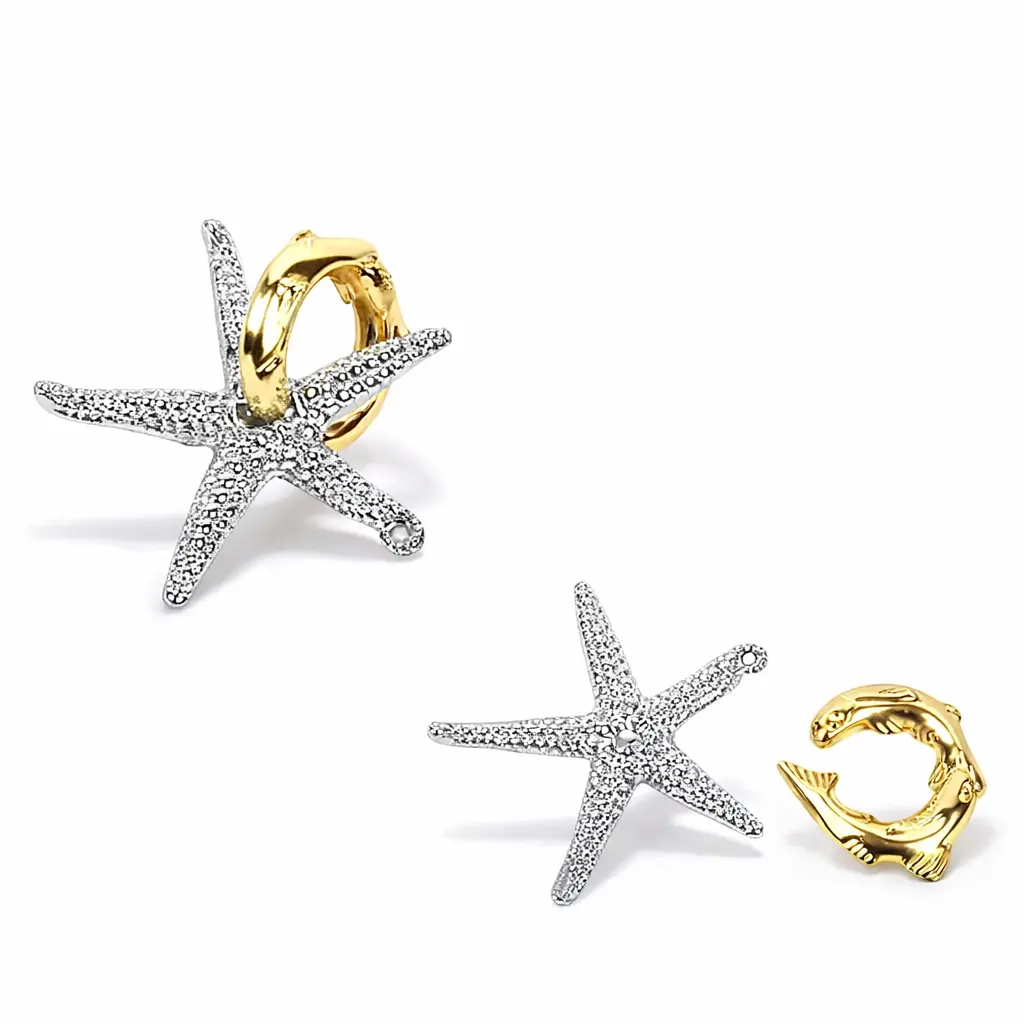
This distinction informs its role in a collection. The Reef is a story piece. Its solved state—the coral and two separate fish laid side-by-side—is visually communicative. On a shelf, it sparks curiosity. It is a display object first, a fidget second. The solve, once internalized, becomes a smooth, almost meditative cycle of assembly and disassembly. (Contrast this with Cast Enigma, a level 6, which you solve once, exhale deeply, and likely never intentionally scramble again.) For a collector, this makes the Reef a reliable ambassador to show guests—approachable, beautiful, and with a solution elegant enough to demonstrate without a twenty-minute struggle. For a broader evaluation of where such pieces rank, consider another hands-on Cast Reef review, which echoes its accessible elegance.
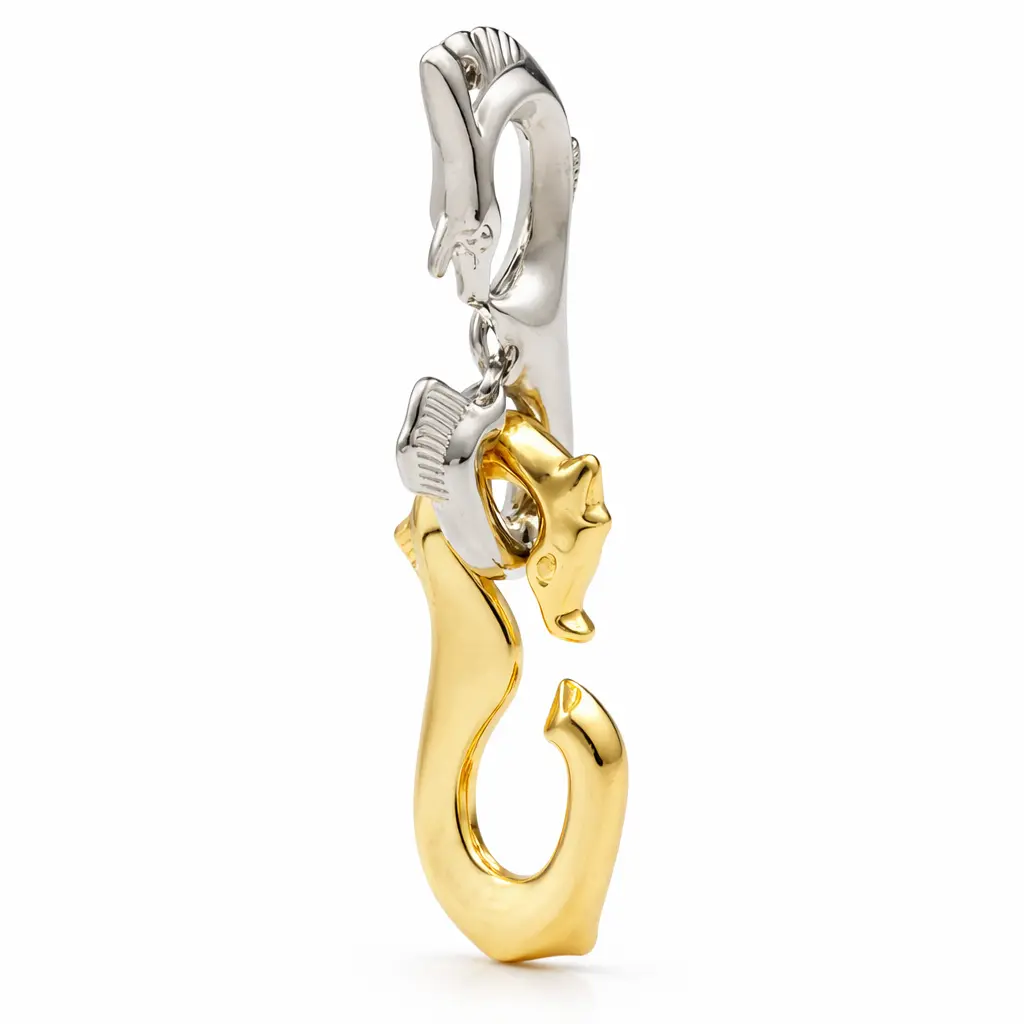
Is it worth the $15-$25 compared to other desk toys? The heft answers. This isn’t a flimsy, stamped alloy. It’s a dense, cold-finished object with the permanence of a tool. For the price of a mass-produced plastic fidget, you acquire a miniature kinetic sculpture with a designed intellectual payload. Its value accrues not from hours of mindless manipulation, but from the moment of clarity it delivers—and retains as a benchmark of accessible, thoughtful design. For a broader survey of where such benchmarks lie, from friendly to fiendish, one might consult a connoisseur’s guide to the ruthless cast puzzles for connoisseurs. The Reef is not among those ruthless ones. It is, instead, a harmonious and essential inhabitant of the collection’s ecosystem.
The Verdict: For Whom Does This Coral Reef Bloom?
Having established its harmonious place in the collection’s ecosystem, the Cast Reef’s true purpose crystallizes: it is a gateway object. This puzzle blooms most vividly for the curious novice seeking a tactile introduction to metal disentanglement, thanks to its deliberate Level 3 difficulty and a sub-$25 investment that delivers disproportionate heft and intellectual reward. It is a fulfilling, not frustrating, gift where the design ensures a logical path to satisfaction.
For the curious novice, this is an ideal first cast metal puzzle. The Level 3 rating is accurate—it presents a genuine labyrinth of dead ends but denies true obscurity. The solve teaches fundamental vocabulary: listening for tactile feedback, mapping grooves, and understanding that force is the enemy. A patient 10-year-old could solve it; an adult new to puzzles will experience the full, rewarding emotional arc from intrigue to mastery without the despair of a higher-level puzzle. It is a tutor in anodized metal.
For the seasoned collector, the Reef is a kinetic sculpture and a study in elegant representation. Its value lies not in brutal difficulty but in its symbiotic mechanism and aesthetic contrast. Compared to the Cast Starfish—another Marine series puzzle—the Reef is less about sequential discovery and more about spatial harmony. The Starfish involves separating five intertwined stars; its challenge is combinatorial. The Reef’s challenge is perceptual, centered on that critical track between the two gobies. It’s the piece you display for its story, not just its solve.
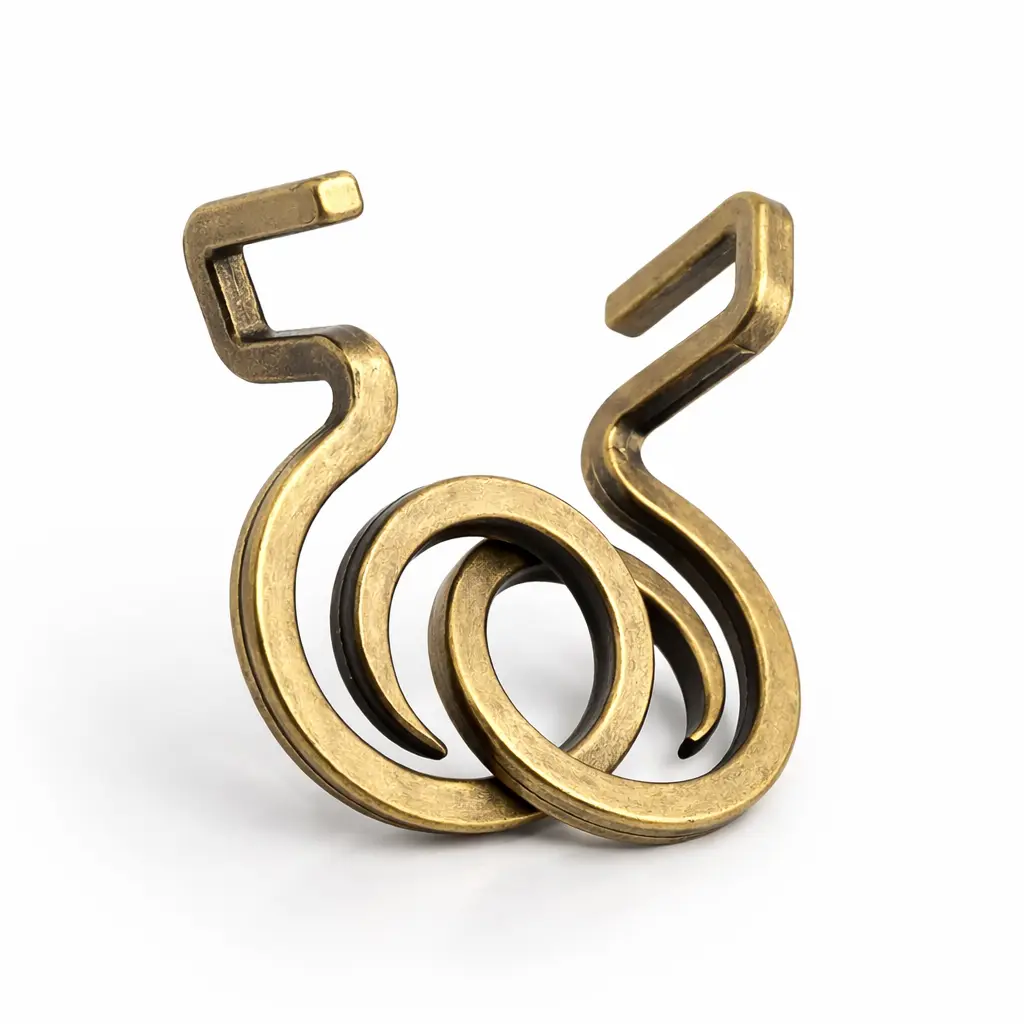
For the gift-giver, address the core question: frustrating or fulfilling? It is fulfilling. The puzzle contains its own hints—the cool, dense metal seems to guide the fingers toward the solution. (I have gifted it three times, each to non-enthusiasts, and each recipient solved it within an hour, beaming with that specific intellectual ‘aha’.) Its presentation as a miniature art object mitigates any potential frustration; it remains desirable even if momentarily unsolved. Compared to a fidget spinner or plastic toy, it conveys thoughtfulness. For broader guidance on selecting such a puzzle, the principles in this guide to choosing your metal brain teaser apply. You may also find my list of the best metal disentanglement puzzles judged by a machinist a useful resource for expanding a collection.
The verdict is tactile. The satisfaction is not in conquering a beast but in understanding a relationship—the mechanical symbiosis between fish and coral. It endures on the desk not as a defeated challenge, but as a polished artifact that recalls the moment the silver grooves released the gold gobies. It blooms for anyone who appreciates that moment where design, story, and mechanism click into alignment. A benchmark of accessible elegance.
Acquiring the Artifact: A Buyer’s Guide to the Cast Reef
Acquiring the Cast Reef is a straightforward endeavor, with the puzzle consistently retailing between $15 and $25 USD. This price point places it firmly in the accessible mid-range of cast metal puzzles, offering significant tactile and intellectual value for the cost. Your primary task is to secure an authentic copy from a reputable source.
Having established its place as a benchmark of accessible elegance, the logical next step is procurement. The market for Hanayama puzzles is mature, but a focused approach ensures you receive the precisely anodized metal artifact you expect, not a subpar imitation.
For guaranteed authenticity, prioritize specialty puzzle retailers. These shops, often run by enthusiasts, understand the lineage of the Cast series. Puzzle Master in Canada is a canonical example, a source many collectors use for its reliable stock and knowledgeable service. Major online marketplaces like Amazon and eBay also list the Reef, but here, vigilance is key. Scrutinize seller ratings and reviews specifically for mentions of Hanayama branding and quality. The secondary keyword ‘where to buy cast reef’ often leads to these storefronts, but the ‘puzzle master reef’ search is a more targeted path to a specialist.
Identifying a genuine Hanayama product is a tactile forensics exercise. The real Reef has a specific heft—approximately 90 grams of cool, dense metal. The gold and silver anodization should be uniform, with no flaking or uneven coloration. Look for the subtle “Hanayama” and “Made in Japan” engravings, often on the inner edge of the coral piece. The mechanism should move with a firm, smooth precision; any gritty feel or excessive wiggle indicates a counterfeit. The packaging, while secondary, should be the classic Hanayama box with the correct puzzle name and difficulty level (3) clearly printed.
Is the $15-$25 investment worth it compared to other desk toys? Absolutely. Against a mass-produced fidget spinner or plastic bauble, the Reef offers a permanent, intellectual sculpture. Its value isn’t consumed in the solve; it transitions from puzzle to conversation piece. Compared to other cast puzzles, its Level 3 difficulty and marine aesthetic give it a unique niche, as discussed in our comparison to the Cast Starfish. It represents a high point of design-per-dollar in the hobby.
For a deeper dive into the principles of selecting and vetting such mechanisms, my veteran’s guide to durable cast metal puzzles elaborates on material quality and brand trust. And if you’re building a Hanayama collection, my definitive Hanayama puzzle buying guide provides a structured framework for exploration. Ultimately, acquiring the Cast Reef is the final step in a journey that begins with visual intrigue and ends with the satisfying click of two gold gobies swimming free from their silver coral—a journey best ensured by a thoughtful purchase.
SOLUTION: Charting the Goby’s Escape (Spoiler Protocol)
WARNING: This section contains the complete, step-by-step solution. Proceed only if you wish to know the exact sequence.
This is the definitive text-based solution for the Hanayama Cast Reef. To separate the two gold fish from the silver coral, you must follow a precise sequence of rotations and slides that utilizes the space between the fish bodies as its primary track—the critical path hinted at in our opening. The solve occurs in two distinct phases: aligning the internal gates and executing the escape.
First, orient the puzzle so the coral’s broad, flat base is facing you. Hold the coral stationary. Your goal is to manipulate the two intertwined fish as a single unit initially. Rotate this fish unit 90 degrees clockwise (from the top-down view), aligning the long, straight edge of one fish with a specific open channel on the coral’s interior. You will feel a new degree of lateral freedom. Slide the fish unit to the left, about a centimeter, until it stops. This aligns the internal gates.
Now for the escape. The puzzle’s secret is that the fish must exit sequentially, not simultaneously. Holding the coral firmly, rotate the fish unit counter-clockwise back about 45 degrees. You will feel a subtle but distinct shift in weight. One fish is now mechanically disengaged. Carefully slide the now-loose fish laterally through the gap you created, navigating it through the silver coral grooves until it is completely free. Its partner, still captive, will have shifted position. Return to the original aligned gate and repeat the counter-clockwise rotation and slide for the second fish. It will follow a mirrored path out of the structure.
Reassembly is the reverse, but with a key insight. Do not try to insert both fish at once. Insert the first fish fully into the coral’s central cavity. Then, introduce the second fish into the space beside the first, not into the coral. Their intertwined geometry only locks when you then maneuver the second fish into its final seated position against the coral’s internal walls. You will hear a soft, metallic click—the sound of symbiotic pieces finding their shared equilibrium.
With the mechanism mastered, place the solved pieces aside. Let the aha moment settle. The true next step is to revisit the puzzle in a week, when muscle memory fades, to rediscover the logic purely by touch. For those who wish to contextualize this solution within the full Hanayama difficulty spectrum, you can explore Hanayama cast puzzle solutions by difficulty level.